Ratio of sides when equations of sides are given§
Consider three lines:
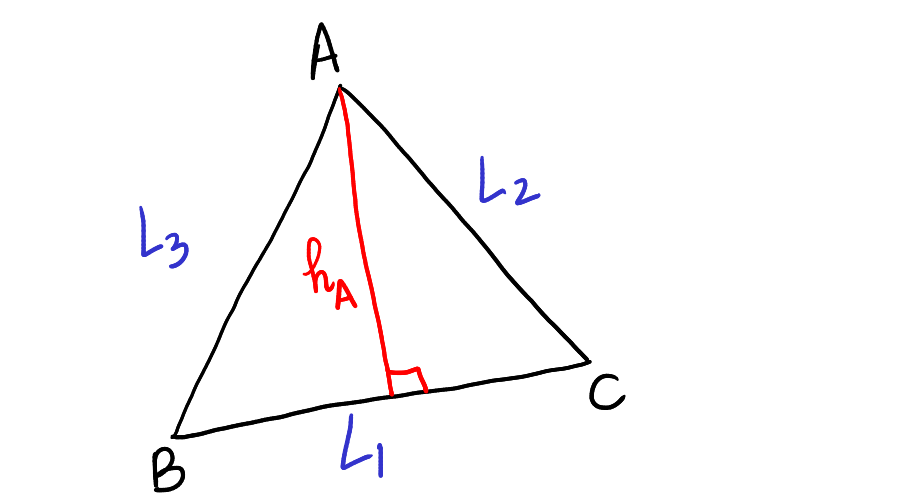
L 1 : a 1 x + b 1 y + c 1 = 0 L_1: a_1x + b_1y + c_1 = 0 L 1 : a 1 x + b 1 y + c 1 = 0 L 2 : a 2 x + b 2 y + c 2 = 0 L_2: a_2x + b_2y + c_2 = 0 L 2 : a 2 x + b 2 y + c 2 = 0 L 3 : a 3 x + b 3 y + c 3 = 0 L_3: a_3x + b_3y + c_3 = 0 L 3 : a 3 x + b 3 y + c 3 = 0 L 2 L_2 L 2 L 3 L_3 L 3 A A A L 3 L_3 L 3 L 1 L_1 L 1 B B B L 1 L_1 L 1 L 2 L_2 L 2 C C C
Coordinates of point A A A
x A = ∣ b 2 c 2 b 3 c 3 ∣ ∣ a 2 b 2 a 3 b 3 ∣ , y A = − ∣ a 2 c 2 a 3 c 3 ∣ ∣ a 2 b 2 a 3 b 3 ∣ x_A = \frac{\begin{vmatrix} b_2 & c_2 \\ b_3 & c_3 \end{vmatrix}}{\begin{vmatrix} a_2 & b_2 \\ a_3 & b_3 \end{vmatrix}}, \quad y_A = -\frac{\begin{vmatrix} a_2 & c_2 \\ a_3 & c_3 \end{vmatrix}}{\begin{vmatrix} a_2 & b_2 \\ a_3 & b_3 \end{vmatrix}} x A = a 2 a 3 b 2 b 3 b 2 b 3 c 2 c 3 , y A = − a 2 a 3 b 2 b 3 a 2 a 3 c 2 c 3 Similarly, coordinates of B B B
( ∣ b 3 c 3 b 1 c 1 ∣ ∣ a 3 b 3 a 1 b 1 ∣ , − ∣ a 3 c 3 a 1 c 1 ∣ ∣ a 3 b 3 a 1 b 1 ∣ ) \left( \frac{\begin{vmatrix} b_3 & c_3 \\ b_1 & c_1 \end{vmatrix}}{\begin{vmatrix} a_3 & b_3 \\ a_1 & b_1 \end{vmatrix}}, -\frac{\begin{vmatrix} a_3 & c_3 \\ a_1 & c_1 \end{vmatrix}}{\begin{vmatrix} a_3 & b_3 \\ a_1 & b_1 \end{vmatrix}} \right) a 3 a 1 b 3 b 1 b 3 b 1 c 3 c 1 , − a 3 a 1 b 3 b 1 a 3 a 1 c 3 c 1 Coordinates of C C C
( ∣ b 1 c 1 b 2 c 2 ∣ ∣ a 1 b 1 a 2 b 2 ∣ , − ∣ a 1 c 1 a 2 c 2 ∣ ∣ a 1 b 1 a 2 b 2 ∣ ) \left( \frac{\begin{vmatrix} b_1 & c_1 \\ b_2 & c_2 \end{vmatrix}}{\begin{vmatrix} a_1 & b_1 \\ a_2 & b_2 \end{vmatrix}}, -\frac{\begin{vmatrix} a_1 & c_1 \\ a_2 & c_2 \end{vmatrix}}{\begin{vmatrix} a_1 & b_1 \\ a_2 & b_2 \end{vmatrix}} \right) a 1 a 2 b 1 b 2 b 1 b 2 c 1 c 2 , − a 1 a 2 b 1 b 2 a 1 a 2 c 1 c 2 The distance of A A A B C BC B C h A h_A h A
h A = ∣ a 1 x A + b 1 y A + c 1 ∣ a 1 2 + b 1 2 h_A = \frac{|a_1 x_A + b_1 y_A + c_1|}{\sqrt{a_1^2 + b_1^2}} h A = a 1 2 + b 1 2 ∣ a 1 x A + b 1 y A + c 1 ∣ a 1 x A + b 1 y A + c 1 = a 1 ∣ b 2 c 2 b 3 c 3 ∣ ∣ a 2 b 2 a 3 b 3 ∣ − b 1 ∣ a 2 c 2 a 3 c 3 ∣ ∣ a 2 b 2 a 3 b 3 ∣ + c 1 a_1 x_A + b_1 y_A + c_1 = a_1 \frac{\begin{vmatrix} b_2 & c_2 \\ b_3 & c_3 \end{vmatrix}}{\begin{vmatrix} a_2 & b_2 \\ a_3 & b_3 \end{vmatrix}} - b_1 \frac{\begin{vmatrix} a_2 & c_2 \\ a_3 & c_3 \end{vmatrix}}{\begin{vmatrix} a_2 & b_2 \\ a_3 & b_3 \end{vmatrix}} + c_1 a 1 x A + b 1 y A + c 1 = a 1 a 2 a 3 b 2 b 3 b 2 b 3 c 2 c 3 − b 1 a 2 a 3 b 2 b 3 a 2 a 3 c 2 c 3 + c 1 = a 1 ∣ b 2 c 2 b 3 c 3 ∣ − b 1 ∣ a 2 c 2 a 3 c 3 ∣ + c 1 ∣ a 2 b 2 a 3 b 3 ∣ ∣ a 2 b 2 a 3 b 3 ∣ = \frac{a_1 \begin{vmatrix} b_2 & c_2 \\ b_3 & c_3 \end{vmatrix} - b_1 \begin{vmatrix} a_2 & c_2 \\ a_3 & c_3 \end{vmatrix} + c_1 \begin{vmatrix} a_2 & b_2 \\ a_3 & b_3 \end{vmatrix}}{\begin{vmatrix} a_2 & b_2 \\ a_3 & b_3 \end{vmatrix}} = a 2 a 3 b 2 b 3 a 1 b 2 b 3 c 2 c 3 − b 1 a 2 a 3 c 2 c 3 + c 1 a 2 a 3 b 2 b 3 = ∣ a 1 b 2 c 2 a 2 b 3 c 3 a 3 b 2 c 2 ∣ ∣ a 2 b 2 a 3 b 3 ∣ = \frac{\begin{vmatrix} a_1 & b_2 & c_2 \\ a_2 & b_3 & c_3 \\ a_3 & b_2 & c_2 \end{vmatrix}}{\begin{vmatrix} a_2 & b_2 \\ a_3 & b_3 \end{vmatrix}} = a 2 a 3 b 2 b 3 a 1 a 2 a 3 b 2 b 3 b 2 c 2 c 3 c 2 Thus,
h A = Δ a 1 2 + b 1 2 ∣ a 2 b 2 a 3 b 3 ∣ h_A = \frac{\Delta}{\sqrt{a_1^2 + b_1^2}\begin{vmatrix} a_2 & b_2 \\ a_3 & b_3 \end{vmatrix}} h A = a 1 2 + b 1 2 a 2 a 3 b 2 b 3 Δ where, Δ = ∣ a 1 b 2 c 2 a 2 b 3 c 3 a 3 b 2 c 2 ∣ \Delta=\begin{vmatrix} a_1 & b_2 & c_2 \\ a_2 & b_3 & c_3 \\ a_3 & b_2 & c_2 \end{vmatrix} Δ = a 1 a 2 a 3 b 2 b 3 b 2 c 2 c 3 c 2
Similarly,
h B = Δ a 2 2 + b 2 2 ∣ a 1 b 3 a 1 b 3 ∣ , h C = Δ a 3 2 + b 3 2 ∣ a 1 b 2 a 1 b 2 ∣ h_B = \frac{\Delta}{\sqrt{a_2^2 + b_2^2}\begin{vmatrix} a_1 & b_3 \\ a_1 & b_3 \end{vmatrix}}, \quad h_C = \frac{\Delta}{\sqrt{a_3^2 + b_3^2}\begin{vmatrix} a_1 & b_2 \\ a_1 & b_2 \end{vmatrix}} h B = a 2 2 + b 2 2 a 1 a 1 b 3 b 3 Δ , h C = a 3 2 + b 3 2 a 1 a 1 b 2 b 2 Δ Area of triangle A B C ABC A B C
Area = 1 2 B C ⋅ h A = 1 2 C A ⋅ h B = 1 2 A B ⋅ h C \text{Area} = \frac{1}{2} BC \cdot h_A = \frac{1}{2} CA \cdot h_B = \frac{1}{2} AB \cdot h_C Area = 2 1 B C ⋅ h A = 2 1 C A ⋅ h B = 2 1 A B ⋅ h C ⟹ B C : C A : A B = 1 h A : 1 h B : 1 h C \implies BC : CA : AB = \frac{1}{h_A} : \frac{1}{h_B} : \frac{1}{h_C} ⟹ B C : C A : A B = h A 1 : h B 1 : h C 1 ⟹ B C : C A : A B = a 1 2 + b 1 2 ∣ a 2 b 2 a 3 b 3 ∣ : a 2 2 + b 2 2 ∣ a 1 b 3 a 1 b 3 ∣ : a 3 2 + b 3 2 ∣ a 1 b 2 a 1 b 2 ∣ \implies BC:CA:AB = \sqrt{a_1^2 + b_1^2}\begin{vmatrix} a_2 & b_2 \\ a_3 & b_3 \end{vmatrix}: \sqrt{a_2^2 + b_2^2}\begin{vmatrix} a_1 & b_3 \\ a_1 & b_3 \end{vmatrix}:\sqrt{a_3^2 + b_3^2}\begin{vmatrix} a_1 & b_2 \\ a_1 & b_2 \end{vmatrix} ⟹ B C : C A : A B = a 1 2 + b 1 2 a 2 a 3 b 2 b 3 : a 2 2 + b 2 2 a 1 a 1 b 3 b 3 : a 3 2 + b 3 2 a 1 a 1 b 2 b 2 Area of the triangle made by a line with axes§
The area of the triangle formed by the line a x + b y + c = 0 ax + by + c = 0 a x + b y + c = 0 c 2 2 ∣ a b ∣ \frac{c^2}{2|ab|} 2∣ ab ∣ c 2
Proof:
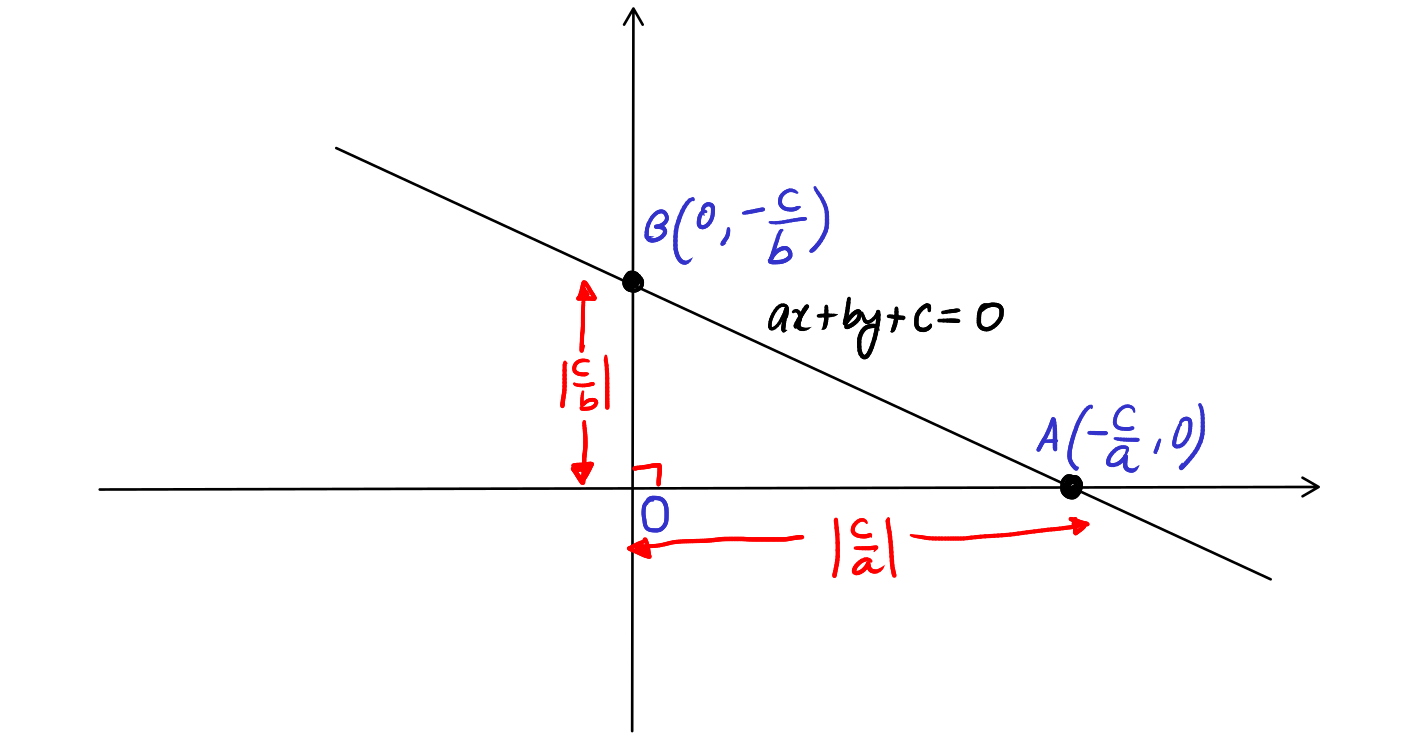
Consider the line a x + b y + c = 0 ax + by + c = 0 a x + b y + c = 0
Finding the x-intercept:
Set y = 0 y = 0 y = 0
a x + c = 0 ⟹ x = − c a ax + c = 0 \implies x = -\frac{c}{a} a x + c = 0 ⟹ x = − a c Therefore, the x-intercept is ( − c a , 0 ) \left( -\frac{c}{a}, 0 \right) ( − a c , 0 )
Finding the y-intercept:
Set x = 0 x = 0 x = 0
b y + c = 0 ⟹ y = − c b by + c = 0 \implies y = -\frac{c}{b} b y + c = 0 ⟹ y = − b c Therefore, the y-intercept is ( 0 , − c b ) \left( 0, -\frac{c}{b} \right) ( 0 , − b c )
Area of the triangle formed by the line and the coordinate axes:
The vertices of the triangle are ( 0 , 0 ) (0, 0) ( 0 , 0 ) ( − c a , 0 ) \left( -\frac{c}{a}, 0 \right) ( − a c , 0 ) ( 0 , − c b ) \left( 0, -\frac{c}{b} \right) ( 0 , − b c )
The area A A A ( 0 , 0 ) (0,0) ( 0 , 0 ) ( x 1 , 0 ) (x_1, 0) ( x 1 , 0 ) ( 0 , y 1 ) (0, y_1) ( 0 , y 1 )
A = 1 2 ∣ x 1 ⋅ y 1 ∣ A = \frac{1}{2} \left| x_1 \cdot y_1 \right| A = 2 1 ∣ x 1 ⋅ y 1 ∣ Substituting x 1 = − c a x_1 = -\frac{c}{a} x 1 = − a c y 1 = − c b y_1 = -\frac{c}{b} y 1 = − b c
A = 1 2 ∣ ( − c a ) ( − c b ) ∣ A = \frac{1}{2} \left| \left( -\frac{c}{a} \right) \left( -\frac{c}{b} \right) \right| A = 2 1 ( − a c ) ( − b c ) A = 1 2 ∣ c 2 a b ∣ A = \frac{1}{2} \left| \frac{c^2}{ab} \right| A = 2 1 ab c 2 A = c 2 2 ∣ a b ∣ A = \frac{c^2}{2|ab|} A = 2∣ ab ∣ c 2 Therefore, the area of the triangle formed by the line a x + b y + c = 0 ax + by + c = 0 a x + b y + c = 0 c 2 2 ∣ a b ∣ \frac{c^2}{2|ab|} 2∣ ab ∣ c 2
Consider the three lines:
L 1 : a 1 x + b 1 y + c 1 = 0 L_1: a_1 x + b_1 y + c_1 = 0 L 1 : a 1 x + b 1 y + c 1 = 0 L 2 : a 2 x + b 2 y + c 2 = 0 L_2: a_2 x + b_2 y + c_2 = 0 L 2 : a 2 x + b 2 y + c 2 = 0 L 3 : a 3 x + b 3 y + c 3 = 0 L_3: a_3 x + b_3 y + c_3 = 0 L 3 : a 3 x + b 3 y + c 3 = 0 These lines form a triangle Δ A B C \Delta ABC Δ A B C L 1 L_1 L 1 B C BC B C L 2 L_2 L 2 C A CA C A L 3 L_3 L 3 A B AB A B
Coordinates of vertices A , B , A, B, A , B , C C C can be calculated using the cross-multiplication method:
A = ( ∣ b 2 c 2 b 3 c 3 ∣ ∣ a 2 b 2 a 3 b 3 ∣ , − ∣ a 2 c 2 a 3 c 3 ∣ ∣ a 2 b 2 a 3 b 3 ∣ ) A = \left( \frac{\left| \begin{matrix}
b_2 & c_2 \\
b_3 & c_3
\end{matrix} \right|}{\left| \begin{matrix}
a_2 & b_2 \\
a_3 & b_3
\end{matrix} \right|}, \, -\frac{\left| \begin{matrix}
a_2 & c_2 \\
a_3 & c_3
\end{matrix} \right|}{\left| \begin{matrix}
a_2 & b_2 \\
a_3 & b_3
\end{matrix} \right|} \right) A = a 2 a 3 b 2 b 3 b 2 b 3 c 2 c 3 , − a 2 a 3 b 2 b 3 a 2 a 3 c 2 c 3 B = ( ∣ b 1 c 1 b 3 c 3 ∣ ∣ a 1 b 1 a 3 b 3 ∣ , − ∣ a 1 c 1 a 3 c 3 ∣ ∣ a 1 b 1 a 3 b 3 ∣ ) B = \left( \frac{\left| \begin{matrix}
b_1 & c_1 \\
b_3 & c_3
\end{matrix} \right|}{\left| \begin{matrix}
a_1 & b_1 \\
a_3 & b_3
\end{matrix} \right|}, \, -\frac{\left| \begin{matrix}
a_1 & c_1 \\
a_3 & c_3
\end{matrix} \right|}{\left| \begin{matrix}
a_1 & b_1 \\
a_3 & b_3
\end{matrix} \right|} \right) B = a 1 a 3 b 1 b 3 b 1 b 3 c 1 c 3 , − a 1 a 3 b 1 b 3 a 1 a 3 c 1 c 3 C = ( ∣ b 1 c 1 b 2 c 2 ∣ ∣ a 1 b 1 a 2 b 2 ∣ , − ∣ a 1 c 1 a 2 c 2 ∣ ∣ a 1 b 1 a 2 b 2 ∣ ) C = \left( \frac{\left| \begin{matrix}
b_1 & c_1 \\
b_2 & c_2
\end{matrix} \right|}{\left| \begin{matrix}
a_1 & b_1 \\
a_2 & b_2
\end{matrix} \right|}, \, -\frac{\left| \begin{matrix}
a_1 & c_1 \\
a_2 & c_2
\end{matrix} \right|}{\left| \begin{matrix}
a_1 & b_1 \\
a_2 & b_2
\end{matrix} \right|} \right) C = a 1 a 2 b 1 b 2 b 1 b 2 c 1 c 2 , − a 1 a 2 b 1 b 2 a 1 a 2 c 1 c 2 Consider the determinant :
D = ∣ a 1 b 1 c 1 a 2 b 2 c 2 a 3 b 3 c 3 ∣ D = \left| \begin{matrix}
a_1 & b_1 & c_1 \\
a_2 & b_2 & c_2 \\
a_3 & b_3 & c_3
\end{matrix} \right| D = a 1 a 2 a 3 b 1 b 2 b 3 c 1 c 2 c 3 Cofactor matrix of D D D
Cofactor ( D ) = [ C 11 C 12 C 13 C 21 C 22 C 23 C 31 C 32 C 33 ] \text{Cofactor}(D) = \begin{bmatrix}
C_{11} & C_{12} & C_{13} \\
C_{21} & C_{22} & C_{23} \\
C_{31} & C_{32} & C_{33}
\end{bmatrix} Cofactor ( D ) = C 11 C 21 C 31 C 12 C 22 C 32 C 13 C 23 C 33 Observe that the coordinates A , B , A, B, A , B , C C C D D D
A = ( C 11 C 13 , C 12 C 13 ) A = \left( \frac{C_{11}}{C_{13}}, \frac{C_{12}}{C_{13}} \right) A = ( C 13 C 11 , C 13 C 12 ) B = ( C 21 C 23 , C 22 C 23 ) B = \left( \frac{C_{21}}{C_{23}}, \frac{C_{22}}{C_{23}} \right) B = ( C 23 C 21 , C 23 C 22 ) C = ( C 31 C 33 , C 32 C 33 ) C = \left( \frac{C_{31}}{C_{33}}, \frac{C_{32}}{C_{33}} \right) C = ( C 33 C 31 , C 33 C 32 ) Area of Δ A B C \Delta ABC Δ A B C :
Area = 1 2 ∣ x A y A 1 x B y B 1 x C y C 1 ∣ \text{Area} = \frac{1}{2} \left| \begin{matrix}
x_A & y_A & 1 \\
x_B & y_B & 1 \\
x_C & y_C & 1
\end{matrix} \right| Area = 2 1 x A x B x C y A y B y C 1 1 1 Substitute the coordinates:
Area = 1 2 ∣ ∣ C 11 C 13 C 12 C 13 1 C 21 C 23 C 22 C 23 1 C 31 C 33 C 32 C 33 1 ∣ ∣ \text{Area} = \frac{1}{2} \left|\left| \begin{matrix}
\frac{C_{11}}{C_{13}} & \frac{C_{12}}{C_{13}} & 1 \\
\frac{C_{21}}{C_{23}} & \frac{C_{22}}{C_{23}} & 1 \\
\frac{C_{31}}{C_{33}} & \frac{C_{32}}{C_{33}} & 1
\end{matrix} \right|\right| Area = 2 1 C 13 C 11 C 23 C 21 C 33 C 31 C 13 C 12 C 23 C 22 C 33 C 32 1 1 1 This can be simplified to:
Area = 1 2 ∣ C 13 C 23 C 33 ∣ ∣ ∣ C 11 C 12 C 13 C 21 C 22 C 23 C 31 C 32 C 33 ∣ ∣ \text{Area} = \frac{1}{2\left|C_{13}C_{23}C_{33}\right|} \left|\left| \begin{matrix}
C_{11} & C_{12} & C_{13} \\
C_{21} & C_{22} & C_{23} \\
C_{31} & C_{32} & C_{33}
\end{matrix} \right|\right| Area = 2 ∣ C 13 C 23 C 33 ∣ 1 C 11 C 21 C 31 C 12 C 22 C 32 C 13 C 23 C 33 We know that:
∣ Cof ( X ) ∣ = [ det ( X ) ] 2 \left| \text{Cof}(X) \right| = [\text{det}(X)]^2 ∣ Cof ( X ) ∣ = [ det ( X ) ] 2 Therefore:
Area = 1 2 ∣ C 13 C 23 C 33 ∣ ∣ a 1 b 1 c 1 a 2 b 2 c 2 a 3 b 3 c 3 ∣ 2 \text{Area} = \frac{1}{2\left|C_{13}C_{23}C_{33}\right|} \left| \begin{matrix}
a_1 & b_1 & c_1 \\
a_2 & b_2 & c_2 \\
a_3 & b_3 & c_3
\end{matrix} \right|^2 Area = 2 ∣ C 13 C 23 C 33 ∣ 1 a 1 a 2 a 3 b 1 b 2 b 3 c 1 c 2 c 3 2 Where:
C 13 = ∣ a 2 b 2 a 3 b 3 ∣ C_{13} = \left| \begin{matrix}
a_2 & b_2 \\
a_3 & b_3
\end{matrix} \right| C 13 = a 2 a 3 b 2 b 3 C 23 = ∣ a 1 b 1 a 3 b 3 ∣ C_{23} = \left| \begin{matrix}
a_1 & b_1 \\
a_3 & b_3
\end{matrix} \right| C 23 = a 1 a 3 b 1 b 3 C 33 = ∣ a 1 b 1 a 2 b 2 ∣ C_{33} = \left| \begin{matrix}
a_1 & b_1 \\
a_2 & b_2
\end{matrix} \right| C 33 = a 1 a 2 b 1 b 2 Thus, the area of the triangle formed by the three lines is:
Area = 1 2 ∣ C 13 C 23 C 33 ∣ ∣ a 1 b 1 c 1 a 2 b 2 c 2 a 3 b 3 c 3 ∣ 2 \text{Area} = \frac{1}{2\left|C_{13}C_{23}C_{33}\right|} \left| \begin{matrix}
a_1 & b_1 & c_1 \\
a_2 & b_2 & c_2 \\
a_3 & b_3 & c_3
\end{matrix} \right|^2 Area = 2 ∣ C 13 C 23 C 33 ∣ 1 a 1 a 2 a 3 b 1 b 2 b 3 c 1 c 2 c 3 2 When the equations of lines are given in the form:
L 1 : y = m 1 x + c 1 L_1: y = m_1 x + c_1 L 1 : y = m 1 x + c 1 L 2 : y = m 2 x + c 2 L_2: y = m_2 x + c_2 L 2 : y = m 2 x + c 2 L 3 : y = m 3 x + c 3 L_3: y = m_3 x + c_3 L 3 : y = m 3 x + c 3 The area of the triangle formed by L 1 , L 2 , L_1, L_2, L 1 , L 2 , L 3 L_3 L 3
1 2 ∣ ∑ ( c 1 − c 2 ) 2 m 1 − m 2 ∣ \frac{1}{2} \left| \sum \frac{(c_1 - c_2)^2}{m_1 - m_2} \right| 2 1 ∑ m 1 − m 2 ( c 1 − c 2 ) 2 Area of a parallelogram§
Area of a Parallelogram§
The area of a parallelogram can be determined when the distances between the pairs of parallel sides are d 1 d_1 d 1 d 2 d_2 d 2 θ \theta θ
Area = d 1 d 2 ∣ sin θ ∣ \text{Area} = \frac{d_1 d_2}{|\sin \theta|} Area = ∣ sin θ ∣ d 1 d 2 Consider the parallelogram A B C D ABCD A B C D ∠ B A D = θ \angle BAD = \theta ∠ B A D = θ
The area of the parallelogram is given by the base times the height:
Area of parallelogram = base × height = A B × D N \text{Area of parallelogram} = \text{base} \times \text{height} = AB \times DN Area of parallelogram = base × height = A B × D N Since A B = C D AB = CD A B = C D
Area = C D × D N \text{Area} = CD \times DN Area = C D × D N The height D N DN D N d 1 d_1 d 1 d 2 d_2 d 2 θ \theta θ
Area = ∣ D M × D N sin θ ∣ \text{Area} = \left| \frac{DM \times DN}{\sin \theta} \right| Area = sin θ D M × D N Thus,
Area = d 1 ⋅ d 2 ∣ sin θ ∣ \text{Area} = \frac{d_1 \cdot d_2}{|\sin \theta|} Area = ∣ sin θ ∣ d 1 ⋅ d 2 Thus, the area of the parallelogram A B C D ABCD A B C D
Area = d 1 d 2 ∣ sin θ ∣ \text{Area} = \frac{d_1 d_2}{|\sin \theta|} Area = ∣ sin θ ∣ d 1 d 2 Area of a Parallelogram Given the Equations of Its Sides§
Consider a parallelogram A B C D ABCD A B C D
A B : a x + b y + c 1 = 0 AB: ax + by + c_1 = 0 A B : a x + b y + c 1 = 0 B C : d x + e y + f 1 = 0 BC: dx + ey + f_1 = 0 B C : d x + ey + f 1 = 0 C D : a x + b y + c 2 = 0 CD: ax + by + c_2 = 0 C D : a x + b y + c 2 = 0 A D : d x + e y + f 2 = 0 AD: dx + ey + f_2 = 0 A D : d x + ey + f 2 = 0
We aim to find the area of the parallelogram.
Formula for the Area
The area of the parallelogram can be given by:
Area = ∣ ( c 1 − c 2 ) ( f 1 − f 2 ) ∣ a b d e ∣ ∣ \text{Area} = \left| \frac{(c_1 - c_2)(f_1 - f_2)}{\left| \begin{matrix} a & b \\ d & e \end{matrix} \right|} \right| Area = a d b e ( c 1 − c 2 ) ( f 1 − f 2 ) We know that the area of a parallelogram is given by:
Area = ∣ d 1 d 2 sin θ ∣ \text{Area} = \left| \frac{d_1 d_2}{\sin \theta} \right| Area = sin θ d 1 d 2 where d 1 d_1 d 1 d 2 d_2 d 2 θ \theta θ
Calculate d 1 d_1 d 1 d 2 d_2 d 2 :
The distance between the lines a x + b y + c 1 = 0 ax + by + c_1 = 0 a x + b y + c 1 = 0 a x + b y + c 2 = 0 ax + by + c_2 = 0 a x + b y + c 2 = 0 d 1 d_1 d 1
d 1 = ∣ c 1 − c 2 ∣ a 2 + b 2 d_1 = \frac{|c_1 - c_2|}{\sqrt{a^2 + b^2}} d 1 = a 2 + b 2 ∣ c 1 − c 2 ∣ The distance between the lines d x + e y + f 1 = 0 dx + ey + f_1 = 0 d x + ey + f 1 = 0 d x + e y + f 2 = 0 dx + ey + f_2 = 0 d x + ey + f 2 = 0 d 2 d_2 d 2
d 2 = ∣ f 1 − f 2 ∣ d 2 + e 2 d_2 = \frac{|f_1 - f_2|}{\sqrt{d^2 + e^2}} d 2 = d 2 + e 2 ∣ f 1 − f 2 ∣ Calculate the Slope of the Sides :
Calculate tan θ \tan \theta tan θ :
tan θ = slope of A B − slope of A D 1 + ( slope of A B ) ( slope of A D ) \tan \theta = \frac{\text{slope of } AB - \text{slope of } AD}{1 + (\text{slope of } AB) (\text{slope of } AD)} tan θ = 1 + ( slope of A B ) ( slope of A D ) slope of A B − slope of A D tan θ = − a b − ( − d e ) 1 + ( − a b ) ( − d e ) \tan \theta = \frac{-\frac{a}{b} - \left(-\frac{d}{e}\right)}{1 + \left(-\frac{a}{b}\right) \left(-\frac{d}{e}\right)} tan θ = 1 + ( − b a ) ( − e d ) − b a − ( − e d ) tan θ = − a b + d e 1 + a d b e = b d − a e b e + a d \tan \theta = \frac{-\frac{a}{b} + \frac{d}{e}}{1 + \frac{ad}{be}} = \frac{bd - ae}{be + ad} tan θ = 1 + b e a d − b a + e d = b e + a d b d − a e Calculate sin θ \sin \theta sin θ :
tan θ = b d − a e b e + a d ⇒ sin θ = b d − a e ( b d − a e ) 2 + ( b e + a d ) 2 \tan \theta = \frac{bd - ae}{be + ad} \Rightarrow \sin \theta = \frac{bd - ae}{\sqrt{(bd - ae)^2 + (be + ad)^2}} tan θ = b e + a d b d − a e ⇒ sin θ = ( b d − a e ) 2 + ( b e + a d ) 2 b d − a e = b d − a e b 2 d 2 + a 2 e 2 − 2 b d a e + b 2 e 2 + a 2 d 2 + 2 b d a e = \frac{bd - ae}{\sqrt{b^2 d^2 + a^2 e^2 - 2 bdae + b^2 e^2 + a^2 d^2 + 2 bdae}} = b 2 d 2 + a 2 e 2 − 2 b d a e + b 2 e 2 + a 2 d 2 + 2 b d a e b d − a e = b d − a e b 2 ( d 2 + e 2 ) + a 2 ( e 2 + d 2 ) = \frac{bd - ae}{\sqrt{b^2(d^2 + e^2) + a^2(e^2 + d^2)}} = b 2 ( d 2 + e 2 ) + a 2 ( e 2 + d 2 ) b d − a e = b d − a e ( d 2 + e 2 ) ( a 2 + b 2 ) = \frac{bd - ae}{\sqrt{(d^2 + e^2)(a^2 + b^2)}} = ( d 2 + e 2 ) ( a 2 + b 2 ) b d − a e Substitute d 1 d_1 d 1 d 2 d_2 d 2 sin θ \sin \theta sin θ :
Area = ∣ d 1 d 2 sin θ ∣ \text{Area} = \left| \frac{d_1 d_2}{\sin \theta} \right| Area = sin θ d 1 d 2 Substituting d 1 d_1 d 1 d 2 d_2 d 2 sin θ \sin \theta sin θ
Area = ∣ ( ∣ c 1 − c 2 ∣ a 2 + b 2 ) ( ∣ f 1 − f 2 ∣ d 2 + e 2 ) ∣ b d − a e ( d 2 + e 2 ) ( a 2 + b 2 ) ∣ ∣ \text{Area} = \left| \frac{\left(\frac{|c_1 - c_2|}{\sqrt{a^2 + b^2}}\right) \left(\frac{|f_1 - f_2|}{\sqrt{d^2 + e^2}}\right)}{\left| \frac{bd - ae}{\sqrt{(d^2 + e^2)(a^2 + b^2)}} \right|} \right| Area = ( d 2 + e 2 ) ( a 2 + b 2 ) b d − a e ( a 2 + b 2 ∣ c 1 − c 2 ∣ ) ( d 2 + e 2 ∣ f 1 − f 2 ∣ ) Simplifying:
Area = ∣ ( c 1 − c 2 ) ( f 1 − f 2 ) ( b d − a e ) ∣ \text{Area} = \left| \frac{(c_1 - c_2)(f_1 - f_2)}{(bd - ae)} \right| Area = ( b d − a e ) ( c 1 − c 2 ) ( f 1 − f 2 ) Thus, the area of the parallelogram A B C D ABCD A B C D
Area = ∣ ( c 1 − c 2 ) ( f 1 − f 2 ) ∣ a b d e ∣ ∣ \text{Area} = \left| \frac{(c_1 - c_2)(f_1 - f_2)}{\left| \begin{matrix} a & b \\ d & e \end{matrix} \right|} \right| Area = a d b e ( c 1 − c 2 ) ( f 1 − f 2 )