
Interaction between Lines
Intersection of two Lines§
Consider two lines given by the equations:
There are three possible cases for the relationship between these two lines:
Case 1: Parallel Lines
Two lines are parallel if:
In this case, the lines do not intersect.
Case 2: Coincident Lines
Two lines are coincident if:
In this case, the lines overlap completely and have infinitely many points of intersection.
Case 3: Intersecting Lines
Two lines intersect at a unique point if:
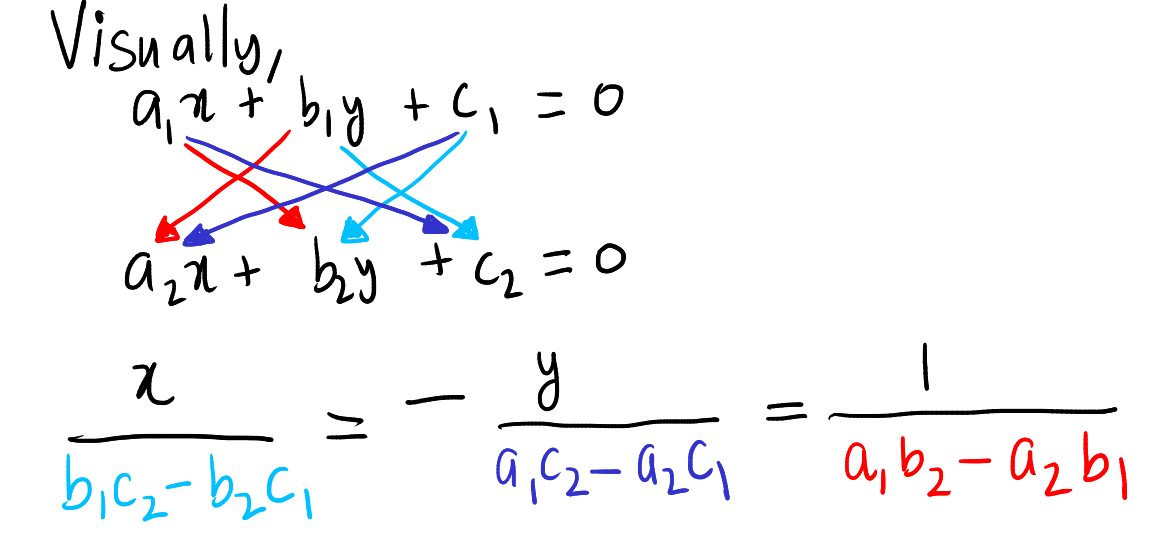
In this case, the lines intersect at a single point. The intersection point is given by:
From this, the coordinates of the intersection point can be found as:
Intersection of Three Lines at a Common Point§
Given three lines in 2D space:
These three lines intersect at a common point if and only if the determinant of the coefficients is zero. The determinant is formed by placing the coefficients of , , and the constants from the three equations into a matrix. The condition for the lines to intersect at a common point is:
Parallel Lines§
-
Condition for Parallel Lines
Two lines and are parallel if:
This condition means that the ratios of the coefficients of and are equal, indicating that the lines have the same slope and will never intersect.
-
Equation of a Line Parallel to a Given Line
The equation of a line parallel to can be written as , where is a constant. The only difference between the two equations is the constant term, which translates the line parallelly without changing its slope.
For example, if the given line is:
A parallel line would have the form:
where is a different constant.
-
Equation of a Parallel Line Passing Through a Given Point
To find the equation of a line parallel to and passing through a specific point , we use the following steps:
- Start with the general form of the parallel line: .
- Substitute the coordinates of the given point into the equation to find .
The equation of the parallel line passing through is:
Substitute :
Solving for , we get:
Thus, the equation of the line parallel to and passing through is:
This can also be written as:
-
Distance Between Two Parallel Lines
The distance between two parallel lines and is given by:
Proof:
-
Assume a Point on :
Let be a point on the line . Therefore, the coordinates satisfy the equation of :
-
Distance from Point to Line:
The distance from point to the line is given by the distance formula for a point to a line:
-
Substitute and into :
Since lies on , we have:
-
Replace in the Distance Formula:
Substitute into the distance formula:
Simplify the absolute value expression:
-
Conclusion:
Therefore, the distance between the two parallel lines and is:
-
-
Equation of a Line Parallel to at a Distance
The equations of lines parallel to at a distance from it are given by:
-
Equation of a Line Parallel to Two Given Parallel Lines and Dividing the Region in a Given Ratio
Given two parallel lines and , a line parallel to both and that divides the region between and in the ratio is given by:
Ceva's Theorem§
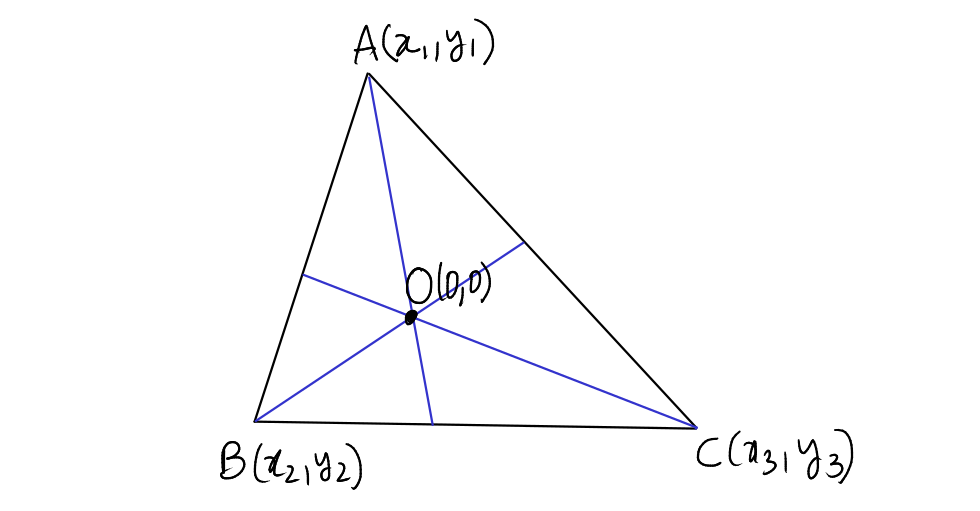
If the lines joining any point to the vertices , , and of a triangle meet the opposite sides in , , and respectively, then:
Menelau's Theorem§
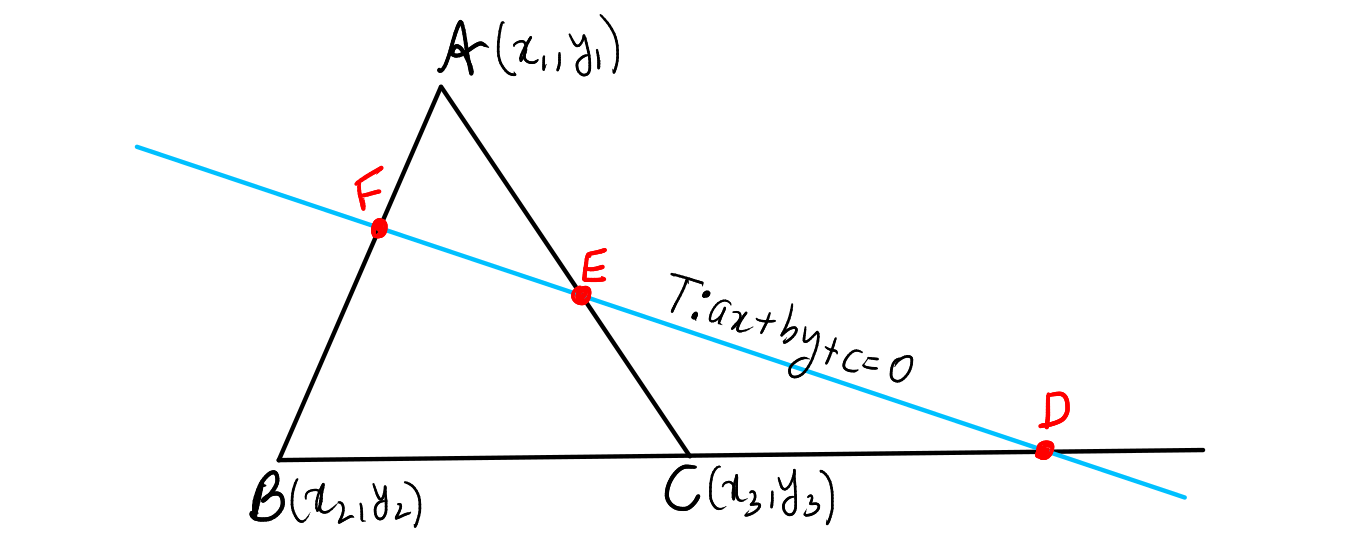
Consider a triangle . If a transversal cuts the sides , , and at , , and respectively, then
Mark this section complete when you have worked through its proofs.