The equation of a horizontal line in the Cartesian coordinate system can be described by a constant y-coordinate since all points on the line have the same vertical position. Thus, the general equation of a horizontal line is:
y=k
where k is the y-coordinate of any point on the line.
The equation of a vertical line, conversely, is given by a constant x-coordinate, as all points on the line share the same horizontal position. The general equation of a vertical line is:
x=h
where h is the x-coordinate of any point on the line.
Equation of a line with given slope and a point on it§
The equation of a line with slope m passing through a given point A(x1,y1) is y−y1=m(x−x1).
The equation of a line passing through two distinct points A(x1,y1) and B(x2,y2) is given by y−y1=x2−x1y2−y1(x−x1).
Proof:
Let the slope m of the line connecting points A and B be defined by the change in y-coordinates divided by the change in x-coordinates between these two points. Thus, the slope m is calculated as:
m=x2−x1y2−y1
This formula for the slope stems from the definition of slope in the Cartesian coordinate system, representing the rate of change of y with respect to x along the line.
Given the point-slope form of the equation of a line, which states that the difference in the y-coordinates of any point (x,y) on the line and point A is proportional to the difference in their x-coordinates, scaled by the slope m, we express this relationship as:
y−y1=m(x−x1)
Substituting the expression for m into the point-slope form yields:
y−y1=x2−x1y2−y1(x−x1)
This equation confirms that any point (x,y) satisfying this equation will lie on the line through A and B, thus proving that it is the equation of the line joining points A and B. The equation is valid provided that x1=x2, ensuring that the denominator is non-zero and the slope is defined.
A line passing through two points A(x1,y1) and B(x2,y2) is given by:
xx1x2yy1y2111=0
Proof:
Let P(x,y) be an arbitrary point on the line joining A and B.
The area of a triangle formed by three points in a Cartesian plane can be calculated using the determinant of a matrix formed by their coordinates. For the points A(x1,y1), B(x2,y2), and P(x,y), the formula for the area is given by:
Δ=21xx1x2yy1y2111
Since the points are collinear, the area Δ must be zero. Therefore, we set the determinant to zero:
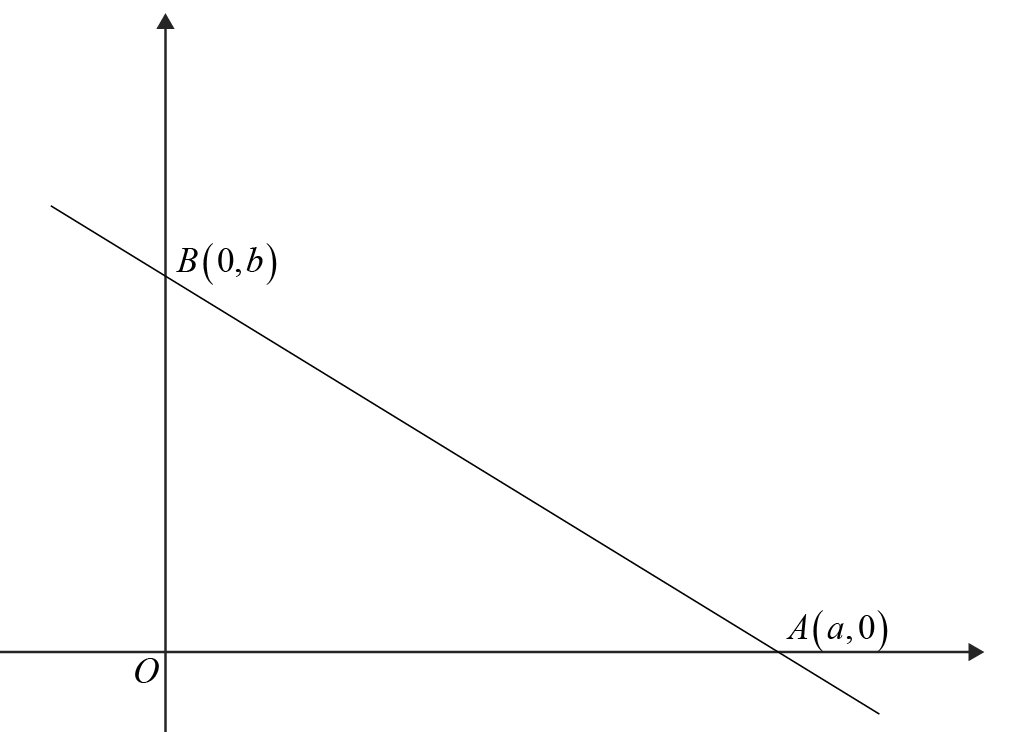
If a line intersects the x-axis at the point (a,0), then the x-axis intercept is simply referred to as a. This value represents the point along the x-axis where the line crosses. Similarly, if the line intersects the y-axis at the point (0,b), then the y-axis intercept is denoted by b. This value indicates the point along the y-axis where the line crosses. These intercepts, a and b, provide a concise way to describe the behavior of the line in relation to each axis.
The slope-intercept form of a line is a way to express the equation of a straight line when its slope m and y-intercept c are known. This form is represented as:
y=mx+c
Here, m represents the slope of the line, and c represents the y-coordinate of the point where the line intersects the y-axis, commonly referred to as the y-intercept.
Proof:
Consider a line with a known slope m that passes through the y-axis at the point (0,c). The slope m is defined as the ratio of the change in the y-coordinates to the change in the x-coordinates between any two points on the line. Specifically, if you have a point (x,y) on the line and another point (0,c) on the line (the y-intercept), the slope m can be calculated as follows:
m=x−0y−cm=xy−c
Rearranging this equation to solve for y gives:
y−c=mxy=mx+c
This confirms that the line's equation is y=mx+c. This form is particularly useful because it provides a straightforward method to graph the line by starting at the y-intercept (0,c) and using the slope m to determine the rise over run, moving from the intercept to other points on the line.
The slope-intercept form of a line, represented as y=mx+c, is highly significant for us for various reasons:
Clarity and Simplicity:
The slope-intercept form directly shows the slope m and the y-intercept c of the line. This clarity makes it straightforward to understand and visualize the behavior of the line without additional calculations.
Ease of Graphing:
This form simplifies graphing the line. By starting at the y-intercept c on the y-axis and using the slope m to determine the rise over run, one can plot subsequent points with ease.
Analytical Convenience:
Analyzing relationships between variables in various fields such as physics, economics, and biology often involves linear models. For example you might have seen the equation v=u+at is physics motion chapter as the motion of a particle under constant acceleration. u in the initial velocity, t is the variable time, v is the velocity at time t and a is the constant acceleration. If you will plot the graph of v versus t, then u is the y-intercept and a is the slope of the line.
If a line has a known slope m and an x-intercept a, the equation of the line can be expressed as y=m(x−a).
Proof:
Consider the general point-slope form of a line equation, where (x1,y1) is any point on the line, and m is the slope:
y−y1=m(x−x1)
For a line with an x-intercept at a, the point (a,0) lies on the line. Substituting x1=a and y1=0 into the point-slope equation, we obtain:
y−0=m(x−a)
This simplifies directly to:
y=m(x−a)
This derivation confirms that the line equation y=m(x−a) correctly represents a line with slope m passing through the x-intercept a, thus concluding the proof. ■
If a line has known x-intercept a and y-intercept b, then the equation of the line can be expressed in intercept form as:
ax+by=1
Proof:
Given that the line intercepts the x-axis at a and the y-axis at b, it passes through the points (a,0) and (0,b). We can derive the equation of the line using these intercepts.
Use the two-point form of a line equation:
The general equation of a line passing through two points (x1,y1) and (x2,y2) is given by:
y2−y1y−y1=x2−x1x−x1
Substituting the points (a,0) and (0,b):
b−0y−0=0−ax−a
Simplifying gives:
by=−ax−aby=−ax+1
Rearrange to form the intercept equation:
Rearranging the equation gives:
The general equation of a line in the Cartesian coordinate system is expressed as:
ax+by+c=0
Here, a, b, and c are constants. This form of the line equation is versatile and can represent any line in a two-dimensional space, including vertical, horizontal, and oblique lines.
a and b cannot both be zero simultaneously. This ensures that the equation represents a line and not a degenerate case.
Horizontal Line: If a=0, the equation simplifies to by+c=0. Rearranging gives y=−bc, which is the equation of a horizontal line parallel to the x-axis.
Vertical Line: If b=0, the equation simplifies to ax+c=0. Rearranging yields x=−ac, representing a vertical line parallel to the y-axis.
Line Passing Through the Origin: If c=0, the equation reduces to ax+by=0, indicating that the line passes through the origin (0,0).
Slope of the Line: The slope m of the line can be derived by rearranging the line equation into slope-intercept form y=mx+n. Starting from ax+by+c=0 and solving for y, we obtain y=−bax−bc. Therefore, the slope m of the line is −ba.
X-intercept: To find the x-intercept, set y=0 in the general equation:
ax+by+c=0⟹ax+c=0⟹x=−ac.
Hence, the x-intercept is (−ac,0).
Y-intercept: To find the y-intercept, set x=0 in the general equation:
ax+by+c=0⟹by+c=0⟹y=−bc.
Therefore, the y-intercept is (0,−bc).
In summary, the line described by the equation ax+by+c=0 has characteristics that depend on the coefficients a, b, and c. It may be horizontal, vertical, or have a negative reciprocal slope depending on the values of a and b. The line intersects the x-axis and y-axis at calculated points unless it is parallel to one of the axes.
Consider two lines L1 and L2 given by the equations:
L1:a1x+b1y+c1=0L2:a2x+b2y+c2=0
Parallel Lines:
For the lines L1 and L2 to be parallel, their slopes must be equal. The slope of a line ax+by+c=0 is given by −ba (provided b=0). Therefore, the slopes of L1 and L2 are −b1a1 and −b2a2 respectively. Setting these slopes equal gives:
−b1a1=−b2a2⟹a2a1=b2b1
Thus, for L1 and L2 to be parallel, a2a1=b2b1.
Coincident Lines:
Lines L1 and L2 are coincident if they are not only parallel but also have the same y-intercept. This condition is met if the entire equations are proportional, i.e., a2a1=b2b1=c2c1. This proportionality ensures that every point on L1 also lies on L2, and vice versa, indicating that the two lines are indeed the same (coincident).
Perpendicular Lines:
Two lines are perpendicular if the product of their slopes is −1. From the slope expressions derived, the product of the slopes of L1 and L2 is:
(−b1a1)(−b2a2)=b1b2a1a2
Setting this equal to −1 for perpendicularity, we have:
b1b2a1a2=−1⟹a1a2+b1b2=0
Therefore, for L1 and L2 to be perpendicular, a1a2+b1b2=0.
To determine the intersection point of two lines given by their equations L1:a1x+b1y+c1=0 and L2:a2x+b2y+c2=0, we consider three scenarios:
I. Parallel but not Coincident Lines:
For two lines to be parallel but not coincident, they must have the same slope but different y-intercepts. This condition is represented by a2a1=b2b1 and a2a1=c2c1. In this case, there is no intersection point as the lines are parallel and distinct.
II. Coincident Lines:
Lines are coincident when a2a1=b2b1=c2c1. This implies that every point on L1 is also on L2, leading to infinitely many intersection points, essentially all points on either line.
III. Not Parallel Lines (Intersecting Lines):
When lines are not parallel, they will intersect at a unique point. The condition for non-parallel lines is a2a1=b2b1, which ensures that the determinant of the coefficient matrix is non-zero. The determinant is given by D=a1b2−a2b1. If D=0, the lines will intersect at a unique point. The coordinates (x,y) of the intersection point can be found using cross-multiplication method:
Three lines L1:a1x+b1y+c1=0, L2:a2x+b2y+c2=0, and L3:a3x+b3y+c3=0 are concurrent (intersect at a single point) if and only if the determinant of their coefficient matrix is zero:
a1a2a3b1b2b3c1c2c3=0
Proof:
Assume that the lines L1, L2, and L3 are concurrent. This implies there exists a point (x,y) that simultaneously satisfies all three line equations.
Intersection of L1 and L2:
Calculate the intersection point of L1 and L2 using Cramer's Rule. For non-parallel lines, the intersection point (x,y) can be derived as follows:
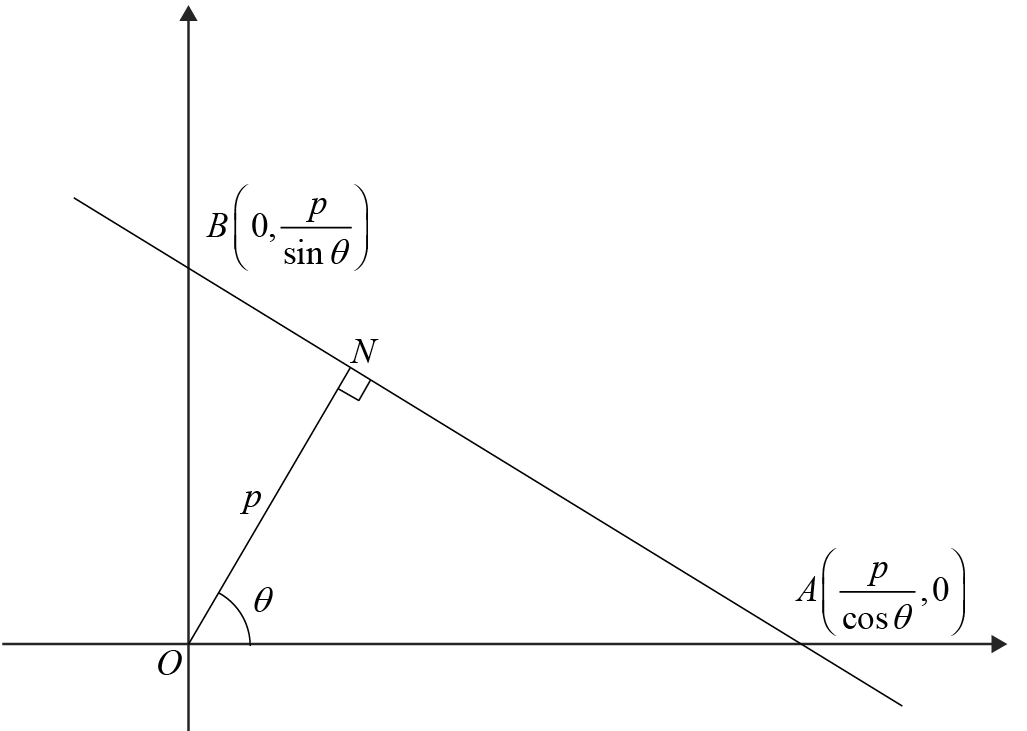
The normal form of the equation of a straight line is xcosθ+ysinθ=p, where p is the perpendicular distance from the origin to the line, and θ is the angle the normal makes with the positive x-axis.
Proof:
To derive this form, consider a line that cuts the x-axis at point A and the y-axis at point B. Let the foot of the perpendicular dropped from the origin O to the line be N, making ON=p and θ the angle ON makes with the positive x-axis.
Axis Intercepts:
In triangle OAN, the angle at O is θ, ON=p is the length of the perpendicular from the origin to the line, and OA is along the x-axis.
Using the definition of cosine in triangle OAN, we have:
cosθ=OAON⟹OA=cosθON=cosθp
Thus, the x-intercept A is (cosθp,0).
In triangle OBN, the angle at O is 90∘−θ, and OB is along the y-axis.
Using the definition of sine in triangle OBN, we find:
sinθ=OBON⟹OB=sinθON=sinθp
Therefore, the y-intercept B is (0,sinθp).
Derivation of Line Equation via Intercept Form:
The intercept form of a line's equation is ax+by=1, where a and b are the x- and y-intercepts, respectively.
Substituting a=cosθp and b=sinθp, the line equation becomes:
The symmetric form of a line is a useful representation that captures the orientation and position of a line in a coordinate plane. It is given by the equation:
cosθx−x1=sinθy−y1=r
Here, (x1,y1) is a known point through which the line passes, θ is the angle the line makes with the positive x-axis, and r is the parameter representing the signed distance from the point (x1,y1) to any point (x,y) on the line. ∣r∣ is the actual distance between (x1,y1) and (x,y).
Proof:
Consider the straight line containing the fixed point A(x1,y1) and an arbitrary point P(x,y). Construct the right angled triangle APN. The ∠NAP=θ. By the definition of cosine and sine in a right-angled triangle:
If point P is situated below A, the signs of the components change, giving us AN=x1−x and PN=y1−y, which results in:
x1−x=rcos(θ)andy1−y=rsin(θ)
Leading to:
cos(θ)x−x1=−randsin(θ)y−y1=−r
Therefore, for any arbitrary point P on the line, we establish that:
cos(θ)x−x1=sin(θ)y−y1=±r
Here, r is a positive number representing the distance from A to P. The ± symbol accounts for the fact that r can be oriented in either direction along the line. We replace ±r by just r (absorbing ± in r). Now, r can be considered a signed distance, where the sign indicates the direction with respect to the fixed point A. Consequently, ∣r∣ gives the absolute distance from A to P without concern for direction. ■
Section 2 of 8 · Straight Lines
Mark this section complete when you have worked through its proofs.
Type any topic, theorem, or concept to jump directly to the section.