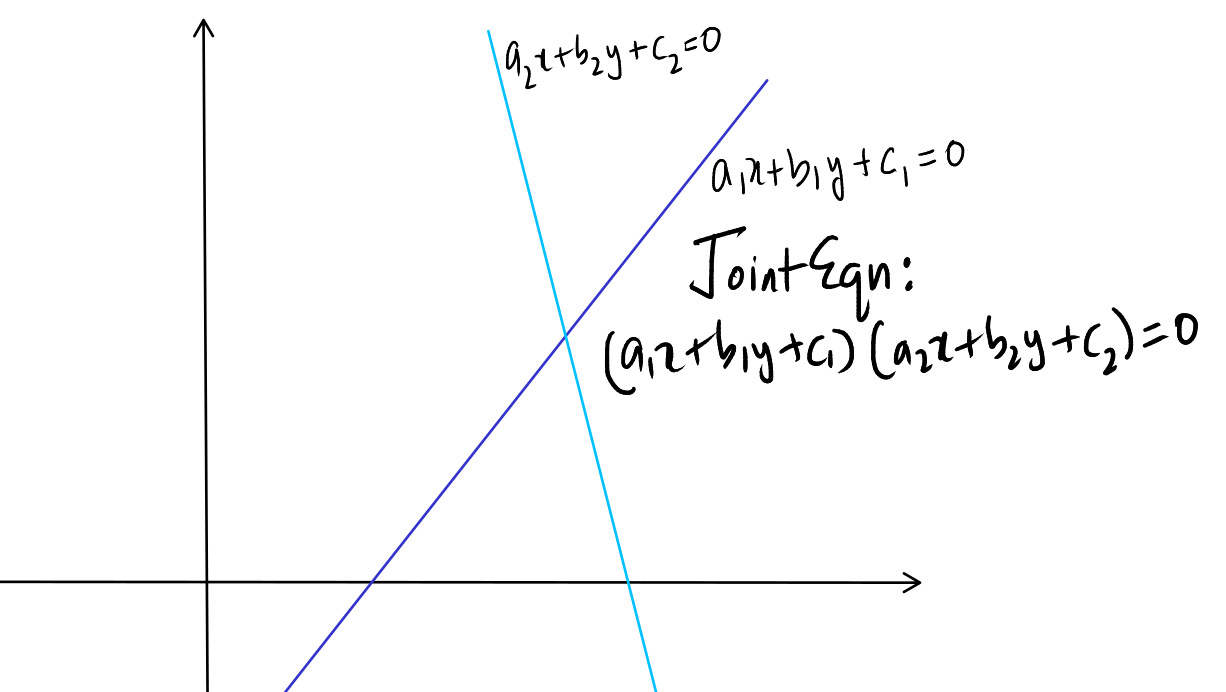
Joint Equations of Straight Lines§
The joint equation of two lines represented by the equations:
a 1 x + b 1 y + c 1 = 0 a_1x + b_1y + c_1 = 0 a 1 x + b 1 y + c 1 = 0 a 2 x + b 2 y + c 2 = 0 a_2x + b_2y + c_2 = 0 a 2 x + b 2 y + c 2 = 0 is given by:
( a 1 x + b 1 y + c 1 ) ( a 2 x + b 2 y + c 2 ) = 0 (a_1x + b_1y + c_1)(a_2x + b_2y + c_2) = 0 ( a 1 x + b 1 y + c 1 ) ( a 2 x + b 2 y + c 2 ) = 0 The joint equation of two straight lines is often referred to as a pair of straight lines
The joint equation, being the product of the two linear equations, represents the set of points that lie on either of the lines. . Specifically:
Any point ( x , y ) (x, y) ( x , y ) a 1 x + b 1 y + c 1 = 0 a_1x + b_1y + c_1 = 0 a 1 x + b 1 y + c 1 = 0
Similarly, any point that satisfies the second line equation a 2 x + b 2 y + c 2 = 0 a_2x + b_2y + c_2 = 0 a 2 x + b 2 y + c 2 = 0
For example:
Consider the lines:
2 x − y + 3 = 0 2x - y + 3 = 0 2 x − y + 3 = 0 x + 4 y − 5 = 0 x + 4y - 5 = 0 x + 4 y − 5 = 0 The joint equation is obtained by multiplying these equations:
( 2 x − y + 3 ) ( x + 4 y − 5 ) = 0 (2x - y + 3)(x + 4y - 5) = 0 ( 2 x − y + 3 ) ( x + 4 y − 5 ) = 0 Expanding this product, we get:
( 2 x − y + 3 ) ( x + 4 y − 5 ) = 2 x ( x + 4 y − 5 ) − y ( x + 4 y − 5 ) + 3 ( x + 4 y − 5 ) = 2 x 2 + 8 x y − 10 x − x y − 4 y 2 + 5 y + 3 x + 12 y − 15 = 2 x 2 + 7 x y − 4 y 2 − 7 x + 17 y − 15 = 0 \begin{aligned}
(2x - y + 3)(x + 4y - 5) &= 2x(x + 4y - 5) - y(x + 4y - 5) + 3(x + 4y - 5) \\
&= 2x^2 + 8xy - 10x - xy - 4y^2 + 5y + 3x + 12y - 15 \\
&= 2x^2 + 7xy - 4y^2 - 7x + 17y - 15 = 0
\end{aligned} ( 2 x − y + 3 ) ( x + 4 y − 5 ) = 2 x ( x + 4 y − 5 ) − y ( x + 4 y − 5 ) + 3 ( x + 4 y − 5 ) = 2 x 2 + 8 x y − 10 x − x y − 4 y 2 + 5 y + 3 x + 12 y − 15 = 2 x 2 + 7 x y − 4 y 2 − 7 x + 17 y − 15 = 0 Thus, the joint equation of the two given lines is:
2 x 2 + 7 x y − 4 y 2 − 7 x + 17 y − 15 = 0 2x^2 + 7xy - 4y^2 - 7x + 17y - 15 = 0 2 x 2 + 7 x y − 4 y 2 − 7 x + 17 y − 15 = 0 Joint Equation of Multiple Straight Lines§
Just like we saw above with the joint equation of two straight lines, we can also derive the joint equation of three or more straight lines. For three lines given by the equations:
a 1 x + b 1 y + c 1 = 0 a_1x + b_1y + c_1 = 0 a 1 x + b 1 y + c 1 = 0 a 2 x + b 2 y + c 2 = 0 a_2x + b_2y + c_2 = 0 a 2 x + b 2 y + c 2 = 0 a 3 x + b 3 y + c 3 = 0 a_3x + b_3y + c_3 = 0 a 3 x + b 3 y + c 3 = 0 The joint equation is obtained by multiplying the individual linear equations:
( a 1 x + b 1 y + c 1 ) ( a 2 x + b 2 y + c 2 ) ( a 3 x + b 3 y + c 3 ) = 0 (a_1x + b_1y + c_1)(a_2x + b_2y + c_2)(a_3x + b_3y + c_3) = 0 ( a 1 x + b 1 y + c 1 ) ( a 2 x + b 2 y + c 2 ) ( a 3 x + b 3 y + c 3 ) = 0 This product represents the set of points that lie on any of the three lines. Any point ( x , y ) (x, y) ( x , y )
For Example,
Consider the lines:
2 x − y + 3 = 0 2x - y + 3 = 0 2 x − y + 3 = 0 x + 4 y − 5 = 0 x + 4y - 5 = 0 x + 4 y − 5 = 0 3 x − 2 y + 1 = 0 3x - 2y + 1 = 0 3 x − 2 y + 1 = 0 The joint equation is:
( 2 x − y + 3 ) ( x + 4 y − 5 ) ( 3 x − 2 y + 1 ) = 0 (2x - y + 3)(x + 4y - 5)(3x - 2y + 1) = 0 ( 2 x − y + 3 ) ( x + 4 y − 5 ) ( 3 x − 2 y + 1 ) = 0 Expanding this product in one step:
( 2 x − y + 3 ) ( x + 4 y − 5 ) ( 3 x − 2 y + 1 ) = ( 2 x − y + 3 ) [ ( x + 4 y − 5 ) ( 3 x − 2 y + 1 ) ] = ( 2 x − y + 3 ) [ 3 x 2 − 2 x y + x + 12 x y − 8 y 2 + 4 y − 15 x + 10 y − 5 ] = ( 2 x − y + 3 ) [ 3 x 2 + 10 x y − 8 y 2 − 14 x + 14 y − 5 ] = 2 x [ 3 x 2 + 10 x y − 8 y 2 − 14 x + 14 y − 5 ] − y [ 3 x 2 + 10 x y − 8 y 2 − 14 x + 14 y − 5 ] + 3 [ 3 x 2 + 10 x y − 8 y 2 − 14 x + 14 y − 5 ] = 6 x 3 + 20 x 2 y − 16 x y 2 − 28 x 2 + 28 x y − 10 x − 3 x 2 y − 10 x y 2 + 8 y 3 + 14 x 2 − 14 x y + 5 y + 9 x 2 + 30 x y − 24 y 2 − 42 x + 42 y − 15 = 6 x 3 + 17 x 2 y − 18 x y 2 + 8 y 3 − 5 x 2 − 2 x y − 19 x + 47 y − 15 \begin{aligned}
(2x - y + 3)(x + 4y - 5)(3x - 2y + 1) &= (2x - y + 3) \left[(x + 4y - 5)(3x - 2y + 1)\right] \\
&= (2x - y + 3) \left[3x^2 - 2xy + x + 12xy - 8y^2 + 4y - 15x + 10y - 5\right] \\
&= (2x - y + 3) \left[3x^2 + 10xy - 8y^2 - 14x + 14y - 5\right] \\
&= 2x \left[3x^2 + 10xy - 8y^2 - 14x + 14y - 5\right] - y \left[3x^2 + 10xy - 8y^2 - 14x + 14y - 5\right] \\
&\quad + 3 \left[3x^2 + 10xy - 8y^2 - 14x + 14y - 5\right] \\
&= 6x^3 + 20x^2y - 16xy^2 - 28x^2 + 28xy - 10x \\
&\quad - 3x^2y - 10xy^2 + 8y^3 + 14x^2 - 14xy + 5y \\
&\quad + 9x^2 + 30xy - 24y^2 - 42x + 42y - 15 \\
&= 6x^3 + 17x^2y - 18xy^2 + 8y^3 - 5x^2 - 2xy - 19x + 47y - 15
\end{aligned} ( 2 x − y + 3 ) ( x + 4 y − 5 ) ( 3 x − 2 y + 1 ) = ( 2 x − y + 3 ) [ ( x + 4 y − 5 ) ( 3 x − 2 y + 1 ) ] = ( 2 x − y + 3 ) [ 3 x 2 − 2 x y + x + 12 x y − 8 y 2 + 4 y − 15 x + 10 y − 5 ] = ( 2 x − y + 3 ) [ 3 x 2 + 10 x y − 8 y 2 − 14 x + 14 y − 5 ] = 2 x [ 3 x 2 + 10 x y − 8 y 2 − 14 x + 14 y − 5 ] − y [ 3 x 2 + 10 x y − 8 y 2 − 14 x + 14 y − 5 ] + 3 [ 3 x 2 + 10 x y − 8 y 2 − 14 x + 14 y − 5 ] = 6 x 3 + 20 x 2 y − 16 x y 2 − 28 x 2 + 28 x y − 10 x − 3 x 2 y − 10 x y 2 + 8 y 3 + 14 x 2 − 14 x y + 5 y + 9 x 2 + 30 x y − 24 y 2 − 42 x + 42 y − 15 = 6 x 3 + 17 x 2 y − 18 x y 2 + 8 y 3 − 5 x 2 − 2 x y − 19 x + 47 y − 15 Thus, the expanded joint equation is:
6 x 3 + 17 x 2 y − 18 x y 2 + 8 y 3 − 5 x 2 − 2 x y − 19 x + 47 y − 15 = 0 6x^3 + 17x^2y - 18xy^2 + 8y^3 - 5x^2 - 2xy - 19x + 47y - 15 = 0 6 x 3 + 17 x 2 y − 18 x y 2 + 8 y 3 − 5 x 2 − 2 x y − 19 x + 47 y − 15 = 0 This is a cubic polynomial equation in two variables x x x y y y
We will mostly study the joint equation of two straight lines.
When forming the joint equation of two lines, it is crucial to correctly multiply the entire original linear equations, not just their left-hand sides.
For example, given the lines:
2 x + 3 y = 5 2x + 3y = 5 2 x + 3 y = 5 x − y = 7 x - y = 7 x − y = 7 The correct joint equation should be:
( 2 x + 3 y − 5 ) ( x − y − 7 ) = 0 (2x + 3y - 5)(x - y - 7) = 0 ( 2 x + 3 y − 5 ) ( x − y − 7 ) = 0 An incorrect form might be:
( 2 x + 3 y ) ( x − y ) = 35 (2x + 3y)(x - y) = 35 ( 2 x + 3 y ) ( x − y ) = 35 This is wrong. The new equation obtained this way is not a joint equation of the given lines. While one or two points from the original lines might satisfy this incorrect equation, most will not. For instance, the point ( 1 , 1 ) (1, 1) ( 1 , 1 ) 2 x + 3 y = 5 2x + 3y = 5 2 x + 3 y = 5 ( 2 x + 3 y ) ( x − y ) = 35 (2x + 3y)(x - y) = 35 ( 2 x + 3 y ) ( x − y ) = 35
Homogeneous Polynomial in Two Variables§
Before you begin please understand the meaning of the term 'homogenous' that we will use here.
A polynomial P ( x , y ) P(x, y) P ( x , y ) x x x y y y n n n n n n x x x y y y
For example, a homogeneous polynomial of degree n n n
P ( x , y ) = ∑ i = 0 n a i x n − i y i P(x, y) = \sum_{i=0}^{n} a_i x^{n-i} y^i P ( x , y ) = i = 0 ∑ n a i x n − i y i Where each term a i x n − i y i a_i x^{n-i} y^i a i x n − i y i n n n
Examples:
3 x 2 + 2 x y + y 2 3x^2 + 2xy + y^2 3 x 2 + 2 x y + y 2 4 x 3 − 3 x 2 y + 2 x y 2 − y 3 4x^3 - 3x^2y + 2xy^2 - y^3 4 x 3 − 3 x 2 y + 2 x y 2 − y 3