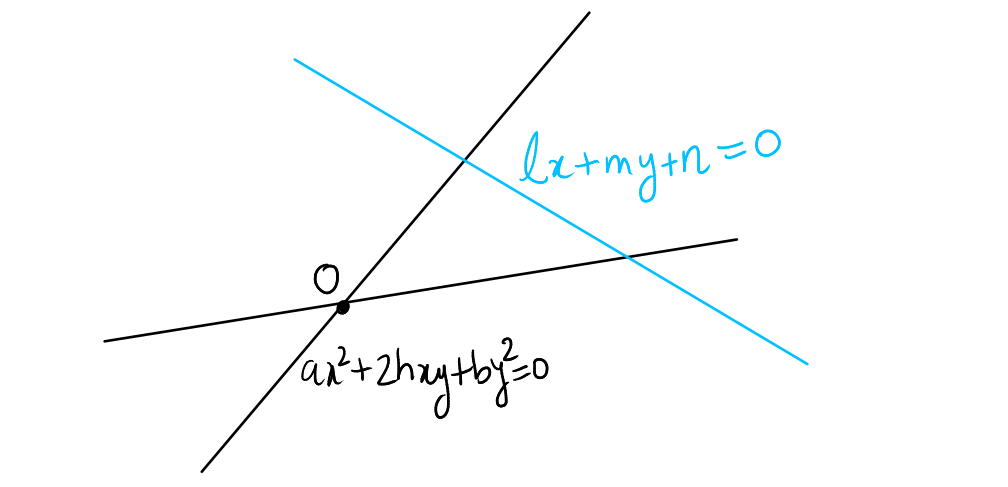
Consider a pair of straight lines a x 2 + 2 h x y + b y 2 = 0 ax^2 + 2hxy + by^2 = 0 a x 2 + 2 h x y + b y 2 = 0 l x + m y + n = 0 lx + my + n = 0 l x + m y + n = 0 A A A B B B Δ O A B \Delta OAB Δ O A B
The triangle Δ O A B \Delta OAB Δ O A B a x 2 + 2 h x y + b y 2 = 0 ax^2 + 2hxy + by^2 = 0 a x 2 + 2 h x y + b y 2 = 0 l x + m y + n = 0 lx + my + n = 0 l x + m y + n = 0 h ( l 2 − m 2 ) = ( a − b ) l m h(l^2 - m^2) = (a - b)lm h ( l 2 − m 2 ) = ( a − b ) l m
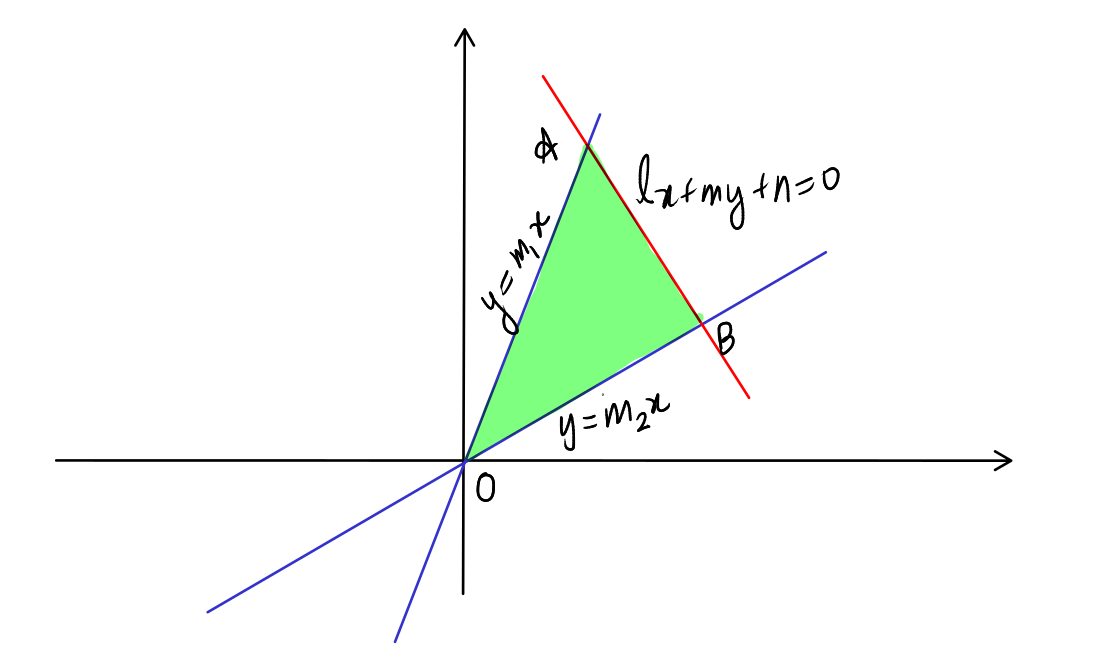
Let y = m 1 x y = m_1x y = m 1 x y = m 2 x y = m_2x y = m 2 x a x 2 + 2 h x y + b y 2 = 0 ax^2 + 2hxy + by^2 = 0 a x 2 + 2 h x y + b y 2 = 0
m 1 + m 2 = − 2 h b m_1 + m_2 = -\frac{2h}{b} m 1 + m 2 = − b 2 h m 1 m 2 = a b m_1m_2 = \frac{a}{b} m 1 m 2 = b a Slope of line A B AB A B − l m -\frac{l}{m} − m l
Since ∠ O A B = ∠ O B A \angle OAB = \angle OBA ∠ O A B = ∠ O B A
tan ∠ O A B = tan ∠ O B A \tan \angle OAB = \tan \angle OBA tan ∠ O A B = tan ∠ O B A ⟹ − l m − m 1 1 + l m m 1 = m 2 + l m 1 − l m m 2 \implies \frac{-\frac{l}{m} - m_1}{1 + \frac{l}{m} m_1} = \frac{m_2 + \frac{l}{m}}{1 - \frac{l}{m} m_2} ⟹ 1 + m l m 1 − m l − m 1 = 1 − m l m 2 m 2 + m l ⟹ − l − m m 1 m + l m 1 = m 2 m + l m − l m 2 \implies \frac{-l - mm_1}{m + lm_1} = \frac{m_2m + l}{m - lm_2} ⟹ m + l m 1 − l − m m 1 = m − l m 2 m 2 m + l ⟹ ( l + m m 1 ) ( m − l m 2 ) = ( l m 1 − m ) ( l + m m 2 ) \implies (l + mm_1)(m - lm_2) = (lm_1 - m)(l + mm_2) ⟹ ( l + m m 1 ) ( m − l m 2 ) = ( l m 1 − m ) ( l + m m 2 ) ⟹ l m − l 2 m 2 + m 2 m 1 − m m 1 l m 2 = l 2 m 1 + l m 1 m 2 − m 2 m 2 \implies lm - l^2m_2 + m^2m_1 - mm_1lm_2 = l^2m_1 + lm_1m_2 - m^2m_2 ⟹ l m − l 2 m 2 + m 2 m 1 − m m 1 l m 2 = l 2 m 1 + l m 1 m 2 − m 2 m 2 ⟹ 2 l m = 2 l m m 1 m 2 + l 2 ( m 1 − m 2 ) − m 2 ( m 1 − m 2 ) \implies 2lm = 2lm m_1m_2 + l^2(m_1 - m_2) - m^2(m_1 - m_2) ⟹ 2 l m = 2 l m m 1 m 2 + l 2 ( m 1 − m 2 ) − m 2 ( m 1 − m 2 ) Substituting m 1 + m 2 = − 2 h b m_1 + m_2 = -\frac{2h}{b} m 1 + m 2 = − b 2 h m 1 m 2 = a b m_1m_2 = \frac{a}{b} m 1 m 2 = b a
⟹ 2 l m = 2 l m a b − ( l 2 − m 2 ) 2 h b \implies 2lm = 2lm \frac{a}{b} - (l^2 - m^2)\frac{2h}{b} ⟹ 2 l m = 2 l m b a − ( l 2 − m 2 ) b 2 h ⟹ 2 l m b = 2 l m a − ( l 2 − m 2 ) 2 h \implies 2lmb = 2lma - (l^2 - m^2)2h ⟹ 2 l mb = 2 l ma − ( l 2 − m 2 ) 2 h ⟹ l m b = l m a − ( l 2 − m 2 ) h \implies lmb = lma - (l^2 - m^2)h ⟹ l mb = l ma − ( l 2 − m 2 ) h ⟹ ( l 2 − m 2 ) h = l m ( a − b ) \implies (l^2 - m^2)h = lm(a - b) ⟹ ( l 2 − m 2 ) h = l m ( a − b ) Therefore, the triangle Δ O A B \Delta OAB Δ O A B
h ( l 2 − m 2 ) = ( a − b ) l m \boxed{h(l^2 - m^2) = (a - b)lm} h ( l 2 − m 2 ) = ( a − b ) l m This completes the proof.
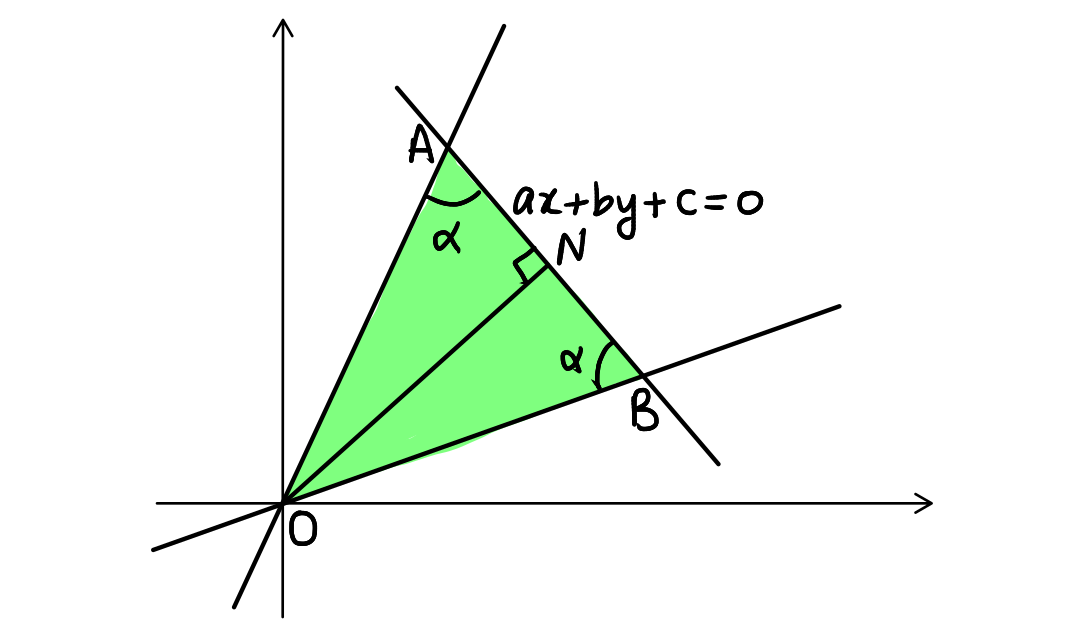
Consider a straight line a x + b y + c = 0 ax + by + c = 0 a x + b y + c = 0 a x + b y + c = 0 ax + by + c = 0 a x + b y + c = 0 α \alpha α
Theorem : The equation of a pair of straight lines passing through the origin and forming an isosceles triangle with a given line a x + b y + c = 0 ax + by + c = 0 a x + b y + c = 0 α \alpha α ( a x + b y ) 2 − tan 2 α ( b x − a y ) 2 = 0 (ax + by)^2 - \tan^2 \alpha (bx - ay)^2 = 0 ( a x + b y ) 2 − tan 2 α ( b x − a y ) 2 = 0
Let the lines O A OA O A O B OB O B ( x , y ) (x, y) ( x , y ) O A OA O A O A OA O A y x \frac{y}{x} x y
The slope of the line a x + b y + c = 0 ax + by + c = 0 a x + b y + c = 0 − a b -\frac{a}{b} − b a
Given that ∠ O A B = α \angle OAB = \alpha ∠ O A B = α
tan α = ∣ − a b − y x 1 + a b y x ∣ = ∣ a x + b y b x − a y ∣ \tan \alpha = \left| \frac{-\frac{a}{b} - \frac{y}{x}}{1 + \frac{a}{b} \frac{y}{x}} \right| = \left| \frac{ax + by}{bx - ay} \right| tan α = 1 + b a x y − b a − x y = b x − a y a x + b y ⟹ tan 2 α = ( a x + b y b x − a y ) 2 \implies \tan^2 \alpha = \left( \frac{ax + by}{bx - ay} \right)^2 ⟹ tan 2 α = ( b x − a y a x + b y ) 2 ⟹ ( a x + b y ) 2 − tan 2 α ( b x − a y ) 2 = 0 \implies (ax + by)^2 - \tan^2 \alpha (bx - ay)^2 = 0 ⟹ ( a x + b y ) 2 − tan 2 α ( b x − a y ) 2 = 0 Therefore, the equation of the pair of lines is:
( a x + b y ) 2 − tan 2 α ( b x − a y ) 2 = 0 \boxed{(ax + by)^2 - \tan^2 \alpha (bx - ay)^2 = 0} ( a x + b y ) 2 − tan 2 α ( b x − a y ) 2 = 0 This completes the proof.
Special Cases:
If α = 60 ∘ \alpha = 60^\circ α = 6 0 ∘ :
The triangle formed is equilateral.
The equation becomes:
( a x + b y ) 2 − 3 ( b x − a y ) 2 = 0 (ax + by)^2 - 3(bx - ay)^2 = 0 ( a x + b y ) 2 − 3 ( b x − a y ) 2 = 0
If α = 45 ∘ \alpha = 45^\circ α = 4 5 ∘ :
The triangle formed is a right-angled isosceles triangle.
The equation becomes:
( a x + b y ) 2 − ( b x − a y ) 2 = 0 (ax + by)^2 - (bx - ay)^2 = 0 ( a x + b y ) 2 − ( b x − a y ) 2 = 0
A pair of straight lines a x 2 + 2 h x y + b y 2 = 0 ax^2 + 2hxy + by^2 = 0 a x 2 + 2 h x y + b y 2 = 0 l x + m y + n = 0 lx + my + n = 0 l x + m y + n = 0
( l x + m y ) 2 − 3 ( m x − l y ) 2 = 0 (lx + my)^2 - 3(mx - ly)^2 = 0 ( l x + m y ) 2 − 3 ( m x − l y ) 2 = 0 e.g. The pair of straight lines 3 x 2 + 48 x y + 23 y 2 = 0 3x^2 + 48xy + 23y^2 = 0 3 x 2 + 48 x y + 23 y 2 = 0 3 x − 2 y + 4 = 0 3x - 2y + 4 = 0 3 x − 2 y + 4 = 0 ( 3 x − 2 y ) 2 − 3 ( 2 x + 3 y ) 2 = 0 (3x - 2y)^2 - 3(2x + 3y)^2 = 0 ( 3 x − 2 y ) 2 − 3 ( 2 x + 3 y ) 2 = 0
( 3 x − 2 y ) 2 − 3 ( 2 x + 3 y ) 2 = 0 (3x - 2y)^2 - 3(2x + 3y)^2 = 0 ( 3 x − 2 y ) 2 − 3 ( 2 x + 3 y ) 2 = 0 ⟹ ( 3 x − 2 y ) 2 − 3 ( 2 x + 3 y ) 2 = ( 9 x 2 − 12 x y + 4 y 2 ) − 3 ( 4 x 2 + 12 x y + 9 y 2 ) = 9 x 2 − 12 x y + 4 y 2 − ( 12 x 2 + 36 x y + 27 y 2 ) = ( 9 x 2 − 12 x 2 ) + ( − 12 x y − 36 x y ) + ( 4 y 2 − 27 y 2 ) = − 3 x 2 − 48 x y − 23 y 2 \implies \begin{align*} (3x - 2y)^2 - 3(2x + 3y)^2 & = (9x^2 - 12xy + 4y^2) - 3(4x^2 + 12xy + 9y^2) \\ & = 9x^2 - 12xy + 4y^2 - (12x^2 + 36xy + 27y^2) \\ & = (9x^2 - 12x^2) + (-12xy - 36xy) + (4y^2 - 27y^2) \\ & = -3x^2 - 48xy - 23y^2 \end{align*} ⟹ ( 3 x − 2 y ) 2 − 3 ( 2 x + 3 y ) 2 = ( 9 x 2 − 12 x y + 4 y 2 ) − 3 ( 4 x 2 + 12 x y + 9 y 2 ) = 9 x 2 − 12 x y + 4 y 2 − ( 12 x 2 + 36 x y + 27 y 2 ) = ( 9 x 2 − 12 x 2 ) + ( − 12 x y − 36 x y ) + ( 4 y 2 − 27 y 2 ) = − 3 x 2 − 48 x y − 23 y 2 Thus,
( 3 x − 2 y ) 2 − 3 ( 2 x + 3 y ) 2 = 0 ⟹ − 3 x 2 − 48 x y − 23 y 2 = 0 (3x - 2y)^2 - 3(2x + 3y)^2 = 0 \implies -3x^2 - 48xy - 23y^2 = 0 ( 3 x − 2 y ) 2 − 3 ( 2 x + 3 y ) 2 = 0 ⟹ − 3 x 2 − 48 x y − 23 y 2 = 0 which simplifies to:
3 x 2 + 48 x y + 23 y 2 = 0 3x^2 + 48xy + 23y^2 = 0 3 x 2 + 48 x y + 23 y 2 = 0 Therefore, the pair of straight lines 3 x 2 + 48 x y + 23 y 2 = 0 3x^2 + 48xy + 23y^2 = 0 3 x 2 + 48 x y + 23 y 2 = 0 3 x − 2 y + 4 = 0 3x - 2y + 4 = 0 3 x − 2 y + 4 = 0 ( 3 x − 2 y ) 2 − 3 ( 2 x + 3 y ) 2 = 0 (3x - 2y)^2 - 3(2x + 3y)^2 = 0 ( 3 x − 2 y ) 2 − 3 ( 2 x + 3 y ) 2 = 0
A line l x + m y + n = 0 lx + my + n = 0 l x + m y + n = 0 a x 2 + 2 h x y + b y 2 = 0 ax^2 + 2hxy + by^2 = 0 a x 2 + 2 h x y + b y 2 = 0 a + b = 0 a + b = 0 a + b = 0 a l 2 + 2 h l m + b m 2 = 0 al^2 + 2hlm + bm^2 = 0 a l 2 + 2 h l m + b m 2 = 0
We know that the angle between a pair of lines is a right angle if a + b = 0 a + b = 0 a + b = 0 l x + m y + n = 0 lx + my + n = 0 l x + m y + n = 0
A right-angled triangle can also be obtained if the line l x + m y + n = 0 lx + my + n = 0 l x + m y + n = 0 a x 2 + 2 h x y + b y 2 = 0 ax^2 + 2hxy + by^2 = 0 a x 2 + 2 h x y + b y 2 = 0
Let y = m 1 x y = m_1x y = m 1 x y = m 2 x y = m_2x y = m 2 x a x 2 + 2 h x y + b y 2 = 0 ax^2 + 2hxy + by^2 = 0 a x 2 + 2 h x y + b y 2 = 0
Let l x + m y + n = 0 lx + my + n = 0 l x + m y + n = 0 y = m 1 x y = m_1x y = m 1 x
Then:
− l m ⋅ m 1 = − 1 ⟹ m 1 = m l -\frac{l}{m} \cdot m_1 = -1 \implies m_1 = \frac{m}{l} − m l ⋅ m 1 = − 1 ⟹ m 1 = l m We know that:
a + 2 h m 1 + b m 1 2 = 0 a + 2hm_1 + bm_1^2 = 0 a + 2 h m 1 + b m 1 2 = 0 ⟹ a + 2 h ( m l ) + b ( m l ) 2 = 0 \implies a + 2h\left(\frac{m}{l}\right) + b\left(\frac{m}{l}\right)^2 = 0 ⟹ a + 2 h ( l m ) + b ( l m ) 2 = 0 ⟹ a + 2 h m l + b m 2 l 2 = 0 \implies a + \frac{2hm}{l} + \frac{bm^2}{l^2} = 0 ⟹ a + l 2 hm + l 2 b m 2 = 0 ⟹ a l 2 + 2 h l m + b m 2 = 0 \implies al^2 + 2hlm + bm^2 = 0 ⟹ a l 2 + 2 h l m + b m 2 = 0 Hence, a line l x + m y + n = 0 lx + my + n = 0 l x + m y + n = 0 a x 2 + 2 h x y + b y 2 = 0 ax^2 + 2hxy + by^2 = 0 a x 2 + 2 h x y + b y 2 = 0
a + b = 0 or a l 2 + 2 h l m + b m 2 = 0 \boxed{a + b = 0 \text{ or } al^2 + 2hlm + bm^2 = 0} a + b = 0 or a l 2 + 2 h l m + b m 2 = 0
Consider the triangle formed by a pair of straight lines a x 2 + 2 h x y + b y 2 = 0 ax^2 + 2hxy + by^2 = 0 a x 2 + 2 h x y + b y 2 = 0 l x + m y + n = 0 lx + my + n = 0 l x + m y + n = 0
Let y = m 1 x y = m_1x y = m 1 x y = m 2 x y = m_2x y = m 2 x a x 2 + 2 h x y + b y 2 = 0 ax^2 + 2hxy + by^2 = 0 a x 2 + 2 h x y + b y 2 = 0
m 1 + m 2 = − 2 h b and m 1 m 2 = a b m_1 + m_2 = -\frac{2h}{b} \quad \text{and} \quad m_1m_2 = \frac{a}{b} m 1 + m 2 = − b 2 h and m 1 m 2 = b a Let A A A B B B l x + m y + n = 0 lx + my + n = 0 l x + m y + n = 0 y = m 1 x y = m_1x y = m 1 x y = m 2 x y = m_2x y = m 2 x A A A B B B
For A A A
l x + m m 1 x + n = 0 ⟹ x = − n l + m m 1 , y = − n m 1 l + m m 1 lx + mm_1x + n = 0 \implies x = \frac{-n}{l + mm_1}, \quad y = \frac{-nm_1}{l + mm_1} l x + m m 1 x + n = 0 ⟹ x = l + m m 1 − n , y = l + m m 1 − n m 1 Therefore, A A A
A ( − n l + m m 1 , − n m 1 l + m m 1 ) A \left( \frac{-n}{l + mm_1}, \frac{-nm_1}{l + mm_1} \right) A ( l + m m 1 − n , l + m m 1 − n m 1 ) Similarly, for B B B
B ( − n l + m m 2 , − n m 2 l + m m 2 ) B \left( \frac{-n}{l + mm_2}, \frac{-nm_2}{l + mm_2} \right) B ( l + m m 2 − n , l + m m 2 − n m 2 ) The area of Δ O A B \Delta OAB Δ O A B
Area = 1 2 ∣ x A y B − x B y A ∣ \text{Area} = \frac{1}{2} \left| x_A y_B - x_B y_A \right| Area = 2 1 ∣ x A y B − x B y A ∣ Substituting the coordinates:
Area = 1 2 ∣ − n l + m m 1 ⋅ − n m 2 l + m m 2 − − n l + m m 2 ⋅ − n m 1 l + m m 1 ∣ \text{Area} = \frac{1}{2} \left| \frac{-n}{l + mm_1} \cdot \frac{-nm_2}{l + mm_2} - \frac{-n}{l + mm_2} \cdot \frac{-nm_1}{l + mm_1} \right| Area = 2 1 l + m m 1 − n ⋅ l + m m 2 − n m 2 − l + m m 2 − n ⋅ l + m m 1 − n m 1 = 1 2 ∣ n 2 m 2 ( l + m m 1 ) ( l + m m 2 ) − n 2 m 1 ( l + m m 2 ) ( l + m m 1 ) ∣ = \frac{1}{2} \left| \frac{n^2 m_2}{(l + mm_1)(l + mm_2)} - \frac{n^2 m_1}{(l + mm_2)(l + mm_1)} \right| = 2 1 ( l + m m 1 ) ( l + m m 2 ) n 2 m 2 − ( l + m m 2 ) ( l + m m 1 ) n 2 m 1 = n 2 2 ∣ m 2 − m 1 ( l + m m 1 ) ( l + m m 2 ) ∣ = \frac{n^2}{2} \left| \frac{m_2 - m_1}{(l + mm_1)(l + mm_2)} \right| = 2 n 2 ( l + m m 1 ) ( l + m m 2 ) m 2 − m 1 = n 2 2 ∣ ( − 2 h b ) 2 − 4 ( a b ) l 2 + l m ( − 2 h b ) + m 2 ( a b ) ∣ = \frac{n^2}{2} \left| \frac{\sqrt{\left( \frac{-2h}{b} \right)^2 - 4 \left( \frac{a}{b} \right)}}{l^2 + lm \left( -\frac{2h}{b} \right) + m^2 \left( \frac{a}{b} \right)} \right| = 2 n 2 l 2 + l m ( − b 2 h ) + m 2 ( b a ) ( b − 2 h ) 2 − 4 ( b a ) = n 2 2 ∣ 4 h 2 b 2 − 4 a b l 2 − 2 h l m b + a m 2 b ∣ = \frac{n^2}{2} \left| \frac{\sqrt{\frac{4h^2}{b^2} - \frac{4a}{b}}}{l^2 - \frac{2hlm}{b} + \frac{a m^2}{b}} \right| = 2 n 2 l 2 − b 2 h l m + b a m 2 b 2 4 h 2 − b 4 a = n 2 2 ∣ 2 h 2 − a b b ( l 2 − 2 h l m b + a m 2 b ) ∣ = \frac{n^2}{2} \left| \frac{2 \sqrt{h^2 - ab}}{b \left( l^2 - \frac{2hlm}{b} + \frac{a m^2}{b} \right)} \right| = 2 n 2 b ( l 2 − b 2 h l m + b a m 2 ) 2 h 2 − ab = n 2 h 2 − a b ∣ b ( l 2 − 2 h l m b + a m 2 b ) ∣ = \frac{n^2 \sqrt{h^2 - ab}}{ \left| b \left( l^2 - \frac{2hlm}{b} + \frac{a m^2}{b} \right) \right|} = b ( l 2 − b 2 h l m + b a m 2 ) n 2 h 2 − ab = n 2 h 2 − a b ∣ b l 2 − 2 h l m + a m 2 ∣ = \frac{n^2 \sqrt{h^2 - ab}}{ \left| bl^2 - 2hlm + am^2 \right|} = ∣ b l 2 − 2 h l m + a m 2 ∣ n 2 h 2 − ab Therefore, the area of the triangle is:
Area = n 2 h 2 − a b ∣ b l 2 − 2 h l m + a m 2 ∣ \boxed{\text{Area} = \frac{n^2 \sqrt{h^2 - ab}}{ \left| bl^2 - 2hlm + am^2 \right|}} Area = ∣ b l 2 − 2 h l m + a m 2 ∣ n 2 h 2 − ab
Consider a straight line a x + b y + c = 0 ax + by + c = 0 a x + b y + c = 0 a x + b y + c = 0 ax + by + c = 0 a x + b y + c = 0 α \alpha α
( a x + b y ) 2 − tan 2 α ( b x − a y ) 2 = 0 (ax + by)^2 - \tan^2 \alpha (bx - ay)^2 = 0 ( a x + b y ) 2 − tan 2 α ( b x − a y ) 2 = 0 We are now interested in finding the area of this isosceles triangle.
First, we need to calculate the altitude O N ON O N Δ O A B \Delta OAB Δ O A B O O O A B AB A B
O N = perpendicular distance of origin O from the line A B ON = \text{perpendicular distance of origin O from the line } AB O N = perpendicular distance of origin O from the line A B O N = ∣ c ∣ a 2 + b 2 ON = \frac{|c|}{\sqrt{a^2 + b^2}} O N = a 2 + b 2 ∣ c ∣ Next, we calculate A N AN A N A A A N N N ∠ O A N = α \angle OAN = \alpha ∠ O A N = α
A N = O N cot α AN = ON \cot \alpha A N = O N cot α Since the triangle is isosceles, the base A B AB A B A N AN A N
A B = 2 A N = 2 O N cot α AB = 2AN = 2ON \cot \alpha A B = 2 A N = 2 O N cot α Now, we can calculate the area of Δ O A B \Delta OAB Δ O A B
Area of Δ O A B = 1 2 × A B × O N \text{Area of } \Delta OAB = \frac{1}{2} \times AB \times ON Area of Δ O A B = 2 1 × A B × O N Substituting the expressions for A B AB A B O N ON O N
Area of Δ O A B = 1 2 × 2 O N cot α × O N \text{Area of } \Delta OAB = \frac{1}{2} \times 2ON \cot \alpha \times ON Area of Δ O A B = 2 1 × 2 O N cot α × O N = O N 2 cot α = ON^2 \cot \alpha = O N 2 cot α Substituting the value of O N ON O N
O N = ∣ c ∣ a 2 + b 2 ON = \frac{|c|}{\sqrt{a^2 + b^2}} O N = a 2 + b 2 ∣ c ∣ Thus:
Area = ( ∣ c ∣ a 2 + b 2 ) 2 cot α \text{Area} = \left( \frac{|c|}{\sqrt{a^2 + b^2}} \right)^2 \cot \alpha Area = ( a 2 + b 2 ∣ c ∣ ) 2 cot α = c 2 cot α a 2 + b 2 = \frac{c^2 \cot \alpha}{a^2 + b^2} = a 2 + b 2 c 2 cot α = c 2 tan α ( a 2 + b 2 ) = \frac{c^2}{\tan \alpha (a^2 + b^2)} = tan α ( a 2 + b 2 ) c 2 Therefore, the area of the isosceles triangle formed by the pair of straight lines ( a x + b y ) 2 − tan 2 α ( b x − a y ) 2 = 0 (ax + by)^2 - \tan^2 \alpha (bx - ay)^2 = 0 ( a x + b y ) 2 − tan 2 α ( b x − a y ) 2 = 0 a x + b y + c = 0 ax + by + c = 0 a x + b y + c = 0
Area = c 2 tan α ( a 2 + b 2 ) \boxed{\text{Area} = \frac{c^2}{\tan \alpha (a^2 + b^2)}} Area = tan α ( a 2 + b 2 ) c 2