Given the pair of straight lines 2 x 2 − 3 x y − y 2 = 0 2x^2 - 3xy - y^2 = 0 2 x 2 − 3 x y − y 2 = 0 ( 1 , − 2 ) (1, -2) ( 1 , − 2 )
Solution:
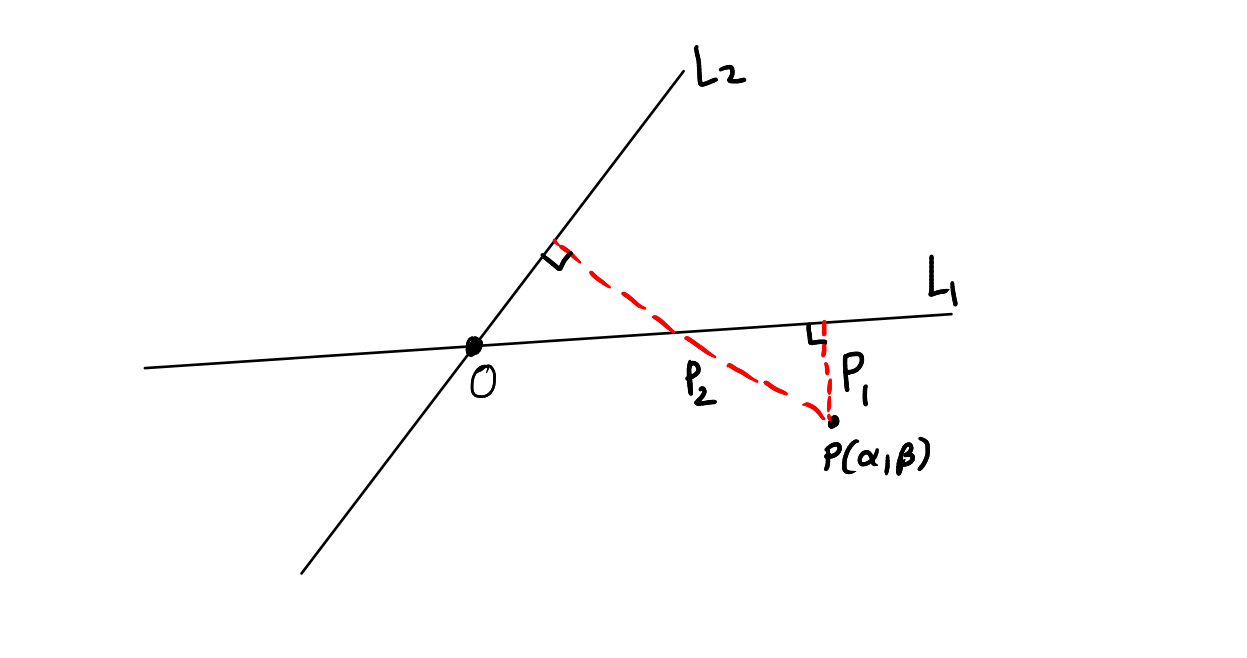
The general formula for the product of the lengths of perpendiculars from a point ( α , β ) (\alpha, \beta) ( α , β ) a x 2 + 2 h x y + b y 2 = 0 ax^2 + 2hxy + by^2 = 0 a x 2 + 2 h x y + b y 2 = 0
P 1 P 2 = ∣ a α 2 + 2 h α β + b β 2 ∣ ( a − b ) 2 + 4 h 2 P_1P_2 = \frac{|a\alpha^2 + 2h\alpha\beta + b\beta^2|}{\sqrt{(a - b)^2 + 4h^2}} P 1 P 2 = ( a − b ) 2 + 4 h 2 ∣ a α 2 + 2 h α β + b β 2 ∣ For the given equation 2 x 2 − 3 x y − y 2 = 0 2x^2 - 3xy - y^2 = 0 2 x 2 − 3 x y − y 2 = 0
a = 2 , h = − 3 2 , b = − 1 a = 2, \; h = -\frac{3}{2}, \; b = -1 a = 2 , h = − 2 3 , b = − 1 The point given is ( α , β ) = ( 1 , − 2 ) (\alpha, \beta) = (1, -2) ( α , β ) = ( 1 , − 2 )
Substituting these values into the formula, we get:
P 1 P 2 = ∣ 2 ( 1 ) 2 + 2 ( − 3 2 ) ( 1 ) ( − 2 ) + ( − 1 ) ( − 2 ) 2 ∣ ( 2 − ( − 1 ) ) 2 + 4 ( − 3 2 ) 2 = ∣ 2 + 6 − 4 ∣ ( 2 + 1 ) 2 + 4 ( 9 4 ) = ∣ 4 ∣ 3 2 + 9 = 4 9 + 9 = 4 18 = 4 3 2 = 4 2 6 = 2 2 3 \begin{align*} P_1P_2 &= \frac{|2(1)^2 + 2(-\frac{3}{2})(1)(-2) + (-1)(-2)^2|}{\sqrt{(2 - (-1))^2 + 4(-\frac{3}{2})^2}} \\ &= \frac{|2 + 6 - 4|}{\sqrt{(2 + 1)^2 + 4\left(\frac{9}{4}\right)}} \\ &= \frac{|4|}{\sqrt{3^2 + 9}} \\ &= \frac{4}{\sqrt{9 + 9}} \\ &= \frac{4}{\sqrt{18}} \\ &= \frac{4}{3\sqrt{2}} \\ &= \frac{4\sqrt{2}}{6} \\ &= \frac{2\sqrt{2}}{3} \end{align*} P 1 P 2 = ( 2 − ( − 1 ) ) 2 + 4 ( − 2 3 ) 2 ∣2 ( 1 ) 2 + 2 ( − 2 3 ) ( 1 ) ( − 2 ) + ( − 1 ) ( − 2 ) 2 ∣ = ( 2 + 1 ) 2 + 4 ( 4 9 ) ∣2 + 6 − 4∣ = 3 2 + 9 ∣4∣ = 9 + 9 4 = 18 4 = 3 2 4 = 6 4 2 = 3 2 2 Thus, the product of the lengths of the perpendiculars from the point ( 1 , − 2 ) (1, -2) ( 1 , − 2 ) 2 x 2 − 3 x y − y 2 = 0 2x^2 - 3xy - y^2 = 0 2 x 2 − 3 x y − y 2 = 0
2 2 3 \boxed{\frac{2\sqrt{2}}{3}} 3 2 2