MatheramaMatherama
← Pair of Straight Lines
Pair of Straight Lines·Section 4·8 min read

Angle between pair of Straight Lines

Angle Between a Pair of Straight Lines§
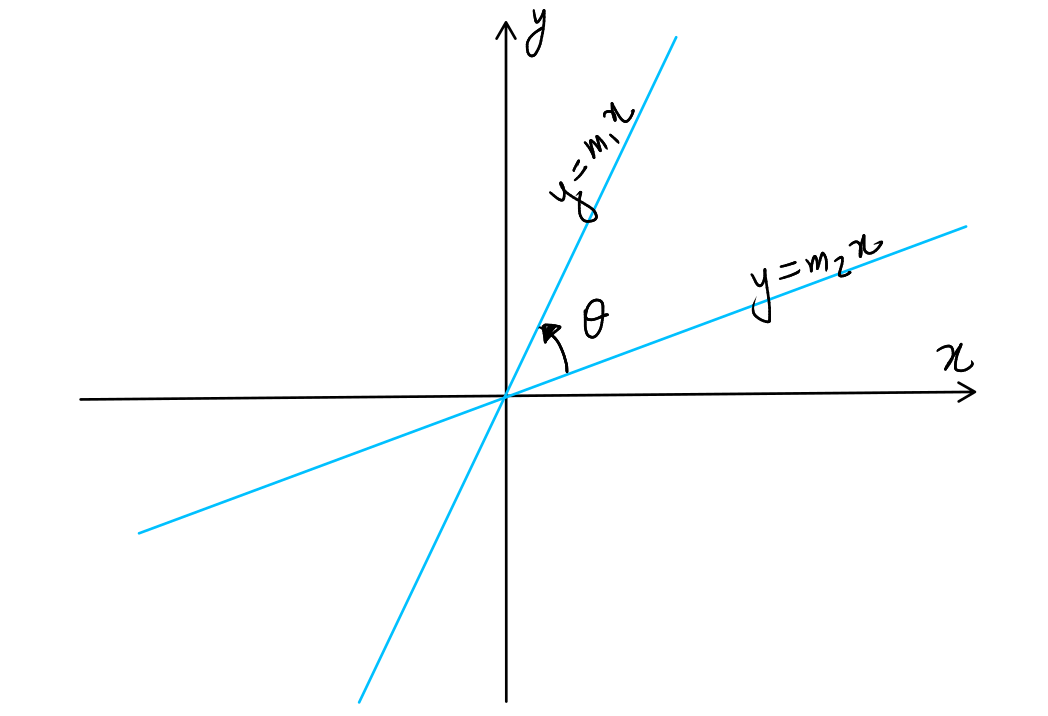
Angle between pair of straight lines

As a first example of the above theory, let us calculate the angle between a pair of straight lines. Consider the joint equation:

ax2+2hxy+by2=0ax^2 + 2hxy + by^2 = 0

Let us assume that this equation represents two straight lines y=m1xy = m_1x and y=m2xy = m_2x. Now, we know that:

m1+m2=−2hbm_1 + m_2 = -\frac{2h}{b} m1m2=abm_1m_2 = \frac{a}{b}

Suppose the acute angle between these lines is θ\theta. Then:

tan⁡θ=∣m1−m21+m1m2∣\tan \theta = \left| \frac{m_1 - m_2}{1 + m_1m_2} \right|

Using the identity (a−b)2=(a+b)2−4ab(a - b)^2 = (a+b)^2 - 4ab, we have:

(m1−m2)2=(m1+m2)2−4m1m2(m_1 - m_2)^2 = (m_1 + m_2)^2 - 4m_1m_2

Therefore:

tan⁡2θ=(m1−m2)2(1+m1m2)2=(m1+m2)2−4m1m2(1+m1m2)2\tan^2 \theta = \frac{(m_1 - m_2)^2}{(1 + m_1m_2)^2} = \frac{(m_1 + m_2)^2 - 4m_1m_2}{(1 + m_1m_2)^2}

Substituting the values of m1+m2m_1 + m_2 and m1m2m_1m_2:

(m1+m2)2=(−2hb)2=4h2b2(m_1 + m_2)^2 = \left( -\frac{2h}{b} \right)^2 = \frac{4h^2}{b^2} 4m1m2=4⋅ab=4ab4m_1m_2 = 4 \cdot \frac{a}{b} = \frac{4a}{b}

Hence:

tan⁡2θ=4h2b2−4ab(1+ab)2=4(h2−abb2)(b+ab)2=4(h2−ab)b2⋅b2(a+b)2=4(h2−ab)(a+b)2\tan^2 \theta = \frac{\frac{4h^2}{b^2} - \frac{4a}{b}}{(1 + \frac{a}{b})^2} = \frac{4 \left( \frac{h^2 - ab}{b^2} \right)}{\left( \frac{b + a}{b} \right)^2} = \frac{4(h^2 - ab)}{b^2} \cdot \frac{b^2}{(a + b)^2} = \frac{4(h^2 - ab)}{(a + b)^2}

Therefore:

tan⁡θ=4(h2−ab)(a+b)2=2h2−ab∣a+b∣\tan \theta = \sqrt{ \frac{4(h^2 - ab)}{(a + b)^2} } = \frac{2\sqrt{h^2 - ab}}{|a + b|}

So, the tangent of the acute angle θ\theta between the two straight lines is:

tan⁡θ=2h2−ab∣a+b∣\tan \theta = \frac{2\sqrt{h^2 - ab}}{|a + b|}

We can calculate cos⁡θ\cos \theta as follows:

cos⁡θ=∣a+b∣(a+b)2+(2h2−ab)2=∣a+b∣(a+b)2+4(h2−ab)=∣a+b∣a2+b2+2ab+4h2−4ab=∣a+b∣a2+b2−2ab+4h2=∣a+b∣(a−b)2+4h2\begin{aligned} \cos \theta &= \frac{|a + b|}{\sqrt{(a + b)^2 + (2\sqrt{h^2 - ab})^2}} \\ &= \frac{|a + b|}{\sqrt{(a + b)^2 + 4(h^2 - ab)}} \\ &= \frac{|a + b|}{\sqrt{a^2 + b^2 + 2ab + 4h^2 - 4ab}} \\ &= \frac{|a + b|}{\sqrt{a^2 + b^2 - 2ab + 4h^2}} \\ &= \frac{|a + b|}{\sqrt{(a - b)^2 + 4h^2}} \end{aligned}

Thus:

cos⁡θ=∣a+b∣(a−b)2+4h2\cos \theta = \frac{|a + b|}{\sqrt{(a - b)^2 + 4h^2}}

Using the identity sin⁡2θ+cos⁡2θ=1\sin^2 \theta + \cos^2 \theta = 1, we can find sin⁡θ\sin \theta:

sin⁡θ=2h2−ab(a−b)2+4h2\sin \theta = \frac{2\sqrt{h^2 - ab}}{\sqrt{(a - b)^2 + 4h^2}}

Hence, we have:

cos⁡θ=∣a+b∣(a−b)2+4h2\cos \theta = \frac{|a + b|}{\sqrt{(a - b)^2 + 4h^2}} sin⁡θ=2h2−ab(a−b)2+4h2\sin \theta = \frac{2\sqrt{h^2 - ab}}{\sqrt{(a - b)^2 + 4h^2}}

Perpendicular Lines§

The lines represented by ax2+2hxy+by2=0ax^2 + 2hxy + by^2 = 0 are perpendicular if and only if a+b=0a + b = 0.

Equation of perpendicular pair of straight lines to a given pair§

The equation of a pair of straight lines, each perpendicular to a given pair of straight lines represented by ax2+2hxy+by2=0ax^2 + 2hxy + by^2 = 0, is given by bx2−2hxy+ay2=0bx^2 - 2hxy + ay^2 = 0.

Equation of a Pair of Straight Lines Parallel to a given homogenous Pair§

The joint equation of a pair of straight lines intersecting at (x1,y1)(x_1, y_1) and parallel to a homogeneous pair of straight lines given by ax2+2hxy+by2=0ax^2 + 2hxy + by^2 = 0 is:

a(x−x1)2+2h(x−x1)(y−y1)+b(y−y1)2=0.a(x - x_1)^2 + 2h(x - x_1)(y - y_1) + b(y - y_1)^2 = 0.

Common Line to Pair of Lines§

When one line in a pair is parallel to a line in another pair§

Suppose we wish to check whether two given pairs of straight lines:

a1x2+2h1xy+b1y2=0anda2x2+2h2xy+b2y2=0a_1x^2 + 2h_1xy + b_1y^2 = 0 \quad \text{and} \quad a_2x^2 + 2h_2xy + b_2y^2 = 0

have a line in common. We can determine this without actually factorizing the equations by the following condition:

If the pairs of straight lines have a line in common, then:

∣a12h1a22h2∣∣2h1b12h2b2∣=∣a1b1a2b2∣2.\begin{vmatrix} a_1 & 2h_1 \\ a_2 & 2h_2 \end{vmatrix} \begin{vmatrix} 2h_1 & b_1 \\ 2h_2 & b_2 \end{vmatrix} = \begin{vmatrix} a_1 & b_1 \\ a_2 & b_2 \end{vmatrix}^2.

When one line in one pair is perpendicular to a line in another pair§

If one of the lines represented by a1x2+2h1xy+b1y2=0a_1x^2 + 2h_1xy + b_1y^2 = 0 is perpendicular to one of the lines represented by a2x2+2h2xy+b2y2=0a_2x^2 + 2h_2xy + b_2y^2 = 0, then:

∣a12h1−b2−2h2∣∣2h1b1−2h2a2∣=∣a1b1b2a2∣2.\begin{vmatrix} a_1 & 2h_1 \\ -b_2 & -2h_2 \end{vmatrix} \begin{vmatrix} 2h_1 & b_1 \\ -2h_2 & a_2 \end{vmatrix} = \begin{vmatrix} a_1 & b_1 \\ b_2 & a_2 \end{vmatrix}^2.
Section 4 of 12 · Pair of Straight Lines

Mark this section complete when you have worked through its proofs.