Centroid§
Consider a triangle formed by a pair of straight lines passing through the origin, ax2+2hxy+by2=0, and a line lx+my+n=0. Then the centroid (α,β) of this triangle is given by:
bl−hmα=am−hlβ=3(am2−2hlm+bl2)−2n
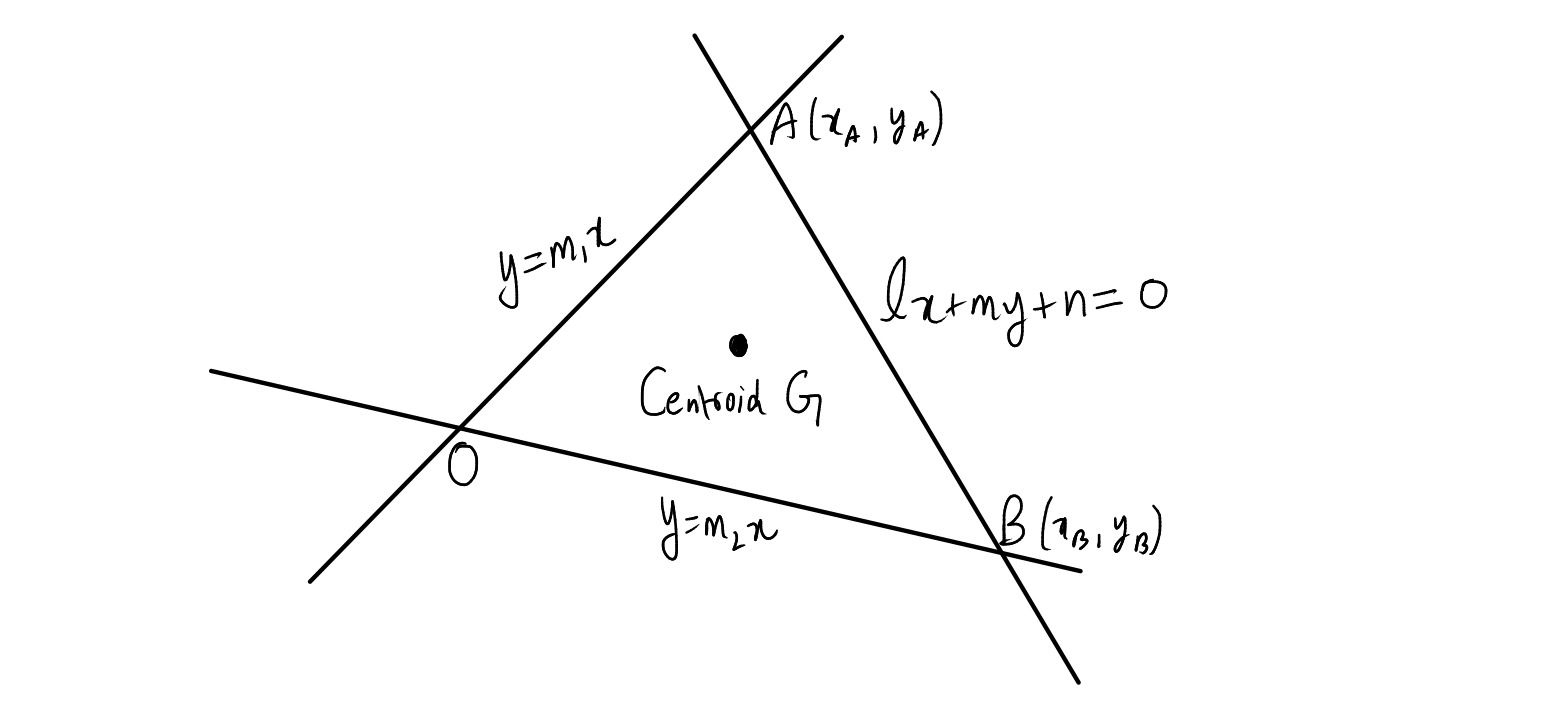
Proof:
Let y=m1x and y=m2x be lines represented by ax2+2hxy+by2=0. Then,
m1+m2=−b2handm1m2=ba
Let the line lx+my+n=0 cut the pair at points A and B. We wish to calculate the centroid of △OAB. To do that, we find A and B.
A is the intersection point of y=m1x and lx+my+n=0: Eliminating y,
lx+mm1x+n=0⟹x=l+mm1−n
⟹A=(l+mm1−n,l+mm1−m1n)
Similarly, B is the intersection point of y=m2x and lx+my+n=0:
⟹B=(l+mm2−n,l+mm2−m2n)
The centroid of △OAB is:
(30+xA+xB,30+yA+yB)
For the x-coordinate:
3xA+xB=3−n(l+mm11+l+mm21)
=3−n((l+mm1)(l+mm2)(l+mm2)+(l+mm1))
=3−n(l2+ml(m1+m2)+m2m1m22l+m(m1+m2))
=3−n(l2−b2hlm+bam22l−mb2h)
=3−n(bl2−2hlm+am22bl−2hm)
=3(bl2−2hlm+am2)−2n(bl−hm)
For the y-coordinate:
3yA+yB=3(l+mm1)−nm1+3(l+mm2)−nm2
=3−n((l+mm1)(l+mm2)m1(l+mm2)+m2(l+mm1))
=3−n(l2+lm(m1+m2)+m2m1m2m1l+m12m+m2l+m22m)
=3−n(l2+lm(m1+m2)+m2m1m2l(m1+m2)+2mm1m2)
=3−n(l2−lmb2h+m2balb−2h+2mba)
=3(bl2−2hlm+am2)−2n(hl−am)
So, the centroid (α,β) is given by:
α=3(bl2−2hlm+am2)−2n(bl−hm)andβ=3(bl2−2hlm+am2)−2n(hl−am)
⟹bl−hmα=am−hlβ=3(am2−2hlm+bl2)−2n
Orthocentre§
Consider a pair of straight lines ax2+2hxy+by2=0 forming a triangle with lx+my+n=0. We wish to find the orthocentre of this triangle.
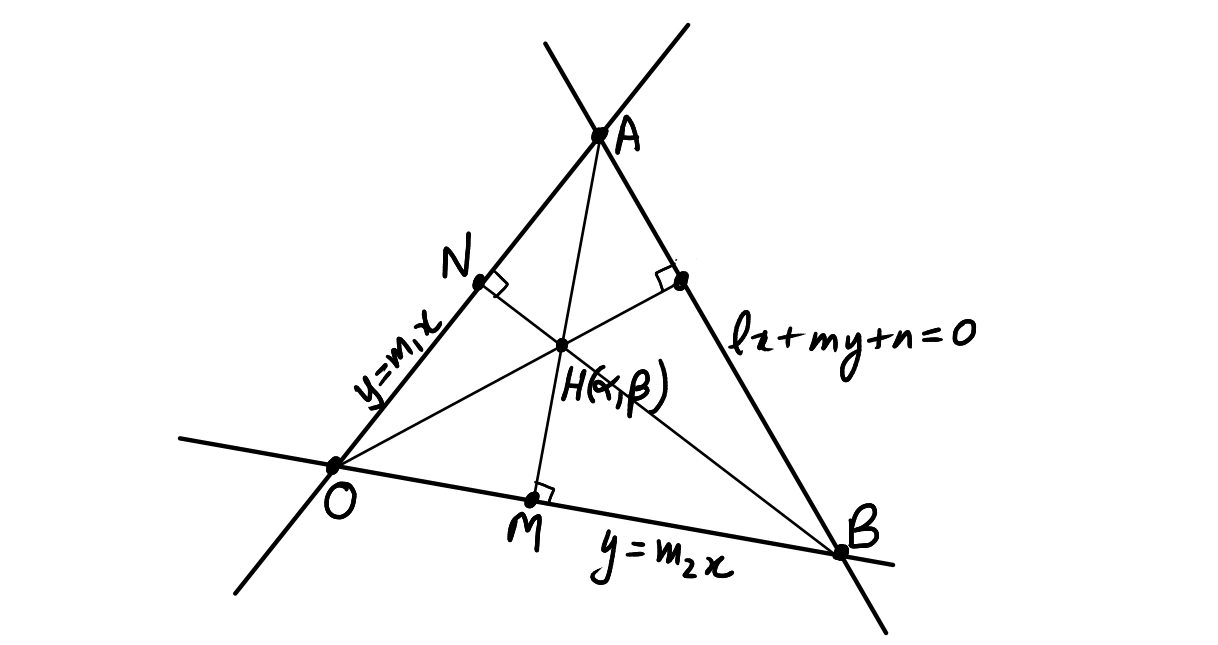
To do that we first finf the points of intersection A and B of the line with the pair of straight lines. we have already done so in the calculation of centroid. So for the sake of efficiency let's use that.
Coordinates of point A are:
(l+mm1−n,l+mm1−nm1)
Coordinates of point B are:
(l+mm2−n,l+mm2−nm2)
We know that the orthocenter H(α,β) is the intersection of altitudes of the ΔOAB. Consider altitudes AM and BN.
−m21
−m11
−m21=x−xAy−yA⟹y=−m21(x−xA)+yA(1)
−m11=x−xBy−yB⟹y=−m11(x−xB)+yB(2)
Orthocenter H(α,β) is the intersection point of (1) and (2). Eliminating y:
−m21(x−xA)+yA(m11−m21)x=−m11(x−xB)+yB=m1xB−m2xA+yB−yA
(m11−m21)x=m1xB−m2xA+yB−yA
m1m2m2−m1x=−(l+mm2)m1n+(l+mm1)m2n−(l+mm2)nm2+(l+mm1)nm1
m1m2m2−m1x=−l+mm2n(m11+m2)+l+mm1n(m21+m1)
m1m2m2−m1x=−m1(l+mm2)n(1+m1m2)+m2(l+mm1)n(1+m1m2)
m1m2m2−m1x=−n(1+m1m2)[m1m2(l+mm1)(l+mm2)m2l+mm1m2−m1l−mm1m2]
m1m2m2−m1x=−n(1+m1m2)[m1m2(l2+lm(m1+m2)+m2m1m2)l(m2−m1)]
x=l2+lm(m1+m2)+m2m1m2−nl(1+m1m2)=l2−b2mh+bm2a−nl(1+ba)=bl2−2hlm+am2−nl(a+b)
Thus:
α=−bl2−2hlm+am2nl(a+b)
Since (α,β) also lies on the third altitude from origin whose slope is lm:
β=lmα⟹β=lm(−bl2−2hlm+am2nl(a+b))⟹β=−bl2−2hlm+am2nm(a+b)
We can write this as:
lα=mβ=−bl2−2hlm+am2n(a+b)
Equation of a line with known midpoint§
Consider the pair of straight lines given by the equation ax2+2hxy+by2=0 and a line L that intersects these lines at points A and B. Suppose the midpoint of the segment AB is known to be (x1,y1). We aim to determine the equation of the line L.
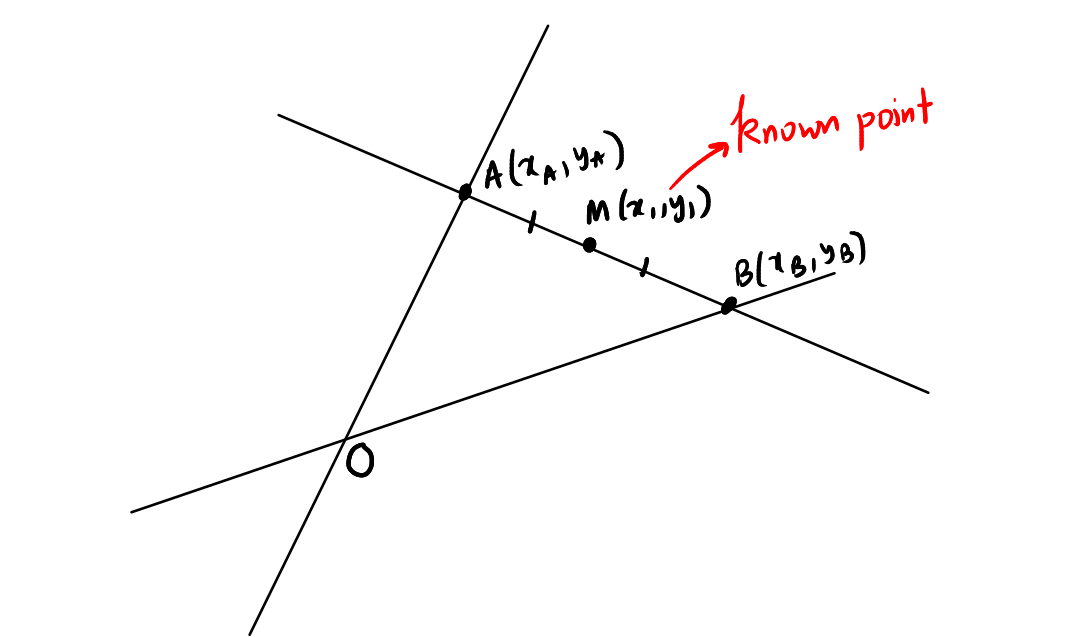
To find the equation of line L, we only need to find it's slope because we already know a point on it. Let the slope of L be m. Thus, the equation of L can be expressed in slope-intercept form as:
y=mx+c
Since (x1,y1) lies on L, we substitute these coordinates into the line equation:
y1=mx1+c⟹c=y1−mx1
Thus, the equation of L becomes:
y=mx+(y1−mx1)
Next, we substitute y=mx+(y1−mx1) into the equation of the pair of lines ax2+2hxy+by2=0 to find the points of intersection A and B:
ax2+2hx(mx+y1−mx1)+b(mx+y1−mx1)2=0
This simplifies to a quadratic equation in x, which can be written as:
ax2+2hx(mx+y1−mx1)+b(mx+y1−mx1)2=0
Expanding and simplifying, we find:
ax2+2hx(mx+y1−mx1)+b(m2x2+2mx(y1−mx1)+(y1−mx1)2)=0
Grouping like terms, the quadratic equation in x becomes:
(a+2hm+bm2)x2+2(h+bm)(y1−mx1)x+b(y1−mx1)2=0
Absciisas of A and B, that is, xA and xB are the roots of this quadratic equation. Since (x1,y1) is the midpoint of A(xA,yA) and B(xB,yB), we have:
2xA+xB=x1
From the properties of the roots of a quadratic equation, the sum of the roots xA and xB is given by:
xA+xB=−Coefficient of x2Coefficient of x=−a+2hm+bm22(h+bm)(y1−mx1)
Thus,
2x1=−a+2hm+bm22(h+bm)(y1−mx1)⟹x1=−a+2hm+bm2(h+bm)(y1−mx1)
Rewriting this, we obtain:
(a+2hm+bm2)x1=−(h+bm)(y1−mx1)
ax1+2hmx1+bm2x1=−hy1+hmx1−by1m+bm2x1
ax1+hmx1+bmy1+hy1=0
Solving for m:
m=−hx1+by1ax1+hy1
Thus, the slope m is found. Now, substituting back, the equation of the line L in point-slope form is:
hx1+by1−(ax1+hy1)=x−x1y−y1
Expanding and verifying, we obtain:
−ax1+ax12−hy1x+hy1x1=hx1y−hx1y1+byy1−by2
ax12+by2+2hx1y=h(xy1+yx1)+ax1+byy1
ax12+2hx1y+by2=ax1+h(xy1+yx1)+byy1
Hence, we have derived the equation of the line L that intersects the given pair of lines at points A and B, with the midpoint of the segment AB being (x1,y1).
