Product of Perpendiculars § Finding the Product of Perpendiculars from a Point to a Pair of Straight Lines§
Consider a pair of straight lines given by the equation:
a x 2 + 2 h x y + b y 2 + 2 g x + 2 f y + c = 0 ax^2 + 2hxy + by^2 + 2gx + 2fy + c = 0 a x 2 + 2 h x y + b y 2 + 2 g x + 2 f y + c = 0 We wish to find the product of the perpendiculars drawn from the point ( α , β ) (\alpha, \beta) ( α , β )
Previously, we saw that the product of the perpendiculars from ( α , β ) (\alpha, \beta) ( α , β ) a x 2 + 2 h x y + b y 2 = 0 ax^2 + 2hxy + by^2 = 0 a x 2 + 2 h x y + b y 2 = 0
∣ a α 2 + 2 h α β + b β 2 ∣ ( a − b ) 2 + 4 h 2 \frac{|a\alpha^2 + 2h\alpha\beta + b\beta^2|}{\sqrt{(a - b)^2 + 4h^2}} ( a − b ) 2 + 4 h 2 ∣ a α 2 + 2 h α β + b β 2 ∣ Let ( x 1 , y 1 ) (x_1, y_1) ( x 1 , y 1 ) ( x 1 , y 1 ) (x_1, y_1) ( x 1 , y 1 ) ( α , β ) (\alpha, \beta) ( α , β ) ( α − x 1 , β − y 1 ) (\alpha - x_1, \beta - y_1) ( α − x 1 , β − y 1 )
a x 2 + 2 h x y + b y 2 = 0 ax^2 + 2hxy + by^2 = 0 a x 2 + 2 h x y + b y 2 = 0 The product of the perpendiculars from ( α − x 1 , β − y 1 ) (\alpha - x_1, \beta - y_1) ( α − x 1 , β − y 1 )
∣ a ( α − x 1 ) 2 + 2 h ( α − x 1 ) ( β − y 1 ) + b ( β − y 1 ) 2 ∣ ( a − b ) 2 + 4 h 2 \frac{|a(\alpha - x_1)^2 + 2h(\alpha - x_1)(\beta - y_1) + b(\beta - y_1)^2|}{\sqrt{(a - b)^2 + 4h^2}} ( a − b ) 2 + 4 h 2 ∣ a ( α − x 1 ) 2 + 2 h ( α − x 1 ) ( β − y 1 ) + b ( β − y 1 ) 2 ∣ Expanding the numerator:
a ( α − x 1 ) 2 + 2 h ( α − x 1 ) ( β − y 1 ) + b ( β − y 1 ) 2 a(\alpha - x_1)^2 + 2h(\alpha - x_1)(\beta - y_1) + b(\beta - y_1)^2 a ( α − x 1 ) 2 + 2 h ( α − x 1 ) ( β − y 1 ) + b ( β − y 1 ) 2 Expanding the terms:
a ( α 2 − 2 α x 1 + x 1 2 ) + 2 h ( α β − α y 1 − β x 1 + x 1 y 1 ) + b ( β 2 − 2 β y 1 + y 1 2 ) a(\alpha^2 - 2\alpha x_1 + x_1^2) + 2h(\alpha\beta - \alpha y_1 - \beta x_1 + x_1 y_1) + b(\beta^2 - 2\beta y_1 + y_1^2) a ( α 2 − 2 α x 1 + x 1 2 ) + 2 h ( α β − α y 1 − β x 1 + x 1 y 1 ) + b ( β 2 − 2 β y 1 + y 1 2 ) Combining like terms, we get:
a α 2 − 2 a α x 1 + a x 1 2 + 2 h α β − 2 h α y 1 − 2 h β x 1 + 2 h x 1 y 1 + b β 2 − 2 b β y 1 + b y 1 2 a\alpha^2 - 2a\alpha x_1 + ax_1^2 + 2h\alpha\beta - 2h\alpha y_1 - 2h\beta x_1 + 2hx_1 y_1 + b\beta^2 - 2b\beta y_1 + by_1^2 a α 2 − 2 a α x 1 + a x 1 2 + 2 h α β − 2 h α y 1 − 2 h β x 1 + 2 h x 1 y 1 + b β 2 − 2 b β y 1 + b y 1 2 Rewriting, we observe:
a α 2 + 2 h α β + b β 2 − 2 α ( a x 1 + h y 1 ) − 2 β ( h x 1 + b y 1 ) + a x 1 2 + 2 h x 1 y 1 + b y 1 2 a\alpha^2 + 2h\alpha\beta + b\beta^2 - 2\alpha(ax_1 + hy_1) - 2\beta(hx_1 + by_1) + ax_1^2 + 2hx_1 y_1 + by_1^2 a α 2 + 2 h α β + b β 2 − 2 α ( a x 1 + h y 1 ) − 2 β ( h x 1 + b y 1 ) + a x 1 2 + 2 h x 1 y 1 + b y 1 2 We know that:
a x 1 + h y 1 + g = 0 ( 1 ) ax_1 + hy_1 + g = 0 \quad (1) a x 1 + h y 1 + g = 0 ( 1 ) h x 1 + b y 1 + f = 0 ( 2 ) hx_1 + by_1 + f = 0 \quad (2) h x 1 + b y 1 + f = 0 ( 2 ) g x 1 + f y 1 + c = 0 ( 3 ) gx_1 + fy_1 + c = 0 \quad (3) g x 1 + f y 1 + c = 0 ( 3 ) Since ( x 1 , y 1 ) (x_1, y_1) ( x 1 , y 1 )
a x 1 2 + 2 h x 1 y 1 + b y 1 2 + 2 g x 1 + 2 f y 1 + c = 0 ax_1^2 + 2hx_1 y_1 + by_1^2 + 2gx_1 + 2fy_1 + c = 0 a x 1 2 + 2 h x 1 y 1 + b y 1 2 + 2 g x 1 + 2 f y 1 + c = 0 a x 1 2 + 2 h x 1 y 1 + b y 1 2 + 2 ( g x 1 + f y 1 ) + c = 0 ax_1^2 + 2hx_1 y_1 + by_1^2 + 2(gx_1 + fy_1) + c = 0 a x 1 2 + 2 h x 1 y 1 + b y 1 2 + 2 ( g x 1 + f y 1 ) + c = 0 Using these equation (3) , we get:
a x 1 2 + 2 h x 1 y 1 + b y 1 2 − 2 c + c = 0 ax_1^2 + 2hx_1 y_1 + by_1^2 - 2c + c = 0 a x 1 2 + 2 h x 1 y 1 + b y 1 2 − 2 c + c = 0 a x 1 2 + 2 h x 1 y 1 + b y 1 2 = c ( 4 ) ax_1^2 + 2hx_1 y_1 + by_1^2 = c \quad (4) a x 1 2 + 2 h x 1 y 1 + b y 1 2 = c ( 4 ) Using (1) and (2) and (4) the expanded numerator simplifies to:
a α 2 + 2 h α β + b β 2 + 2 g α + 2 f β + c a\alpha^2 + 2h\alpha\beta + b\beta^2 + 2g\alpha + 2f\beta + c a α 2 + 2 h α β + b β 2 + 2 g α + 2 f β + c The product of the perpendiculars is:
∣ a α 2 + 2 h α β + b β 2 + 2 g α + 2 f β + c ∣ ( a − b ) 2 + 4 h 2 \boxed{\frac{|a\alpha^2 + 2h\alpha\beta + b\beta^2 + 2g\alpha + 2f\beta + c|}{\sqrt{(a - b)^2 + 4h^2}} } ( a − b ) 2 + 4 h 2 ∣ a α 2 + 2 h α β + b β 2 + 2 g α + 2 f β + c ∣ Using the formula derived earlier, the product of perpendiculars from the origin to the pair of straight lines is given by:
∣ a α 2 + 2 h α β + b β 2 + 2 g α + 2 f β + c ∣ ( a − b ) 2 + 4 h 2 \frac{|a\alpha^2 + 2h\alpha\beta + b\beta^2 + 2g\alpha + 2f\beta + c|}{\sqrt{(a - b)^2 + 4h^2}} ( a − b ) 2 + 4 h 2 ∣ a α 2 + 2 h α β + b β 2 + 2 g α + 2 f β + c ∣ Substituting α = 0 \alpha = 0 α = 0 β = 0 \beta = 0 β = 0
∣ a ( 0 ) 2 + 2 h ( 0 ) ( 0 ) + b ( 0 ) 2 + 2 g ( 0 ) + 2 f ( 0 ) + c ∣ ( a − b ) 2 + 4 h 2 \frac{|a(0)^2 + 2h(0)(0) + b(0)^2 + 2g(0) + 2f(0) + c|}{\sqrt{(a - b)^2 + 4h^2}} ( a − b ) 2 + 4 h 2 ∣ a ( 0 ) 2 + 2 h ( 0 ) ( 0 ) + b ( 0 ) 2 + 2 g ( 0 ) + 2 f ( 0 ) + c ∣ This simplifies to:
∣ c ∣ ( a − b ) 2 + 4 h 2 \frac{|c|}{\sqrt{(a - b)^2 + 4h^2}} ( a − b ) 2 + 4 h 2 ∣ c ∣ Therefore, the product of perpendiculars from the origin to the pair of straight lines represented by the equation a x 2 + 2 h x y + b y 2 + 2 g x + 2 f y + c = 0 ax^2 + 2hxy + by^2 + 2gx + 2fy + c = 0 a x 2 + 2 h x y + b y 2 + 2 g x + 2 f y + c = 0
∣ c ∣ ( a − b ) 2 + 4 h 2 \frac{|c|}{\sqrt{(a - b)^2 + 4h^2}} ( a − b ) 2 + 4 h 2 ∣ c ∣ A pair of lines equidistant from origin§
If the pair of straight lines a x 2 + 2 h x y + b y 2 + 2 g x + 2 f y + c = 0 ax^2 + 2hxy + by^2 + 2gx + 2fy + c = 0 a x 2 + 2 h x y + b y 2 + 2 g x + 2 f y + c = 0 f 4 − g 4 = c ( b f 2 − a g 2 ) f^4 - g^4 = c(bf^2 - ag^2) f 4 − g 4 = c ( b f 2 − a g 2 )
Proof:
Let y = m 1 x + c 1 y = m_1 x + c_1 y = m 1 x + c 1 y = m 2 x + c 2 y = m_2 x + c_2 y = m 2 x + c 2
We know the following relationships from the coefficients of the quadratic equation:
m 1 + m 2 = − 2 h b m_1 + m_2 = -\frac{2h}{b} m 1 + m 2 = − b 2 h m 1 m 2 = a b m_1 m_2 = \frac{a}{b} m 1 m 2 = b a m 1 c 2 + m 2 c 1 = 2 g b m_1 c_2 + m_2 c_1 = \frac{2g}{b} m 1 c 2 + m 2 c 1 = b 2 g c 1 + c 2 = − 2 f b c_1 + c_2 = -\frac{2f}{b} c 1 + c 2 = − b 2 f c 1 c 2 = c b c_1 c_2 = \frac{c}{b} c 1 c 2 = b c The distance of the origin from the line y = m 1 x + c 1 y = m_1 x + c_1 y = m 1 x + c 1 y = m 2 x + c 2 y = m_2 x + c_2 y = m 2 x + c 2
∣ c 1 ∣ 1 + m 1 2 = ∣ c 2 ∣ 1 + m 2 2 \frac{|c_1|}{\sqrt{1 + m_1^2}} = \frac{|c_2|}{\sqrt{1 + m_2^2}} 1 + m 1 2 ∣ c 1 ∣ = 1 + m 2 2 ∣ c 2 ∣ Squaring both sides and simplifying, we get:
c 1 2 ( 1 + m 2 2 ) = c 2 2 ( 1 + m 1 2 ) c_1^2 (1 + m_2^2) = c_2^2 (1 + m_1^2) c 1 2 ( 1 + m 2 2 ) = c 2 2 ( 1 + m 1 2 ) c 1 2 − c 2 2 = m 2 2 c 2 2 − m 1 2 c 1 2 c_1^2 - c_2^2 = m_2^2 c_2^2 - m_1^2 c_1^2 c 1 2 − c 2 2 = m 2 2 c 2 2 − m 1 2 c 1 2 ( c 1 + c 2 ) ( c 1 − c 2 ) = ( m 1 c 2 + m 2 c 1 ) ( m 1 c 2 − m 2 c 1 ) (c_1 + c_2)(c_1 - c_2) = (m_1 c_2 + m_2 c_1)(m_1 c_2 - m_2 c_1) ( c 1 + c 2 ) ( c 1 − c 2 ) = ( m 1 c 2 + m 2 c 1 ) ( m 1 c 2 − m 2 c 1 ) ( c 1 + c 2 ) 2 ( c 1 − c 2 ) 2 = ( m 1 c 2 + m 2 c 1 ) 2 ( m 1 c 2 − m 2 c 1 ) 2 (c_1 + c_2)^2 (c_1 - c_2)^2 = (m_1 c_2 + m_2 c_1)^2 (m_1 c_2 - m_2 c_1)^2 ( c 1 + c 2 ) 2 ( c 1 − c 2 ) 2 = ( m 1 c 2 + m 2 c 1 ) 2 ( m 1 c 2 − m 2 c 1 ) 2 ⇒ ( c 1 + c 2 ) 2 ( c 1 − c 2 ) 2 = ( m 1 c 2 + m 2 c 1 ) 2 ( m 1 c 2 − m 2 c 1 ) 2 \Rightarrow (c_1 + c_2)^2 (c_1 - c_2)^2 = (m_1 c_2 + m_2 c_1)^2 (m_1 c_2 - m_2 c_1)^2 ⇒ ( c 1 + c 2 ) 2 ( c 1 − c 2 ) 2 = ( m 1 c 2 + m 2 c 1 ) 2 ( m 1 c 2 − m 2 c 1 ) 2 ⇒ ( c 1 + c 2 ) 2 [ ( c 1 + c 2 ) 2 − 4 c 1 c 2 ] = ( m 1 c 2 + m 2 c 1 ) 2 [ ( m 1 c 2 + m 2 c 1 ) 2 − 4 m 1 m 2 c 1 c 2 ] \Rightarrow (c_1 + c_2)^2 \left[(c_1 + c_2)^2 - 4c_1 c_2 \right] = (m_1 c_2 + m_2 c_1)^2 \left[(m_1 c_2 + m_2 c_1)^2 - 4m_1 m_2 c_1 c_2 \right] ⇒ ( c 1 + c 2 ) 2 [ ( c 1 + c 2 ) 2 − 4 c 1 c 2 ] = ( m 1 c 2 + m 2 c 1 ) 2 [ ( m 1 c 2 + m 2 c 1 ) 2 − 4 m 1 m 2 c 1 c 2 ] Substituting the known values from the quadratic coefficients:
( 4 f 2 b 2 ) = ( 4 g 2 b 2 − 4 a c b 2 ) \left(\frac{4f^2}{b^2}\right) = \left(\frac{4g^2}{b^2} - \frac{4ac}{b^2}\right) ( b 2 4 f 2 ) = ( b 2 4 g 2 − b 2 4 a c ) Simplifying further, we get:
f 2 ( f 2 − c 2 ) = g 2 ( g 2 − a c ) f^2(f^2 - c^2) = g^2(g^2 - ac) f 2 ( f 2 − c 2 ) = g 2 ( g 2 − a c ) ⟹ f 4 − f 2 c 2 = g 4 − g 2 a c \implies f^4 - f^2 c^2 = g^4 - g^2 ac ⟹ f 4 − f 2 c 2 = g 4 − g 2 a c ⟹ f 4 − g 4 = c ( b f 2 − a g 2 ) \implies f^4 - g^4 = c(bf^2 - ag^2) ⟹ f 4 − g 4 = c ( b f 2 − a g 2 ) Hence, it follows that:
f 4 − g 4 = c ( b f 2 − a g 2 ) f^4 - g^4 = c(bf^2 - ag^2) f 4 − g 4 = c ( b f 2 − a g 2 ) This completes the proof of the theorem.
Area of Triangle§
Consider the area of a triangle formed by the line l x + m y + n = 0 lx + my + n = 0 l x + m y + n = 0 a x 2 + 2 h x y + b y 2 + 2 g x + 2 f y + c = 0 ax^2 + 2hxy + by^2 + 2gx + 2fy + c = 0 a x 2 + 2 h x y + b y 2 + 2 g x + 2 f y + c = 0 ( x 1 , y 1 ) (x_1, y_1) ( x 1 , y 1 )
The area of the triangle is given by:
Area = ( l x 1 + m y 1 + n ) 2 h 2 − a b ∣ a m 2 − 2 h l m + b l 2 ∣ \text{Area} = \frac{(lx_1 + my_1 + n)^2 \sqrt{h^2 - ab}}{|am^2 - 2hlm + bl^2|} Area = ∣ a m 2 − 2 h l m + b l 2 ∣ ( l x 1 + m y 1 + n ) 2 h 2 − ab Proof:
We know that the area of the triangle formed by a line l x + m y + n = 0 lx + my + n = 0 l x + m y + n = 0 a x 2 + 2 h x y + b y 2 = 0 ax^2 + 2hxy + by^2 = 0 a x 2 + 2 h x y + b y 2 = 0
Area = n 2 h 2 − a b ∣ a m 2 − 2 h l m + b l 2 ∣ \text{Area} = \frac{n^2 \sqrt{h^2 - ab}}{|am^2 - 2hlm + bl^2|} Area = ∣ a m 2 − 2 h l m + b l 2 ∣ n 2 h 2 − ab To generalize this for the pair of straight lines intersecting at ( x 1 , y 1 ) (x_1, y_1) ( x 1 , y 1 ) ( x 1 , y 1 ) (x_1, y_1) ( x 1 , y 1 )
a x 2 + 2 h x y + b y 2 + 2 g x + 2 f y + c = 0 transforms to a x 2 + 2 h x y + b y 2 = 0 ax^2 + 2hxy + by^2 + 2gx + 2fy + c = 0 \quad \text{transforms to} \quad ax^2 + 2hxy + by^2 = 0 a x 2 + 2 h x y + b y 2 + 2 g x + 2 f y + c = 0 transforms to a x 2 + 2 h x y + b y 2 = 0 The line l x + m y + n lx + my + n l x + m y + n
l ( x + x 1 ) + m ( y + y 1 ) + n = 0 ⟹ l x + m y + ( l x 1 + m y 1 + n ) = 0 l(x + x_1) + m(y + y_1) + n = 0 \implies lx + my + (lx_1 + my_1 + n) = 0 l ( x + x 1 ) + m ( y + y 1 ) + n = 0 ⟹ l x + m y + ( l x 1 + m y 1 + n ) = 0 Therefore, the area of the triangle formed is:
Area = ( l x 1 + m y 1 + n ) 2 h 2 − a b ∣ a m 2 − 2 h l m + b l 2 ∣ \text{Area} = \frac{(lx_1 + my_1 + n)^2 \sqrt{h^2 - ab}}{|am^2 - 2hlm + bl^2|} Area = ∣ a m 2 − 2 h l m + b l 2 ∣ ( l x 1 + m y 1 + n ) 2 h 2 − ab Intercepts on Axes§
Length of x-intercept§
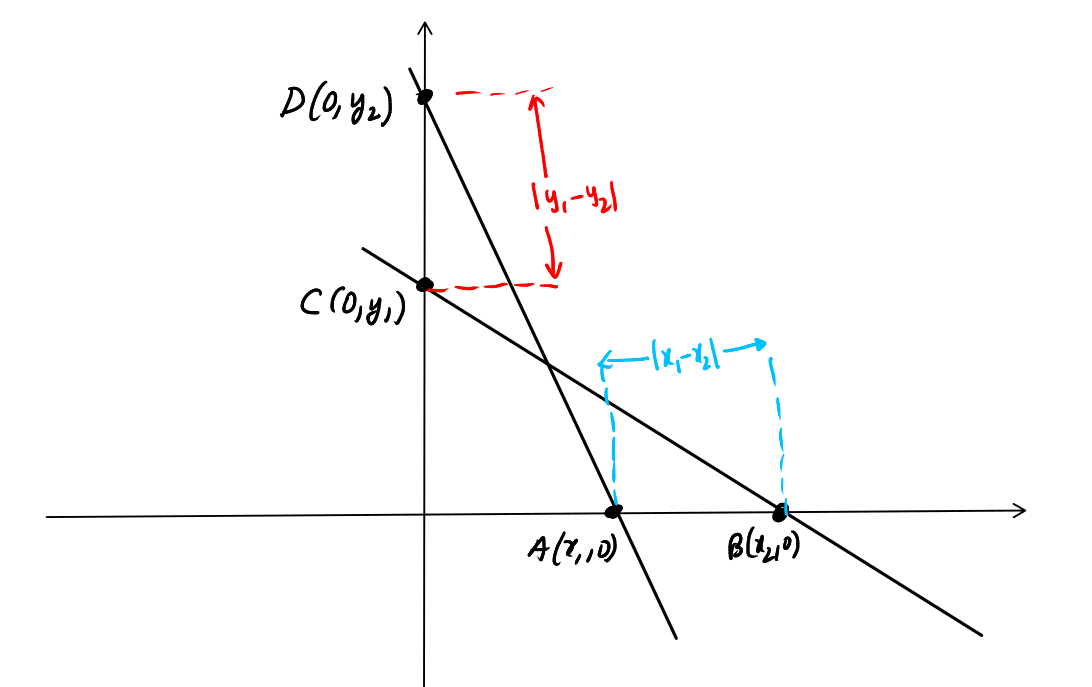
The length of the intercept made by a general pair of straight lines a x 2 + 2 h x y + b y 2 + 2 g x + 2 f y + c = 0 ax^2 + 2hxy + by^2 + 2gx + 2fy + c = 0 a x 2 + 2 h x y + b y 2 + 2 g x + 2 f y + c = 0 2 g 2 − a c ∣ a ∣ \frac{2\sqrt{g^2 - ac}}{|a|} ∣ a ∣ 2 g 2 − a c
Proof:
Consider the given equation of the pair of straight lines a x 2 + 2 h x y + b y 2 + 2 g x + 2 f y + c = 0 ax^2 + 2hxy + by^2 + 2gx + 2fy + c = 0 a x 2 + 2 h x y + b y 2 + 2 g x + 2 f y + c = 0
When these lines intersect the x-axis, y = 0 y = 0 y = 0 y = 0 y = 0 y = 0
a x 2 + 2 g x + c = 0 ax^2 + 2gx + c = 0 a x 2 + 2 g x + c = 0 This is a quadratic equation in x x x
Let x 1 x_1 x 1 x 2 x_2 x 2
x 1 + x 2 = − 2 g a and x 1 x 2 = c a x_1 + x_2 = -\frac{2g}{a} \quad \text{and} \quad x_1 x_2 = \frac{c}{a} x 1 + x 2 = − a 2 g and x 1 x 2 = a c The length of the intercept A B AB A B x 1 x_1 x 1 x 2 x_2 x 2
∣ x 1 − x 2 ∣ = ( x 1 + x 2 ) 2 − 4 x 1 x 2 |x_1 - x_2| = \sqrt{(x_1 + x_2)^2 - 4x_1 x_2} ∣ x 1 − x 2 ∣ = ( x 1 + x 2 ) 2 − 4 x 1 x 2 Substituting the values from Vieta's formulas:
∣ x 1 − x 2 ∣ = ( − 2 g a ) 2 − 4 ( c a ) |x_1 - x_2| = \sqrt{\left( -\frac{2g}{a} \right)^2 - 4 \left( \frac{c}{a} \right)} ∣ x 1 − x 2 ∣ = ( − a 2 g ) 2 − 4 ( a c ) = 4 g 2 a 2 − 4 a c a 2 = \sqrt{\frac{4g^2}{a^2} - \frac{4ac}{a^2}} = a 2 4 g 2 − a 2 4 a c = 4 ( g 2 − a c ) a 2 = \sqrt{\frac{4(g^2 - ac)}{a^2}} = a 2 4 ( g 2 − a c ) = 2 g 2 − a c ∣ a ∣ = \frac{2\sqrt{g^2 - ac}}{|a|} = ∣ a ∣ 2 g 2 − a c Therefore, the length of the intercept made by the pair of straight lines on the x-axis is:
2 g 2 − a c ∣ a ∣ \boxed{\frac{2\sqrt{g^2 - ac}}{|a|}} ∣ a ∣ 2 g 2 − a c Length of y-intercept§
The length of the intercept made by a general pair of straight lines a x 2 + 2 h x y + b y 2 + 2 g x + 2 f y + c = 0 ax^2 + 2hxy + by^2 + 2gx + 2fy + c = 0 a x 2 + 2 h x y + b y 2 + 2 g x + 2 f y + c = 0 2 f 2 − b c ∣ b ∣ \frac{2\sqrt{f^2 - bc}}{|b|} ∣ b ∣ 2 f 2 − b c
Proof:
Consider the given equation of the pair of straight lines a x 2 + 2 h x y + b y 2 + 2 g x + 2 f y + c = 0 ax^2 + 2hxy + by^2 + 2gx + 2fy + c = 0 a x 2 + 2 h x y + b y 2 + 2 g x + 2 f y + c = 0
When these lines intersect the y-axis, x = 0 x = 0 x = 0 x = 0 x = 0 x = 0
b y 2 + 2 f y + c = 0 by^2 + 2fy + c = 0 b y 2 + 2 f y + c = 0 This is a quadratic equation in y y y
Let y 1 y_1 y 1 y 2 y_2 y 2
y 1 + y 2 = − 2 f b and y 1 y 2 = c b y_1 + y_2 = -\frac{2f}{b} \quad \text{and} \quad y_1 y_2 = \frac{c}{b} y 1 + y 2 = − b 2 f and y 1 y 2 = b c The length of the intercept C D CD C D y 1 y_1 y 1 y 2 y_2 y 2
∣ y 1 − y 2 ∣ = ( y 1 + y 2 ) 2 − 4 y 1 y 2 |y_1 - y_2| = \sqrt{(y_1 + y_2)^2 - 4y_1 y_2} ∣ y 1 − y 2 ∣ = ( y 1 + y 2 ) 2 − 4 y 1 y 2 Substituting the values from Vieta's formulas:
∣ y 1 − y 2 ∣ = ( − 2 f b ) 2 − 4 ( c b ) |y_1 - y_2| = \sqrt{\left( -\frac{2f}{b} \right)^2 - 4 \left( \frac{c}{b} \right)} ∣ y 1 − y 2 ∣ = ( − b 2 f ) 2 − 4 ( b c ) = 4 f 2 b 2 − 4 b c b 2 = \sqrt{\frac{4f^2}{b^2} - \frac{4bc}{b^2}} = b 2 4 f 2 − b 2 4 b c = 4 ( f 2 − b c ) b 2 = \sqrt{\frac{4(f^2 - bc)}{b^2}} = b 2 4 ( f 2 − b c ) = 2 f 2 − b c ∣ b ∣ = \frac{2\sqrt{f^2 - bc}}{|b|} = ∣ b ∣ 2 f 2 − b c Therefore, the length of the intercept made by the pair of straight lines on the y-axis is:
2 f 2 − b c ∣ b ∣ \boxed{\frac{2\sqrt{f^2 - bc}}{|b|}} ∣ b ∣ 2 f 2 − b c Angle Bisectors§
The equation of the pair of bisectors of a pair of straight lines a x 2 + 2 h x y + b y 2 + 2 g x + 2 f y + c = 0 ax^2 + 2hxy + by^2 + 2gx + 2fy + c = 0 a x 2 + 2 h x y + b y 2 + 2 g x + 2 f y + c = 0
h [ ( x − x 1 ) 2 − ( y − y 1 ) 2 ] = ( a − b ) ( x − x 1 ) ( y − y 1 ) h[(x - x_1)^2 - (y - y_1)^2] = (a - b)(x - x_1)(y - y_1) h [( x − x 1 ) 2 − ( y − y 1 ) 2 ] = ( a − b ) ( x − x 1 ) ( y − y 1 ) where ( x 1 , y 1 ) (x_1, y_1) ( x 1 , y 1 )
We can prove this easily using shifting the origin method.
Quadrilaterals§