We wish to determine the condition under which the line and the plane are parallel.
A line is said to be parallel to a plane if it does not intersect the plane. This happens precisely when the direction vector b of the line is perpendicular to the normal vector n of the plane.
That is, the line and plane are parallel if and only if:
b⋅n=0.
Now, since the line is parallel to the plane, the distance between the line and the plane is the perpendicular distance from any point on the line to the plane.
We may choose the point with position vector a, which lies on the line
r=a+λb.
Then the perpendicular distance from a to the plane r⋅n=d is given by the standard formula:
Distance=∣n∣∣a⋅n−d∣.
Thus, the distance between the line and the plane is
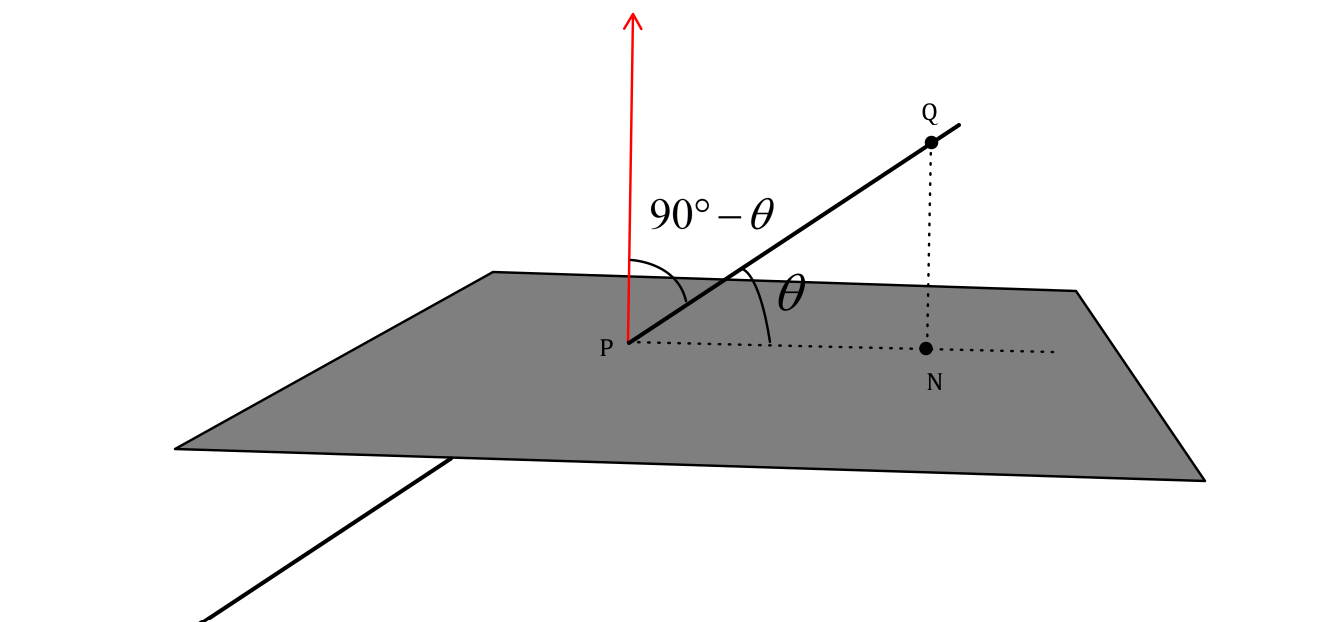
Assume the line intersects the plane at a point P. From any point Q on the line, drop a perpendicular onto the plane, meeting the plane at point N. The angle θ between the line and the plane is defined as the angle ∠QPN.
Now observe that the vector b, which is the direction of the line, and the normal vector n to the plane form a right triangle at point P, with angle between them equal to 90∘−θ.
Hence,
∠(b,n)=90∘−θ.
Taking cosine on both sides, we get:
cos(90∘−θ)=sinθ=∣b∣∣n∣∣b⋅n∣.
Therefore, the angle θ between a line and a plane is given by
sinθ=∣b∣∣n∣∣b⋅n∣.
This formula captures the acute angle between the line and the plane at the point of intersection.
This is straightforward and has already appeared in many earlier contexts.
Consider a line given by
r=a+λb,
and a plane given by
r⋅n=d.
To find the point of intersection of the line and the plane, substitute the expression for r from the line into the plane equation:
(a+λb)⋅n=d.
Expanding the dot product:
a⋅n+λb⋅n=d⟹λ=b⋅nd−a⋅n.
Thus, the value of λ at the point of intersection is known. Substituting this back into the line equation gives the intersection point:
r=a+(b⋅nd−a⋅n)b.
This expression gives the position vector of the point where the line intersects the plane, provided b⋅n=0. If b⋅n=0, then the line is parallel to the plane.
If the line and the plane are both given in Cartesian form, the process of finding their intersection is just as systematic.
Let the line be given as
lx−x0=my−y0=nz−z0=λ,
and the plane be given by the equation
ax+by+cz+d=0.
Let the point of intersection be the point on the line corresponding to parameter λ. The coordinates of this point are:
x=lλ+x0,y=mλ+y0,z=nλ+z0.
Substitute these into the plane equation:
a(lλ+x0)+b(mλ+y0)+c(nλ+z0)+d=0.
Expanding:
λ(al+bm+cn)+(ax0+by0+cz0+d)=0.
Solving for λ:
λ=−al+bm+cnax0+by0+cz0+d.
This gives the parameter value corresponding to the point of intersection. Substituting back, the coordinates of the intersection point are:
x=lλ+x0,y=mλ+y0,z=nλ+z0,
with λ as above.
This method works as long as the denominator al+bm+cn=0; if it is zero, the line is parallel to the plane, and there may be either no intersection.
A plane contains a line if the entire line lies on the plane—that is, every point of the line satisfies the plane equation. In this case, the line intersects the plane at infinitely many points, not just one.
Let the line be given in vector form as
r=a+λb,
and the plane be
r⋅n=d.
Then the plane contains the line if and only if both of the following conditions hold:
1. b⋅n=0: so that the direction vector of the line is perpendicular to the normal vector of the plane, meaning the line is parallel to the plane.
2. a⋅n=d: so that the point a (through which the line passes) lies on the plane.
These two together ensure that not only is the line parallel to the plane, but it also passes through a point on the plane, and hence lies entirely on the plane.
Let us understand the idea of projecting a line onto a plane.
By the projection of a line on a plane, we mean the following: if we drop perpendiculars from every point on the given line onto the plane, then the feet of these perpendiculars trace out a new line lying entirely on the plane. This new line is called the projection of the given line onto the plane.
Case I : Line is Parallel to the Plane
Consider a line in symmetric form:
px−x1=qy−y1=rz−z1,
and a plane:
ax+by+cz+d=0.
Assume the line is parallel to the plane, which means its direction vector (p,q,r) is perpendicular to the normal vector of the plane (a,b,c), i.e.,
ap+bq+cr=0.
To write the equation of the projected line, we need:
A point on the projected line,
Its direction.
The direction is immediate: it is the same as that of the original line since the projection preserves direction when the line is parallel to the plane. So, the direction ratios of the projected line are (p,q,r).
To find a point on the projected line, we project any one point from the original line onto the plane. The simplest choice is the point (x1,y1,z1), which lies on the line.
We now find the foot of the perpendicular from (x1,y1,z1) to the plane using the formula:
Let the right-hand side be λ, then the coordinates of the foot (say, point P) are:
x=x1+aλ,y=y1+bλ,z=z1+cλ.
Substituting:
λ=−a2+b2+c2ax1+by1+cz1+d.
This gives a point on the projected line.
Thus, the projection of the given line onto the plane is the line that:
– passes through the point
(x1+aλ,y1+bλ,z1+cλ),
with λ=−a2+b2+c2ax1+by1+cz1+d,
– and has direction ratios (p,q,r).
That is the required projected line lying entirely on the plane.
Case 2: Line Is Not Parallel to the Plane
Now consider the case when the given line is not parallel to the plane. That is, the direction vector of the line is not orthogonal to the normal vector of the plane. So the line intersects the plane at exactly one point.
Let the line be
px−x1=qy−y1=rz−z1or in vector formr=a+λb,
and let the plane be
ax+by+cz+d=0or in vector formr⋅n=d.
In this case, the projection of the line onto the plane is again the locus of the feet of perpendiculars dropped from every point on the line to the plane.
To describe this projection, we need:
– A point on the projected line,
– A direction vector of the projected line.
We can easily get two points lying on the projected line:
The intersection point of the line and the plane. This is obtained by substituting r=a+λb into the plane equation and solving for λ, as done earlier.
The foot of the perpendicular from the point (x1,y1,z1) to the plane, using the formula
Having these two points, we can write the equation of the projected line in symmetric form.
But there is a far more elegant way to directly obtain the direction of the projected line—using the vector triple product.
Observe that the direction vector of the projected line:
– lies in the same plane as the direction vector b of the given line and the normal vector n of the plane (since projection of a line is obtained by dropping perpendiculars from each point of the line),
– and is also perpendicular to n, because the projected line lies on the plane.
The unique vector satisfying these two conditions is
n×(n×b).
Indeed, the cross product n×b gives a vector perpendicular to both n and b. Taking the cross product of n again with this vector gives a vector lying in the plane spanned by n and b, and also perpendicular to n. That is precisely the direction of the projection of b onto the plane.
So the direction vector of the projection is
n×(n×b).
Thus, the projection of the line onto the plane is a line:
– passing through any point of projection (intersection point or foot),
– with direction vector n×(n×b).
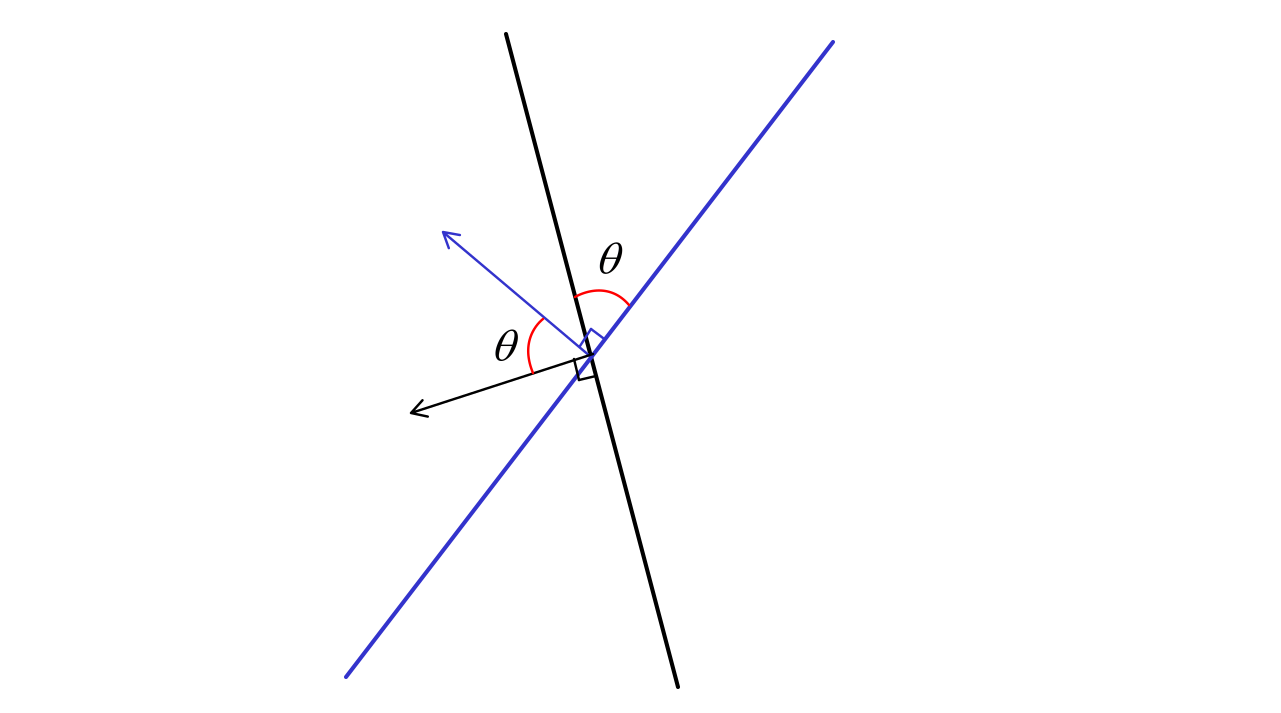
The angle of intersection between the two planes is defined as the acute angle between them where they meet. Geometrically, this angle is equal to the angle between their normal vectorsn1 and n2.
Let the angle between the planes be θ. Then
cosθ=∣n1∣∣n2∣∣n1⋅n2∣.
The absolute value ensures that θ is the acute angle between the planes.
So, the angle between two planes is the same as the angle between their normal vectors.
Special Cases
1. Parallel Planes
Two planes are parallel if and only if their normal vectors are parallel, i.e.,
n1=kn2for some k∈R.
Equivalently,
n1×n2=0.
This implies that the angle between the normal vectors is either 0∘ or 180∘, and hence the planes are either identical or distinct but parallel.
In Cartesian form, planes
a1x+b1y+c1z+d1=0anda2x+b2y+c2z+d2=0
are parallel if
a2a1=b2b1=c2c1.
2. Perpendicular Planes
Two planes are perpendicular if and only if their normal vectors are perpendicular, i.e.,
n1⋅n2=0.
In Cartesian form, if
n1=a1i+b1j+c1k,n2=a2i+b2j+c2k,
then the condition becomes:
a1a2+b1b2+c1c2=0.
This ensures the planes intersect at a right angle.
Writing the Equation of a Plane Parallel to Another
Suppose a plane is given by
ax+by+cz+d=0.
Any plane parallel to this plane must have the same normal vector(a,b,c), since parallel planes share the same orientation in space.
Hence, the equation of a plane parallel to this one is
ax+by+cz+k=0,
where k∈R is some constant.
Observe that parallel planes differ only by their constant term. The coefficients of x,y,z remain unchanged, preserving the direction of the normal vector.
To determine the specific value of k, we must be given some additional information, such as a point (x0,y0,z0) that lies on the required plane. Substituting this point into the general equation
ax+by+cz+k=0
gives:
ax0+by0+cz0+k=0⟹k=−(ax0+by0+cz0).
Thus, the specific plane parallel to ax+by+cz+d=0 and passing through (x0,y0,z0) is
Since the coefficients of x,y,z are the same, the two planes are parallel (or identical if d1=d2). Their normal vector is n=ai+bj+ck.
Let P(α,β,γ) be any point on the first plane Π1. Then it satisfies:
aα+bβ+cγ+d1=0.(1)
We now drop a perpendicular from P to the second plane Π2. Let N be the foot of this perpendicular. Then the segment PN is perpendicular to both planes (since they are parallel), and its length gives the distance between the two planes.
Using the standard formula for the perpendicular distance from a point to a plane, the distance from P to Π2 is:
a2+b2+c2∣aα+bβ+cγ+d2∣.
But from equation (1), we know
aα+bβ+cγ=−d1,
so the numerator becomes
∣−d1+d2∣=∣d1−d2∣.
Therefore, the distance between the two parallel planes is
a2+b2+c2∣d1−d2∣.
This is valid for any pair of parallel planes having the same normal vector (a,b,c).
Equation of a Plane at a Certain Distance from a Given Plane§
Let a plane be given in Cartesian form as
ax+by+cz+d=0.
We are asked to find the equation(s) of plane(s) parallel to it at a distance D.
Since the required plane is parallel, it must have the same normal vector(a,b,c). Therefore, its equation must be of the form
ax+by+cz+k=0,
where k∈R is to be determined.
Now, the distance between two parallel planes
ax+by+cz+d=0andax+by+cz+k=0
is given by:
a2+b2+c2∣k−d∣.
We are told that this distance equals D. Therefore:
a2+b2+c2∣k−d∣=D⟹∣k−d∣=Da2+b2+c2.
Hence,
k−d=±Da2+b2+c2⟹k=d±Da2+b2+c2.
This gives us two values of k, and hence two parallel planes, one on each side of the original plane at distance D.
Thus, the equations of the required planes are:
ax+by+cz+d±Da2+b2+c2=0.
These represent the two planes that are parallel to ax+by+cz+d=0 and lie at a distance D from it.
and suppose they are not parallel. Then the intersection is a straight line which lies on both planes.
A point on this line must satisfy both plane equations simultaneously. Thus, the line is the set of points (x,y,z)∈R3 satisfying both equations. Geometrically, the line lies entirely in each plane.
To describe this line, we need:
A point on it, say (x0,y0,z0),
A direction vector (A,B,C) along the line.
Let
n1=a1i^+b1j^+c1k^,n2=a2i^+b2j^+c2k^
be the normal vectors to π1 and π2 respectively.
Since the line lies in both planes, it must be perpendicular to both normal vectors. Hence, its direction vector must be orthogonal to both n1 and n2. The vector that satisfies this condition is their cross product:
d=n1×n2
To find a point on the line, assign a convenient value to one of the variables—say z=0—as long as it appears with nonzero coefficient in at least one of the equations. Substitute into both plane equations to reduce the system to two equations in two variables. Solving this yields a point (x0,y0,z0) on the line.
Once we have a point and a direction vector, the symmetric form of the line is:
Ax−x0=By−y0=Cz−z0
An alternative method to find the line of intersection of two planes involves treating one variable as a parameter and solving the resulting system in terms of that parameter. This approach avoids the need to choose a specific numerical value and instead yields a fully parametric representation directly.
Consider the two planes:
π1:x+y−2z=3,π2:2x−y+4z=4
Let us set
z=λ
which is valid since z appears with nonzero coefficient in both equations. Substituting into the plane equations yields two equations in x and y in terms of λ:
x+y=3+2λ(1)2x−y=4−4λ(2)
Adding (1) and (2) gives:
3x=7−2λ⟹x=37−2λ
Substituting back into (1):
37−2λ+y=3+2λ⟹y=3+2λ−37−2λ
Simplify:
y=39+6λ−7+2λ=32+8λ
Thus, the coordinates of a general point on the line are:
x=37−2λ,y=32+8λ,z=λ
To express this in symmetric form, islolate λ from each equation:
From x=37−2λ⟹3x=7−2λ⟹λ=27−3x
From y=32+8λ⟹3y=2+8λ⟹λ=83y−2
From z=λ
Thus, the symmetric form is:
27−3x=83y−2=z
Equivalently, to match the usual structure:
−23x−7=83y−2=z
This is the required equation of the line of intersection.
If we choose a different variable—say x=λ—the parametric expressions for y and z will look different, but the resulting line remains the same, as it represents the same set of points in space.
Let us again consider the planes:
π1:x+y−2z=3,π2:2x−y+4z=4
Let
x=λ
Substituting into both equations:
From π1:
λ+y−2z=3⟹y−2z=3−λ(1)
From π2:
2λ−y+4z=4⟹−y+4z=4−2λ(2)
Add (1) and (2):
(−y+4z)+(y−2z)=(4−2λ)+(3−λ)⟹2z=7−3λ⟹z=27−3λ
Substitute into (1):
y−2(27−3λ)=3−λ⟹y−(7−3λ)=3−λ⟹y=10−4λ
Thus, we have:
x=λ,y=10−4λ,z=27−3λ
Now eliminate λ to get the symmetric form:
From x=λ, we have λ=x
From y=10−4λ, we get λ=410−y
From z=27−3λ⟹2z=7−3λ⟹λ=37−2z
Thus, the symmetric form is:
x=410−y=37−2z
Or rearranged into the usual form:
x=−4y−10=−32z−7
This equation represents the same line as before. Though the expressions differ, they describe the same geometric object—the line of intersection of the two given planes.
Family of Planes Passing Through the Line of Intersection of Two Given Planes§
Let π1:a1x+b1y+c1z+d1=0 and π2:a2x+b2y+c2z+d2=0 be two non-parallel planes. The intersection of π1 and π2 is a straight line. We are interested in finding the family of all planes that pass through this common line.
Let us understand why this form always defines a plane and why it necessarily contains the line of intersection of π1 and π2.
First, observe that π1+λπ2=0 is of the form:
(a1+λa2)x+(b1+λb2)y+(c1+λc2)z+(d1+λd2)=0
which is a linear equation in x,y,z, hence represents a plane in R3 for each fixed λ.
Next, let us check that this plane always passes through the line of intersection of π1 and π2. Let (x0,y0,z0) be any point lying on that line. Then:
These planes intersect in a straight line. The bisector planes are defined as the two planes that bisect the angle formed between π1 and π2 at each point along their line of intersection. There are always two such planes: one lies between the faces of π1 and π2 that form the acute angle, and the other lies between the faces forming the obtuse angle.
The equations of the bisector planes are given by:
Let (x,y,z) be a point lying on one of the bisector planes. By geometric definition, a bisector plane consists of all points that are equidistant from the two given planes. The perpendicular distance from a point (x,y,z) to the plane π1 is
a12+b12+c12∣a1x+b1y+c1z+d1∣
and the perpendicular distance to π2 is
a22+b22+c22∣a2x+b2y+c2z+d2∣
For the point to lie on the bisector, these distances must be equal:
Each sign yields a distinct plane, and these are the two bisector planes of the angle between π1 and π2.
Acute and Obtuse Angle Bisector Planes
Calculating the equations of the bisector planes between two non-parallel planes is straightforward. However, distinguishing which one bisects the acute angle and which one bisects the obtuse angle requires further analysis.
Recall that when two non-parallel planes intersect, they form two angles at their line of intersection — one acute and one obtuse. The two bisector planes divide space accordingly: one lies in the region between the acute faces of the original planes, and the other between the obtuse faces. The one that bisects the acute angle is called the acute angle bisector, and the other is the obtuse angle bisector.
This distinction cannot be made when the two planes are perpendicular, because both angles formed are right angles, and both bisector planes will be at 45∘ from the given planes.
For non-perpendicular planes, the following method allows us to determine which bisector plane corresponds to the acute angle:
Let b be the normal vector of one of the bisector planes, and let n be the normal vector of either of the original planes (say π1). Then compute the angle θ between them using:
cosθ=∣b∣∣n∣∣b⋅n∣
Now interpret the result:
If θ<45∘, then this bisector makes an acute angle with π1, and hence must be the acute angle bisector.
Thus, by checking the angle between a bisector plane and one of the original planes, we can reliably identify which bisector corresponds to the acute angle.
Alternative Method: Distinguishing Between Acute and Obtuse Angle Bisectors
Another elegant and more direct method to distinguish between the acute and obtuse angle bisector planes involves analyzing the location of the origin with respect to the two given planes. While the reasoning behind this method is deeper, it provides a clean algebraic criterion once the underlying geometry is understood.
Consider two non-parallel planes given by:
π1:a1x+b1y+c1z+d1=0,π2:a2x+b2y+c2z+d2=0
Assume that the origin does not lie on either of the planes. That is, d1=0, d2=0, and we further assume d1<0 and d2<0. This implies that the values of π1(0,0,0)=d1 and π2(0,0,0)=d2 are both negative, so the origin lies on the same side of both planes.
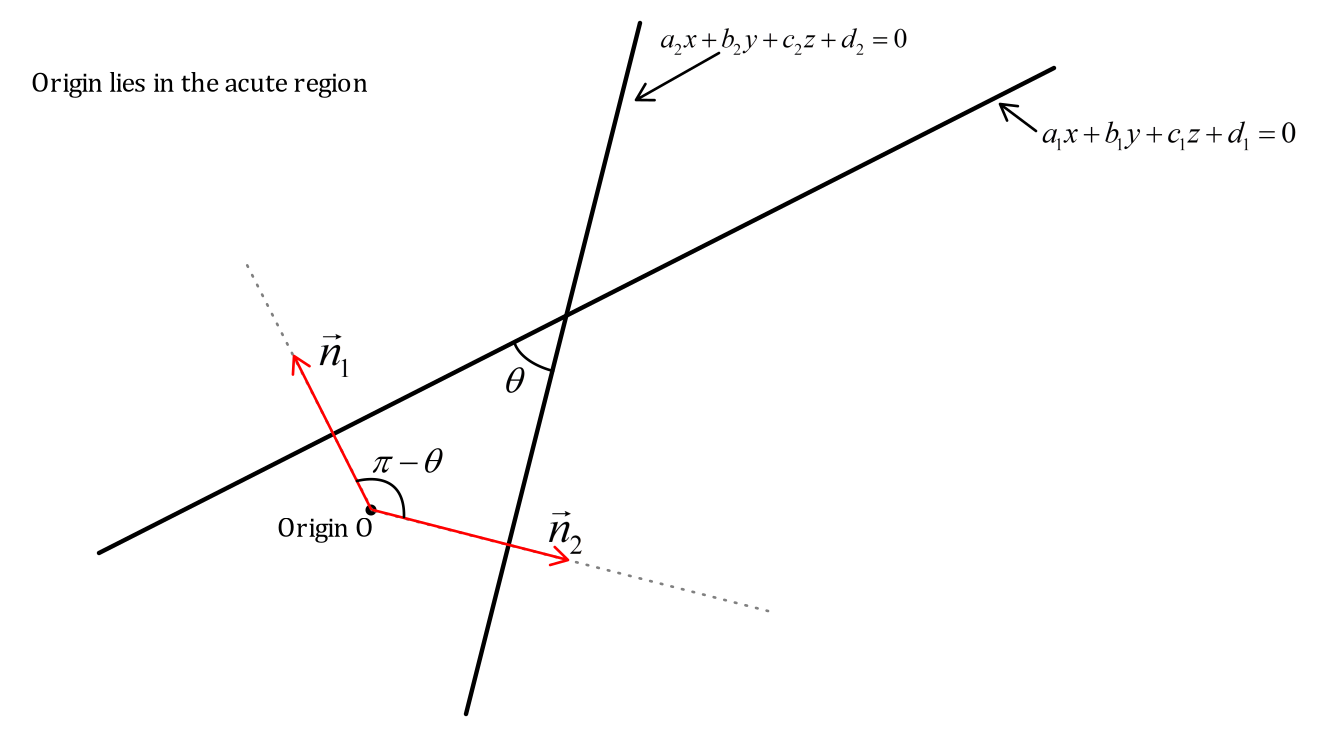
Let us suppose that the origin lies in the acute region between the two planes. Then consider the expression
a1x+b1y+c1z=−d1(since d1<0)
The right-hand side is positive, so the normal vector n1=a1i^+b1j^+c1k^ points from the origin toward the plane. The same logic applies to π2, so both normal vectors n1 and n2 point outward from the acute region.
Now, since the angle θ between the planes is acute, the angle between their outward normal vectors is π−θ, which is obtuse. Therefore,
n1⋅n2=a1a2+b1b2+c1c2<0
Hence, if the origin lies in the acute region between the two planes, then the dot product of their normal vectors is negative.
Similarly, if the origin lies in the obtuse region, then the angle between n1 and n2 is acute, and therefore:
a1a2+b1b2+c1c2>0
So, by computing the dot product of the normal vectors, we can determine whether the origin lies in the acute or obtuse region between the planes.
Once this is known, we use this to determine which bisector is in which region.
Consider again the two non-parallel planes:
π1:a1x+b1y+c1z+d1=0,π2:a2x+b2y+c2z+d2=0
Assume d1<0 and d2<0, so that the origin does not lie on either plane. The bisector planes are given by the standard equation:
Let us use the theory of the location of the origin to determine which of the two signs corresponds to the acute angle bisector.
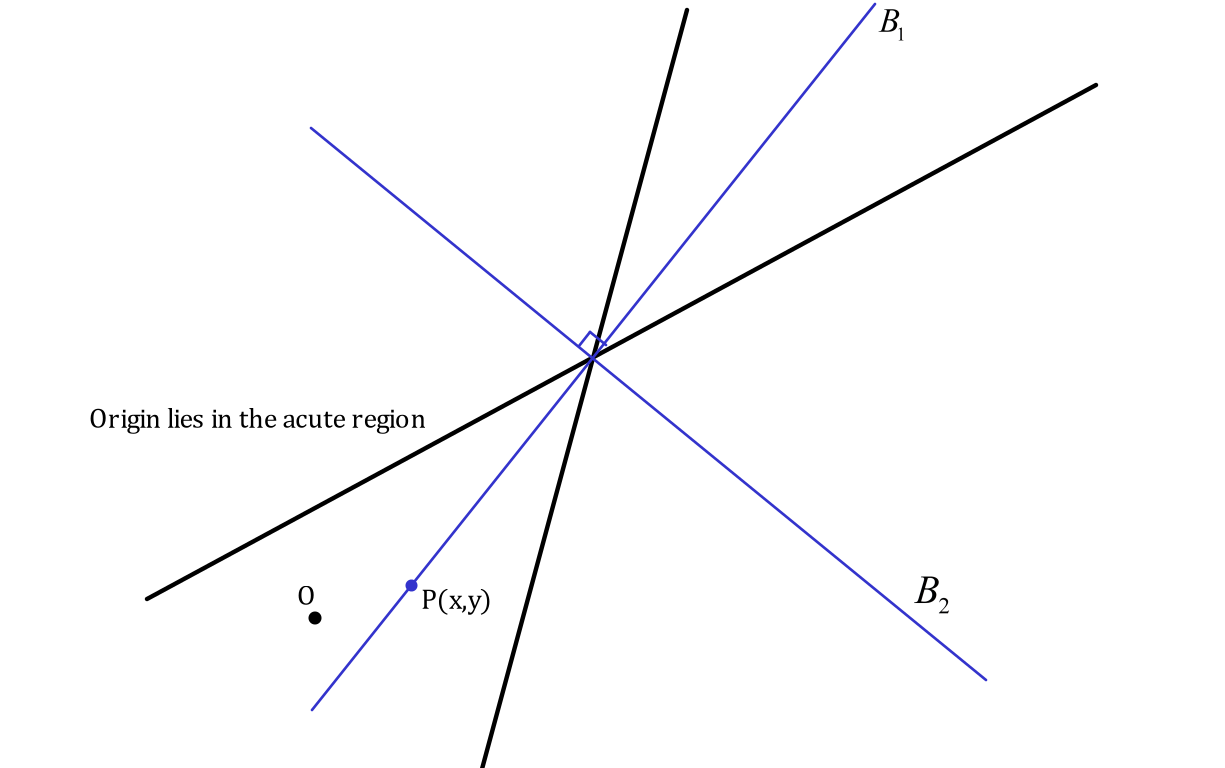
Case 1: Origin lies in the acute region
Suppose the origin lies in the acute region formed by the intersection of the two planes. As we saw above, this means that
n1⋅n2=a1a2+b1b2+c1c2<0(2)
Let B1 denote the acute angle bisector and let P=(x,y,z) be a point on B1. Since B1 lies in the acute region, and the origin also lies in that region, the point P and the origin are on the same side of both planes. Therefore:
Now substitute point P into equation (1). The left-hand side and right-hand side are both negative (by (3) and (4)), and their denominators are positive. The only way equality can hold is by choosing the positive sign:
positivenegative=positivenegative
The negative sign would produce a contradiction. Therefore, in this case the plus sign in equation (1) gives the acute angle bisector, and the minus sign gives the obtuse angle bisector.
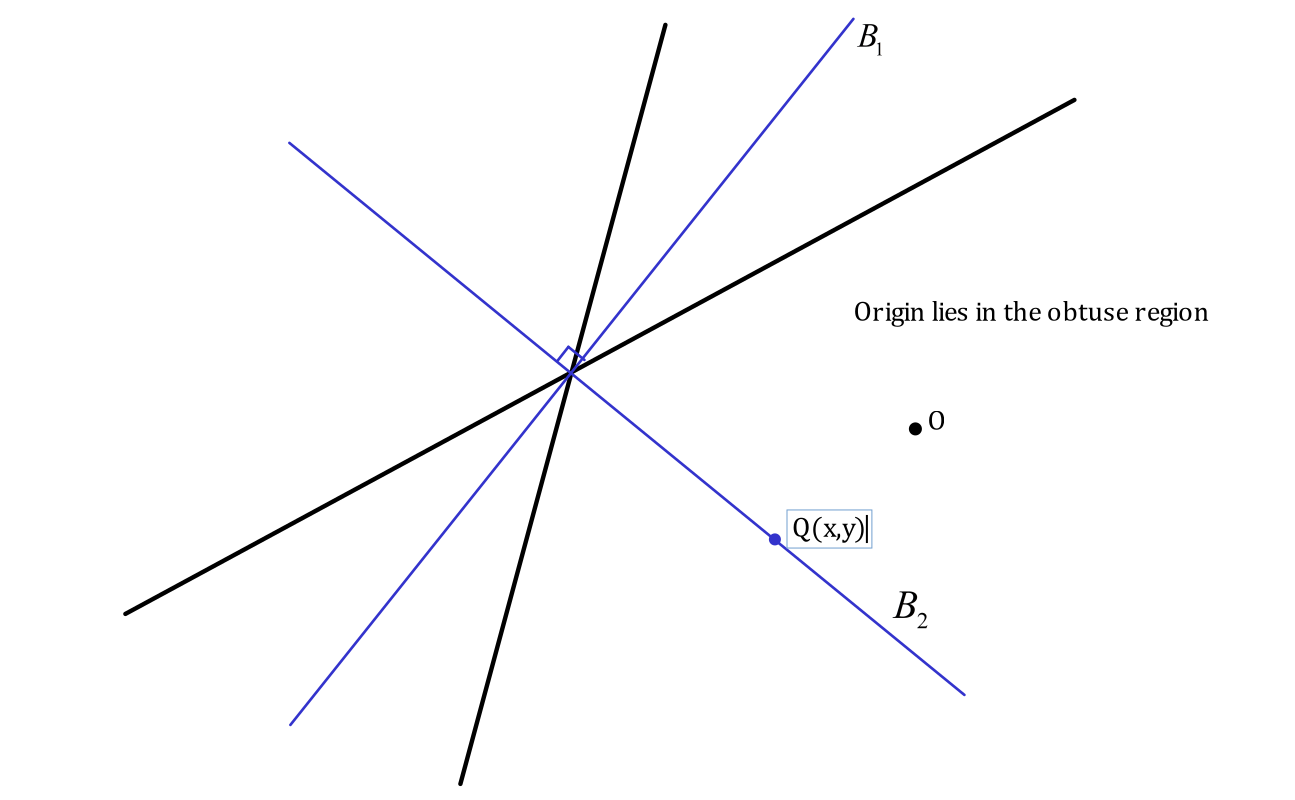
Case 2: Origin lies in the obtuse region
Now suppose the origin lies in the obtuse region between the two planes. Then:
n1⋅n2=a1a2+b1b2+c1c2>0(5)
Let B2 denote the obtuse angle bisector, and let Q=(x,y,z) be a point on it. Since the origin and Q lie on the same side of both planes, the same logic as in Case 1 yields:
a1x+b1y+c1z+d1<0,a2x+b2y+c2z+d2<0
Again, substitution into equation (1) shows that the plus sign must be taken to preserve equality, and hence in this case the plus sign gives the obtuse angle bisector, and the minus sign gives the acute.
Summary Table:
Location of Origin
a1a2+b1b2+c1c2
‘+’ in Equation (1) Gives
‘−’ in Equation (1) Gives
Origin in acute region
<0
Acute angle bisector
Obtuse angle bisector
Origin in obtuse region
>0
Obtuse angle bisector
Acute angle bisector
This criterion allows one to determine the nature of the bisector planes purely algebraically, without computing any angles or distances.
Section 14 of 15 · Vector Algebra and Three Dimensional Geometry
Mark this section complete when you have worked through its proofs.
Type any topic, theorem, or concept to jump directly to the section.