The vector triple product refers to the cross product of a vector with the cross product of two other vectors. Given three vectors a,b,c, the vector triple product is expressed as
a×(b×c).
This is not a new kind of product but simply a sequential application of the cross product to three vectors. We can evaluate it directly by first computing b×c and then taking its cross product with a. However, rather than performing two separate cross products, this expression can be significantly simplified using an important identity, which reduces computational effort.
Additionally, the vector triple product has a crucial geometric interpretation, making it highly useful in various applications.
The vector triple product identity provides a useful simplification for expressions involving the cross product of three vectors. The key identities are:
a×(b×c)=(a⋅c)b−(a⋅b)c(a×b)×c=(c⋅b)a−(a⋅b)c
These identities allow us to evaluate vector triple products without explicitly computing two separate cross products.
Geometrical Interpretation of Vector Triple Product§
The geometrical interpretation of the vector triple product follows naturally from its algebraic structure. Given three vectors a,b,c, consider the expression
a×(b×c).
From the vector triple product identity,
a×(b×c)=(a⋅c)b−(a⋅b)c.
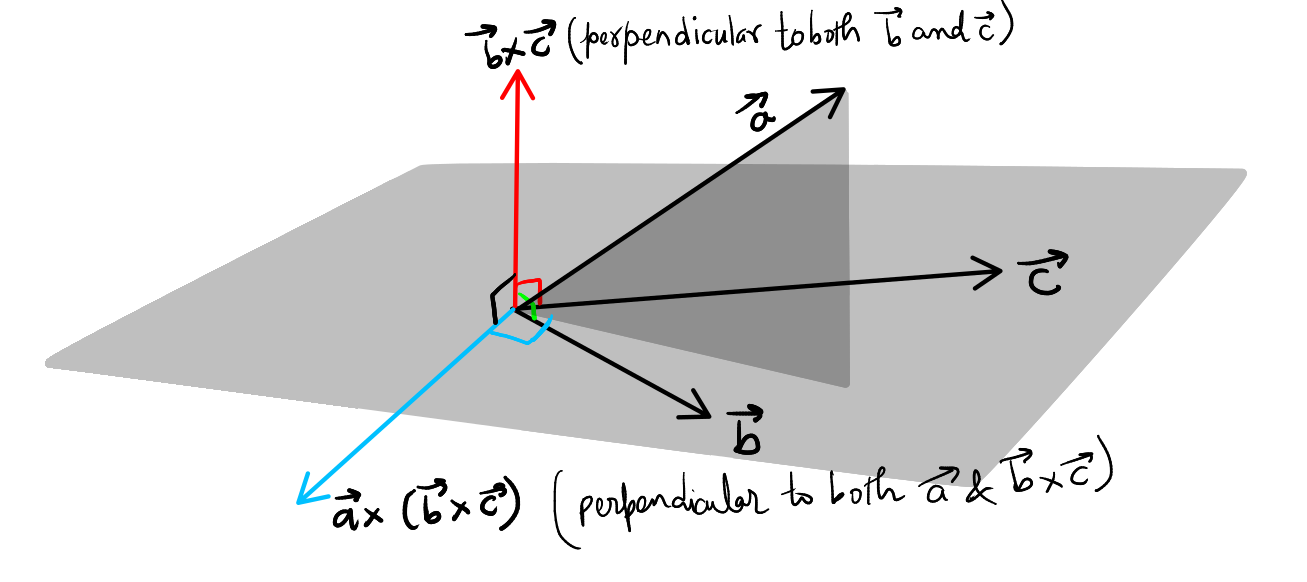
This result is a linear combination ofbandc, which implies that the vector a×(b×c) must lie in the plane spanned bybandc. Furthermore, since the cross product b×c is perpendicular to both b and c, the vector a×(b×c) is perpendicular to a, as illustrated in the figure.
Similarly, for
(a×b)×c,
the identity
(a×b)×c=(c⋅a)b−(c⋅b)a
shows that this vector is a linear combination of a and b, meaning it lies in the plane spanned byaandb. Since a×b is perpendicular to both a and b, the vector (a×b)×c is necessarily perpendicular to c.
Thus, the vector triple product identities not only provide computational simplifications but also encode essential geometric information—the resultant vector always lies in a specific plane and is perpendicular to the remaining vector.
The vector triple product solves the problem of finding a vector that is coplanar with two given, non-collinear vectors b and c but is also perpendicular to some other vector a.
Given three vectors a,b,c, the vector a×(b×c) is always in the plane of b and c and perpendicular to a. This follows from the identity:
a×(b×c)=(a⋅c)b−(a⋅b)c.
Since this result is a linear combination ofbandc, it must be coplanar with them. Furthermore, as a×(b×c) arises from a cross product involving a, it is necessarily perpendicular to a.
Thus, if we need a vector v that is coplanar with b,c but perpendicular to a, we conclude that
v∥a×(b×c).
Therefore, the most general form of such a vector can be taken as
v=λa×(b×c)
for some scalar λ.
Another very common situation is finding a vector v that is coplanar with two non-collinear vectors a and b, but also perpendicular to a.
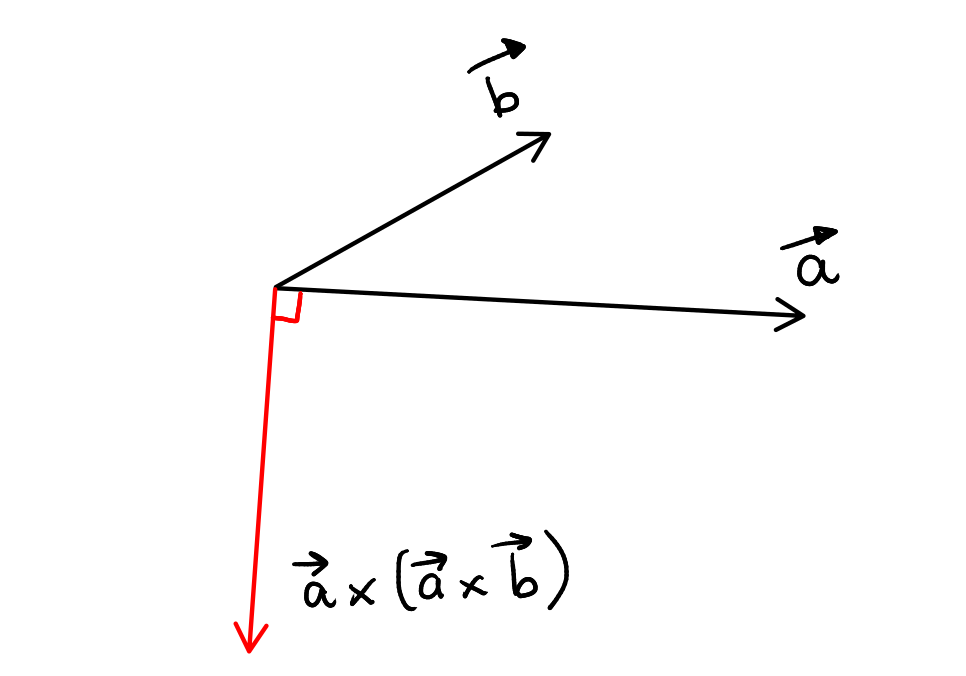
Since a×b is perpendicular to both a and b, taking the cross product of a with a×b ensures that the resulting vector lies in the plane spanned by a and b, while still being perpendicular to a. This follows from the identity:
a×(a×b)=(a⋅b)a−(a⋅a)b.
Since this vector is both coplanar withaandb and also perpendicular toa, any vector v satisfying these conditions must be collinear with a×(a×b), meaning
is not immediately suitable for algebraic manipulation. However, we can transform it using the cyclic property of the scalar triple product. Define u=a×b, so that
(a×b)⋅(c×d)=u⋅(c×d).
This is now in the form of a scalar triple product, which satisfies the identity
u⋅(c×d)=c⋅(d×u).
Substituting back u=a×b, we obtain
c⋅(d×(a×b)).
Now applying the vector triple product identity,
d×(a×b)=(d⋅b)a−(d⋅a)b,
we substitute this into the expression:
c⋅((d⋅b)a−(d⋅a)b).
Using the distributive property of the dot product,
(d⋅b)(c⋅a)−(d⋅a)(c⋅b).
Since d⋅b and d⋅a are scalars, this expression is equivalent to the determinant
(a×b)⋅(c×d)=a⋅cb⋅ca⋅db⋅d.
This result is known as Lagrange’s identity, which expresses the dot product of two cross products in terms of a determinant of inner products.
As a special case, setting c=a and d=b in Lagrange’s identity,
(a×b)⋅(c×d)=a⋅cb⋅ca⋅db⋅d,
yields
(a×b)⋅(a×b)=a⋅ab⋅aa⋅bb⋅b.
Since (a×b)⋅(a×b)=∣a×b∣2, we obtain
∣a×b∣2=∣a∣2a⋅ba⋅b∣b∣2.
Expanding the determinant,
∣a×b∣2=∣a∣2∣b∣2−(a⋅b)2.
Rearranging,
∣a×b∣2+(a⋅b)2=∣a∣2∣b∣2.
This is a fundamental identity in vector algebra, showing that the sum of the squared magnitudes of the cross product and the dot product equals the product of the squared magnitudes of the vectors. It expresses the Pythagorean relation in terms of vector products, capturing the decomposition of a and b into perpendicular and parallel components.
Since the result is a combination of two vectors, it must lie in the plane formed by those two vectors.
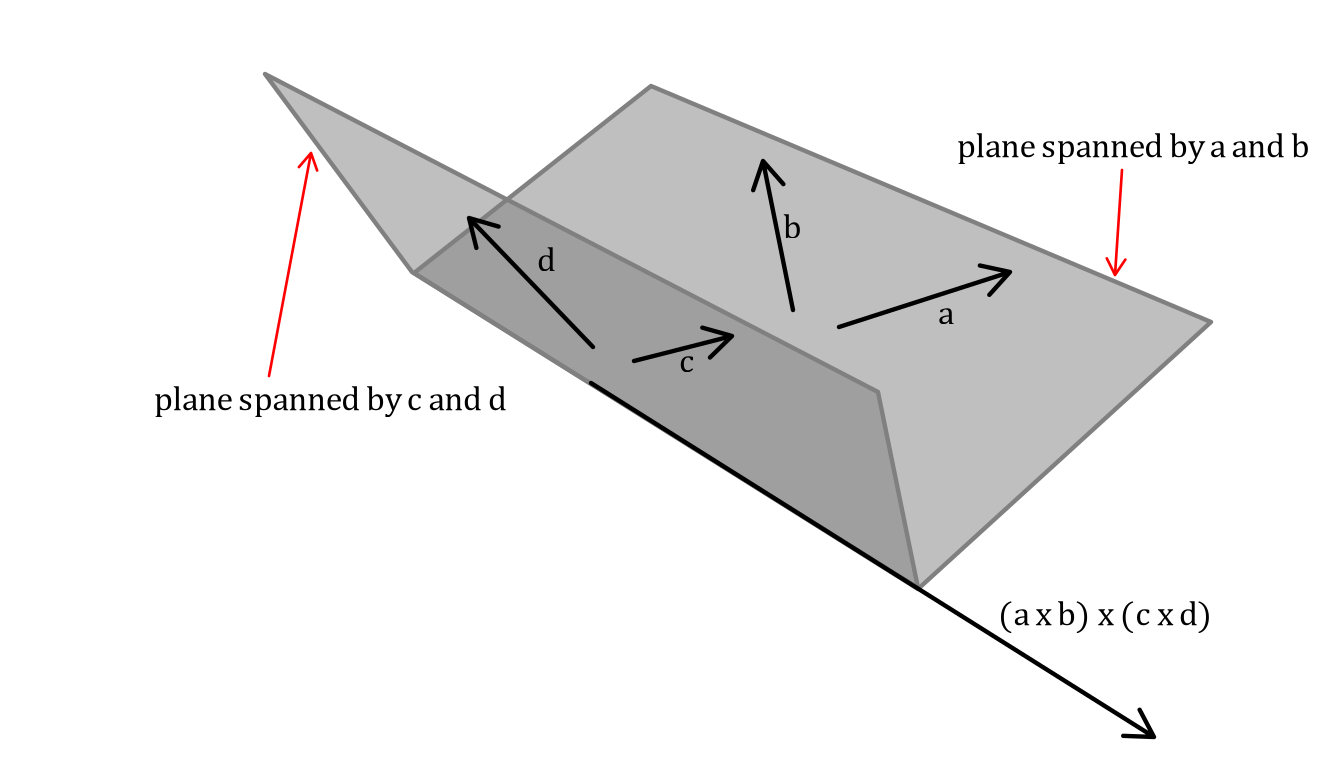
The first form shows that (a×b)×(c×d) lies in the plane spanned byc and d.
The second form shows that it also lies in the plane spanned bya and b.
This means that the resulting vector is in both planes at the same time. The only vectors that satisfy this condition lie in the intersection of the two planes.
Thus, (a×b)×(c×d) is a vector that belongs to the common plane of botha,b and c,d. This is clearly reflected in its algebraic form, which expresses it in terms of vectors from both planes.
Section 10 of 15 · Vector Algebra and Three Dimensional Geometry
Mark this section complete when you have worked through its proofs.
Type any topic, theorem, or concept to jump directly to the section.