The cross product arises when we try to solve the following problem:
Find a unit vector perpendicular to two noncollinear vectors
a=a1i+a2j+a3k
and
b=b1i+b2j+b3k.
To solve this problem, we use the dot product of vectors. The objective is to find a vector that is perpendicular to both a and b, and among all such vectors, we seek one that has unit magnitude.
Let
n=n1i+n2j+n3k
be the required unit vector. Since n is a unit vector, its magnitude must satisfy the fundamental property
n12+n22+n32=1.(1)
Additionally, since it is perpendicular to a, the dot product condition gives
a⋅n=0⟹a1n1+a2n2+a3n3=0.(2)
Similarly, since n is perpendicular to b, we impose another orthogonality condition
b⋅n=0⟹b1n1+b2n2+b3n3=0.(3)
Thus, we now have a system of three equations for the three unknowns n1,n2,n3. Our goal is to solve for these unknowns in a systematic manner.
From equations (2) and (3), we observe that this system of equations is linear in n1,n2,n3. We can express these variables in terms of determinants as follows:
Let this common ratio be λ, an arbitrary scalar factor that determines the magnitude of n. Thus, we obtain explicit expressions for the components of n as
Now, the denominator in this expression is significant. To gain further insight into it, we recall the fundamental formula for the cosine of the angle θ between two vectors:
This result shows that there are two possible unit vectors, each pointing in opposite directions perpendicular to the plane containing a and b.
The determinant in the numerator of n is significant because it represents a vector that is perpendicular to both a and b. This determinant is given by
ia1b1ja2b2ka3b3.
This determinant is given a special name in vector algebra: it is called the cross product of a and b, denoted by a×b. That is,
a×b=ia1b1ja2b2ka3b3.
Using this notation, our previously derived expression for n can now be written compactly as
n=±∣a∣∣b∣sinθa×b.
This form clearly shows that the cross product a×b gives a vector perpendicular to both a and b, and dividing it by ∣a∣∣b∣sinθ normalizes its magnitude to 1, ensuring that n is a unit vector. There are two possible choices for n, one in each direction perpendicular to the plane of a and b.
In the expression
n=±∣a∣∣b∣sinθa×b,
there are two possible values for n, corresponding to the two opposite directions perpendicular to both a and b. To determine which of these two directions corresponds to a given choice of sign, we must establish a convention for the orientation of n relative to a and b.
To do this, we make the two vectors a and bcoinitial, meaning we consider them starting from the same point. Then, we shift the reference point of the Cartesian coordinate system to this common initial point of a and b, effectively making this point the origin. Next, we align the positive x-axis along a and rotate the coordinate system such that b lies in the xy-plane. This transformation does not affect the algebra of vectors since vector operations are independent of the choice of coordinate system.
In this new coordinate system, the vectors take the simplified forms
a=a1i,a1>0,b=b1i+b2j.
Since b lies in the xy-plane, its z-component is zero. Now, we compute the cross product:
a×b=ia1b1j0b2k00.
Expanding this determinant along the first row,
a×b=i0b200−ja1b100+ka1b10b2.
Since the first two determinants are zero, we are left with
a×b=(a1b2)k.
Thus,
n=±a1∣b∣sinθa1b2k.
Canceling a1 from the numerator and denominator,
n=±∣b∣sinθb2k.
Now, observe that sinθ is always positive because the angle θ between two vectors lies in the range 0≤θ≤π. The sign of n thus depends only on b2:
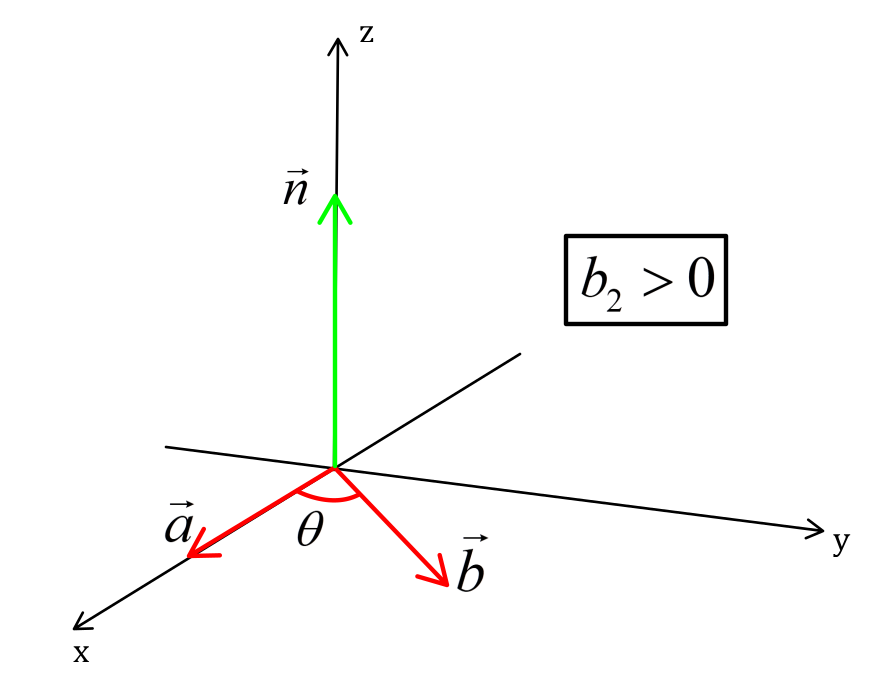
If b2>0, then choosing the positive sign gives n along the positive z-axis.
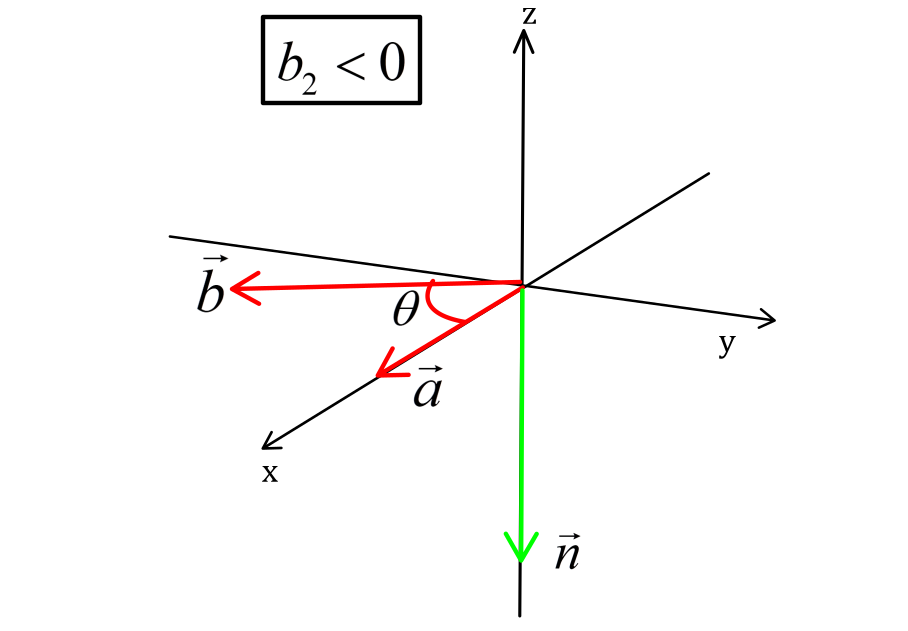
If b2<0, then choosing the positive sign gives n along the negative z-axis.
This matches a well-known orientation rule: If you take your right hand, align your fingers along a and curl them toward b, then your thumb points in the direction of n.
Thus, the right-hand rule determines the direction of n. This means that instead of using both signs, we definen as
n=∣a∣∣b∣sinθa×b.
That is, we do not use the negative sign explicitly, and we always choose the direction given by the right-hand rule.
This convention allows us to unambiguously determine the orientation of n: if you place your right hand so that your fingers point along a and curl them toward b, your thumb will point in the direction of n.
From our detailed discussion, we define the cross product of two vectors a and b as follows:
When the vectors are expressed explicitly in resolved form, the cross product is given by the determinant:
a×b=ia1b1ja2b2ka3b3.
Earlier, we found the unit vector n perpendicular to both a and b as:
n=∣a∣∣b∣sinθa×b.
Thus, we have an alternative way of expressing the cross product as:
a×b=∣a∣∣b∣sinθn,0≤θ≤π.
Since 0≤θ≤π, it follows that sinθ≥0. Here, n is a unit vector perpendicular to both vectors a and b, whose direction is uniquely determined by the right-hand rule.
Note that even though, in the initial calculation of n, we explicitly assumed a and b to be noncollinear, we extend the definition of the cross product to include the case of collinear vectors as well. In such cases, θ=0 or π, hence:
a×b=∣a∣∣b∣sin0or∣a∣∣b∣sinπ=0.
Thus, for collinear vectors, the cross product is defined to be the zero vector. In this special scenario, the unit vector n no longer makes sense, because there is no unique direction perpendicular to two collinear vectors—indeed, there are infinitely many such directions.
Finally, since n is a unit vector, the magnitude of the cross product a×b is simply the nonnegative scalar ∣a∣∣b∣sinθ. Thus, we clearly have:
∣a×b∣=∣a∣∣b∣sinθ.
We do not put a modulus sign around sinθ, as we have established that sinθ is always nonnegative in the range 0≤θ≤π.
Also, from our earlier expression for n, we have another useful way of expressing it compactly:
We have introduced a new kind of product on vectors—the cross product. Let us now learn and understand its properties thoroughly and explore how it behaves with respect to various operations.
The cross product, unlike scalar multiplication or dot product, is not commutative. Specifically, we have the important identity:
a×b=−(b×a)
This property can be understood clearly using the determinant definition of the cross product. Recall,
a×b=ia1b1ja2b2ka3b3.
If we interchange vectors a and b, this corresponds exactly to interchanging the second and third rows of the determinant:
b×a=ib1a1jb2a2kb3a3.
But from determinants' properties, interchanging two rows changes the determinant's sign. Thus,
b×a=−(a×b).
Additionally, this anti-commutativity can also be understood intuitively by the right-hand rule. If we apply the right-hand rule by aligning fingers along a and curling them toward b, the thumb points in one particular direction. Reversing the order, aligning fingers along b first and then curling toward a, the thumb points exactly in the opposite direction. Hence, we again verify the anti-commutative property.
Thus, the cross product is fundamentally anti-commutative.
Another important property of the cross product is its compatibility with scalar multiplication. If k is any scalar and a, b are vectors, we have the following identity:
k(a×b)=(ka)×b=a×(kb).
This can easily be understood using the determinant definition of the cross product:
Recall that
a×b=ia1b1ja2b2ka3b3.
Multiplying by scalar k:
Multiplying vector a by k corresponds to multiplying the second row of this determinant by k:
(ka)×b=ika1b1jka2b2kka3b3.
Similarly, multiplying vector b by k corresponds to multiplying the third row of the determinant by k:
a×(kb)=ia1kb1ja2kb2ka3kb3.
By determinant properties, multiplying a row by a scalar k simply factors k out of the determinant. Thus, in each case, the scalar k can be factored out:
(ka)×b=k(a×b),a×(kb)=k(a×b).
Hence, scalar multiplication distributes naturally over the cross product, confirming the above stated identities rigorously.
In a right-handed coordinate system, the cross products involving unit vectors along coordinate axes have simple and important results. Consider unit vectors i, j, and k along the positive x-, y-, and z-axes, respectively. Then we have:
The cross product of any vector with itself is always zero:
i×i=0,j×j=0,k×k=0
(This is because the angle between a vector and itself is zero, and thus sin0=0.)
Cross products of distinct unit vectors follow the right-hand rule cyclically:
i×j=k,j×k=i,k×i=j.
These relations can easily be verified using the determinant definition. For instance:
i×j=i10j01k00=(0)i−(0)j+(1)k=k.
Thus, summarizing clearly:
i×i=j×j=k×k=0.
i×j=k,j×k=i,k×i=j.
Cross Product and Basis in Three-dimensional Space§
If a and b are two nonzero and noncollinear vectors, then the vectors
a,b,anda×b
are always noncoplanar.
To understand why, recall that a×b is perpendicular to both a and b. If these three vectors were coplanar, then a×b would lie in the plane formed by a and b. But this is impossible, since by definition, a×b must be perpendicular to that very plane. Thus, these three vectors cannot lie in the same plane and are therefore noncoplanar.
Consequently, by the fundamental theorem of three-dimensional geometry, any vector r in three-dimensional space can be uniquely expressed as a linear combination of these three noncoplanar vectors. Formally, we have:
r=xa+yb+z(a×b)
for some scalars x,y,z. We will see later on how such a formulation is helpful.
The relationship between the cross product and the area of a parallelogram formed by two vectors is quite surprising and insightful. To understand this clearly, let us revisit the cross product with a geometric perspective.
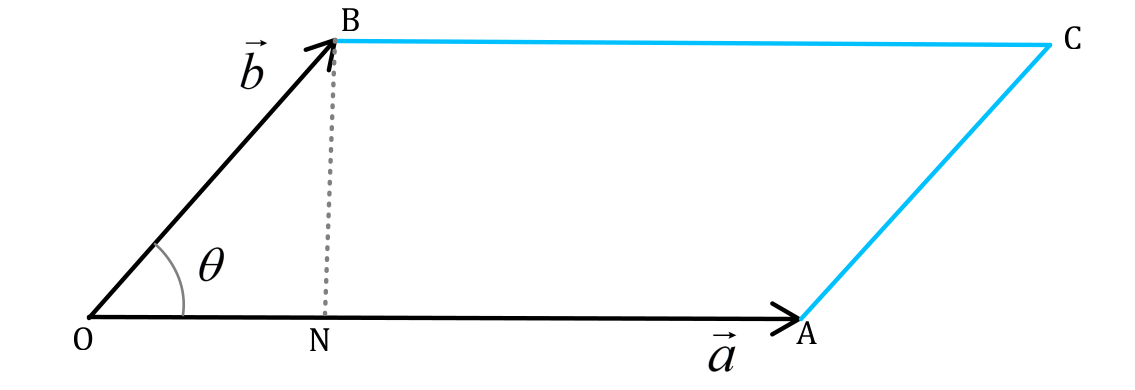
Consider two vectors a and b, placed with their initial points coinciding (making them coinitial). Construct a parallelogram using these two vectors as adjacent sides—precisely the same way we do when applying the parallelogram law of vector addition.
Let us denote the parallelogram formed by vectors a and b as parallelogram OACB, where O is the common initial point, OA=a, OB=b, and C is the opposite vertex formed by completing the parallelogram.
Now, our question is simple yet fundamental: What is the area of this parallelogram formed by a and b?
We recall from basic geometry that the area of any parallelogram is given by the formula:
Area=base×height.
Taking OA as the base, the length of the base is ∣a∣. Let θ be the angle between vectors a and b. Drop a perpendicular from vertex B onto the base OA, meeting at point N. Then, by simple trigonometry, the perpendicular height BN is given by:
BN=∣b∣sinθ.
Thus, the area of the parallelogram is:
Area=∣a∣×∣b∣sinθ.
However, we immediately recognize this quantity: It is precisely the magnitude of the cross product a×b. Indeed, we previously established that:
∣a×b∣=∣a∣∣b∣sinθ.
Thus, we arrive at a remarkable and fundamental geometric interpretation of the cross product:
∣a×b∣=Area of parallelogram formed by a and b.
This connection between geometry and algebra highlights one of the most elegant and surprising features of the cross product.
Consequently, the area of the triangle formed by the two vectors a and b, placed coinitially, is exactly half the area of the parallelogram we just discussed.
If we have a triangle ABC with vertices at points A, B, and C, the area of this triangle can be neatly expressed using the cross product of vectors formed by its sides.
Specifically, the area of triangle ABC can be computed by considering the vectors formed by any two sides emanating from a common vertex:
Area of triangle ABC=21AB×AC=21BA×BC=21CA×CB.
If the points A,B,C have position vectors a,b,c respectively, then the area of triangle ABC can be expressed directly using these position vectors.
First, recall the general formula we just derived:
Area of triangle ABC=21AB×AC.
Since AB=b−a and AC=c−a, we have:
Area=21(b−a)×(c−a).
Expanding using distributivity of cross product, we get:
Consider a planar quadrilateral ABCD situated in three-dimensional space. We will now prove a rather surprising and elegant result: the area of this quadrilateral equals half the magnitude of the cross product of its diagonals. Formally stated, we have:
Area of quadrilateral ABCD=21AC×BD.
Proof:
To see why this is true, we begin by dividing the quadrilateral ABCD into two triangles by drawing diagonal AC. Thus, the area of quadrilateral ABCD equals the sum of the areas of triangles ABC and CDA:
Area of quadrilateral ABCD=Area of triangle ABC+Area of triangle CDA.
Expressing these triangle areas using cross products, we have:
=21AB×AC+21AC×AD.
Now, observe carefully the directions of vectors using the right-hand rule. Since ABCD is planar, both cross products AB×AC and AC×AD are perpendicular to the same plane, and thus point in the same (or exactly opposite) direction. By appropriate labeling of vertices (as done here), we ensure they point in the same direction.
If two vectors u and v have the same direction, then clearly:
∣u∣+∣v∣=∣u+v∣.
Using this observation, we combine the magnitudes of our two cross products into a single magnitude:
Area of quadrilateral ABCD=21AB×AC+AC×AD.
Factor out vector AC carefully, noting the anti-commutative property AB×AC=−AC×AB:
=21−AC×AB+AC×AD.
This simplifies neatly by distributivity of the cross product:
=21AC×(AD−AB).
But the vector difference AD−AB is precisely the diagonal vector BD. Hence, we have:
Area of quadrilateral ABCD=21AC×BD.
Thus, the area of a planar quadrilateral in space can be directly computed by taking half the magnitude of the cross product of its two diagonals. ■
Section 8 of 15 · Vector Algebra and Three Dimensional Geometry
Mark this section complete when you have worked through its proofs.
Type any topic, theorem, or concept to jump directly to the section.