Definition§
Scalar Triple Product§
In vector algebra, it is common to see combinations involving dot and cross products together. One important combination is called the scalar triple product .
Given three vectors a , b , c \mathbf{a}, \mathbf{b}, \mathbf{c} a , b , c
[ a b c ] = a ⋅ ( b × c ) [\mathbf{a}\,\mathbf{b}\,\mathbf{c}] = \mathbf{a}\cdot(\mathbf{b}\times\mathbf{c}) [ a b c ] = a ⋅ ( b × c ) The order of vectors inside the brackets is very important because changing the order may change the value.
Let the vectors be expressed in terms of unit vectors i , j , k \mathbf{i}, \mathbf{j}, \mathbf{k} i , j , k
a = a 1 i + a 2 j + a 3 k , b = b 1 i + b 2 j + b 3 k , c = c 1 i + c 2 j + c 3 k . \mathbf{a} = a_1\mathbf{i}+a_2\mathbf{j}+a_3\mathbf{k},\quad
\mathbf{b} = b_1\mathbf{i}+b_2\mathbf{j}+b_3\mathbf{k},\quad
\mathbf{c} = c_1\mathbf{i}+c_2\mathbf{j}+c_3\mathbf{k}. a = a 1 i + a 2 j + a 3 k , b = b 1 i + b 2 j + b 3 k , c = c 1 i + c 2 j + c 3 k . Then, the scalar triple product becomes:
[ a b c ] = a ⋅ ( b × c ) = ( a 1 i + a 2 j + a 3 k ) ⋅ ∣ i j k b 1 b 2 b 3 c 1 c 2 c 3 ∣ . [\mathbf{a}\,\mathbf{b}\,\mathbf{c}]
= \mathbf{a}\cdot(\mathbf{b}\times\mathbf{c})
= (a_1\mathbf{i}+a_2\mathbf{j}+a_3\mathbf{k}) \cdot
\begin{vmatrix}
\mathbf{i} & \mathbf{j} & \mathbf{k}\\[6pt]
b_1 & b_2 & b_3\\[6pt]
c_1 & c_2 & c_3
\end{vmatrix}. [ a b c ] = a ⋅ ( b × c ) = ( a 1 i + a 2 j + a 3 k ) ⋅ i b 1 c 1 j b 2 c 2 k b 3 c 3 . Expanding the determinant, we get:
[ a b c ] = ( a 1 i + a 2 j + a 3 k ) ⋅ [ i ( b 2 c 3 − b 3 c 2 ) − j ( b 1 c 3 − b 3 c 1 ) + k ( b 1 c 2 − b 2 c 1 ) ] . [\mathbf{a}\,\mathbf{b}\,\mathbf{c}]
= (a_1\mathbf{i}+a_2\mathbf{j}+a_3\mathbf{k}) \cdot \left[\mathbf{i}(b_2c_3 - b_3c_2) - \mathbf{j}(b_1c_3 - b_3c_1) + \mathbf{k}(b_1c_2 - b_2c_1)\right]. [ a b c ] = ( a 1 i + a 2 j + a 3 k ) ⋅ [ i ( b 2 c 3 − b 3 c 2 ) − j ( b 1 c 3 − b 3 c 1 ) + k ( b 1 c 2 − b 2 c 1 ) ] . Performing the dot product, we have:
[ a b c ] = a 1 ( b 2 c 3 − b 3 c 2 ) − a 2 ( b 1 c 3 − b 3 c 1 ) + a 3 ( b 1 c 2 − b 2 c 1 ) . [\mathbf{a}\,\mathbf{b}\,\mathbf{c}]
= a_1(b_2c_3 - b_3c_2) - a_2(b_1c_3 - b_3c_1) + a_3(b_1c_2 - b_2c_1). [ a b c ] = a 1 ( b 2 c 3 − b 3 c 2 ) − a 2 ( b 1 c 3 − b 3 c 1 ) + a 3 ( b 1 c 2 − b 2 c 1 ) . Careful observation reveals that this is exactly the determinant of the following 3 × 3 3 \times 3 3 × 3
[ a b c ] = ∣ a 1 a 2 a 3 b 1 b 2 b 3 c 1 c 2 c 3 ∣ . [\mathbf{a}\,\mathbf{b}\,\mathbf{c}]
= \begin{vmatrix}
a_1 & a_2 & a_3 \\[6pt]
b_1 & b_2 & b_3 \\[6pt]
c_1 & c_2 & c_3
\end{vmatrix}. [ a b c ] = a 1 b 1 c 1 a 2 b 2 c 2 a 3 b 3 c 3 . Thus, the scalar triple product can be neatly expressed as the determinant of a matrix formed by placing each vector's components in rows.
Let us take three specific vectors:
a = 2 i − j + 3 k , b = i + 2 j − k , c = 3 i − j + 2 k . \mathbf{a} = 2\mathbf{i} - \mathbf{j} + 3\mathbf{k},\quad \mathbf{b} = \mathbf{i} + 2\mathbf{j} - \mathbf{k},\quad \mathbf{c} = 3\mathbf{i} - \mathbf{j} + 2\mathbf{k}. a = 2 i − j + 3 k , b = i + 2 j − k , c = 3 i − j + 2 k . We want to find the scalar triple product [ a b c ] [\mathbf{a}\,\mathbf{b}\,\mathbf{c}] [ a b c ]
This is evaluated as a determinant:
[ a b c ] = ∣ 2 − 1 3 1 2 − 1 3 − 1 2 ∣ . [\mathbf{a}\,\mathbf{b}\,\mathbf{c}] = \begin{vmatrix} 2 & -1 & 3 \\[6pt] 1 & 2 & -1 \\[6pt] 3 & -1 & 2 \end{vmatrix}. [ a b c ] = 2 1 3 − 1 2 − 1 3 − 1 2 . Expanding the determinant, we have:
[ a b c ] = 2 ∣ 2 − 1 − 1 2 ∣ − ( − 1 ) ∣ 1 − 1 3 2 ∣ + 3 ∣ 1 2 3 − 1 ∣ = 2 ( 4 − 1 ) + 1 ( 2 + 3 ) + 3 ( − 1 − 6 ) = 2 ( 3 ) + 1 ( 5 ) + 3 ( − 7 ) = 6 + 5 − 21 = − 10. \begin{aligned} [\mathbf{a}\,\mathbf{b}\,\mathbf{c}] &= 2\begin{vmatrix}2 & -1 \\ -1 & 2\end{vmatrix} - (-1)\begin{vmatrix}1 & -1 \\ 3 & 2\end{vmatrix} + 3\begin{vmatrix}1 & 2 \\ 3 & -1\end{vmatrix}\\[6pt] &= 2(4 - 1) + 1(2 + 3) + 3(-1 - 6) \\[6pt] &= 2(3) + 1(5) + 3(-7) \\[6pt] &= 6 + 5 - 21 \\[6pt] &= -10. \end{aligned} [ a b c ] = 2 2 − 1 − 1 2 − ( − 1 ) 1 3 − 1 2 + 3 1 3 2 − 1 = 2 ( 4 − 1 ) + 1 ( 2 + 3 ) + 3 ( − 1 − 6 ) = 2 ( 3 ) + 1 ( 5 ) + 3 ( − 7 ) = 6 + 5 − 21 = − 10. Thus, the scalar triple product is:
[ a b c ] = − 10. [\mathbf{a}\,\mathbf{b}\,\mathbf{c}] = -10. [ a b c ] = − 10. Properties of Scalar Triple Product § The scalar triple product [ a b c ] [\mathbf{a}\,\mathbf{b}\,\mathbf{c}] [ a b c ] 3 × 3 3\times 3 3 × 3 a , b , c \mathbf{a}, \mathbf{b}, \mathbf{c} a , b , c
[ a b c ] = a ⋅ ( b × c ) = ∣ a 1 a 2 a 3 b 1 b 2 b 3 c 1 c 2 c 3 ∣ . [\mathbf{a}\,\mathbf{b}\,\mathbf{c}]
= \mathbf{a}\cdot(\mathbf{b}\times\mathbf{c})
= \begin{vmatrix}
a_1 & a_2 & a_3 \\[6pt]
b_1 & b_2 & b_3 \\[6pt]
c_1 & c_2 & c_3
\end{vmatrix}. [ a b c ] = a ⋅ ( b × c ) = a 1 b 1 c 1 a 2 b 2 c 2 a 3 b 3 c 3 . Since the scalar triple product is merely a concise notation for the determinant, all fundamental properties of determinants hold true here.
Interchanging positions of dot and cross products§
One important property arising from this fact is that the positions of the dot and cross products can be interchanged without altering the result. Explicitly,
a ⋅ ( b × c ) = ( a × b ) ⋅ c . \mathbf{a}\cdot(\mathbf{b}\times\mathbf{c}) = (\mathbf{a}\times\mathbf{b})\cdot\mathbf{c}. a ⋅ ( b × c ) = ( a × b ) ⋅ c . To verify this rigorously, express the product in determinant form:
( a × b ) ⋅ c = c ⋅ ( a × b ) = ∣ c 1 c 2 c 3 a 1 a 2 a 3 b 1 b 2 b 3 ∣ . (\mathbf{a}\times\mathbf{b})\cdot\mathbf{c}
= \mathbf{c}\cdot(\mathbf{a}\times\mathbf{b})
= \begin{vmatrix}
c_1 & c_2 & c_3 \\[6pt]
a_1 & a_2 & a_3 \\[6pt]
b_1 & b_2 & b_3
\end{vmatrix}. ( a × b ) ⋅ c = c ⋅ ( a × b ) = c 1 a 1 b 1 c 2 a 2 b 2 c 3 a 3 b 3 . By performing two successive row interchanges on the above determinant, namely R 1 ↔ R 2 R_1 \leftrightarrow R_2 R 1 ↔ R 2 R 2 ↔ R 3 R_2 \leftrightarrow R_3 R 2 ↔ R 3 a ⋅ ( b × c ) \mathbf{a}\cdot(\mathbf{b}\times\mathbf{c}) a ⋅ ( b × c )
∣ c 1 c 2 c 3 a 1 a 2 a 3 b 1 b 2 b 3 ∣ → R 1 ↔ R 2 ∣ a 1 a 2 a 3 c 1 c 2 c 3 b 1 b 2 b 3 ∣ → R 2 ↔ R 3 ∣ a 1 a 2 a 3 b 1 b 2 b 3 c 1 c 2 c 3 ∣ . \begin{vmatrix}
c_1 & c_2 & c_3 \\[6pt]
a_1 & a_2 & a_3 \\[6pt]
b_1 & b_2 & b_3
\end{vmatrix}
\xrightarrow[R_1 \leftrightarrow R_2]{}
\begin{vmatrix}
a_1 & a_2 & a_3 \\[6pt]
c_1 & c_2 & c_3 \\[6pt]
b_1 & b_2 & b_3
\end{vmatrix}
\xrightarrow[R_2 \leftrightarrow R_3]{}
\begin{vmatrix}
a_1 & a_2 & a_3 \\[6pt]
b_1 & b_2 & b_3 \\[6pt]
c_1 & c_2 & c_3
\end{vmatrix}. c 1 a 1 b 1 c 2 a 2 b 2 c 3 a 3 b 3 R 1 ↔ R 2 a 1 c 1 b 1 a 2 c 2 b 2 a 3 c 3 b 3 R 2 ↔ R 3 a 1 b 1 c 1 a 2 b 2 c 2 a 3 b 3 c 3 . Since two row interchanges leave the determinant unchanged, it follows that:
( a × b ) ⋅ c = a ⋅ ( b × c ) . (\mathbf{a}\times\mathbf{b})\cdot\mathbf{c} = \mathbf{a}\cdot(\mathbf{b}\times\mathbf{c}). ( a × b ) ⋅ c = a ⋅ ( b × c ) . Scalar triple product involving zero vector§
If any one of the vectors a , b , c \mathbf{a}, \mathbf{b}, \mathbf{c} a , b , c
[ 0 b c ] = [ a 0 c ] = [ a b 0 ] = 0 [\mathbf{0}\,\mathbf{b}\,\mathbf{c}] = [\mathbf{a}\,\mathbf{0}\,\mathbf{c}] = [\mathbf{a}\,\mathbf{b}\,\mathbf{0}] = 0 [ 0 b c ] = [ a 0 c ] = [ a b 0 ] = 0 Proof:
Let vector a \mathbf{a} a 0 \mathbf{0} 0
[ 0 b c ] = 0 ⋅ ( b × c ) = 0. [\mathbf{0}\,\mathbf{b}\,\mathbf{c}]
= \mathbf{0}\cdot(\mathbf{b}\times\mathbf{c})
= 0. [ 0 b c ] = 0 ⋅ ( b × c ) = 0. Similarly, if vector b \mathbf{b} b
[ a 0 c ] = a ⋅ ( 0 × c ) = a ⋅ 0 = 0. [\mathbf{a}\,\mathbf{0}\,\mathbf{c}]
= \mathbf{a}\cdot(\mathbf{0}\times\mathbf{c})
= \mathbf{a}\cdot\mathbf{0}
= 0. [ a 0 c ] = a ⋅ ( 0 × c ) = a ⋅ 0 = 0. Lastly, if vector c \mathbf{c} c
[ a b 0 ] = a ⋅ ( b × 0 ) = a ⋅ 0 = 0. [\mathbf{a}\,\mathbf{b}\,\mathbf{0}]
= \mathbf{a}\cdot(\mathbf{b}\times\mathbf{0})
= \mathbf{a}\cdot\mathbf{0}
= 0. [ a b 0 ] = a ⋅ ( b × 0 ) = a ⋅ 0 = 0. Hence, the property is established rigorously.
Scalar triple product involving two equal vectors§
If any two of the vectors in the scalar triple product are equal, then the scalar triple product is zero. Formally, if a , b , c \mathbf{a},\mathbf{b},\mathbf{c} a , b , c
[ a a c ] = [ a b a ] = [ b a a ] = 0. [\mathbf{a}\,\mathbf{a}\,\mathbf{c}]
= [\mathbf{a}\,\mathbf{b}\,\mathbf{a}]
= [\mathbf{b}\,\mathbf{a}\,\mathbf{a}]
= 0. [ a a c ] = [ a b a ] = [ b a a ] = 0. Proof: a = ( a 1 , a 2 , a 3 ) \mathbf{a} = (a_1,a_2,a_3) a = ( a 1 , a 2 , a 3 ) b = ( b 1 , b 2 , b 3 ) \mathbf{b} = (b_1,b_2,b_3) b = ( b 1 , b 2 , b 3 ) c = ( c 1 , c 2 , c 3 ) \mathbf{c} = (c_1,c_2,c_3) c = ( c 1 , c 2 , c 3 )
[ a a c ] = ∣ a 1 a 2 a 3 a 1 a 2 a 3 c 1 c 2 c 3 ∣ . [\mathbf{a}\,\mathbf{a}\,\mathbf{c}]
= \begin{vmatrix}
a_1 & a_2 & a_3 \\[6pt]
a_1 & a_2 & a_3 \\[6pt]
c_1 & c_2 & c_3
\end{vmatrix}. [ a a c ] = a 1 a 1 c 1 a 2 a 2 c 2 a 3 a 3 c 3 . Since this determinant has two identical rows (first and second), its value is zero. Similarly,
[ a b a ] = ∣ a 1 a 2 a 3 b 1 b 2 b 3 a 1 a 2 a 3 ∣ = 0 , [\mathbf{a}\,\mathbf{b}\,\mathbf{a}]
= \begin{vmatrix}
a_1 & a_2 & a_3 \\[6pt]
b_1 & b_2 & b_3 \\[6pt]
a_1 & a_2 & a_3
\end{vmatrix}
= 0, [ a b a ] = a 1 b 1 a 1 a 2 b 2 a 2 a 3 b 3 a 3 = 0 , due to the first and third rows being identical. By the same reasoning,
[ b a a ] = ∣ b 1 b 2 b 3 a 1 a 2 a 3 a 1 a 2 a 3 ∣ = 0. [\mathbf{b}\,\mathbf{a}\,\mathbf{a}]
= \begin{vmatrix}
b_1 & b_2 & b_3 \\[6pt]
a_1 & a_2 & a_3 \\[6pt]
a_1 & a_2 & a_3
\end{vmatrix}
= 0. [ b a a ] = b 1 a 1 a 1 b 2 a 2 a 2 b 3 a 3 a 3 = 0. Interchanging two vectors changes the sign§
Interchanging the positions of any two vectors in the scalar triple product changes its sign. Mathematically, for any three vectors a , b , c \mathbf{a},\mathbf{b},\mathbf{c} a , b , c
[ a b c ] = − [ b a c ] [\mathbf{a}\,\mathbf{b}\,\mathbf{c}] = -[\mathbf{b}\,\mathbf{a}\,\mathbf{c}] [ a b c ] = − [ b a c ] Proof:
[ a b c ] = ∣ a 1 a 2 a 3 b 1 b 2 b 3 c 1 c 2 c 3 ∣ . [\mathbf{a}\,\mathbf{b}\,\mathbf{c}] =
\begin{vmatrix}
a_1 & a_2 & a_3 \\[6pt]
b_1 & b_2 & b_3 \\[6pt]
c_1 & c_2 & c_3
\end{vmatrix}. [ a b c ] = a 1 b 1 c 1 a 2 b 2 c 2 a 3 b 3 c 3 . When vectors a \mathbf{a} a b \mathbf{b} b
[ b a c ] = ∣ b 1 b 2 b 3 a 1 a 2 a 3 c 1 c 2 c 3 ∣ . [\mathbf{b}\,\mathbf{a}\,\mathbf{c}] =
\begin{vmatrix}
b_1 & b_2 & b_3 \\[6pt]
a_1 & a_2 & a_3 \\[6pt]
c_1 & c_2 & c_3
\end{vmatrix}. [ b a c ] = b 1 a 1 c 1 b 2 a 2 c 2 b 3 a 3 c 3 . Since interchanging two rows of a determinant multiplies its value by ( − 1 ) (-1) ( − 1 )
[ b a c ] = − [ a b c ] . [\mathbf{b}\,\mathbf{a}\,\mathbf{c}] = -[\mathbf{a}\,\mathbf{b}\,\mathbf{c}]. [ b a c ] = − [ a b c ] . Hence, the property is established.
Cyclic permutation of vectors§
The scalar triple product is invariant under cyclic permutation of its vectors. Formally, for any three vectors a , b , c \mathbf{a}, \mathbf{b}, \mathbf{c} a , b , c
[ a b c ] = [ b c a ] = [ c a b ] [\mathbf{a}\,\mathbf{b}\,\mathbf{c}]
= [\mathbf{b}\,\mathbf{c}\,\mathbf{a}]
= [\mathbf{c}\,\mathbf{a}\,\mathbf{b}] [ a b c ] = [ b c a ] = [ c a b ] Proof:
Using the determinant definition explicitly, write:
[ a b c ] = ∣ a 1 a 2 a 3 b 1 b 2 b 3 c 1 c 2 c 3 ∣ [\mathbf{a}\,\mathbf{b}\,\mathbf{c}] =
\begin{vmatrix}
a_1 & a_2 & a_3 \\[6pt]
b_1 & b_2 & b_3 \\[6pt]
c_1 & c_2 & c_3
\end{vmatrix} [ a b c ] = a 1 b 1 c 1 a 2 b 2 c 2 a 3 b 3 c 3 Consider the cyclic permutation a → b \mathbf{a}\to\mathbf{b} a → b b → c \mathbf{b}\to\mathbf{c} b → c c → a \mathbf{c}\to\mathbf{a} c → a
[ b c a ] = ∣ b 1 b 2 b 3 c 1 c 2 c 3 a 1 a 2 a 3 ∣ [\mathbf{b}\,\mathbf{c}\,\mathbf{a}] =
\begin{vmatrix}
b_1 & b_2 & b_3 \\[6pt]
c_1 & c_2 & c_3 \\[6pt]
a_1 & a_2 & a_3
\end{vmatrix} [ b c a ] = b 1 c 1 a 1 b 2 c 2 a 2 b 3 c 3 a 3 Performing two cyclic row interchanges ( R 1 → R 2 , R 2 → R 3 , R 3 → R 1 ) (R_1 \to R_2, R_2 \to R_3, R_3 \to R_1) ( R 1 → R 2 , R 2 → R 3 , R 3 → R 1 )
[ a b c ] = [ b c a ] = [ c a b ] [\mathbf{a}\,\mathbf{b}\,\mathbf{c}]
= [\mathbf{b}\,\mathbf{c}\,\mathbf{a}]
= [\mathbf{c}\,\mathbf{a}\,\mathbf{b}] [ a b c ] = [ b c a ] = [ c a b ] as required.
Multiplying by a Scalar§
Multiplying the scalar triple product by a scalar k k k any one of its vectors by that scalar. Formally, for vectors a , b , c \mathbf{a}, \mathbf{b}, \mathbf{c} a , b , c k k k
k [ a b c ] = [ k a b c ] = [ a k b c ] = [ a b k c ] . k[\mathbf{a}\,\mathbf{b}\,\mathbf{c}] = [k\mathbf{a}\,\mathbf{b}\,\mathbf{c}] = [\mathbf{a}\,k\mathbf{b}\,\mathbf{c}] = [\mathbf{a}\,\mathbf{b}\,k\mathbf{c}]. k [ a b c ] = [ k a b c ] = [ a k b c ] = [ a b k c ] . Proof:
Using the determinant definition explicitly,
k [ a b c ] = k ∣ a 1 a 2 a 3 b 1 b 2 b 3 c 1 c 2 c 3 ∣ . k[\mathbf{a}\,\mathbf{b}\,\mathbf{c}] =
k\begin{vmatrix}
a_1 & a_2 & a_3\\[6pt]
b_1 & b_2 & b_3\\[6pt]
c_1 & c_2 & c_3
\end{vmatrix}. k [ a b c ] = k a 1 b 1 c 1 a 2 b 2 c 2 a 3 b 3 c 3 . By the linearity property of determinants, multiplying a determinant by k k k k k k
k ∣ a 1 a 2 a 3 b 1 b 2 b 3 c 1 c 2 c 3 ∣ = ∣ k a 1 k a 2 k a 3 b 1 b 2 b 3 c 1 c 2 c 3 ∣ = ∣ a 1 a 2 a 3 k b 1 k b 2 k b 3 c 1 c 2 c 3 ∣ = ∣ a 1 a 2 a 3 b 1 b 2 b 3 k c 1 k c 2 k c 3 ∣ . k\begin{vmatrix}
a_1 & a_2 & a_3\\[6pt]
b_1 & b_2 & b_3\\[6pt]
c_1 & c_2 & c_3
\end{vmatrix}
= \begin{vmatrix}
ka_1 & ka_2 & ka_3\\[6pt]
b_1 & b_2 & b_3\\[6pt]
c_1 & c_2 & c_3
\end{vmatrix}
= \begin{vmatrix}
a_1 & a_2 & a_3\\[6pt]
kb_1 & kb_2 & kb_3\\[6pt]
c_1 & c_2 & c_3
\end{vmatrix}
= \begin{vmatrix}
a_1 & a_2 & a_3\\[6pt]
b_1 & b_2 & b_3\\[6pt]
kc_1 & kc_2 & kc_3
\end{vmatrix}. k a 1 b 1 c 1 a 2 b 2 c 2 a 3 b 3 c 3 = k a 1 b 1 c 1 k a 2 b 2 c 2 k a 3 b 3 c 3 = a 1 k b 1 c 1 a 2 k b 2 c 2 a 3 k b 3 c 3 = a 1 b 1 k c 1 a 2 b 2 k c 2 a 3 b 3 k c 3 . Thus, the stated property holds.
Distributivity of Scalar Triple Product over Vector Addition§
The scalar triple product satisfies the following distributive property with respect to vector addition:
[ a + p b c ] = [ a b c ] + [ p b c ] [\mathbf{a} + \mathbf{p}\,\mathbf{b}\,\mathbf{c}] = [\mathbf{a}\,\mathbf{b}\,\mathbf{c}] + [\mathbf{p}\,\mathbf{b}\,\mathbf{c}] [ a + p b c ] = [ a b c ] + [ p b c ] Proof:
Expressing explicitly using determinants, consider:
[ a + p b c ] = ∣ a 1 + p 1 a 2 + p 2 a 3 + p 3 b 1 b 2 b 3 c 1 c 2 c 3 ∣ [\mathbf{a} + \mathbf{p}\,\mathbf{b}\,\mathbf{c}]
=
\begin{vmatrix}
a_1 + p_1 & a_2 + p_2 & a_3 + p_3 \\[6pt]
b_1 & b_2 & b_3 \\[6pt]
c_1 & c_2 & c_3
\end{vmatrix} [ a + p b c ] = a 1 + p 1 b 1 c 1 a 2 + p 2 b 2 c 2 a 3 + p 3 b 3 c 3 By the linearity of determinants (with respect to rows), the determinant separates as follows:
= ∣ a 1 a 2 a 3 b 1 b 2 b 3 c 1 c 2 c 3 ∣ + ∣ p 1 p 2 p 3 b 1 b 2 b 3 c 1 c 2 c 3 ∣ =
\begin{vmatrix}
a_1 & a_2 & a_3 \\[6pt]
b_1 & b_2 & b_3 \\[6pt]
c_1 & c_2 & c_3
\end{vmatrix}
+
\begin{vmatrix}
p_1 & p_2 & p_3 \\[6pt]
b_1 & b_2 & b_3 \\[6pt]
c_1 & c_2 & c_3
\end{vmatrix} = a 1 b 1 c 1 a 2 b 2 c 2 a 3 b 3 c 3 + p 1 b 1 c 1 p 2 b 2 c 2 p 3 b 3 c 3 which gives precisely the desired identity:
[ a + p b c ] = [ a b c ] + [ p b c ] . [\mathbf{a} + \mathbf{p}\,\mathbf{b}\,\mathbf{c}] = [\mathbf{a}\,\mathbf{b}\,\mathbf{c}] + [\mathbf{p}\,\mathbf{b}\,\mathbf{c}]. [ a + p b c ] = [ a b c ] + [ p b c ] . Invariance Under Addition of Scalar Multiples of Vectors§
The scalar triple product remains unchanged if a scalar multiple of one vector is added to another vector within it. Formally, for vectors a , b , c \mathbf{a},\mathbf{b},\mathbf{c} a , b , c λ \lambda λ
[ a b c ] = [ a + λ b b c ] [\mathbf{a}\,\mathbf{b}\,\mathbf{c}]
= [\mathbf{a} + \lambda\mathbf{b}\,\mathbf{b}\,\mathbf{c}] [ a b c ] = [ a + λ b b c ] Proof:
Expanding explicitly, we have:
[ a + λ b b c ] = ∣ a 1 + λ b 1 a 2 + λ b 2 a 3 + λ b 3 b 1 b 2 b 3 c 1 c 2 c 3 ∣ [\mathbf{a} + \lambda\mathbf{b}\,\mathbf{b}\,\mathbf{c}]
=
\begin{vmatrix}
a_1 + \lambda b_1 & a_2 + \lambda b_2 & a_3 + \lambda b_3 \\[6pt]
b_1 & b_2 & b_3 \\[6pt]
c_1 & c_2 & c_3
\end{vmatrix} [ a + λ b b c ] = a 1 + λ b 1 b 1 c 1 a 2 + λ b 2 b 2 c 2 a 3 + λ b 3 b 3 c 3 By linearity of determinants, the above can be split as:
= ∣ a 1 a 2 a 3 b 1 b 2 b 3 c 1 c 2 c 3 ∣ + λ ∣ b 1 b 2 b 3 b 1 b 2 b 3 c 1 c 2 c 3 ∣ =
\begin{vmatrix}
a_1 & a_2 & a_3 \\[6pt]
b_1 & b_2 & b_3 \\[6pt]
c_1 & c_2 & c_3
\end{vmatrix}
+
\lambda\begin{vmatrix}
b_1 & b_2 & b_3 \\[6pt]
b_1 & b_2 & b_3 \\[6pt]
c_1 & c_2 & c_3
\end{vmatrix} = a 1 b 1 c 1 a 2 b 2 c 2 a 3 b 3 c 3 + λ b 1 b 1 c 1 b 2 b 2 c 2 b 3 b 3 c 3 Since the second determinant contains two identical rows (first and second rows are both vector b \mathbf{b} b
[ a + λ b b c ] = [ a b c ] [\mathbf{a} + \lambda\mathbf{b}\,\mathbf{b}\,\mathbf{c}] = [\mathbf{a}\,\mathbf{b}\,\mathbf{c}] [ a + λ b b c ] = [ a b c ] [ b + c c + a a + b ] = 2 [ a b c ] [\mathbf{b} + \mathbf{c}\;\;\mathbf{c} + \mathbf{a}\;\;\mathbf{a} + \mathbf{b}] = 2[\mathbf{a}\;\mathbf{b}\;\mathbf{c}] [ b + c c + a a + b ] = 2 [ a b c ] Solution:
Start with the left-hand side:
[ b + c c + a a + b ] [\mathbf{b} + \mathbf{c}\;\;\mathbf{c} + \mathbf{a}\;\;\mathbf{a} + \mathbf{b}] [ b + c c + a a + b ] Applying properties step-by-step:
Add the second and third vectors to the first vector inside the triple product (note this does not change the scalar triple product):
= [ ( b + c ) + ( c + a ) + ( a + b ) c + a a + b ] = [(\mathbf{b} + \mathbf{c}) + (\mathbf{c} + \mathbf{a}) + (\mathbf{a} + \mathbf{b})\;\;\mathbf{c} + \mathbf{a}\;\;\mathbf{a} + \mathbf{b}] = [( b + c ) + ( c + a ) + ( a + b ) c + a a + b ] Simplify the first vector:
= [ 2 ( a + b + c ) c + a a + b ] = [2(\mathbf{a} + \mathbf{b} + \mathbf{c})\;\;\mathbf{c} + \mathbf{a}\;\;\mathbf{a} + \mathbf{b}] = [ 2 ( a + b + c ) c + a a + b ] Factor out scalar 2 2 2
= 2 [ a + b + c c + a a + b ] = 2[\mathbf{a} + \mathbf{b} + \mathbf{c}\;\;\mathbf{c} + \mathbf{a}\;\;\mathbf{a} + \mathbf{b}] = 2 [ a + b + c c + a a + b ] Now subtract the second vector from the first:
= 2 [ a + b + c − ( c + a ) c + a a + b ] = 2 [ b c + a a + b ] = 2[\mathbf{a} + \mathbf{b} + \mathbf{c} - (\mathbf{c} + \mathbf{a})\;\;\mathbf{c} + \mathbf{a}\;\;\mathbf{a} + \mathbf{b}] = 2[\mathbf{b}\;\;\mathbf{c} + \mathbf{a}\;\;\mathbf{a} + \mathbf{b}] = 2 [ a + b + c − ( c + a ) c + a a + b ] = 2 [ b c + a a + b ] Next, subtract the first vector from the third:
= 2 [ b c + a ( a + b ) − b ] = 2 [ b c + a a ] = 2[\mathbf{b}\;\;\mathbf{c} + \mathbf{a}\;\;(\mathbf{a} + \mathbf{b}) - \mathbf{b}] = 2[\mathbf{b}\;\;\mathbf{c} + \mathbf{a}\;\;\mathbf{a}] = 2 [ b c + a ( a + b ) − b ] = 2 [ b c + a a ] Finally, subtract the third vector from the second:
= 2 [ b ( c + a ) − a a ] = 2 [ b c a ] = 2[\mathbf{b}\;\;(\mathbf{c} + \mathbf{a}) - \mathbf{a}\;\;\mathbf{a}] = 2[\mathbf{b}\;\;\mathbf{c}\;\;\mathbf{a}] = 2 [ b ( c + a ) − a a ] = 2 [ b c a ] Using cyclic property, rearrange to standard order:
= 2 [ a b c ] = 2[\mathbf{a}\;\;\mathbf{b}\;\;\mathbf{c}] = 2 [ a b c ] Thus, we have shown:
[ b + c c + a a + b ] = 2 [ a b c ] [\mathbf{b} + \mathbf{c}\;\;\mathbf{c} + \mathbf{a}\;\;\mathbf{a} + \mathbf{b}] = 2[\mathbf{a}\;\;\mathbf{b}\;\;\mathbf{c}] [ b + c c + a a + b ] = 2 [ a b c ] Expansion of Scalar Triple Product into Determinants§
The scalar triple product of vectors expressed as linear combinations of other vectors satisfies the following identity:
[ l 1 a + m 1 b + n 1 c l 2 a + m 2 b + n 2 c l 3 a + m 3 b + n 3 c ] = ∣ l 1 m 1 n 1 l 2 m 2 n 2 l 3 m 3 n 3 ∣ [ a b c ] [l_1\mathbf{a}+m_1\mathbf{b}+n_1\mathbf{c}\;\;l_2\mathbf{a}+m_2\mathbf{b}+n_2\mathbf{c}\;\;l_3\mathbf{a}+m_3\mathbf{b}+n_3\mathbf{c}]
=
\begin{vmatrix}
l_1 & m_1 & n_1 \\[6pt]
l_2 & m_2 & n_2 \\[6pt]
l_3 & m_3 & n_3
\end{vmatrix}
[\mathbf{a}\;\mathbf{b}\;\mathbf{c}] [ l 1 a + m 1 b + n 1 c l 2 a + m 2 b + n 2 c l 3 a + m 3 b + n 3 c ] = l 1 l 2 l 3 m 1 m 2 m 3 n 1 n 2 n 3 [ a b c ] Proof:
Let the vectors be given explicitly as:
a = a 1 i + a 2 j + a 3 k , b = b 1 i + b 2 j + b 3 k , c = c 1 i + c 2 j + c 3 k . \mathbf{a} = a_1\mathbf{i} + a_2\mathbf{j} + a_3\mathbf{k},\quad
\mathbf{b} = b_1\mathbf{i} + b_2\mathbf{j} + b_3\mathbf{k},\quad
\mathbf{c} = c_1\mathbf{i} + c_2\mathbf{j} + c_3\mathbf{k}. a = a 1 i + a 2 j + a 3 k , b = b 1 i + b 2 j + b 3 k , c = c 1 i + c 2 j + c 3 k . Then, by substituting these into the given scalar triple product, we have:
[ l 1 a + m 1 b + n 1 c l 2 a + m 2 b + n 2 c l 3 a + m 3 b + n 3 c ] [l_1\mathbf{a}+m_1\mathbf{b}+n_1\mathbf{c}\;\;l_2\mathbf{a}+m_2\mathbf{b}+n_2\mathbf{c}\;\;l_3\mathbf{a}+m_3\mathbf{b}+n_3\mathbf{c}] [ l 1 a + m 1 b + n 1 c l 2 a + m 2 b + n 2 c l 3 a + m 3 b + n 3 c ] This becomes explicitly, using the determinant form:
= ∣ l 1 a 1 + m 1 b 1 + n 1 c 1 l 1 a 2 + m 1 b 2 + n 1 c 2 l 1 a 3 + m 1 b 3 + n 1 c 3 l 2 a 1 + m 2 b 1 + n 2 c 1 l 2 a 2 + m 2 b 2 + n 2 c 2 l 2 a 3 + m 2 b 3 + n 2 c 3 l 3 a 1 + m 3 b 1 + n 3 c 1 l 3 a 2 + m 3 b 2 + n 3 c 2 l 3 a 3 + m 3 b 3 + n 3 c 3 ∣ =
\begin{vmatrix}
l_1a_1+m_1b_1+n_1c_1 & l_1a_2+m_1b_2+n_1c_2 & l_1a_3+m_1b_3+n_1c_3 \\[6pt]
l_2a_1+m_2b_1+n_2c_1 & l_2a_2+m_2b_2+n_2c_2 & l_2a_3+m_2b_3+n_2c_3 \\[6pt]
l_3a_1+m_3b_1+n_3c_1 & l_3a_2+m_3b_2+n_3c_2 & l_3a_3+m_3b_3+n_3c_3
\end{vmatrix} = l 1 a 1 + m 1 b 1 + n 1 c 1 l 2 a 1 + m 2 b 1 + n 2 c 1 l 3 a 1 + m 3 b 1 + n 3 c 1 l 1 a 2 + m 1 b 2 + n 1 c 2 l 2 a 2 + m 2 b 2 + n 2 c 2 l 3 a 2 + m 3 b 2 + n 3 c 2 l 1 a 3 + m 1 b 3 + n 1 c 3 l 2 a 3 + m 2 b 3 + n 2 c 3 l 3 a 3 + m 3 b 3 + n 3 c 3 This determinant can be factored into a product of two determinants by noting linearity with respect to each column. Factor out the components of a , b , c \mathbf{a},\mathbf{b},\mathbf{c} a , b , c
= ∣ l 1 m 1 n 1 l 2 m 2 n 2 l 3 m 3 n 3 ∣ ∣ a 1 a 2 a 3 b 1 b 2 b 3 c 1 c 2 c 3 ∣ =
\begin{vmatrix}
l_1 & m_1 & n_1 \\[6pt]
l_2 & m_2 & n_2 \\[6pt]
l_3 & m_3 & n_3
\end{vmatrix}
\begin{vmatrix}
a_1 & a_2 & a_3 \\[6pt]
b_1 & b_2 & b_3 \\[6pt]
c_1 & c_2 & c_3
\end{vmatrix} = l 1 l 2 l 3 m 1 m 2 m 3 n 1 n 2 n 3 a 1 b 1 c 1 a 2 b 2 c 2 a 3 b 3 c 3 Recognize that the second determinant is exactly [ a b c ] [\mathbf{a}\;\mathbf{b}\;\mathbf{c}] [ a b c ]
Thus, we have established the required identity:
[ l 1 a + m 1 b + n 1 c l 2 a + m 2 b + n 2 c l 3 a + m 3 b + n 3 c ] = ∣ l 1 m 1 n 1 l 2 m 2 n 2 l 3 m 3 n 3 ∣ [ a b c ] . [l_1\mathbf{a}+m_1\mathbf{b}+n_1\mathbf{c}\;\;l_2\mathbf{a}+m_2\mathbf{b}+n_2\mathbf{c}\;\;l_3\mathbf{a}+m_3\mathbf{b}+n_3\mathbf{c}]
=
\begin{vmatrix}
l_1 & m_1 & n_1 \\[6pt]
l_2 & m_2 & n_2 \\[6pt]
l_3 & m_3 & n_3
\end{vmatrix}
[\mathbf{a}\;\mathbf{b}\;\mathbf{c}]. [ l 1 a + m 1 b + n 1 c l 2 a + m 2 b + n 2 c l 3 a + m 3 b + n 3 c ] = l 1 l 2 l 3 m 1 m 2 m 3 n 1 n 2 n 3 [ a b c ] . Condition for coplanarity of vectors§
Three vectors a , b , c \mathbf{a}, \mathbf{b}, \mathbf{c} a , b , c
[ a b c ] = 0 [\mathbf{a}\,\mathbf{b}\,\mathbf{c}] = 0 [ a b c ] = 0 Proof:
Suppose vectors a , b , c \mathbf{a}, \mathbf{b}, \mathbf{c} a , b , c
c = λ a + μ b , for some scalars λ , μ . \mathbf{c} = \lambda \mathbf{a} + \mu \mathbf{b}, \quad \text{for some scalars } \lambda, \mu. c = λ a + μ b , for some scalars λ , μ . Then, the scalar triple product is:
[ a b c ] = [ a b λ a + μ b ] [\mathbf{a}\,\mathbf{b}\,\mathbf{c}]
= [\mathbf{a}\,\mathbf{b}\,\lambda \mathbf{a} + \mu \mathbf{b}] [ a b c ] = [ a b λ a + μ b ] Multiply the first vector by λ \lambda λ μ \mu μ
[ a b λ a + μ b ] = [ a b 0 ] = 0 [\mathbf{a}\,\mathbf{b}\,\lambda \mathbf{a} + \mu \mathbf{b}]
= [\mathbf{a}\,\mathbf{b}\,\mathbf{0}] = 0 [ a b λ a + μ b ] = [ a b 0 ] = 0 Therefore, coplanarity implies [ a b c ] = 0 [\mathbf{a}\,\mathbf{b}\,\mathbf{c}] = 0 [ a b c ] = 0
Now, suppose [ a b c ] = 0 [\mathbf{a}\,\mathbf{b}\,\mathbf{c}] = 0 [ a b c ] = 0
a ⋅ ( b × c ) = 0 \mathbf{a}\cdot(\mathbf{b}\times\mathbf{c}) = 0 a ⋅ ( b × c ) = 0 The above can occur in three cases:
If any one vector is the zero vector, then trivially vectors are coplanar.
If two vectors are collinear, the three vectors clearly lie in one plane.
If a \mathbf{a} a b × c \mathbf{b}\times\mathbf{c} b × c a \mathbf{a} a b \mathbf{b} b c \mathbf{c} c
In every case, the vectors are coplanar.
Hence, the scalar triple product is zero if and only if the vectors are coplanar:
[ a b c ] = 0 ⟺ a , b , c are coplanar. [\mathbf{a}\,\mathbf{b}\,\mathbf{c}] = 0 \iff \mathbf{a},\mathbf{b},\mathbf{c} \text{ are coplanar.} [ a b c ] = 0 ⟺ a , b , c are coplanar. Geometrical Interpretation of the Scalar Triple Product § The scalar triple product,
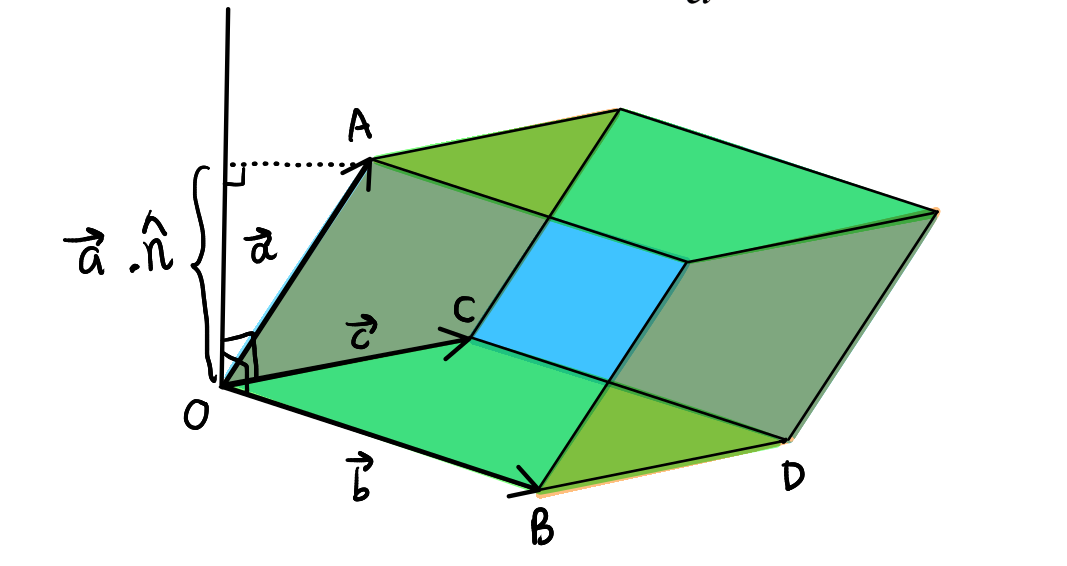
[ a b c ] = a ⋅ ( b × c ) , [\mathbf{a}\,\mathbf{b}\,\mathbf{c}] = \mathbf{a} \cdot (\mathbf{b} \times \mathbf{c}), [ a b c ] = a ⋅ ( b × c ) , represents the volume of a parallelepiped formed by the three vectors a \mathbf{a} a b \mathbf{b} b c \mathbf{c} c
The cross product b × c \mathbf{b} \times \mathbf{c} b × c b \mathbf{b} b c \mathbf{c} c
b × c = ∣ b × c ∣ n , \mathbf{b} \times \mathbf{c} = |\mathbf{b} \times \mathbf{c}| \mathbf{n}, b × c = ∣ b × c ∣ n , where n \mathbf{n} n unit vector normal to the plane containing b \mathbf{b} b c \mathbf{c} c ∣ b × c ∣ |\mathbf{b} \times \mathbf{c}| ∣ b × c ∣ area of the parallelogram formed by these two vectors.
Substituting this in the definition of the scalar triple product,
[ a b c ] = a ⋅ ( ∣ b × c ∣ n ) , [\mathbf{a}\,\mathbf{b}\,\mathbf{c}] = \mathbf{a} \cdot (|\mathbf{b} \times \mathbf{c}| \mathbf{n}), [ a b c ] = a ⋅ ( ∣ b × c ∣ n ) , which simplifies to
[ a b c ] = ∣ b × c ∣ ( a ⋅ n ) . [\mathbf{a}\,\mathbf{b}\,\mathbf{c}] = |\mathbf{b} \times \mathbf{c}| (\mathbf{a} \cdot \mathbf{n}). [ a b c ] = ∣ b × c ∣ ( a ⋅ n ) . The quantity a ⋅ n \mathbf{a} \cdot \mathbf{n} a ⋅ n scalar projection of a \mathbf{a} a n \mathbf{n} n perpendicular height of the parallelepiped when b \mathbf{b} b c \mathbf{c} c
Thus, the product ∣ b × c ∣ ( a ⋅ n ) |\mathbf{b} \times \mathbf{c}| (\mathbf{a} \cdot \mathbf{n}) ∣ b × c ∣ ( a ⋅ n )
One set of parallel opposite faces formed by the parallelograms spanned by a \mathbf{a} a b \mathbf{b} b
Another set formed by b \mathbf{b} b c \mathbf{c} c
A third set formed by c \mathbf{c} c a \mathbf{a} a
The volume of the parallelepiped formed by the vectors a , b , c \mathbf{a}, \mathbf{b}, \mathbf{c} a , b , c
V = ∣ [ a b c ] ∣ V = |[\mathbf{a}\, \mathbf{b}\, \mathbf{c}]| V = ∣ [ a b c ] ∣ Since the scalar triple product can be negative depending on the orientation of the vectors, the absolute value ensures that volume, being a scalar quantity, is always non-negative.
Maximum and Minimum Values of the Scalar Triple Product § The scalar triple product can be rewritten as:
a ⋅ ( b × c ) = a ⋅ ( ∣ b ∣ ∣ c ∣ sin θ n ) , \mathbf{a} \cdot (\mathbf{b} \times \mathbf{c}) = \mathbf{a} \cdot (|\mathbf{b}||\mathbf{c}|\sin\theta \,\mathbf{n}), a ⋅ ( b × c ) = a ⋅ ( ∣ b ∣∣ c ∣ sin θ n ) , where n \mathbf{n} n unit vector perpendicular to both b \mathbf{b} b c \mathbf{c} c right-hand rule . Expanding the dot product,
a ⋅ ( b × c ) = ∣ b ∣ ∣ c ∣ sin θ ( a ⋅ n ) . \mathbf{a} \cdot (\mathbf{b} \times \mathbf{c}) = |\mathbf{b}||\mathbf{c}|\sin\theta \, (\mathbf{a} \cdot \mathbf{n}). a ⋅ ( b × c ) = ∣ b ∣∣ c ∣ sin θ ( a ⋅ n ) . If a \mathbf{a} a ϕ \phi ϕ n \mathbf{n} n
a ⋅ n = ∣ a ∣ ∣ n ∣ cos ϕ = ∣ a ∣ cos ϕ . \mathbf{a} \cdot \mathbf{n} = |\mathbf{a}||\mathbf{n}|\cos\phi = |\mathbf{a}|\cos\phi. a ⋅ n = ∣ a ∣∣ n ∣ cos ϕ = ∣ a ∣ cos ϕ . Thus, the scalar triple product simplifies to:
a ⋅ ( b × c ) = ∣ a ∣ ∣ b ∣ ∣ c ∣ sin θ cos ϕ . \mathbf{a} \cdot (\mathbf{b} \times \mathbf{c}) = |\mathbf{a}||\mathbf{b}||\mathbf{c}|\sin\theta\cos\phi. a ⋅ ( b × c ) = ∣ a ∣∣ b ∣∣ c ∣ sin θ cos ϕ . Since both sin θ \sin\theta sin θ cos ϕ \cos\phi cos ϕ [ − 1 , 1 ] [-1,1] [ − 1 , 1 ]
− ∣ a ∣ ∣ b ∣ ∣ c ∣ ≤ a ⋅ ( b × c ) ≤ ∣ a ∣ ∣ b ∣ ∣ c ∣ . -|\mathbf{a}||\mathbf{b}||\mathbf{c}| \leq \mathbf{a} \cdot (\mathbf{b} \times \mathbf{c}) \leq |\mathbf{a}||\mathbf{b}||\mathbf{c}|. − ∣ a ∣∣ b ∣∣ c ∣ ≤ a ⋅ ( b × c ) ≤ ∣ a ∣∣ b ∣∣ c ∣. The maximum value occurs when sin θ = 1 \sin\theta = 1 sin θ = 1 cos ϕ = 1 \cos\phi = 1 cos ϕ = 1 θ = π 2 \theta = \frac{\pi}{2} θ = 2 π ϕ = 0 \phi = 0 ϕ = 0
b \mathbf{b} b c \mathbf{c} c perpendicular to each other.a \mathbf{a} a parallel to n \mathbf{n} n a \mathbf{a} a b \mathbf{b} b c \mathbf{c} c
Thus, the maximum occurs when a , b , c \mathbf{a}, \mathbf{b}, \mathbf{c} a , b , c mutually perpendicular and follow the right-hand rule.
The minimum value occurs when sin θ = 1 \sin\theta = 1 sin θ = 1 cos ϕ = − 1 \cos\phi = -1 cos ϕ = − 1 θ = π 2 \theta = \frac{\pi}{2} θ = 2 π ϕ = π \phi = \pi ϕ = π
b \mathbf{b} b c \mathbf{c} c perpendicular to each other.a \mathbf{a} a antiparallel to n \mathbf{n} n a \mathbf{a} a b \mathbf{b} b c \mathbf{c} c left-hand rule .
Thus, a ⋅ ( b × c ) \mathbf{a} \cdot (\mathbf{b} \times \mathbf{c}) a ⋅ ( b × c ) maximized when a , b , c \mathbf{a}, \mathbf{b}, \mathbf{c} a , b , c minimized when they follow the left-hand rule.