A plane is a surface that is completely flat. Mathematically, it is a surface such that if we take any two points on it, the line segment joining them also lies entirely on the surface.
We now seek to find an equation that describes a plane. That is, we aim to determine a condition that a point (x,y,z) must satisfy to lie on a given plane. Alternatively, in vector form, if r is the position vector of any point on the plane, we wish to derive the equation that r must satisfy.
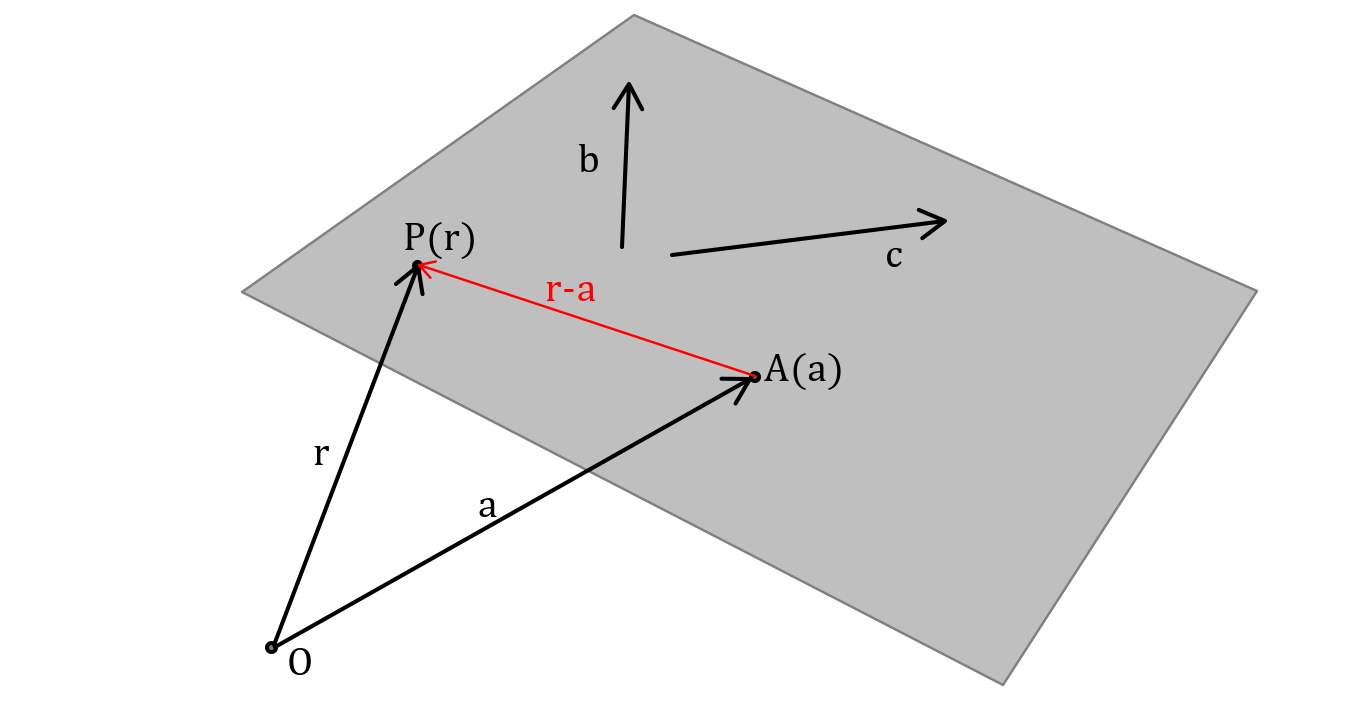
Consider a plane that passes through a fixed point A whose position vector is a. Suppose two non-collinear vectors b and c lie parallel to the plane. Since two non-collinear vectors define a plane, our plane must be parallel to the plane formed by b and c. However, infinitely many such planes exist, all parallel to the plane of b and c. To uniquely specify a single plane, we also require a fixed point A on it. This ensures a unique plane.
To determine the equation of this plane, let P be any point on the plane, with its position vector denoted by r. The displacement vector from A to P is
AP=OP−OA=r−a.
Since AP, b, and c are coplanar, by the fundamental theorem of three-dimensional geometry, the vector r−a must be expressible as a linear combination of b and c:
r−a=λb+μc,λ,μ∈R.
Thus, the equation of the plane is given by
r=a+λb+μc,λ,μ∈R.
By varying λ and μ, we obtain different points r on the plane. These parameters provide a parametric representation of the plane, ensuring that each point on the plane corresponds to a unique pair of values (λ,μ).
Two points and a vector parallel to the plane are known
If two points on the plane are known, along with a vector parallel to the plane, we can determine its equation as follows.
Let A and B be two points on the plane with position vectors a and b, respectively. Suppose a vector c is also given, which is parallel to the plane.
Now, let P be any point on the plane with position vector r. The displacement vectors are:
AP=r−a,AB=b−a.
Since AP, AB, and c are coplanar, we apply the fundamental theorem of three-dimensional geometry, which states that a vector lying in the plane of two other vectors can be expressed as their linear combination. Thus,
r−a=λ(b−a)+μc,λ,μ∈R.
Rearranging, we obtain the equation of the plane:
r=a+λ(b−a)+μc,λ,μ∈R.
Here, λ and μ are independent parameters, allowing us to generate all points r on the plane. This provides a parametric representation of the plane when two specific points and a parallel vector are known.
Parametric forms of planes are not very commonly used, but whenever they appear, one should be able to interpret them correctly.
The equation
r=j+k+s(i−j)+t(2i−j+3k)
represents a plane that is parallel to the vectors i−j and 2i−j+3k and passes through the point whose position vector is j+k.
Here, s and t are independent parameters that generate all points on the plane.
Three points on the plane given
If we know the position vectors of three non-collinear points on a plane, then the plane is uniquely determined.
Let A, B, and C be three points on the plane with position vectors a, b, and c, respectively. Let P be any point on the plane with position vector r.
Since the vectors PA, AB, and AC lie in the plane, they are coplanar. The displacement vectors are:
PA=r−a,AB=b−a,AC=c−a.
By the fundamental theorem of three-dimensional geometry, since these vectors are coplanar, PA must be a linear combination of AB and AC, meaning there exist scalars λ,μ∈R such that:
r−a=λ(b−a)+μ(c−a).
Rearranging,
r=a+λ(b−a)+μ(c−a),λ,μ∈R.
This is the parametric equation of the plane passing through the three given points. Different values of λ and μ generate different points r on the plane.
Given a point A with position vector a on the plane and two non-collinear vectors b and c parallel to the plane, let r be the position vector of an arbitrary point on the plane.
Since the vectors r−a, b, and c are coplanar, instead of expressing r−a as a linear combination of b and c, we use the fact that three vectors are coplanar if and only if their scalar triple product is zero.
(r−a)⋅(b×c)=0
which in determinant form is written as
[r−a,b,c]=0.
Expanding using determinant properties,
[r,b,c]−[a,b,c]=0
which simplifies to
[r,b,c]=[a,b,c].
This provides an alternative implicit form of the plane equation using the scalar triple product.
The normal line of a plane is a line that is perpendicular to every line lying on the plane. This line is said to be perpendicular to the plane itself. A vector parallel to this normal line is called a normal vector to the plane.
We can express the equation of a plane using its normal line or normal vector. The normal vector determines the orientation of the plane, but to uniquely determine the plane, we also require a specific point on it. Given a point on the plane and a normal vector, we can easily derive the equation of the plane.
Let n be a normal vector to the plane, and let a be the position vector of a known point A on the plane. Suppose P is any other general point on the plane, with position vector r.
Since n is perpendicular to every vector lying on the plane, the displacement vector AP, given by
AP=r−a,
must also be perpendicular to n. Thus,
AP⋅n=0.
This gives the equation of the plane in normal form:
(r−a)⋅n=0.
This is the vector equation of a plane using a normal vector.
For example:
Suppose a plane is passing through a point whose position vector is
a=i−j−2k,
and the plane has a normal vector
n=2i+j+k.
Then the equation of the plane is given by
(r−a)⋅n=0⟹r⋅n=a⋅n.
Substituting the given vectors,
r⋅(2i+j+k)=(i−j−2k)⋅(2i+j+k)⟹r⋅(2i+j+k)=2−1−2=−1.
Thus,
r⋅(2i+j+k)=−1.
Now, if r=xi+yj+zk, that is, if the terminal point is (x,y,z), then
(xi+yj+zk)⋅(2i+j+k)=−1⟹2x+y+z=−1.
This is the Cartesian form of the equation of the plane. We will study this form in detail soon.
The quantity a⋅n is a scalar constant that depends only on the given point a on the plane and the normal vector n. Let this constant be denoted by d. Then the equation becomes
r⋅n=d.
Thus, any plane whose equation is written using a normal vector reduces to the general form
r⋅n=d,
where n is a fixed non-zero vector (the normal vector), and d∈R is a constant. This compact expression captures all planes in space through a linear condition on the dot product of the position vector r with the normal vector.
As discussed earlier, to write the equation of a plane, we require two pieces of data:
– a point on the plane, and
– a vector normal to the plane.
Let a line normal to the plane have direction ratios (a,b,c), and let it pass through a point A(x1,y1,z1) on the plane. Let P(x,y,z) be any other point on the plane. Then the direction ratios of the vector AP are
(x−x1,y−y1,z−z1).
Since vector AP lies on the plane and the normal vector is perpendicular to every vector on the plane, it follows that
a(x−x1)+b(y−y1)+c(z−z1)=0.
This is the Cartesian equation of the plane. It is a first-degree equation in x,y,z, and all such equations represent planes in three-dimensional space.
Example:
Suppose a plane has a normal vector with direction ratios (1,−1,2), and passes through the point (0,1,−2). Then the equation of the plane is:
If we expand the general equation of a plane written using a point and a normal vector:
a(x−x1)+b(y−y1)+c(z−z1)=0,
we obtain:
ax+by+cz−(ax1+by1+cz1)=0.
The last term is constant, so denote it by d=−(ax1+by1+cz1). Hence, the equation becomes
ax+by+cz+d=0.
This shows that any plane can be represented by an equation of the form
ax+by+cz+d=0.
But is the converse also true? That is, does any equation of the form ax+by+cz+d=0, where a,b,c are not all zero, always represent a plane?
Yes, it does. Let us prove this.
Assume that
ax+by+cz+d=0
defines some surface in R3. Let P1=(x1,y1,z1) and P2=(x2,y2,z2) be any two points satisfying this equation. Then:
ax1+by1+cz1+d=0,ax2+by2+cz2+d=0.
Subtracting the two equations,
a(x1−x2)+b(y1−y2)+c(z1−z2)=0.
Now, let
P1P2=(x2−x1)i+(y2−y1)j+(z2−z1)k,
and let
n=ai+bj+ck.
The above scalar equation
a(x1−x2)+b(y1−y2)+c(z1−z2)=0
is precisely
P1P2⋅n=0,
i.e., the vector joining any two points on the surface is orthogonal to the fixed vectorn. Hence, n is perpendicular to every line segment joining two points on the surface. This implies that the entire surface lies in a plane orthogonal to n.
Thus,
ax+by+cz+d=0
always represents a plane (provided a,b,c are not all zero).
Interpreting ax+by+cz+d=0:
One should be able to interpret the equation
ax+by+cz+d=0
geometrically. This is the Cartesian form of the equation of a plane. It represents a plane in three-dimensional space, provided that a,b,c are not all zero.
The key point is that the vector
n=ai+bj+ck
is normal (perpendicular) to the plane. That is, the plane has normal direction ratios(a,b,c), or equivalently, it has a normal vectorn pointing in the direction ai+bj+ck.
So whenever one sees an equation of the form
ax+by+cz+d=0,
they should immediately interpret it as describing a plane whose normal vector is
n=ai+bj+ck.
This vector determines the orientation of the plane.
Other Important Interpretations of the Plane Equation ax+by+cz+d=0
If d=0:
The equation becomes
ax+by+cz=0,
which clearly passes through the origin (0,0,0). So whenever d=0, the plane passes through the origin.
If c=0:
The equation becomes
ax+by+d=0.
There is no z-term, which means z can take any real value independently. This looks like a straight line equation in the xy-plane, but in three dimensions, it describes a plane parallel to the z-axis.
To justify this rigorously: if a plane is parallel to the z-axis, then its normal vector must be perpendicular to the z-axis. Here, the normal vector is
n=ai+bj,and the direction of the z-axis is k.
Since
n⋅k=0,
the plane is indeed perpendicular to k, meaning it is parallel to the z-axis.
If b=0:
The equation becomes
ax+cz+d=0.
There is no y-term, so y is unrestricted. The plane is therefore parallel to the y-axis.
Similarly, if a=0, the plane is parallel to the x-axis.
If b=0 and c=0:
The equation becomes
ax+d=0,
so x is fixed, and y,z are free. The plane is parallel to both y-axis and z-axis, and hence perpendicular to the x-axis.
Similarly:
If a=0 and c=0, the plane is perpendicular to the y-axis.
If a=0 and b=0, the plane is perpendicular to the z-axis.
All of a,b,c cannot be zero simultaneously.
If a=b=c=0, the equation becomes
0x+0y+0z+d=0⟹d=0,
which is either always true or always false depending on the value of d, and hence does not define a plane. Therefore, at least one of a,b,c must be non-zero for the equation to represent a plane.
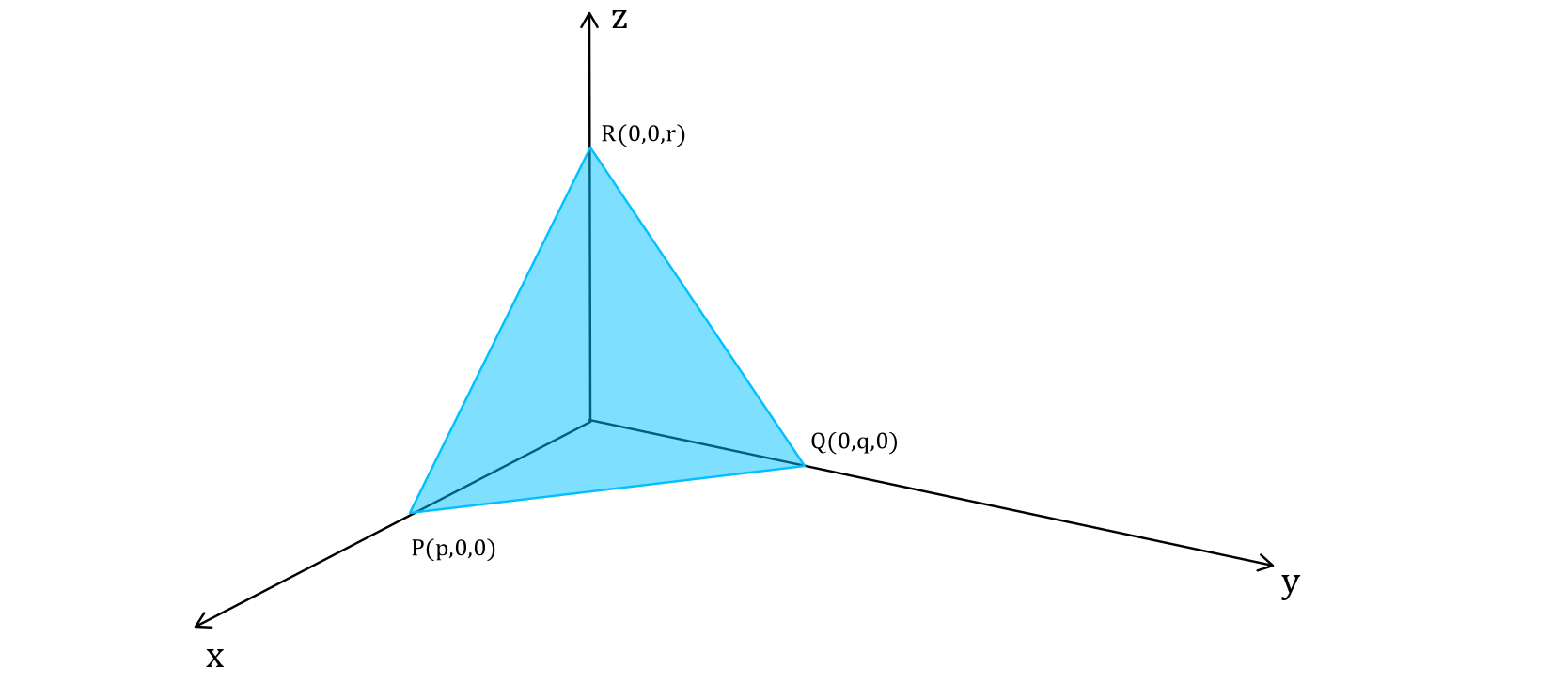
If a plane cuts the x-axis at point P(p,0,0), we say its x-intercept is p.
If it cuts the y-axis at point Q(0,q,0), its y-intercept is q.
If it cuts the z-axis at point R(0,0,r), its z-intercept is r.
Given these three intercepts p,q,r=0, the points P,Q,R are all on the plane. Since we are given three non-collinear points, the plane is uniquely determined.
So the normal vector is n=qri+prj+pqk, and we can now write the equation of the plane using point P(p,0,0) and normal vector n:
a(x−p)+b(y−0)+c(z−0)=0,
where a=qr,b=pr,c=pq. Substituting:
qr(x−p)+pr(y)+pq(z)=0.
Divide the entire equation by pqr=0:
px+qy+rz=1.
This is the intercept form of the equation of a plane. It represents a plane that cuts the x-, y-, and z-axes at p,q,r respectively (none of which are zero).
The normalized form of a plane reveals a lot about the orientation and position of the plane in space.
Suppose the equation of a plane is given in vector form as
r⋅n=d,
or equivalently in Cartesian form as
ax+by+cz+d=0.
Can we understand the orientation of the plane just by looking at this equation? One way is to rewrite the equation in intercept form, which gives immediate geometric insight. But a more refined and analytically rich way is to write the equation in normalized form.
Assume the plane is given in the form
r⋅n=d,
where n is the normal vector and d>0. (If d<0, we simply multiply both sides by −1 to make the right-hand side positive. For instance,
r⋅(i+j−k)=−3can be written asr⋅(−i−j+k)=3.)
Now, divide both sides by the magnitude of the normal vector ∣n∣:
r⋅∣n∣n=∣n∣d.
Let
n^=∣n∣n,d0=∣n∣d.
Then the equation becomes
r⋅n^=d0.
This is the normalized form of the plane. It satisfies two properties:
– n^ is a unit vector normal to the plane,
– d0>0 is a scalar.
But this form tells much more.
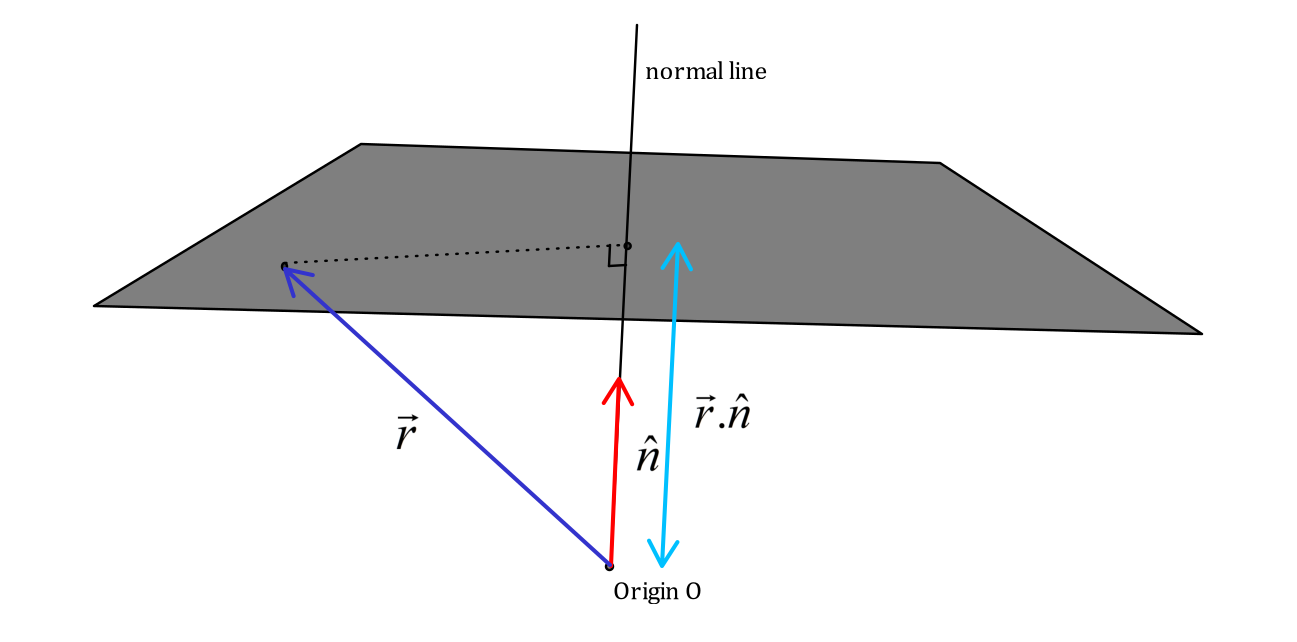
Recall that r is the position vector of any point on the plane. Then r⋅n^ is the projection of r along the direction of n^. Since
r⋅n^=d0>0,
this projection is positive, meaning that the angle between r and n^ is acute. Wherever r lies on the plane, the angle between it and the unit normal vector n^ is always acute.
Now observe this geometrically: the projection of r onto n^ is always a segment of length d0, and since r⋅n^=d0 for all r on the plane, this implies the entire plane lies at a fixed perpendicular distanced0 from the origin.
Thus:
n^ points from the origin toward the plane,
d0 is the perpendicular distance from the origin to the plane.
Hence, the normalized form
r⋅n^=d0,with d0>0,
encodes direction, orientation, and distance all at once.
For example, consider the plane given by the equation
r⋅(i−j+k)+3=0.
This can be rewritten as
r⋅(−i+j−k)=3.
Now compute the magnitude of the normal vector:
∣−i+j−k∣=12+12+12=3.
Divide both sides by 3 to obtain the normalized form:
r⋅(3−i+j−k)=3.
Thus, the plane lies at a distance 3 from the origin, and the unit normal vector
n^=3−i+j−k
points from the origin toward the plane.
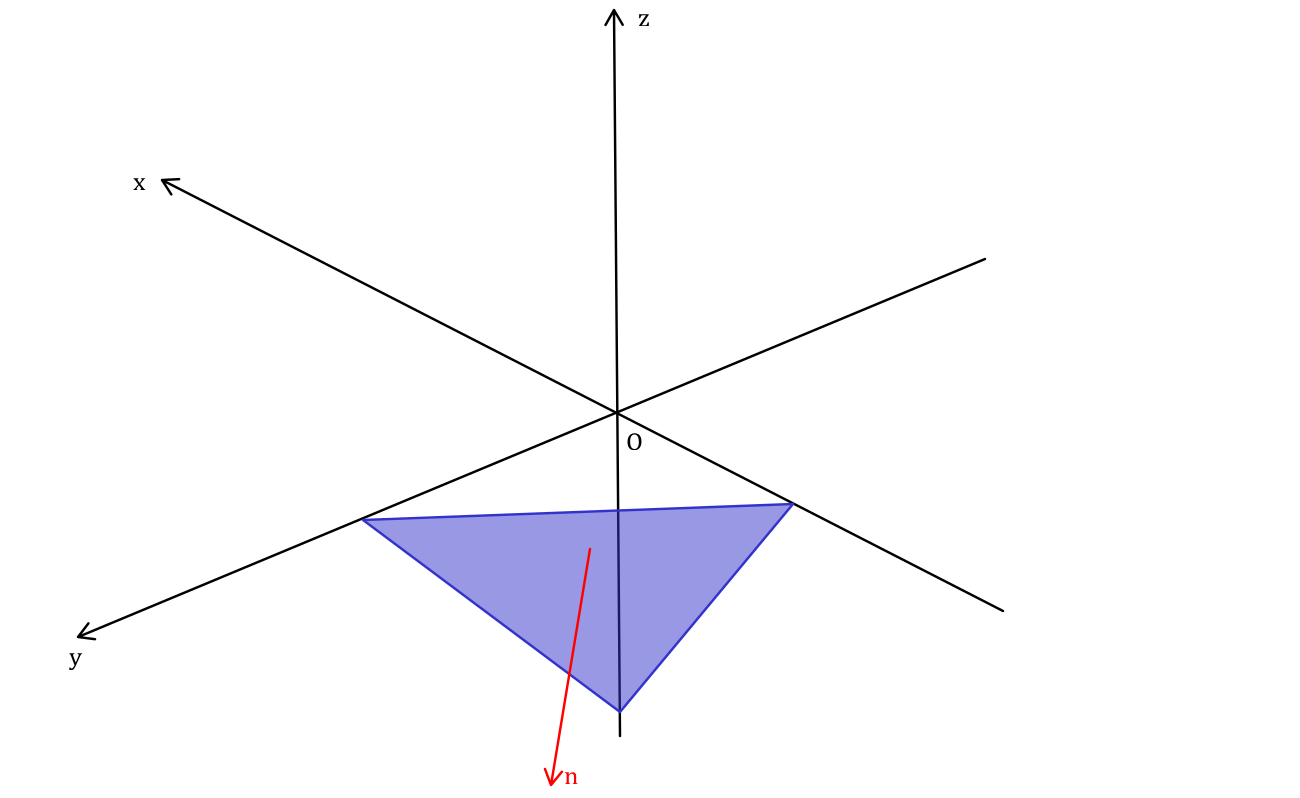
The direction of this vector shows that the plane is oriented to cut:
– the negative x-axis (since the i-component is negative),
– the positive y-axis (since the j-component is positive),
– the negative z-axis (since the k-component is negative).
This geometric picture is captured in the figure above: the red vector n is the unit normal from the origin to the plane, and the perpendicular length from the origin to the plane is 3.
So, in normalized form, the equation
r⋅n^=d0
gives both the orientation (via n^) and the position (via d0) of the plane in a geometrically meaningful way.
Normalized Cartesian Form
If the equation of the plane is given in Cartesian form as
ax+by+cz+d=0,
then we first rearrange it as
ax+by+cz=−d.
To express this in normalized form, we must ensure that the right-hand side is positive. If −d>0, proceed directly. If −d<0, multiply both sides by −1 to make the right-hand side positive.
Now divide both sides by
a2+b2+c2,
which is the magnitude ∣n∣ of the normal vector n=ai+bj+ck.
We get:
a2+b2+c2ax+by+cz=a2+b2+c2−d.
Let
n^=a2+b2+c2ai+bj+ck,d0=a2+b2+c2−d.
Then the equation becomes
r⋅n^=d0,
which is the normalized form of the plane. It gives a unit normal vector n^ pointing from the origin toward the plane, and d0>0 is the perpendicular distance of the plane from the origin.
When a point P lies near a plane Π, we are often interested in certain geometric quantities that describe the relationship between the point and the plane. These include:
– the perpendicular distance from point P to the plane Π,
– the foot of the perpendicular from P onto the plane Π,
– the image of point P with respect to the plane Π (i.e., its reflection across the plane).
We shall now learn how to compute all of these using both the vector form and the Cartesian form of the equation of a plane.
Consider a point P having position vector p, and a plane given by the equation
(r−a)⋅n=0,
representing a plane that passes through point A, whose position vector is a, and has a normal vector n.
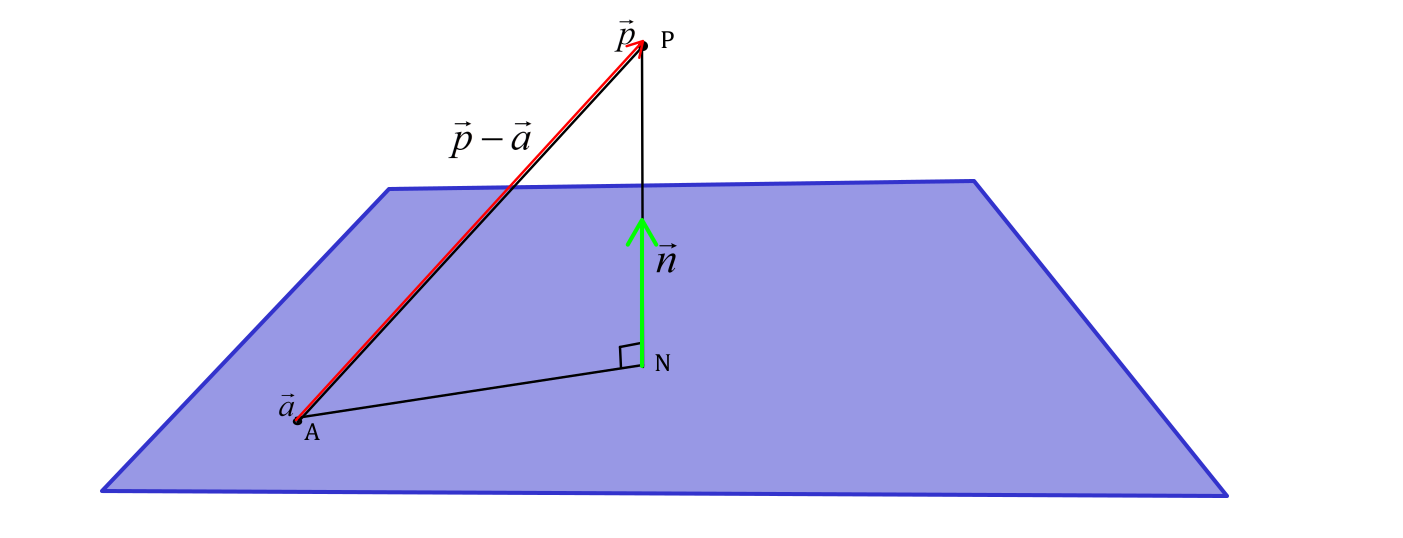
Drop a perpendicular from point P to the plane, and let it meet the plane at point N. Then triangle △APN is a right-angled triangle at N, and the vector n lies along the direction of PN, the perpendicular from P to the plane.
The vector from A to P is
AP=p−a.
The length of the perpendicular segment PN is the magnitude of the projection of vector AP along n. That is,
∣PN∣=∣n∣(p−a)⋅n=∣n∣∣(p−a)⋅n∣.
This expression gives the perpendicular distance from point P to the plane.
Calculation of Foot:
Let us now compute the foot of the perpendicular from the point P.
Let N be the foot of the perpendicular from P onto the plane. Then the vector NP is the projection of AP along the normal direction, i.e.,
NP=(∣n∣2(p−a)⋅n)n.
Since
OP−ON=NP,
we get:
ON=OP−NP=p−(∣n∣2(p−a)⋅n)n.
Hence, the position vector of the foot N of point P on the plane is:
rN=p−∣n∣2(p−a)⋅nn.
Calculation of Perpendicular Distance and Foot when the Plane is in General Vector Form
But in most problems, the plane is not given in the form (r−a)⋅n=0. Instead, it is typically given in the form
r⋅n=d,
which does not explicitly mention any point a on the plane.
Let us compute the perpendicular distance from a point P, having position vector p, to the plane Π with equation r⋅n=d.
From point P, drop a perpendicular to the plane. Let this perpendicular meet the plane at point N, the foot of the perpendicular. Since the line segment PN is perpendicular to the plane, it must be parallel to the normal vectorn.
Hence, the line passing through point P and directed along n is given by
r=p+λn,λ∈R.
To find the foot N, we need the value of λ such that this point lies on the plane. Substituting into the plane equation:
This is the general formula for the perpendicular distance from a point to a plane given in the form r⋅n=d.
While computing the perpendicular distance from point P to the plane r⋅n=d, we also obtained the foot of the perpendicular, that is, the point N on the plane where the perpendicular from P meets the plane.
This point N has position vector
rN=p+∣n∣2d−p⋅nn.
Cartesian Form of Plane: Foot of the Perpendicular and Distance from a Point to a Plane§
Consider a plane Π given by
ax+by+cz+d=0,
and a point P(x0,y0,z0) in space. Drop a perpendicular PN from the point P to the plane. Let the foot of this perpendicular be N. Since PN is normal to the plane, its direction ratios are (a,b,c).
Let us now write the equation of the line passing through P and perpendicular to the plane. The direction ratios are (a,b,c), and the line passes through (x0,y0,z0), so the line is given by:
ax−x0=by−y0=cz−z0=λ.
This gives the coordinates of any point on the line as:
x=aλ+x0,y=bλ+y0,z=cλ+z0.
Since point N lies on this line and also lies on the plane, it must satisfy the plane equation. Substituting into the plane equation:
The calculation of the image of a point with respect to a plane is quite straightforward.
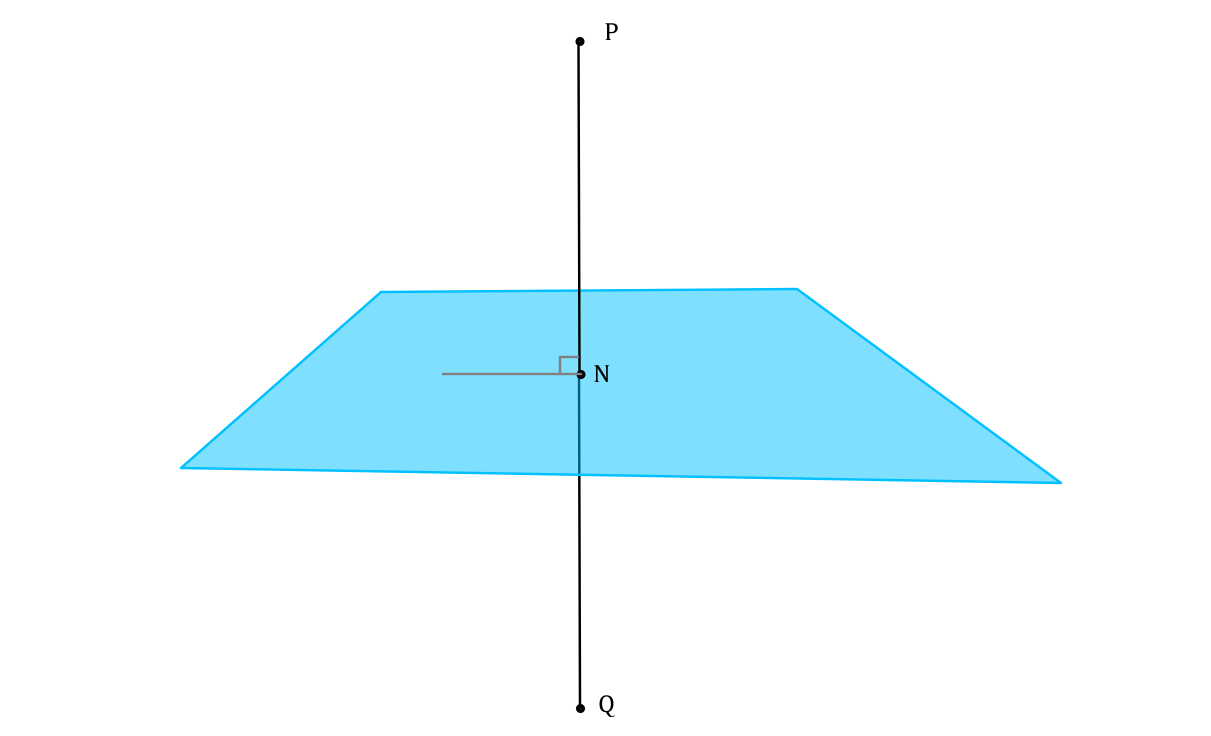
Let Q be the image of a point P in a plane Π. Then, by definition, the midpoint of the segment PQ lies on the plane and is the foot of the perpendicular from P to the plane. Let this foot be denoted by N.
Since N is the midpoint of P and Q, we have:
Q=2N−P.
So to compute the image point Q, we first compute the foot N of point P on the plane, and then use the midpoint formula to compute Q.
There is also a direct formula to calculate the image of point P(x0,y0,z0) in the plane
ax+by+cz+d=0,
without computing the foot explicitly.
The image point Q(x,y,z) satisfies the symmetric equation:
This formula is similar to the one used for the foot of the perpendicular, but now includes a factor of 2 in the numerator. This factor appears because the image point lies on the opposite side of the plane, at the same distance as P, along the line perpendicular to the plane.
You are encouraged to derive this formula yourself in the same we derived foot formula above.
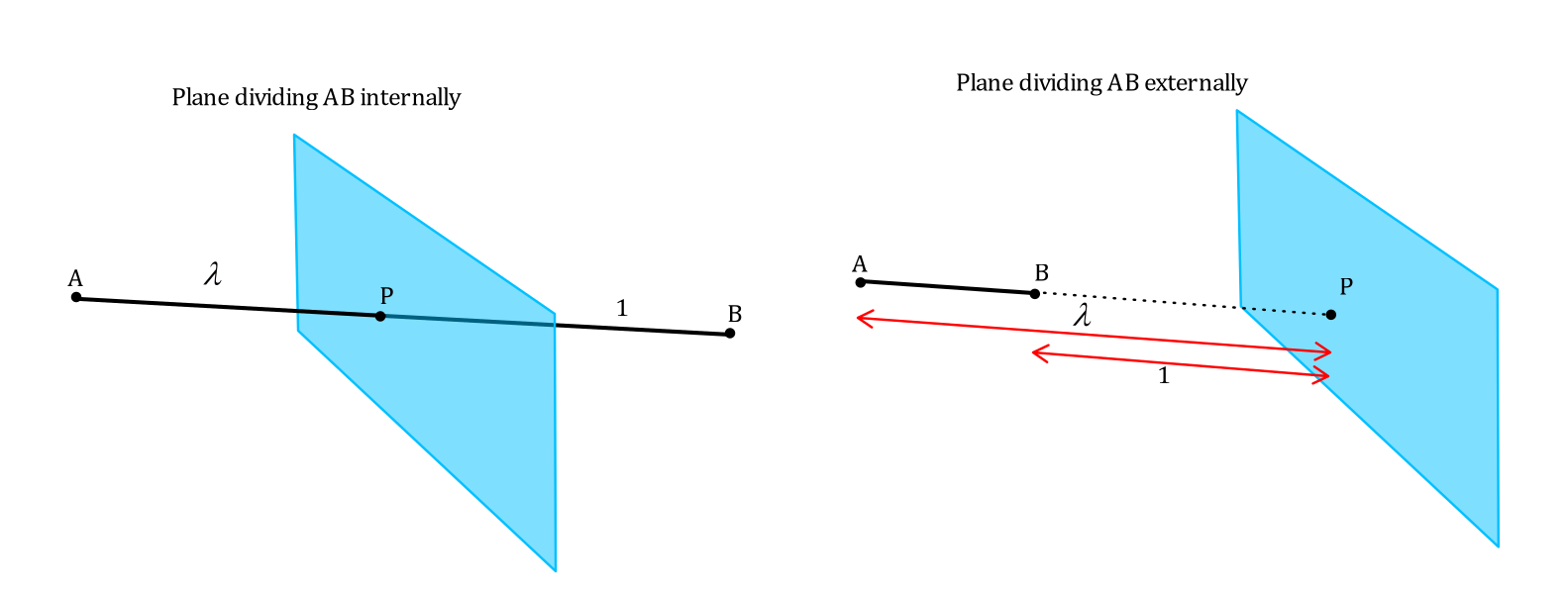
The division may be internal or external, depending on the sign of the ratio. Let the plane Π intersect the line segment AB at a point P. Assume that P divides AB in the ratio λ:1, where λ∈R.
Then, by the section formula, the coordinates of point P are:
(λ+1λx2+x1,λ+1λy2+y1,λ+1λz2+z1).
Since P lies on the plane Π, it must satisfy the plane equation. Substituting the coordinates of P into the plane equation:
Combine all terms over the common denominator λ+1:
λ+1λ(ax2+by2+cz2)+(ax1+by1+cz1)+d=0.
Multiply both sides by λ+1:
λ(ax2+by2+cz2)+(ax1+by1+cz1)+d(λ+1)=0.
Group and simplify:
λ(ax2+by2+cz2+d)+(ax1+by1+cz1+d)=0.
Isolating λ:
λ=−ax2+by2+cz2+dax1+by1+cz1+d.
This can be abbreviated as
λ=−Π(x2,y2,z2)Π(x1,y1,z1),
where Π(x,y,z) denotes the left-hand side of the plane equation evaluated at that point.
Thus, to find the ratio in which the plane divides the segment AB, we evaluate the plane equation at both endpoints, and take the negative ratio.
Relative Location of Points with Respect to a Plane§
Consider two points
A(x1,y1,z1)andB(x2,y2,z2)
in space, and let there be a plane
Π:ax+by+cz+d=0.
We wish to determine whether the points A and B lie on the same side of the plane, on opposite sides, or if either of them lies on the plane.
This concept has wide relevance—not just in geometry, but also in machine learning, where it is used to classify objects. For instance, an algorithm might learn to distinguish a cat from a dog by representing them as points in a high-dimensional space, and then using a plane (called a decision boundary) to separate the two classes. This geometric idea is precisely what's happening here.
Let us now analyze the situation.
Evaluate the left-hand side of the plane equation at both points:
Π(A)=ax1+by1+cz1+d,Π(B)=ax2+by2+cz2+d.
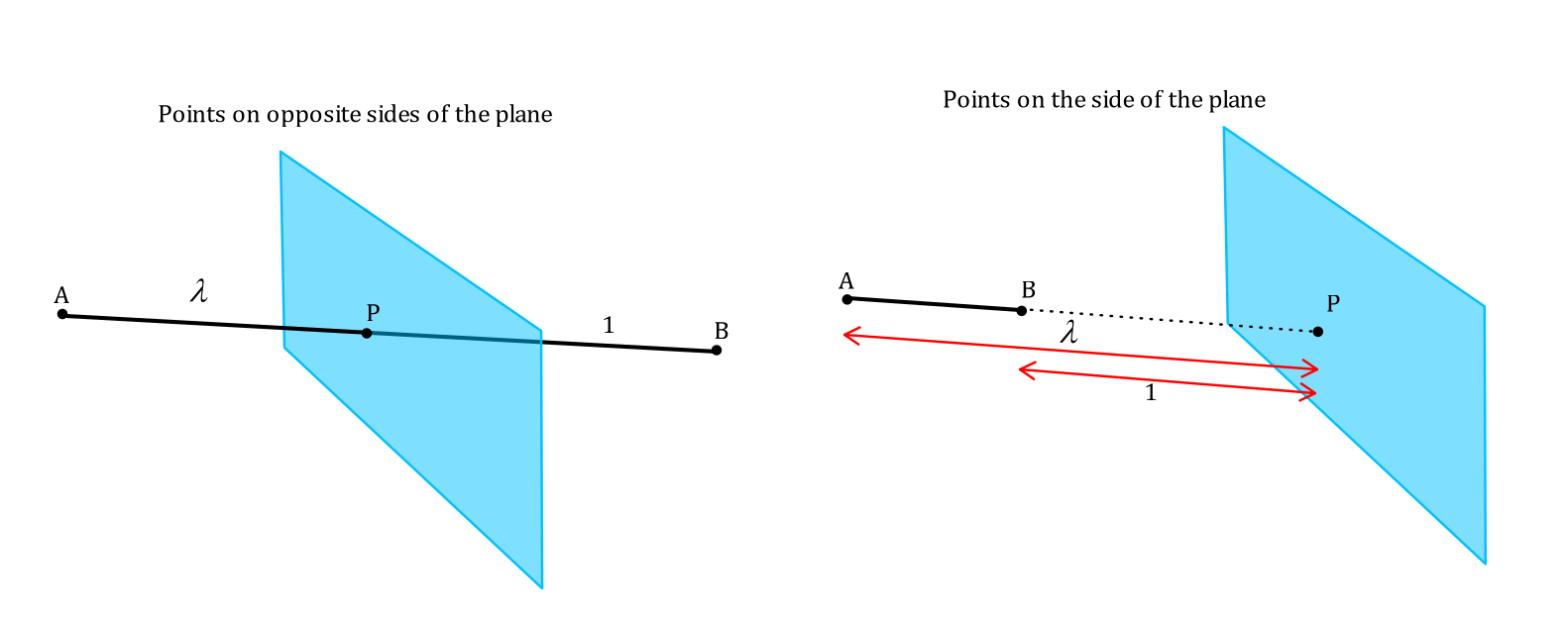
Now suppose A and B lie on opposite sides of the plane. Then the plane divides the line segmentABinternally, and the ratio in which it divides is
λ=−ax2+by2+cz2+dax1+by1+cz1+d.
Since this is an internal division, the ratio λ must be positive, so:
−Π(B)Π(A)>0⟹Π(B)Π(A)<0⟹Π(A)⋅Π(B)<0.
That is, the two evaluated expressions must have opposite signs, meaning the two points are on opposite sides of the plane.
Similarly, if both points lie on the same side of the plane, then the plane divides the line joining them externally, and the ratio λ is negative, so:
−Π(B)Π(A)<0⟹Π(A)⋅Π(B)>0.
Thus:
In simple terms, if two points are on the same side of a plane, then when we substitute their coordinates into the left-hand side of the plane equation
ax+by+cz+d,
both will give values with the same sign—either both positive or both negative.
On the other hand, if the two points are on opposite sides of the plane, then substituting their coordinates into the left-hand side of the plane equation will give opposite signs—one positive and one negative.
This leads to an important geometric conclusion:
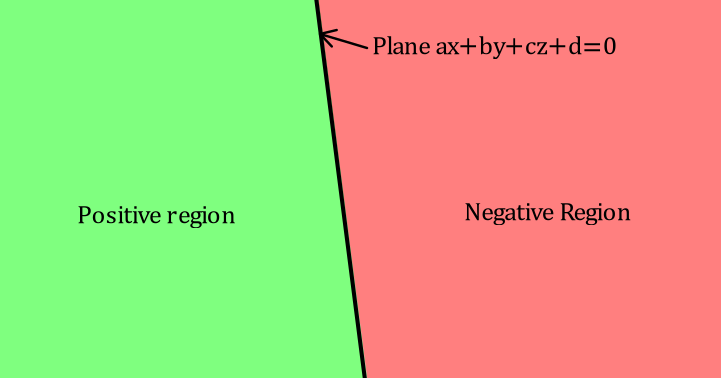
A plane divides the entire space into two distinct regions—
– In one region, every point gives a positive value when substituted into the plane equation.
– In the other region, every point gives a negative value.
– The points on the plane itself are precisely those for which the value is zero.
This is the fundamental idea behind how a plane partitions space.
In vector form, a plane is written as
r⋅n=d,
where n is the normal vector to the plane and d is a constant.
Just like in Cartesian form, this equation divides space into three parts:
– For points on the plane:
r⋅n=d.
– For points on one side of the plane:
r⋅n>d.
– For points on the other side of the plane:
r⋅n<d.
Thus, the plane divides space into two regions:
– One region where every point satisfies r⋅n>d,
– Another region where every point satisfies r⋅n<d.
Distance of a Point from a Plane Measured Along a Given Line§
Consider a plane given by
ax+by+cz+d=0,
and a point P(x0,y0,z0) in space.
We already have the standard formula to measure the perpendicular distance from P to the plane—that is, the shortest distance measured along the normal to the plane.
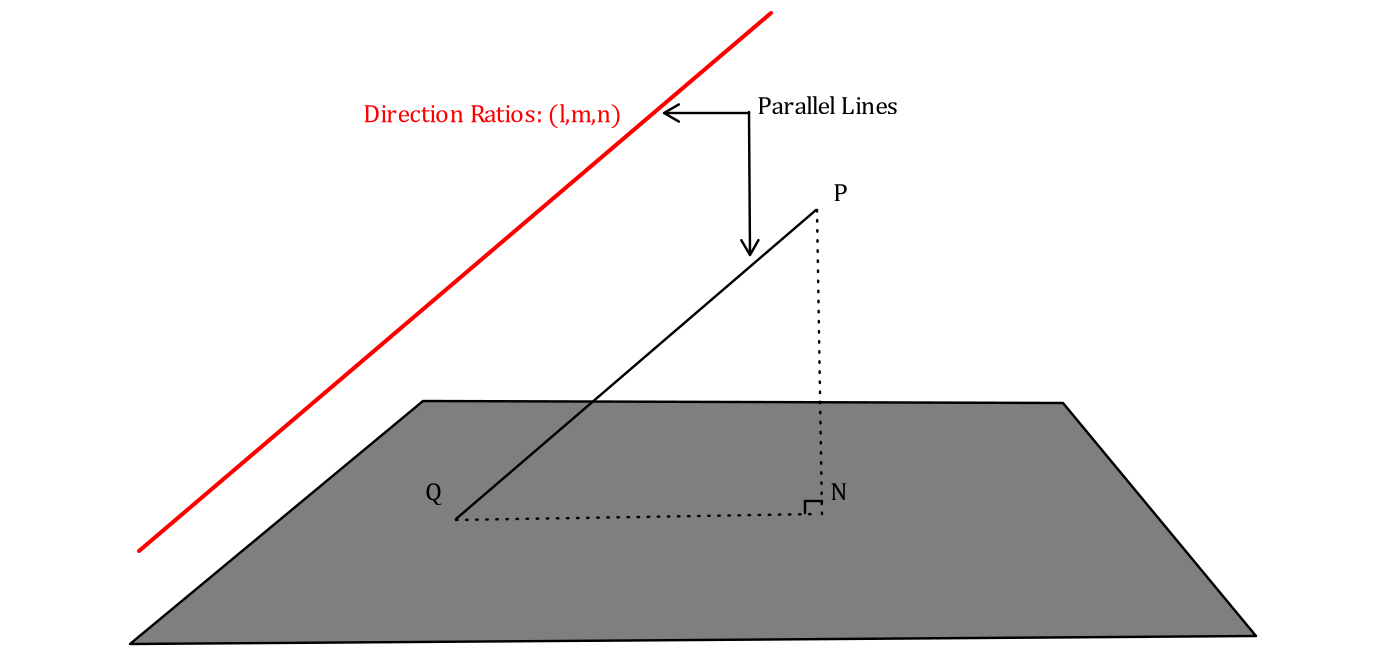
But suppose we want to measure the distance from P to the plane along some other line, not necessarily perpendicular to the plane. Let this line have direction ratiosl,m,n.
That is, we draw a line passing through point P with direction ratios (l,m,n), and let this line intersect the plane at a point Q. The length of the segment PQ is then what we call the distance of point P from the plane measured along the line l,m,n.
We begin by writing the equation of the line PQ in symmetric form:
lx−x0=my−y0=nz−z0=λ.
Hence, the coordinates of point Q can be expressed as:
x=lλ+x0,y=mλ+y0,z=nλ+z0,
for some λ∈R.
Now, since point Q lies on the plane, it must satisfy the plane equation. Substituting: