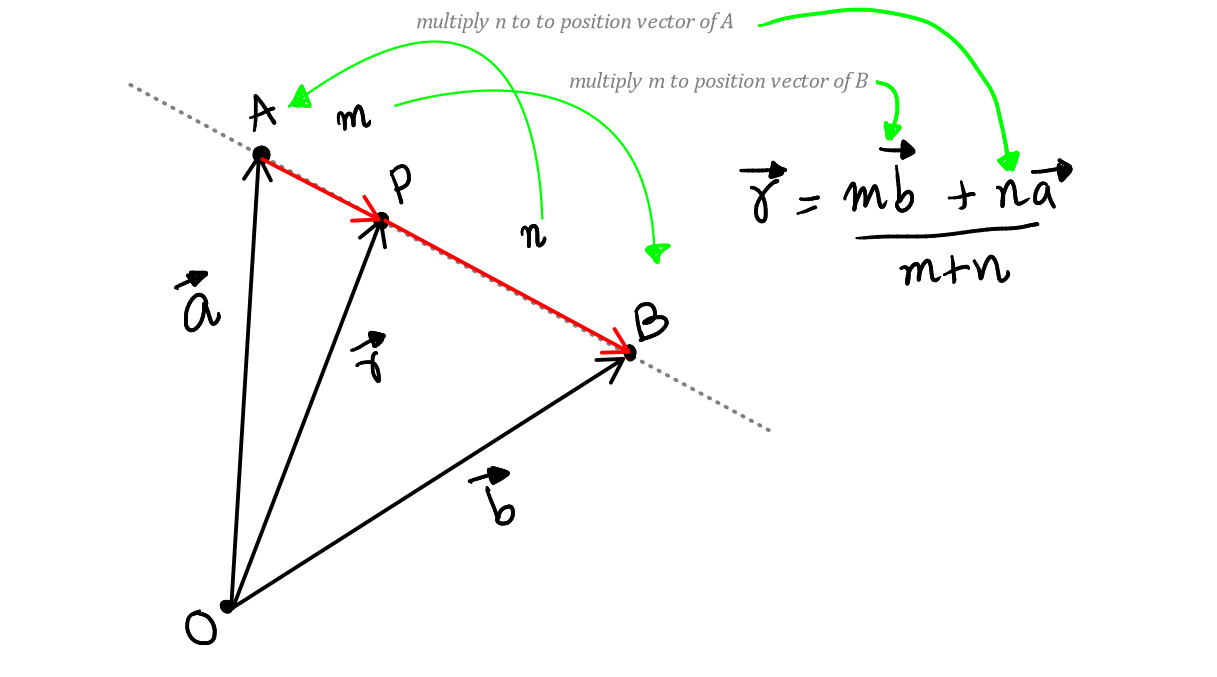
Let A and B be two points in space, and let O be our chosen reference point. The position vectors of A and B with respect to O are given by
OA=a,OB=b.
There exists a point P that divides the line segmentABinternally in the ratio m:n, meaning:
∣PB∣∣AP∣=nm.
We aim to determine the position vectorr of P, where
OP=r.
Since P lies on the line segment AB, the displacement vectors satisfy:
AP=OP−OA=r−a,PB=OB−OP=b−r.
From the given ratio,
n∣AP∣=m∣PB∣.
Since AP and PB are collinear, this implies a vector equation:
nAP=mPB.
Substituting,
n(r−a)=m(b−r).
Expanding,
nr−na=mb−mr.
Rearranging terms,
nr+mr=mb+na.
Factoring r,
(m+n)r=mb+na.
Dividing by m+n,
r=m+nmb+na.
Thus, the position vector of P, which divides AB internally in the ratio m:n, is given by:
OP=m+nmb+na.
This result is the section formula in vector form, which provides a way to determine the position vector of a point dividing a line segment in a given ratio.
For example, if the point Pdivides the line segment AB internally in the ratio 1:2, then we set m=1 and n=2.
Using the section formula:
r=m+nmb+na,
substituting m=1 and n=2, we obtain:
r=1+21⋅b+2⋅a.
Simplifying,
r=3b+2a.
Thus, the position vector of P is:
OP=3b+2a.
This means P is positioned closer to A than to B, at a distance of one-third the way along AB from A.
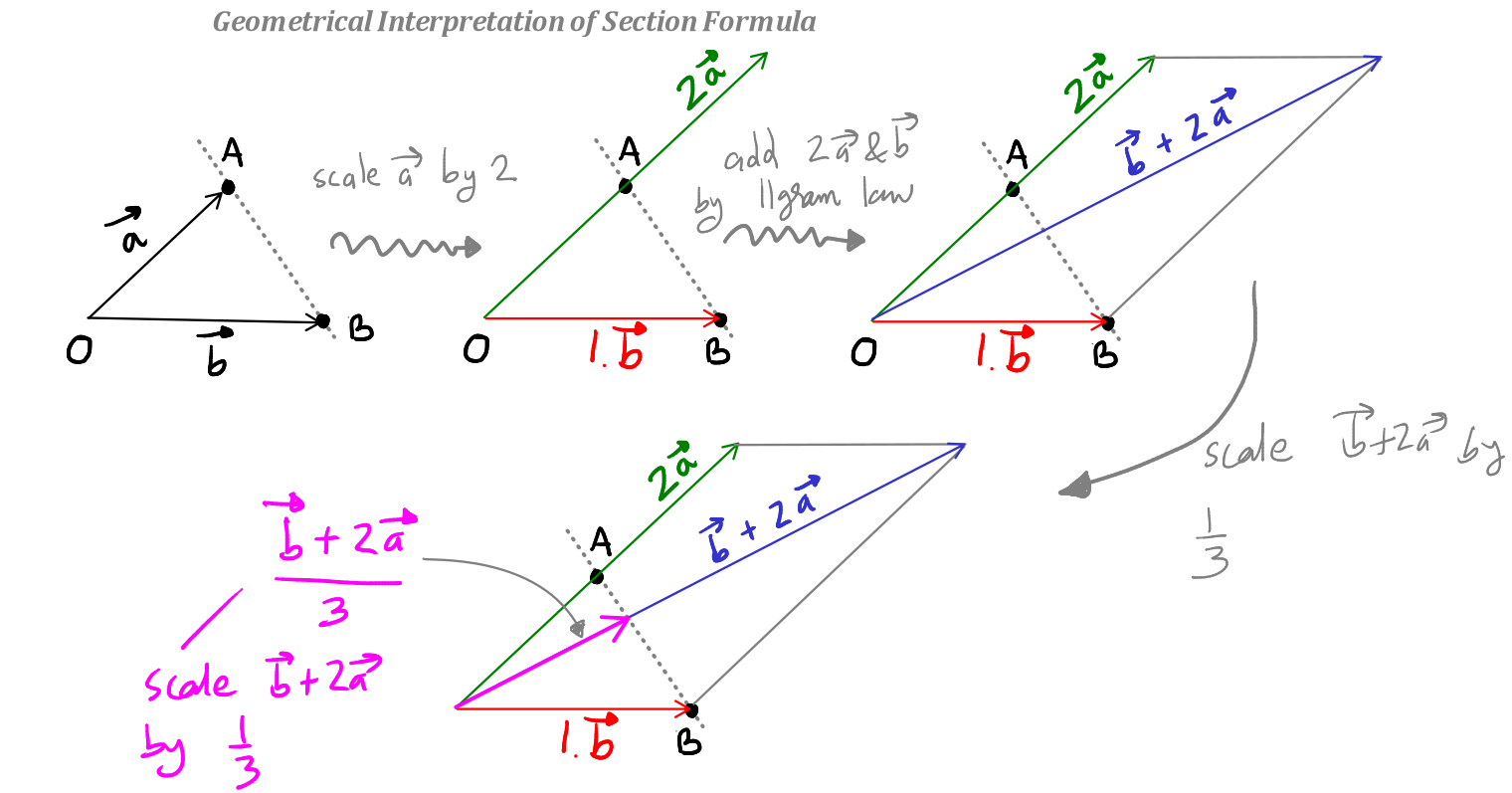
The geometrical interpretation of the section formula in this case, where P divides AB in the ratio 1:2, can be done as follows:
The position vector of A is given by a=OA and that of B is b=OB.
Since P divides AB in the ratio 1:2, the formula for the position vector of P is:
OP=1+21⋅b+2⋅a=3b+2a.
Scaling Step:
The vector a is scaled by 2 to obtain 2a, which places it twice as long in the same direction as a.
The vector b is kept as it is.
Vector Addition using the Parallelogram Law:
The sum b+2a is obtained using the parallelogram law of vector addition, which gives a resultant vector pointing to an extended point.
Scaling the Result:
The resultant vector b+2a is then scaled by 31 to bring it into the correct ratio.
This ensures that the new vector 3b+2a correctly positions P along AB at one-third the way from A to B.
Instead of expressing the division ratio as m:n, it can be rewritten in the form
m:n=nm:1.
Let
λ=nm.
This means that the point P divides AB in the ratio λ:1, where λ is a single scalar. Using the section formula, the position vector of P is
r=m+nmb+na.
Substituting m=λn,
r=λn+nλnb+na.
Factoring out n in both numerator and denominator,
r=n(λ+1)n(λb+a).
Canceling n,
r=λ+1λb+a.
Thus, when expressing the ratio as λ:1, the position vector of the dividing point simplifies to:
r=λ+1λb+a.
This form is often useful, as it expresses the section formula in terms of a single parameter λ rather than two separate values m and n.
Another alternative way to express the section formula is by considering the fractional position along the segment rather than the direct ratio of segment parts. Instead of knowing the ratio AP:PB=m:n or λ:1, suppose we know the ratio AP:AB=λ, meaning that P is located at a fraction λ of the total segment AB.
Since AB=AP+PB, the ratio can be rewritten as:
AP:AB=λ⇒AP:PB=λ:(1−λ).
Using this ratio in the standard section formula, the position vector of P is given by:
r=λ+(1−λ)λb+(1−λ)a.
Since λ+(1−λ)=1, this simplifies to:
r=λb+(1−λ)a.
Thus, when the known ratio is AP:AB = λ (instead of AP:PB), the position vector of P is given by:
r=λb+(1−λ)a.
This formulation is particularly useful because it eliminates the fraction that appears in the standard section formula, making calculations simpler and more efficient in many cases. Instead of working with a numerator and denominator, we directly express the position vector of P as a linear combination of a and b:
r=λb+(1−λ)a.
Since there is no division, this expression is often easier to manipulate in problems involving vector equations.
Moreover, this form provides an intuitive way to interpret the position vector r as a weighted sum of a and b, where λ determines how much contribution comes from each. If λ=0, we recover r=a (point P coincides with A), and if λ=1, we get r=b (point P coincides with B).
Consider three points A,B,P such that P lies on the line joiningA and B but not on the segment AB. The point P divides ABexternally in the ratio:
AP:PB=m:n.
We aim to determine the position vector of P in terms of the position vectors of A and B.
Let the position vectors of A, B, and P with respect to a chosen reference point O be:
OA=a,OB=b,OP=r.
Since P lies externally, the ratio AP:PB=m:n implies that:
If m<n, then P lies beyond A on the extension of AB.
If m>n, then P lies beyond B on the extension of AB.
The vectors PA and PB can be written as:
PA=a−r,PB=b−r.
Since the vectors PA and PB are collinear and have the same sense and also from the given ratio:
n∣PA∣=m∣PB∣,
this implies:
nPA=mPB.
Substituting the expressions for PA and PB:
n(a−r)=m(b−r).
Expanding:
na−nr=mb−mr.
Rearranging:
mb−na=mr−nr.
Factoring r:
mb−na=(m−n)r.
Dividing by (m−n), we obtain the position vector of P:
r=m−nmb−na.
Thus, if Pdivides AB externally in the ratio m:n, its position vector is:
OP=m−nmb−na.
This formula shows that external division results in a difference in the denominator, unlike the internal division formula, which has a sum.
Midpoint Formula
The midpoint of a line segment joining two points A and B is the point that divides the segment into two equal parts. This corresponds to the special case of the section formula where the ratio is 1:1.
Let A and B have position vectors:
OA=a,OB=b.
Since the midpoint M divides AB in the ratio 1:1, applying the internal division formula:
OM=1+11⋅b+1⋅a.
Simplifying,
OM=2a+b.
Thus, the position vector of the midpoint is:
M=2a+b.
Point of Trisection Formula
A point of trisection divides a line segment in the ratio 1:2 or 2:1.
Let P and Q be the points that divide the segment ABinternally in the ratio 1:2 and 2:1, respectively.
Consider a triangle with verticesA,B,C having position vectors:
OA=a,OB=b,OC=c.
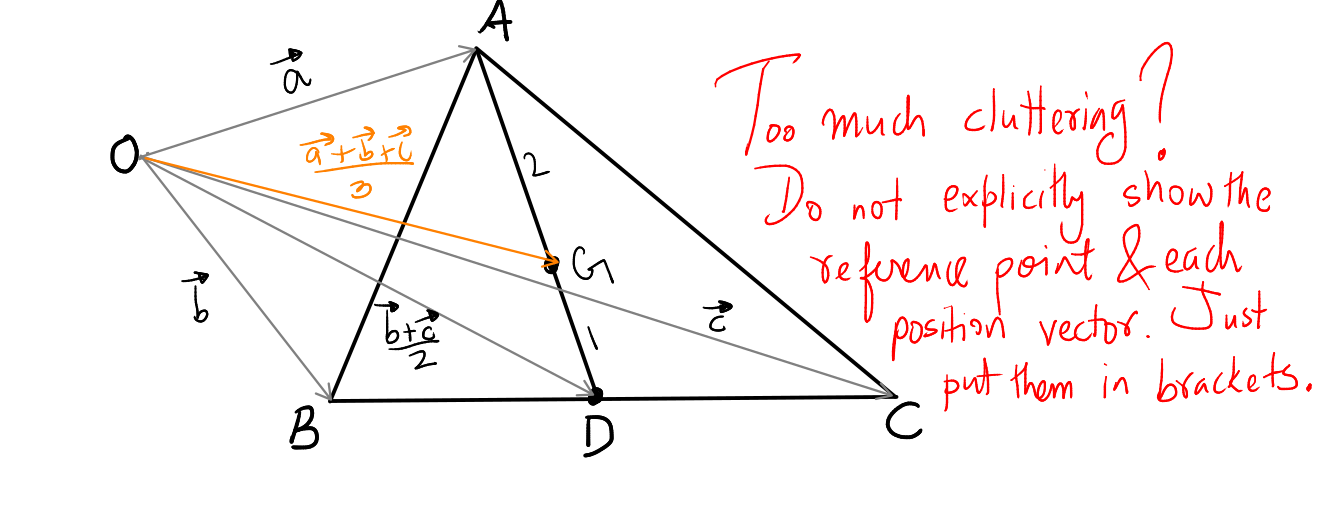
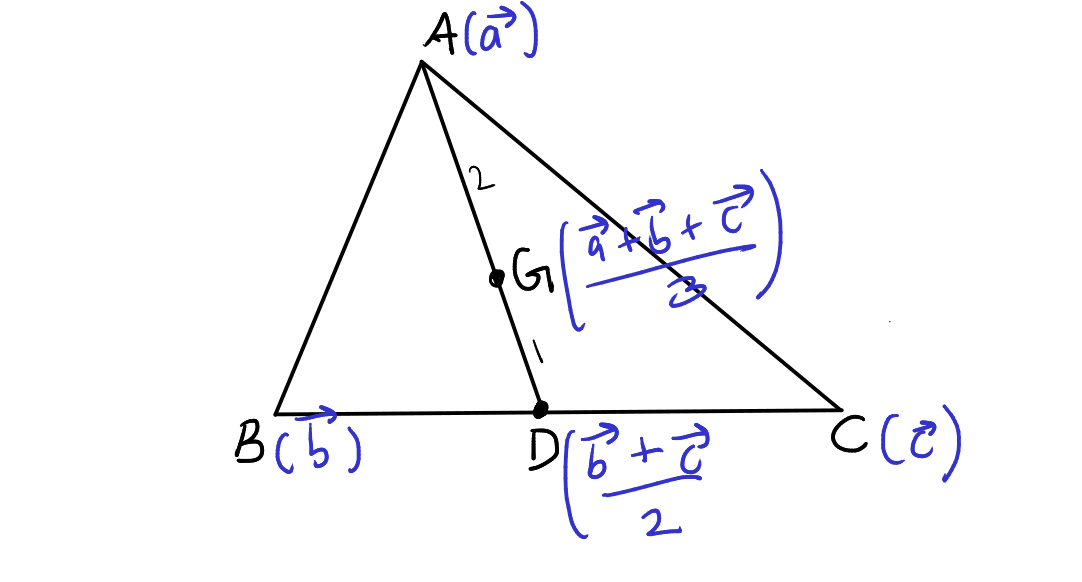
A median of the triangle is a line segment joining a vertex to the midpoint of the opposite side. Let AD be the median from A to the midpoint D of BC.
Since D is the midpoint of BC, its position vector is given by the midpoint formula:
OD=2b+c.
The centroid G of the triangle is the point where all three medians intersect. It divides each median in the ratio 2:1, with the longer part towards the vertex.
Since G divides AD in the ratio 2:1, applying the section formula:
OG=2+12OD+1OA.
Substituting OD=2b+c:
OG=32(2b+c)+a.
Simplifying,
OG=3b+c+a.
Since the centroid is independent of which median is chosen, the final formula for the position vector of the centroid G is:
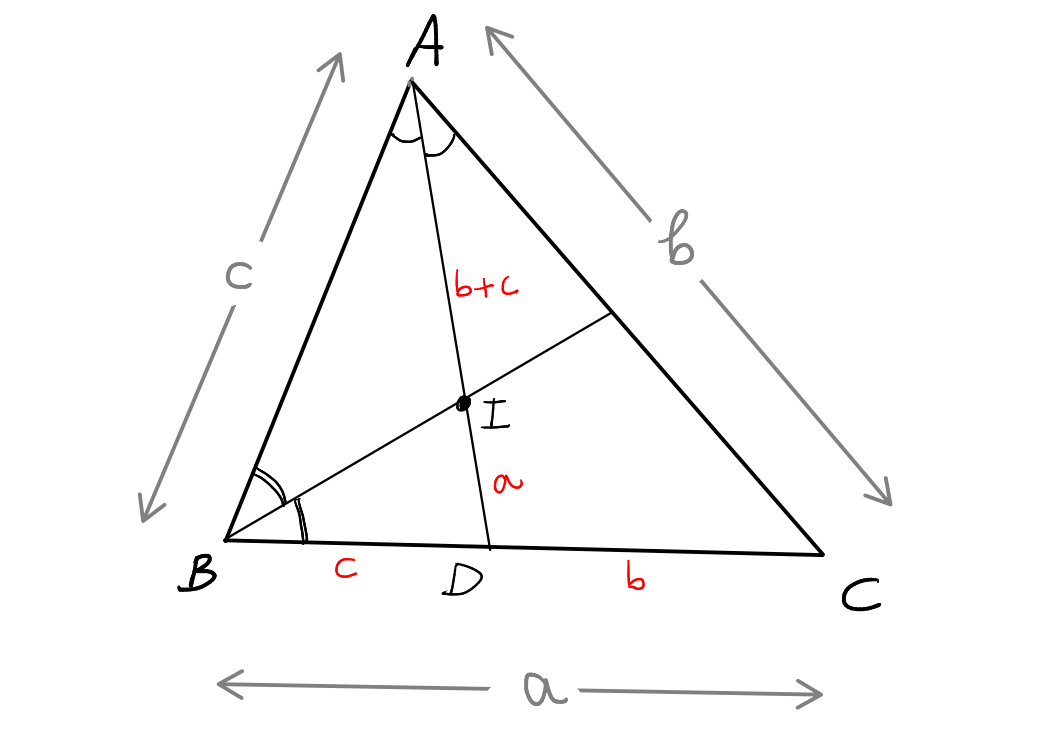
The incentreI of a triangle is the point where the angle bisectors of the three interior angles meet. It is the centre of the incircle, the unique circle that is tangent to all three sides of the triangle.
Let the vertices of △ABC have position vectors:
OA=a,OB=b,OC=c,
with respect to some reference pointO. The side lengths of the triangle are:
BC=a,CA=b,AB=c.
To determine the position vector of the incentre, we follow these steps:
Find the Position Vector of D
The point D is where the angle bisector of ∠A meets BC. The angle bisector theorem states that:
DCBD=ACAB=bc.
This means that D divides BC internally in the ratio c:b. By the internal division formula, the position vector of D is:
OD=c+bcOC+bOB.
Find the Position Vector of I
The incentre I lies on the angle bisector of ∠A and divides AD in the ratio (b+c):a (the sum of the other two sides to the opposite side). Using the section formula again:
Thus, the position vector of the incentre is given by:
I=a+b+caOA+bOB+cOC.
This result shows that the incentre is a weighted sum of the position vectors of the vertices, where the weights are the lengths of the opposite sides. The incentre is always located inside the triangle and serves as the centre of the inscribed circle.
If S is the circumcentre and H is the orthocentre of △ABC, and O is the reference point, then their position vectors with respect to O are given by:
Centroid, Circumcentre, Orthocentre and Euler's Line§
Given a triangle ABC with centroid G and reference point O, the position vector of G is:
OG=3OA+OB+OC.
Now, changing the reference point from O to G, the position vector of G with respect to itself is:
GG=3GA+GB+GC.
Since GG=0, we get:
GA+GB+GC=3GG=0.
Thus,
GA+GB+GC=0.
This confirms that in a triangle, the sum of the position vectors of the vertices relative to the centroid is always zero.
Uniqueness of the Centroid
The centroid is not just one point that satisfies PA+PB+PC=0; in fact, it is the only such point. This leads to the following theorem:
Theorem:
Let △ABC be a triangle. A point P satisfies
PA+PB+PC=0
if and only ifP is the centroid of △ABC.
Proof:
Sufficiency (Only the Centroid Satisfies This Condition)
Assume that there exists a point Panywhere in space (not necessarily in the plane of △ABC) such that
PA+PB+PC=0.
Let D be the midpoint of BC, so its position vector is
PD=2PB+PC.
Rewriting the given condition:
PA+PB+PC=0.
Substituting PB+PC=2PD, we obtain:
PA+2PD=0.
Rearranging,
PA=−2PD.
This implies that AP and PD are collinear vectors, which means that the points A,P, and D are collinear. Since D is the midpoint of BC, this means that P lies on the median AD.
Moreover, from the relation PA=−2PD, we get:
AP:PD=2:1.
This means Pdivides the median AD in the ratio 2:1, which uniquely identifies P as the centroid of △ABC.
Necessity (Centroid Satisfies the Condition)
If P is the centroid, we have already shown above that:
PA+PB+PC=0.
Thus, we conclude that the centroid is the only point that satisfies this condition.
Hence, a point P satisfies PA+PB+PC=0if and only ifP is the centroid of △ABC.
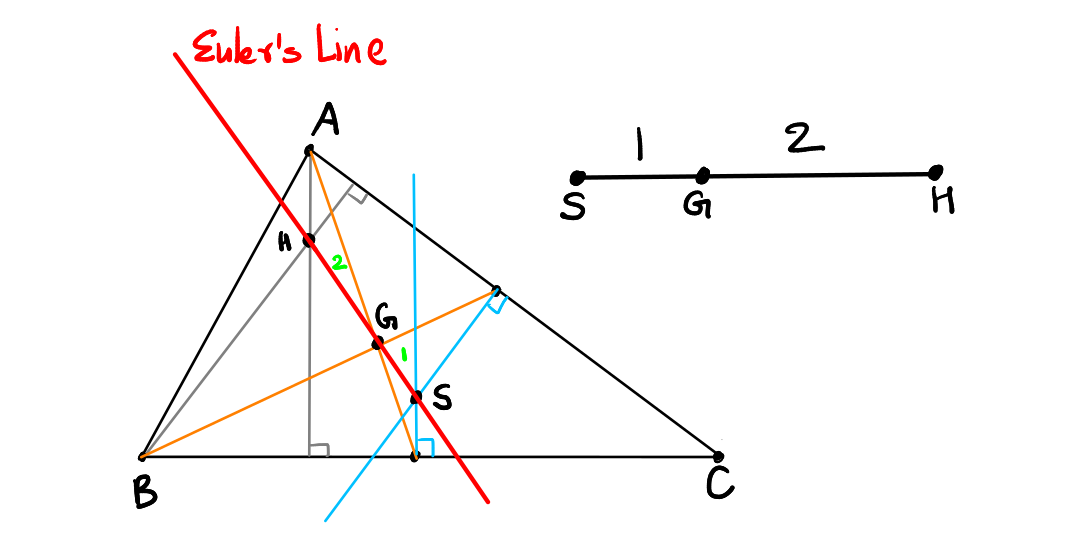
In any non-equilateral triangle△ABC, the circumcentreS, centroidG, and orthocentreH are collinear, meaning they lie on a single straight line known as Euler’s line.
Moreover, the centroid G divides the segment joining the circumcentre S and the orthocentre H in the ratio:
SG:GH=1:2.
This means that G is positioned one-third of the way from S to H and two-thirds of the way from H to S. This property holds for all non-equilateral triangles.
Special Case: Equilateral Triangle
For an equilateral triangle, all three points S,G,Hcoincide at the same location. That is,
S=G=H.
Since all three centers are the same point, Euler’s line degenerates into a single point. Thus, while every non-equilateral triangle has a unique Euler’s line, an equilateral triangle does not have a distinct Euler’s line, as all three centers are identical.
We know that,
OA+OB+OC=3OG.
This equation states that the sum of the position vectors of the vertices of △ABC, when referenced from any arbitrary point O, is three times the position vector of the centroid measured from O.
Case 1: Setting O=S (Circumcentre as Reference Point)
Choosing the circumcentre S as the reference point, we replace O with S in the equation:
SA+SB+SC=3SG.
From Euler’s line, we know that the centroid G divides the segment joining the circumcentre S and the orthocentre H in the ratio 1:2, implying:
3SG=SH.
Substituting this in the equation above:
SA+SB+SC=SH.
This result shows that the sum of the vectors from the circumcentre to the three vertices is equal to the vector from the circumcentre to the orthocentre.
Case 2: Setting O=H (Orthocentre as Reference Point)
Now, taking the orthocentre H as the reference point, we obtain:
HA+HB+HC=3HG.
From Euler’s line, we also know that the centroid divides the segment SH in the ratio 1:2, which implies:
HG=32HS.
Multiplying both sides by 3,
3HG=2HS.
Thus, substituting in the equation,
HA+HB+HC=2HS.
This result tells us that the sum of the vectors from the orthocentre to the three vertices is equal to twice the vector from the orthocentre to the circumcentre.
Section 3 of 15 · Vector Algebra and Three Dimensional Geometry
Mark this section complete when you have worked through its proofs.
Type any topic, theorem, or concept to jump directly to the section.