MatheramaMatherama
← Trigonometry
Trigonometry·Section 9·8 min read

Submultiple Angles

Submultiple angles in trigonometry refer to angles that are a fraction of a given angle, typically a half or a third. They are used in trigonometric identities and equations where a larger angle is expressed as a multiple of a smaller one. For example, if θ\theta is an angle, then θ/2\theta/2 and θ/3\theta/3 are its submultiples. Trigonometric functions involving submultiple angles (like sin⁡(θ/2)\sin(\theta/2), cos⁡(θ/3)\cos(\theta/3), etc.) are important in solving various trigonometric problems and are often used in deriving certain identities and equations.

sin⁡(θ)=2sin⁡(θ2)cos⁡(θ2)\sin(\theta) = 2\sin\left(\frac{\theta}{2}\right)\cos\left(\frac{\theta}{2}\right)
Proof:

We will prove this using the double angle formula for sine, which states:

sin⁡(2α)=2sin⁡(α)cos⁡(α)\sin(2\alpha) = 2\sin(\alpha)\cos(\alpha)

Let α=θ2\alpha = \frac{\theta}{2}. Then the double angle formula becomes:

sin⁡(2×θ2)=2sin⁡(θ2)cos⁡(θ2)\sin(2 \times \frac{\theta}{2}) = 2\sin\left(\frac{\theta}{2}\right)\cos\left(\frac{\theta}{2}\right)

Simplifying the left-hand side, we have:

sin⁡(θ)=2sin⁡(θ2)cos⁡(θ2)\sin(\theta) = 2\sin\left(\frac{\theta}{2}\right)\cos\left(\frac{\theta}{2}\right)

■\blacksquare

cos⁡(θ)=cos⁡2(θ2)−sin⁡2(θ2)=2cos⁡2(θ2)−1=1−2sin⁡2(θ2)\cos(\theta) = \cos^2\left(\frac{\theta}{2}\right) - \sin^2\left(\frac{\theta}{2}\right) = 2\cos^2\left(\frac{\theta}{2}\right) - 1 = 1 - 2\sin^2\left(\frac{\theta}{2}\right)
Proof:

We will use the cosine double angle formula, cos⁡(2α)=2cos⁡2(α)−1\cos(2\alpha) = 2\cos^2(\alpha) - 1 and cos⁡(2α)=1−2sin⁡2(α)\cos(2\alpha) = 1 - 2\sin^2(\alpha), replacing α\alpha with θ2\frac{\theta}{2} to prove this theorem.

  1. Using Cosine Double Angle Formula:

    cos⁡(θ)=cos⁡(2×θ2)=2cos⁡2(θ2)−1\cos(\theta) = \cos(2 \times \frac{\theta}{2}) = 2\cos^2\left(\frac{\theta}{2}\right) - 1
  2. Alternatively, Using the Other Form of Cosine Double Angle Formula:

    cos⁡(θ)=cos⁡(2×θ2)=1−2sin⁡2(θ2)\cos(\theta) = \cos(2 \times \frac{\theta}{2}) = 1 - 2\sin^2\left(\frac{\theta}{2}\right)
  3. Using the Identity cos⁡2(α)−sin⁡2(α)=cos⁡(2α)\cos^2(\alpha) - \sin^2(\alpha) = \cos(2\alpha):

    cos⁡(θ)=cos⁡2(θ2)−sin⁡2(θ2)\cos(\theta) = \cos^2\left(\frac{\theta}{2}\right) - \sin^2\left(\frac{\theta}{2}\right)
tan⁡(θ)=2tan⁡(θ2)1−tan⁡2(θ2)\tan(\theta) = \frac{2\tan\left(\frac{\theta}{2}\right)}{1 - \tan^2\left(\frac{\theta}{2}\right)}
Proof:

The formula for the tangent of a sum, tan⁡(α+β)\tan(\alpha + \beta), is:

tan⁡(α+β)=tan⁡(α)+tan⁡(β)1−tan⁡(α)tan⁡(β)\tan(\alpha + \beta) = \frac{\tan(\alpha) + \tan(\beta)}{1 - \tan(\alpha)\tan(\beta)}

Let α=β=θ2\alpha = \beta = \frac{\theta}{2}. Then, we get:

tan⁡(θ)=tan⁡(θ2+θ2)=tan⁡(θ2)+tan⁡(θ2)1−tan⁡(θ2)tan⁡(θ2)\tan(\theta) = \tan\left(\frac{\theta}{2} + \frac{\theta}{2}\right) = \frac{\tan\left(\frac{\theta}{2}\right) + \tan\left(\frac{\theta}{2}\right)}{1 - \tan\left(\frac{\theta}{2}\right)\tan\left(\frac{\theta}{2}\right)} =2tan⁡(θ2)1−tan⁡2(θ2)= \frac{2\tan\left(\frac{\theta}{2}\right)}{1 - \tan^2\left(\frac{\theta}{2}\right)}

■\blacksquare

cot⁡(θ)=cot⁡2(θ2)−12cot⁡(θ2)\cot(\theta) = \frac{\cot^2\left(\frac{\theta}{2}\right) - 1}{2\cot\left(\frac{\theta}{2}\right)}
Proof:

The formula for the cotangent of a sum α+β\alpha + \beta is:

cot⁡(α+β)=cot⁡(α)cot⁡(β)−1cot⁡(β)+cot⁡(α)\cot(\alpha + \beta) = \frac{\cot(\alpha)\cot(\beta) - 1}{\cot(\beta) + \cot(\alpha)}

Let α=β=θ2\alpha = \beta = \frac{\theta}{2}. Then, we have:

cot⁡(θ)=cot⁡(θ2+θ2)=cot⁡2(θ2)−1cot⁡(θ2)+cot⁡(θ2)\cot(\theta) = \cot\left(\frac{\theta}{2} + \frac{\theta}{2}\right) = \frac{\cot^2\left(\frac{\theta}{2}\right) - 1}{\cot\left(\frac{\theta}{2}\right) + \cot\left(\frac{\theta}{2}\right)} =cot⁡2(θ2)−12cot⁡(θ2)= \frac{\cot^2\left(\frac{\theta}{2}\right) - 1}{2\cot\left(\frac{\theta}{2}\right)}

■\blacksquare

  1. Expressing trigonometrical ratios of the angle θ2\frac{\theta}{2} in terms of cos⁡θ\cos\theta.

The expressions for cos⁡(θ2)\cos\left(\frac{\theta}{2}\right), sin⁡(θ2)\sin\left(\frac{\theta}{2}\right), and tan⁡(θ2)\tan\left(\frac{\theta}{2}\right) in terms of cos⁡(θ)\cos(\theta) are given by:

  1. cos⁡(θ2)=±1+cos⁡(θ)2\cos\left(\frac{\theta}{2}\right) = \pm\sqrt{\frac{1 + \cos(\theta)}{2}}
  2. sin⁡(θ2)=±1−cos⁡(θ)2\sin\left(\frac{\theta}{2}\right) = \pm\sqrt{\frac{1 - \cos(\theta)}{2}}
  3. tan⁡(θ2)=±1−cos⁡(θ)1+cos⁡(θ)\tan\left(\frac{\theta}{2}\right) = \pm\sqrt{\frac{1 - \cos(\theta)}{1 + \cos(\theta)}}

The plus or minus sign is determined based on the quadrant of θ2\frac{\theta}{2}.

Proof:
  1. For cos⁡(θ2)\cos\left(\frac{\theta}{2}\right): From the identity

    cos⁡(θ)=2cos⁡2(θ2)−1\cos(\theta) = 2\cos^2\left(\frac{\theta}{2}\right) - 1

    we rearrange to find cos⁡(θ2)\cos\left(\frac{\theta}{2}\right):

    cos⁡2(θ2)=1+cos⁡(θ)2\cos^2\left(\frac{\theta}{2}\right) = \frac{1 + \cos(\theta)}{2}

    Taking the square root (and considering the quadrant for the correct sign):

    cos⁡(θ2)=±1+cos⁡(θ)2\cos\left(\frac{\theta}{2}\right) = \pm\sqrt{\frac{1 + \cos(\theta)}{2}}
  2. For sin⁡(θ2)\sin\left(\frac{\theta}{2}\right): Using the Pythagorean identity sin⁡2(x)+cos⁡2(x)=1\sin^2(x) + \cos^2(x) = 1, we have

    sin⁡2(θ2)=1−cos⁡2(θ2)\sin^2\left(\frac{\theta}{2}\right) = 1 - \cos^2\left(\frac{\theta}{2}\right)

    Substitute cos⁡2(θ2)\cos^2\left(\frac{\theta}{2}\right) from the previous step:

    sin⁡2(θ2)=1−1+cos⁡(θ)2=1−cos⁡(θ)2\sin^2\left(\frac{\theta}{2}\right) = 1 - \frac{1 + \cos(\theta)}{2} = \frac{1 - \cos(\theta)}{2}

    Taking the square root (considering the quadrant for the correct sign):

    sin⁡(θ2)=±1−cos⁡(θ)2\sin\left(\frac{\theta}{2}\right) = \pm\sqrt{\frac{1 - \cos(\theta)}{2}}
  3. For tan⁡(θ2)\tan\left(\frac{\theta}{2}\right): Using the definition of tangent in terms of sine and cosine:

    tan⁡(θ2)=sin⁡(θ2)cos⁡(θ2)\tan\left(\frac{\theta}{2}\right) = \frac{\sin\left(\frac{\theta}{2}\right)}{\cos\left(\frac{\theta}{2}\right)}

    Substitute the expressions for sin⁡(θ2)\sin\left(\frac{\theta}{2}\right) and cos⁡(θ2)\cos\left(\frac{\theta}{2}\right):

    tan⁡(θ2)=±1−cos⁡(θ)2±1+cos⁡(θ)2\tan\left(\frac{\theta}{2}\right) = \frac{\pm\sqrt{\frac{1 - \cos(\theta)}{2}}}{\pm\sqrt{\frac{1 + \cos(\theta)}{2}}}

    Simplifying, we get:

    tan⁡(θ2)=±1−cos⁡(θ)1+cos⁡(θ)\tan\left(\frac{\theta}{2}\right) = \pm\sqrt{\frac{1 - \cos(\theta)}{1 + \cos(\theta)}}

This completes the proof of the theorem. The correct sign in each case depends on the quadrant in which θ2\frac{\theta}{2} lies.

(sin⁡(θ/2)±cos⁡(θ/2))2=1±sin⁡(θ)(\sin(\theta/2) \pm \cos(\theta/2))^2 = 1 \pm \sin(\theta)
Proof:

Expanding the left-hand side and using trigonometric identities, we have:

sin⁡2(θ/2)±2sin⁡(θ/2)cos⁡(θ/2)+cos⁡2(θ/2)\sin^2(\theta/2) \pm 2\sin(\theta/2)\cos(\theta/2) + \cos^2(\theta/2) =1±2sin⁡(θ/2)cos⁡(θ/2)= 1 \pm 2\sin(\theta/2)\cos(\theta/2)

(Using sin⁡2(α)+cos⁡2(α)=1\sin^2(\alpha) + \cos^2(\alpha) = 1)

Applying the double angle formula for sine (sin⁡(θ)=2sin⁡(θ/2)cos⁡(θ/2)\sin(\theta) = 2\sin(\theta/2)\cos(\theta/2)):

=1±sin⁡(θ)= 1 \pm \sin(\theta)

This completes the proof.

sin⁡(θ2)=(±1+sin⁡(θ))+(±1−sin⁡(θ))2\sin\left(\frac{\theta}{2}\right) = \frac{\left(\pm\sqrt{1 + \sin(\theta)}\right) + \left(\pm\sqrt{1 - \sin(\theta)}\right)}{2} cos⁡(θ2)=(±1+sin⁡(θ))−(±1−sin⁡(θ))2\cos\left(\frac{\theta}{2}\right) = \frac{\left(\pm\sqrt{1 + \sin(\theta)}\right) - \left(\pm\sqrt{1 - \sin(\theta)}\right)}{2}
Proof:
sin⁡(θ2)+cos⁡(θ2)=±1+sin⁡(θ)(1)\sin\left(\frac{\theta}{2}\right) + \cos\left(\frac{\theta}{2}\right) = \pm\sqrt{1 + \sin(\theta)} \tag{1} sin⁡(θ2)−cos⁡(θ2)=±1−sin⁡(θ)(2)\sin\left(\frac{\theta}{2}\right) - \cos\left(\frac{\theta}{2}\right) = \pm\sqrt{1 - \sin(\theta)} \tag{2}

By adding equations (1) and (2), we find 2sin⁡(θ/2)2\sin(\theta/2):

2sin⁡(θ2)=(±1+sin⁡(θ))+(±1−sin⁡(θ))2\sin\left(\frac{\theta}{2}\right) = \left(\pm\sqrt{1 + \sin(\theta)}\right) + \left(\pm\sqrt{1 - \sin(\theta)}\right) sin⁡(θ2)=(±1+sin⁡(θ))+(±1−sin⁡(θ))2\sin\left(\frac{\theta}{2}\right) = \frac{\left(\pm\sqrt{1 + \sin(\theta)}\right) + \left(\pm\sqrt{1 - \sin(\theta)}\right)}{2}

By subtracting equation (2) from (1), we find 2cos⁡(θ/2)2\cos(\theta/2):

2cos⁡(θ2)=(±1+sin⁡(θ))−(±1−sin⁡(θ))2\cos\left(\frac{\theta}{2}\right) = \left(\pm\sqrt{1 + \sin(\theta)}\right) - \left(\pm\sqrt{1 - \sin(\theta)}\right) cos⁡(θ2)=(±1+sin⁡(θ))−(±1−sin⁡(θ))2\cos\left(\frac{\theta}{2}\right) = \frac{\left(\pm\sqrt{1 + \sin(\theta)}\right) - \left(\pm\sqrt{1 - \sin(\theta)}\right)}{2}

These results give us sin⁡(θ/2)\sin(\theta/2) and cos⁡(θ/2)\cos(\theta/2) in terms of sin⁡(θ)\sin(\theta).

How to choose the signs in the above formula

Above we explained the formula which expresses sin⁡θ2\sin\frac{\theta}{2} and cos⁡θ2\cos\frac{\theta}{2} in terms of sinθsin\theta, but we do not still know about how to decide those signs.

sin⁡(θ2)+cos⁡(θ2)=±1+sin⁡(θ)(1)\sin\left(\frac{\theta}{2}\right) + \cos\left(\frac{\theta}{2}\right) = \pm\sqrt{1 + \sin(\theta)} \tag{1} sin⁡(θ2)−cos⁡(θ2)=±1−sin⁡(θ)(2)\sin\left(\frac{\theta}{2}\right) - \cos\left(\frac{\theta}{2}\right) = \pm\sqrt{1 - \sin(\theta)} \tag{2}

Equations (1) and (2) in the proof are the key equations to decide the correct signs. in eqn (1) we decide whether the the expression on the left sin⁡(θ2)+cos⁡(θ2)\sin\left(\frac{\theta}{2}\right) + \cos\left(\frac{\theta}{2}\right) is positive or negative depending on the value or some information about θ2\frac{\theta}{2}.

sign of sin theta by 2 plus cos theta by 2

Draw a unit circle as in the above figure. Draw a line PQPQ making an angle of π4\frac{\pi}{4} with negative x-axis. Thsi line divides the circle into two regions. If the terminal point of angle θ2\frac{\theta}{2} lies the blue region, then sin⁡(θ2)+cos⁡(θ2)\sin\left(\frac{\theta}{2}\right) + \cos\left(\frac{\theta}{2}\right) is positive and if lies in the red region, then it is negative.

The explanation of this fact is quite simple and we leave it as an exercise for you to verify.

Similarly we decide the sign of sin⁡(θ2)−cos⁡(θ2)\sin\left(\frac{\theta}{2}\right) - \cos\left(\frac{\theta}{2}\right) of the left hand side of eqn(2) using the figure below.
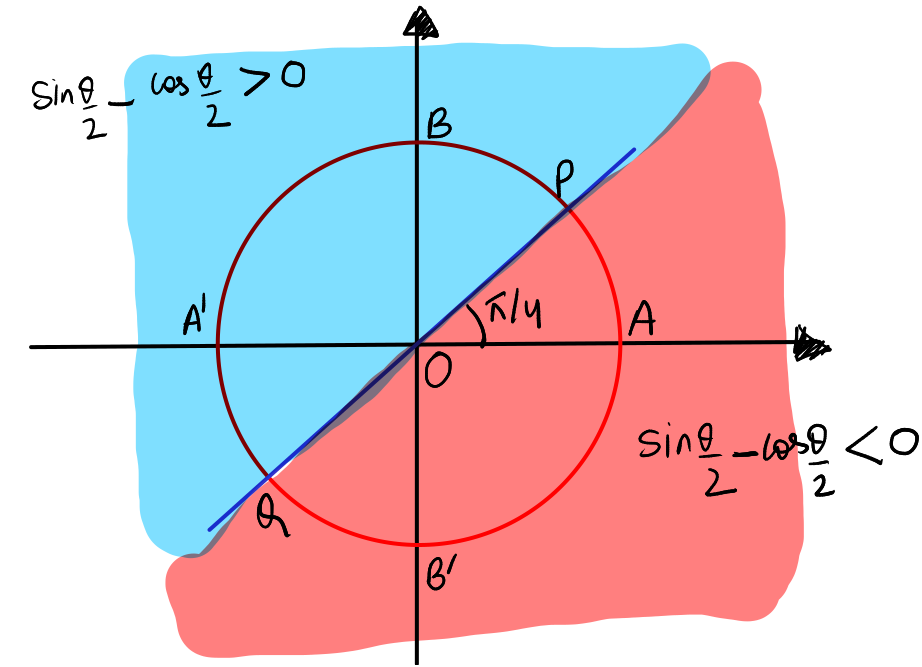
sign of sin theta by 2 minus sign theta by 2

  1. The trigonometric functions sin⁡(θ)\sin(\theta), cos⁡(θ)\cos(\theta), and tan⁡(θ)\tan(\theta) can be expressed in terms of tan⁡(θ/2)\tan(\theta/2) using the tangent half-angle formulas:
  • Sine in terms of tan⁡(θ/2)\tan(\theta/2):

    sin⁡(θ)=2tan⁡(θ/2)1+tan⁡2(θ/2)\sin(\theta) = \frac{2\tan(\theta/2)}{1 + \tan^2(\theta/2)}
  • Cosine in terms of tan⁡(θ/2)\tan(\theta/2):

    cos⁡(θ)=1−tan⁡2(θ/2)1+tan⁡2(θ/2)\cos(\theta) = \frac{1 - \tan^2(\theta/2)}{1 + \tan^2(\theta/2)}
  • Tangent in terms of tan⁡(θ/2)\tan(\theta/2):

    tan⁡(θ)=2tan⁡(θ/2)1−tan⁡2(θ/2)\tan(\theta) = \frac{2\tan(\theta/2)}{1 - \tan^2(\theta/2)}

These formulas come from the double angle and half-angle formulas in trigonometry, where tan⁡(θ/2)\tan(\theta/2) is often denoted as tt when simplifying expressions or solving trigonometric equations.

  1. The trigonometric functions sin⁡(θ)\sin(\theta), cos⁡(θ)\cos(\theta), and tan⁡(θ)\tan(\theta) can be expressed in terms of sin⁡(θ3)\sin\left(\frac{\theta}{3}\right), cos⁡(θ3)\cos\left(\frac{\theta}{3}\right), and tan⁡(θ3)\tan\left(\frac{\theta}{3}\right) respectively, as follows:
  • sin⁡(θ)\sin(\theta) can be expressed as:

    sin⁡(θ)=3sin⁡(θ3)−4sin⁡3(θ3)\sin(\theta) = 3\sin\left(\frac{\theta}{3}\right) - 4\sin^3\left(\frac{\theta}{3}\right)
  • cos⁡(θ)\cos(\theta) can be expressed as:

    cos⁡(θ)=4cos⁡3(θ3)−3cos⁡(θ3)\cos(\theta) = 4\cos^3\left(\frac{\theta}{3}\right) - 3\cos\left(\frac{\theta}{3}\right)
  • tan⁡(θ)\tan(\theta) can be expressed as:

    tan⁡(θ)=3tan⁡(θ3)−tan⁡3(θ3)1−3tan⁡2(θ3)\tan(\theta) = \frac{3\tan\left(\frac{\theta}{3}\right) - \tan^3\left(\frac{\theta}{3}\right)}{1 - 3\tan^2\left(\frac{\theta}{3}\right)}
Proof:

Let α=θ3\alpha = \frac{\theta}{3}. We will use the triple-angle formulas to prove the identities for sin⁡(θ)\sin(\theta), cos⁡(θ)\cos(\theta), and tan⁡(θ)\tan(\theta).

  1. For sin⁡(θ)\sin(\theta): The triple-angle formula for sine is given by:
sin⁡(3α)=3sin⁡(α)−4sin⁡3(α)\sin(3\alpha) = 3\sin(\alpha) - 4\sin^3(\alpha)

Substituting α=θ3\alpha = \frac{\theta}{3} gives us:

sin⁡(θ)=3sin⁡(θ3)−4sin⁡3(θ3)\sin(\theta) = 3\sin\left(\frac{\theta}{3}\right) - 4\sin^3\left(\frac{\theta}{3}\right)
  1. For cos⁡(θ)\cos(\theta): The triple-angle formula for cosine is:
cos⁡(3α)=4cos⁡3(α)−3cos⁡(α)\cos(3\alpha) = 4\cos^3(\alpha) - 3\cos(\alpha)

Substituting α=θ3\alpha = \frac{\theta}{3} gives us:

cos⁡(θ)=4cos⁡3(θ3)−3cos⁡(θ3)\cos(\theta) = 4\cos^3\left(\frac{\theta}{3}\right) - 3\cos\left(\frac{\theta}{3}\right)
  1. For tan⁡(θ)\tan(\theta): The triple-angle formula for tangent, derived from the sine and cosine triple-angle formulas, is:
tan⁡(3α)=3tan⁡(α)−tan⁡3(α)1−3tan⁡2(α)\tan(3\alpha) = \frac{3\tan(\alpha) - \tan^3(\alpha)}{1 - 3\tan^2(\alpha)}

Substituting α=θ3\alpha = \frac{\theta}{3} gives us:

tan⁡(θ)=3tan⁡(θ3)−tan⁡3(θ3)1−3tan⁡2(θ3)\tan(\theta) = \frac{3\tan\left(\frac{\theta}{3}\right) - \tan^3\left(\frac{\theta}{3}\right)}{1 - 3\tan^2\left(\frac{\theta}{3}\right)}
Section 9 of 13 · Trigonometry

Mark this section complete when you have worked through its proofs.