What is wrong with degree system (also called sexagesimal system by the way)?
Degree system is very intuitive and is probably the best but it has a shortcoming. Why divide the circle into 360 equal parts? This number 360 which I explained before is just too arbitrary. We have a better system – the radian measure of angles.
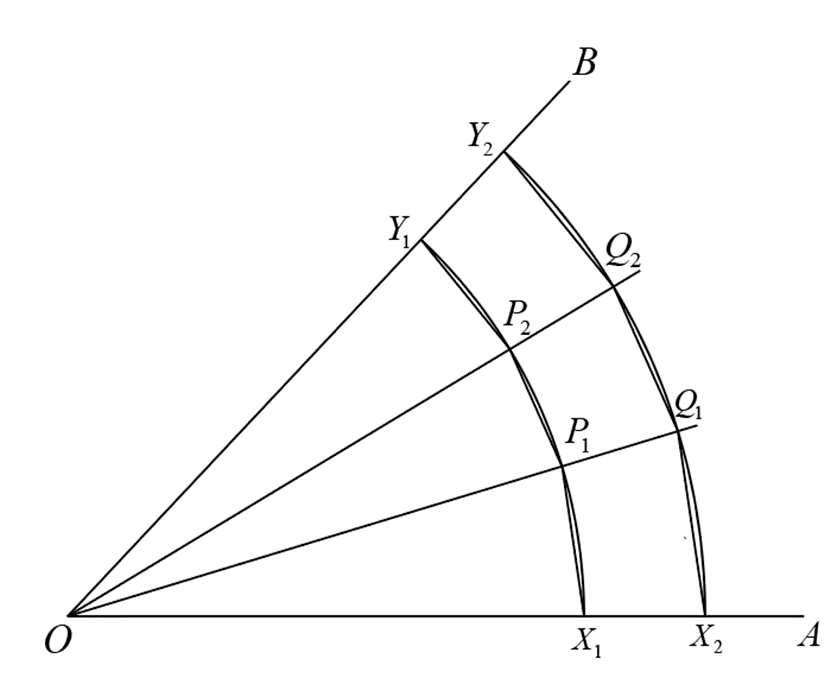
Let there be two diverging rays OA and OB emanating from point O. These rays contain some angle.
Draw an arc of any radius (say r1) intersecting the rays OA and OB at X1 and Y1 respectively. Draw another arc of different radius r2 intersecting rays OA and OB at X2 and Y2 respectively. Let us assume that the lengths of arcs X1Y1 and X2Y2 are l1 and l2 respectively.
Choose n−1 points P1,P2,...,Pn−1 on the arc X1Y1. These points divide the arc into n equal parts. Draw radial lines from O to the points P1,P2,...,Pn−1 and extend them so that they cut the other arc X2Y2 at points Q1,Q2,...,Qn−1 respectively. Points X1,P1,P2,...,Pn−1 form an open polygon of n sides.
Now it can be easily proven that △OX1P1∼△OX2Q1. Similarly △OY1Pn−1∼△OY2Qn−1 and △OPkPk+1∼△OQkQk+1 for all k=1,2,3,...,n−1.
Since corresponding sides are proportional, we get,
⇒r1Perimeter of open polygon on arc X1Y1=r2Perimeter of open polygon on arc X2Y2
If the number of sides of the open polygon n approaches infinity i.e. n becomes larger and larger, the perimeter of the open polygon on the arc X1Y1 approaches the limit l1 (length of the arc X1Y1) and the perimeter of the open polygon on the arc X2Y2 approaches the limit l2.
Thus, r1l1=r2l2
Since we had taken two random arcs, if we had drawn an arc of any other radius (say r3) and length (say l3), then r1l1=r2l2=r3l3
We can conclude that if we draw any arc of any radius between these rays, then
radiusLength of the arc=constant
This constant quantity can be used to measure the angle between the rays. If we keep the radius of the arc constant, we see that this constant is directly proportional to the length of the arc. That is, this constant can be said to be proportional to the amount of rotation. When the rays are coinciding, this constant is equal to zero. We define
Angle between rays OA and OB=its radiusLength of any arc between the rays
This measurement of angle is called the radian measure or circular measure of angles.
Radian: 1 radian (or written as 1 rad or 1c) is the angle made by two rays such that any arc drawn between them has the same length as its radius.
For a complete circle, a similar process (draw a regular polygon of n sides) can be used to prove that. This constant, when measured, is equal to 2π, where π is an irrational number approximately equal to 3.142. Thus circumference of a circle is equal to 2πr.
Conversion between Degree Measure and Radian Measure§
Radian measure is a very natural way to measure angles using property of a circle. Still, the degree measure is quite prevalent owing to its simplicity. we should know well how to inter-convert both measures.
A circle contains an angle of 2π radians which in degrees would have been 360∘. 360∘ in circular measure is equal to 2π radians, which gives a simple formula to convert radian to degrees and degrees to radians.
X∘=X×180πrad
And,
X rad=(X×π180)∘
To convert an angle in degrees to radians, multiply it with 180π and to convert an angle in radians to degrees, multiply it with π180.
For example: How much is 30∘ in radians?
Solution: 30∘=30×180π=6π
One must remember, the radian measure of certain special angles in degrees.
Sr No.
Angle in degrees
Angle in radians
Remarks on how to quickly convert and remember.
| 0° | 0 |
| 360° | 2π |
| 180° | π | Half of 360
| 90° | 2π | 90° is the half of 180°. Thus in radian measure it is 2π, which is the half of π
| 30° | 6π | One-sixth of 180°
| 45° | 4π | Half of 90°
| 60° | 3π | One-third of 180°
| 120° | 32π | Twice of 60°, thus, twice of 3π
| 150° | 65π | Five times of 30°, thus, five times of 6π
| 210° | 67π | Seven times of 30° or we may say that it is 180° + 30° i.e. π+6π=67π
| 240° | 34π | Four times of 60°
| 270° | 23π | Three times of 90°
| 300° | 35π | Five times of 60°
| 330° | 611π | Eleven times of 30°
| 15° | 12π | Half of 30° i.e. Half of 6π
| 22.5° | 8π | Half of 4π
| 18° | 10π | One-tenth of 180° is 18 i.e. One tenth of π
Knowing the exact quadrant of terminal point of an angle is important, so that we can decide the correct values of trigonometric functions that we will study later. For instance, suppose you know the angle is 8π, and you want to also know where the terminal point for this angle is. Since 8π=4∗2π and 2π is one complete revolution starting from positive x-axis, we can conclude that 8π is 4 revolutions and thus the terminal point is at positive x-axis.
To understand this further, read the following points:
For angles of the form 2nπ, where n∈Z, the terminal point lies on the positive x-axis. e.g., …,−8π,−4π,−2π,0,2π,4π,6π,8π,… all such angles clearly lie on the positive x-axis. It is easy to see that when the angle is of the form [evennumber]×π, the angle lies on the positive x-axis.
For angles of the form (2n+1)π, n∈Z, the terminal point lies on the negative x-axis. Angles like …,−7π,−5π,−3π,−π,π,3π,5π,… lie on the negative x-axis. So, whenever the angle is of the form [oddnumber]×π, it lies on the negative y-axis.
For angles of the form 2nπ+2π, n∈Z, the terminal point lies on the positive y-axis.
For angles of the form 2nπ−2π, n∈Z, the terminal point lies on the negative y-axis.
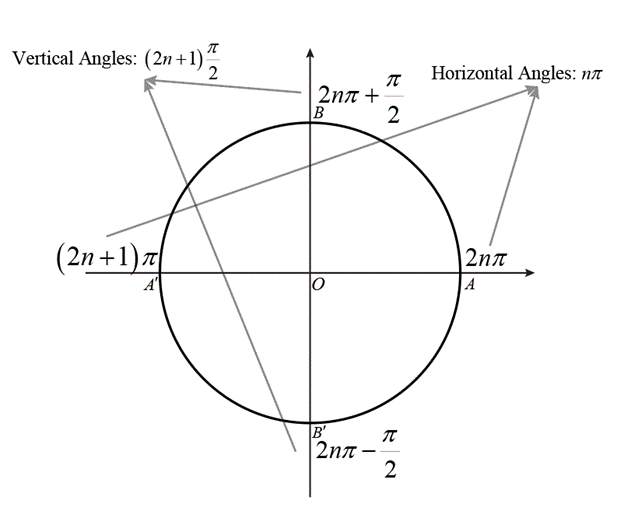
For angles of the form nπ, n∈Z, the terminal point lies either on the positive x-axis or on the negative x-axis. These are called as Horizontal Angles. e.g., …,−3π,−2π,−π,0,π,2π,3π,…
For angles of the form (2n+1)2π, n∈Z, the terminal point lies on the positive y-axis or on the negative y-axis. These are called as Vertical Angles. e.g., …,25π,23π,2π,−2π,−23π,−25π,…
Please remember the above results and use the following figure as a memory aid:
If you have understood the above examples, you can easily understand the next concept.
Let us take an example. Suppose θ=325π . We wish to know the quadrant of θ. Find the multiple of denominator 3 which is the closest to 25 . Write 25 in terms of that multiple.
i.e. 325π=(24+1)3π=8π+3π
Now we can tell the correct quadrant in which 325π lies. Since, 8π lies on positive x-axis. We add 3π to it. Thus the terminal point moves anticlockwise and it lies in the first quadrant.
That’s it. This is what we do.
Let us take more examples.
Section 3 of 13 · Trigonometry
Mark this section complete when you have worked through its proofs.
Type any topic, theorem, or concept to jump directly to the section.