Compound angles involve expressions where two or more angles are combined through addition or subtraction, such as α + β \alpha + \beta α + β α − β \alpha - \beta α − β
Value of Trigonometric Functions for the sum of two angles§
For sine (sin \sin sin
sin ( α + β ) = sin ( α ) cos ( β ) + cos ( α ) sin ( β ) \sin(\alpha + \beta) = \sin(\alpha) \cos(\beta) + \cos(\alpha) \sin(\beta) sin ( α + β ) = sin ( α ) cos ( β ) + cos ( α ) sin ( β ) For cosine (cos \cos cos
cos ( α + β ) = cos ( α ) cos ( β ) − sin ( α ) sin ( β ) \cos(\alpha + \beta) = \cos(\alpha) \cos(\beta) - \sin(\alpha) \sin(\beta) cos ( α + β ) = cos ( α ) cos ( β ) − sin ( α ) sin ( β ) For tangent (tan \tan tan
tan ( α + β ) = tan ( α ) + tan ( β ) 1 − tan ( α ) tan ( β ) \tan(\alpha + \beta) = \frac{\tan(\alpha) + \tan(\beta)}{1 - \tan(\alpha)\tan(\beta)} tan ( α + β ) = 1 − tan ( α ) tan ( β ) tan ( α ) + tan ( β ) These formulas express the trigonometric functions of a sum of two angles in terms of the trigonometric functions of each individual angle.
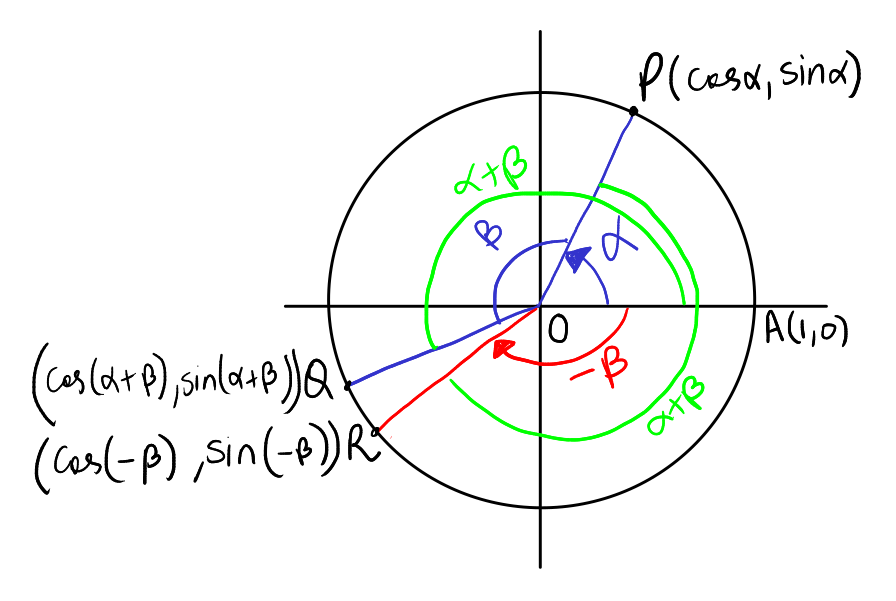
Proof: To prove we begin with proving cosine of sum. There are so many proofs available. In my opinion, this is probably the best one as it does not assume angles α \alpha α β \beta β
In the unit circle representation, let's define the points associated with the angles α \alpha α β \beta β α + β \alpha + \beta α + β
Point P P P ( cos α , sin α ) (\cos\alpha, \sin\alpha) ( cos α , sin α ) α \alpha α Point Q Q Q P P P β \beta β ( cos ( α + β ) , sin ( α + β ) ) (\cos(\alpha + \beta), \sin(\alpha + \beta)) ( cos ( α + β ) , sin ( α + β )) Point R R R ( cos ( − β ) , sin ( − β ) ) (\cos(-\beta), \sin(-\beta)) ( cos ( − β ) , sin ( − β )) ( cos β , − sin β ) (\cos\beta, -\sin\beta) ( cos β , − sin β ) − β -\beta − β Since the arc A Q AQ A Q P R PR P R β \beta β O O O A Q AQ A Q P R PR P R
A Q 2 = P R 2 AQ^2 = PR^2 A Q 2 = P R 2 Now, considering the distance formula:
A Q 2 = ( cos ( α + β ) − 1 ) 2 + sin 2 ( α + β ) AQ^2 = (\cos(\alpha + \beta) - 1)^2 + \sin^2(\alpha + \beta) A Q 2 = ( cos ( α + β ) − 1 ) 2 + sin 2 ( α + β )
P R 2 = ( cos α − cos β ) 2 + ( sin α + sin β ) 2 PR^2 = (\cos \alpha - \cos \beta)^2 + (\sin \alpha + \sin \beta)^2 P R 2 = ( cos α − cos β ) 2 + ( sin α + sin β ) 2
Equating the two expressions:
( cos ( α + β ) − 1 ) 2 + sin 2 ( α + β ) (\cos(\alpha + \beta) - 1)^2 + \sin^2(\alpha + \beta) ( cos ( α + β ) − 1 ) 2 + sin 2 ( α + β ) ( cos α − cos β ) 2 + ( sin α + sin β ) 2 (\cos \alpha - \cos \beta)^2 + (\sin \alpha + \sin \beta)^2 ( cos α − cos β ) 2 + ( sin α + sin β ) 2
Expanding both sides gives us:
cos 2 ( α + β ) − 2 cos ( α + β ) + 1 + sin 2 ( α + β ) \cos^2(\alpha + \beta) - 2\cos(\alpha + \beta) + 1 + \sin^2(\alpha + \beta) cos 2 ( α + β ) − 2 cos ( α + β ) + 1 + sin 2 ( α + β ) = cos 2 α − 2 cos α cos β + cos 2 β + sin 2 α + 2 sin α sin β + sin 2 β = \cos^2 \alpha - 2\cos \alpha \cos \beta + \cos^2 \beta + \sin^2 \alpha + 2\sin \alpha \sin \beta + \sin^2 \beta = cos 2 α − 2 cos α cos β + cos 2 β + sin 2 α + 2 sin α sin β + sin 2 β
Using the Pythagorean identity cos 2 θ + sin 2 θ = 1 \cos^2 \theta + \sin^2 \theta = 1 cos 2 θ + sin 2 θ = 1
1 − 2 cos ( α + β ) + 1 = 1 − 2 cos α cos β + 1 + 2 sin α sin β 1 - 2\cos(\alpha + \beta) + 1 = 1 - 2\cos \alpha \cos \beta + 1 + 2\sin \alpha \sin \beta 1 − 2 cos ( α + β ) + 1 = 1 − 2 cos α cos β + 1 + 2 sin α sin β
This simplifies to:
− 2 cos ( α + β ) = − 2 cos α cos β + 2 sin α sin β -2\cos(\alpha + \beta) = -2\cos \alpha \cos \beta + 2\sin \alpha \sin \beta − 2 cos ( α + β ) = − 2 cos α cos β + 2 sin α sin β
Dividing through by -2:
cos ( α + β ) = cos α cos β − sin α sin β \cos(\alpha + \beta) = \cos \alpha \cos \beta - \sin \alpha \sin \beta cos ( α + β ) = cos α cos β − sin α sin β
And that gives us the required formula for the cosine of a sum of two angles.
Using this formula we can derive the sine formula.
Start with the expression for sin ( α + β ) \sin(\alpha + \beta) sin ( α + β )
s i n ( α + β ) = cos ( π 2 − ( α + β ) ) sin(\alpha + \beta) = \cos\left(\frac{\pi}{2} - (\alpha + \beta)\right) s in ( α + β ) = cos ( 2 π − ( α + β ) )
Expand the inside of the cosine using the sum formula for cosine:
cos ( π 2 − α − β ) = cos ( π 2 − α ) cos ( − β ) + sin ( π 2 − α ) sin ( − β ) \cos\left(\frac{\pi}{2} - \alpha - \beta\right) = \cos\left(\frac{\pi}{2} - \alpha\right)\cos(-\beta) + \sin\left(\frac{\pi}{2} - \alpha\right)\sin(-\beta) cos ( 2 π − α − β ) = cos ( 2 π − α ) cos ( − β ) + sin ( 2 π − α ) sin ( − β )
Apply the co-function identity and the fact that (cos ( − β ) = cos ( β ) \cos(-\beta) = \cos(\beta) cos ( − β ) = cos ( β ) sin ( − β ) = − sin ( β ) \sin(-\beta) = -\sin(\beta) sin ( − β ) = − sin ( β )
sin ( α + β ) = sin ( α ) cos ( β ) − cos ( α ) sin ( β ) \sin(\alpha + \beta) = \sin(\alpha)\cos(\beta) - \cos(\alpha)\sin(\beta) sin ( α + β ) = sin ( α ) cos ( β ) − cos ( α ) sin ( β )
Rearrange to match the standard form of the sine sum formula:
sin ( α + β ) = sin ( α ) cos ( β ) + cos ( α ) sin ( β ) \sin(\alpha + \beta) = \sin(\alpha)\cos(\beta) + \cos(\alpha)\sin(\beta) sin ( α + β ) = sin ( α ) cos ( β ) + cos ( α ) sin ( β )
Thus, we have derived the sine sum formula.
Now we derive the tangent of sum: To derive the formula for tan ( α + β ) \tan(\alpha + \beta) tan ( α + β ) tan ( θ ) = sin ( θ ) cos ( θ ) \tan(\theta) = \frac{\sin(\theta)}{\cos(\theta)} tan ( θ ) = c o s ( θ ) s i n ( θ )
Use the sine and cosine sum formulas: tan ( α + β ) = sin ( α + β ) cos ( α + β ) \tan(\alpha + \beta) = \frac{\sin(\alpha + \beta)}{\cos(\alpha + \beta)} tan ( α + β ) = c o s ( α + β ) s i n ( α + β )
⟹ tan ( α + β ) = sin ( α ) cos ( β ) + cos ( α ) sin ( β ) cos ( α ) cos ( β ) − sin ( α ) sin ( β ) \implies \tan(\alpha + \beta) = \frac{\sin(\alpha)\cos(\beta) + \cos(\alpha)\sin(\beta)}{\cos(\alpha)\cos(\beta) - \sin(\alpha)\sin(\beta)} ⟹ tan ( α + β ) = c o s ( α ) c o s ( β ) − s i n ( α ) s i n ( β ) s i n ( α ) c o s ( β ) + c o s ( α ) s i n ( β )
Divide the numerator and the denominator by cos ( α ) cos ( β ) \cos(\alpha)\cos(\beta) cos ( α ) cos ( β )
tan ( α + β ) = sin ( α ) cos ( α ) + sin ( β ) cos ( β ) 1 − sin ( α ) cos ( α ) sin ( β ) cos ( β ) \tan(\alpha + \beta) = \frac{\frac{\sin(\alpha)}{\cos(\alpha)} + \frac{\sin(\beta)}{\cos(\beta)}}{1 - \frac{\sin(\alpha)}{\cos(\alpha)}\frac{\sin(\beta)}{\cos(\beta)}} tan ( α + β ) = 1 − c o s ( α ) s i n ( α ) c o s ( β ) s i n ( β ) c o s ( α ) s i n ( α ) + c o s ( β ) s i n ( β )
⟹ tan ( α + β ) = tan ( α ) + tan ( β ) 1 − tan ( α ) tan ( β ) \implies \tan(\alpha + \beta) = \frac{\tan(\alpha) + \tan(\beta)}{1 - \tan(\alpha)\tan(\beta)} ⟹ tan ( α + β ) = 1 − t a n ( α ) t a n ( β ) t a n ( α ) + t a n ( β )
So, the formula for tan ( α + β ) \tan(\alpha + \beta) tan ( α + β )
tan ( α + β ) = tan ( α ) + tan ( β ) 1 − tan ( α ) tan ( β ) \tan(\alpha + \beta) = \frac{\tan(\alpha) + \tan(\beta)}{1 - \tan(\alpha)\tan(\beta)} tan ( α + β ) = 1 − t a n ( α ) t a n ( β ) t a n ( α ) + t a n ( β )
This completes the proof. ■ \blacksquare ■
Value of Trigonometric Functions for the difference of angles§
For sine (sin \sin sin
sin ( α − β ) = sin α cos β − cos α sin β \sin(\alpha - \beta) = \sin\alpha \cos\beta - \cos\alpha \sin\beta sin ( α − β ) = sin α cos β − cos α sin β For cosine (cos \cos cos
cos ( α − β ) = cos α cos β + sin α sin β \cos(\alpha - \beta) = \cos\alpha \cos\beta + \sin\alpha \sin\beta cos ( α − β ) = cos α cos β + sin α sin β For tangent (tan \tan tan
tan ( α − β ) = tan α − tan β 1 + tan α tan β \tan(\alpha - \beta) = \frac{\tan\alpha - \tan\beta}{1 + \tan\alpha \tan\beta} tan ( α − β ) = 1 + tan α tan β tan α − tan β Proof: To derive the formulas for the difference of two angles for sine, cosine, and tangent functions, we can utilize the sum formulas for trigonometric functions and simply replace β \beta β − β -\beta − β
For Sine:
The sum formula for sine is:
sin ( α + β ) = sin α cos β + cos α sin β \sin(\alpha + \beta) = \sin\alpha \cos\beta + \cos\alpha \sin\beta sin ( α + β ) = sin α cos β + cos α sin β
Replacing β \beta β − β -\beta − β
sin ( α − β ) = sin α cos ( − β ) + cos α sin ( − β ) \sin(\alpha - \beta) = \sin\alpha \cos(-\beta) + \cos\alpha \sin(-\beta) sin ( α − β ) = sin α cos ( − β ) + cos α sin ( − β )
Since cos ( − β ) = cos β \cos(-\beta) = \cos\beta cos ( − β ) = cos β sin ( − β ) = − sin β \sin(-\beta) = -\sin\beta sin ( − β ) = − sin β
sin ( α − β ) = sin α cos β − cos α sin β \sin(\alpha - \beta) = \sin\alpha \cos\beta - \cos\alpha \sin\beta sin ( α − β ) = sin α cos β − cos α sin β
For Cosine:
The sum formula for cosine is:
cos ( α + β ) = cos α cos β − sin α sin β \cos(\alpha + \beta) = \cos\alpha \cos\beta - \sin\alpha \sin\beta cos ( α + β ) = cos α cos β − sin α sin β
Again, replace β \beta β − β -\beta − β
cos ( α − β ) = cos α cos ( − β ) − sin α sin ( − β ) \cos(\alpha - \beta) = \cos\alpha \cos(-\beta) - \sin\alpha \sin(-\beta) cos ( α − β ) = cos α cos ( − β ) − sin α sin ( − β )
⟹ cos ( α − β ) = cos α cos β + sin α sin β \implies \cos(\alpha - \beta) = \cos\alpha \cos\beta + \sin\alpha \sin\beta ⟹ cos ( α − β ) = cos α cos β + sin α sin β
For Tangent:
The sum formula for tangent is:
tan ( α + β ) = tan α + tan β 1 − tan α tan β \tan(\alpha + \beta) = \frac{\tan\alpha + \tan\beta}{1 - \tan\alpha \tan\beta} tan ( α + β ) = 1 − t a n α t a n β t a n α + t a n β
Substituting β \beta β − β -\beta − β
tan ( α − β ) = tan α + tan ( − β ) 1 − tan α tan ( − β ) \tan(\alpha - \beta) = \frac{\tan\alpha + \tan(-\beta)}{1 - \tan\alpha \tan(-\beta)} tan ( α − β ) = 1 − t a n α t a n ( − β ) t a n α + t a n ( − β )
And since tan ( − β ) = − tan β \tan(-\beta) = -\tan\beta tan ( − β ) = − tan β
tan ( α − β ) = tan α − tan β 1 + tan α tan β \tan(\alpha - \beta) = \frac{\tan\alpha - \tan\beta}{1 + \tan\alpha \tan\beta} tan ( α − β ) = 1 + t a n α t a n β t a n α − t a n β
These are the formulas for the difference of two angles in trigonometry. They are directly derived from the sum formulas with the substitution of β \beta β − β -\beta − β
Product-to-Sum identities: § The product of sine and cosine functions can be expressed as the sum of sine or cosine functions. The identities are as follows:
For the product of a sine and a cosine function of two angles:
sin A cos B = 1 2 [ sin ( A + B ) + sin ( A − B ) ] \sin A \cos B = \frac{1}{2}[\sin(A + B) + \sin(A - B)] sin A cos B = 2 1 [ sin ( A + B ) + sin ( A − B )] cos A sin B = 1 2 [ sin ( A + B ) − sin ( A − B ) ] \cos A \sin B = \frac{1}{2}[\sin(A + B) - \sin(A - B)] cos A sin B = 2 1 [ sin ( A + B ) − sin ( A − B )]
For the product of two cosine functions:
cos A cos B = 1 2 [ cos ( A + B ) + cos ( A − B ) ] \cos A \cos B = \frac{1}{2}[\cos(A + B) + \cos(A - B)] cos A cos B = 2 1 [ cos ( A + B ) + cos ( A − B )]
For the product of two sine functions:
sin A sin B = 1 2 [ cos ( A − B ) − cos ( A + B ) ] \sin A \sin B = \frac{1}{2}[\cos(A - B) - \cos(A + B)] sin A sin B = 2 1 [ cos ( A − B ) − cos ( A + B )]
Proof:
To derive the identity for sin A cos B \sin A \cos B sin A cos B
sin ( A + B ) = sin A cos B + cos A sin B \sin(A + B) = \sin A \cos B + \cos A \sin B sin ( A + B ) = sin A cos B + cos A sin B
sin ( A − B ) = sin A cos B − cos A sin B \sin(A - B) = \sin A \cos B - \cos A \sin B sin ( A − B ) = sin A cos B − cos A sin B
Adding these two equations, we get:
sin ( A + B ) + sin ( A − B ) = 2 sin A cos B \sin(A + B) + \sin(A - B) = 2 \sin A \cos B sin ( A + B ) + sin ( A − B ) = 2 sin A cos B
Dividing by 2:
sin A cos B = 1 2 [ sin ( A + B ) + sin ( A − B ) ] \sin A \cos B = \frac{1}{2}[\sin(A + B) + \sin(A - B)] sin A cos B = 2 1 [ sin ( A + B ) + sin ( A − B )]
For cos A sin B \cos A \sin B cos A sin B
sin ( A + B ) − sin ( A − B ) = 2 cos A sin B \sin(A + B) - \sin(A - B) = 2 \cos A \sin B sin ( A + B ) − sin ( A − B ) = 2 cos A sin B
Dividing by 2:
cos A sin B = 1 2 [ sin ( A + B ) − sin ( A − B ) ] \cos A \sin B = \frac{1}{2}[\sin(A + B) - \sin(A - B)] cos A sin B = 2 1 [ sin ( A + B ) − sin ( A − B )]
For cos A cos B \cos A \cos B cos A cos B
cos ( A + B ) = cos A cos B − sin A sin B \cos(A + B) = \cos A \cos B - \sin A \sin B cos ( A + B ) = cos A cos B − sin A sin B
cos ( A − B ) = cos A cos B + sin A sin B \cos(A - B) = \cos A \cos B + \sin A \sin B cos ( A − B ) = cos A cos B + sin A sin B
Adding these two equations, we get:
cos ( A + B ) + cos ( A − B ) = 2 cos A cos B \cos(A + B) + \cos(A - B) = 2 \cos A \cos B cos ( A + B ) + cos ( A − B ) = 2 cos A cos B
Dividing by 2:
cos A cos B = 1 2 [ cos ( A + B ) + cos ( A − B ) ] \cos A \cos B = \frac{1}{2}[\cos(A + B) + \cos(A - B)] cos A cos B = 2 1 [ cos ( A + B ) + cos ( A − B )]
Lastly, for sin A sin B \sin A \sin B sin A sin B
cos ( A − B ) − cos ( A + B ) = 2 sin A sin B \cos(A - B) - \cos(A + B) = 2 \sin A \sin B cos ( A − B ) − cos ( A + B ) = 2 sin A sin B
Dividing by 2:
sin A sin B = 1 2 [ cos ( A − B ) − cos ( A + B ) ] \sin A \sin B = \frac{1}{2}[\cos(A - B) - \cos(A + B)] sin A sin B = 2 1 [ cos ( A − B ) − cos ( A + B )]
This concludes the proof of the product-to-sum identities for sine and cosine functions. ■ \blacksquare ■
Suppose you want to calculate 0.31425 × 0.64256 0.31425 \times 0.64256 0.31425 × 0.64256
Find the angles A A A B B B cos ( A ) = 0.31425 \cos(A) = 0.31425 cos ( A ) = 0.31425 cos ( B ) = 0.64256 \cos(B) = 0.64256 cos ( B ) = 0.64256 Use the product-to-sum formula: cos ( A ) cos ( B ) = 1 2 [ cos ( A + B ) + cos ( A − B ) ] \cos(A) \cos(B) = \frac{1}{2} [\cos(A + B) + \cos(A - B)] cos ( A ) cos ( B ) = 2 1 [ cos ( A + B ) + cos ( A − B )] Find the values of cos ( A + B ) \cos(A + B) cos ( A + B ) cos ( A − B ) \cos(A - B) cos ( A − B ) Finally, calculate the product 0.31425 × 0.64256 0.31425 \times 0.64256 0.31425 × 0.64256 Of course, this is an old way of multiplying two numbers. You can read about it here: Prosthaphaeresis
For us, the main purpose of these formulas is in simplifying expressions. Converting a product of sines and cosines to sum is sometimes desired during simplification of expressions or solving equations.
Given two angles C C C D D D
For the sum of two sine functions:
sin C + sin D = 2 sin ( C + D 2 ) cos ( C − D 2 ) \sin C + \sin D = 2 \sin\left(\frac{C + D}{2}\right) \cos\left(\frac{C - D}{2}\right) sin C + sin D = 2 sin ( 2 C + D ) cos ( 2 C − D )
For the difference of two sine functions:
sin C − sin D = 2 cos ( C + D 2 ) sin ( C − D 2 ) \sin C - \sin D = 2 \cos\left(\frac{C + D}{2}\right) \sin\left(\frac{C - D}{2}\right) sin C − sin D = 2 cos ( 2 C + D ) sin ( 2 C − D )
For the sum of two cosine functions:
cos C + cos D = 2 cos ( C + D 2 ) cos ( C − D 2 ) \cos C + \cos D = 2 \cos\left(\frac{C + D}{2}\right) \cos\left(\frac{C - D}{2}\right) cos C + cos D = 2 cos ( 2 C + D ) cos ( 2 C − D )
For the difference of two cosine functions:
cos C − cos D = − 2 sin ( C + D 2 ) sin ( C − D 2 ) \cos C - \cos D = -2 \sin\left(\frac{C + D}{2}\right) \sin\left(\frac{C - D}{2}\right) cos C − cos D = − 2 sin ( 2 C + D ) sin ( 2 C − D )
Proof:
To derive these formulas, we use the identities for the cosine of a sum and cosine of a difference, along with the corresponding identities for sine.
For the sine sum formula, we start with the sum and difference formulas for sine:
sin ( A + B ) = sin A cos B + cos A sin B \sin(A + B) = \sin A \cos B + \cos A \sin B sin ( A + B ) = sin A cos B + cos A sin B sin ( A − B ) = sin A cos B − cos A sin B \sin(A - B) = \sin A \cos B - \cos A \sin B sin ( A − B ) = sin A cos B − cos A sin B Adding these two equations, we get:
sin ( A + B ) + sin ( A − B ) = 2 sin A cos B \sin(A + B) + \sin(A - B) = 2 \sin A \cos B sin ( A + B ) + sin ( A − B ) = 2 sin A cos B Now, let A = C + D 2 A = \frac{C + D}{2} A = 2 C + D B = C − D 2 B = \frac{C - D}{2} B = 2 C − D
sin C + sin D = 2 sin ( C + D 2 ) cos ( C − D 2 ) \sin C + \sin D = 2 \sin\left(\frac{C + D}{2}\right) \cos\left(\frac{C - D}{2}\right) sin C + sin D = 2 sin ( 2 C + D ) cos ( 2 C − D ) Similarly, by subtracting the sine difference formula from the sine sum formula, we can derive the second formula. The third and fourth formulas follow from the sum and difference formulas for cosine in an analogous manner.
I. For any angles A A A B B B
cot ( A + B ) = cot A ⋅ cot B − 1 cot A + cot B \cot(A + B) = \frac{\cot A \cdot \cot B - 1}{\cot A + \cot B} cot ( A + B ) = c o t A + c o t B c o t A ⋅ c o t B − 1 cot ( A − B ) = cot A ⋅ cot B + 1 cot B − cot A \cot(A - B) = \frac{\cot A \cdot \cot B + 1}{\cot B - \cot A} cot ( A − B ) = c o t B − c o t A c o t A ⋅ c o t B + 1
Proof To prove the first identity, we start by expressing the cotangent in terms of the sine and cosine functions:
cot ( A + B ) = cos ( A + B ) sin ( A + B ) \cot(A + B) = \frac{\cos(A + B)}{\sin(A + B)} cot ( A + B ) = sin ( A + B ) cos ( A + B ) Using the angle sum formulas for sine and cosine, we have:
cos ( A + B ) = cos A ⋅ cos B − sin A ⋅ sin B \cos(A + B) = \cos A \cdot \cos B - \sin A \cdot \sin B cos ( A + B ) = cos A ⋅ cos B − sin A ⋅ sin B sin ( A + B ) = sin A ⋅ cos B + cos A ⋅ sin B \sin(A + B) = \sin A \cdot \cos B + \cos A \cdot \sin B sin ( A + B ) = sin A ⋅ cos B + cos A ⋅ sin B Substituting these into our expression for cot ( A + B ) \cot(A + B) cot ( A + B )
cot ( A + B ) = cos A ⋅ cos B − sin A ⋅ sin B sin A ⋅ cos B + cos A ⋅ sin B \cot(A + B) = \frac{\cos A \cdot \cos B - \sin A \cdot \sin B}{\sin A \cdot \cos B + \cos A \cdot \sin B} cot ( A + B ) = sin A ⋅ cos B + cos A ⋅ sin B cos A ⋅ cos B − sin A ⋅ sin B Now, dividing both numerator and denominator by cos A ⋅ cos B \cos A \cdot \cos B cos A ⋅ cos B
cot ( A + B ) = 1 − tan A ⋅ tan B tan A + tan B \cot(A + B) = \frac{1 - \tan A \cdot \tan B}{\tan A + \tan B} cot ( A + B ) = tan A + tan B 1 − tan A ⋅ tan B Finally, taking the reciprocal of both tan A \tan A tan A tan B \tan B tan B cot θ = 1 tan θ \cot \theta = \frac{1}{\tan \theta} cot θ = t a n θ 1
cot ( A + B ) = cot A ⋅ cot B − 1 cot A + cot B \cot(A + B) = \frac{\cot A \cdot \cot B - 1}{\cot A + \cot B} cot ( A + B ) = cot A + cot B cot A ⋅ cot B − 1 This proves the first identity.
For the second identity, we use a similar approach:
cot ( A − B ) = cos ( A − B ) sin ( A − B ) \cot(A - B) = \frac{\cos(A - B)}{\sin(A - B)} cot ( A − B ) = sin ( A − B ) cos ( A − B ) Using the angle difference formulas for sine and cosine, we have:
cos ( A − B ) = cos A ⋅ cos B + sin A ⋅ sin B \cos(A - B) = \cos A \cdot \cos B + \sin A \cdot \sin B cos ( A − B ) = cos A ⋅ cos B + sin A ⋅ sin B sin ( A − B ) = sin A ⋅ cos B − cos A ⋅ sin B \sin(A - B) = \sin A \cdot \cos B - \cos A \cdot \sin B sin ( A − B ) = sin A ⋅ cos B − cos A ⋅ sin B Substituting these into our expression for cot ( A − B ) \cot(A - B) cot ( A − B )
cot ( A − B ) = cos A ⋅ cos B + sin A ⋅ sin B sin A ⋅ cos B − cos A ⋅ sin B \cot(A - B) = \frac{\cos A \cdot \cos B + \sin A \cdot \sin B}{\sin A \cdot \cos B - \cos A \cdot \sin B} cot ( A − B ) = sin A ⋅ cos B − cos A ⋅ sin B cos A ⋅ cos B + sin A ⋅ sin B Dividing both numerator and denominator by cos A ⋅ cos B \cos A \cdot \cos B cos A ⋅ cos B
cot ( A − B ) = 1 + tan A ⋅ tan B tan B − tan A \cot(A - B) = \frac{1 + \tan A \cdot \tan B}{\tan B - \tan A} cot ( A − B ) = tan B − tan A 1 + tan A ⋅ tan B Taking the reciprocal of both tan A \tan A tan A tan B \tan B tan B
cot ( A − B ) = cot A ⋅ cot B + 1 cot B − cot A \cot(A - B) = \frac{\cot A \cdot \cot B + 1}{\cot B - \cot A} cot ( A − B ) = cot B − cot A cot A ⋅ cot B + 1 This proves the second identity.
■ \blacksquare ■
II. For any angles A A A B B B
sin ( A + B ) ⋅ sin ( A − B ) = sin 2 A − sin 2 B \sin(A + B) \cdot \sin(A - B) = \sin^2 A - \sin^2 B sin ( A + B ) ⋅ sin ( A − B ) = sin 2 A − sin 2 B cos ( A + B ) ⋅ cos ( A − B ) = cos 2 A − sin 2 B \cos(A + B) \cdot \cos(A - B) = \cos^2 A - \sin^2 B cos ( A + B ) ⋅ cos ( A − B ) = cos 2 A − sin 2 B tan ( A + B ) ⋅ tan ( A − B ) = tan 2 A − tan 2 B 1 − tan 2 A ⋅ tan 2 B \tan(A + B) \cdot \tan(A - B) = \frac{\tan^2 A - \tan^2 B}{1 - \tan^2 A \cdot \tan^2 B} tan ( A + B ) ⋅ tan ( A − B ) = 1 − t a n 2 A ⋅ t a n 2 B t a n 2 A − t a n 2 B
Proof: For identity 1:
We start by applying the sine addition and subtraction formulas:
sin ( A + B ) = sin A cos B + cos A sin B \sin(A + B) = \sin A \cos B + \cos A \sin B sin ( A + B ) = sin A cos B + cos A sin B sin ( A − B ) = sin A cos B − cos A sin B \sin(A - B) = \sin A \cos B - \cos A \sin B sin ( A − B ) = sin A cos B − cos A sin B Multiplying these two expressions together yields:
sin ( A + B ) sin ( A − B ) = ( sin A cos B + cos A sin B ) ( sin A cos B − cos A sin B ) \sin(A + B) \sin(A - B) = (\sin A \cos B + \cos A \sin B)(\sin A \cos B - \cos A \sin B) sin ( A + B ) sin ( A − B ) = ( sin A cos B + cos A sin B ) ( sin A cos B − cos A sin B ) This expands to:
= sin 2 A cos 2 B − sin A cos A sin B cos B + sin A cos A sin B cos B − cos 2 A sin 2 B = \sin^2 A \cos^2 B - \sin A \cos A \sin B \cos B + \sin A \cos A \sin B \cos B - \cos^2 A \sin^2 B = sin 2 A cos 2 B − sin A cos A sin B cos B + sin A cos A sin B cos B − cos 2 A sin 2 B Simplifying, we get:
= sin 2 A cos 2 B − cos 2 A sin 2 B = \sin^2 A \cos^2 B - \cos^2 A \sin^2 B = sin 2 A cos 2 B − cos 2 A sin 2 B Since cos 2 B = 1 − sin 2 B \cos^2 B = 1 - \sin^2 B cos 2 B = 1 − sin 2 B cos 2 A = 1 − sin 2 A \cos^2 A = 1 - \sin^2 A cos 2 A = 1 − sin 2 A
= sin 2 A ( 1 − sin 2 B ) − ( 1 − sin 2 A ) sin 2 B = \sin^2 A (1 - \sin^2 B) - (1 - \sin^2 A) \sin^2 B = sin 2 A ( 1 − sin 2 B ) − ( 1 − sin 2 A ) sin 2 B = sin 2 A − sin 2 A sin 2 B − sin 2 B + sin 2 A sin 2 B = \sin^2 A - \sin^2 A \sin^2 B - \sin^2 B + \sin^2 A \sin^2 B = sin 2 A − sin 2 A sin 2 B − sin 2 B + sin 2 A sin 2 B = sin 2 A − sin 2 B = \sin^2 A - \sin^2 B = sin 2 A − sin 2 B For identity 2:
Applying the cosine addition and subtraction formulas:
cos ( A + B ) = cos A cos B − sin A sin B \cos(A + B) = \cos A \cos B - \sin A \sin B cos ( A + B ) = cos A cos B − sin A sin B cos ( A − B ) = cos A cos B + sin A sin B \cos(A - B) = \cos A \cos B + \sin A \sin B cos ( A − B ) = cos A cos B + sin A sin B Multiplying these two expressions:
cos ( A + B ) cos ( A − B ) = ( cos A cos B − sin A sin B ) ( cos A cos B + sin A sin B ) \cos(A + B) \cos(A - B) = (\cos A \cos B - \sin A \sin B)(\cos A \cos B + \sin A \sin B) cos ( A + B ) cos ( A − B ) = ( cos A cos B − sin A sin B ) ( cos A cos B + sin A sin B ) Expands to:
= cos 2 A cos 2 B − sin 2 A sin 2 B = \cos^2 A \cos^2 B - \sin^2 A \sin^2 B = cos 2 A cos 2 B − sin 2 A sin 2 B Using the Pythagorean identity sin 2 θ + cos 2 θ = 1 \sin^2 \theta + \cos^2 \theta = 1 sin 2 θ + cos 2 θ = 1
cos 2 B = 1 − sin 2 B \cos^2 B = 1 - \sin^2 B cos 2 B = 1 − sin 2 B cos 2 A = 1 − sin 2 A \cos^2 A = 1 - \sin^2 A cos 2 A = 1 − sin 2 A Substituting these into our equation:
= cos 2 A ( 1 − sin 2 B ) − ( 1 − cos 2 B ) sin 2 A = \cos^2 A (1 - \sin^2 B) - (1 - \cos^2 B) \sin^2 A = cos 2 A ( 1 − sin 2 B ) − ( 1 − cos 2 B ) sin 2 A = cos 2 A − cos 2 A sin 2 B − sin 2 A + sin 2 A cos 2 B = \cos^2 A - \cos^2 A \sin^2 B - \sin^2 A + \sin^2 A \cos^2 B = cos 2 A − cos 2 A sin 2 B − sin 2 A + sin 2 A cos 2 B = cos 2 A − sin 2 B = \cos^2 A - \sin^2 B = cos 2 A − sin 2 B For identity 3:
We use the tangent addition and subtraction formulas:
tan ( A + B ) = tan A + tan B 1 − tan A tan B \tan(A + B) = \frac{\tan A + \tan B}{1 - \tan A \tan B} tan ( A + B ) = 1 − tan A tan B tan A + tan B tan ( A − B ) = tan A − tan B 1 + tan A tan B \tan(A - B) = \frac{\tan A - \tan B}{1 + \tan A \tan B} tan ( A − B ) = 1 + tan A tan B tan A − tan B Multiplying these two expressions:
tan ( A + B ) tan ( A − B ) = ( tan A + tan B 1 − tan A tan B ) ( tan A − tan B 1 + tan A tan B ) \tan(A + B) \tan(A - B) = \left(\frac{\tan A + \tan B}{1 - \tan A \tan B}\right)\left(\frac{\tan A - \tan B}{1 + \tan A \tan B}\right) tan ( A + B ) tan ( A − B ) = ( 1 − tan A tan B tan A + tan B ) ( 1 + tan A tan B tan A − tan B ) This simplifies to:
= tan 2 A − tan 2 B 1 − tan 2 A tan 2 B = \frac{\tan^2 A - \tan^2 B}{1 - \tan^2 A \tan^2 B} = 1 − tan 2 A tan 2 B tan 2 A − tan 2 B Thus, we have proved all three identities.
■ \blacksquare ■
III. For any angle θ \theta θ
tan ( π 4 + θ ) = 1 + tan θ 1 − tan θ \tan\left(\frac{\pi}{4} + \theta\right) = \frac{1 + \tan \theta}{1 - \tan \theta} tan ( 4 π + θ ) = 1 − t a n θ 1 + t a n θ tan ( π 4 − θ ) = 1 − tan θ 1 + tan θ \tan\left(\frac{\pi}{4} - \theta\right) = \frac{1 - \tan \theta}{1 + \tan \theta} tan ( 4 π − θ ) = 1 + t a n θ 1 − t a n θ tan ( π 4 + θ ) ⋅ tan ( π 4 − θ ) = 1 \tan\left(\frac{\pi}{4} + \theta\right) \cdot \tan\left(\frac{\pi}{4} - \theta\right) = 1 tan ( 4 π + θ ) ⋅ tan ( 4 π − θ ) = 1
Proof: For identity 1:
The tangent addition formula states that for any angles x x x y y y
tan ( x + y ) = tan x + tan y 1 − tan x tan y \tan(x + y) = \frac{\tan x + \tan y}{1 - \tan x \tan y} tan ( x + y ) = 1 − tan x tan y tan x + tan y Let x = π 4 x = \frac{\pi}{4} x = 4 π y = θ y=\theta y = θ
tan ( π 4 + θ ) = tan ( π 4 ) + tan θ 1 − tan ( π 4 ) tan θ \tan\left(\frac{\pi}{4} + \theta\right) = \frac{\tan\left(\frac{\pi}{4}\right) + \tan \theta}{1 - \tan\left(\frac{\pi}{4}\right) \tan \theta} tan ( 4 π + θ ) = 1 − tan ( 4 π ) tan θ tan ( 4 π ) + tan θ Knowing that tan ( π 4 ) = 1 \tan\left(\frac{\pi}{4}\right) = 1 tan ( 4 π ) = 1
tan ( π 4 + θ ) = 1 + tan θ 1 − 1 ⋅ tan θ \tan\left(\frac{\pi}{4} + \theta\right) = \frac{1 + \tan \theta}{1 - 1 \cdot \tan \theta} tan ( 4 π + θ ) = 1 − 1 ⋅ tan θ 1 + tan θ = 1 + tan θ 1 − tan θ = \frac{1 + \tan \theta}{1 - \tan \theta} = 1 − tan θ 1 + tan θ For identity 2:
Applying the tangent subtraction formula similarly:
tan ( π 4 − θ ) = tan ( π 4 ) − tan θ 1 + tan ( π 4 ) tan θ \tan\left(\frac{\pi}{4} - \theta\right) = \frac{\tan\left(\frac{\pi}{4}\right) - \tan \theta}{1 + \tan\left(\frac{\pi}{4}\right) \tan \theta} tan ( 4 π − θ ) = 1 + tan ( 4 π ) tan θ tan ( 4 π ) − tan θ Again, tan ( π 4 ) = 1 \tan\left(\frac{\pi}{4}\right) = 1 tan ( 4 π ) = 1
tan ( π 4 − θ ) = 1 − tan θ 1 + 1 ⋅ tan θ \tan\left(\frac{\pi}{4} - \theta\right) = \frac{1 - \tan \theta}{1 + 1 \cdot \tan \theta} tan ( 4 π − θ ) = 1 + 1 ⋅ tan θ 1 − tan θ = 1 − tan θ 1 + tan θ = \frac{1 - \tan \theta}{1 + \tan \theta} = 1 + tan θ 1 − tan θ For identity 3:
Multiplying the results of identity 1 and identity 2 gives us:
tan ( π 4 + θ ) ⋅ tan ( π 4 − θ ) = 1 + tan θ 1 − tan θ ⋅ 1 − tan θ 1 + tan θ \tan\left(\frac{\pi}{4} + \theta\right) \cdot \tan\left(\frac{\pi}{4} - \theta\right) = \frac{1 + \tan \theta}{1 - \tan \theta} \cdot \frac{1 - \tan \theta}{1 + \tan \theta} tan ( 4 π + θ ) ⋅ tan ( 4 π − θ ) = 1 − tan θ 1 + tan θ ⋅ 1 + tan θ 1 − tan θ This simplifies to:
tan ( π 4 + θ ) ⋅ tan ( π 4 − θ ) = ( 1 + tan θ ) ( 1 − tan θ ) ( 1 − tan θ ) ( 1 + tan θ ) \tan\left(\frac{\pi}{4} + \theta\right) \cdot \tan\left(\frac{\pi}{4} - \theta\right) = \frac{(1 + \tan \theta)(1 - \tan \theta)}{(1 - \tan \theta)(1 + \tan \theta)} tan ( 4 π + θ ) ⋅ tan ( 4 π − θ ) = ( 1 − t a n θ ) ( 1 + t a n θ ) ( 1 + t a n θ ) ( 1 − t a n θ ) = 1 = 1 = 1
Thus, we have proved all three identities.
■ \blacksquare ■
IV. For any angle θ \theta θ
sin θ + sin ( θ − 120 ∘ ) + sin ( θ + 120 ∘ ) = 0 \sin \theta + \sin(\theta - 120^\circ) + \sin(\theta + 120^\circ) = 0 sin θ + sin ( θ − 12 0 ∘ ) + sin ( θ + 12 0 ∘ ) = 0 cos θ + cos ( θ − 120 ∘ ) + cos ( θ + 120 ∘ ) = 0 \cos \theta + \cos(\theta - 120^\circ) + \cos(\theta + 120^\circ) = 0 cos θ + cos ( θ − 12 0 ∘ ) + cos ( θ + 12 0 ∘ ) = 0
Proof: For identity 1:
We apply the sine addition and subtraction formulas:
sin ( θ ± 120 ∘ ) = sin θ cos 120 ∘ ± cos θ sin 120 ∘ \sin(\theta \pm 120^\circ) = \sin \theta \cos 120^\circ \pm \cos \theta \sin 120^\circ sin ( θ ± 12 0 ∘ ) = sin θ cos 12 0 ∘ ± cos θ sin 12 0 ∘ Knowing that cos 120 ∘ = − 1 2 \cos 120^\circ = -\frac{1}{2} cos 12 0 ∘ = − 2 1 sin 120 ∘ = 3 2 \sin 120^\circ = \frac{\sqrt{3}}{2} sin 12 0 ∘ = 2 3
sin ( θ − 120 ∘ ) = sin θ ( − 1 2 ) − cos θ ( 3 2 ) \sin(\theta - 120^\circ) = \sin \theta \left(-\frac{1}{2}\right) - \cos \theta \left(\frac{\sqrt{3}}{2}\right) sin ( θ − 12 0 ∘ ) = sin θ ( − 2 1 ) − cos θ ( 2 3 ) sin ( θ + 120 ∘ ) = sin θ ( − 1 2 ) + cos θ ( 3 2 ) \sin(\theta + 120^\circ) = \sin \theta \left(-\frac{1}{2}\right) + \cos \theta \left(\frac{\sqrt{3}}{2}\right) sin ( θ + 12 0 ∘ ) = sin θ ( − 2 1 ) + cos θ ( 2 3 ) Adding the three sine terms:
sin θ + sin ( θ − 120 ∘ ) + sin ( θ + 120 ∘ ) \sin \theta + \sin(\theta - 120^\circ) + \sin(\theta + 120^\circ) sin θ + sin ( θ − 12 0 ∘ ) + sin ( θ + 12 0 ∘ ) = sin θ − 1 2 sin θ − 3 2 cos θ − 1 2 sin θ + 3 2 cos θ = \sin \theta - \frac{1}{2}\sin \theta - \frac{\sqrt{3}}{2}\cos \theta - \frac{1}{2}\sin \theta + \frac{\sqrt{3}}{2}\cos \theta = sin θ − 2 1 sin θ − 2 3 cos θ − 2 1 sin θ + 2 3 cos θ = sin θ − sin θ = \sin \theta - \sin \theta = sin θ − sin θ = 0 = 0 = 0 For identity 2:
We apply the cosine addition and subtraction formulas:
cos ( θ ± 120 ∘ ) = cos θ cos 120 ∘ ∓ sin θ sin 120 ∘ \cos(\theta \pm 120^\circ) = \cos \theta \cos 120^\circ \mp \sin \theta \sin 120^\circ cos ( θ ± 12 0 ∘ ) = cos θ cos 12 0 ∘ ∓ sin θ sin 12 0 ∘ Substitute the known values for cos 120 ∘ \cos 120^\circ cos 12 0 ∘ sin 120 ∘ \sin 120^\circ sin 12 0 ∘
cos ( θ − 120 ∘ ) = cos θ ( − 1 2 ) + sin θ ( 3 2 ) \cos(\theta - 120^\circ) = \cos \theta \left(-\frac{1}{2}\right) + \sin \theta \left(\frac{\sqrt{3}}{2}\right) cos ( θ − 12 0 ∘ ) = cos θ ( − 2 1 ) + sin θ ( 2 3 ) cos ( θ + 120 ∘ ) = cos θ ( − 1 2 ) − sin θ ( 3 2 ) \cos(\theta + 120^\circ) = \cos \theta \left(-\frac{1}{2}\right) - \sin \theta \left(\frac{\sqrt{3}}{2}\right) cos ( θ + 12 0 ∘ ) = cos θ ( − 2 1 ) − sin θ ( 2 3 ) Adding the three cosine terms:
cos θ + cos ( θ − 120 ∘ ) + cos ( θ + 120 ∘ ) \cos \theta + \cos(\theta - 120^\circ) + \cos(\theta + 120^\circ) cos θ + cos ( θ − 12 0 ∘ ) + cos ( θ + 12 0 ∘ ) = cos θ − 1 2 cos θ + 3 2 sin θ − 1 2 cos θ − 3 2 sin θ = \cos \theta - \frac{1}{2}\cos \theta + \frac{\sqrt{3}}{2}\sin \theta - \frac{1}{2}\cos \theta - \frac{\sqrt{3}}{2}\sin \theta = cos θ − 2 1 cos θ + 2 3 sin θ − 2 1 cos θ − 2 3 sin θ = cos θ − cos θ = \cos \theta - \cos \theta = cos θ − cos θ = 0 = 0 = 0 Thus, we have proved both identities.
■ \blacksquare ■
V. For any angles A A A B B B C C C
The sine of the sum A + B + C A + B + C A + B + C
sin ( A + B + C ) = cos A cos B cos C ( tan A + tan B + tan C − tan A tan B tan C ) \sin (A + B + C) = \cos A \cos B \cos C (\tan A + \tan B + \tan C - \tan A \tan B \tan C) sin ( A + B + C ) = cos A cos B cos C ( tan A + tan B + tan C − tan A tan B tan C )
The cosine of the sum A + B + C A + B + C A + B + C
cos ( A + B + C ) = cos A cos B cos C ( 1 − tan B tan C − tan C tan A − tan A tan B ) \cos (A + B + C) = \cos A \cos B \cos C (1 - \tan B \tan C - \tan C \tan A - \tan A \tan B) cos ( A + B + C ) = cos A cos B cos C ( 1 − tan B tan C − tan C tan A − tan A tan B )
Proof: For identity 1:
Using the sum of angles formula for sine, we have:
sin ( A + B + C ) = sin ( A + B ) cos C + cos ( A + B ) sin C \sin(A + B + C) = \sin(A + B) \cos C + \cos(A + B) \sin C sin ( A + B + C ) = sin ( A + B ) cos C + cos ( A + B ) sin C Applying the sum formula for sin ( A + B ) \sin(A + B) sin ( A + B ) cos ( A + B ) \cos(A + B) cos ( A + B )
sin ( A + B ) = sin A cos B + cos A sin B \sin(A + B) = \sin A \cos B + \cos A \sin B sin ( A + B ) = sin A cos B + cos A sin B cos ( A + B ) = cos A cos B − sin A sin B \cos(A + B) = \cos A \cos B - \sin A \sin B cos ( A + B ) = cos A cos B − sin A sin B Substitute these into the original expression:
= ( sin A cos B + cos A sin B ) cos C + ( cos A cos B − sin A sin B ) sin C = (\sin A \cos B + \cos A \sin B) \cos C + (\cos A \cos B - \sin A \sin B) \sin C = ( sin A cos B + cos A sin B ) cos C + ( cos A cos B − sin A sin B ) sin C Grouping terms and factoring out cos A cos B cos C \cos A \cos B \cos C cos A cos B cos C
= cos A cos B cos C ( sin A cos A + sin B cos B + sin C cos C − sin A cos A sin B cos B sin C cos C ) = \cos A \cos B \cos C (\frac{\sin A}{\cos A} + \frac{\sin B}{\cos B} + \frac{\sin C}{\cos C} - \frac{\sin A}{\cos A} \frac{\sin B}{\cos B} \frac{\sin C}{\cos C}) = cos A cos B cos C ( cos A sin A + cos B sin B + cos C sin C − cos A sin A cos B sin B cos C sin C ) Recognizing that sin θ cos θ = tan θ \frac{\sin \theta}{\cos \theta} = \tan \theta c o s θ s i n θ = tan θ
= cos A cos B cos C ( tan A + tan B + tan C − tan A tan B tan C ) = \cos A \cos B \cos C (\tan A + \tan B + \tan C - \tan A \tan B \tan C) = cos A cos B cos C ( tan A + tan B + tan C − tan A tan B tan C ) For identity 2:
Starting with the cosine of a sum formula:
cos ( A + B + C ) = cos ( A + B ) cos C − sin ( A + B ) sin C \cos(A + B + C) = \cos(A + B) \cos C - \sin(A + B) \sin C cos ( A + B + C ) = cos ( A + B ) cos C − sin ( A + B ) sin C Using the earlier mentioned formulas for sin ( A + B ) \sin(A + B) sin ( A + B ) cos ( A + B ) \cos(A + B) cos ( A + B )
= ( cos A cos B − sin A sin B ) cos C − ( sin A cos B + cos A sin B ) sin C = (\cos A \cos B - \sin A \sin B) \cos C - (\sin A \cos B + \cos A \sin B) \sin C = ( cos A cos B − sin A sin B ) cos C − ( sin A cos B + cos A sin B ) sin C Grouping terms and factoring out cos A cos B cos C \cos A \cos B \cos C cos A cos B cos C
= cos A cos B cos C ( 1 − sin B cos B sin C cos C − sin C cos C sin A cos A − sin A cos A sin B cos B ) = \cos A \cos B \cos C (1 - \frac{\sin B}{\cos B} \frac{\sin C}{\cos C} - \frac{\sin C}{\cos C} \frac{\sin A}{\cos A} - \frac{\sin A}{\cos A} \frac{\sin B}{\cos B}) = cos A cos B cos C ( 1 − cos B sin B cos C sin C − cos C sin C cos A sin A − cos A sin A cos B sin B ) Again, recognizing the tangent function, we substitute:
= cos A cos B cos C ( 1 − tan B tan C − tan C tan A − tan A tan B ) = \cos A \cos B \cos C (1 - \tan B \tan C - \tan C \tan A - \tan A \tan B) = cos A cos B cos C ( 1 − tan B tan C − tan C tan A − tan A tan B ) Thus, we have proved both identities.
■ \blacksquare ■
VI. For any angles A A A B B B C C C
The tangent of the sum A + B + C A + B + C A + B + C
tan ( A + B + C ) = tan A + tan B + tan C − tan A tan B tan C 1 − tan B tan C − tan C tan A − tan A tan B \tan(A + B + C) = \frac{\tan A + \tan B + \tan C - \tan A \tan B \tan C}{1 - \tan B \tan C - \tan C \tan A - \tan A \tan B} tan ( A + B + C ) = 1 − tan B tan C − tan C tan A − tan A tan B tan A + tan B + tan C − tan A tan B tan C
The cotangent of the sum A + B + C A + B + C A + B + C
cot ( A + B + C ) = cot A cot B cot C − cot A − cot B − cot C 1 − cot B cot C − cot C cot A − cot A cot B \cot(A + B + C) = \frac{\cot A \cot B \cot C - \cot A - \cot B - \cot C}{1 - \cot B \cot C - \cot C \cot A - \cot A \cot B} cot ( A + B + C ) = 1 − cot B cot C − cot C cot A − cot A cot B cot A cot B cot C − cot A − cot B − cot C
Proof: For identity 1:
Using the previously derived expressions for sin ( A + B + C ) \sin(A + B + C) sin ( A + B + C ) cos ( A + B + C ) \cos(A + B + C) cos ( A + B + C ) tan θ = sin θ cos θ \tan \theta = \frac{\sin \theta}{\cos \theta} tan θ = c o s θ s i n θ
tan ( A + B + C ) = sin ( A + B + C ) cos ( A + B + C ) \tan(A + B + C) = \frac{\sin(A + B + C)}{\cos(A + B + C)} tan ( A + B + C ) = cos ( A + B + C ) sin ( A + B + C ) = cos A cos B cos C ( tan A + tan B + tan C − tan A tan B tan C ) cos A cos B cos C ( 1 − tan B tan C − tan C tan A − tan A tan B ) = \frac{\cos A \cos B \cos C (\tan A + \tan B + \tan C - \tan A \tan B \tan C)}{\cos A \cos B \cos C (1 - \tan B \tan C - \tan C \tan A - \tan A \tan B)} = cos A cos B cos C ( 1 − tan B tan C − tan C tan A − tan A tan B ) cos A cos B cos C ( tan A + tan B + tan C − tan A tan B tan C ) Simplifying by dividing out the common factor of cos A cos B cos C \cos A \cos B \cos C cos A cos B cos C
tan ( A + B + C ) = tan A + tan B + tan C − tan A tan B tan C 1 − tan B tan C − tan C tan A − tan A tan B \tan(A + B + C) = \frac{\tan A + \tan B + \tan C - \tan A \tan B \tan C}{1 - \tan B \tan C - \tan C \tan A - \tan A \tan B} tan ( A + B + C ) = 1 − tan B tan C − tan C tan A − tan A tan B tan A + tan B + tan C − tan A tan B tan C For identity 2:
Starting with the cotangent identity cot θ = 1 tan θ \cot \theta = \frac{1}{\tan \theta} cot θ = t a n θ 1 cot ( A + B + C ) \cot(A + B + C) cot ( A + B + C )
cot ( A + B + C ) = 1 tan ( A + B + C ) \cot(A + B + C) = \frac{1}{\tan(A + B + C)} cot ( A + B + C ) = tan ( A + B + C ) 1 = 1 − tan B tan C − tan C tan A − tan A tan B tan A + tan B + tan C − tan A tan B tan C = \frac{1 - \tan B \tan C - \tan C \tan A - \tan A \tan B}{\tan A + \tan B + \tan C - \tan A \tan B \tan C} = tan A + tan B + tan C − tan A tan B tan C 1 − tan B tan C − tan C tan A − tan A tan B Now, replacing tan A \tan A tan A tan B \tan B tan B tan C \tan C tan C 1 cot A \frac{1}{\cot A} c o t A 1 1 cot B \frac{1}{\cot B} c o t B 1 1 cot C \frac{1}{\cot C} c o t C 1 cot A cot B cot C \cot A \cot B \cot C cot A cot B cot C
cot ( A + B + C ) = cot A cot B cot C − cot A cot B cot C ( 1 cot A + 1 cot B + 1 cot C − 1 cot A cot B cot C ) cot A cot B cot C ( 1 − 1 cot B cot C − 1 cot C cot A − 1 cot A cot B ) \cot(A + B + C) = \frac{\cot A \cot B \cot C - \cot A \cot B \cot C (\frac{1}{\cot A} + \frac{1}{\cot B} + \frac{1}{\cot C} - \frac{1}{\cot A \cot B \cot C})}{\cot A \cot B \cot C (1 - \frac{1}{\cot B \cot C} - \frac{1}{\cot C \cot A} - \frac{1}{\cot A \cot B})} cot ( A + B + C ) = cot A cot B cot C ( 1 − c o t B c o t C 1 − c o t C c o t A 1 − c o t A c o t B 1 ) cot A cot B cot C − cot A cot B cot C ( c o t A 1 + c o t B 1 + c o t C 1 − c o t A c o t B c o t C 1 ) Simplifying this expression, we obtain:
cot ( A + B + C ) = cot A cot B cot C − cot A − cot B − cot C 1 − cot B cot C − cot C cot A − cot A cot B \cot(A + B + C) = \frac{\cot A \cot B \cot C - \cot A - \cot B - \cot C}{1 - \cot B \cot C - \cot C \cot A - \cot A \cot B} cot ( A + B + C ) = 1 − cot B cot C − cot C cot A − cot A cot B cot A cot B cot C − cot A − cot B − cot C Thus, we have proved both identities.
■ \blacksquare ■
VII. For a set of n n n A 1 , A 2 , . . . , A n A_1, A_2, ..., A_n A 1 , A 2 , ... , A n
Let S r S_r S r r r r n − r n - r n − r A 1 , A 2 , . . . , A n A_1, A_2, ..., A_n A 1 , A 2 , ... , A n r r r
Then, the sine of the sum of the angles is given by:
sin ( A 1 + A 2 + . . . + A n ) = S 1 − S 3 + S 5 − . . . \sin(A_1 + A_2 + ... + A_n) = S_1 - S_3 + S_5 - ... sin ( A 1 + A 2 + ... + A n ) = S 1 − S 3 + S 5 − ... and the cosine of the sum of the angles is given by:
cos ( A 1 + A 2 + . . . + A n ) = S 0 − S 2 + S 4 − . . . \cos(A_1 + A_2 + ... + A_n) = S_0 - S_2 + S_4 - ... cos ( A 1 + A 2 + ... + A n ) = S 0 − S 2 + S 4 − ... Where:
S 0 = cos A 1 cos A 2 . . . cos A n S_0 = \cos A_1 \cos A_2 ... \cos A_n S 0 = cos A 1 cos A 2 ... cos A n S 1 = sin A 1 cos A 2 . . . cos A n + cos A 1 sin A 2 cos A 3 . . . cos A n + . . . S_1 = \sin A_1 \cos A_2 ... \cos A_n + \cos A_1 \sin A_2 \cos A_3 ... \cos A_n + ... S 1 = sin A 1 cos A 2 ... cos A n + cos A 1 sin A 2 cos A 3 ... cos A n + ... The proof of this theorem can be constructed using mathematical induction, a powerful proof technique that will be discussed in a subsequent chapter.
Let us apply it for sine and cosine of sum of four angles:
Using the theorem mentioned above, we can express sin ( A + B + C + D ) \sin(A + B + C + D) sin ( A + B + C + D ) cos ( A + B + C + D ) \cos(A + B + C + D) cos ( A + B + C + D ) A , B , C , A, B, C, A , B , C , D D D
For sin ( A + B + C + D ) \sin(A + B + C + D) sin ( A + B + C + D )
S 1 S_1 S 1 S 3 S_3 S 3 Therefore, sin ( A + B + C + D ) \sin(A + B + C + D) sin ( A + B + C + D )
sin ( A + B + C + D ) = S 1 − S 3 \sin(A + B + C + D) = S_1 - S_3 sin ( A + B + C + D ) = S 1 − S 3 where
S 1 = sin A cos B cos C cos D + cos A sin B cos C cos D + cos A cos B sin C cos D + cos A cos B cos C sin D S_1 = \sin A \cos B \cos C \cos D + \cos A \sin B \cos C \cos D + \cos A \cos B \sin C \cos D + \cos A \cos B \cos C \sin D S 1 = sin A cos B cos C cos D + cos A sin B cos C cos D + cos A cos B sin C cos D + cos A cos B cos C sin D and
S 3 = sin A sin B sin C cos D + sin A sin B cos C sin D + sin A cos B sin C sin D + cos A sin B sin C sin D S_3 = \sin A \sin B \sin C \cos D + \sin A \sin B \cos C \sin D + \sin A \cos B \sin C \sin D + \cos A \sin B \sin C \sin D S 3 = sin A sin B sin C cos D + sin A sin B cos C sin D + sin A cos B sin C sin D + cos A sin B sin C sin D For cos ( A + B + C + D ) \cos(A + B + C + D) cos ( A + B + C + D )
S 0 S_0 S 0 S 2 S_2 S 2 S 4 S_4 S 4 Therefore, cos ( A + B + C + D ) \cos(A + B + C + D) cos ( A + B + C + D )
cos ( A + B + C + D ) = S 0 − S 2 + S 4 \cos(A + B + C + D) = S_0 - S_2 + S_4 cos ( A + B + C + D ) = S 0 − S 2 + S 4 where
S 0 = cos A cos B cos C cos D S_0 = \cos A \cos B \cos C \cos D S 0 = cos A cos B cos C cos D S 2 = sin A sin B cos C cos D + sin A cos B sin C cos D + sin A cos B cos C sin D + cos A sin B sin C cos D + cos A sin B cos C sin D + cos A cos B sin C sin D S_2 = \sin A \sin B \cos C \cos D + \sin A \cos B \sin C \cos D + \sin A \cos B \cos C \sin D + \cos A \sin B \sin C \cos D + \cos A \sin B \cos C \sin D + \cos A \cos B \sin C \sin D S 2 = sin A sin B cos C cos D + sin A cos B sin C cos D + sin A cos B cos C sin D + cos A sin B sin C cos D + cos A sin B cos C sin D + cos A cos B sin C sin D S 4 = sin A sin B sin C sin D S_4 = \sin A \sin B \sin C \sin D S 4 = sin A sin B sin C sin D So the full expression for cos ( A + B + C + D ) \cos(A + B + C + D) cos ( A + B + C + D ) S 0 S_0 S 0 S 2 S_2 S 2 S 4 S_4 S 4
cos ( A + B + C + D ) = cos A cos B cos C cos D − ( sin A sin B cos C cos D + sin A cos B sin C cos D + sin A cos B cos C sin D + cos A sin B sin C cos D + cos A sin B cos C sin D + cos A cos B sin C sin D ) + sin A sin B sin C sin D \cos(A + B + C + D) = \cos A \cos B \cos C \cos D - (\sin A \sin B \cos C \cos D + \sin A \cos B \sin C \cos D + \sin A \cos B \cos C \sin D + \cos A \sin B \sin C \cos D + \cos A \sin B \cos C \sin D + \cos A \cos B \sin C \sin D) + \sin A \sin B \sin C \sin D cos ( A + B + C + D ) = cos A cos B cos C cos D − ( sin A sin B cos C cos D + sin A cos B sin C cos D + sin A cos B cos C sin D + cos A sin B sin C cos D + cos A sin B cos C sin D + cos A cos B sin C sin D ) + sin A sin B sin C sin D VIII. The tangent of the sum of n n n A 1 , A 2 , . . . , A n A_1, A_2, ..., A_n A 1 , A 2 , ... , A n
Let t r t_r t r r r r r r r A 1 , A 2 , . . . , A n A_1, A_2, ..., A_n A 1 , A 2 , ... , A n
Then, the tangent of the sum of the n n n
tan ( A 1 + A 2 + . . . + A n ) = t 1 − t 3 + t 5 − . . . 1 − t 2 + t 4 − . . . \tan(A_1 + A_2 + ... + A_n) = \frac{t_1 - t_3 + t_5 - ...}{1 - t_2 + t_4 - ...} tan ( A 1 + A 2 + ... + A n ) = 1 − t 2 + t 4 − ... t 1 − t 3 + t 5 − ... Proof: Starting from the known identities for the sine and cosine of the sum of n n n
sin ( A 1 + A 2 + . . . + A n ) = cos A 1 cos A 2 . . . cos A n ( t 1 − t 3 + t 5 − . . . ) \sin(A_1 + A_2 + ... + A_n) = \cos A_1 \cos A_2 ... \cos A_n (t_1 - t_3 + t_5 - ...) sin ( A 1 + A 2 + ... + A n ) = cos A 1 cos A 2 ... cos A n ( t 1 − t 3 + t 5 − ... ) cos ( A 1 + A 2 + . . . + A n ) = cos A 1 cos A 2 . . . cos A n ( 1 − t 2 + t 4 − . . . ) \cos(A_1 + A_2 + ... + A_n) = \cos A_1 \cos A_2 ... \cos A_n (1 - t_2 + t_4 - ...) cos ( A 1 + A 2 + ... + A n ) = cos A 1 cos A 2 ... cos A n ( 1 − t 2 + t 4 − ... ) Dividing the sine of the sum by the cosine of the sum, we obtain the tangent of the sum:
tan ( A 1 + A 2 + . . . + A n ) = sin ( A 1 + A 2 + . . . + A n ) cos ( A 1 + A 2 + . . . + A n ) \tan(A_1 + A_2 + ... + A_n) = \frac{\sin(A_1 + A_2 + ... + A_n)}{\cos(A_1 + A_2 + ... + A_n)} tan ( A 1 + A 2 + ... + A n ) = cos ( A 1 + A 2 + ... + A n ) sin ( A 1 + A 2 + ... + A n ) Substituting the identities, we get:
tan ( A 1 + A 2 + . . . + A n ) = cos A 1 cos A 2 . . . cos A n ( t 1 − t 3 + t 5 − . . . ) cos A 1 cos A 2 . . . cos A n ( 1 − t 2 + t 4 − . . . ) \tan(A_1 + A_2 + ... + A_n) = \frac{\cos A_1 \cos A_2 ... \cos A_n (t_1 - t_3 + t_5 - ...)}{\cos A_1 \cos A_2 ... \cos A_n (1 - t_2 + t_4 - ...)} tan ( A 1 + A 2 + ... + A n ) = cos A 1 cos A 2 ... cos A n ( 1 − t 2 + t 4 − ... ) cos A 1 cos A 2 ... cos A n ( t 1 − t 3 + t 5 − ... ) Since the products of cosines cos A 1 cos A 2 . . . cos A n \cos A_1 \cos A_2 ... \cos A_n cos A 1 cos A 2 ... cos A n
tan ( A 1 + A 2 + . . . + A n ) = t 1 − t 3 + t 5 − . . . 1 − t 2 + t 4 − . . . \tan(A_1 + A_2 + ... + A_n) = \frac{t_1 - t_3 + t_5 - ...}{1 - t_2 + t_4 - ...} tan ( A 1 + A 2 + ... + A n ) = 1 − t 2 + t 4 − ... t 1 − t 3 + t 5 − ... This completes the proof that the tangent of the sum of n n n t 1 , t 2 , t 3 , . . . t_1, t_2, t_3, ... t 1 , t 2 , t 3 , ... r r r
Q.E.D. (Quod Erat Demonstrandum)