MatheramaMatherama
← Trigonometry
Trigonometry·Section 4·22 min read

Right Triangle Trigonometry

Similarity of Triangles

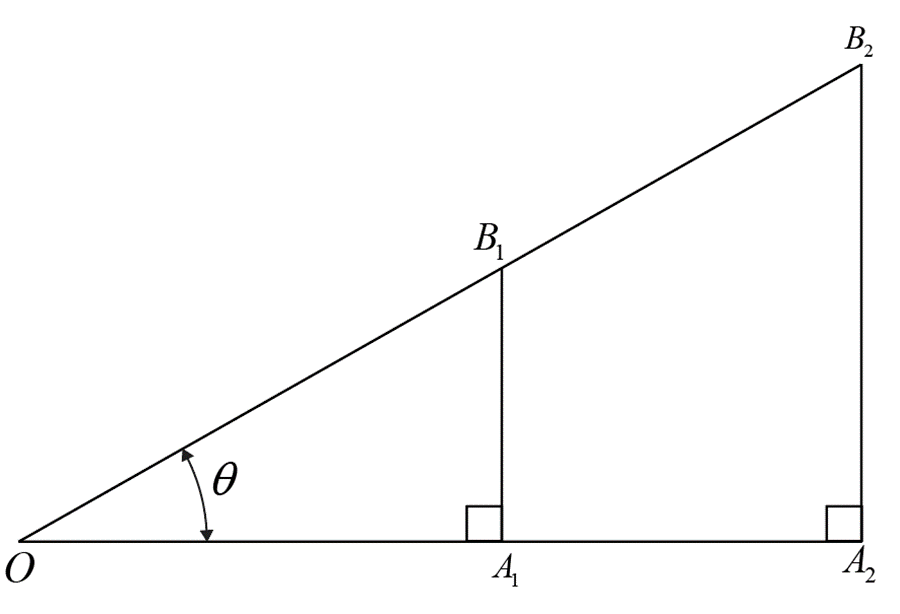
The right angle trigonometry originates from similarity of triangles.

In the above figure △OA1B1∼△OA2B2\triangle OA_1B_1 \sim \triangle OA_2B_2 because ∠A1OB1=∠A2OB2=θ\angle A_1OB_1 = \angle A_2OB_2 = \theta

⇒\Rightarrow their corresponding sides are proportional

We can conclude from proportionality of sides that

A1B1OB1=A2B2OB2....(1)\frac{A_1B_1}{OB_1} = \frac{A_2B_2}{OB_2} \quad ....(1)

OA1OB1=OA2OB2....(2)\frac{OA_1}{OB_1} = \frac{OA_2}{OB_2} \quad ....(2)

And

A1B1OA1=A2B2OA2....(3)\frac{A_1B_1}{OA_1} = \frac{A_2B_2}{OA_2} \quad ....(3)

Let us consider another triangle △OAB\triangle OAB which is similar to △OA1B1\triangle OA_1B_1 and △OA2B2\triangle OA_2B_2

Right angled Triangle

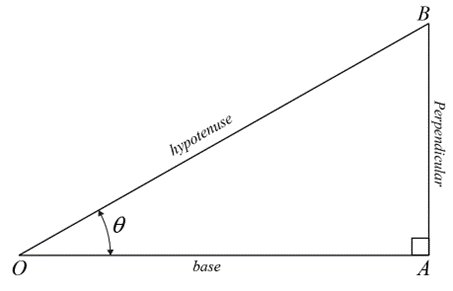
The trigonometric ratios are defined based on the principles of similar triangles. When triangles are similar, their corresponding angles are equal, and their corresponding sides are in proportion. For any right-angled triangle, if we take the angle θ\theta as one of the non-right angles, the side opposite to θ\theta is called the perpendicular, the side adjacent to θ\theta is called the base, and the longest side, opposite the right angle, is called the hypotenuse.

Because the triangles △OA1B1\triangle OA_1B_1, △OA2B2\triangle OA_2B_2, and △OAB\triangle OAB are similar (as they share the same angle θ\theta), the ratios of their corresponding sides are equal and constant for a given angle θ\theta, regardless of the size of the triangle. This constancy allows us to define the following trigonometric ratios:

  1. Sine of angle θ\theta, written as sin⁡θ\sin\theta, is the ratio of the perpendicular to hypotenuse.

    sin⁡θ=perpendicularhypotenuse\sin\theta = \frac{\text{perpendicular}}{\text{hypotenuse}}

  2. Cosine of angle θ\theta, written as cos⁡θ\cos\theta, is the ratio of the base to hypotenuse.

    cos⁡θ=basehypotenuse\cos\theta = \frac{\text{base}}{\text{hypotenuse}}

  3. Tangent of angle θ\theta, written as tan⁡θ\tan\theta, is the ratio of the perpendicular to base.

    tan⁡θ=perpendicularbase\tan\theta = \frac{\text{perpendicular}}{\text{base}}

  4. Cosecant of angle θ\theta, written as csc⁡θ\csc\theta, is the reciprocal of sin⁡θ\sin\theta,

    csc⁡θ=1sin⁡θ⇒csc⁡θ=hypotenuseperpendicular\csc\theta = \frac{1}{\sin\theta} \quad \Rightarrow \quad \csc\theta = \frac{\text{hypotenuse}}{\text{perpendicular}}

  5. Secant of angle θ\theta, written as sec⁡θ\sec\theta, is the reciprocal of cos⁡θ\cos\theta,

    sec⁡θ=1cos⁡θ⇒sec⁡θ=hypotenusebase\sec\theta = \frac{1}{\cos\theta} \quad \Rightarrow \quad \sec\theta = \frac{\text{hypotenuse}}{\text{base}}

  6. Cotangent of angle θ\theta, written as cot⁡θ\cot\theta, is the reciprocal of tan⁡θ\tan\theta,

    cot⁡θ=1tan⁡θ⇒cot⁡θ=baseperpendicular\cot\theta = \frac{1}{\tan\theta} \quad \Rightarrow \quad \cot\theta = \frac{\text{base}}{\text{perpendicular}}

Finding the value of Trigonometric Ratios§

Well from a naïve point of view, one would find out values of trigonometric ratios of any angle by actually drawing a right-angled triangle with that angle. Measure the side lengths with a scale and calculate all six ratios.

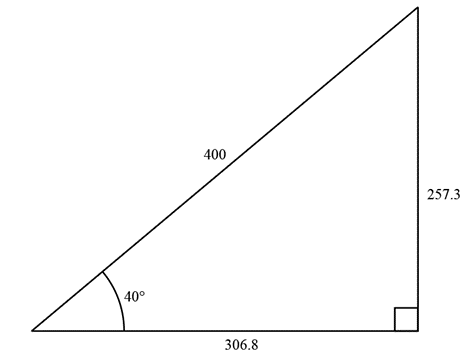
For example, suppose you want to know the values of trigonometric ratios for the angle 40°.

Right Anled Triange with one angle 40 degree

Let us draw a right-angled triangle with one angle 40°. I have drawn this on a software called “Adobe Illustrator” where lengths are in some unit (actually the unit is point. So the hypotenuse is 400 points) I measured that the perpendicular length is 257.3 points and base is 306.8 points.

So, sin 40° = 257.3400=0.643\frac{257.3}{400} = 0.643, cos 40° = 306.8400=0.767\frac{306.8}{400} = 0.767 and tan 40° = 257.3306.8=0.839\frac{257.3}{306.8} = 0.839

Draw your own triangle using a scale and protractor and you should get very similar results.

Actually, all values that I calculated are very near to actual values. We have errors in our result because we had errors in measurement.

Similarly, we can calculate sin(1°), sin(2°), sin(3°), ..., sin(90°) by repeatedly drawing an actual right-angled triangle for correspoding angles. Even though we do not actually do so. As we learn about trigonometry further, we shall see that we have formulas which can calculate these values directly to a great accuracy! We need not calculate these values using formulas as we can always use trigonometric tables (precalculated values presented as tables) or a calculator if you are allowed to do so.

Values of trigonometric ratios for some special angles§

Values of certain trigonometric functions can be found using geometry. You can find them easily using compound angles, multiple angle identities. Then, why know this?

Let us start with the simplest ones.

30° and 60°§

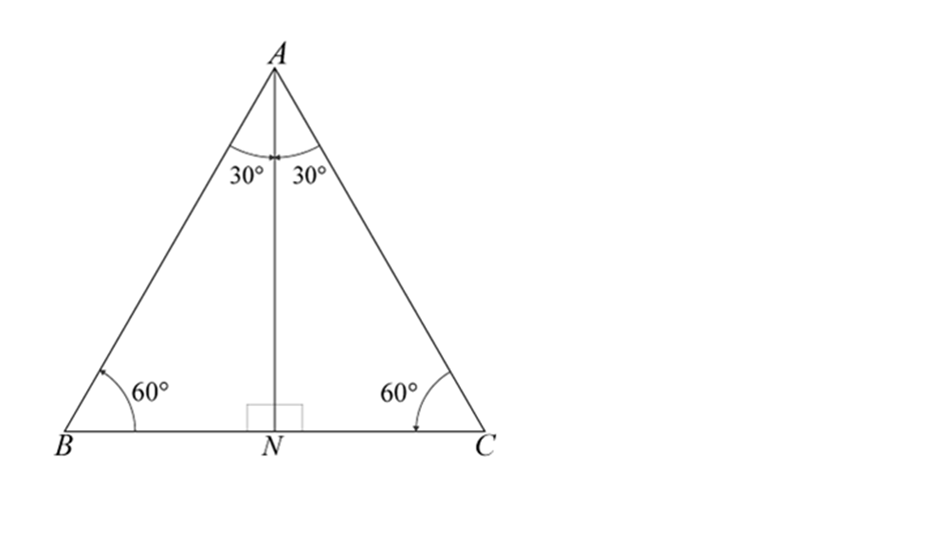
Using an equilateral triangle one can easily find out the values of trigonometric functions of these angles.

Draw an equilateral triangle ABCABC having side lengths equal to 2a2a (why 2a2a? Why not just aa? You can appreciate if you try both ways. We are assuming 2a2a just to avoid fractions. This kind of thing you do at many places in mathematics.)

All angles in this triangle are equal to 60°. Draw a line perpendicular to BCBC from the vertex AA. Let the foot of this perpendicular be NN.

It can easily be proven that ANAN bisects the angle CABCAB and also bisects the side BCBC.

Clearly, BN=NC=aBN = NC = a.

Equilateral tirangle

Observe that in the right-angled triangle △ANB\triangle ANB, ∠BAN=30∘\angle BAN = 30^\circ. By Pythagoras theorem,

AB2=AN2+BN2AB^2 = AN^2 + BN^2 i.e. AN2=4a2−a2=3a2AN^2 = 4a^2 - a^2 = 3a^2

⇒AN=3a\Rightarrow AN = \sqrt{3}a

Keep in mind, in △ANB\triangle ANB, with respect to 30∘30^\circ, BNBN is the perpendicular, ANAN is the base and ABAB is obviously the hypotenuse.

Whereas with respect to 60∘60^\circ ANAN is the perpendicular, BNBN is the base and ABAB is obviously the hypotenuse.

In △ANB\triangle ANB,

sin⁡30∘=BNAB=a2a=12cos⁡30∘=ANAB=3a2a=32tan⁡30∘=BNAN=a3a=13\begin{align*} \sin 30^\circ &= \frac{BN}{AB} = \frac{a}{2a} = \frac{1}{2} \\ \cos 30^\circ &= \frac{AN}{AB} = \frac{\sqrt{3}a}{2a} = \frac{\sqrt{3}}{2} \\ \tan 30^\circ &= \frac{BN}{AN} = \frac{a}{\sqrt{3}a} = \frac{1}{\sqrt{3}} \\ \end{align*} sin⁡60∘=ANAB=3a2a=32cos⁡60∘=BNAB=a2a=12tan⁡60∘=ANBN=3aa=3\begin{align*} \sin 60^\circ &= \frac{AN}{AB} = \frac{\sqrt{3}a}{2a} = \frac{\sqrt{3}}{2} \\ \cos 60^\circ &= \frac{BN}{AB} = \frac{a}{2a} = \frac{1}{2} \\ \tan 60^\circ &= \frac{AN}{BN} = \frac{\sqrt{3}a}{a} = \sqrt{3} \\ \end{align*}

45°§

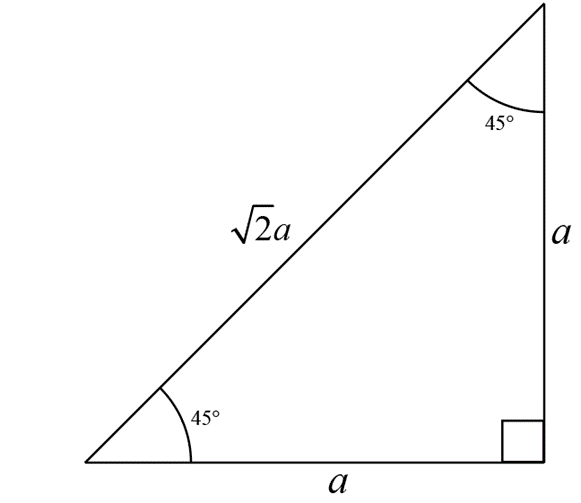
Draw a right-angled isosceles triangle – triangle with one angle 90° and the other two angles are equal to 45°. An isosceles right-angled triangle

If the length of equal sides of the triangle are equal to aa, then the length of the hypotenuse by Pythagoras theorem is 2a\sqrt{2a}.

sin⁡45∘=a2a=12,cos⁡45∘=a2a=12,andtan⁡45∘=aa=1\sin 45^\circ = \frac{a}{\sqrt{2a}} = \frac{1}{\sqrt{2}}, \quad \cos 45^\circ = \frac{a}{\sqrt{2a}} = \frac{1}{\sqrt{2}}, \quad \text{and} \quad \tan 45^\circ = \frac{a}{a} = 1

15° and 75°§

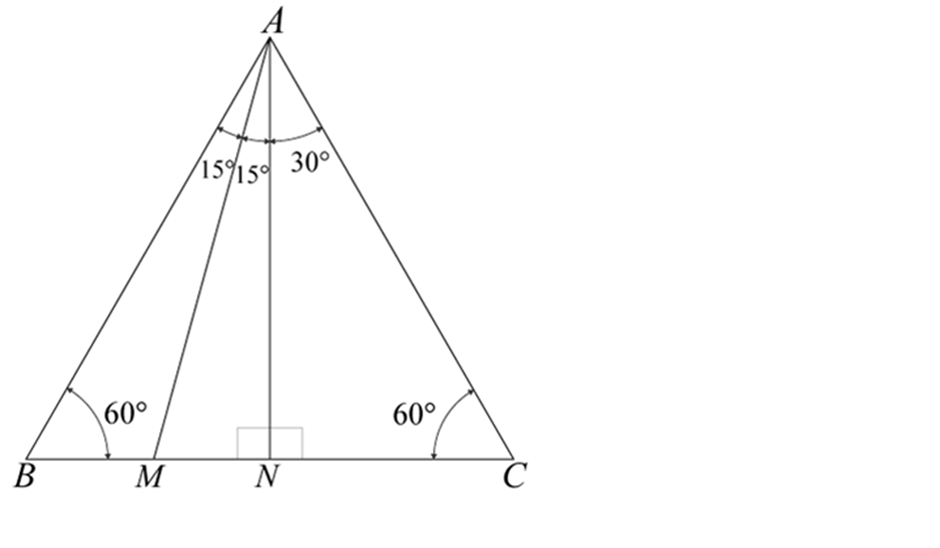
Method 1: Equilaterial triangle Draw an equilateral triangle ABCABC of side length 2a2a. Drop a perpendicular ANAN to side BCBC from vertex AA. Since it is an equilateral triangle, NN is the midpoint of BCBC.

⇒BN=a\Rightarrow BN = a

Now draw the angle bisector AMAM of ∠BAN\angle BAN which cuts BCBC at MM. Thus, ∠MAN=15∘\angle MAN = 15^\circ.

Since, △MAN\triangle MAN is a right angled triangle and its angles are 15∘15^\circ and 75∘75^\circ we can find all trigonometric values for 15∘15^\circ and 75∘75^\circ, if we know lengths of its sides AMAM, MNMN and ANAN

ANAN is the easiest to find out.

In △ABN\triangle ABN,

By Pythagoras theorem,

AN2=AB2−BN2=4a2−a2=3a2AN^2 = AB^2 - BN^2 = 4a^2 - a^2 = 3a^2

⇒AN=3a\Rightarrow AN = \sqrt{3}a

Now, we will find out MNMN.

Since AMAM is the angle bisector of angle ∠BAN\angle BAN in △ABN\triangle ABN, by angle bisector theorem AMAM divides BNBN in the ratio AB:ANAB:AN, that is,

BMMN=ABAN=2a3a=23...(1)\frac{BM}{MN} = \frac{AB}{AN} = \frac{2a}{\sqrt{3}a} = \frac{2}{\sqrt{3}} \quad ...(1)

⇒2MN=3BM\Rightarrow 2MN = \sqrt{3}BM

⇒2MN=3(BN−MN)\Rightarrow 2MN = \sqrt{3} (BN - MN)

⇒(2+3)MN=3BN\Rightarrow (2 + \sqrt{3}) MN = \sqrt{3}BN

⇒MN=3a2+3\Rightarrow MN = \frac{\sqrt{3}a}{2 + \sqrt{3}}

⇒MN=3(2−3)a[Rationalizing the denominator]\Rightarrow MN = \sqrt{3}(2 - \sqrt{3})a \quad \text{[Rationalizing the denominator]}

Lastly we find out AMAM using Pythagoras theorem in △AMN\triangle AMN,

AM2=AN2+MN2AM^2 = AN^2 + MN^2

=3a2+(2−3)2a2=3a2(8−43)= 3a^2 + (2 - \sqrt{3})^2 a^2 = 3a^2 (8 - 4\sqrt{3})

AM2=6a2(4−23)AM^2 = 6a^2 (4 - 2\sqrt{3})

=6a2(3−1)2= 6a^2 \left( \sqrt{3} - 1 \right)^2

AM=6a(3−1)AM = \sqrt{6a} \left( \sqrt{3} - 1 \right)

Finally

sin⁡15∘=MNAM=3(2−3)a6(3−1)a\sin 15^\circ = \frac{MN}{AM} = \frac{\sqrt{3}(2 - \sqrt{3})a}{\sqrt{6}(\sqrt{3} - 1)a}

=4−2322(3−1)=(3−1)222(3−1)=3−122= \frac{4 - 2\sqrt{3}}{2\sqrt{2}(\sqrt{3} - 1)} = \frac{(\sqrt{3} - 1)^2}{2\sqrt{2}(\sqrt{3} - 1)} = \frac{\sqrt{3} - 1}{2\sqrt{2}}

cos⁡15∘=ANAM=3a6a(3−1)=3+122\cos 15^\circ = \frac{AN}{AM} = \frac{\sqrt{3}a}{\sqrt{6a}(\sqrt{3} - 1)} = \frac{\sqrt{3} + 1}{2\sqrt{2}}

tan⁡15∘=MNAN=3(2−3)a3a=2−3\tan 15^\circ = \frac{MN}{AN} = \frac{\sqrt{3}(2 - \sqrt{3})a}{\sqrt{3}a} = 2 - \sqrt{3}

Similarly, we can see that angle ∠AMN=75∘\angle AMN = 75^\circ in △AMN\triangle AMN. Thus,

sin⁡75∘=3+122,cos⁡75∘=3−122,andtan⁡75∘=2+3\sin 75^\circ = \frac{\sqrt{3} + 1}{2\sqrt{2}}, \quad \cos 75^\circ = \frac{\sqrt{3} - 1}{2\sqrt{2}}, \quad \text{and} \quad \tan 75^\circ = 2 + \sqrt{3}

Method 2

Calculation of trigonometric ratios for 15 degree

Certainly, here is the corrected text with proper formatting:

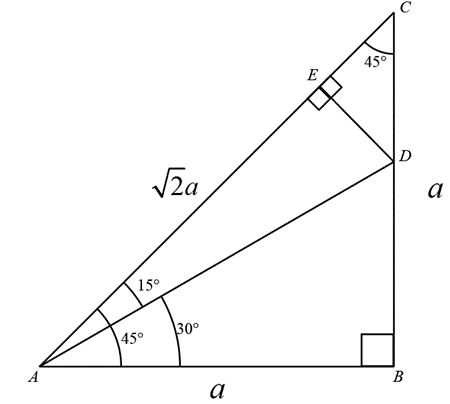
Draw an isosceles right-angled triangle △ABC\triangle ABC right-angled at BB. Let AB=BC=aAB = BC = a.

⇒AC=2a[Using Pythagoras theorem]\Rightarrow AC = \sqrt{2}a \quad \text{[Using Pythagoras theorem]}

Draw ADAD such that ∠BAD=30∘\angle BAD = 30^\circ. Drop a perpendicular DEDE from DD to ACAC. EC=CDEC = CD because △ECD\triangle ECD is a right-angled isosceles triangle.

In △ABD\triangle ABD,

tan⁡30∘=BDAB⇒BD=a3.\tan 30^\circ = \frac{BD}{AB} \Rightarrow BD = \frac{a}{\sqrt{3}}.

⇒CD=BC−BD=a−a3=(3−1)a3\Rightarrow CD = BC - BD = a - \frac{a}{\sqrt{3}} = \left( \sqrt{3} - 1 \right) \frac{a}{\sqrt{3}}

In △ECD\triangle ECD,

cos⁡45∘=ECCD⇒EC=CD⋅cos⁡45∘\cos 45^\circ = \frac{EC}{CD} \Rightarrow EC = CD \cdot \cos 45^\circ

⇒EC=(3−1)a3⋅12=(3−1)a6\Rightarrow EC = \left( \sqrt{3} - 1 \right) \frac{a}{\sqrt{3}} \cdot \frac{1}{\sqrt{2}} = \left( \sqrt{3} - 1 \right) \frac{a}{\sqrt{6}}

In △AED\triangle AED, angle ∠EAD=15∘\angle EAD = 15^\circ and it is a right-angled triangle. We now only need to calculate AEAE, ADAD and EDED.

ED=EC=(3−1)a6ED = EC = \left( \sqrt{3} - 1 \right) \frac{a}{\sqrt{6}}

In △ABD\triangle ABD, cos⁡30∘=ABAD⇒AD=ABcos⁡30∘\cos 30^\circ = \frac{AB}{AD} \Rightarrow AD = \frac{AB}{\cos 30^\circ}

⇒AD=a3=2a3⋅12\Rightarrow AD = \frac{a}{\sqrt{3}} = \frac{2a}{\sqrt{3}} \cdot \frac{1}{2}

In AE=AC−EC=2a−(3−1)a6=(3+1)a6AE = AC - EC = \sqrt{2a} - \left( \sqrt{3} - 1 \right) \frac{a}{\sqrt{6}} = \left( \sqrt{3} + 1 \right) \frac{a}{\sqrt{6}}

Thus, finally,

sin⁡15∘=EDAD=(3−1)a6×32a=(3−1)122\sin 15^\circ = \frac{ED}{AD} = \left( \sqrt{3} - 1 \right) \frac{a}{\sqrt{6}} \times \frac{\sqrt{3}}{2a} = \left( \sqrt{3} - 1 \right) \frac{1}{2\sqrt{2}}

Method 3

Figure for the calculation of trigonometric ratios of 15 degrees

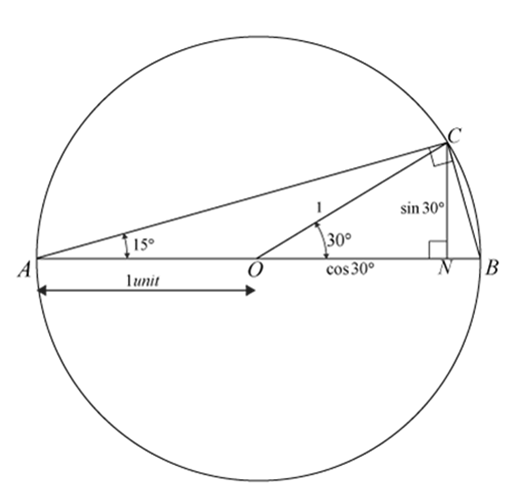
Draw a circle of radius 1 unit. Let ABAB be the diameter with OO as the centre. Draw ACAC such that ∠BAC=15∘\angle BAC = 15^\circ and CC lies on the circle. The angle subtended by BCBC at AA is 15∘15^\circ, then the angle subtended by BCBC at the centre OO is twice of it, that is, 30∘30^\circ. Drop a perpendicular from CC to diameter ABAB, NN being its foot on ABAB.

In △OCN\triangle OCN, OC=1OC = 1 (radius), CN=sin⁡30∘CN = \sin 30^\circ and ON=cos⁡30∘ON = \cos 30^\circ

△MNC\triangle MNC is a right-angled triangle with ∠NAC=15∘\angle NAC = 15^\circ. If we wish to find out the values of trigonometric ratios we need to know the lengths of its sides, that is, ACAC, ANAN and CNCN.

CN=sin⁡30∘=12CN = \sin 30^\circ = \frac{1}{2}

And AN=1+cos⁡30∘AN = 1 + \cos 30^\circ

AC2=AN2+CN2=(1+cos⁡30∘)2+sin⁡230∘=2+2cos⁡30∘AC^2 = AN^2 + CN^2 = (1 + \cos 30^\circ)^2 + \sin^2 30^\circ = 2 + 2 \cos 30^\circ

⇒AC=2+3=4+232=(3+1)22=3+12\Rightarrow AC = \sqrt{2 + \sqrt{3}} = \sqrt{\frac{4 + 2\sqrt{3}}{2}} = \sqrt{\frac{\left(\sqrt{3} + 1\right)^2}{2}} = \frac{\sqrt{3} + 1}{\sqrt{2}}

Therefore,

sin⁡15∘=CNAC\sin 15^\circ = \frac{CN}{AC} =sin⁡30∘2+3= \frac{\sin 30^\circ}{\sqrt{2 + \sqrt{3}}} =223+12=3−122= \frac{\frac{\sqrt{2}}{2}}{\frac{\sqrt{3} + 1}{\sqrt{2}}} = \frac{\sqrt{3} - 1}{2\sqrt{2}}

cos⁡15∘=ANAC=1+cos⁡30∘2+3=2+32(3+1)=3+122\cos 15^\circ = \frac{AN}{AC} = \frac{1 + \cos 30^\circ}{\sqrt{2 + \sqrt{3}}} = \frac{2 + \sqrt{3}}{\sqrt{2}(\sqrt{3} + 1)} = \frac{\sqrt{3} + 1}{2\sqrt{2}}

18°§

Calculating sin 18°

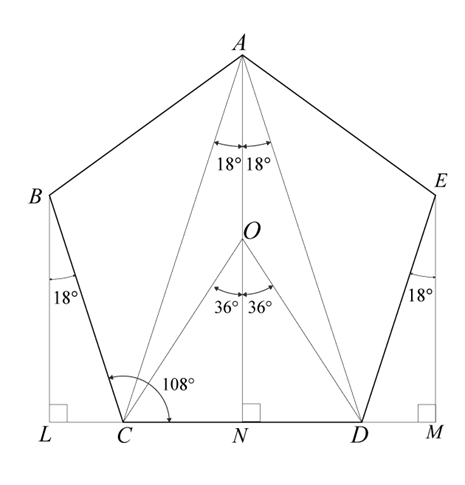
Pentagon for the calculation of trigonometric ratios of 18 degrees

Let there be a regular pentagon ABCDEABCDE having side lengths equal to aa and centre OO.

Construct some extra stuff as shown in the figure. A little angle hunting will show that ∠NAC=18∘\angle NAC = 18^\circ.

Now CN=CD2=a2CN = \frac{CD}{2} = \frac{a}{2}

∠CBL=∠MED=18∘\angle CBL = \angle MED = 18^\circ

LC=BCsin⁡18∘=asin⁡18∘LC = BC \sin 18^\circ = a \sin 18^\circ and DM=asin⁡18∘DM = a \sin 18^\circ

AC+BE=LM=LC+CD+DMAC + BE = LM = LC + CD + DM

AC=asin⁡18∘+a+asin⁡18∘⇒AC=a+2asin⁡18∘AC = a \sin 18^\circ + a + a \sin 18^\circ \Rightarrow AC = a + 2a \sin 18^\circ

In △NAC\triangle NAC, sin⁡18∘=CNAC=a2a+2asin⁡18∘\sin 18^\circ = \frac{CN}{AC} = \frac{\frac{a}{2}}{a + 2a \sin 18^\circ}

⇒sin⁡18∘=12+4sin⁡18∘\Rightarrow \sin 18^\circ = \frac{1}{2 + 4 \sin 18^\circ}

⇒4sin⁡218∘+2sin⁡18∘−1=0\Rightarrow 4 \sin^2 18^\circ + 2 \sin 18^\circ - 1 = 0

⇒sin⁡18∘=−2+4+168=−1+54\Rightarrow \sin 18^\circ = \frac{-2 + \sqrt{4 + 16}}{8} = \frac{-1 + \sqrt{5}}{4}

⇒sin⁡18∘=5−14(sin⁡18∘ cannot be negative value)\Rightarrow \sin 18^\circ = \frac{\sqrt{5} - 1}{4} \quad (\sin 18^\circ \text{ cannot be negative value})

36°§

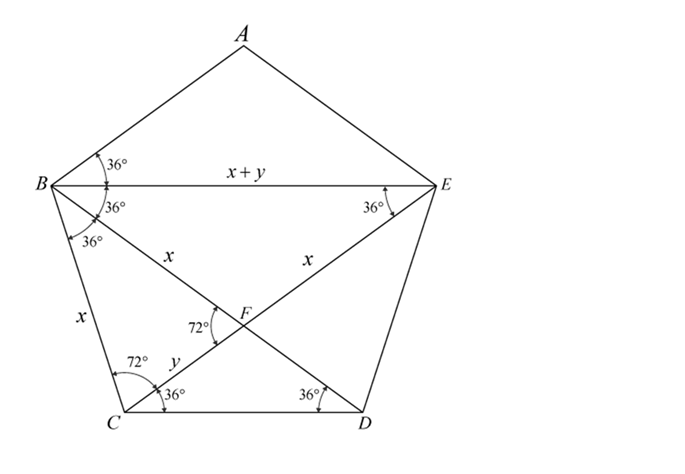
Pentagon for the calculation of trigonometric ratios of 36 degree

Construct a regular pentagon ABCDEABCDE as shown above.

△ECB≅△FCB⇒x+yx=xy⇒xy+y2=x2...(1)\triangle ECB \cong \triangle FCB \Rightarrow \frac{x+y}{x} = \frac{x}{y} \Rightarrow xy + y^2 = x^2 \quad ...(1)

In △BCF\triangle BCF,

cos36∘=x2+x2−y22x2[Using Cosine Rule]cos 36^\circ = \frac{x^2 + x^2 - y^2}{2x^2} \quad \text{[Using Cosine Rule]}

⇒cos⁡36∘=x2+xy2(xy+y2)[Using (1)]\Rightarrow \cos 36^\circ = \frac{x^2 + xy}{2(xy + y^2)} \quad \text{[Using (1)]}

⇒cos⁡36∘=x(x+y)2y(x+y)=x2y\Rightarrow \cos 36^\circ = \frac{x(x+y)}{2y(x+y)} = \frac{x}{2y}

In △BFE\triangle BFE,

2xcos⁡36∘=x+y...(2)2x\cos 36^\circ = x + y \quad ...(2)

From (1) and (2),

2cos⁡36∘=1+12cos⁡36∘2\cos 36^\circ = 1 + \frac{1}{2\cos 36^\circ}

⇒4cos⁡236∘=2cos⁡36∘+1\Rightarrow 4\cos^2 36^\circ = 2\cos 36^\circ + 1

⇒4cos⁡236∘−2cos⁡36∘−1=0\Rightarrow 4\cos^2 36^\circ - 2\cos 36^\circ - 1 = 0

⇒cos⁡36∘=2+4+168\Rightarrow \cos 36^\circ = \frac{2 + \sqrt{4 + 16}}{8}

⇒cos⁡36∘=5+14(cos⁡36∘ cannot be negative)\Rightarrow \cos 36^\circ = \frac{\sqrt{5} + 1}{4} \quad (\cos 36^\circ \text{ cannot be negative})

By the way, △BEC\triangle BEC is called the Golden Triangle. But more on that later, at some place, somewhere else.

22.5°§

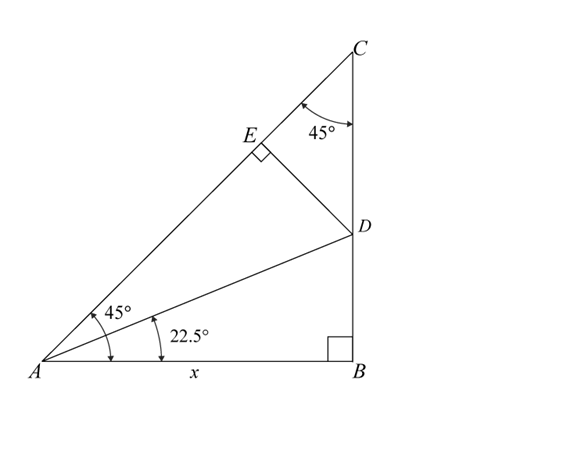
Isosceles triangle for the calculation of trigonometric ratios of 22.5 degree

△ABD≅△AED\triangle ABD \cong \triangle AED

⇒AE=AB=x\Rightarrow AE = AB = x

Thus, EC=AC−AE=2x−x=(2−1)xEC = AC - AE = \sqrt{2}x - x = (\sqrt{2} - 1)x

△CED\triangle CED is an isosceles right-angled triangle

CE=ED=(2−1)xCE = ED = (\sqrt{2} - 1)x

tan⁡22.5∘=EDAE=(2−1)xx=2−1\tan 22.5^\circ = \frac{ED}{AE} = \frac{(\sqrt{2} - 1)x}{x} = \sqrt{2} - 1

We can easily find sin⁡22.5∘\sin 22.5^\circ and cos⁡22.5∘\cos 22.5^\circ

So I in this section tried to introduce you about various techniques used in geometry to find values of various trigonometric ratios. What we discussed is not the whole thing. You may come up with various other techniques.

I think you must be convinced that for certain angles we can find the values of trigonometric ratios using geometry. But this may not be possible for all angles or it may be a very complicated process.

Complementary Angles§

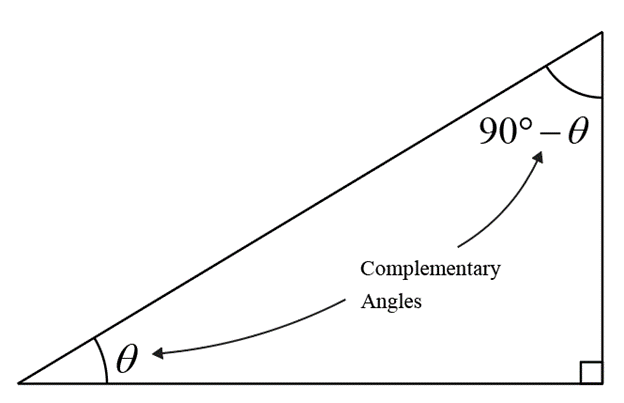
Two angles are said to be complementary angles if and only if their sum is 90°.

For any angle θ\theta, the complement is 90∘−θ90^\circ - \theta.

In a right-angled triangle, one of the angles is 90° and the other two are complementary.

A right angles triangle depicting complementary angles

The perpendicular with respect to θ\theta is the base with respect to 90∘−θ90^\circ - \theta and the base with respect to θ\theta is the perpendicular with respect to 90∘−θ90^\circ - \theta. Because of which,

sin⁡(90∘−θ)=cos⁡θcos⁡(90∘−θ)=sin⁡θtan⁡(90∘−θ)=cot⁡θcsc⁡(90∘−θ)=sec⁡θsec⁡(90∘−θ)=csc⁡θcot⁡(90∘−θ)=tan⁡θ\begin{align*} \sin(90^\circ - \theta) &= \cos \theta \\ \cos(90^\circ - \theta) &= \sin \theta \\ \tan(90^\circ - \theta) &= \cot \theta \\ \csc(90^\circ - \theta) &= \sec \theta \\ \sec(90^\circ - \theta) &= \csc \theta \\ \cot(90^\circ - \theta) &= \tan \theta \end{align*}

Therefore if sin⁡18∘=5−14\sin 18^\circ = \frac{\sqrt{5} - 1}{4} ⇒cos⁡(90∘−18∘)=5−14\Rightarrow \cos(90^\circ - 18^\circ) = \frac{\sqrt{5} - 1}{4} ⇒cos⁡72∘=5−14\Rightarrow \cos 72^\circ = \frac{\sqrt{5} - 1}{4}

Trigonometric Identities§

We have three fundamental identities which relate all six trigonometric ratios of an angle.

  1. sin⁡2θ+cos⁡2θ=1\sin^2 \theta + \cos^2 \theta = 1

  2. 1+tan⁡2θ=sec⁡2θ1 + \tan^2 \theta = \sec^2 \theta

  3. 1+cot⁡2θ=csc⁡2θ1 + \cot^2 \theta = \csc^2 \theta

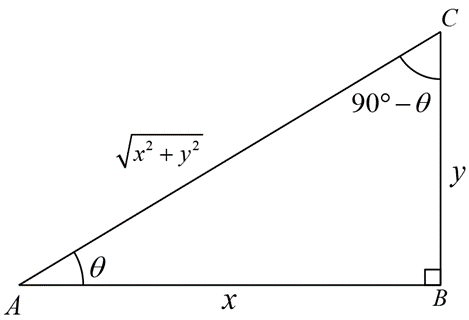
Proof: Let there be a right angled triangle △ABC\triangle ABC such that AB=xAB = x and BC=yBC = y. By Pythagoras theorem, AC=AB2+BC2=x2+y2AC = \sqrt{AB^2 + BC^2} = \sqrt{x^2 + y^2} . Let angle BAC=θBAC = \theta

A right-angled triangle

sin⁡θ=yx2+y2,cos⁡θ=xx2+y2,tan⁡θ=yx\sin \theta = \frac{y}{\sqrt{x^2 + y^2}}, \quad \cos \theta = \frac{x}{\sqrt{x^2 + y^2}}, \quad \tan \theta = \frac{y}{x}

csc⁡θ=x2+y2y,sec⁡θ=x2+y2x,cot⁡θ=xy\csc \theta = \frac{\sqrt{x^2 + y^2}}{y}, \quad \sec \theta = \frac{\sqrt{x^2 + y^2}}{x}, \quad \cot \theta = \frac{x}{y}

sin⁡2θ+cos⁡2θ=y2x2+y2+x2x2+y2=1\sin^2 \theta + \cos^2 \theta = \frac{y^2}{x^2 + y^2} + \frac{x^2}{x^2 + y^2} = 1

1+tan⁡2θ=1+y2x2=x2+y2x2=sec⁡2θ1 + \tan^2 \theta = 1 + \frac{y^2}{x^2} = \frac{x^2 + y^2}{x^2} = \sec^2 \theta

1+cot⁡2θ=1+x2y2=x2+y2y2=csc⁡2θ1 + \cot^2 \theta = 1 + \frac{x^2}{y^2} = \frac{x^2 + y^2}{y^2} = \csc^2 \theta

Given the value of one of the six trigonometric ratios of an angle, how to find values of rest of them for that angle.

Suppose you know that for some angle θ\theta, its sine is ss. i.e. sin⁡θ=s\sin \theta = s. We know that

sin⁡θ=perpendicularhypotenuse\sin \theta = \frac{\text{perpendicular}}{\text{hypotenuse}}

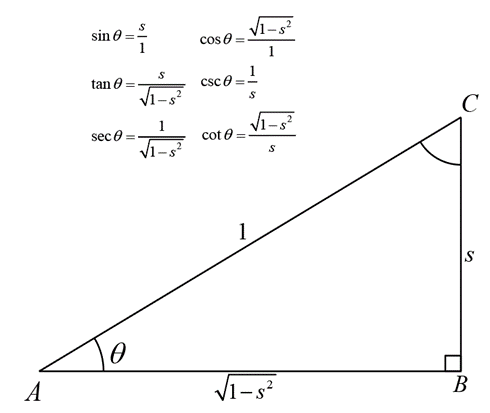
Now sin⁡θ=s\sin \theta = s can be written as sin⁡θ=s1\sin \theta = \frac{s}{1} and we assume, perpendicular=s\text{perpendicular} = s and hypotenuse=1\text{hypotenuse} = 1.

We construct where one of the angle is θ\theta and its perpendicular is of length ss and hypotenuse is of length 1 unit. Then, base, by Pythagoras theorem, is equal to 1−s2\sqrt{1 - s^2}. Thus, now we can calculate values of each trigonometric ratio of angle θ\theta from this triangle.

A right angled triangle

This innocent looking technique of finding trigonometric ratios will be very useful in the future.

Of course, you can directly use identities to calculate other trigonometric ratios.

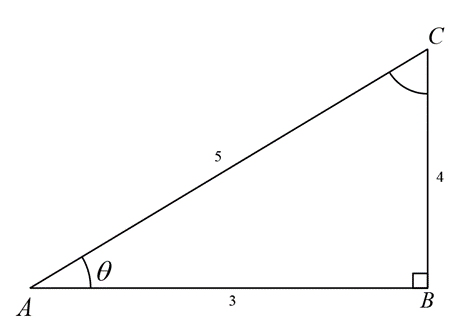
Right-angled triangle

sin⁡θ=45,tan⁡θ=43,csc⁡θ=54,sec⁡θ=53, and cot⁡θ=34\sin \theta = \frac{4}{5}, \tan \theta = \frac{4}{3}, \csc \theta = \frac{5}{4}, \sec \theta = \frac{5}{3}, \text{ and } \cot \theta = \frac{3}{4}

Sometimes it’s suitable to write the identity 1+tan⁡2θ=sec⁡2θ1 + \tan^2 \theta = \sec^2 \theta as sec⁡2θ−tan⁡2θ=1\sec^2 \theta - \tan^2 \theta = 1

⇒(sec⁡θ−tan⁡θ)(sec⁡θ+tan⁡θ)=1⇒sec⁡θ−tan⁡θ=1sec⁡θ+tan⁡θ\Rightarrow (\sec \theta - \tan \theta)(\sec \theta + \tan \theta) = 1 \Rightarrow \sec \theta - \tan \theta = \frac{1}{\sec \theta + \tan \theta}

Suppose if it is known that sec⁡θ−tan⁡θ=p\sec \theta - \tan \theta = p, ...(1)

Then sec⁡θ+tan⁡θ=1p\sec \theta + \tan \theta = \frac{1}{p} ...(2)

Adding (1) and (2),

2sec⁡θ=p+1p⇒sec⁡θ=12(p+1p)2 \sec \theta = p + \frac{1}{p} \Rightarrow \sec \theta = \frac{1}{2}\left( p + \frac{1}{p} \right)

Subtracting (1) from (2), we get,

2tan⁡θ=1p−p⇒tan⁡θ=12(1p−p)2 \tan \theta = \frac{1}{p} - p \Rightarrow \tan \theta = \frac{1}{2}\left( \frac{1}{p} - p \right)

Similarly. csc⁡θ−cot⁡θ=1csc⁡θ+cot⁡θ\csc \theta - \cot \theta = \frac{1}{\csc \theta + \cot \theta}

Section 4 of 13 · Trigonometry

Mark this section complete when you have worked through its proofs.