
Multiple Angles
In trigonometry, the term "multiple angles" pertains to angles that are integer multiples of a single angle, denoted as , where is an integer and is the base angle. Functions involving multiple angles, such as , , and , can be expanded or simplified using trigonometric identities. These identities express the functions of multiple angles in terms of powers or products of functions of the single angle .
Double Angle§
- For any , .
Proof:
We employ the addition formula for sine, which states that for any angles and :
For a double angle, where and are both equal to , the formula becomes:
Since and are identical terms, we can combine them to obtain:
This completes the proof that the sine of a double angle is equal to twice the product of the sine and cosine of the original angle.
- For any ,
Proof:
Begin with the cosine addition formula:
Set to obtain the double angle formula for cosine:
Now, using the identity , rewrite the formula:
Similarly, using , we have:
This completes the proof of the three equivalent forms of the double angle formula for cosine.
Geometric Proof from I and II
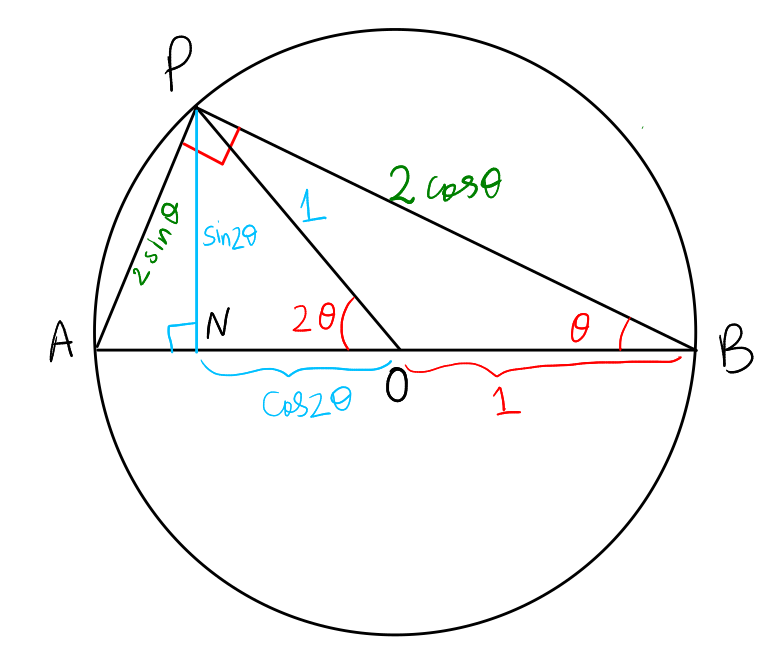
Consider a unit circle with center . Let be the diameter of the circle, and let point be a point on the circumference such that . This construction implies that because an angle at the center of a circle is twice an angle at the circumference that subtends the same arc.
In the right angled triangle, we have:
In :
The length in can be found by extending to , yielding:
And since , we have:
Setting the two expressions for equal to each other:
Subtracting 1 from both sides gives us:
Using the Pythagorean identity , we can rewrite as and substitute to get:
This simplifies to:
- The double-angle formulas for tangent and cotangent for any angle are:
Proof:
Given the previous proof for the double-angle formulas of sine and cosine, we have:
To find the double-angle formula for tangent, we use the identity . Thus, for , we have:
Substituting the double-angle formulas derived for sine and cosine, we get:
Using the identity for tangent, this becomes:
Next, to derive the double-angle formula for cotangent, we use the identity . Thus, is:
Substituting the formula we derived for , we get:
Expressing in terms of , we have , and thus:
Therefore, we have derived the double-angle formulas for tangent and cotangent in terms of and , respectively.
- For any angle , the following identities hold:
-
can be expressed in terms of as:
-
can be expressed in terms of as:
Proof:
To prove these identities, we use the double angle formulas for sine and cosine, along with the definition of tangent.
The double angle formulas are:
Since , we can express and in terms of :
Substituting these into the double angle formulas:
- For :
This simplifies to:
- For :
This simplifies to:
Hence, both identities are proven.
Triple Angle§
- The triple-angle formulas for sine and cosine for any angle are:
Proof:
To prove the triple-angle formulas, we'll use the sum of angles formula for sine and cosine, as well as the double-angle formulas.
-
Proof for :
Start with the sum of angles formula for sine:
Apply the sum of angles formula:
Substitute the double-angle formulas for sine and cosine:
Expand and rearrange:
Since , replace in the equation:
Simplify:
-
Proof for :
Start with the sum of angles formula for cosine:
Apply the sum of angles formula:
Substitute the double-angle formulas for sine and cosine:
Expand and rearrange:
Since , replace in the equation:
Simplify:
- For any angle , the sine of triple that angle, , can be expressed as:
Proof:
Starting from the established identity:
Rewrite the identity as:
Recognize that and use the identity for the difference of squares:
Substitute with and with :
Since as well, in a similar fashion we prove,
- For any angle , the cosine of triple that angle, , can be expressed as:
Proof:
Starting with the triple angle formula for cosine:
Factor from the expression:
Express using the sine function for and , noting that :
Apply the identity :
Thus, both expressions for are established.
- For any angle , the following trigonometric identity holds:
Proof:
To prove this identity, we utilize the sum formula for tangent and the double angle formula. The sum formula for tangent states:
Applying this to :
Using the double angle formula for tangent, , we substitute into the equation:
Simplify the expression by finding a common denominator in the numerator and simplifying the denominator:
This simplifies to:
Thus, the identity is proven.
- For any angle , the followign trigonometric identities are valid:
Proof:
Consider the known identities for and :
By the definition of tangent:
Simplifying the expression:
Recognizing the tangent in each fraction:
Hence, the identity is established.
Proof:
Given the identity , we rearrange it to express as:
Substituting this into the LHS of the theorem, we have:
Now, we use the periodicity and symmetry properties of the sine function:
This simplifies the expression to:
Next, we simplify the sum inside the parentheses. Using the sine angle addition formula, and can be expressed in terms of and . After simplification, this sum evaluates to zero. This leaves us with:
This matches the right-hand side (RHS) of the theorem, thus completing the proof.
Proof:
Utilizing the trigonometric identity for , which is
we rearrange it to express in terms of :
We substitute this expression into the left-hand side (LHS) of our theorem:
Using the periodicity and symmetry properties of the cosine function:
This simplifies the expression to:
Next, we simplify the sum inside the parentheses. Using the cosine angle addition formula, and can be expressed in terms of and . After simplification, this sum evaluates to zero. This leaves us with:
This matches the right-hand side (RHS) of the theorem, thus completing the proof.
nth Angle§
In general for ,
These are expressions for the multiple angle identities of sine and cosine, which are used in trigonometry to express the sine and cosine of multiple angles in terms of powers of the sine and cosine of a single angle.
Also,
The tangent of a multiple angle can be expressed in terms of powers of as:
Proof:
We have:
Dividing we get,
Simplifying each term by dividing by , and using the identity , we obtain:
This series expansion expresses in terms of and completes the proof.
Mark this section complete when you have worked through its proofs.