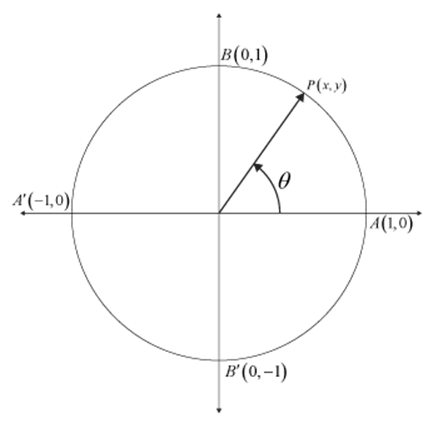
Let there be a unit circle (a circle of radius 1 unit) in the cartesian coordinate system such that the centre of the circle is at the origin. Let θ be any angle such that its terminal point is P(x,y).
θ is a standard angle measured from positive axis.
This circle cuts the axes at A(1,0), B(0,1), A′(−1,0) and B′(0,−1). Thus, for any point P(x,y) on this circle, −1≤x≤1 and −1≤y≤1.
This is how we define trigonometric functions.
SINE of angle θ is defined to be equal to y (the ordinate of point P)
sinθ=y
COSINE of angle θ is defined to be equal to x (the abscissa of point P)
cosθ=x
TANGENT of angle θ is defined to be equal to xy (the ratio of ordinate to abscissa)
tanθ=xy=cosθsinθ
Reciprocal trigonometric functions:
The reciprocal of sine is said to be cosecant.
COSECANT of angle θ is equal to y1
cscθ=y1=sinθ1
SECANT of angle θ is equal to x1
secθ=x1=cosθ1
COTANGENT of angle θ is equal to yx
cotθ=yx=tanθ1=sinθcosθ
That’s it. This is how the circular trigonometric functions are defined.
To understand how to use this new definition we start with calculation of values of trigonometric
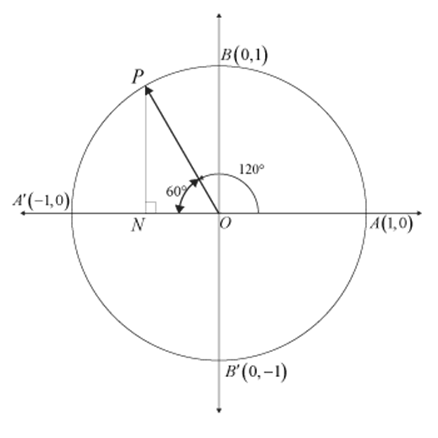
We construct the angle 120° and “somehow” calculate the coordinate of its terminal point. That’s it, we will be done!
Let us construct this angle on the unit circle.
P is the terminal point of the angle 120°. We wish to calculate the coordinates of P. To do that let us drop a perpendicular from point P to the x-axis. In △OPN, the angle NOP is equal to 60°. Using right hand trigonometry, we calculate ON=OPcos60°=21 and PN=OPsin60°=23.
Thus, the coordinates of point P are (−21,23).
According to the definition of circular trigonometric functions,
sin120°=ordinate of point P=23 and cos120°=abscissa of point P=−21
Let us take one more example. For the angle θ=−120°, let us calculate values of trigonometric functions.
Draw θ=−120° on the unit circle. Let P be the terminal point. Drop a perpendicular from point P to the x-axis. In the right-angled triangle OPN, ∠NOP=60°. Using right-angled triangle trigonometry, ON=OPcos60∘=−21 and PN=OPsin60∘=23. Thus the coordinates of P are (−21,−23).
Therefore, sin(−120∘)=−23, cos(−120∘)=−21 and tan(−120∘)=3
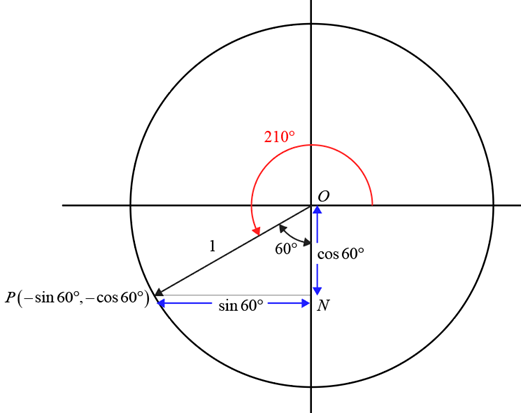
To practice more let us calculate values of trigonometric functions for 210∘
Construct 210°. Terminal point P lies in the third quadrant. We want to find out coordinates of P. To do that let us draw a normal PN from point P to y axis. We get a right-angled triangle OPN. Clearly angle PON is 60°. Using right angles trigonometry sin 60° = ONPN=1PN=PN
⇒PN=sin60°=23 and ON=cos60°=−21. Thus, coordinates of P are (−23,−21).
Therefore, by definitions of trigonometric functions,
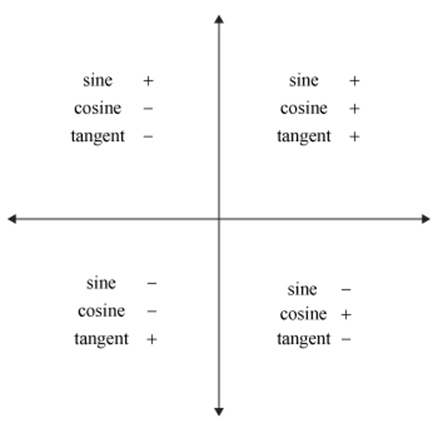
Since, sine of an angle is equal to the ordinate of its terminal point, the value of sine must be positive in the first and the second quadrant and negative in the third and fourth quadrant. Similarly cosine, being equal to abscissa, is positive in first and fourth quadrant and negative in the second and the third quadrant. Tangent, on the other hand, is the ratio of ordinate to abscissa. It is positive when both ordinate and abscissa have same signs. Thus, tangent is positive in the first and the third quadrant, while it is negative in second and the fourth quadrant. Their reciprocal functions also have the corresponding signs.
Now let us learn how this process of calculating values of trigonometric functions for any angle can be made shorter and quicker.
Let there be an angle θ. For some n∈Z, θ=nπ+α such that α is an acute angle. What we mean is this that you are given some angle and you are able to write that angle as a sum of a horizontal angle (multiple of π or 180°) and an acute angle. E.g., 355π can be written as (54+1)3π=18π+3π. If the angle given in radians is of the form qpπ, find the closest multiple of q to p and write p in terms of that multiple. We did the same in the example. 54 is the closest multiple of 3 to 55. Thus we wrote 55=54+1. And the rest is simple. If the angle is in degrees, for instance, 480°, we find the closest multiple of 180° to it, which is 540°, and then we write 480° = 540° - 60°.
Once you’ve done so, now decide the correct quadrant of the angle. With the quadrant of the angle, you should be able to determine the sign of the value. When this is done too, we have this simple rule.
T(θ)=T(Horizontal angle±α)=(+ or − sign based on the quadrant of θ)T(α)
Where T is any trigonometric function like sin, cosine etc.
In the decided quadrant of θ decide whether the trigonometric function T is positive or negative.
e.g. sin344π=sin(345−1π)=sin(315π−3π)
344π=15π−3π lies in the second quadrant where sine is positive. Therefore,
sin(315π−3π)=+sin3π=+23
You may remember the following results if you wish to:
−θ
Since, −θ=0−θ (0 is a horizontal angle)
It lies in the fourth quadrant. Thus,
sin(−θ)=−sinθcos(−θ)=cosθtan(−θ)=−tanθ
π−θ
Since, π−θ lies in the second quadrant,
sin(π−θ)=sinθcos(π−θ)=−cosθtan(π−θ)=−tanθ
π+θ
Since, π+θ lies in the third quadrant,
sin(π+θ)=−sinθcos(π+θ)=−cosθtan(π+θ)=tanθ
2π−θ
Since, 2π−θ lies in the fourth quadrant,
sin(2π−θ)=−sinθcos(2π−θ)=cosθtan(2π−θ)=−tanθ
2π+θ
Since, 2π+θ lies in the first quadrant,
sin(2π+θ)=sinθcos(2π+θ)=cosθtan(2π+θ)=tanθ
We have another rule which makes life easier.
Let there be an angle θ which can be written as θ=(2n+1)2π+α (Assuming α to be acute and n∈Z)
We are writing θ in terms of vertical angle (2n+1)2π.
If T represents some trigonometric function and T′ is its complementary function.
What's a complementary function?
Trigonometric Function
Complementary trigonometric function
sine
cosine
cosine
sine
Secant
Cosecant
cosecant
secant
tangent
cotangent
cotangent
tangent
Now, T(θ)=T(vertical angle±θ)=(± or − sign based on quadrant of θ)T′(α)
For example, cos(90∘+θ)=−sinθ. Why? Because 90∘+θ lies in the second quadrant (we always assume that θ is acute). Since 90∘ is a vertical angle, cosine become sine and we put a minus sign because cosine is negative in the second quadrant.
We may visualize trigonometric functions on a single figure as lengths of line segments. Have you ever wondered why the name “tangent” of one of the trigonometric functions? Are there other trigonometric functions?
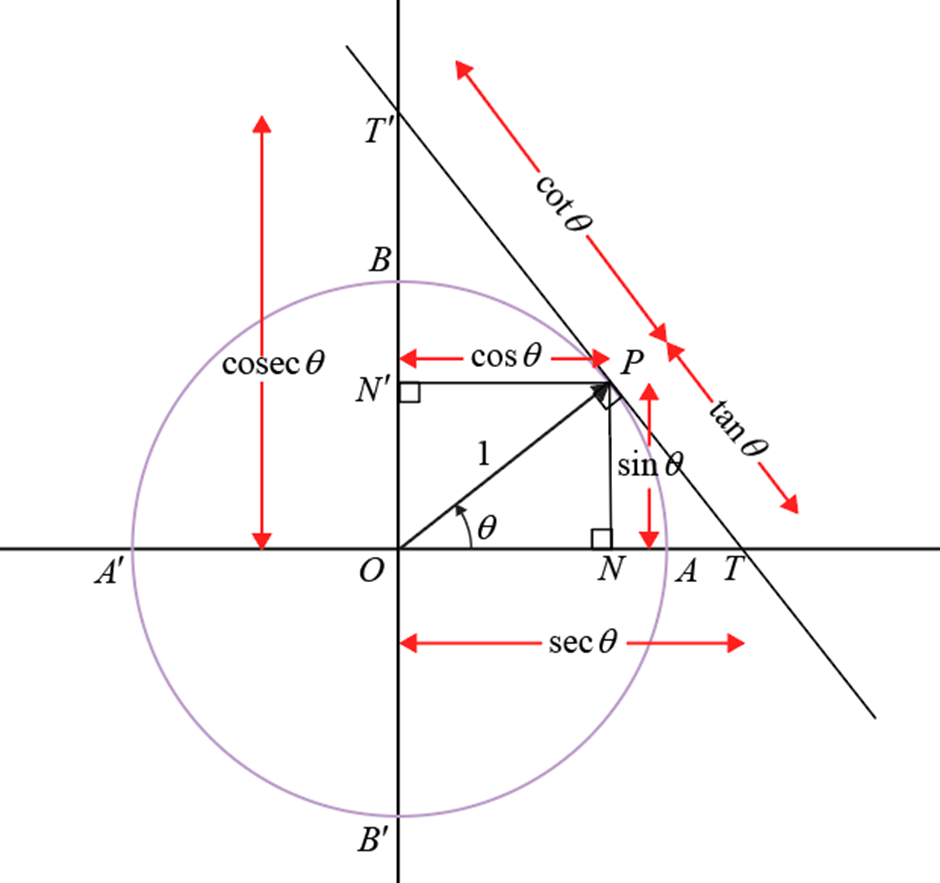
Let there be a unit circle intersecting axes at A,B,A′ and B′. There is a point P in the first quadrant on the circle. From point P, draw normals to x-axis and y-axis such that they intersect at N and N′ respectively. Also draw a tangent to the circle at point P such that it intersects the x-axis and y-axis at T and T′ respectively.
In △OPN which is a right-angled triangle, let angle NOP be θ. Clearly, P is the terminal point of angle θ.
In △OPNsinθ=OPPN=1PN=PN, cosθ=OPON=1ON=ON
Thus, PN=sinθ and PN′=ON=cosθ
“Sine” means “half of the chord”. PN is equal to the half of the length of the chord PP′, where P′ is the point on the circle when PN is extended.
“Cosine” is the sine of the complementary angle of θ. Can you see why?
△OPN is similar to △OPT (why?)
⇒PTPN=OPON (Corresponding sides are proportional)
⇒PT=ONPN
But according to right trigonometry ONPN=tanθ
Thus, PT=tanθ
Similarly, you can prove other results shown in the figure.
By plotting the graph one can find and understand more properties of trigonometric functions. They will prove to be of immense importance at many places while solving problems.
What we want to analyse is, for example, how value of sin θ changes when θ changes. Let us see how.
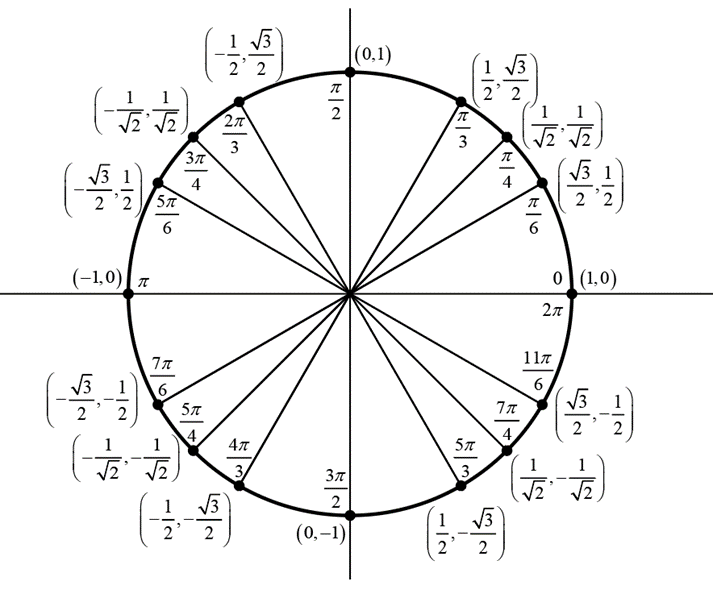
We will use the unit circle below:
It just shows coordinates of terminal points for some of the angles from 0 to 2π. It will help us plot graphs easily.
We can easily observe a few important things about the graphs even before drawing them:
Trigonometric functions must be periodic because when we move around the circle values repeat themselves.
Values of sine and cosine lie in the interval [−1,1] because sine and cosine an angle are ordinate and abscissa of its terminal point. And clearly on a unit circle ordinate abscissa lie in the interval [−1,1].
Sine and cosine are defined for angles, thus, their domain, we say, is R. But that is not so with other trigonometric functions and we can easily conclude why.
Since tanθ=xy, it must be not defined for angles for which x, that is, the abscissa of terminal point is zero. On the unit circle you can see that it is so for all vertical angles i.e. θ=(2n+1)2π, n∈Z. Thus, the domain of tanθ is R−{θ:θ=(2n+1)2π,n∈Z}.
Similarly, secθ=x1 is also not defined for vertical angles θ=(2n+1)2π,n∈Z
On the other hand, cotθ=yx⇒cotθ is not defined for all angles for which y, that is, ordinate is equal to zero. This is so for all horizontal angles, as can be seen on the unit circle. Thus, the domain of cotθ is R−{θ:θ=nπ,n∈Z}
Similarly, the domain of cscθ is also R−{θ:θ=nπ,n∈Z}
Trigonometric Function
Domain
Range
sine
R
[−1,1]
cosine
R
[−1,1]
tangent
R−{θ:θ=(2n+1)2π,n∈Z}
R
cotangent
R−{θ:θ=nπ,n∈Z}
R
secant
R−{θ:θ=(2n+1)2π,n∈Z}
R−(−1,1)
cosecant
R−{θ:θ=nπ,n∈Z}
R−(−1,1)
Section 5 of 13 · Trigonometry
Mark this section complete when you have worked through its proofs.
Type any topic, theorem, or concept to jump directly to the section.