The process of determining the domain of a function involves identifying the largest subset of R where the function is well-defined. This requires remembering the domains of elementary functions and understanding how the algebra of functions influences domains. By systematically applying these principles, we can calculate the domain of any given function.
In this section, we focus on domain calculation. Specifically, we consider the natural domain, which is the largest subset of R such that the expression defining the function is mathematically valid. This involves excluding values that lead to undefined operations such as division by zero, square roots of negative numbers, or logarithms of non-positive values.
You should revisit the domain of fundamental functions, such as polynomials, rational functions, square root functions, logarithmic functions, and trigonometric functions, as these serve as the building blocks for more complex expressions. Additionally, it is important to understand how operations like addition, subtraction, multiplication, division, and composition affect the domain, as these operations often introduce new constraints or restrictions that must be accounted for when calculating the domain of combined or derived functions.
We begin with some common patterns in mathematical expression formed using elementary fucntions and algebraic operations.
For a function f(x)=g(x), where g(x) is any expression in x, the square root imposes the restriction that g(x)≥0. This restriction arises from the fact that the square root function is undefined for negative arguments in the set of real numbers. To determine the domain of f(x), we solve the inequality g(x)≥0, which provides the set of all x for which f(x) is well-defined.
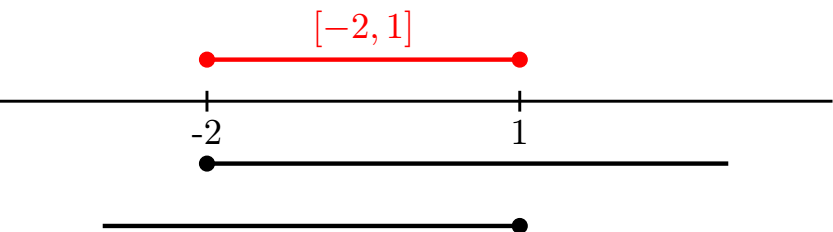
Consider f(x)=x+2+1−x. This function comprises two terms, each imposing its own condition on the domain:
The first term, x+2:
The square root function requires x+2≥0. Solving this inequality:
x≥−2
The second term, 1−x:
Similarly, the square root function requires 1−x≥0. Solving this inequality:
x≤1
The domain of f(x) is the set of x that satisfies both conditions simultaneously, as both square roots must be defined. This means the domain is given by the intersection of the intervals:
For a function of the form f(x)=g(x)1, the expression is undefined when g(x)=0, as division by zero is not defined in the real number system. The domain of f(x) is therefore all x∈R except those for which g(x)=0.
Consider f(x)=x−11. Here, g(x)=x−1. The restriction g(x)=0 translates to:
x−1=0⟹x=1.
Thus, the domain of f(x) is:
Domain: x∈R∖{1}.
In interval notation, the domain is:
(−∞,1)∪(1,∞)
Logarithmic Function with Variable Base and Argument§
For a function of the form logf(x)(g(x)), where both the base f(x) and the argument g(x) depend on x, the domain is determined by the following conditions:
The base f(x) must satisfy:
f(x)>0andf(x)=1.
The argument g(x) must satisfy:
g(x)>0.
These conditions ensure the logarithmic function is well-defined.
Example:f(x)=log1−x(x+3)
Here, the base is 1−x and the argument is x+3. The domain is determined by solving the following inequalities:
Condition on the base 1−x:
1−x>0⟹x<1,1−x=1⟹x=0.
Condition on the argument x+3:
x+3>0⟹x>−3.
Combining x<1, x=0, and x>−3, we find the domain is: