Geometrically, a function is said to be periodic if shifting the function by a fixed amount backward or forward results in the same function. This means that the graph of the function repeats itself identically after such a shift. Mathematically, for a periodic function f(x), if it is shifted by T units (backward or forward) along the x-axis, the resulting graph overlaps perfectly with the original graph, i.e.,
f(x+T)=f(x).
where we call T as the period of the fucntion.
For example, consider the function sin(x). From trigonometry, we know that,
sin(x+2π)=sin(x),∀x∈R.
However, this property is not restricted to 2π. It is also true for:
Thus, 2π,4π,6π,−2π,… are all periods of sin(x). However, among these, 2π is the smallest positive value for which this property holds. This smallest positive period is called the fundamental period of the function.
Therefore, for sin(x), the fundamental period is 2π.
A function f(x) is said to be periodic if and only if there exists a positive real number T, called the period of f(x), such that for everyx in the domain of f(x):
x+T also belongs to the domain of f(x), and
f(x+T)=f(x).
The smallest positive value of T that satisfies these conditions is called the fundamental period of f(x).
Periodicity for Integer Multiples f(x+nT) = f(x)
If f(x+T)=f(x) for all x belonging to the domain of f and some period T, then f(x+nT)=f(x) for all n∈Z.
You can prove it using mathematical induction. We will use this simple reasoning to verify the eracity of this statement.
The identity f(x+T)=f(x) is given. This property implies that the function f(x) repeats its values after every interval of length T.
Forward Iteration:
Start with the identity f(x+T)=f(x).
Replace x by x+T in f(x+T)=f(x), giving:
f((x+T)+T)=f(x+T).
This simplifies to:
f(x+2T)=f(x+T).
Using f(x+T)=f(x), we find:
f(x+2T)=f(x).
Replace x again by x+T:
f((x+2T)+T)=f(x+2T).
This simplifies to:
f(x+3T)=f(x).
Repeating this process for any positive multiple of T, we have:
f(x+nT)=f(x),n∈N.
Backward Iteration:
Replace x by x−T in f(x+T)=f(x):
f((x−T)+T)=f(x−T).
This simplifies to:
f(x)=f(x−T).
Hence, f(x−T)=f(x).
Replace x by x−T again in f(x+T)=f(x):
f((x−T)−T)=f(x−T).
This simplifies to:
f(x−2T)=f(x−T).
Using f(x−T)=f(x), we get:
f(x−2T)=f(x).
Repeating this process for any negative multiple of T, we have:
f(x−nT)=f(x),n∈N.
By repeatedly shifting x forward or backward by multiples of T, we establish that:
To build a strong understanding of periodic functions, it is essential to know the fundamental periods of commonly used trigonometric functions. The table below summarizes the fundamental periods of these elementary functions:
The six fundamental trigonometric functions—sine, cosine, tangent, cotangent, secant, and cosecant—have well-defined fundamental periods. Below is a concise summary of their periodic behavior:
Function
Fundamental Period
sinx
2π
cosx
2π
tanx
π
cotx
π
secx
2π
cscx
2π
Fundamental Periods of the Squares of the Six Trigonometric Functions§
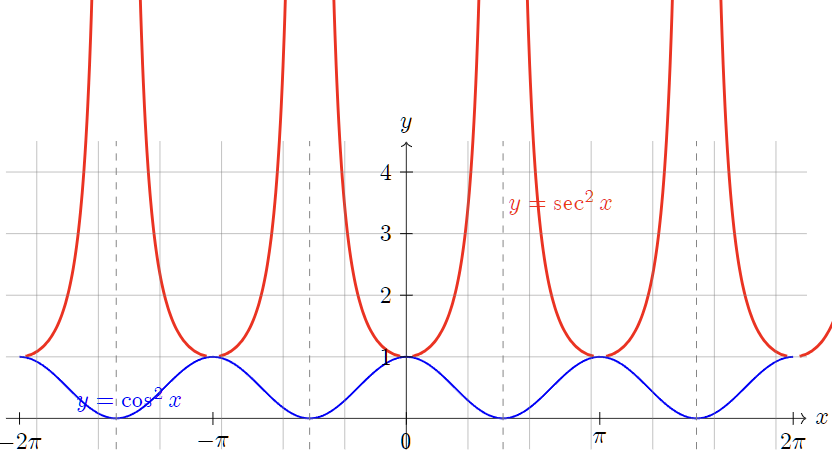
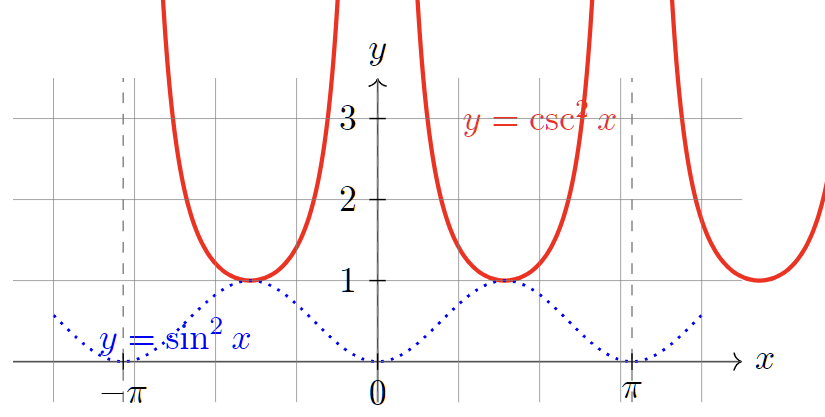
When the six trigonometric functions are squared, their periodicity often changes due to the squaring operation, which eliminates sign changes. Here are the fundamental periods of their squares:
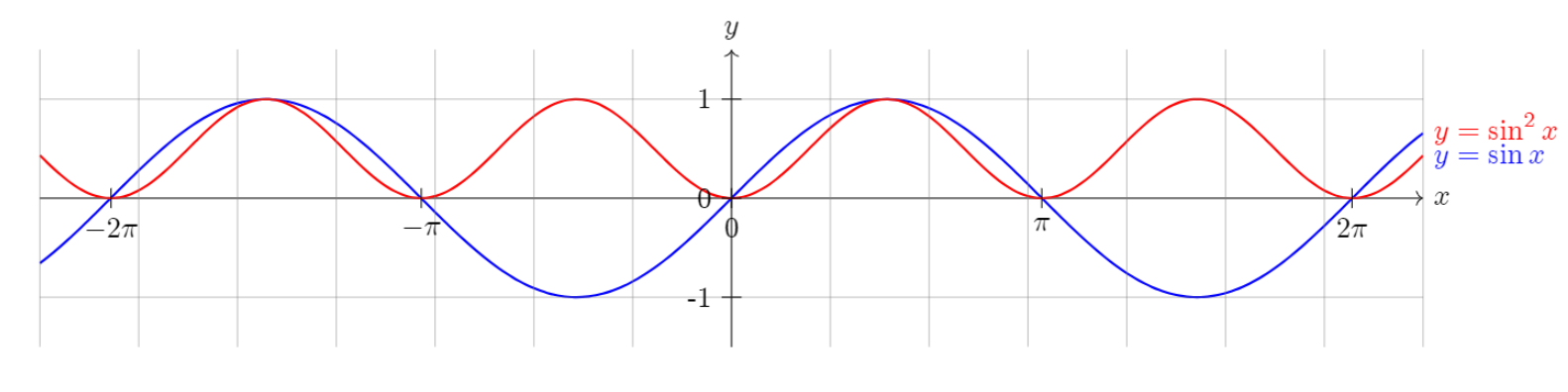
sin2x:
The square of the sine function, sin2x, has a fundamental period of π. This is because squaring eliminates the negative values of sinx, causing the function to repeat every half-cycle of sinx.
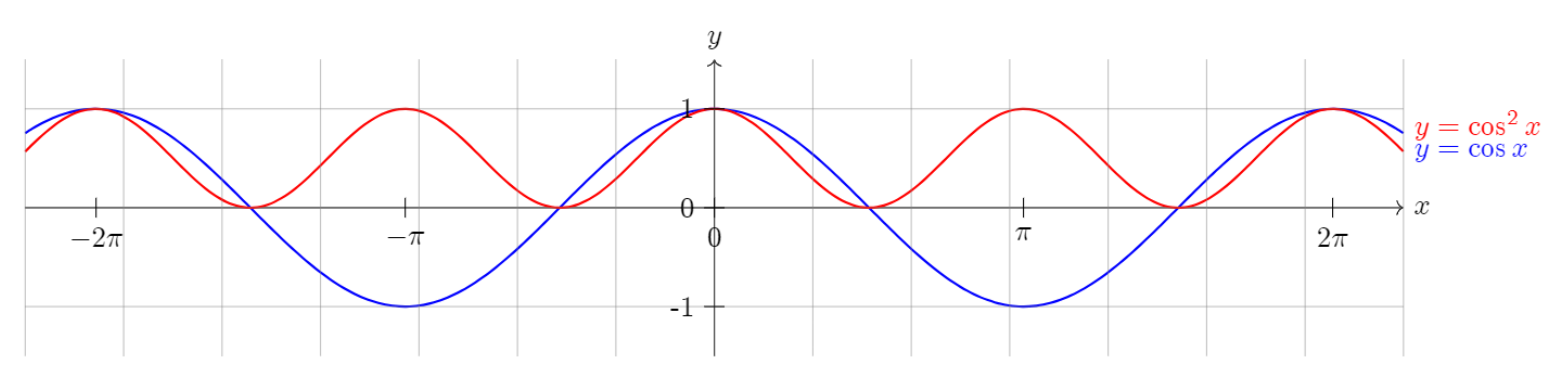
cos2x:
Similarly, the square of the cosine function, cos2x, also has a fundamental period of π. Like sin2x, squaring the cosine function results in a repeating pattern every half-cycle.
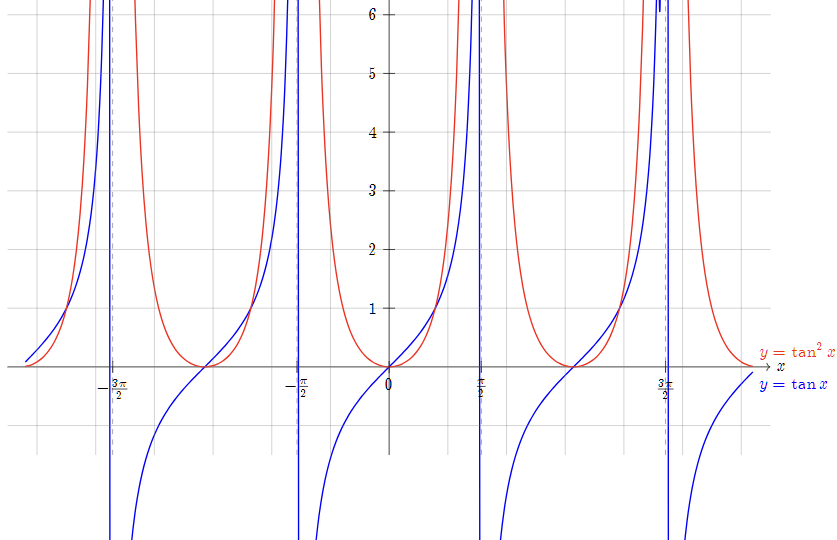
tan2x:
The square of the tangent function, tan2x, retains a fundamental period of π. This is because tanx itself already repeats every π, and squaring does not change this periodicity.
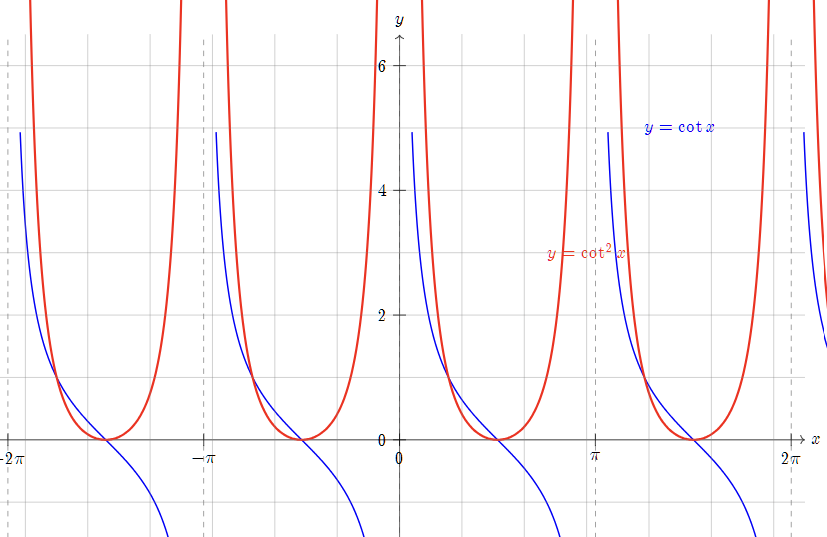
cot2x:
The square of the cotangent function, cot2x, also has a fundamental period of π. Like tan2x, squaring does not affect its repeating behavior.
sec2x:
The square of the secant function, sec2x, has a fundamental period of π. This is due to the squaring operation and the nature of the vertical asymptotes in the secx function, which repeat every π.
csc2x:
The square of the cosecant function, csc2x, also has a fundamental period of π. Like sec2x, the periodicity is halved compared to the original cscx function.
Fundamental Periods of the Modulus of Trigonometric Functions§
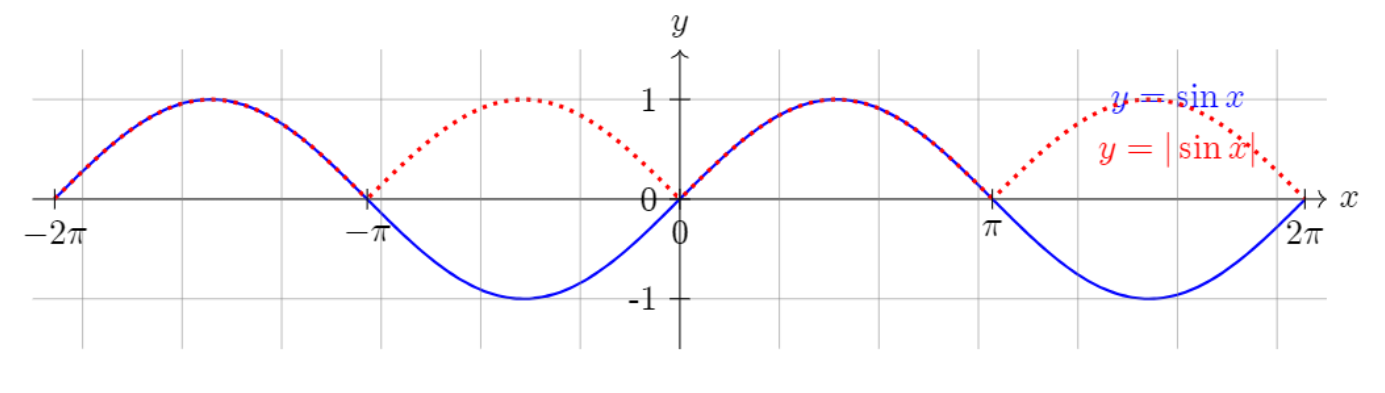
When we take the modulus (absolute value) of a trigonometric function, its periodicity often changes because the negative part of the graph is mirrored into the positive part. Below are the fundamental periods of the modulus of the six basic trigonometric functions:
∣sinx∣:
The function ∣sinx∣ is obtained by reflecting the negative half-cycles of sinx into the positive half-plane. Since sinx repeats every 2π, and the modulus halves the cycle, the fundamental period of ∣sinx∣ is:
T=π.
∣cosx∣:
Similar to ∣sinx∣, ∣cosx∣ is obtained by reflecting the negative values of cosx into the positive plane. This also halves the periodicity of cosx, so the fundamental period of ∣cosx∣ is:
T=π.
∣tanx∣:
The modulus ∣tanx∣ reflects the negative values of tanx into the positive plane. The original fundamental period of tanx is π, and taking the modulus does not change its periodicity. Thus:
T=π.
∣cotx∣:
The modulus ∣cotx∣ behaves like ∣tanx∣, reflecting the negative values into the positive plane. The periodicity remains the same as the original cotx, so:
T=π.
∣secx∣:
The function ∣secx∣ is already non-negative wherever it is defined because secx does not cross zero. The periodicity of secx remains unchanged:
T=2π.
∣cscx∣:
Similar to ∣secx∣, ∣cscx∣ is already non-negative wherever it is defined. Its periodicity is the same as the original cscx:
T=2π.
Cube of Trigonometric Functions and Their Periodicity§
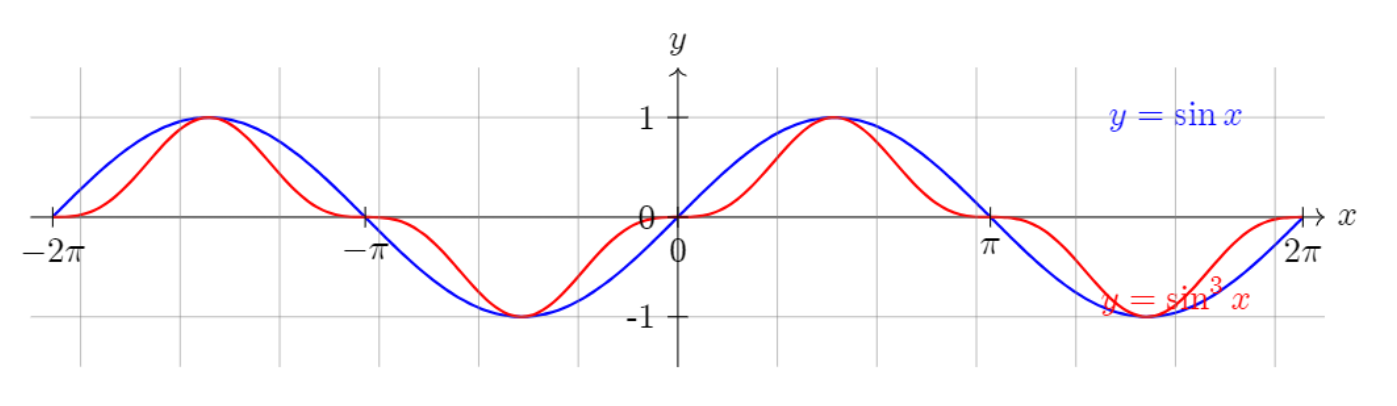
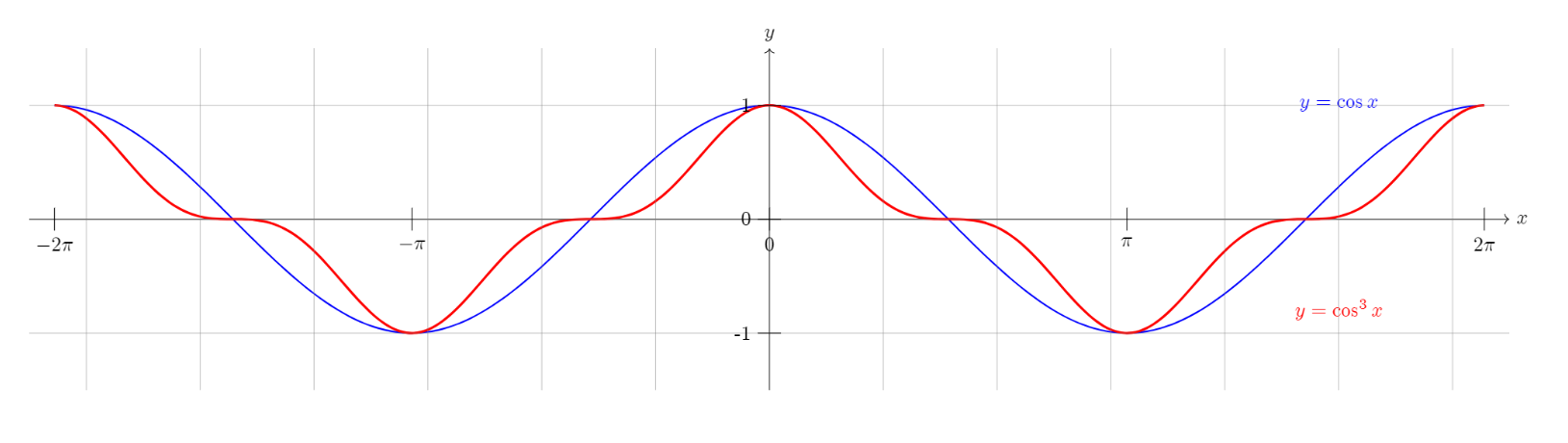
When we take the cube of trigonometric functions, their periodicity remains the same as the original functions because cubing is an odd operation, which does not eliminate negative values or symmetries. Below are the cubes of the six basic trigonometric functions and their fundamental periods:
sin3x:
Cubing sinx preserves its periodicity because it is an odd function and retains the same symmetry as sinx. The fundamental period remains:
T=2π.
cos3x:
Similar to sin3x, cos3x also retains the symmetry and periodicity of cosx. The fundamental period is:
T=2π.
tan3x:
The cube of tanx does not change the periodicity because tanx is already an odd function with symmetry about the origin. The fundamental period remains:
T=π.
cot3x:
Similarly, cot3x retains the periodicity of cotx, with symmetry about the origin. The fundamental period is:
T=π.
sec3x:
Cubing secx does not change its periodicity, as secx retains the same positive and negative patterns. The fundamental period remains:
T=2π.
csc3x:
Like sec3x, csc3x also retains the periodicity of cscx. The fundamental period is:
T=2π.
Cubing does not alter the fundamental periodicity of trigonometric functions, as it preserves their underlying symmetries.
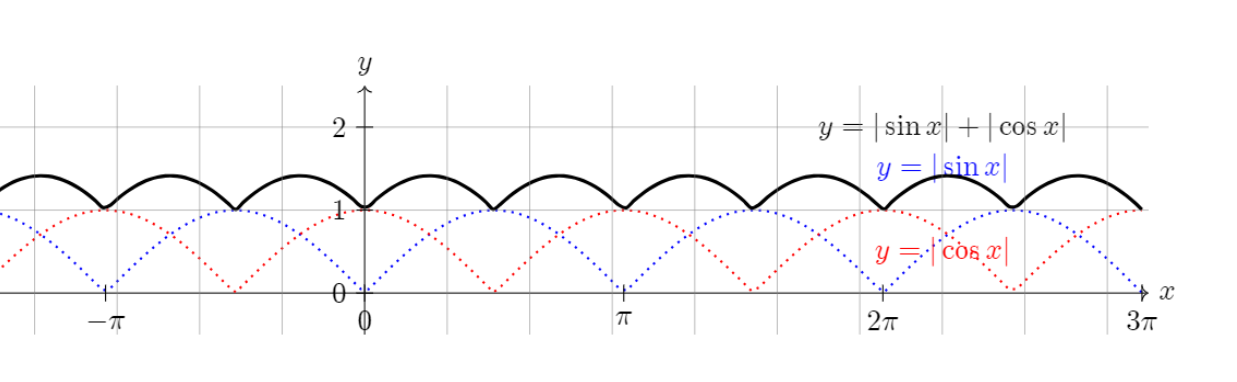
Plot y=∣sinx∣ and y=∣cosx∣, reflecting their negative parts above the x-axis.
Add the two graphs pointwise: for every x, calculate ∣sinx∣+∣cosx∣.
The resulting graph has a fundamental period of π, as both ∣sinx∣ and ∣cosx∣ repeat every π.
We can also verify that f(x)=∣sinx∣+∣cosx∣ has a period of 2π as follows:
f(x+2π)=∣sin(x+2π)∣+∣cos(x+2π)∣.
Using the trigonometric identities:
sin(x+2π)=cosxandcos(x+2π)=−sinx,
we find:
f(x+2π)=∣cosx∣+∣−sinx∣.
Since ∣a∣=∣−a∣, this simplifies to:
f(x+2π)=∣cosx∣+∣sinx∣=f(x).
Thus, 2π is a period of f(x).
To verify that 2π is the fundamental period, we check whether any smaller period exists. If 2π is not the fundamantal period, then 4π must be period as well because 2π is a multiple of 4πf(x). Then:
f(x+4π)=∣sin(x+4π)∣+∣cos(x+4π)∣
would need to equal ∣sinx∣+∣cosx∣ for all x. However, using trigonometric identities, this is not true for all x. For example:
Taking their absolute values and summing generally does not result in ∣sinx∣+∣cosx∣. Hence, 4π is not a period.
Since 2π is a period and no smaller period exists, we conclude that the fundamental period of f(x)=∣sinx∣+∣cosx∣ is:
T=2π.
Let m∈Z∖{−1,0,1}. The function sin2mx+cos2mx has the fundamental period2π.
The function ∣tanx∣+∣cotx∣ has the fundamental period2π.
The function tanx⋅cotx has the fundamental period 2π. This can be understood by analyzing its behavior and graph. The expression simplifies to 1 wherever tanx and cotx are both defined. However, tanx is undefined at x=nπ+2π and cotx is undefined at x=nπ, where n∈Z. Consequently, the graph of tanx⋅cotx consists of horizontal lines at y=1 with holes or missing points at x=nπ and x=nπ+2π. It is evident from the graph that shifting it by 2π results in an identical graph, confirming that the minimum period of the function is 2π.
The function tan2mx+cot2mx, where m∈N, has the fundamental period 2π. This result holds because both tan2mx and cot2mx are periodic with period π, and their sum exhibits symmetry that reduces the fundamental period to 2π.
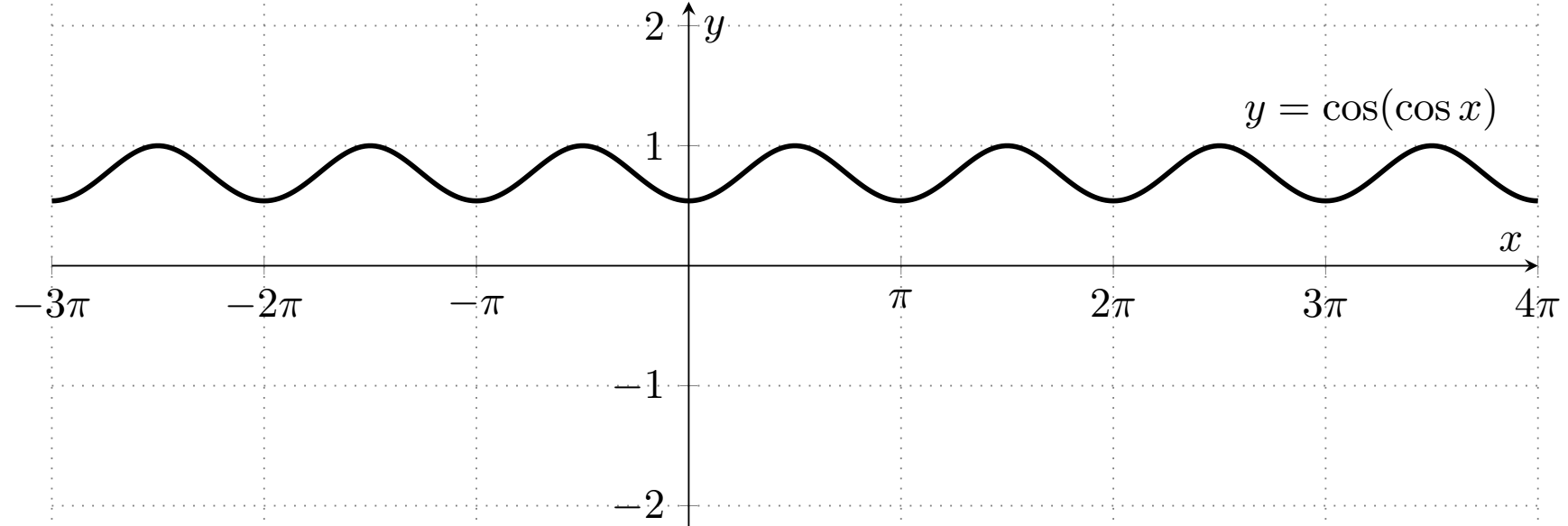
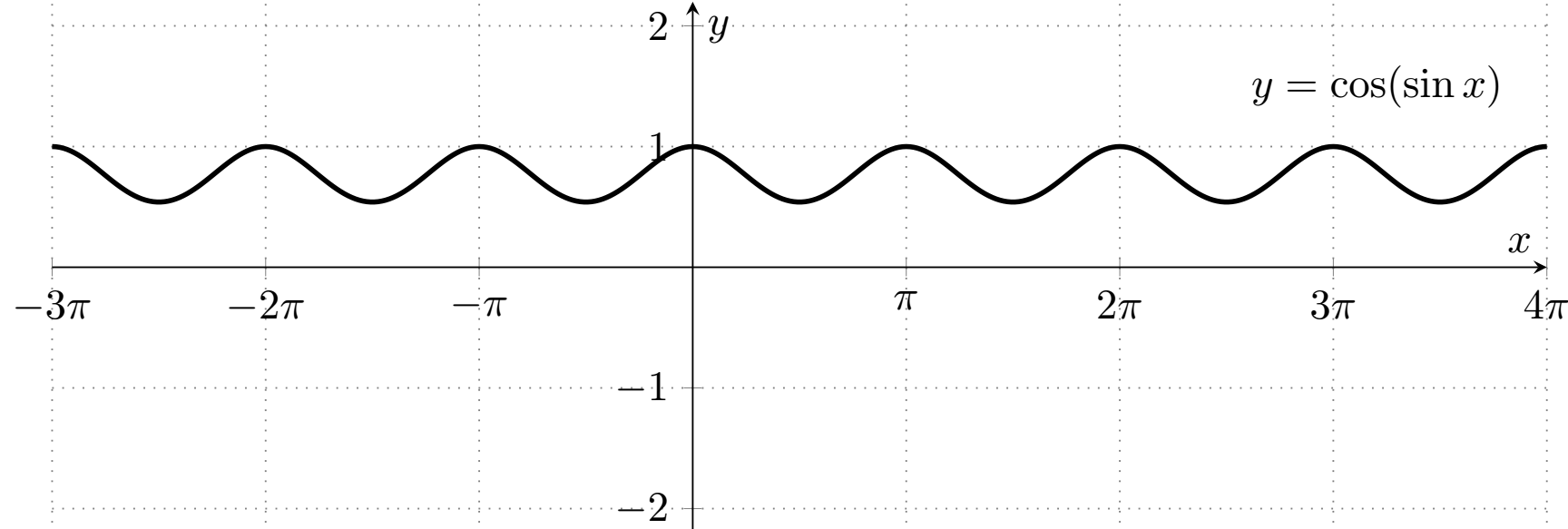
The functions cos(cosx) and cos(sinx) both have the fundamental period π.
cos(sinx)+cos(cosx) has the fundamental period 2π.
sin(sinx) or sin(cosx) have the fundamental period 2π.
∣sin(cosx)∣+∣sin(sinx)∣ has the fundamental period 2π.
Fractional Part Function:
The fractional part function is defined as:
{x}=x−⌊x⌋
It is a periodic function with a fundamental period of 1.
The function {x}+{x−21} has the fundamental period equal to 21.
The function {x}{x−21} has the fundamental period equal to 21.
Effect of Adding or Multiplying a Non-Zero Constant on Periodicity§
If the fundamental period of a function f(x) is T, then transformations like scaling the function by a non-zero constant k or shifting it by a constant k do not affect its periodicity. Specifically, the fundamental periods of kf(x) and f(x)+k, where k is a non-zero real number, remain equal to T.
This can be understood as follows:
Scaling by k:
Consider the function h(x)=kf(x). Since f(x+T)=f(x) for all x, scaling by k gives:
h(x+T)=kf(x+T)=kf(x)=h(x).
Thus, the periodicity of f(x) is preserved in h(x), and the fundamental period remains T.
Shifting by k:
Now consider the function g(x)=f(x)+k. Using the periodicity of f(x), we have:
g(x+T)=f(x+T)+k=f(x)+k=g(x).
Therefore, adding a constant k does not alter the periodicity, and the fundamental period of g(x) is still T.
Consider the function f(x)=sinx, which has a fundamental period of 2π. If we scale and shift it to form:
h(x)=100sinx−1000,
then:
Scaling by 100 modifies the amplitude of sinx, but the period remains unchanged.
Shifting by −1000 vertically translates the graph, but it does not affect the repeating nature of the function.
Thus, the period of h(x)=100sinx−1000 is still 2π, the same as the period of sinx.
Effect of Scaling the Input on the Fundamental Period§
If the fundamental period of a function f(x) is T, then scaling the input of the function by a non-zero real number k results in a new fundamental period equal to ∣k∣T. In this case, scaling affects the fundamental period directly.
Proof:
Let f(x) be a periodic function with fundamental period T, so:
f(x+T)=f(x)for all x.
Now, consider h(x)=f(kx), where k=0, and let T′ be the fundamental period of h(x). By the definition of periodicity:
h(x+T′)=h(x).
Substituting h(x)=f(kx), we get:
f(k(x+T′))=f(kx).
Simplifying this, we obtain:
f(kx+kT′)=f(kx).
For T′ to be the least positive period of h(x), the corresponding shift in f(x) must be the fundamental period T. Hence, we require:
∣kT′∣=T.
Solving for T′, we find:
T′=∣k∣T.
■
Examples
The fundamental period of h(x)=30sin(3x−π/6)−12 is:
T′=∣3∣2π=32π.
The function f(x)={5x} (fractional part of x/5) has a fundamental period:
When two periodic functions f1(x) and f2(x) with fundamental periods T1 and T2 are added, the periodicity of the resulting function h(x)=f1(x)+f2(x) depends on the relationship between T1 and T2. Below, we rigorously analyze the behavior with examples.
General Rule
The function h(x) is periodic if and only if the ratio T2T1 is a rational number. In such cases, the period (not the fundamental period) of h(x) is:
T=LCM(T1,T2),
where LCM represents the least common multiple of T1 and T2.
If T2T1 is irrational, h(x) is aperiodic, meaning it does not repeat after any finite interval. This is because LCM(T1,T2) does not exist when T2T1 is irrational. Why does it not exist? To understand that one needs to take a look at basic definition of LCM.
Example 1: Rational Ratio
Let f1(x)=sinx and f2(x)=cos(2x).
The fundamental period of f1(x) is T1=2π.
The fundamental period of f2(x) is T2=π.
The ratio T2T1=π2π=2 is rational. Hence, h(x)=sinx+cos(2x) is periodic, and the period is:
T=LCM(T1,T2)=LCM(2π,π)=2π.
Example 2: Irrational Ratio
Let f1(x)=sinx and f2(x)=cos(2x).
The fundamental period of f1(x) is T1=2π.
The function f2(x)=cos(2x) has an irrational period T2=22π.
The ratio T2T1=2π/22π=2 is irrational. Therefore, h(x)=sinx+cos(2x) is aperiodic and does not have a period.
Why is the LCM not necessarilty the fundamental period of the sum?
Consider the function h(x)=∣sinx∣+∣cosx∣, where the fundamental period of ∣sinx∣ is T1=π and the fundamental period of ∣cosx∣ is T2=π. Based on the general rule, the least common multiple of T1 and T2 gives T=π, which is often the fundamental period of the sum.
However, due to symmetry in the behavior of ∣sinx∣ and ∣cosx∣, h(x) repeats after a smaller interval T0=2π. Specifically, the symmetry in the absolute values of sinx and cosx ensures that h(x+2π)=h(x). Hence, the actual fundamental period of h(x) is:
T0=2π,
even though the LCM of T1 and T2 is π. This demonstrates how symmetry in the individual functions can lead to a fundamental period smaller than their LCM.
Now, consider another example where the sum of two periodic functions becomes a constant. Take h(x)=sin2x+cos2x. The fundamental periods of both sin2x and cos2x are π. However, their sum simplifies to:
h(x)=sin2x+cos2x=1.
Since h(x) is a constant, it is periodic for every positive T. However, it does not have a fundamental period because there is no smallest positive T satisfying the periodicity condition.
These examples highlight two important situations where the fundamental period of the sum of two periodic functions may differ from the expected LCM of their individual periods:
Symmetry Leading to a Smaller Period
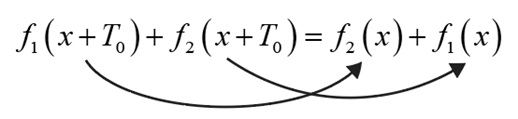
If the functions f1(x) and f2(x) exhibit a symmetry such that a smaller period T0 satisfies:
f1(x+T0)=f2(x),f2(x+T0)=f1(x),
then T0 becomes the fundamental period of h(x)=f1(x)+f2(x), even if T0<LCM(T1,T2).
Sum Becoming a Constant
If the sum of two periodic functions simplifies to a constant, then the resulting function is periodic for all positive T. However, it does not have a fundamental period, as no smallest positive T can exist.
In conclusion, while the LCM of the fundamental periods often provides the fundamental period of the sum of two periodic functions, symmetries or special cases, such as a constant sum, can lead to exceptions. These cases emphasize the importance of analyzing the specific properties of the functions involved.
Periodicity of the Product and Quotient of Two Periodic Functions§
For two periodic functions f1(x) and f2(x) with fundamental periods T1 and T2, the periodicity of their product or quotient depends on the ratio T2T1.
The Product: h(x)=f1(x)⋅f2(x)
If T2T1 is rational, the product h(x) is periodic, with the period given by:
T=LCM(T1,T2).
This happens because the cycles of f1(x) and f2(x) align after a common multiple of their periods. For example, h(x)=sinx⋅cosx. Here, sinx and cosx both have a fundamental period of 2π, so the LCM is 2π, making h(x) periodic with T=2π.
If T2T1 is irrational, the product h(x) is aperiodic. This occurs because the cycles of f1(x) and f2(x) never align after any finite interval, making h(x) non-repeating.
The Quotient: h(x)=f2(x)f1(x)
For quotients, the periodicity follows the same logic as the product. If T2T1 is rational, h(x) is periodic with:
T=LCM(T1,T2).
If T2T1 is irrational, the quotient h(x) is aperiodic for the same reasons as the product.
Generalizing Periodicity for Expressions Involving Sum, Product, and Quotient§
When an expression is composed of multiple terms combined using sums, products, and quotients of periodic functions, the determination of the fundamental period requires careful analysis. The general strategy involves calculating the fundamental period of each individual term and then considering their interactions.
General Rule
If an expression h(x) is composed of multiple terms f1(x),f2(x),…,fn(x) through sums, products, or quotients, the fundamental period T of h(x) is typically a candidate based on the least common multiple:
T=LCM(T1,T2,…,Tn),
where T1,T2,…,Tn are the fundamental periods of the individual terms. However, T may not always be the fundamental period, as symmetries or cancellations in the expression can result in a smaller period.
Rules Regarding Composition of Periodic Functions§
Consider a periodic function g(x) with fundamental period T. If g(x) is composed with another function f, resulting in f(g(x)), then f(g(x)) is periodic with period T. However, we emphasize that this period T is not necessarily the fundamental period of f(g(x)); it must be verified separately. The function f itself can also influence the periodicity. Remember the effect of modulus on the periodicity of sine.
Examples
Exponential Function:
g(x)=sinx, f(y)=ey.
esinx is periodic with fundamental period 2π, since sinx is periodic with period 2π and ey preserves this periodicity.
Fractional Part:
g(x)={x}, where {x} denotes the fractional part function with fundamental period 1.
sin{x} is periodic with fundamental period 1, since {x} repeats every 1.
Double Cosine:
g(x)=cosx, f(y)=cosy.
cos(cosx) is periodic with fundamental period π, not 2π, because outer cos influeced the periodicity.
Square Root of Sine:
g(x)=sinx, f(y)=y (valid for y≥0).
sinx is periodic with fundamental period 2π, as the domain restriction of sinx≥0 does not alter the periodicity of sinx.
Composition of a Periodic with a aperiodic Function
When f is periodic with period T, and g is aperiodic (not periodic), the composition f(g(x)) is typically aperiodic. However, there are specific exceptions where f(g(x)) can still be periodic, depending on the structure of g(x). Understanding and identifying these exceptions is crucial.
When f is periodic and g(x) is a linear function of the form ax+b (which is aperiodic), then f(g(x)) is periodic with period ∣a∣T, where T is the period of f(x).
Another interesting example where f is periodic, g(x) is aperiodic, yet f(g(x)) is periodic is sin(π[x]), where [x] is the greatest integer function. Here, sin(π[x]) has period 2.
To verify:
sin(π[x+2])=sin(π([x]+2))=sin(π[x]+2π).
Using the property that sin(θ+2π)=sin(θ), we get:
sin(π[x+2])=sin(π[x]).
Hence, sin(π[x]) is periodic with period 2.
Section 15 of 18 · Relations and Functions
Mark this section complete when you have worked through its proofs.
Type any topic, theorem, or concept to jump directly to the section.