Consider a function f:A→B, and we wish to define a new function g:B→A that "undoes" the operation of f. Specifically, if f(a)=b, then g(b)=a. Such a function g is called the inverse of f. Intuitively, g reverses the mapping of f, taking the outputs of f and assigning them back to their corresponding inputs. However, constructing such a function g is not always possible for all functions f.
Suppose f is a many-one function, meaning f(a1)=f(a2)=b for some a1,a2∈A. Then, to define g(b), we face a problem: should g(b)=a1 or g(b)=a2? A function cannot assign multiple outputs to the same input, so g would fail to be a function in this case. g would only be a relation from B to A, not a valid function.
Failure in Into Functions:
If f is an into function, then some elements in B have no preimages in A. For example, if b∈B has no a∈A such that f(a)=b, then g(b) would have no value to assign, violating the definition of a function.
Thus, for g to exist as a valid function, f must satisfy two conditions:
f must be one-to-one (injective) so that g(b) is well-defined (no ambiguity in assigning preimages).
f must be onto (surjective) so that every b∈B has a corresponding a∈A.
If f satisfies these two properties, then f is said to be bijective, and we call finvertible.
Formally, the inverse of f:A→B, denoted by f−1, is defined as:
f−1={(b,a)∈B×A:f(a)=b}.
If f is bijective, then f−1 is a function from B→A. For each b∈B, f−1(b) gives the unique a∈A such that f(a)=b.
We can also define inverse like this:
Let f:A→B be a function, where A is the domain and B is the codomain of f. The function f is said to be invertible if there exists a function g:B→A such that:
g(f(x))=x, for all x∈A, and
f(g(y))=y, for all y∈B.
If such a function g exists, it is called the inverse of f and is denoted by f−1:B→A.
Furthermore, if f is invertible, then the inverse f−1 is unique, meaning there is exactly one function g satisfying the above properties.
The inverse is obtained by interchanging the components of each ordered pair, which corresponds to interchanging the input and output of the function. Specifically, for each ordered pair (a,b) in f, the inverse f−1 will contain the pair (b,a). This highlights the fact that the inverse "reverses" the roles of inputs and outputs.
Let:
f={(1,2),(2,3),(3,4)}.
Here, the input-output relationship of f is:
f(1)=2,
f(2)=3,
f(3)=4.
To find the inverse f−1, we reverse these relationships, swapping inputs and outputs. Thus:
f−1={(2,1),(3,2),(4,3)}.
This means:
f−1(2)=1,
f−1(3)=2,
f−1(4)=3.
The inverse reflects the concept of interchanging input and output values.
If f is defined by a formula:
To find the inverse, we interchange x and y in the formula y=f(x). This step corresponds to interchanging the input (x) and output (y) of the function. After interchanging, we solve for y in terms of x, which gives the formula for the inverse function.
Let f(x)=2x+3. Here, the input-output relationship is defined as:
For an input x, the output is f(x)=2x+3.
To find the inverse f−1(x), we follow these steps:
Replace f(x) with y for clarity:
y=2x+3.
Interchange x and y to reflect the reversal of inputs and outputs:
x=2y+3.
Solve for y in terms of x:
2y=x−3⟹y=2x−3.
Thus, the inverse function is:
f−1(x)=2x−3.
This means:
If the output of f is x, the corresponding input is given by f−1(x).
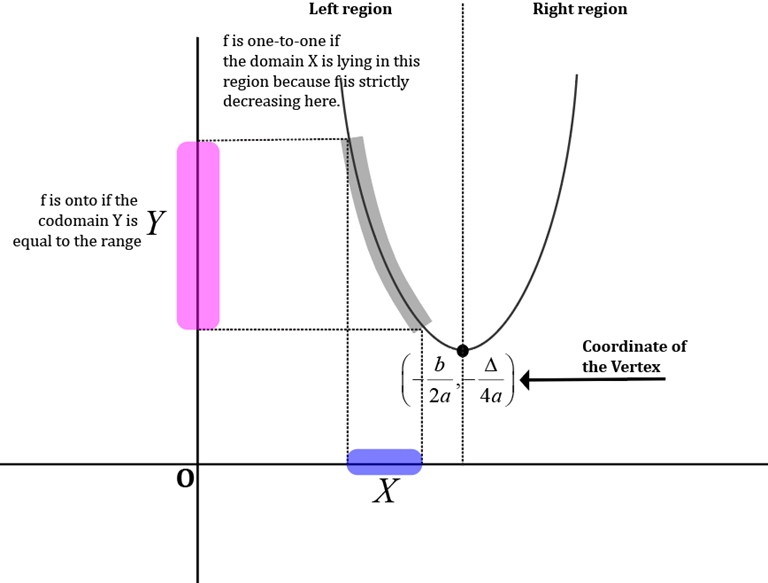
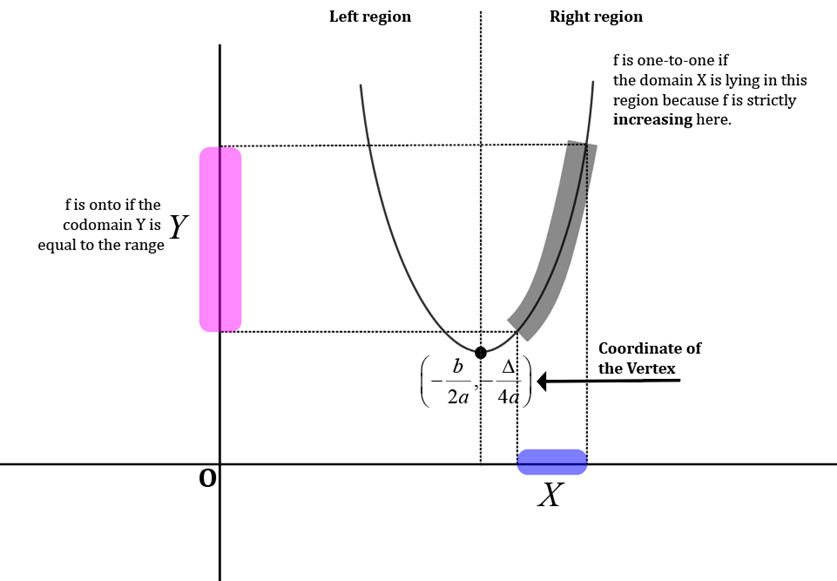
The graph of the quadratic function is a parabola. The vertex of the parabola is
(−2ab,−4aΔ),
where Δ=b2−4ac, and its axis is x=−2ab. If the domain of f, i.e., X, lies in the region left to the axis (or the region right to the axis), then f is one-to-one, and the codomain Y is equal to the range.
Conversion of f(x) into Vertex-Centric Form
Given y=ax2+bx+c, start by rewriting y in a simplified form:
y=a(x2+abx+ac).
Complete the square inside the parentheses:
y=a(x2+2(2ab)x+(2ab)2−(2ab)2+ac).
This simplifies to:
y=a[(x+2ab)2−4a2b2+ac].
Now simplify the constant terms:
y=a(x+2ab)2−a(4a2Δ),
where Δ=b2−4ac.
Thus:
y=a(x+2ab)2−4aΔ.
Solving for x
Rearrange the equation to isolate (x+2ab)2:
y+4aΔ=a(x+2ab)2.
Divide through by a:
ay+4a2Δ=(x+2ab)2.
Take the square root on both sides:
x+2ab=±ay+4a2Δ.
Finally:
x=−2ab±ay+4a2Δ.
Ambiguity of the Sign
The ± introduces an ambiguity: which sign to choose? Both signs cannot simultaneously apply, as this would violate the definition of a function (since a function maps one input to exactly one output). Thus, the choice of the sign depends on the domain of f(x):
Domain Left of the Axis:
If X lies to the left of the axisx=−2ab, choose the negative sign (−):
x+2ab=−ay+4a2Δ.
Rearranging:
x=−2ab−ay+4a2Δ.
Thus:
f−1(x)=−2ab−ax+4a2Δ.
Domain Right of the Axis:
If X lies to the right of the axisx=−2ab, choose the positive sign (+):
x+2ab=ay+4a2Δ.
Rearranging:
x=−2ab+ay+4a2Δ.
Thus:
f−1(x)=−2ab+ax+4a2Δ.
The ambiguity of the ± sign while calculating the inverse occurs because f(x) is not one-to-one over its entire domain. By restricting the domain to either the left or the right branch of the parabola, f(x) becomes one-to-one, and the corresponding branch of the inverse function is well-defined. This highlights that the inverse function exists only on specific branches of the domain.
In mathematics, it is not always possible to express the inverse of a function in terms of elementary functions (i.e., functions involving polynomials, rational expressions, exponentials, logarithms, trigonometric functions, and their combinations).
For example, consider the function f(x)=x+sinx, where x∈R. This function is well-behaved—it is bijective, that can be easily shown. However, the inverse of f(x) cannot be expressed in terms of elementary functions.
Formal Representation of the Inverse
Let y=f(x)=x+sinx. To find the inverse, we must solve for x in terms of y, i.e., solve the equation:
y=x+sinx.
Rewriting:
x=y−sinx.
This equation involves the transcendental function sinx, and there is no algebraic or elementary manipulation that allows us to isolate x explicitly in terms of y. Thus, while f(x) is invertible, its inverse function cannot be written explicitly using elementary functions.
Implicit Definition of the Inverse
Although the inverse cannot be expressed explicitly, it can be implicitly defined. For any x∈R, the value of y=f−1(x) satisfies:
x=y+siny.
This defines f−1(x) implicitly as the unique value of y such that the equation holds. The uniqueness is guaranteed because f(x)=x+sinx is strictly increasing, ensuring that each x∈R corresponds to a single y.
Let f be a bijective function, and let f−1 denote its inverse. The following are detailed and rigorous properties of inverse functions:
Property I: (f−1)−1=f
Let f:A→B be a bijective function, and let f−1:B→A be its inverse. We aim to prove that the inverse of f−1 is f, i.e.,
(f−1)−1=f.
Property II:
Let f:A→B and g:B→C be two functions. If f is invertible and g is invertible, then the composition g∘f:A→C is also invertible. Furthermore, the inverse of g∘f is given by:
(g∘f)−1=f−1∘g−1.
Graphical Relationship between a Function and its inverse§
Consider a point (a,b) in the Cartesian plane. Its reflection in the line y=x can be obtained using the formula for the image of a point in a line. Using the concepts of coordinate geometry, the image of (a,b) in y=x is found by interchanging the coordinates. Therefore, the reflection of (a,b) in y=x is (b,a).
Now, consider a function y=f(x). By definition of the inverse function, we have:
x=f−1(y).
This means the point (x,y) lies on the graph of f, and the point (y,x) lies on the graph of f−1.
Clearly, the point (y,x) is the reflection of (x,y) across the line y=x. Since this relationship holds for every (x,y) on the graph of f, it follows that every point on the graph of f has a corresponding image on the graph of f−1, reflected across y=x.
Thus, the graphs of f and f−1 are symmetric about the line y=x. The reflection property ensures that for every (a,b) on f, the corresponding point (b,a) lies on f−1. This symmetry is fundamental to understanding the relationship between a function and its inverse.
Intersection of f and f−1 Based on Their increasing and decreasing Behavior§
For f to be invertible, it must be one-one (injective). A one-one function implies that f must be either always increasing (strictly increasing) or always decreasing (strictly decreasing).
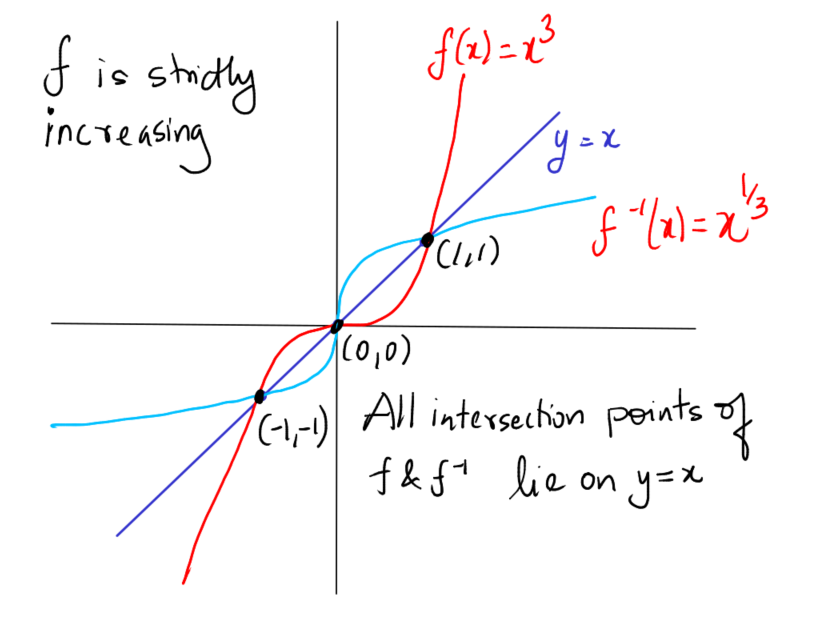
If f is strictly increasing and f intersects its inverse f−1, the points of intersection will always lie on the line y=x.
For strictly increasing functions, f(x)=f−1(x) implies f(x)=x.
This happens because, geometrically, f and f−1 are reflections of each other across the line y=x. Thus, any intersection point must satisfy x=y, lying exactly on y=x.
Example:
For f(x)=x3, which is strictly increasing, its inverse f−1(x)=3x intersects at points satisfying x3=x. Solving this gives intersection points at x=−1,0,1, all of which lie on y=x.
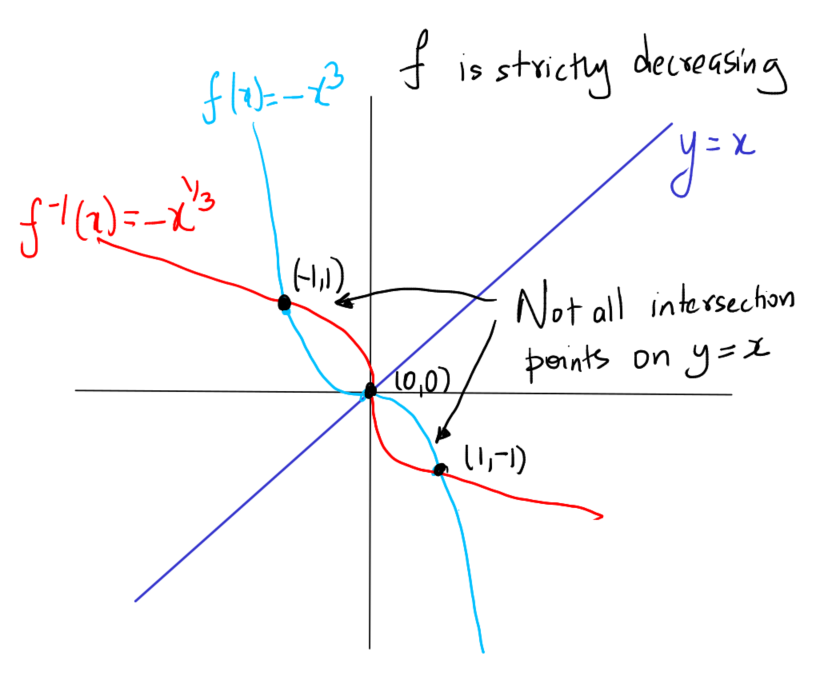
But, if f is strictly decreasing and intersects its inverse f−1, the points of intersection may not lie on the line y=x.
For strictly decreasing functions, f(x)=f−1(x) no longer guarantees that x=y. This is because the reflection property across y=x does not align with the behavior of a decreasing function.
Example:
For f(x)=−x3, a strictly decreasing function, its inverse f−1(x)=−3x intersects at points satisfying −x3=−x, or x3=x. Solving this gives x=−1,0,1. However, while x=0 lies on y=x, the other intersections may not align with this line due to the decreasing nature of f.
Therefore, for strictly increasing functions, the intersection points of f and f−1 always lie on y=x. For strictly decreasing functions, the intersection points may or may not lie on y=x, depending on the specific function.
Section 12 of 18 · Relations and Functions
Mark this section complete when you have worked through its proofs.
Type any topic, theorem, or concept to jump directly to the section.