An even function is defined as a function f(x) that satisfies the condition:
f(−x)=f(x),for all x in the domain of f.
For example, consider the function f(x)=x3sin(x). To determine whether f(x) is even, replace x with −x:
f(−x)=(−x)3sin(−x).
Using the properties of exponents and the sine function:
(−x)3=−x3andsin(−x)=−sin(x),
we get:
f(−x)=(−x3)(−sin(x))=x3sin(x).
Thus, f(−x)=f(x), confirming that f(x)=x3sin(x) is an even function.
In general, to check whether a function f(x) is even, replace x with −x in f(x). If f(−x)=f(x), the function is even. If f(−x)=f(x), the function is not even.
The symmetry of even functions can be understood geometrically. For an even function, the output at a point a is f(a), and the output at −a is f(−a)=f(a). This implies that the points (a,f(a)) and (−a,f(a)) lie on the graph of f(x). Geometrically, (−a,f(a)) is the image of (a,f(a)) when reflected across the y-axis. Since this is true for any point a in the domain of f(x), the graph of f(x) must be symmetric about the y-axis.
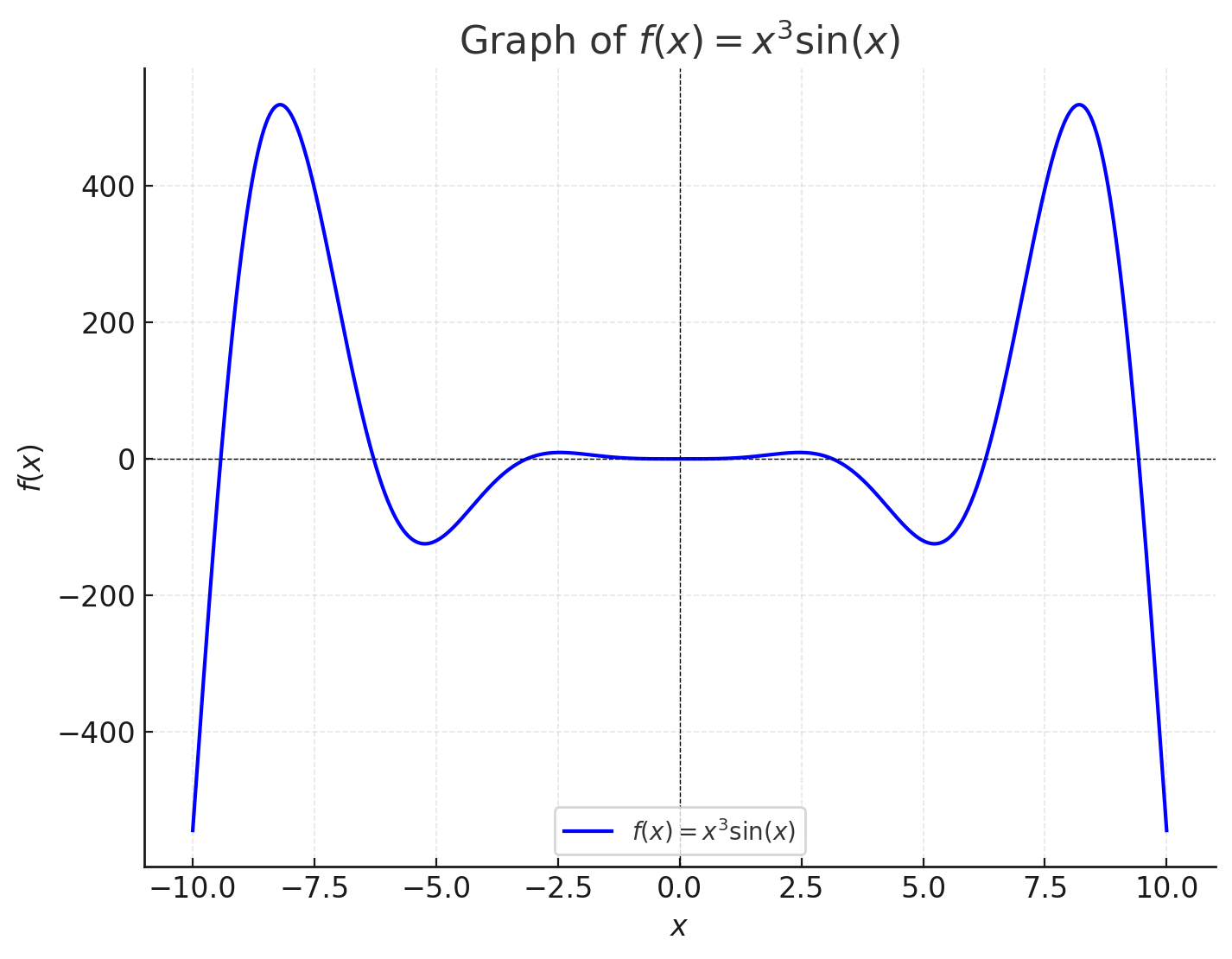
To illustrate this, consider the function f(x)=x3sin(x), which is symmetric about the y-axis. Below is its graph.
The graph above illustrates the function f(x)=x3sin(x). It is symmetric about the y-axis, which confirms that f(x) is an even function. The symmetry occurs because for any point (a,f(a)), there exists a corresponding point (−a,f(a)), satisfying the condition f(−x)=f(x). This symmetry is a fundamental characteristic of all even functions.
An odd function is one where the rule f(−x)=−f(x) holds for all x in the domain. To see this in action, take f(x)=x2sin(x). Replace x with −x:
f(−x)=(−x)2sin(−x)=x2(−sin(x))=−x2sin(x).
Clearly, f(−x)=−f(x), so f(x)=x2sin(x) is odd.
You can check for odd functions in general by replacing x with −x in f(x). If the result is −f(x), the function is odd. Simple.
Odd functions have a distinct symmetry. The output at a is f(a), and the output at −a is f(−a)=−f(a). This means (a,f(a)) and (−a,−f(a)) both lie on the graph. Geometrically, (−a,−f(a)) is the image of (a,f(a)) when reflected about the origin. So, the graph of an odd function always has origin symmetry.
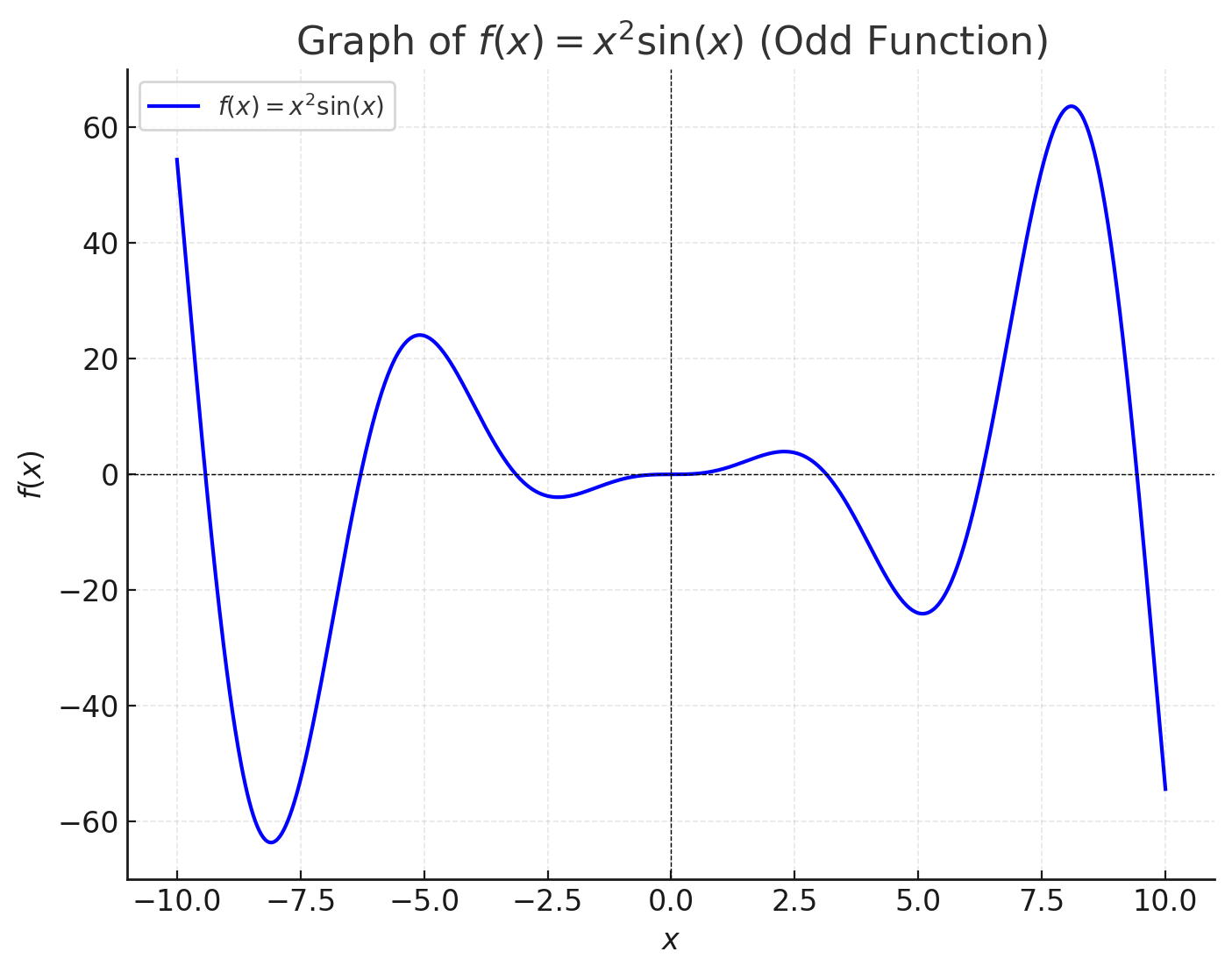
For instance, look at f(x)=x2sin(x). The graph below shows its symmetry about the origin, reinforcing that it’s odd.
The graph of f(x)=x2sin(x) confirms its symmetry about the origin, a hallmark of odd functions. For every point (a,f(a)), there exists a corresponding point (−a,−f(a)), showing that f(−x)=−f(x). This origin symmetry makes f(x) an odd function.
Properties of Even and Odd Functions with Respect to Algebra of Functions§
Let f(x) and g(x) be two functions defined on a common domain. A function f(x) is even if f(−x)=f(x), and odd if f(−x)=−f(x). Using these definitions, we rigorously establish the behavior of even and odd functions under various operations.
Thus, the composition of two even functions is even.
If f(x) and g(x) are both odd, then:
h(−x)=f(g(−x))=f(−g(x))=−f(g(x))=−h(x).
Thus, the composition of two odd functions is odd.
If f(x) is even and g(x) is odd, then:
h(−x)=f(g(−x))=f(−g(x))=f(g(x))=h(x).
Thus, the composition of an even function with an odd function is even.
If f(x) is odd and g(x) is even, then:
h(−x)=f(g(−x))=f(g(x))=h(x).
Thus, the composition of an odd function with an even function is even.
For the composition f(g(x)), if g(x) is an even function (i.e., g(−x)=g(x)), then f(g(x)) is always even, regardless of whether f(x) is odd, even, or neither.
Proof:
Let h(x)=f(g(x)). To check whether h(x) is even, we compute h(−x):
h(−x)=f(g(−x)).
Since g(x) is even, g(−x)=g(x). Substituting this:
h(−x)=f(g(x))=h(x).
Thus, h(x) satisfies the condition h(−x)=h(x), and f(g(x)) is even.
Example:
Let f(x)=x (neither even nor odd) and g(x)=cos(x) (even). Then:
f(g(x))=cos(x).
For h(x)=cos(x), we compute h(−x):
h(−x)=cos(−x).
Since cos(−x)=cos(x), we have:
h(−x)=cos(x)=h(x).
Thus, h(x)=cos(x) is even.
Decomposition of a Function into Even and Odd Parts§
Any function f(x) can be expressed as the sum of an even function and an odd function. This decomposition is given by:
f(x)=fE(x)+fO(x),
where:
fE(x)=2f(x)+f(−x)andfO(x)=2f(x)−f(−x).
Why Does This Work?
To understand why any function f(x) can be expressed as the sum of an even function fE(x) and an odd function fO(x), let us verify the decomposition:
f(x)=fE(x)+fO(x),
where fE(x)=2f(x)+f(−x) and fO(x)=2f(x)−f(−x).
First, consider the even partfE(x). To verify that it is indeed even, compute fE(−x):
fE(−x)=2f(−x)+f(−(−x))=2f(−x)+f(x).
Since the right-hand side simplifies back to fE(x), we conclude that fE(x) satisfies the condition fE(−x)=fE(x), making it even.
Next, examine the odd partfO(x). To verify that it is odd, compute fO(−x):
fO(−x)=2f(−x)−f(−(−x))=2f(−x)−f(x).
Factoring out a negative sign, we get:
fO(−x)=−2f(x)−f(−x)=−fO(x).
Thus, fO(x) satisfies the condition fO(−x)=−fO(x), confirming that it is odd.
Finally, consider the sum of the partsfE(x)+fO(x). Substituting their definitions:
fE(x)+fO(x)=2f(x)+f(−x)+2f(x)−f(−x).
Combining terms, we find:
fE(x)+fO(x)=22f(x)=f(x).
This shows that f(x) can indeed be written as the sum of its even part fE(x) and its odd part fO(x). The decomposition works because the even and odd parts collectively account for both the symmetric and antisymmetric properties of f(x).
Sometimes, we define a function f(x) on a specific domain, say X. For practical reasons, we may want to extend this function to a larger domain A, ensuring that the extended function g(x) behaves consistently with f(x) on X. On the other hand, if a function g(x) is defined on a larger domain A, we might want to restrict it to a smaller subset X, focusing only on part of its behavior. These ideas—extension and restriction—allow us to carefully expand or limit the scope of a function while maintaining mathematical rigor.
Definition
Let f:X→Y be a function, where X⊆A and Y⊆B. We define extension and restriction as follows:
Extension:
A function g:A→B is said to be an extension of f if:
g(x)=f(x)for all x∈X.
This means g(x) agrees with f(x) on the original domain X and may define g(x) for x∈A∖X.
Restriction:
Conversely, f(x) is a restriction of g(x) to X if:
f(x)=g(x)for all x∈X.
In this case, f(x) inherits its values and behavior from g(x), but only on the smaller domain X.
If g(x) is an extension of f(x), then f(x) is a restriction of g(x), and vice versa.
Example
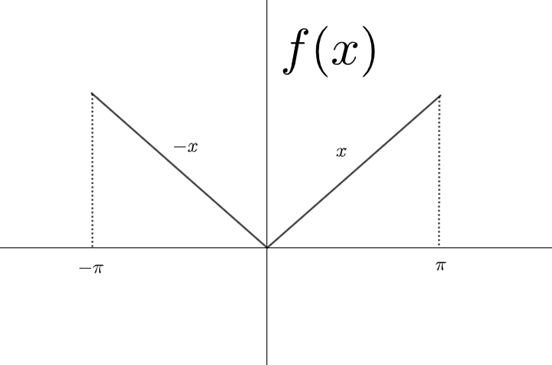
Let f:[−π,π]→R be a function defined as f(x)=∣x∣. Consider the function g:R→R, defined by:
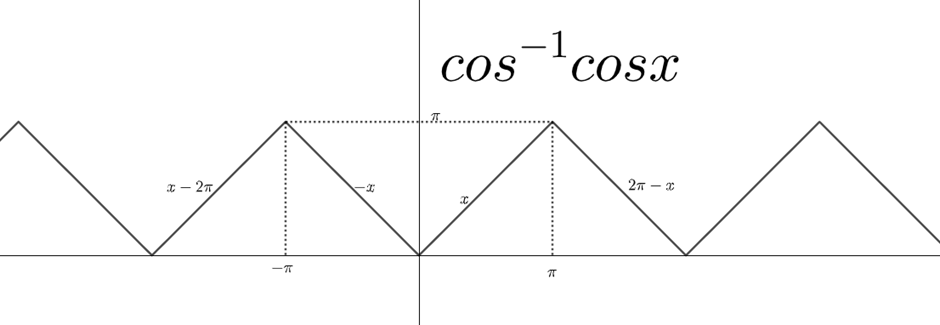
g(x)=cos−1(cosx).
On x∈[−π,π], we compute:
g(x)=cos−1(cosx)=∣x∣,
since cos−1(cosx) reduces to the principal value, which equals ∣x∣ in this interval. Thus, g(x)=f(x) for x∈[−π,π].
For x∈/[−π,π], the function g(x)=cos−1(cosx) extends f(x) to all x∈R, leveraging the periodicity of cosx.
Since g(x) agrees with f(x) on [−π,π] and defines values beyond this domain, g(x) is an extension of f(x). Conversely, f(x) is the restriction of g(x) to [−π,π].
The concepts of extension and restriction are fundamental when we deal with:
Expanding a function's domain while maintaining consistency in its behavior.
Focusing on a subset of a function's domain to study localized behavior.
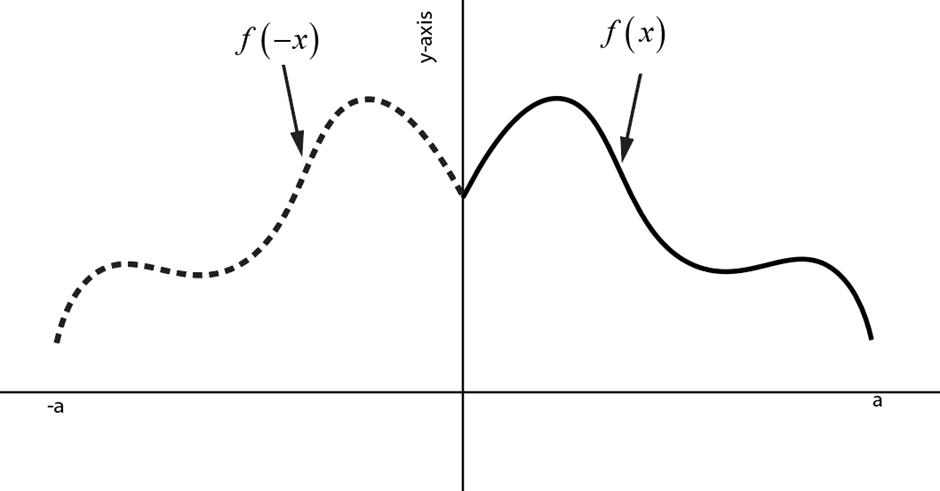
Suppose there is a function f(x) defined on the interval [0,a]. The even extension of f(x) to the interval [−a,a] is a new function fE(x), defined as:
fE(x)={f(x),f(−x),x∈[0,a],x∈[−a,0].
This definition ensures that fE(x) satisfies the property of even functions:
fE(−x)=fE(x),for all x∈[−a,a].
For x∈[0,a], fE(x) is the same as f(x). This retains the original values of the function on the interval where it was initially defined.
For x∈[−a,0], fE(x)=f(−x), which mirrors the values of f(x) from [0,a] into the negative part of the domain. This creates symmetry about the y-axis.
Since fE(x)=fE(−x), the function fE(x) is an even function.
The even extension of f(x) reflects the graph of f(x) from [0,a] into [−a,0] by flipping it across the y-axis. For x∈[−a,0], the function value is f(−x), which corresponds to the reflection of f(x) in the y-axis.
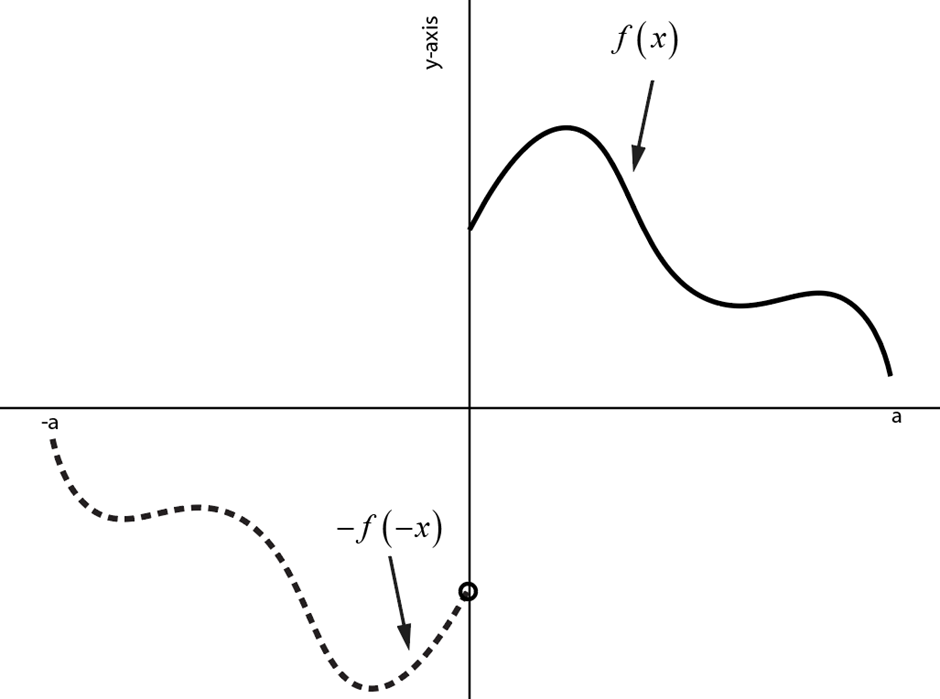
Suppose there is a function f(x) defined on the interval [0,a]. The odd extension of f(x) to the interval [−a,a] is a new function fO(x), defined as:
fO(x)={f(x),−f(−x),x∈[0,a],x∈[−a,0].
Geometric Interpretation
The odd extension of f(x) reflects the graph of f(x) from [0,a] into [−a,0] by flipping it across the origin. For x∈[−a,0], the function value is −f(−x), which corresponds to the reflection of f(x) in the origin.
Example
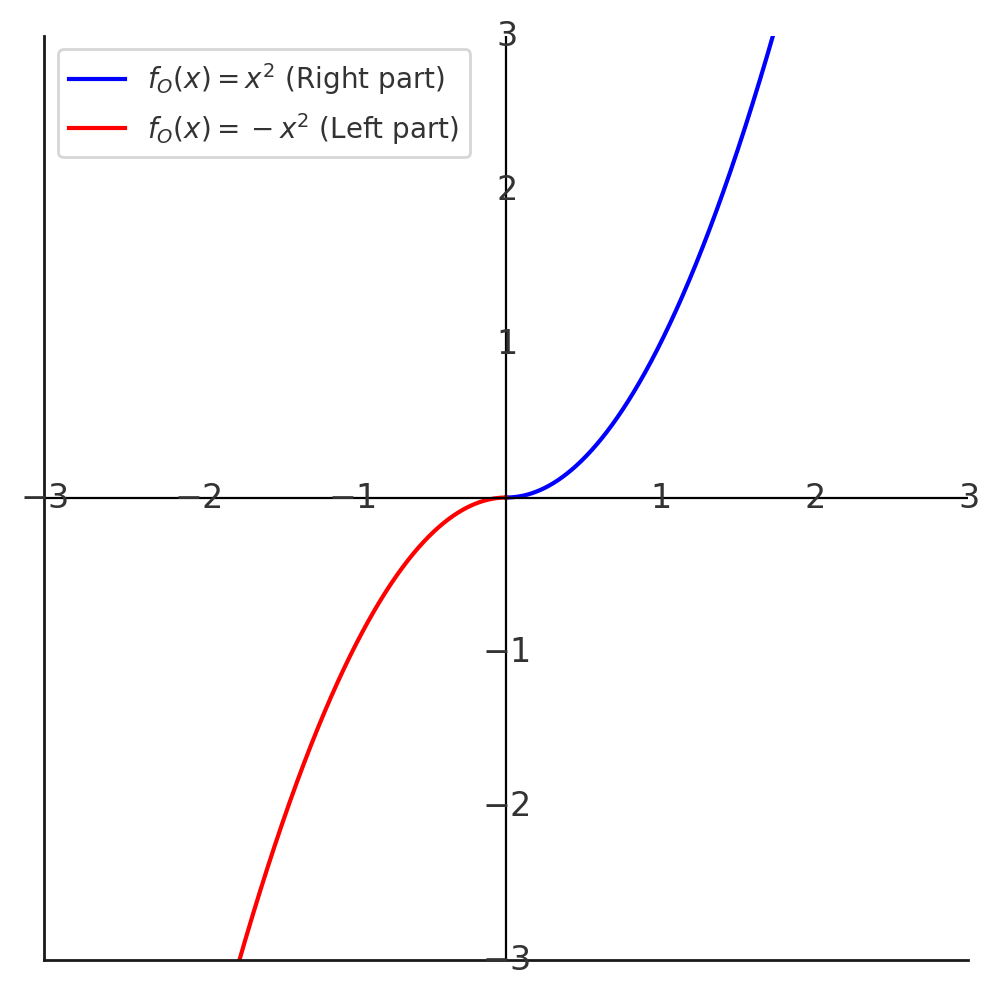
Let f(x)=x2, defined on [0,2]. The odd extension fO(x) is:
fO(x)={x2,−(−x)2,x∈[0,2],x∈[−2,0].
Simplifying:
fO(x)={x2,−x2,x∈[0,2],x∈[−2,0].
The resulting function fO(x) is symmetric about the origin.
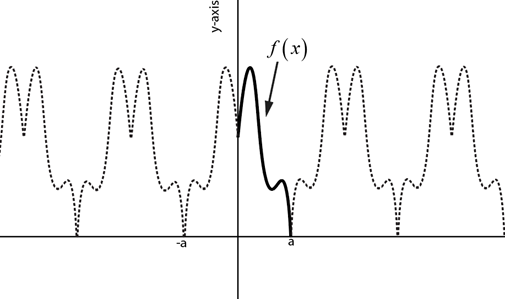
The even periodic extension of a function f(x), originally defined on the interval [0,a], creates a function fEP(x) that is both even and periodic with a period of 2a. It is constructed by reflecting f(x) symmetrically about the y-axis in the interval [−a,a] and repeating this pattern periodically across the entire real line.
Formally, the even periodic extension fEP(x) is defined as:
fEP(x)={f(x),f(−x),x∈[0,a],x∈[−a,0],
with the periodic property:
fEP(x+2a)=fEP(x),for all x∈R.
For x∈[0,a], fEP(x)=f(x), preserving the original function on its domain. For x∈[−a,0], fEP(x)=f(−x), ensuring even symmetry about the y-axis. This construction makes fEP(x) repeat symmetrically and periodically with period 2a.
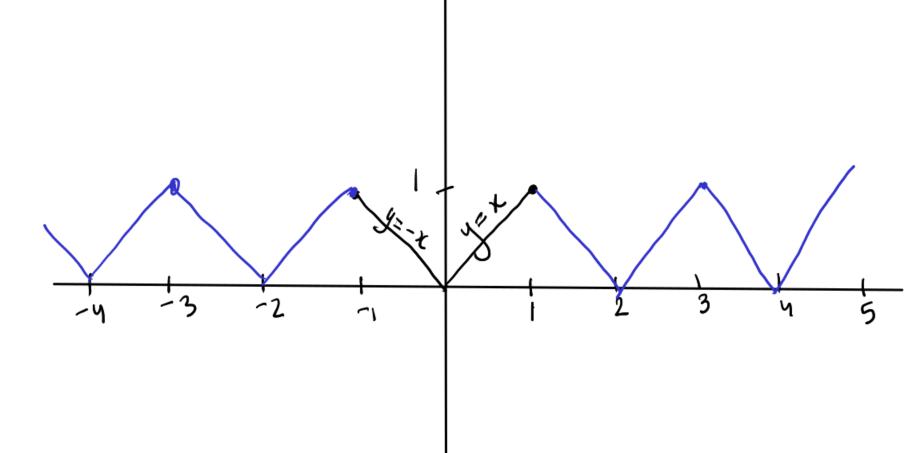
For example, consider f(x)=x, defined on [0,1]. The even periodic extension of f(x) is:
fEP(x)={x,−x,x∈[0,1],x∈[−1,0],
which satisfies fEP(x+2)=fEP(x) for all x. This results in a trnagular wave pattern that is symmetric about the y-axis and repeats with a period of 2.
The odd periodic extension of a function f(x), originally defined on the interval [0,a], constructs a new function fOP(x) that is both odd and periodic, with a period of 2a. It is defined as:
fOP(x)={f(x),−f(−x),x∈[0,a],x∈[−a,0],
and satisfies the periodicity condition:
fOP(x+2a)=fOP(x),for all x∈R.
For x∈[0,a], the function fOP(x) retains the values of the original function f(x). For x∈[−a,0], the function is defined as fOP(x)=−f(−x), ensuring odd symmetry about the origin. This symmetry means that for any x, fOP(−x)=−fOP(x). The periodicity ensures that the pattern repeats every 2a, creating a fully odd and periodic extension of the original function.
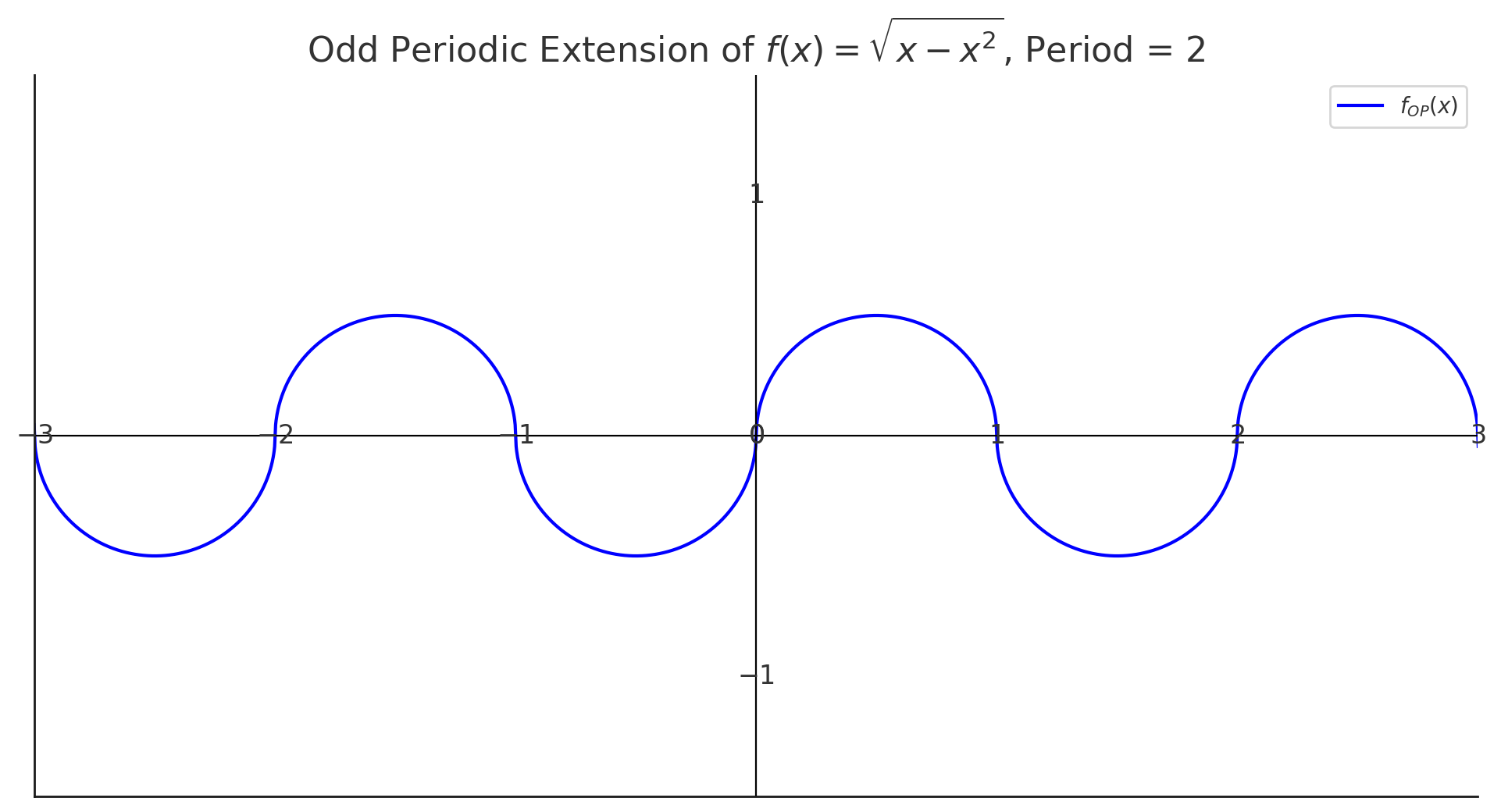
Example: Odd Periodic Extension of f(x)=x−x2 on [0,1]
Let f(x)=x−x2 be defined on [0,1]. The odd periodic extensionfOP(x) is constructed as: