MatheramaMatherama
← Complex Numbers Basics
Complex Numbers Basics·Section 6·4 min read

Polar Form of a Complex Number

Definition§

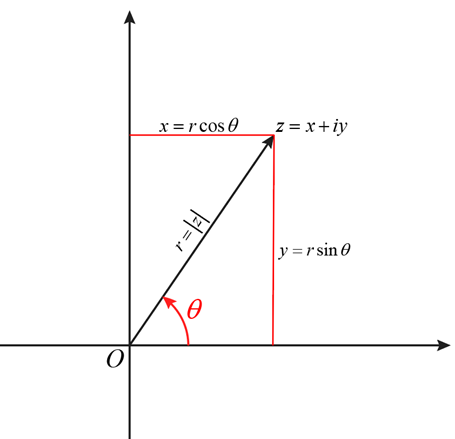
The polar form of a complex number is a way of expressing the number in terms of its magnitude and angle relative to the positive real axis. A complex number zz can be written as z=x+iyz = x + iy, where xx and yy are real numbers representing the real and imaginary parts of zz, respectively. In the complex plane, this number corresponds to the point PP with Cartesian coordinates (x,y)(x, y).

Polar form of complex number

To convert the Cartesian coordinates to polar coordinates, we define rr as the length of the vector OPOP, which represents the magnitude of zz and is given by r=∣z∣=x2+y2r = |z| = \sqrt{x^2 + y^2}. The angle θ\theta, known as the argument of zz, is the angle between the positive real axis and the vector OPOP.

The relationships between the Cartesian coordinates and the polar coordinates are given by:

x=rcos⁡θx = r \cos \theta y=rsin⁡θy = r \sin \theta

So, the complex number zz can also be expressed as:

z=x+iy=rcos⁡θ+irsin⁡θz = x + iy = r \cos \theta + ir \sin \theta z=r(cos⁡θ+isin⁡θ)z = r(\cos \theta + i \sin \theta)

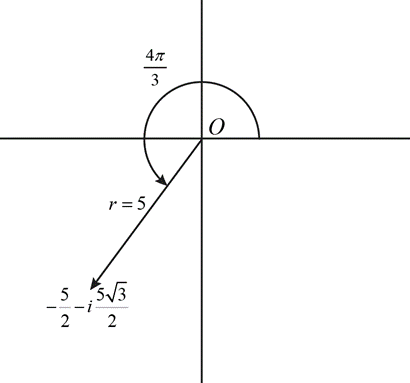
Consider a complex number zz, represented by point PP on the complex plane. If the distance from the origin to PP is 5, and the angle OPOP makes with the positive x-axis is 4π3\frac{4\pi}{3}, then zz is given by:

z=5(cos⁡4π3+isin⁡4π3)z = 5\left(\cos \frac{4\pi}{3} + i\sin \frac{4\pi}{3}\right)

Using the cosine and sine values for the given angle, we can write zz in Cartesian form:

z=5(−12−i32)z = 5\left(-\frac{1}{2} - i\frac{\sqrt{3}}{2}\right) z=−52−i532z = -\frac{5}{2} - i\frac{5\sqrt{3}}{2}

This is the Cartesian form of the complex number whose magnitude is 5 and whose argument (angle from the positive x-axis) is 4π3\frac{4\pi}{3}.

complex number on Argand plane to find the polar form

Some special considerations on polar form:

z=r(cos⁡θ−isin⁡θ)z = r(\cos\theta - i\sin\theta) is not in correct polar form, but we may convert it to correct form by using trigonometric identities.

z=r(cos⁡θ−isin⁡θ)=r(cos⁡(−θ)+isin⁡(−θ))z = r(\cos\theta - i\sin\theta) = r(\cos(-\theta) + i\sin(-\theta)) (Supposing r>0r > 0)

Similarly,

Incorrect polar form Correct polar form
r(−cos⁡θ+isin⁡θ)r(-\cos\theta + i\sin\theta) r(cos⁡(π−θ)+isin⁡(π−θ))r(\cos(\pi - \theta) + i\sin(\pi - \theta))
r(−cos⁡θ−isin⁡θ)r(-\cos\theta - i\sin\theta) r(cos⁡(π+θ)+isin⁡(π+θ))r(\cos(\pi + \theta) + i\sin(\pi + \theta))
r(sin⁡θ+icos⁡θ)r(\sin\theta + i\cos\theta) r(cos⁡(π2−θ)+isin⁡(π2−θ))r(\cos(\frac{\pi}{2} - \theta) + i\sin(\frac{\pi}{2} - \theta))
r(sin⁡θ−icos⁡θ)r(\sin\theta - i\cos\theta) r(cos⁡(θ−π2)+isin⁡(θ−π2))r(\cos(\theta - \frac{\pi}{2}) + i\sin(\theta - \frac{\pi}{2}))
r(−sin⁡θ+icos⁡θ)r(-\sin\theta + i\cos\theta) r(cos⁡(π2+θ)+isin⁡(π2+θ))r(\cos(\frac{\pi}{2} + \theta) + i\sin(\frac{\pi}{2} + \theta))
r(−sin⁡θ−icos⁡θ)r(-\sin\theta - i\cos\theta) r(cos⁡(π2−θ)+isin⁡(π2−θ))r(\cos(\frac{\pi}{2} - \theta) + i\sin(\frac{\pi}{2} - \theta))
Section 6 of 7 · Complex Numbers Basics

Mark this section complete when you have worked through its proofs.