Introduction§
The conjugate, modulus, and argument of a complex number are interconnected concepts that play crucial roles in complex number theory. The conjugate of a complex number z = a + b i z = a + bi z = a + bi z ‾ = a − b i \overline{z} = a - bi z = a − bi z z z ∣ z ∣ |z| ∣ z ∣ z z z a 2 + b 2 \sqrt{a^2 + b^2} a 2 + b 2 arg ( z ) \arg(z) arg ( z ) θ \theta θ z z z z z z z z z z ‾ \overline{z} z z ‾ \overline{z} z z z z
Properties of conjugate§
For a complex number z z z z ‾ \overline{z} z
Double Conjugate Property: z ‾ ‾ = z \overline{\overline{z}} = z z = z
Conjugation and Real and Imaginary Parts:
z + z ‾ = 2 Re ( z ) z + \overline{z} = 2\text{Re}(z) z + z = 2 Re ( z ) z − z ‾ = 2 i Im ( z ) z - \overline{z} = 2i\text{Im}(z) z − z = 2 i Im ( z )
Thus, z + z ‾ = 0 z + \overline{z} = 0 z + z = 0 z z z z = z ‾ z = \overline{z} z = z z z z
Proof:
Let z = a + b i z = a + bi z = a + bi a , b ∈ R a, b \in \mathbb{R} a , b ∈ R i i i z z z z ‾ \overline{z} z a − b i a - bi a − bi
z + z ‾ = ( a + b i ) + ( a − b i ) = a + a = 2 a = 2 Re ( z ) z + \overline{z} = (a + bi) + (a - bi) = a + a = 2a = 2\text{Re}(z) z + z = ( a + bi ) + ( a − bi ) = a + a = 2 a = 2 Re ( z )
z − z ‾ = ( a + b i ) − ( a − b i ) = b i + b i = 2 b i = 2 i Im ( z ) z - \overline{z} = (a + bi) - (a - bi) = bi + bi = 2bi = 2i\text{Im}(z) z − z = ( a + bi ) − ( a − bi ) = bi + bi = 2 bi = 2 i Im ( z )
For the implications:
If z + z ‾ = 0 z + \overline{z} = 0 z + z = 0 2 Re ( z ) = 0 2\text{Re}(z) = 0 2 Re ( z ) = 0 Re ( z ) = 0 \text{Re}(z) = 0 Re ( z ) = 0 z z z z = a + b i z = a + bi z = a + bi a = 0 a = 0 a = 0
Conversely, if z z z a = 0 a = 0 a = 0 z = b i z = bi z = bi z + z ‾ = b i − b i = 0 z + \overline{z} = bi - bi = 0 z + z = bi − bi = 0
If z = z ‾ z = \overline{z} z = z a + b i = a − b i a + bi = a - bi a + bi = a − bi b i = − b i bi = -bi bi = − bi b = 0 b = 0 b = 0 z z z z = a + 0 i z = a + 0i z = a + 0 i
Conversely, if z z z z = a z = a z = a z ‾ = a \overline{z} = a z = a z = z ‾ z = \overline{z} z = z
In summary, z z z z + z ‾ = 0 z + \overline{z} = 0 z + z = 0 z z z z = z ‾ z = \overline{z} z = z
Modulus Property: z z ‾ = ∣ z ∣ 2 z\overline{z} = |z|^2 z z = ∣ z ∣ 2
Proof: If z = a + b i z = a + bi z = a + bi z ‾ = a − b i \overline{z} = a - bi z = a − bi z z ‾ = ( a + b i ) ( a − b i ) = a 2 + b 2 = ∣ z ∣ 2 z\overline{z} = (a + bi)(a - bi) = a^2 + b^2 = |z|^2 z z = ( a + bi ) ( a − bi ) = a 2 + b 2 = ∣ z ∣ 2
Let z z z ∣ z ∣ = 1 |z| = 1 ∣ z ∣ = 1 z z ‾ = ∣ z ∣ 2 z\overline{z} = |z|^2 z z = ∣ z ∣ 2 ∣ z ∣ = 1 |z| = 1 ∣ z ∣ = 1
z z ‾ = 1. z\overline{z} = 1. z z = 1. Therefore, the complex conjugate z ‾ \overline{z} z z z z
z ‾ = 1 z . \overline{z} = \frac{1}{z}. z = z 1 .
Summation Property:
z 1 + z 2 ‾ = z 1 ‾ + z 2 ‾ \overline{z_1 + z_2} = \overline{z_1} + \overline{z_2} z 1 + z 2 = z 1 + z 2
Proof: Let z 1 = a + b i z_1 = a + bi z 1 = a + bi z 2 = c + d i z_2 = c + di z 2 = c + d i z 1 + z 2 ‾ = ( a + b i ) + ( c + d i ) ‾ = ( a + c ) + ( b + d ) i ‾ = ( a + c ) − ( b + d ) i = z 1 ‾ + z 2 ‾ \overline{z_1 + z_2} = \overline{(a + bi) + (c + di)} = \overline{(a + c) + (b + d)i} = (a + c) - (b + d)i = \overline{z_1} + \overline{z_2} z 1 + z 2 = ( a + bi ) + ( c + d i ) = ( a + c ) + ( b + d ) i = ( a + c ) − ( b + d ) i = z 1 + z 2
Product Property: z 1 z 2 ‾ = z 1 ‾ ⋅ z 2 ‾ \overline{z_1z_2} = \overline{z_1} \cdot \overline{z_2} z 1 z 2 = z 1 ⋅ z 2
Proof: Using the definition of complex multiplication,
z 1 z 2 ‾ = ( a + b i ) ( c + d i ) ‾ = ( a c − b d ) + ( b c + a d ) i ‾ = ( a c − b d ) − ( b c + a d ) i = z 1 ‾ ⋅ z 2 ‾ \overline{z_1z_2} = \overline{(a + bi)(c + di)} = \overline{(ac - bd) + (bc + ad)i} = (ac - bd) - (bc + ad)i = \overline{z_1} \cdot \overline{z_2} z 1 z 2 = ( a + bi ) ( c + d i ) = ( a c − b d ) + ( b c + a d ) i = ( a c − b d ) − ( b c + a d ) i = z 1 ⋅ z 2
Division Property: z 1 ‾ z 2 = z 1 ‾ z 2 ‾ \frac{\overline{z_1}}{z_2} = \frac{\overline{z_1}}{\overline{z_2}} z 2 z 1 = z 2 z 1 z 2 ≠ 0 z_2 \neq 0 z 2 = 0
Proof: Multiply numerator and denominator by z 2 ‾ \overline{z_2} z 2 z 1 ‾ z 2 = z 1 ‾ ⋅ z 2 ‾ z 2 ⋅ z 2 ‾ = z 1 ‾ z 2 ‾ \frac{\overline{z_1}}{z_2} = \frac{\overline{z_1} \cdot \overline{z_2}}{z_2 \cdot \overline{z_2}} = \frac{\overline{z_1}}{\overline{z_2}} z 2 z 1 = z 2 ⋅ z 2 z 1 ⋅ z 2 = z 2 z 1 z 2 z 2 ‾ = ∣ z 2 ∣ 2 z_2\overline{z_2} = |z_2|^2 z 2 z 2 = ∣ z 2 ∣ 2
∣ z ∣ = ∣ z ‾ ∣ |z| = |\overline{z}| ∣ z ∣ = ∣ z ∣
Proof: ∣ z ‾ ∣ 2 = z ‾ ⋅ z = ∣ z ∣ 2 |\overline{z}|^2 = \overline{z} \cdot z = |z|^2 ∣ z ∣ 2 = z ⋅ z = ∣ z ∣ 2 ∣ z ∣ = ∣ z ‾ ∣ |z| = |\overline{z}| ∣ z ∣ = ∣ z ∣
Argument Property: arg ( z ‾ ) = − arg ( z ) \text{arg}(\overline{z}) = -\text{arg}(z) arg ( z ) = − arg ( z )
Proof: If z = r e i θ z = re^{i\theta} z = r e i θ z ‾ = r e − i θ \overline{z} = re^{-i\theta} z = r e − i θ arg ( z ‾ ) = − θ = − arg ( z ) \text{arg}(\overline{z}) = -\theta = -\text{arg}(z) arg ( z ) = − θ = − arg ( z )
Theorem: The square of the modulus of the sum of two complex numbers z 1 z_1 z 1 z 2 z_2 z 2
∣ z 1 + z 2 ∣ 2 = ∣ z 1 ∣ 2 + ∣ z 2 ∣ 2 + 2 Re ( z 1 z 2 ‾ ) . |z_1 + z_2|^2 = |z_1|^2 + |z_2|^2 + 2\text{Re}(z_1\overline{z_2}). ∣ z 1 + z 2 ∣ 2 = ∣ z 1 ∣ 2 + ∣ z 2 ∣ 2 + 2 Re ( z 1 z 2 ) . Proof: Let z 1 z_1 z 1 z 2 z_2 z 2 z 1 + z 2 z_1 + z_2 z 1 + z 2 z 1 + z 2 ‾ \overline{z_1 + z_2} z 1 + z 2
∣ z 1 + z 2 ∣ 2 = ( z 1 + z 2 ) ( z 1 ‾ + z 2 ‾ ) = z 1 z 1 ‾ + z 1 z 2 ‾ + z 2 z 1 ‾ + z 2 z 2 ‾ = ∣ z 1 ∣ 2 + z 1 z 2 ‾ + z 1 ‾ z 2 + ∣ z 2 ∣ 2 . \begin{align*} |z_1 + z_2|^2 &= (z_1 + z_2)(\overline{z_1} + \overline{z_2}) \\ &= z_1\overline{z_1} + z_1\overline{z_2} + z_2\overline{z_1} + z_2\overline{z_2} \\ &= |z_1|^2 + z_1\overline{z_2} + \overline{z_1}z_2 + |z_2|^2. \end{align*} ∣ z 1 + z 2 ∣ 2 = ( z 1 + z 2 ) ( z 1 + z 2 ) = z 1 z 1 + z 1 z 2 + z 2 z 1 + z 2 z 2 = ∣ z 1 ∣ 2 + z 1 z 2 + z 1 z 2 + ∣ z 2 ∣ 2 . Notice that z 1 z 2 ‾ z_1\overline{z_2} z 1 z 2 z 1 ‾ z 2 \overline{z_1}z_2 z 1 z 2
z 1 z 2 ‾ + z 1 ‾ z 2 = 2 Re ( z 1 z 2 ‾ ) . z_1\overline{z_2} + \overline{z_1}z_2 = 2\text{Re}(z_1\overline{z_2}). z 1 z 2 + z 1 z 2 = 2 Re ( z 1 z 2 ) . Substituting this into our previous equation, we obtain:
∣ z 1 + z 2 ∣ 2 = ∣ z 1 ∣ 2 + ∣ z 2 ∣ 2 + 2 Re ( z 1 z 2 ‾ ) . |z_1 + z_2|^2 = |z_1|^2 + |z_2|^2 + 2\text{Re}(z_1\overline{z_2}). ∣ z 1 + z 2 ∣ 2 = ∣ z 1 ∣ 2 + ∣ z 2 ∣ 2 + 2 Re ( z 1 z 2 ) . Hence, the theorem is proved. ■ \blacksquare ■
Similarly, for the difference:
∣ z 1 − z 2 ∣ 2 = ( z 1 − z 2 ) ( z 1 ‾ − z 2 ‾ ) |z_1 - z_2|^2 = (z_1 - z_2)(\overline{z_1} - \overline{z_2}) ∣ z 1 − z 2 ∣ 2 = ( z 1 − z 2 ) ( z 1 − z 2 ) = z 1 z 1 ‾ − z 1 z 2 ‾ − z 2 z 1 ‾ + z 2 z 2 ‾ = z_1\overline{z_1} - z_1\overline{z_2} - z_2\overline{z_1} + z_2\overline{z_2} = z 1 z 1 − z 1 z 2 − z 2 z 1 + z 2 z 2 = ∣ z 1 ∣ 2 − z 1 z 2 ‾ − z 1 ‾ z 2 + ∣ z 2 ∣ 2 = |z_1|^2 - z_1\overline{z_2} - \overline{z_1}z_2 + |z_2|^2 = ∣ z 1 ∣ 2 − z 1 z 2 − z 1 z 2 + ∣ z 2 ∣ 2 = ∣ z 1 ∣ 2 + ∣ z 2 ∣ 2 − 2 Re ( z 1 z 2 ‾ ) = |z_1|^2 + |z_2|^2 - 2\text{Re}(z_1\overline{z_2}) = ∣ z 1 ∣ 2 + ∣ z 2 ∣ 2 − 2 Re ( z 1 z 2 )
Properties of Modulus§
Some important properties of the Modulus of a complex number:
∥ z ∥ = ∣ z ∣ \|z\| = |z| ∥ z ∥ = ∣ z ∣
∣ z ∣ = ∣ z ‾ ∣ |z| = |\overline{z}| ∣ z ∣ = ∣ z ∣
∣ − z ∣ = ∣ z ∣ |-z| = |z| ∣ − z ∣ = ∣ z ∣
∣ k z ∣ = ∣ k ∣ ∣ z ∣ |kz| = |k||z| ∣ k z ∣ = ∣ k ∣∣ z ∣ k k k
∣ z 1 z 2 ∣ = ∣ z 1 ∣ ∣ z 2 ∣ |z_1z_2| = |z_1||z_2| ∣ z 1 z 2 ∣ = ∣ z 1 ∣∣ z 2 ∣
Proof of Property 5:
Let z 1 = x 1 + i y 1 z_1 = x_1 + iy_1 z 1 = x 1 + i y 1 z 2 = x 2 + i y 2 z_2 = x_2 + iy_2 z 2 = x 2 + i y 2
Then,
z 1 z 2 = ( x 1 + i y 1 ) ( x 2 + i y 2 ) = ( x 1 x 2 − y 1 y 2 ) + i ( x 1 y 2 + y 1 x 2 ) , \begin{align*}
z_1z_2 &= (x_1 + iy_1)(x_2 + iy_2) \\
&= (x_1x_2 - y_1y_2) + i(x_1y_2 + y_1x_2),
\end{align*} z 1 z 2 = ( x 1 + i y 1 ) ( x 2 + i y 2 ) = ( x 1 x 2 − y 1 y 2 ) + i ( x 1 y 2 + y 1 x 2 ) , and so,
∣ z 1 z 2 ∣ = ( x 1 x 2 − y 1 y 2 ) 2 + ( x 1 y 2 + y 1 x 2 ) 2 = x 1 2 x 2 2 + y 1 2 y 2 2 − 2 x 1 x 2 y 1 y 2 + x 1 2 y 2 2 + y 1 2 x 2 2 + 2 x 1 y 2 y 1 x 2 = x 1 2 ( x 2 2 + y 2 2 ) + y 1 2 ( x 2 2 + y 2 2 ) = ( x 1 2 + y 1 2 ) ( x 2 2 + y 2 2 ) = x 1 2 + y 1 2 x 2 2 + y 2 2 = ∣ z 1 ∣ ∣ z 2 ∣ . \begin{align*}
|z_1z_2| &= \sqrt{(x_1x_2 - y_1y_2)^2 + (x_1y_2 + y_1x_2)^2} \\
&= \sqrt{x_1^2x_2^2 + y_1^2y_2^2 - 2x_1x_2y_1y_2 + x_1^2y_2^2 + y_1^2x_2^2 + 2x_1y_2y_1x_2} \\
&= \sqrt{x_1^2(x_2^2 + y_2^2) + y_1^2(x_2^2 + y_2^2)} \\
&= \sqrt{(x_1^2 + y_1^2)(x_2^2 + y_2^2)} \\
&= \sqrt{x_1^2 + y_1^2} \sqrt{x_2^2 + y_2^2} \\
&= |z_1||z_2|.
\end{align*} ∣ z 1 z 2 ∣ = ( x 1 x 2 − y 1 y 2 ) 2 + ( x 1 y 2 + y 1 x 2 ) 2 = x 1 2 x 2 2 + y 1 2 y 2 2 − 2 x 1 x 2 y 1 y 2 + x 1 2 y 2 2 + y 1 2 x 2 2 + 2 x 1 y 2 y 1 x 2 = x 1 2 ( x 2 2 + y 2 2 ) + y 1 2 ( x 2 2 + y 2 2 ) = ( x 1 2 + y 1 2 ) ( x 2 2 + y 2 2 ) = x 1 2 + y 1 2 x 2 2 + y 2 2 = ∣ z 1 ∣∣ z 2 ∣. This completes the proof that the modulus of the product of two complex numbers is equal to the product of their moduli.■ \blacksquare ■
( a c ± b d ) 2 + ( a d ∓ b c ) 2 = ( a 2 + b 2 ) ( c 2 + d 2 ) (ac \pm bd)^2 + (ad \mp bc)^2 = (a^2 + b^2)(c^2 + d^2) ( a c ± b d ) 2 + ( a d ∓ b c ) 2 = ( a 2 + b 2 ) ( c 2 + d 2 ) This can be proved as follows:
Consider the left-hand side of the equation:
( a c ± b d ) 2 + ( a d ∓ b c ) 2 (ac \pm bd)^2 + (ad \mp bc)^2 ( a c ± b d ) 2 + ( a d ∓ b c ) 2 Expanding both squares, we have:
( a c ± b d ) 2 = a 2 c 2 ± 2 a b c d + b 2 d 2 (ac \pm bd)^2 = a^2c^2 \pm 2abcd + b^2d^2 ( a c ± b d ) 2 = a 2 c 2 ± 2 ab c d + b 2 d 2 ( a d ∓ b c ) 2 = a 2 d 2 ∓ 2 a b c d + b 2 c 2 (ad \mp bc)^2 = a^2d^2 \mp 2abcd + b^2c^2 ( a d ∓ b c ) 2 = a 2 d 2 ∓ 2 ab c d + b 2 c 2 Adding these expansions together:
a 2 c 2 ± 2 a b c d + b 2 d 2 + a 2 d 2 ∓ 2 a b c d + b 2 c 2 a^2c^2 \pm 2abcd + b^2d^2 + a^2d^2 \mp 2abcd + b^2c^2 a 2 c 2 ± 2 ab c d + b 2 d 2 + a 2 d 2 ∓ 2 ab c d + b 2 c 2 Notice that ± 2 a b c d \pm 2abcd ± 2 ab c d ∓ 2 a b c d \mp 2abcd ∓ 2 ab c d
a 2 c 2 + a 2 d 2 + b 2 d 2 + b 2 c 2 a^2c^2 + a^2d^2 + b^2d^2 + b^2c^2 a 2 c 2 + a 2 d 2 + b 2 d 2 + b 2 c 2 Factor by grouping a 2 a^2 a 2 b 2 b^2 b 2
a 2 ( c 2 + d 2 ) + b 2 ( c 2 + d 2 ) a^2(c^2 + d^2) + b^2(c^2 + d^2) a 2 ( c 2 + d 2 ) + b 2 ( c 2 + d 2 ) This can be further factored to get the right-hand side of the original equation:
( a 2 + b 2 ) ( c 2 + d 2 ) (a^2 + b^2)(c^2 + d^2) ( a 2 + b 2 ) ( c 2 + d 2 ) Thus proving the original assertion.
∣ z 1 z 2 ∣ = ∣ z 1 ∣ ∣ z 2 ∣ \left| \frac{z_1}{z_2} \right| = \frac{|z_1|}{|z_2|} z 2 z 1 = ∣ z 2 ∣ ∣ z 1 ∣
− ∣ z ∣ ≤ Re ( z ) ≤ ∣ z ∣ -|z| \leq \text{Re}(z) \leq |z| − ∣ z ∣ ≤ Re ( z ) ≤ ∣ z ∣ − ∣ z ∣ ≤ Im ( z ) ≤ ∣ z ∣ -|z| \leq \text{Im}(z) \leq |z| − ∣ z ∣ ≤ Im ( z ) ≤ ∣ z ∣
Proof of Property 7:
Let z z z z = a + b i z = a + bi z = a + bi a = Re ( z ) a = \text{Re}(z) a = Re ( z ) b = Im ( z ) b = \text{Im}(z) b = Im ( z )
The modulus of z z z ∣ z ∣ = a 2 + b 2 |z| = \sqrt{a^2 + b^2} ∣ z ∣ = a 2 + b 2
The square of the modulus is ∣ z ∣ 2 = a 2 + b 2 |z|^2 = a^2 + b^2 ∣ z ∣ 2 = a 2 + b 2
Since b 2 b^2 b 2 a 2 ≤ a 2 + b 2 a^2 \leq a^2 + b^2 a 2 ≤ a 2 + b 2 ∣ a ∣ ≤ ∣ z ∣ |a| \leq |z| ∣ a ∣ ≤ ∣ z ∣ a ≤ ∣ z ∣ a \leq |z| a ≤ ∣ z ∣ − a ≤ ∣ z ∣ -a \leq |z| − a ≤ ∣ z ∣ − ∣ z ∣ ≤ a -|z| \leq a − ∣ z ∣ ≤ a
Since a = Re ( z ) a = \text{Re}(z) a = Re ( z ) − ∣ z ∣ ≤ Re ( z ) ≤ ∣ z ∣ -|z| \leq \text{Re}(z) \leq |z| − ∣ z ∣ ≤ Re ( z ) ≤ ∣ z ∣
Similarly, since a 2 a^2 a 2 b 2 ≤ a 2 + b 2 b^2 \leq a^2 + b^2 b 2 ≤ a 2 + b 2 ∣ b ∣ ≤ ∣ z ∣ |b| \leq |z| ∣ b ∣ ≤ ∣ z ∣ − ∣ z ∣ ≤ b -|z| \leq b − ∣ z ∣ ≤ b b ≤ ∣ z ∣ b \leq |z| b ≤ ∣ z ∣ − ∣ z ∣ ≤ Im ( z ) ≤ ∣ z ∣ -|z| \leq \text{Im}(z) \leq |z| − ∣ z ∣ ≤ Im ( z ) ≤ ∣ z ∣
■ \blacksquare ■
Triangle's Inequality§
Triangle Inequality Theorem for Complex Numbers:
For any complex numbers z 1 z_1 z 1 z 2 z_2 z 2
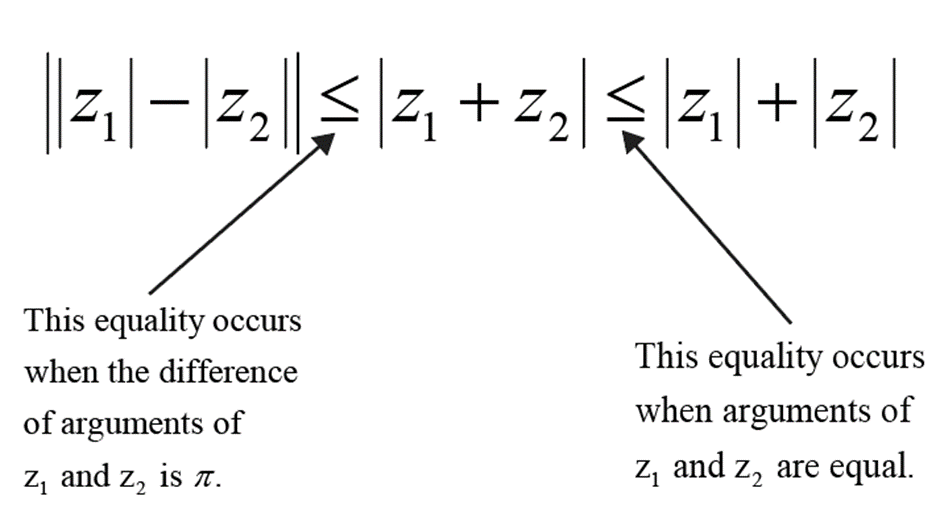
∣ ∣ z 1 ∣ − ∣ z 2 ∣ ∣ ≤ ∣ z 1 + z 2 ∣ ≤ ∣ z 1 ∣ + ∣ z 2 ∣ ||z_1| - |z_2|| \leq |z_1 + z_2| \leq |z_1| + |z_2| ∣∣ z 1 ∣ − ∣ z 2 ∣∣ ≤ ∣ z 1 + z 2 ∣ ≤ ∣ z 1 ∣ + ∣ z 2 ∣
The left inequality becomes an equality if and only if the difference in the arguments of z 1 z_1 z 1 z 2 z_2 z 2 π \pi π z 1 z_1 z 1 z 2 z_2 z 2
The right inequality becomes an equality if and only if the arguments of z 1 z_1 z 1 z 2 z_2 z 2 z 1 z_1 z 1 z 2 z_2 z 2
Geometric Proof:
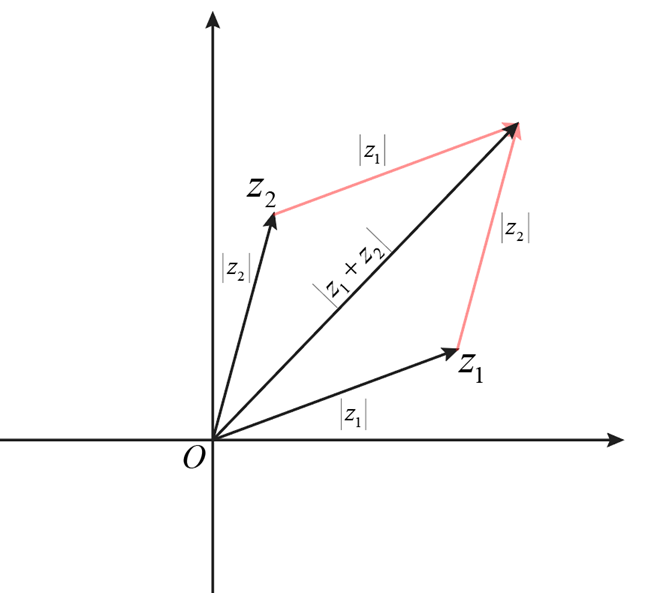
In the complex plane, the complex numbers z 1 z_1 z 1 z 2 z_2 z 2 z 1 + z 2 z_1 + z_2 z 1 + z 2
To prove the right inequality ∣ z 1 + z 2 ∣ ≤ ∣ z 1 ∣ + ∣ z 2 ∣ |z_1 + z_2| \leq |z_1| + |z_2| ∣ z 1 + z 2 ∣ ≤ ∣ z 1 ∣ + ∣ z 2 ∣
Observe triangle OAC. By the triangle inequality in geometry (not to be confused with the Triangle Inequality Theorem for complex numbers), the sum of the lengths of two sides of a triangle is greater than or equal to the length of the third side. Hence, O A + A C ≥ O C OA + AC \geq OC O A + A C ≥ O C ∣ z 1 ∣ + ∣ z 2 ∣ ≥ ∣ z 1 + z 2 ∣ |z_1| + |z_2| \geq |z_1 + z_2| ∣ z 1 ∣ + ∣ z 2 ∣ ≥ ∣ z 1 + z 2 ∣
The equality ∣ z 1 + z 2 ∣ = ∣ z 1 ∣ + ∣ z 2 ∣ |z_1 + z_2| = |z_1| + |z_2| ∣ z 1 + z 2 ∣ = ∣ z 1 ∣ + ∣ z 2 ∣ z 1 z_1 z 1 z 2 z_2 z 2
To prove the left inequality ∣ ∣ z 1 ∣ − ∣ z 2 ∣ ∣ ≤ ∣ z 1 + z 2 ∣ ||z_1| - |z_2|| \leq |z_1 + z_2| ∣∣ z 1 ∣ − ∣ z 2 ∣∣ ≤ ∣ z 1 + z 2 ∣
First, consider triangle OCB. Using the triangle inequality, O C + O B ≥ B C OC + OB \geq BC O C + O B ≥ B C O C ≥ O B − O C OC \geq OB - OC O C ≥ O B − O C ∣ z 1 + z 2 ∣ ≥ ∣ z 2 ∣ − ∣ z 1 ∣ |z_1 + z_2| \geq |z_2| - |z_1| ∣ z 1 + z 2 ∣ ≥ ∣ z 2 ∣ − ∣ z 1 ∣
Next, observe triangle OAC. Again applying the triangle inequality, O A + O C ≥ A C OA + OC \geq AC O A + O C ≥ A C O C ≥ O A − O C OC \geq OA - OC O C ≥ O A − O C ∣ z 1 + z 2 ∣ ≥ ∣ z 1 ∣ − ∣ z 2 ∣ |z_1 + z_2| \geq |z_1| - |z_2| ∣ z 1 + z 2 ∣ ≥ ∣ z 1 ∣ − ∣ z 2 ∣
Combining both results, we conclude that ∣ z 1 + z 2 ∣ ≥ ∣ ∣ z 1 ∣ − ∣ z 2 ∣ ∣ |z_1 + z_2| \geq ||z_1| - |z_2|| ∣ z 1 + z 2 ∣ ≥ ∣∣ z 1 ∣ − ∣ z 2 ∣∣
The equality ∣ z 1 + z 2 ∣ = ∣ ∣ z 1 ∣ − ∣ z 2 ∣ ∣ |z_1 + z_2| = ||z_1| - |z_2|| ∣ z 1 + z 2 ∣ = ∣∣ z 1 ∣ − ∣ z 2 ∣∣ z 1 z_1 z 1 z 2 z_2 z 2 π \pi π
Thus, the geometrical interpretation of the complex plane and the properties of triangles provide a convincing proof of the Triangle Inequality Theorem for complex numbers.
The image contains a two-part algebraic proof concerning the modulus of a complex number and its components, using properties of the real and imaginary parts. Here is the transcription of the proof provided in the images:
Algebraic proof
If z 1 = x 1 + i y 1 z_1 = x_1 + iy_1 z 1 = x 1 + i y 1 z 2 = x 2 + i y 2 z_2 = x_2 + iy_2 z 2 = x 2 + i y 2
∣ z 1 + z 2 ∣ 2 = ∣ z 1 ∣ 2 + ∣ z 2 ∣ 2 + 2 Re ( z 1 z 2 ‾ ) ...(1) |z_1 + z_2|^2 = |z_1|^2 + |z_2|^2 + 2\text{Re}(z_1\overline{z_2}) \quad \text{...(1)} ∣ z 1 + z 2 ∣ 2 = ∣ z 1 ∣ 2 + ∣ z 2 ∣ 2 + 2 Re ( z 1 z 2 ) ...(1) Let us do some analysis of the third term of the above identity.
Now using the inequality, − ∣ z ∣ ≤ Re ( z ) ≤ ∣ z ∣ -|z| \leq \text{Re}(z) \leq |z| − ∣ z ∣ ≤ Re ( z ) ≤ ∣ z ∣
− ∣ z 1 z 2 ∣ ≤ Re ( z 1 z 2 ‾ ) ≤ ∣ z 1 z 2 ∣ -|z_1z_2| \leq \text{Re}(z_1\overline{z_2}) \leq |z_1z_2| − ∣ z 1 z 2 ∣ ≤ Re ( z 1 z 2 ) ≤ ∣ z 1 z 2 ∣ ⇒ − ∣ z 1 ∣ ∣ z 2 ∣ ≤ Re ( z 1 z 2 ‾ ) ≤ ∣ z 1 ∣ ∣ z 2 ∣ ...(2) \Rightarrow -|z_1||z_2| \leq \text{Re}(z_1\overline{z_2}) \leq |z_1||z_2| \quad \text{...(2)} ⇒ − ∣ z 1 ∣∣ z 2 ∣ ≤ Re ( z 1 z 2 ) ≤ ∣ z 1 ∣∣ z 2 ∣ ...(2) Equality on the right side occurs when imaginary part of z 1 z 2 ‾ z_1\overline{z_2} z 1 z 2
z 1 z 2 ‾ = ( x 1 + i y 1 ) ( x 2 − i y 2 ) z_1\overline{z_2} = (x_1 + iy_1)(x_2 - iy_2) z 1 z 2 = ( x 1 + i y 1 ) ( x 2 − i y 2 )
Clearly,
Im ( z 1 z 2 ‾ ) = y 1 x 2 − x 1 y 2 \text{Im}(z_1\overline{z_2}) = y_1x_2 - x_1y_2 Im ( z 1 z 2 ) = y 1 x 2 − x 1 y 2
Im ( z 1 z 2 ‾ ) = 0 ⇒ y 1 x 1 = y 2 x 2 ⇒ \text{Im}(z_1\overline{z_2}) = 0 \Rightarrow \frac{y_1}{x_1} = \frac{y_2}{x_2} \Rightarrow Im ( z 1 z 2 ) = 0 ⇒ x 1 y 1 = x 2 y 2 ⇒ The line joining origin to ( x 1 , y 1 ) (x_1, y_1) ( x 1 , y 1 ) ( x 2 , y 2 ) (x_2, y_2) ( x 2 , y 2 )
Now, Re ( z 1 z 2 ‾ ) > 0 \text{Re}(z_1\overline{z_2}) > 0 Re ( z 1 z 2 ) > 0 x 1 x 2 + y 1 y 2 > 0 x_1x_2 + y_1y_2 > 0 x 1 x 2 + y 1 y 2 > 0 ( x 1 , y 1 ) (x_1, y_1) ( x 1 , y 1 ) ( x 2 , y 2 ) (x_2, y_2) ( x 2 , y 2 ) Re ( z 1 z 2 ‾ ) < 0 \text{Re}(z_1\overline{z_2}) < 0 Re ( z 1 z 2 ) < 0 x 1 x 2 + y 1 y 2 < 0 x_1x_2 + y_1y_2 < 0 x 1 x 2 + y 1 y 2 < 0 ( x 1 , y 1 ) (x_1, y_1) ( x 1 , y 1 ) ( x 2 , y 2 ) (x_2, y_2) ( x 2 , y 2 )
Finally, we can conclude that when equality occurs on the right side, arguments of z 1 z_1 z 1 z 2 z_2 z 2 z 1 z_1 z 1 z 2 z_2 z 2 π \pi π
We can now go back to (1). Using the result of (2), we can say that
∣ z 1 ∣ 2 + ∣ z 2 ∣ 2 − 2 ∣ z 1 ∣ ∣ z 2 ∣ ≤ ∣ z 1 ∣ 2 + ∣ z 2 ∣ 2 + 2 Re ( z 1 z 2 ‾ ) ≤ ∣ z 1 ∣ 2 + ∣ z 2 ∣ 2 + 2 ∣ z 1 ∣ ∣ z 2 ∣ |z_1|^2 + |z_2|^2 - 2|z_1||z_2| \leq |z_1|^2 + |z_2|^2 + 2\text{Re}(z_1\overline{z_2}) \leq |z_1|^2 + |z_2|^2 + 2|z_1||z_2| ∣ z 1 ∣ 2 + ∣ z 2 ∣ 2 − 2∣ z 1 ∣∣ z 2 ∣ ≤ ∣ z 1 ∣ 2 + ∣ z 2 ∣ 2 + 2 Re ( z 1 z 2 ) ≤ ∣ z 1 ∣ 2 + ∣ z 2 ∣ 2 + 2∣ z 1 ∣∣ z 2 ∣ ⇒ ( ∣ z 1 ∣ − ∣ z 2 ∣ ) 2 ≤ ∣ z 1 + z 2 ∣ 2 ≤ ( ∣ z 1 ∣ + ∣ z 2 ∣ ) 2 \Rightarrow (|z_1| - |z_2|)^2 \leq |z_1 + z_2|^2 \leq (|z_1| + |z_2|)^2 ⇒ ( ∣ z 1 ∣ − ∣ z 2 ∣ ) 2 ≤ ∣ z 1 + z 2 ∣ 2 ≤ ( ∣ z 1 ∣ + ∣ z 2 ∣ ) 2 ⇒ ∣ ∣ z 1 ∣ − ∣ z 2 ∣ ∣ ≤ ∣ z 1 + z 2 ∣ ≤ ∣ z 1 ∣ + ∣ z 2 ∣ . . . [ ∵ , x 2 = ∣ x ∣ ] \Rightarrow ||z_1| - |z_2|| \leq |z_1 + z_2| \leq |z_1| + |z_2| ... \left[ \because , \sqrt{x^2}=|x|\right] ⇒ ∣∣ z 1 ∣ − ∣ z 2 ∣∣ ≤ ∣ z 1 + z 2 ∣ ≤ ∣ z 1 ∣ + ∣ z 2 ∣... [ ∵ , x 2 = ∣ x ∣ ] (Using the fact that a 2 ≤ x 2 ≤ b 2 a^2 \leq x^2 \leq b^2 a 2 ≤ x 2 ≤ b 2 ∣ a ∣ ≤ ∣ x ∣ ≤ ∣ b ∣ |a| \leq |x| \leq |b| ∣ a ∣ ≤ ∣ x ∣ ≤ ∣ b ∣ ∣ z 1 + z 2 ∣ |z_1 + z_2| ∣ z 1 + z 2 ∣ ∣ z 1 ∣ + ∣ z 2 ∣ |z_1| + |z_2| ∣ z 1 ∣ + ∣ z 2 ∣ ∣ z 1 ∣ − ∣ z 2 ∣ |z_1| - |z_2| ∣ z 1 ∣ − ∣ z 2 ∣
We will call the right inequality: ∣ z 1 + z 2 ∣ ≤ ∣ z 1 ∣ + ∣ z 2 ∣ |z_1 + z_2| \leq |z_1| + |z_2| ∣ z 1 + z 2 ∣ ≤ ∣ z 1 ∣ + ∣ z 2 ∣ First Triangle's Inequality and the left one: ∣ ∣ z 1 ∣ − ∣ z 2 ∣ ∣ ≤ ∣ z 1 + z 2 ∣ ||z_1| - |z_2|| \leq |z_1 + z_2| ∣∣ z 1 ∣ − ∣ z 2 ∣∣ ≤ ∣ z 1 + z 2 ∣ Second or Reverse Triangle's Inequality .
The Second Triangle Inequality for complex numbers z 1 z_1 z 1 z 2 z_2 z 2 − z 2 -z_2 − z 2 z 2 z_2 z 2
Using the First Triangle Inequality ∣ z 1 + z 2 ∣ ≤ ∣ z 1 ∣ + ∣ z 2 ∣ |z_1 + z_2| \leq |z_1| + |z_2| ∣ z 1 + z 2 ∣ ≤ ∣ z 1 ∣ + ∣ z 2 ∣ z 2 z_2 z 2 − z 2 -z_2 − z 2
∣ z 1 − z 2 ∣ ≤ ∣ z 1 ∣ + ∣ − z 2 ∣ |z_1 - z_2| \leq |z_1| + |-z_2| ∣ z 1 − z 2 ∣ ≤ ∣ z 1 ∣ + ∣ − z 2 ∣ Since ∣ − z ∣ = ∣ z ∣ |-z| = |z| ∣ − z ∣ = ∣ z ∣ z z z
∣ z 1 − z 2 ∣ ≤ ∣ z 1 ∣ + ∣ z 2 ∣ |z_1 - z_2| \leq |z_1| + |z_2| ∣ z 1 − z 2 ∣ ≤ ∣ z 1 ∣ + ∣ z 2 ∣ The equality occurs only when z 1 z_1 z 1 z 2 z_2 z 2 p i pi p i
Similarly, we get:
∣ ∣ z 1 ∣ − ∣ z 2 ∣ ∣ ≤ ∣ z 1 − z 2 ∣ ||z_1| - |z_2|| \leq |z_1 - z_2| ∣∣ z 1 ∣ − ∣ z 2 ∣∣ ≤ ∣ z 1 − z 2 ∣ Equality occurs when z 1 z_1 z 1 z 2 z_2 z 2
Application of Triangle's Inequalities§
One of the main usage of these inequalities is in calculation of minimum and maximum values of expressions involving complex numbers. Consider the following examples:
Problem: Given a complex number z z z ∣ z ∣ = 4 |z| = 4 ∣ z ∣ = 4 ∣ z − 3 − 4 i ∣ |z - 3 - 4i| ∣ z − 3 − 4 i ∣
Solution: To find the maximum value of ∣ z − 3 − 4 i ∣ |z - 3 - 4i| ∣ z − 3 − 4 i ∣ z 1 z_1 z 1 z 2 z_2 z 2 ∣ z 1 + z 2 ∣ ≤ ∣ z 1 ∣ + ∣ z 2 ∣ |z_1 + z_2| \leq |z_1| + |z_2| ∣ z 1 + z 2 ∣ ≤ ∣ z 1 ∣ + ∣ z 2 ∣ ∣ z − ( 3 + 4 i ) ∣ |z - (3 + 4i)| ∣ z − ( 3 + 4 i ) ∣
∣ z − ( 3 + 4 i ) ∣ ≤ ∣ z ∣ + ∣ 3 + 4 i ∣ |z - (3 + 4i)| \leq |z| + |3 + 4i| ∣ z − ( 3 + 4 i ) ∣ ≤ ∣ z ∣ + ∣3 + 4 i ∣ Since ∣ z ∣ = 4 |z| = 4 ∣ z ∣ = 4 ∣ 3 + 4 i ∣ = 5 |3 + 4i| = 5 ∣3 + 4 i ∣ = 5
∣ z − ( 3 + 4 i ) ∣ ≤ 4 + 5 |z - (3 + 4i)| \leq 4 + 5 ∣ z − ( 3 + 4 i ) ∣ ≤ 4 + 5 Therefore, the maximum value of ∣ z − 3 − 4 i ∣ |z - 3 - 4i| ∣ z − 3 − 4 i ∣ 9 9 9
Problem: Given a complex number z z z ∣ z − 2 ∣ ≤ 3 |z - 2| \leq 3 ∣ z − 2∣ ≤ 3 ∣ z + i ∣ |z + i| ∣ z + i ∣
Solution: Start by expressing ∣ z + i ∣ |z + i| ∣ z + i ∣ ∣ z − 2 ∣ |z - 2| ∣ z − 2∣
∣ z + i ∣ = ∣ z − 2 + 2 + i ∣ |z + i| = |z - 2 + 2 + i| ∣ z + i ∣ = ∣ z − 2 + 2 + i ∣ By applying the Triangle Inequality, which states that ∣ a + b ∣ ≤ ∣ a ∣ + ∣ b ∣ |a + b| \leq |a| + |b| ∣ a + b ∣ ≤ ∣ a ∣ + ∣ b ∣ a a a b b b
∣ z − 2 + 2 + i ∣ ≤ ∣ z − 2 ∣ + ∣ 2 + i ∣ |z - 2 + 2 + i| \leq |z - 2| + |2 + i| ∣ z − 2 + 2 + i ∣ ≤ ∣ z − 2∣ + ∣2 + i ∣ Since ∣ 2 + i ∣ = 2 2 + 1 2 = 5 |2 + i| = \sqrt{2^2 + 1^2} = \sqrt{5} ∣2 + i ∣ = 2 2 + 1 2 = 5
∣ z + i ∣ ≤ ∣ z − 2 ∣ + 5 |z + i| \leq |z - 2| + \sqrt{5} ∣ z + i ∣ ≤ ∣ z − 2∣ + 5 because ∣ z − 2 ∣ ≤ 3 |z - 2| \leq 3 ∣ z − 2∣ ≤ 3
∣ z + i ∣ ≤ ∣ z − 2 ∣ + 5 ≤ 3 + 5 |z + i| \leq |z - 2| + \sqrt{5} \leq 3 + \sqrt{5} ∣ z + i ∣ ≤ ∣ z − 2∣ + 5 ≤ 3 + 5 ⟹ ∣ z + i ∣ ≤ 3 + 5 \implies |z + i| \leq 3 + \sqrt{5} ⟹ ∣ z + i ∣ ≤ 3 + 5 Thus, the maximum value of ∣ z + i ∣ |z + i| ∣ z + i ∣ 3 + 5 3 + \sqrt{5} 3 + 5
Problem: Given a complex number z z z ∣ z − 1 ∣ ≥ 5 |z - 1| \geq 5 ∣ z − 1∣ ≥ 5 ∣ z − 2 i ∣ |z - 2i| ∣ z − 2 i ∣
Solution: We can use the Reverse Triangle Inequality, which states that for any two complex numbers a a a b b b ∣ ∣ a ∣ − ∣ b ∣ ∣ ≤ ∣ a + b ∣ ||a| - |b|| \leq |a + b| ∣∣ a ∣ − ∣ b ∣∣ ≤ ∣ a + b ∣ ∣ z − 2 i ∣ |z - 2i| ∣ z − 2 i ∣ ∣ z − 1 ∣ |z - 1| ∣ z − 1∣
∣ z − 2 i ∣ = ∣ z − 1 + 1 − 2 i ∣ |z - 2i| = |z - 1 + 1 - 2i| ∣ z − 2 i ∣ = ∣ z − 1 + 1 − 2 i ∣ Using the Reverse Triangle Inequality, we have:
∣ z − 2 i ∣ ≥ ∣ ∣ z − 1 ∣ − ∣ 1 − 2 i ∣ ∣ |z - 2i| \geq ||z - 1| - |1 - 2i|| ∣ z − 2 i ∣ ≥ ∣∣ z − 1∣ − ∣1 − 2 i ∣∣ Now, we know that ∣ z − 1 ∣ > 5 |z - 1| > 5 ∣ z − 1∣ > 5
∣ z − 2 i ∣ ≥ ∣ ∣ z − 1 ∣ − ∣ 1 − 2 i ∣ ∣ ≥ ∣ 5 − ∣ 1 − 2 i ∣ ∣ |z - 2i| \geq ||z - 1| - |1 - 2i|| \geq |5 - |1 - 2i|| ∣ z − 2 i ∣ ≥ ∣∣ z − 1∣ − ∣1 − 2 i ∣∣ ≥ ∣5 − ∣1 − 2 i ∣∣ We know that,
∣ 1 − 2 i ∣ = 1 2 + ( − 2 ) 2 = 1 + 4 = 5 |1 - 2i| = \sqrt{1^2 + (-2)^2} = \sqrt{1 + 4} = \sqrt{5} ∣1 − 2 i ∣ = 1 2 + ( − 2 ) 2 = 1 + 4 = 5 So we continue:
∣ z − 2 i ∣ ≥ ∣ 5 − 5 ∣ |z - 2i| \geq |5 - \sqrt{5}| ∣ z − 2 i ∣ ≥ ∣5 − 5 ∣ Since 5 − 5 5 - \sqrt{5} 5 − 5 5 > 5 5 > \sqrt{5} 5 > 5
∣ z − 2 i ∣ ≥ 5 − 5 |z - 2i| \geq 5 - \sqrt{5} ∣ z − 2 i ∣ ≥ 5 − 5 Thus, the minimum value of ∣ z − 2 i ∣ |z - 2i| ∣ z − 2 i ∣ 5 − 5 5 - \sqrt{5} 5 − 5 ■ \blacksquare ■
Problem: Let z z z ∣ z ∣ = r |z| = r ∣ z ∣ = r r > 0 r > 0 r > 0 ∣ z + 1 z ∣ |z + \frac{1}{z}| ∣ z + z 1 ∣
Solution:
To find the maximum value of ∣ z + 1 z ∣ |z + \frac{1}{z}| ∣ z + z 1 ∣
∣ z + 1 z ∣ ≤ ∣ z ∣ + ∣ 1 z ∣ |z + \frac{1}{z}| \leq |z| + \left|\frac{1}{z}\right| ∣ z + z 1 ∣ ≤ ∣ z ∣ + z 1 Since ∣ z ∣ = r |z| = r ∣ z ∣ = r ∣ 1 z ∣ = 1 ∣ z ∣ = 1 r \left|\frac{1}{z}\right| = \frac{1}{|z|} = \frac{1}{r} z 1 = ∣ z ∣ 1 = r 1
∣ z + 1 z ∣ ≤ r + 1 r |z + \frac{1}{z}| \leq r + \frac{1}{r} ∣ z + z 1 ∣ ≤ r + r 1 This is the maximum value of ∣ z + 1 z ∣ |z + \frac{1}{z}| ∣ z + z 1 ∣
To find the minimum value of ∣ z + 1 z ∣ |z + \frac{1}{z}| ∣ z + z 1 ∣
∣ ∣ z ∣ − ∣ 1 z ∣ ∣ ≤ ∣ z + 1 z ∣ \left||z| - \left|\frac{1}{z}\right|\right| \leq |z + \frac{1}{z}| ∣ z ∣ − z 1 ≤ ∣ z + z 1 ∣ Using the given that ∣ z ∣ = r |z| = r ∣ z ∣ = r
∣ r − 1 r ∣ ≤ ∣ z + 1 z ∣ \left|r - \frac{1}{r}\right| \leq |z + \frac{1}{z}| r − r 1 ≤ ∣ z + z 1 ∣ If r ≥ 1 r \geq 1 r ≥ 1 r − 1 r r - \frac{1}{r} r − r 1
r − 1 r ≤ ∣ z + 1 z ∣ r - \frac{1}{r} \leq |z + \frac{1}{z}| r − r 1 ≤ ∣ z + z 1 ∣ If r < 1 r < 1 r < 1 r − 1 r r - \frac{1}{r} r − r 1
1 r − r ≤ ∣ z + 1 z ∣ \frac{1}{r} - r \leq |z + \frac{1}{z}| r 1 − r ≤ ∣ z + z 1 ∣ Since r > 0 r > 0 r > 0 ∣ z + 1 z ∣ |z + \frac{1}{z}| ∣ z + z 1 ∣ ∣ r − 1 r ∣ \left|r - \frac{1}{r}\right| r − r 1 r ≥ 1 r \geq 1 r ≥ 1 r < 1 r < 1 r < 1
Thus, the minimum value of ∣ z + 1 z ∣ |z + \frac{1}{z}| ∣ z + z 1 ∣ ∣ r − 1 r ∣ \left|r - \frac{1}{r}\right| r − r 1 r + 1 r r + \frac{1}{r} r + r 1 ■ \blacksquare ■
Problem:
Find the range of ∣ z ∣ |z| ∣ z ∣ ∣ z + 1 z ∣ = r |z + \frac{1}{z}| = r ∣ z + z 1 ∣ = r r r r
Solution:
We know that,
∣ ∣ z ∣ − ∣ 1 z ∣ ∣ ≤ ∣ z + 1 z ∣ ≤ ∣ z ∣ + ∣ 1 z ∣ (Triangles inequality) \left| |z| - \left|\frac{1}{z}\right| \right| \leq \left|z + \frac{1}{z}\right| \leq |z| + \left|\frac{1}{z}\right| \quad \text{(Triangles inequality)} ∣ z ∣ − z 1 ≤ z + z 1 ≤ ∣ z ∣ + z 1 (Triangles inequality) Let us first solve: ∣ z + 1 z ∣ ≤ ∣ z ∣ + ∣ 1 z ∣ |z + \frac{1}{z}| \leq |z| + \left|\frac{1}{z}\right| ∣ z + z 1 ∣ ≤ ∣ z ∣ + z 1
We have ∣ z ∣ + ∣ 1 z ∣ ≥ r |z| + \left|\frac{1}{z}\right| \geq r ∣ z ∣ + z 1 ≥ r
This implies that ∣ z ∣ 2 − r ∣ z ∣ + 1 ≥ 0 |z|^2 - r|z| + 1 \geq 0 ∣ z ∣ 2 − r ∣ z ∣ + 1 ≥ 0 ∣ z ∣ ≥ r + r 2 − 4 2 |z| \geq \frac{r + \sqrt{r^2 - 4}}{2} ∣ z ∣ ≥ 2 r + r 2 − 4 0 ≤ ∣ z ∣ ≤ r − r 2 − 4 2 0 \leq |z| \leq \frac{r - \sqrt{r^2 - 4}}{2} 0 ≤ ∣ z ∣ ≤ 2 r − r 2 − 4 r ≥ 2 r \geq 2 r ≥ 2
If r < 2 r < 2 r < 2 ∣ z ∣ > 0 |z| > 0 ∣ z ∣ > 0
Now let us solve ∣ ∣ z ∣ − ∣ 1 z ∣ ∣ ≤ r \left| |z| - \left|\frac{1}{z}\right| \right| \leq r ∣ z ∣ − z 1 ≤ r − r ≤ ∣ z ∣ − ∣ 1 z ∣ ≤ r -r \leq |z| - \left|\frac{1}{z}\right| \leq r − r ≤ ∣ z ∣ − z 1 ≤ r
⇒ − r ∣ z ∣ ≤ ( ∣ z ∣ 2 − 1 ) ≤ r ∣ z ∣ \Rightarrow -r|z| \leq (|z|^2 - 1) \leq r|z| ⇒ − r ∣ z ∣ ≤ ( ∣ z ∣ 2 − 1 ) ≤ r ∣ z ∣ The above inequality can be solved as
− r + r 2 + 4 2 ≤ ∣ z ∣ ≤ r + r 2 + 4 2 (try it!) \frac{-r+\sqrt{r^2 + 4}}{2} \leq |z| \leq \frac{r+\sqrt{r^2 + 4}}{2} \quad \text{(try it!)} 2 − r + r 2 + 4 ≤ ∣ z ∣ ≤ 2 r + r 2 + 4 (try it!) Combining the result (which requires a little more algebra, try!):
For r ≤ 2 r \leq 2 r ≤ 2
− r + r 2 + 4 2 ≤ ∣ z ∣ ≤ r + r 2 + 4 2 \frac{-r+\sqrt{r^2+4}}{2} \leq |z| \leq \frac{r+\sqrt{r^2+4}}{2} 2 − r + r 2 + 4 ≤ ∣ z ∣ ≤ 2 r + r 2 + 4 For r > 2 r > 2 r > 2
− r + r 2 + 4 2 ≤ ∣ z ∣ ≤ r − r 2 − 4 2 or r + r 2 − 4 2 ≤ ∣ z ∣ ≤ r + r 2 + 4 2 \frac{-r+\sqrt{r^2+4}}{2} \leq |z| \leq \frac{r-\sqrt{r^2-4}}{2} \quad \text{or} \quad \frac{r+\sqrt{r^2-4}}{2} \leq |z| \leq \frac{r+\sqrt{r^2+4}}{2} 2 − r + r 2 + 4 ≤ ∣ z ∣ ≤ 2 r − r 2 − 4 or 2 r + r 2 − 4 ≤ ∣ z ∣ ≤ 2 r + r 2 + 4 More properties§
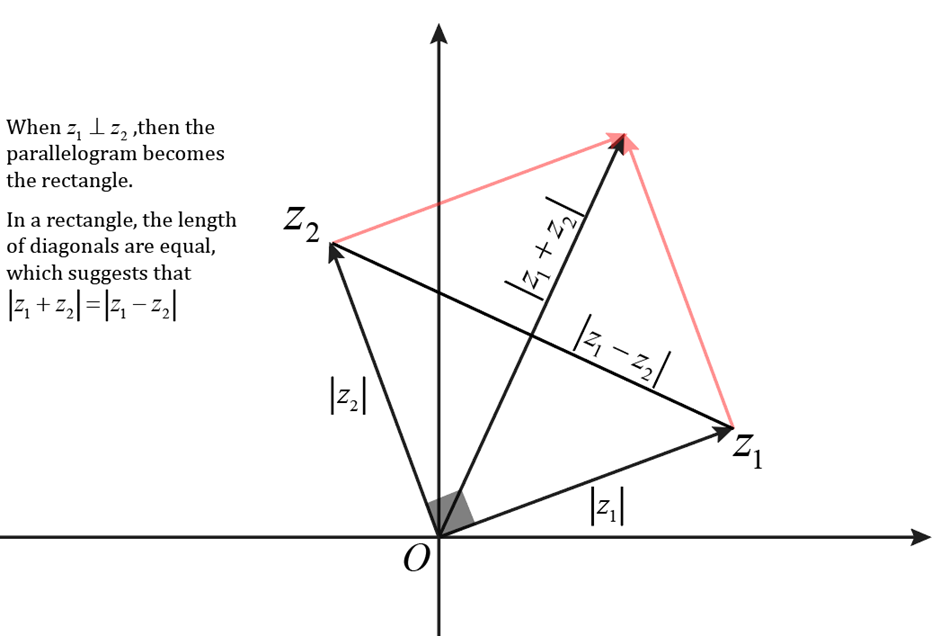
∣ z 1 + z 2 ∣ = ∣ z 1 − z 2 ∣ ⟹ O z 1 ⊥ O z 2 |z_1 + z_2| = |z_1 - z_2| \implies O_{z_1} \perp O_{z_2} ∣ z 1 + z 2 ∣ = ∣ z 1 − z 2 ∣ ⟹ O z 1 ⊥ O z 2 This relation can be deduced from the geometric representation.
The algebraic proof is even more important here.
Take the square of both sides,
∣ z 1 + z 2 ∣ 2 = ∣ z 1 − z 2 ∣ 2 |z_1 + z_2|^2 = |z_1 - z_2|^2 ∣ z 1 + z 2 ∣ 2 = ∣ z 1 − z 2 ∣ 2 This implies
( z 1 + z 2 ) ( z 1 ‾ + z 2 ‾ ) = ( z 1 − z 2 ) ( z 1 ‾ − z 2 ‾ ) [ Using z z = ∣ z ∣ 2 ] (z_1 + z_2)(\overline{z_1} + \overline{z_2}) = (z_1 - z_2)(\overline{z_1} - \overline{z_2}) \quad [\text{Using } zz = |z|^2 ] ( z 1 + z 2 ) ( z 1 + z 2 ) = ( z 1 − z 2 ) ( z 1 − z 2 ) [ Using z z = ∣ z ∣ 2 ] This expands to
z 1 z 1 ‾ + z 2 z 2 ‾ + z 1 z 2 ‾ + z 2 z 1 ‾ = z 1 z 1 ‾ + z 2 z 2 ‾ − z 1 z 2 ‾ − z 2 z 1 ‾ z_1\overline{z_1} + z_2\overline{z_2} + z_1\overline{z_2} + z_2\overline{z_1} = z_1\overline{z_1} + z_2\overline{z_2} - z_1\overline{z_2} - z_2\overline{z_1} z 1 z 1 + z 2 z 2 + z 1 z 2 + z 2 z 1 = z 1 z 1 + z 2 z 2 − z 1 z 2 − z 2 z 1 Simplifying,
∣ z 1 ∣ 2 + ∣ z 2 ∣ 2 + 2 z 1 z 2 ‾ + 2 z 2 z 1 ‾ = ∣ z 1 ∣ 2 + ∣ z 2 ∣ 2 − 2 z 1 z 2 ‾ − 2 z 2 z 1 ‾ |z_1|^2 + |z_2|^2 + 2z_1\overline{z_2} + 2z_2\overline{z_1} = |z_1|^2 + |z_2|^2 - 2z_1\overline{z_2} - 2z_2\overline{z_1} ∣ z 1 ∣ 2 + ∣ z 2 ∣ 2 + 2 z 1 z 2 + 2 z 2 z 1 = ∣ z 1 ∣ 2 + ∣ z 2 ∣ 2 − 2 z 1 z 2 − 2 z 2 z 1 Thus,
2 z 1 z 2 ‾ + 2 z 2 z 1 ‾ = 0 2z_1\overline{z_2} + 2z_2\overline{z_1} = 0 2 z 1 z 2 + 2 z 2 z 1 = 0 Which simplifies to
z 1 z 2 ‾ = − z 2 z 1 ‾ z_1\overline{z_2} = -z_2\overline{z_1} z 1 z 2 = − z 2 z 1 This can be rewritten as
z 1 z 2 = − z 1 ‾ z 2 ‾ \frac{z_1}{z_2} = -\frac{\overline{z_1}}{\overline{z_2}} z 2 z 1 = − z 2 z 1 Thus, we have
z 1 z 2 = − ( z 1 z 2 ) ‾ \frac{z_1}{z_2} = -\overline{\left( \frac{z_1}{z_2} \right)} z 2 z 1 = − ( z 2 z 1 ) Therefore,
z 1 z 2 is purely imaginary ⇒ angle between O z 1 and O z 2 is π 2 . \frac{z_1}{z_2} \text{ is purely imaginary} \quad \Rightarrow \text{ angle between } O_{z_1} \text{ and } O_{z_2} \text{ is } \frac{\pi}{2}. z 2 z 1 is purely imaginary ⇒ angle between O z 1 and O z 2 is 2 π . This concludes the algebraic proof showing that if the modulus of the sum is equal to the modulus of the difference of two complex numbers, the vectors representing these complex numbers in the complex plane are perpendicular to each other.
Given z 1 = a 1 + i b 1 z_1 = a_1 + ib_1 z 1 = a 1 + i b 1 z 2 = a 2 + i b 2 z_2 = a_2 + ib_2 z 2 = a 2 + i b 2 z 1 z 2 \frac{z_1}{z_2} z 2 z 1
The division of z 1 z_1 z 1 z 2 z_2 z 2
z 1 z 2 = a 1 + i b 1 a 2 + i b 2 \frac{z_1}{z_2} = \frac{a_1 + ib_1}{a_2 + ib_2} z 2 z 1 = a 2 + i b 2 a 1 + i b 1 Multiplying numerator and denominator by the conjugate of the denominator to make the denominator real:
z 1 z 2 = ( a 1 + i b 1 ) ( a 2 − i b 2 ) a 2 2 + b 2 2 \frac{z_1}{z_2} = \frac{(a_1 + ib_1)(a_2 - ib_2)}{a_2^2 + b_2^2} z 2 z 1 = a 2 2 + b 2 2 ( a 1 + i b 1 ) ( a 2 − i b 2 ) z 1 z 2 = a 1 a 2 + b 1 b 2 a 2 2 + b 2 2 + i a 2 b 1 − a 1 b 2 a 2 2 + b 2 2 \frac{z_1}{z_2} = \frac{a_1a_2 + b_1b_2}{a_2^2 + b_2^2} + i\frac{a_2b_1 - a_1b_2}{a_2^2 + b_2^2} z 2 z 1 = a 2 2 + b 2 2 a 1 a 2 + b 1 b 2 + i a 2 2 + b 2 2 a 2 b 1 − a 1 b 2 For z 1 z 2 \frac{z_1}{z_2} z 2 z 1
a 1 a 2 + b 1 b 2 a 2 2 + b 2 2 = 0 \frac{a_1a_2 + b_1b_2}{a_2^2 + b_2^2} = 0 a 2 2 + b 2 2 a 1 a 2 + b 1 b 2 = 0 a 1 a 2 + b 1 b 2 = 0 a_1a_2 + b_1b_2 = 0 a 1 a 2 + b 1 b 2 = 0 Now, we interpret a 1 , b 1 a_1, b_1 a 1 , b 1 a 2 , b 2 a_2, b_2 a 2 , b 2 z 1 z_1 z 1 z 2 z_2 z 2 O z 1 O_{z_1} O z 1 O z 2 O_{z_2} O z 2 O z 1 O_{z_1} O z 1 O z 2 O_{z_2} O z 2
Alternatively, the equation a 1 a 2 + b 1 b 2 = 0 a_1a_2 + b_1b_2 = 0 a 1 a 2 + b 1 b 2 = 0 O z 1 O_{z_1} O z 1 O z 2 O_{z_2} O z 2
b 1 a 1 . b 2 a 2 = − 1 \frac{b_1}{a_1}.\frac{b_2}{a_2} =-1 a 1 b 1 . a 2 b 2 = − 1 Thus, the product of slopes of the lines from the origin to z 1 z_1 z 1 z 2 z_2 z 2 − 1 -1 − 1
Therefore, O z 1 O_{z_1} O z 1 O z 2 O_{z_2} O z 2 90 ∘ 90^\circ 9 0 ∘ π 2 \frac{\pi}{2} 2 π
If you do not know the concept of slopes of straightn lines, you can totally ignore this proof for a while. A more straightforward proof will soon follow.
∣ z 1 + z 2 ∣ 2 = ∣ z 1 ∣ 2 + ∣ z 2 ∣ 2 ⇒ O z 1 ⊥ O z 2 |z_1 + z_2|^2 = |z_1|^2 + |z_2|^2 \Rightarrow O_{z_1} \perp O_{z_2} ∣ z 1 + z 2 ∣ 2 = ∣ z 1 ∣ 2 + ∣ z 2 ∣ 2 ⇒ O z 1 ⊥ O z 2
In the complex plane, ∣ z 1 + z 2 ∣ |z_1 + z_2| ∣ z 1 + z 2 ∣ ∣ z 1 − z 2 ∣ |z_1 - z_2| ∣ z 1 − z 2 ∣ z 1 z_1 z 1 z 2 z_2 z 2
From the parallelogram law, if z 1 z_1 z 1 z 2 z_2 z 2
∣ z 1 + z 2 ∣ = ∣ z 1 − z 2 ∣ |z_1 + z_2| = |z_1 - z_2| ∣ z 1 + z 2 ∣ = ∣ z 1 − z 2 ∣ Now, if we apply the Pythagorean theorem to the right-angled triangle formed by z 1 z_1 z 1 z 2 z_2 z 2 z 1 + z 2 z_1 + z_2 z 1 + z 2 z 1 − z 2 z_1 - z_2 z 1 − z 2
∣ z 1 ∣ 2 + ∣ z 2 ∣ 2 = ∣ z 1 + z 2 ∣ 2 |z_1|^2 + |z_2|^2 = |z_1 + z_2|^2 ∣ z 1 ∣ 2 + ∣ z 2 ∣ 2 = ∣ z 1 + z 2 ∣ 2 This is only true if z 1 z_1 z 1 z 2 z_2 z 2 z 1 z_1 z 1 z 2 z_2 z 2
Therefore, by observing the given figure and using the properties of a parallelogram and the Pythagorean theorem, we can conclude that O z 1 O_{z_1} O z 1 O z 2 O_{z_2} O z 2
Given a a a b b b z 1 z_1 z 1 z 2 z_2 z 2
∣ a z 1 + b z 2 ∣ 2 + ∣ b z 1 − a z 2 ∣ 2 = ( a 2 + b 2 ) ( ∣ z 1 ∣ 2 + ∣ z 2 ∣ 2 ) |az_1 + bz_2|^2 + |bz_1 - az_2|^2 = (a^2 + b^2)(|z_1|^2 + |z_2|^2) ∣ a z 1 + b z 2 ∣ 2 + ∣ b z 1 − a z 2 ∣ 2 = ( a 2 + b 2 ) ( ∣ z 1 ∣ 2 + ∣ z 2 ∣ 2 ) We expand the left-hand side (LHS) using ∣ z ∣ 2 = z z ∗ |z|^2 = zz^* ∣ z ∣ 2 = z z ∗ z ∗ z^* z ∗ z z z
For the first term ∣ a z 1 + b z 2 ∣ 2 |az_1 + bz_2|^2 ∣ a z 1 + b z 2 ∣ 2
∣ a z 1 + b z 2 ∣ 2 = ( a z 1 + b z 2 ) ( a z 1 ‾ + b z 2 ‾ ) |az_1 + bz_2|^2 = (az_1 + bz_2)(a\overline{z_1} + b\overline{z_2}) ∣ a z 1 + b z 2 ∣ 2 = ( a z 1 + b z 2 ) ( a z 1 + b z 2 ) = a 2 z 1 z 1 ‾ + a b z 1 z 2 ‾ + a b z 2 z 1 ‾ + b 2 z 2 z 2 ‾ = a^2z_1\overline{z_1} + abz_1\overline{z_2} + abz_2\overline{z_1} + b^2z_2\overline{z_2} = a 2 z 1 z 1 + ab z 1 z 2 + ab z 2 z 1 + b 2 z 2 z 2 = a 2 ∣ z 1 ∣ 2 + a b ( z 1 z 2 ‾ + z 2 z 1 ‾ ) + b 2 ∣ z 2 ∣ 2 = a^2|z_1|^2 + ab(z_1\overline{z_2} + z_2\overline{z_1}) + b^2|z_2|^2 = a 2 ∣ z 1 ∣ 2 + ab ( z 1 z 2 + z 2 z 1 ) + b 2 ∣ z 2 ∣ 2 For the second term ∣ b z 1 − a z 2 ∣ 2 |bz_1 - az_2|^2 ∣ b z 1 − a z 2 ∣ 2
∣ b z 1 − a z 2 ∣ 2 = ( b z 1 − a z 2 ) ( b z 1 ‾ − a z 2 ‾ ) |bz_1 - az_2|^2 = (bz_1 - az_2)(b\overline{z_1} - a\overline{z_2}) ∣ b z 1 − a z 2 ∣ 2 = ( b z 1 − a z 2 ) ( b z 1 − a z 2 ) = b 2 z 1 z 1 ‾ − a b z 1 z 2 ‾ − a b z 2 z 1 ‾ + a 2 z 2 z 2 ‾ = b^2z_1\overline{z_1} - abz_1\overline{z_2} - abz_2\overline{z_1} + a^2z_2\overline{z_2} = b 2 z 1 z 1 − ab z 1 z 2 − ab z 2 z 1 + a 2 z 2 z 2 = b 2 ∣ z 1 ∣ 2 − a b ( z 1 z 2 ‾ + z 2 z 1 ‾ ) + a 2 ∣ z 2 ∣ 2 = b^2|z_1|^2 - ab(z_1\overline{z_2} + z_2\overline{z_1}) + a^2|z_2|^2 = b 2 ∣ z 1 ∣ 2 − ab ( z 1 z 2 + z 2 z 1 ) + a 2 ∣ z 2 ∣ 2 Adding the two expansions together, the mixed terms a b ( z 1 z 2 ‾ + z 2 z 1 ‾ ) ab(z_1\overline{z_2} + z_2\overline{z_1}) ab ( z 1 z 2 + z 2 z 1 )
a 2 ∣ z 1 ∣ 2 + b 2 ∣ z 2 ∣ 2 + b 2 ∣ z 1 ∣ 2 + a 2 ∣ z 2 ∣ 2 a^2|z_1|^2 + b^2|z_2|^2 + b^2|z_1|^2 + a^2|z_2|^2 a 2 ∣ z 1 ∣ 2 + b 2 ∣ z 2 ∣ 2 + b 2 ∣ z 1 ∣ 2 + a 2 ∣ z 2 ∣ 2 = a 2 ( ∣ z 1 ∣ 2 + ∣ z 2 ∣ 2 ) + b 2 ( ∣ z 1 ∣ 2 + ∣ z 2 ∣ 2 ) = a^2(|z_1|^2 + |z_2|^2) + b^2(|z_1|^2 + |z_2|^2) = a 2 ( ∣ z 1 ∣ 2 + ∣ z 2 ∣ 2 ) + b 2 ( ∣ z 1 ∣ 2 + ∣ z 2 ∣ 2 ) = ( a 2 + b 2 ) ( ∣ z 1 ∣ 2 + ∣ z 2 ∣ 2 ) = (a^2 + b^2)(|z_1|^2 + |z_2|^2) = ( a 2 + b 2 ) ( ∣ z 1 ∣ 2 + ∣ z 2 ∣ 2 ) This completes the proof that the original identity holds true.
When a = 1 a = 1 a = 1 b = 1 b = 1 b = 1
∣ z 1 + z 2 ∣ 2 + ∣ z 1 − z 2 ∣ 2 = ( 1 2 + 1 2 ) ( ∣ z 1 ∣ 2 + ∣ z 2 ∣ 2 ) |z_1 + z_2|^2 + |z_1 - z_2|^2 = (1^2 + 1^2)(|z_1|^2 + |z_2|^2) ∣ z 1 + z 2 ∣ 2 + ∣ z 1 − z 2 ∣ 2 = ( 1 2 + 1 2 ) ( ∣ z 1 ∣ 2 + ∣ z 2 ∣ 2 ) Simplifying further gives us:
∣ z 1 + z 2 ∣ 2 + ∣ z 1 − z 2 ∣ 2 = 2 ( ∣ z 1 ∣ 2 + ∣ z 2 ∣ 2 ) |z_1 + z_2|^2 + |z_1 - z_2|^2 = 2(|z_1|^2 + |z_2|^2) ∣ z 1 + z 2 ∣ 2 + ∣ z 1 − z 2 ∣ 2 = 2 ( ∣ z 1 ∣ 2 + ∣ z 2 ∣ 2 ) This is an instance of the parallelogram law in complex numbers, which states that the sum of the squares of the lengths of the diagonals of a parallelogram is equal to the sum of the squares of the lengths of all sides.