In this section you are going to learn about geometrical representation of a complex number. You will learn about modulus and argument of a complex number and how to evaluate them in detail for any complex number. There is a small section on conjugate of a complex number in the end. We will discuss the properties of modulus, argument and conjugate later. But knowing them now only will give us a clear picture of what a complex number is.
The Argand plane, also known as the complex plane, is a way to visualize complex numbers just as we visualize real numbers on the number line. The real number line is a one-dimensional line where every point corresponds to a real number, with positive numbers lying to the right of the origin and negative numbers to the left. The real number line is sufficient for representing all real numbers, but it cannot represent complex numbers that have both a real and an imaginary component. A real line has one dimension. For a complex number because two components we need two dimensions. Here is how we do it:
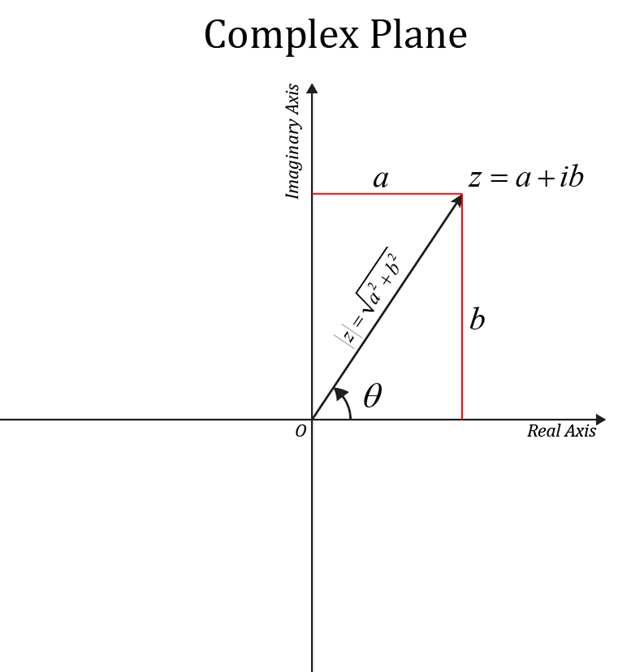
The geometrical representation of complex numbers is elegantly depicted on the Argand plane, also known as the complex plane. This plane is a Cartesian coordinate system where a complex number z=a+ib is represented as an ordered pair (a,b). Here, each point on the complex plane corresponds uniquely to a complex number in the set C, establishing a one-to-one correspondence between the set of complex numbers and points on the plane.
The distance of the complex number z=a+ib from the origin 0+i0 is termed the modulus or magnitude of the complex number, denoted as ∣z∣, and is computed as a2+b2.
The angle θ, formed by the line connecting the complex number to the origin with the positive x-axis, is known as the argument or amplitude of the complex number. It is symbolized by arg(z) or sometimes amp(z).
Through this representation, complex numbers gain a spatial interpretation, allowing for a deeper understanding of their properties and interactions.
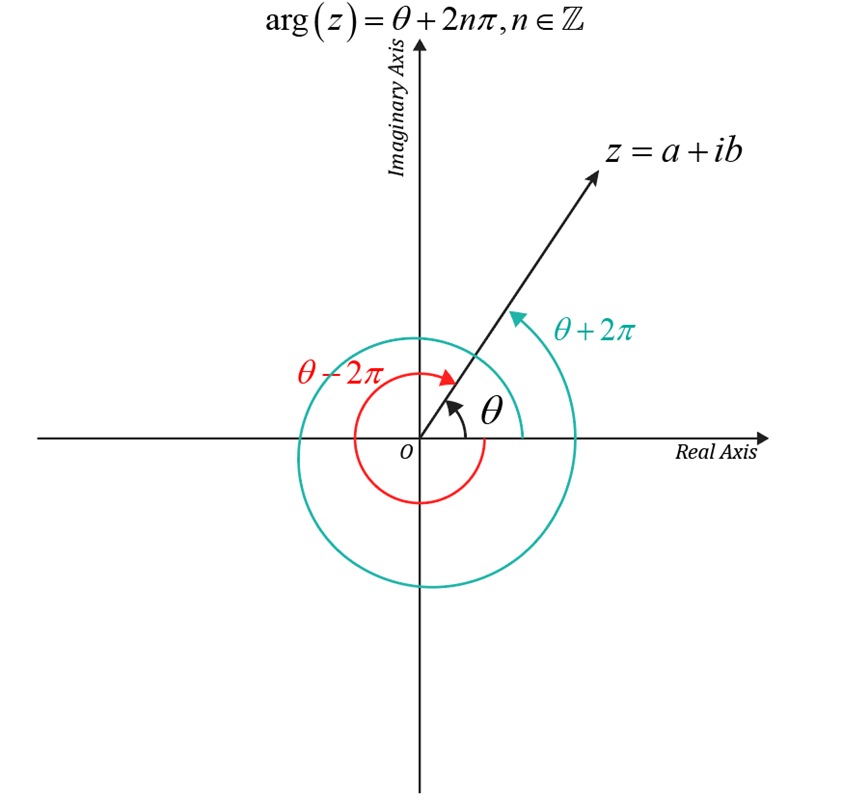
Argument of a complex number is not unique. If θ is the argument of the complex number so can be θ+2π or θ−2π or θ+4π and so on. In general the argument of a complex number is θ+2nπ where θ is any one of the argument.
To make the argument unique we define principal argument.
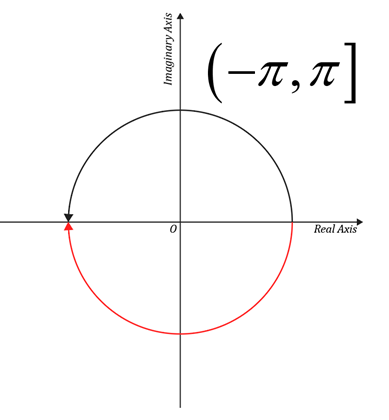
Principal Argument of a complex number is that argument of the complex number which lies in the interval (−π,π]. Exactly one such argument out of infinite arguments lie in this interval. (−π,π] denotes one complete revolution around the circle with centre at origin. An argument lying in (−π,π] also has the smallest magnitude.
Suppose a complex number has the general argument 2nπ+34π, n∈Z.
For n=0, we get 34π
For n=1, we get 310π
For n=−1 we get −32π
For n=−2 we get −38π
Thus we can see clearly that only one argument which is −32π lies in the interval (−π,π] and we call it the principal argument.
How to calculate the argument of a complex number?§
Consider the following examples:
Given a complex number z=x+iy
Case I)z lies on axes
x=0 and y=0.
The complex number lies at origin.
In this case the argument is not defined.
x>0 and y=0
The complex number lies on the positive real axis and thus the argument is 2nπ,n∈Z
The principal argument is 0
x<0 and y=0
The complex number lies on the negative real axis and thus the argument is (2n+1)π,n∈Z
The principal argument is π.
x=0 and y>0
The complex number lies on the positive imaginary axis and thus the argument is
2nπ+2π,n∈Z
The principal argument is 2π
x=0 and y<0
The complex number lies on the negative imaginary axis and thus the argument is
2nπ−2π,n∈Z
The principal argument is −2π
Case II)For complex numbers not lying on axes:
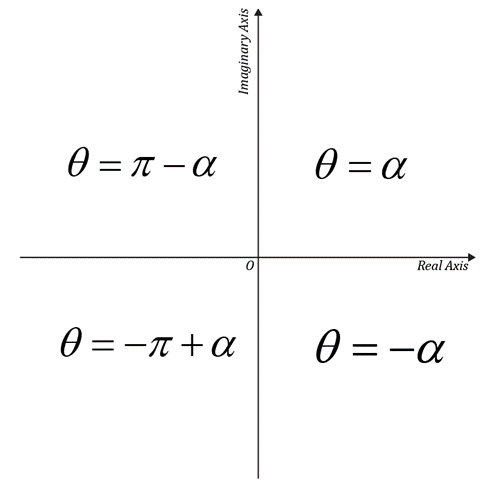
Calculate α=tan−1(xy)
Decide the quadrant in which the complex number lies.
Use the following figure to evaluate principal argument θ.
The conjugate of a complex number is obtained by changing the sign of the imaginary part of the complex number. If a complex number is represented as z=x+iy, then its conjugate, denoted as zˉ, is given by zˉ=x−iy. The process of taking a conjugate involves putting a bar over the complex number and then switching the sign of the imaginary component.
For example, if the complex number is 2−3i, its conjugate would be 2+3i. The sum and product of a complex number and its conjugate are always real numbers. The equation provided for this is (x+iy)(x−iy)=x2+y2 and x+iy+x−iy=2x.
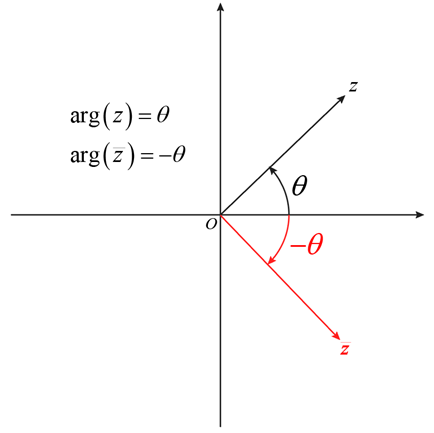
Geometrically, the conjugate of a complex number z is the reflection of z in the real axis. Therefore, the argument of the conjugate of z, denoted as arg(zˉ), is the negative of the argument of z, which can be written as arg(zˉ)=−arg(z).
For a quadratic equation ax2+bx+c=0 with real coefficients a, b, and c and a discriminant Δ=b2−4ac<0, the roots of the equation are complex and are conjugates of each other.
Proof:
Let the quadratic equation be given by ax2+bx+c=0, where a,b,c∈R and a=0.
Consider the discriminant Δ=b2−4ac. For complex roots, we have Δ<0.
The quadratic formula for finding the roots of ax2+bx+c=0 is:
x=2a−b±Δ
Since Δ<0, we cannot take the square root of a negative number in the real number system. Therefore, we introduce the imaginary unit i where i2=−1. This allows us to write Δ as i−Δ since Δ is negative.
Substituting i−Δ for Δ in the quadratic formula, we get:
x=2a−b±i−Δ
Hence, the roots of the quadratic equation are:
x1=2a−b+2ai−Δx2=2a−b−2ai−Δ
Notice that x1 and x2 are of the form p+qi and p−qi respectively, where p=−2ab and q=2a−Δ.
Therefore, x1 and x2 are complex conjugates of each other, as they have the same real part p and imaginary parts that are negatives of each other ±q.
Thus, for any quadratic equation with real coefficients and a negative discriminant, the roots will always be complex conjugates of the form 2a−b±2ai−Δ.
QED
Section 2 of 7 · Complex Numbers Basics
Mark this section complete when you have worked through its proofs.
Type any topic, theorem, or concept to jump directly to the section.