
Fundamental Operations on Complex Numbers
Introduction§
 In mathematics, when a new mathematical object is introduced, defining operations on it is crucial to understanding its properties and how it interacts with other objects. This is evident in the creation and exploration of complex numbers, which extend the operations defined for real numbers.
Complex numbers expand the operations on real numbers to include an imaginary unit, , where . This addition allows for a richer set of operations that are not possible within the real numbers alone. The operations on complex numbers, like addition, subtraction, multiplication, and division, are consistent with those on real numbers but are extended to accommodate the interaction between the real and imaginary parts.
You have seen many mathematical objects before and operations defined on them.
-
Real Numbers Operations: The operations on real numbers are closed, commutative, associative, and have elements of identity and inverses. They are defined for addition, subtraction, multiplication, and division (except division by zero).
-
Sets Operations: Operations on sets, such as union, intersection, and complement, follow different rules and laws, like commutativity, associativity, and distributivity, which dictate how sets combine and relate to each other.
-
Vector Operations: Operations on vectors include addition, scalar multiplication, dot product, and cross product. These operations are defined in the context of a vector space and have their own set of rules, such as the commutative and associative properties for vector addition and the distributive property for scalar multiplication.
Complex numbers, while they include an element (the imaginary unit) that vectors and sets do not, still maintain a structure with operations that resemble those of real numbers in many ways, albeit extended into two dimensions. This system of operations allows complex numbers to form a field, similar to real numbers, which supports a broad range of mathematical exploration and application.
Ordering Relations§
Equality§
Equality of complex numbers is defined based on the equality of their real and imaginary components. Two complex numbers are considered equal if, and only if, their corresponding real parts are equal and their corresponding imaginary parts are equal.
If we have two complex numbers, and , where and are real numbers, and is the imaginary unit (), then and are equal if:
In other words, if and only if and .
Inequalities§
In the real number line, which is a single-dimensional line, we can easily compare numbers using symbols like and . For instance, if we have two real numbers, and , we can say because on the real number line, is to the left of .
However, when we step into the realm of complex numbers and their representation on the Argand plane, this kind of simple comparison doesn't work anymore. The Argand plane is a two-dimensional space where the horizontal axis represents the real part of complex numbers and the vertical axis represents the imaginary part. So, a complex number is represented as a point on this plane, with its position determined by both its real and imaginary components.
For example, consider two complex numbers and . On the Argand plane, these numbers are points in different positions, one not simply "greater" or "less" than the other in the way real numbers are on the real line. One might be further to the right (indicating a larger real part) or higher up (indicating a larger imaginary part), but these differences don't translate into a straightforward or comparison as they do on the real line.
Therefore, in the context of the Argand plane and complex numbers, we don't use or to compare numbers. Instead, we can talk about their magnitude (distance from the origin) or their angle with the real axis, but there's no direct way to say one complex number is greater or less than another like we can with numbers on the real line.
Operations on Complex Numbers§
Addition of Complex Numbers:§
Let and , where and are real numbers and is the imaginary unit. The sum of and is a complex number found by adding the real parts and the imaginary parts separately:
For example:
Let and .
To add and , we combine their real parts and their imaginary parts separately:
So, the sum of and is .
Properties of addition for complex numbers are as follows:
-
Closure Property: The sum of two complex numbers is a complex number, meaning if and are in the set of complex numbers , then is also in .
-
Commutative Property: The addition of complex numbers is commutative, which means that the order of addition does not affect the sum:
-
Associative Property: The addition of complex numbers is associative, indicating that when three complex numbers are added, the sum is the same regardless of how the numbers are grouped:
-
Additive Identity: The complex number , or simply , serves as the additive identity in the set of complex numbers, meaning adding zero to any complex number will yield :
-
Additive Inverse: Every complex number has an additive inverse , such that their sum is the additive identity :
Subtraction of Complex Numbers:§
Let and , then we define subtraction as
i.e., subtraction of from is equivalent to the addition of the additive inverse of to .
For example:
Let and .
To subtract from , we first find the additive inverse of , which is . Then, we add this additive inverse to :
So, the result of the subtraction is .
Visualizing Addition and Subtraction of Complex Numbers§
Addition
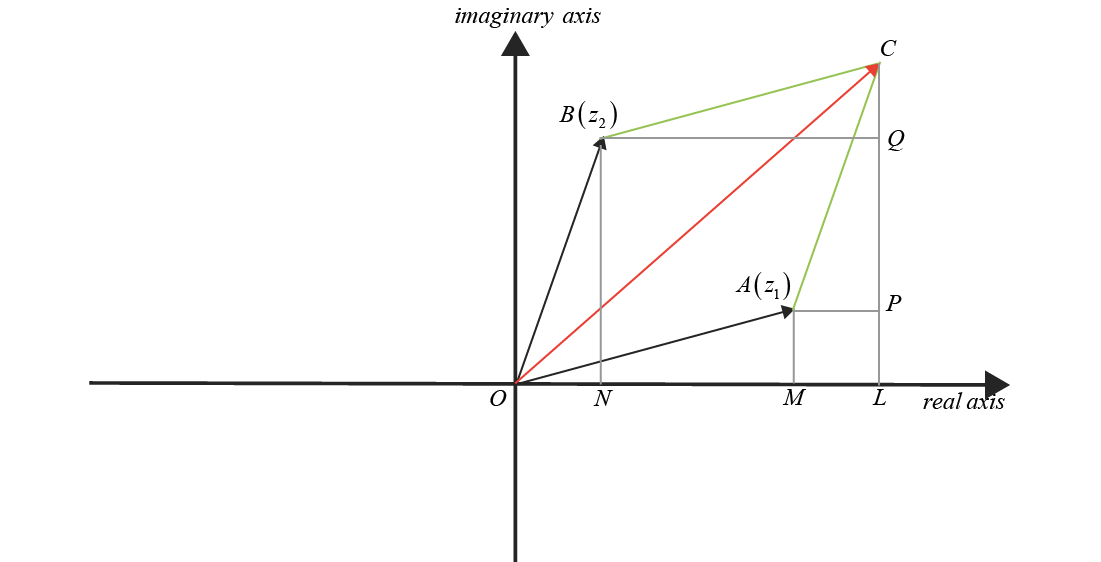
The addition of complex numbers can be represented geometrically using the Argand plane. Each complex number corresponds to a point on this plane, and their addition results in a new point that corresponds to the sum. If we have two complex numbers, and , with represented by point and by point , the addition is illustrated by plotting these points and completing a parallelogram with the origin. The point , which is the opposite vertex of the parallelogram from the origin, represents the sum .
-
The point represents the complex number . This is shown in the diagram where is the real component and is the imaginary component of .
-
Similarly, point represents the complex number , with as the real part and as the imaginary part.
-
Observe that triangle is congruent to triangle . They are congruent because they have the same side lengths ( and ) and their corresponding angles are equal (each pair of angles are vertical angles formed by intersecting lines, which are congruent).
-
Triangle is congruent to triangle . These triangles are congruent for similar reasons: corresponding sides are equal (, ), and corresponding angles are equal.
Due to these congruencies, the horizontal and vertical components of the diagonals can be summed:
-
(the total real part of ) is equal to which is the same as because is equal to . Therefore, .
-
(the total imaginary part of ) is equal to which is equal to since and . Hence, .
The coordinates of point are therefore , which means that point represents the complex number . Point is the endpoint of the diagonal of parallelogram , which geometrically represents the sum of the complex numbers and .
Subtraction§
To achieve this geometrically, we first draw which is equal in length to but in the opposite direction. represents . And now we complete the parallelogram , where the point represents .
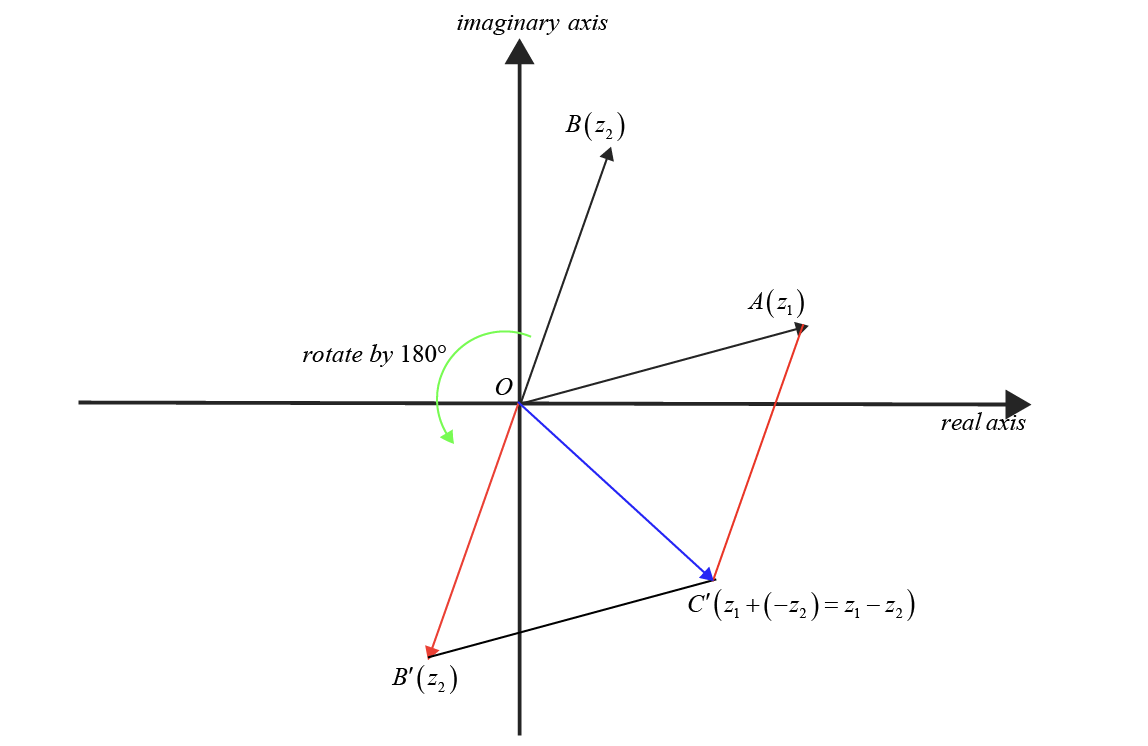
Similarly, we plot . Clearly, is the additive inverse of , and thus has the opposite direction of .
The above figure illustrates the geometric representation of addition and subtraction of complex numbers on the Argand plane.
- Parallelogram demonstrates the addition of and . Point represents , and point represents . The diagonal represents the sum .
- The parallelogram shows the subtraction of from , where represents and represents . The diagonal represents the difference .
- The parallelogram represents the subtraction of from , with diagonal representing .
Multiplication of Complex Numbers§
When multiplying two complex numbers and , we follow the distributive and commutative laws of algebra, similar to multiplying real numbers, while treating as a coefficient that also follows the special property .
The multiplication process is as follows:
\begin{align} (x_1 + iy_1)(x_2 + iy_2) &= x_1x_2 + x_1(iy_2) + (iy_1)x_2 + (iy_1)(iy_2)\ &= x_1x_2 + ix_1y_2 + ix_2y_1 + i^2y_1y_2 \ &= x_1x_2 + i(x_1y_2 + x_2y_1) + (-1)y_1y_2 \quad(since, i^2 = -1)\ &= (x_1x_2 - y_1y_2) + i(x_1y_2 + x_2y_1) \end{align}
This multiplication produces another complex number where is the real part and is the imaginary part.
Further observations include:
-
where
-
Properties of Multiplication
-
Closure: The product of any two complex numbers is always another complex number. This ensures that complex numbers are closed under multiplication within the set of complex numbers.
-
Commutativity: For two complex numbers and , the product is the same regardless of the order in which they are multiplied, i.e., .
-
Associativity: Multiplication of complex numbers is associative, meaning that when multiplying three complex numbers together, the product is the same no matter how the numbers are grouped. If , , and are complex numbers, then .
-
Existence of Multiplicative Identity: For every complex number , there exists a multiplicative identity which is (or ) such that . Thus, (or ) is the multiplicative identity in the set of complex numbers.
-
Multiplicative Inverse: Every complex number that isn’t zero has a multiplicative inverse, called , and it’s a number that, when multiplied by , gives 1. If , then the inverse would be some .
To find this , you multiply by and set it to equal 1:
This equation expands to:
For the equation to hold true, the real parts must add up to 1 and the imaginary parts must cancel out:
and
Solving these gives you and . Therefore, the inverse of is:
And another way to write this is:
This is how you find the multiplicative inverse of a complex number—it’s just a matter of switching the sign of the imaginary part and dividing by the sum of the squares of both parts.
-
Distributive: The multiplication of complex numbers is distributive over addition.
For all ,
Division of complex numbers§
Let and . Then the division of complex number by , i.e., , is a complex number such that , i.e.it is a product of with multiplicative inverse of .
Thus, to obtain the quotient , we multiply the numerator and denominator of the fraction with the conjugate of .
In this way, by multiplying by the conjugate, we rationalize the denominator, transforming the division of complex numbers into an easier addition of two complex numbers in standard form, where the real and imaginary parts are separated.
Powers of iota§
The imaginary unit is defined such that . Using this definition, the powers of can be determined:
- : This is the definition of the imaginary unit.
- : Here, we multiply by to get .
- : Squaring results in 1 because the square of -1 is 1.
Thus, in general, where is an integer, and where .
Here’s what the general formula means:
- is an integer representing the exponent to which is raised.
- is the quotient when is divided by 4. It represents how many full cycles of 4 (the period of the powers of ) there are in .
- is the remainder when is divided by 4. It determines the actual power of since , and therefore for any integer , the value of ultimately depends only on .
This leads to the simplified form , where can only be 0, 1, 2, or 3.
For example, .
- is divided by 4 giving and .
- We only need to consider the remainder because regardless of .
- Since , we use the base power .
Sum of four integral powers of iota is equal to zero, i.e., .
This statement asserts that the sum of any four consecutive powers of is zero. It’s valid because the powers of are cyclical with a period of 4:
And since , the sequence repeats. Thus, the sum of these four quantities is .
Mark this section complete when you have worked through its proofs.