
Permutations with Repetition and Multisets
In Sections 03 and 05, every object was distinct from every other object. In real counting problems, however, identical copies of objects often appear—such as repeated letters in a word, identical coins in a pocket, or digits reused in an access code.
When some objects are indistinguishable, swapping two identical objects does not create a new arrangement, so the total number of distinct permutations shrinks. In this section we study three regimes of permutations with repetition:
- Full permutations when each object repeats a fixed number of times (multisets).
- Partial (-) permutations of a finite multiset.
- Permutations when repetition is allowed any number of times (unlimited supply).
Permutations of a Multiset (Fixed Multiplicities)§
Start with a small example: how many distinct permutations of the letters exist?
Listing all possibilities gives only three arrangements:
If all three letters had been distinct (), there would have been permutations. Because the two 's are identical, interchanging them produces no new word, cutting the count in half.
Now consider a larger word: MISSISSIPPI. It has letters, with several repetitions. To record both the distinct types of objects and how many times each occurs, we write a multiset:
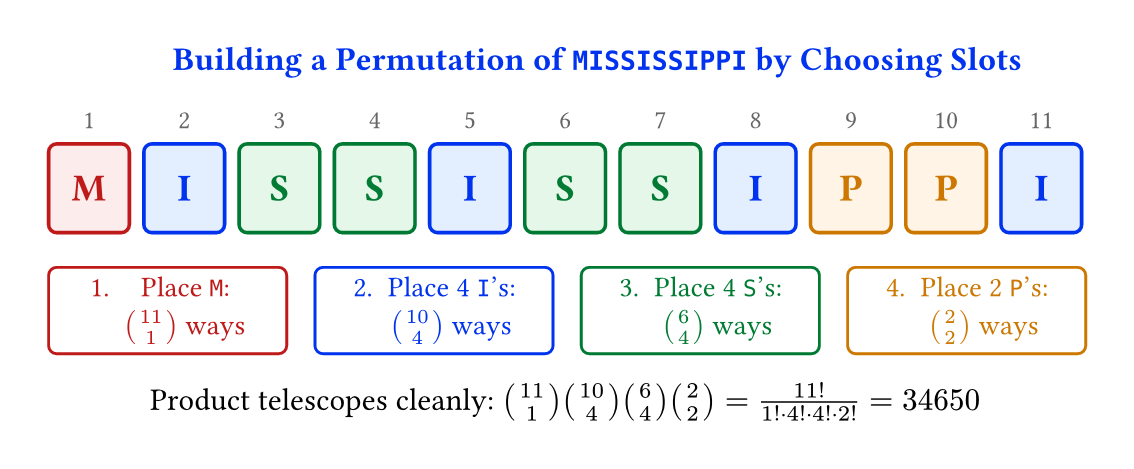
To count all distinct -letter arrangements of MISSISSIPPI, picture distinct numbered slots in a row and place one letter type at a time:
- Place the
M: Choose of the slots in ways. Now slots remain. - Place the identical
I's: Choose of the remaining slots in ways. Notice that we use combinations (not permutations) because all fourI's are identical—rearranging them among their chosen slots produces the exact same word. Now slots remain. - Place the identical
S's: Choose of the remaining slots in ways. Now slots remain. - Place the identical
P's: Fill the final slots in way.
By the Multiplication Principle, the intermediate factorials cancel cleanly:
The General Multiset Permutation Theorem§
Theorem (Multiset Permutations): Let be a multiset containing distinct types of objects repeated times respectively, and let be the total number of objects. The total number of distinct linear permutations of all objects is:
Proof 1 (Sequential Slot Selection): Choose of the slots for the copies of in ways, then of the remaining slots for in ways, and continue until the last copies of fill the remaining slots in ways. Multiplying and canceling consecutive factorials gives:
Proof 2 (Via the Division Principle): Temporarily attach distinct subscript labels to identical objects so all objects become distinguishable. These labeled objects permute in ways. Removing the temporary labels groups every distinct multiset permutation into an equivalence class of equal size (the number of ways to permute identical copies among themselves). By the Division Principle, dividing by yields the exact count.
Example 1 (Bundle Method with Identical Objects): In how many ways can the letters of ASSASSINATION be arranged so that all the S's stay together?
Solution: The word has letters: .
Tie all S's into a single block [SSSS]. Because all four S's are identical, there is only internal arrangement inside the block (not ). We now permute objects with multiplicities A's, I's, N's, T, O, and [SSSS]:
Example 2 (Gap Method with Identical Objects): Find the number of arrangements of MISSISSIPPI in which no two I's are adjacent.
Solution: First arrange the non-I letters (M, S's, P's):
These letters create gaps (including both outer ends). We must place the I's into of these gaps. Be careful: because all I's are identical, we choose gaps using —not !
Example 3 (Fixed Relative Order): In how many ways can the letters of MATHEMATICS be arranged such that the vowels (A, E, A, I) always appear in alphabetical order (A, A, E, I) from left to right (not necessarily adjacent)?
Solution: MATHEMATICS has letters: .
Here is a slick trick using the multiset formula: temporarily treat all vowels (A, A, E, I) as identical blank tokens □, □, □, □! Arrange the symbols ( □'s, M's, T's, H, C, S) in:
In every such arrangement, there is only way to replace the four □ slots from left to right with A, A, E, I in alphabetical order! Hence the answer is .
Dictionary Rank of a Word with Repeated Letters§
In Section 03, we computed the dictionary rank of words whose letters are all distinct. Now that we have the Multiset Permutation Formula, we can extend that exact prefix-by-prefix algorithm to words with repeated letters.
At each position from left to right, count how many words start with a smaller unused letter at position . Whenever a remaining suffix has repeated letters with multiplicities , the number of distinct suffix permutations is . Equivalently, you may count all unused letters strictly before the -th letter (with multiplicity) and divide by the factorials of the multiplicities of all remaining letters (including the current letter itself).
Example 4 (Repeated Letters — SMALL): Find the dictionary rank of the word SMALL.
Solution: Sort the letters alphabetically: A, L, L, M, S.
- Position 1 (
S): Remaining multiset is{A, L, L, M, S}(Lrepeated twice). There are letters strictly beforeS(A, L, L, M), giving preceding words. (Check directly: starting withAgives ; starting withLgives ; starting withMgives ; and .) LockS. - Position 2 (
M): Remaining{A, L, L, M}(Lrepeated twice). Three letters precedeM(A, L, L), giving words. LockM. - Position 3 (
A): Remaining{A, L, L}; letters precedeA. LockA. - Position 4 (
L): Remaining{L, L}; letters precedeL. LockL. - Position 5 (
L): .
Adding for SMALL itself:
Example 5 (Multiple Repeated Letters — BANANA): Find the dictionary rank of the word BANANA.
Solution: Sort the letters alphabetically: A, A, A, B, N, N.
- Position 1 (
B): Remaining{A, A, A, B, N, N}(A's,N's). OnlyAprecedesB( copies), giving words (starting withA, the remaining{A, A, B, N, N}permute in ways). LockB. - Position 2 (
A): Remaining{A, A, A, N, N}; letters precedeA. LockA. - Position 3 (
N): Remaining{A, A, N, N}(A's,N's). TwoA's precedeN, giving words. LockN. - Position 4 (
A): Remaining{A, A, N}; letters precedeA. LockA. - Position 5 (
N): Remaining{A, N}. OneAprecedesN, giving word (BANANAis preceded byBANAAN). LockN. - Position 6 (
A): .
Adding for BANANA itself:
Partial Permutations of Non-Distinct Objects§
What if we do not use all letters of a multiset, and instead ask for the number of -permutations (say, -letter words) formed from a multiset like MISSISSIPPI?
Here there is no single elementary closed-form formula, because different letters have different supply limits. (In a later chapter, Exponential Generating Functions provide a general algebraic engine for this problem.) With our current tools, the clean, rigorous method is to partition all -letter words into mutually exclusive, exhaustive cases based on how many distinct letters appear and how often they repeat, then add the cases.
Example 6 (Four-Letter Words from MISSISSIPPI): How many distinct -letter words can be formed using the letters of MISSISSIPPI?
Solution: Our available multiset is ( distinct letter types). Partition all -letter words by the number of distinct letters they contain:
Case I (All letters distinct — pattern ): There are only distinct letter types in total (M, I, S, P), so we must use one of each. They permute in:
Case II (Exactly distinct letters — pattern ): One letter must appear twice, and two other letters once each.
- Only
I,S, andPhave at least copies, so choose the repeating letter in ways. - Choose other distinct letters from the remaining letter types in ways.
- Arrange the selected letters (one repeated twice) in ways.
Total words in Case II:
Case III (Exactly distinct letters): Two letters forming a -letter word can repeat in two disjoint ways—either both appear twice (), or one appears three times and the other once ().
- Subcase IIIa (Pattern ):
Mcannot be used (only copy available). Choose letter types from{I, S, P}in ways, and arrange them in ways:
- Subcase IIIb (Pattern ): Only
IandShave at least copies. Choose the triply repeated letter in ways, choose other distinct letter from the remaining types in ways, and arrange in ways:
Total words in Case III .
Case IV (Only distinct letter — pattern ): The single letter must repeat times. Only I and S have copies, giving words (IIII and SSSS).
By the Addition Principle, summing all four disjoint, exhaustive cases:
Example 7 (Four-Letter Words from EXAMINATION): How many distinct -letter words can be formed using the letters of EXAMINATION?
Solution: The multiset is . There are distinct letter types; types (A, I, N) appear twice, and no letter appears or more times. Thus only three patterns are possible:
- Pattern : .
- Pattern : .
- Pattern : .
Total -letter words .
Permutations with Unlimited Repetition§
In many situations, copies of every distinct object are available in unlimited (infinite) supply. We denote such a multiset by:
Suppose we arrange objects from into distinct fixed places. Because each type can be reused freely, the first place can be filled in ways, the second place in ways, ..., and the -th place in ways independently.
Theorem (Permutations with Unlimited Repetition): The number of -permutations of distinct types of objects when each type may be repeated any number of times is:
Example 8: How many -digit numbers can be formed using the digits if repetition of digits is allowed and the number must be divisible by ?
Solution:
- Ten-thousands place: choices (; cannot be ).
- Thousands, hundreds, and tens places: choices each (all digits allowed with repetition).
- Units place: choices ( or , for divisibility by ).
By the Multiplication Principle, there are such numbers.
Example 9 (Ship Signals): A ship carries an unlimited supply of red, blue, and green signal flags. How many distinct vertical signals can be hoisted using at least and at most flags?
Solution: Partition by the exact number of flags hoisted (). A vertical signal of flags can be formed in ways. By the Addition Principle:
Summary Table§
| Problem Type | Formula / Method | Key Detail |
|---|---|---|
| Full permutation of multiset | () | Divide by the factorial of each multiplicity |
| -permutation of finite multiset | Partition by frequency patterns of | Select letter types per pattern, then arrange via multiset formula |
| -permutation with unlimited repetition | Each of positions has independent choices | |
| No two identical objects adjacent | Arrange remaining objects, then choose gaps with | Use , not , because identical copies are indistinguishable |
| Fixed relative order among objects | Replace those objects by identical tokens □ |
Only way to fill the □ slots in the required order |
Mark this section complete when you have worked through its proofs.