
Combinations and Combinatorial Proofs
In Section 03 we counted permutations, where the arrangement (order) of the chosen objects matters. In many problems, however, order plays no role at all—we only wish to select a group of objects, such as picking students for a committee or choosing books to carry in a bag. Unordered selections of this kind are called combinations.
From Sequences to Unordered Subsets§
Consider five distinct objects in a set . Suppose we ask: how many ordered sequences of objects (called triplets) can be formed from ?
Examples of triplets are , , and . Notice that we write sequences inside parentheses because position matters: and are different sequences even though they contain the exact same three letters. Just like seating students on distinct chairs, we already know the total number of triplets is .
Now look at this exact same counting problem from a second perspective.
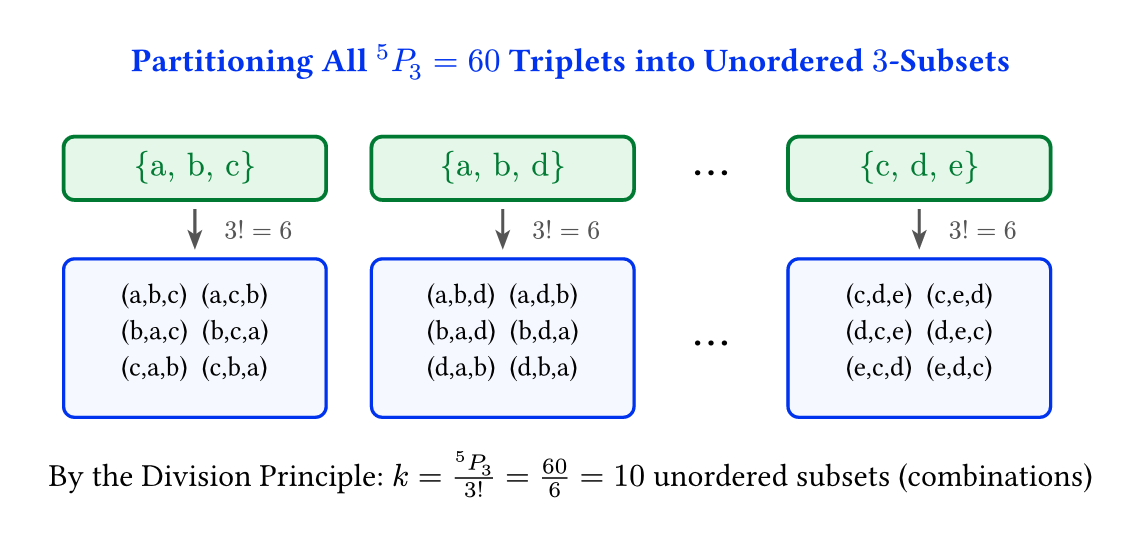
To form a triplet, first simply pick any objects from without arranging them—say . Why do we use curly brackets here? Because a set is unordered; we have only chosen which objects will participate, and we have not yet placed them in sequence. Clearly is a -element subset of .
Once is chosen, we can arrange its letters into distinct triplets:
If we instead pick a different -element subset, such as , it again generates exactly distinct triplets—and none of them overlap with the triplets from .
Now ask the natural question: how many -element subsets can be formed from these distinct objects? Let this unknown number be (called the -combination of objects). Since every one of the subsets generates unique triplets and together they produce all triplets:
Therefore, there are exactly ways to select (without arranging) objects from distinct objects.
The General Combination Formula§
Definition (-Combination): An -combination of distinct objects () is the number of ways to select objects from distinct objects when order does not matter—equivalently, the number of -element subsets of an -element set. It is denoted by or .
Theorem (Combination Formula): For all integers :
Proof (Via the Division Principle): Let be the set of all -permutations of distinct objects, so . Partition into pairwise disjoint, exhaustive subsets , where each part contains all permutations made from the exact same -element subset of objects.
Since any distinct objects can be arranged in ways, every part has equal size . By the Division Principle, the number of distinct -element subsets is:
Permutations vs. Combinations at a Glance:
Rewriting the formula as makes the relationship unmistakable: means "select only", whereas means "select objects first (), then arrange those selected objects ()".
Example 1: In how many ways can a team of students be formed from a class of students?
Solution: Since all team positions are equivalent (order does not matter), the number of teams is:
Combinations Under Restrictions§
Suppose we wish to select objects from a pool of distinct objects under three common types of restrictions. Notice carefully the difference between Restriction 2 and Restriction 3:
1. particular objects are always selected (): Place those objects into our selection right away ( way). We must then choose the remaining objects from the remaining objects:
2. particular objects are never selected all together: Here some (or even ) of the objects may still be chosen—we only forbid all of them appearing together in the same selection. Using the Subtraction Principle, subtract Restriction 1 from the unrestricted total:
3. particular objects are never selected (none of them allowed, ): Here not even a single one of the objects may enter our selection. Discard those objects completely and select all objects from the remaining objects:
Example 2 (Committee with Minimum Quota): From men and women, a committee of members must be formed containing at least men. In how many ways can this be done?
Solution: Partition the valid committees by the exact number of men selected:
- Case 1 ( men and women): .
- Case 2 ( men and woman): .
- Case 3 ( men and women): .
By the Addition Principle, there are valid committees.
Example 3 (Why "Select Minimum First, Then Fill Rest" Overcounts!): In Example 2, a common mistake is to argue: "First choose men from in ways to satisfy the minimum, then choose the remaining members from the remaining people in ways, giving ." Why is wrong?
Solution: Suppose a valid committee has men and woman . Under that faulty method, this single committee is counted four separate times:
- chosen first, then ;
- chosen first, then ;
- chosen first, then ;
- chosen first, then .
Similarly, a committee of men is counted times! The cases overlap heavily, violating pairwise disjointness. Always partition by exact counts of each type (as in Example 2) when solving "at least" selection problems.
Select-and-Arrange: Combining Selection with Arrangement§
Now that we have the combination formula in hand, we can add a fourth powerful strategy to the three restricted-permutation techniques from Section 03: Select-and-Arrange.
Whenever a problem asks us to arrange objects drawn from two or more separate pools—say objects from a pool of distinct objects and objects from a pool of distinct objects—trying to fill positions directly fails because we do not know which positions will hold objects from and which from . Instead, decouple the task into two completely independent stages:
- Select: Choose objects from in ways and objects from in ways.
- Arrange: Arrange all chosen objects in a row in ways.
By the Multiplication Principle:
Example 4 (Words from Vowels and Consonants): How many -letter words (with or without meaning, no letter repeated) can be formed using consonants chosen from distinct consonants and vowels chosen from distinct vowels?
Solution: First select the letters ( choices of consonants and choices of vowels), then arrange all chosen letters in ways:
Properties of Binomial Coefficients and Combinatorial Proofs§
A combinatorial proof (also called a double-counting proof) proves a mathematical identity by counting the exact same finite set in two different ways and equating the two resulting expressions. Unlike purely algebraic manipulation, a combinatorial proof reveals why an identity must be true.
Property 1: Symmetry§
Combinatorial Proof: Selecting objects to include from a group of distinct objects is equivalent to selecting the remaining objects to leave out. Every -selection corresponds bijectively to an -exclusion (exactly the basketball team-vs.-bench bijection from Section 01!).
Algebraic Proof:
(Useful consequence: If , then either or .)
Property 2: Pascal's Formula§
Combinatorial Proof: Suppose a class has students and we wish to form a team of students for a science expedition. Let be the set of all possible teams; directly, .
Now single out one particular student in the class named . Any valid team either includes or excludes —there is no third possibility. Partition into two disjoint, exhaustive sets:
- (Teams including ): With already on the team, we need more members from the remaining students, giving .
- (Teams excluding ): Leaving out, we must select all members from the remaining students, giving .
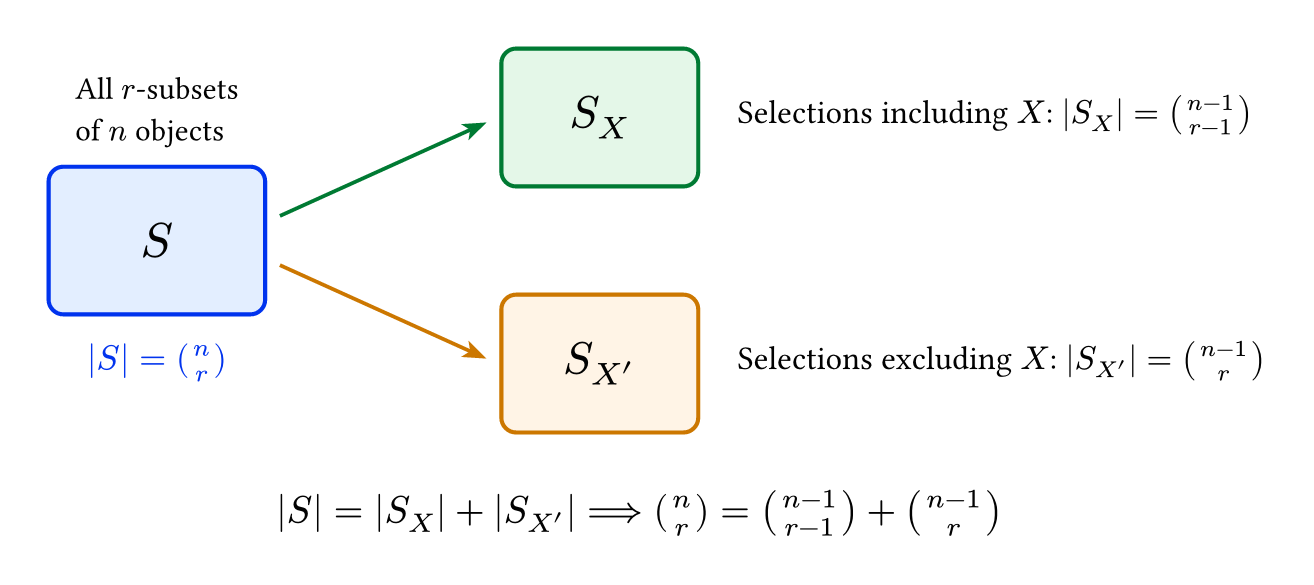
Since , equating both counts yields .
Algebraic Proof:
Property 3: Sum of All Binomial Coefficients§
Combinatorial Proof: Let . Count the total number of subsets of in two ways:
Way 1 (Partition by subset size): There is subset of size (the empty set ), subsets of size , subsets of size , ..., and subsets of size . Adding across all disjoint sizes gives .
Way 2 (Element-by-element choice): To form any subset , each element independently faces choices: either or . By the Multiplication Principle, there are subsets in total.
Equating both counts proves .
Property 4: Vandermonde's Identity§
(where we adopt the standard convention whenever or ).
Combinatorial Proof: Consider a combined pool of distinct objects split into Group ( objects) and Group ( objects). Directly, there are ways to select objects from the combined pool.
Alternatively, partition these selections by the exact number of objects drawn from Group (). When objects are chosen from Group , the remaining objects must come from Group , which can be done in ways. Summing over all produces the left-hand side.
Important Special Case (Sum of Squares): Setting and in Vandermonde's Identity gives:
Applying Symmetry () yields the celebrated identity:
Property 5: Generalized Pascal Decomposition§
Replacing by (i.e., splitting objects into subgroups of sizes and ) turns Vandermonde's Identity into:
- Setting immediately recovers Pascal's Formula: .
- Setting proves the second-order identity:
Property 6: The Hockey-Stick Identity§
Proof 1 (Telescoping via Pascal's Formula): Since , rewrite the first term and collapse pairs repeatedly using Pascal's Formula:
Continuing this chain reaction all the way to the final term yields:
Proof 2 (Combinatorial Proof): Consider a row of numbered positions () filled with identical black balls and identical white balls. Directly, choosing which positions hold the black balls can be done in ways.
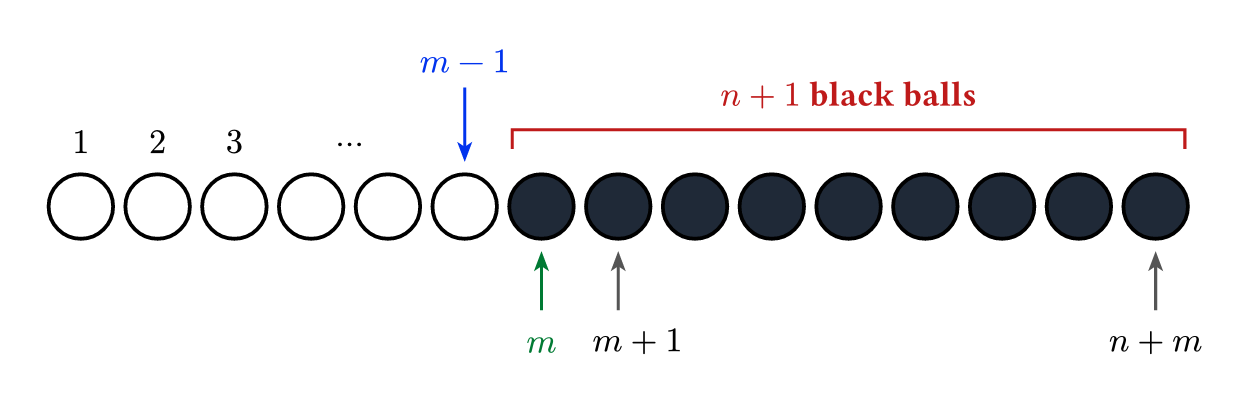
Now count the exact same arrangements by scanning from left to right and recording the position of the first (leftmost) black ball. Since more black balls must fit strictly to its right, the farthest right the first black ball can sit is position (when all black balls are pushed flush against the right end, occupying positions ). Thus :
- If the first black ball is at position , the remaining black balls occupy the positions to its right in way.
- If the first black ball is at position , the remaining black balls choose from positions to its right in ways.
- In general, when the first black ball sits at position (), the remaining black balls choose from the positions to its right in ways.
Summing over gives .
Property 7: The Subset-of-a-Subset (Committee–Subcommittee) Identity§
Combinatorial Proof: Suppose we have distinct balls and two distinct boxes, Box and Box . We want to end up with balls in Box and balls in Box (leaving balls outside).
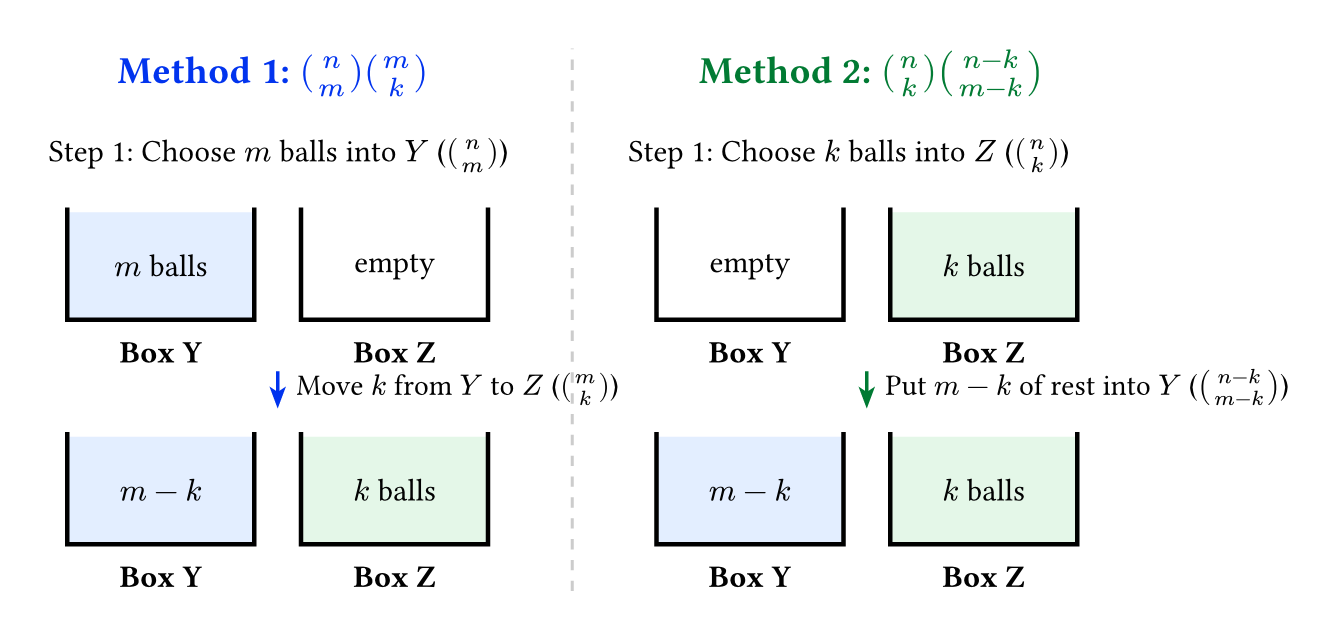
Method 1: First select balls and place all of them into Box ( ways). Next select of those balls from Box and move them into Box ( ways). Total ways: .
Method 2: First select balls directly into Box ( ways), leaving balls. Next select balls from those remaining balls and place them into Box ( ways). Total ways: .
Since both methods produce the exact same set of final distributions, .
The Absorption Identity (Special Case ): Substituting and gives one of the handiest simplification identities in algebra and combinatorics:
(Combinatorial meaning: choosing a team of players and appointing captain is identical to appointing captain from all players first, then choosing the remaining teammates!)
Example 5 (Evaluating Sums Using Identities): Evaluate: (a) , and (b) .
Solution:
(a) By the Hockey-Stick Identity with and (so ):
(b) Apply the Absorption Identity and then Property 3:
Summary Table§
| Identity / Formula | Expression | Combinatorial Interpretation |
|---|---|---|
| -Combination | Unordered selection of objects from distinct objects | |
| Symmetry | Choosing to include choosing to leave out | |
| Pascal's Formula | Split -teams by whether a fixed person is included or excluded | |
| Subset Sum | Total subsets of an -element set | |
| Vandermonde's Identity | Selecting objects from two pools of sizes and | |
| Hockey-Stick Identity | Partitioning black balls by position of the leftmost black ball | |
| Subset-of-a-Subset | Putting balls in Box and balls in Box | |
| Absorption Identity | Forming an -member team with designated captain |
Mark this section complete when you have worked through its proofs.