
Circular Permutations
Every arrangement we have studied so far placed objects in a straight line—with a clear first position, second position, and last position. From now on, we call those linear permutations. Now suppose objects are arranged around a circle, such as guests seated around a round dining table or flowers strung into a garland. Because a circle has no beginning and no end, only the relative order of the objects around the ring matters.
Cyclic Equivalence and the Division Principle§
Consider a set of distinct objects , and take one linear arrangement: .
Now perform a cyclic shift: move the last object to the front, shifting every other object one step to the right, producing . Repeating this shift generates linear arrangements in total:
These linear arrangements are said to be cyclically related. Watch what happens when we bend each of these strings around a circular ring:
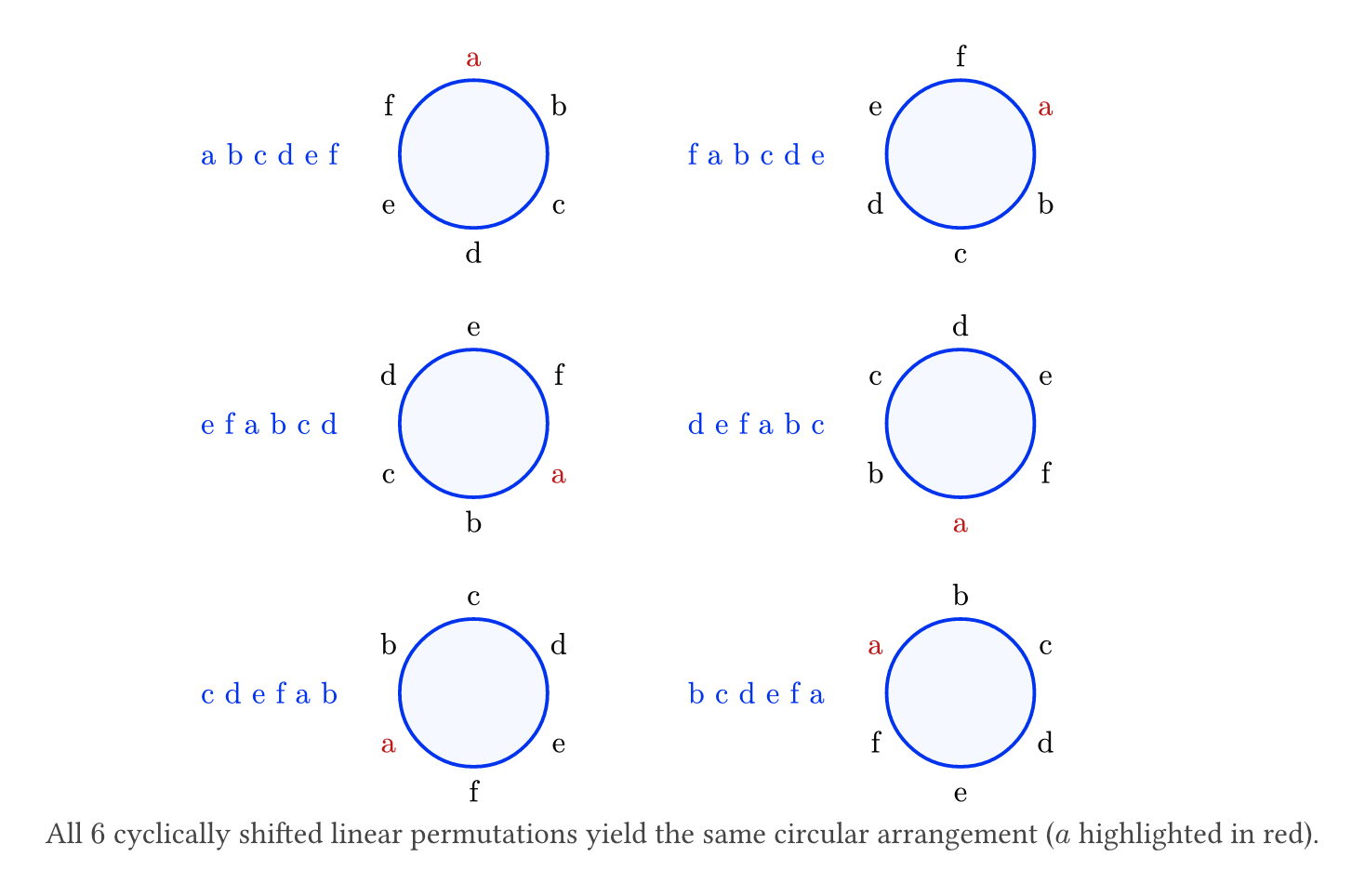
Every single one of the linear arrangements produces the exact same circular arrangement—moving clockwise from , the neighbors are always in that identical order!
Now apply the Division Principle (Section 01): the set has linear permutations in total. Partitioning them into groups of cyclically related arrangements places exactly linear permutations in every group. Therefore, the total number of distinct circular permutations of these objects is:
General Formula for Circular Permutations of Selected Objects§
Suppose we have distinct objects and wish to arrange of them () around a circular ring having identical positions.
Theorem (Circular -Permutation Formula): The number of distinct circular permutations of distinct objects taken at a time () is:
In particular, when all objects are arranged around a circle (), the number of circular permutations is:
Proof (Via the Division Principle): Let be the set of all linear -permutations of distinct objects, so . Partition into equivalence classes , where each class groups together all linear arrangements that are cyclic shifts of one another. Because all objects in any arrangement are distinct, every class contains exactly cyclically related linear permutations: . By the Division Principle:
The Reference-Fixing Method: Round Table in a Vacuum§
The Division Principle above gave us algebraically by dividing out identical rotations. A second viewpoint—fixing a reference—shows geometrically why rotational symmetry disappears the moment one object is placed, and provides a far easier tool for constrained circular seatings.
Suppose people wish to sit around a circular table with identical chairs. Many students initially struggle to understand why rotating everyone by one seat does not create a new arrangement. Why? Because our mind instinctively pictures the circular table sitting inside an asymmetrical room with a door or window. In such a room, the chair closest to the door is visually different from the chair farthest from the door—the door acts as a fixed external reference, making all chairs distinguishable!
To truly grasp circular permutations, imagine the circular table floating in empty space (a vacuum) with no walls, doors, windows, or seat numbers. Now every single chair is 100% identical to every other chair—there is no reference point anywhere.
Pick one particular person among the people, say Mr. , and seat him first:
- Because all chairs are completely indistinguishable, Mr. has only choice—every chair looks identical before anyone sits down.
- Now something remarkable happens: the moment Mr. takes a seat, Mr. himself becomes a reference point! From Mr. 's perspective, the chairs are no longer identical: the chair immediately to his left is distinct from the chair two seats to his left, which is distinct from the chair directly to his right. Starting from his left, we can uniquely number the remaining chairs from to .
- Because those chairs are now distinct linear positions, the remaining people arrange themselves on them in ways!
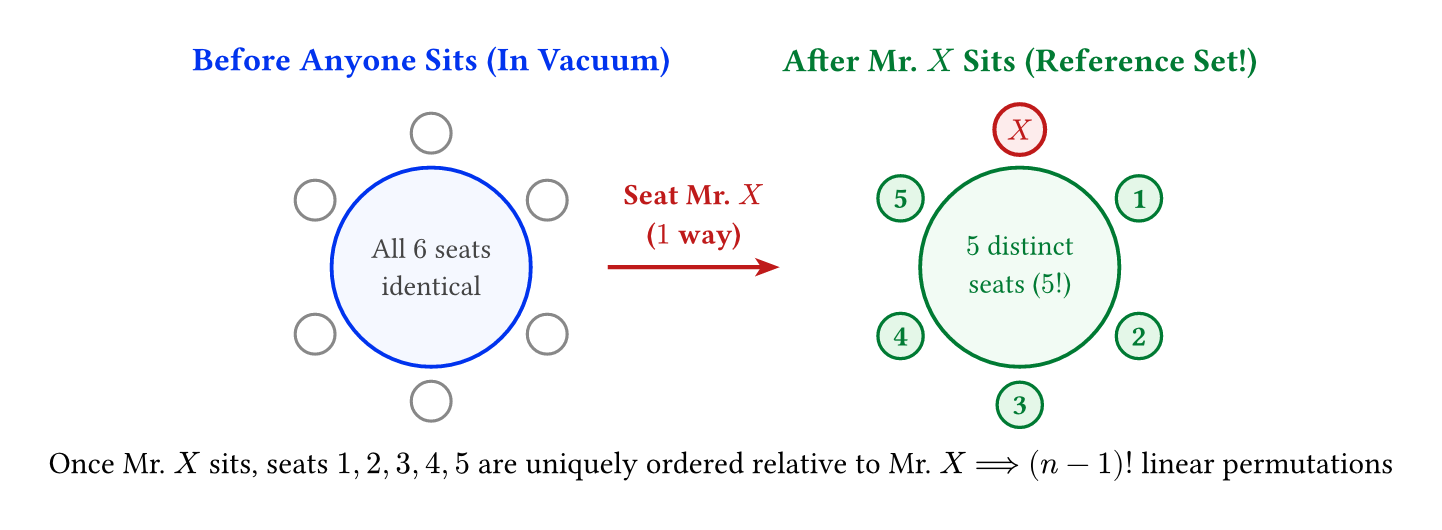
Thus, people can be seated around a circular table of identical chairs in ways.
Using this exact idea, we can also re-derive circular -permutations: first select people from in ways, then seat those people around a circular table of identical chairs in ways:
Watch Out for Hidden References§
Critical Caution:
Never apply automatically just because a problem mentions a circular table! Circular permutation formulas apply only while the seats are completely identical. Once a reference exists—whether because chairs are numbered, a host's chair is marked, or an earlier group of people has already been seated—every remaining chair becomes distinguishable and must be filled using linear permutations!
Example 1 (Alternating Boys and Girls — The Hidden Reference Trap): Five boys and five girls wish to sit around a circular table of identical chairs so that no two boys sit adjacent. In how many ways can they be seated?
Solution:
- Seat the boys first so that there is an empty chair between every pair of boys. Because all chairs are initially identical with no reference, the boys can be arranged around the circle in ways.
- Now seat the girls on the remaining empty chairs. Warning: these empty chairs are no longer identical! The seated boys act as fixed reference points (the chair between Boy and Boy is completely distinct from the chair between Boy and Boy ). Therefore, the girls are arranged linearly in ways—not !
By the Multiplication Principle:
Example 2 (Together, Separated, and Opposite on a Circle): In how many ways can people be seated around a circular table if two particular people, and : (a) must sit together, (b) must not sit together, (c) must sit directly opposite each other?
Solution:
(a) and together: Tie and into one bundle. We now arrange units around a circle in ways, and permute and inside the bundle in ways:
(b) and not together: By the Subtraction Principle, subtract part (a) from all circular seatings:
(c) and directly opposite: Seat on any chair ( way, fixing the reference). Then must sit on the unique chair directly opposite ( way). The remaining chairs are now distinct relative to and , so the remaining people sit linearly in ways:
Example 3 (Identical vs. Numbered Seats): In how many ways can delegates be seated around a round conference table if: (a) all chairs are identical, (b) the chairs are numbered through ?
Solution:
(a) Identical chairs: .
(b) Numbered chairs: Because the seat numbers serve as an external reference, rotating everyone clockwise by one seat changes who sits in Chair and produces a new arrangement. Thus all seats are distinct: .
Example 4 (Couples Seated Together): In how many ways can married couples be seated around a circular table so that every husband and wife sit next to each other?
Solution: Tie each couple into a single unit, creating couple-units. Arrange these units around the circular table in ways. Within each of the couples, the husband and wife can swap left and right positions in ways independently. By the Multiplication Principle:
Necklaces and Garlands (When Clockwise Equals Anticlockwise)§
Around a dining table, clockwise order and anticlockwise order are genuinely different: in the first seating sits to 's left, whereas in the second seating sits to 's right. You cannot pick up a dining table with seated guests and turn it upside down!
Now consider stringing distinct flowers into a garland or distinct beads into a necklace. A physical garland exists in three dimensions and can be flipped upside down. Turning a garland over reverses clockwise into anticlockwise—so two mirror-image circular permutations represent the exact same physical garland.
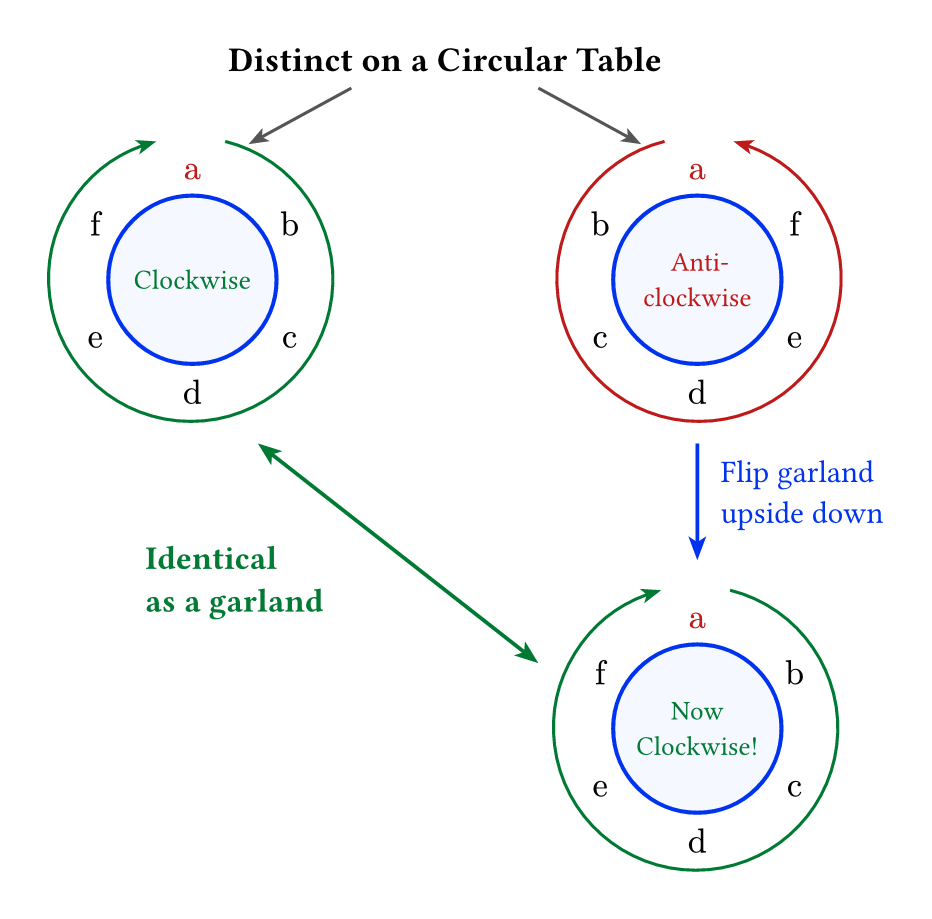
Because every distinct garland corresponds to a pair of opposite-orientation circular permutations (for ), the Division Principle divides the circular permutation count by :
Theorem (Necklaces / Garlands of Distinct Objects):
- The number of distinct necklaces/garlands formed from distinct beads () is:
- The number of distinct necklaces/garlands formed by selecting beads () from distinct beads is:
(Note: For or , there is only arrangement—flipping does not generate a second distinct circular order, so we do not divide by .)
Example 5: In how many ways can different gemstones be strung into a circular necklace if a ruby and an emerald must always sit next to each other?
Solution: Bundle the ruby and emerald into unit, giving units on the ring. Oriented circular arrangements . Since flipping the necklace upside down identifies clockwise and anticlockwise arrangements, divide by :
Example 6: How many distinct -bead bracelets can be made from a box containing different beads?
Solution: Here and , and a bracelet can be flipped over:
Summary Table§
| Situation | Formula | Condition |
|---|---|---|
| Circular permutation of all distinct objects | Identical positions; clockwise anticlockwise | |
| Circular -permutation of distinct objects | ; clockwise anticlockwise | |
| Necklace / garland of distinct objects | ; flippable (clockwise anticlockwise) | |
| Necklace / garland of out of objects | ; flippable | |
| Round table with numbered seats or fixed reference | Reference eliminates rotational symmetry (linear) |
Mark this section complete when you have worked through its proofs.