In the opening sections of this chapter, we learned how to find the area under a continuous curve y=f(x) on [a,b] from first principles. Dividing [a,b] into n equal strips of width h=nb−a (so that nh=b−a) gave the Left Sum and the Right Sum, both of which converge to the definite integral as n→∞:
Now focus on the Right Sum and consider the simplest special case: a=0 and b=1.
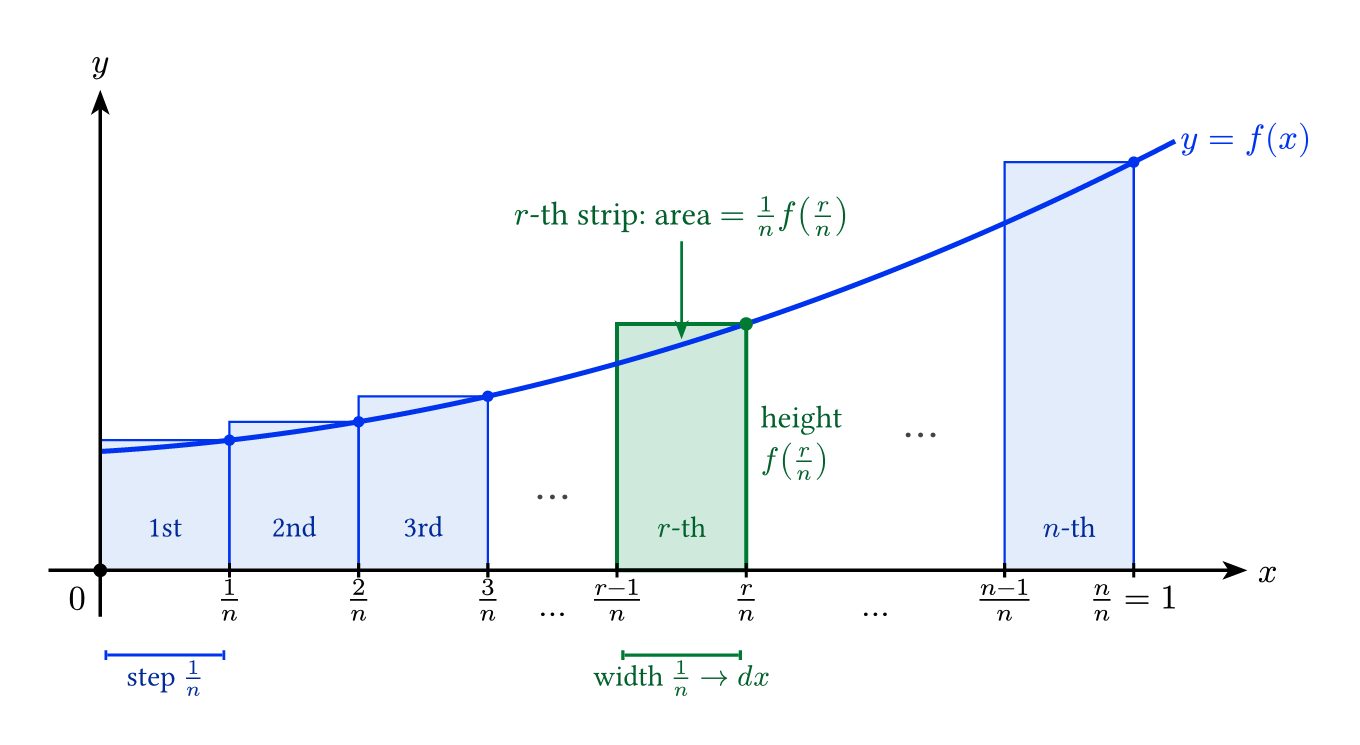
When we divide the interval [0,1] into n equal parts, each step has length h=n1−0=n1, and the division points along the x-axis are:
0,n1,n2,n3,…,nr−1,nr,…,nn=1
As shown in the figure below, the r-th rectangular strip sits on the base [nr−1,nr] of width n1, and its height at the right endpoint xr=nr is f(nr), giving it an area of n1f(nr):
Adding the areas of all n strips from r=1 to r=n and taking the limit as n→∞ gives our fundamental formula on [0,1]:
∫01f(x)dx=n→∞limn1r=1∑nf(nr)
(Similarly, using the Left Sum on [0,1] evaluates heights at the left endpoints, giving ∫01f(x)dx=limn→∞n1∑r=0n−1f(nr).)
Every single term of the series approaches 0! At first glance, you might wonder: if every term approaches 0, shouldn't the entire sum be 0+0+⋯+0=0?
No—that is impossible! By the First Fundamental Theorem of Calculus, we already know the exact value of the left-hand side:
∫011+x21dx=[tan−1x]01=tan−1(1)−tan−1(0)=4π=0
Why doesn't the sum equal 0? Because as each individual term shrinks toward 0 (at the rate of n1), the number of terms n simultaneously grows to ∞! You can only add the limits of individual terms when the number of terms is fixed and finite. When n→∞ terms each of size roughly n1 are added together, the competing effects (n×n1) balance out to produce the finite, non-zero value 4π.
Reversing the Process: From a Series Back to a Definite Integral§
In the example above, we started with a known integral ∫011+x21dx and expanded its Right Sum into a series. In this section, we do the exact opposite process: we are given the limit of a series and asked to find its value by recognizing the definite integral hidden inside it.
Let us see how this works on a concrete example before stating any general rule. Suppose we want to evaluate:
L=n→∞lim(n+11+n+21+n+31+⋯+2n1)
First, notice the telltale signature: as n→∞, each individual term (n+11,n+21,…,2n1) approaches 0, while the number of terms n grows to ∞. So we cannot take the limit term by term. Instead, let us run our Right Sum steps in reverse to match the standard definition on [0,1]:
n→∞limn1r=1∑nf(nr)=∫01f(x)dx
Step 1 (Condense the series into ∑ notation):
Look at how the denominators change from term to term: n+1,n+2,n+3,…,n+n. Using a running index r from 1 to n, the r-th term is n+r1:
L=n→∞limr=1∑nn+r1
Step 2 (Reshape to expose n1 and nr):
In the Right Sum formula n1∑r=1nf(nr), a strip width n1 sits outside the sum and the index r appears only in the ratio nr. To create nr, factor n out of the denominator n+r=n(1+nr):
L=n→∞limn1r=1∑n1+nr1
Step 3 (Compare directly with the Right Sum definition):
Place our limit right next to the Right Sum definition on [0,1]:
By direct comparison, our sum is literally the Right Sum of the function f(x)=1+x1 on [0,1], where n1 is the strip width h and nr is the sample point xr! Therefore, by the definition of the definite integral:
In practice, once you have arranged a limit into the standard form limn→∞n1∑r=1nf(nr), you do not need to write out the full side-by-side comparison every single time. You can convert the sum directly into ∫01f(x)dx using this short working procedure:
Write the series in summation (∑) form using a running index r.
Factor out n1 and rewrite the remaining expression strictly in terms of nr so that it takes the form limn→∞n1∑r=1nf(nr).
Convert to the definite integral by matching each part of the Right Sum:
Replace nr by x (the sample point xr=nr).
Replace n1 by dx (the strip width h=n1).
Replace limn→∞∑r=1n by ∫01 (since nr runs from limn→∞n1=0 at r=1 to limn→∞nn=1 at r=n).
Extending to the General Case: Deciding the Lower and Upper Limits§
What if the summation index r does not simply run from 1 to n? Let us trace what happens when the starting index or ending index changes.
1. Shifted Starting Index (Why r = 6 to n Still Starts at a = 0)§
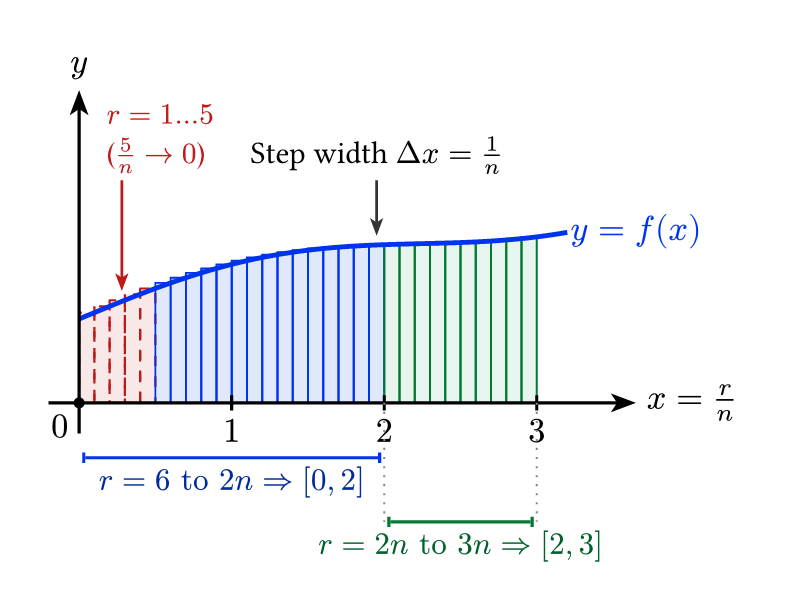
Suppose a sum starts at r=6 instead of r=1. Compared to the full sum from r=1 to n, only the first 5 terms (r=1,2,3,4,5) are missing.
As we just saw in our motivating example, each individual term approaches 0 as n→∞. Because 5 is a fixed finite number of terms, the sum of those 5 missing terms genuinely approaches 0+0+0+0+0=0! Removing or adding any fixed finite number of terms at either end changes nothing in the limit—the lower limit of integration is still a=limn→∞n6=0.
2. Extended Upper Index (0 to 2, 0 to 4, and r = 6 to 2n)§
When r runs from 1 to n, the point xr=nr steps by n1 from n1→0 up to nn=1, covering the interval [0,1].
Up to 2n (e.g., r=1 to 2n, or r=6 to 2n): As r continues past n up to 2n, the fraction nr keeps marching past 1 all the way to n2n=2. Even if the sum starts at r=6 and ends at r=2n, the first point is n6→0 and the last point is n2n=2, so the integral runs from 0 to 2: ∫02f(x)dx.
Up to 4n (e.g., r=0 to 4n−1): The fraction nr sweeps from n0=0 to n4n−1→4, giving an integral from 0 to 4: ∫04f(x)dx.
Starting at a multiple of n (e.g., r=n+1 to 4n): Here the first term sits at nn+1→1 and the last term sits at n4n=4, so the strips cover 1 to 4: ∫14f(x)dx.
Putting these observations together gives the universal rule for any starting index r=ϕ(n) and ending index r=ψ(n). Simply compute the limiting values of nr at the two extremes:
a=n→∞limnϕ(n)andb=n→∞limnψ(n)
Then the limit of the sum converts directly into the definite integral from a to b:
In IA: Setting x=nr, the endpoints run from 0 to 2, and the step size is Δx=n1, so IA=∫02f(x)dx.
In IB: Look closely! If you set x=nr, then r=1 to n gives limits 0 to 1, and the integrand is f(2x), so IB=∫01f(2x)dx. By the scaling property (t=2x), this equals 21∫02f(t)dt—half of IA!
(If you ever choose a scaled variable t=nkr directly inside IB, remember that consecutive values tr+1−tr=nk, so you must pair dt with nk, writing n1=k1(nk)⟶k1dt. Keeping x=nr and using the scaling property afterward avoids this mistake every time!)
Evaluating A: Divide top and bottom by n2 to separate n1 and nr:
A=n→∞limn1r=1∑3n1+(r/n)2r/n
Here a=0 and b=limn→∞n3n=3:
A=∫031+x2xdx=[21ln(1+x2)]03=21ln10
Evaluating B: Using the safe standard choice x=nr with a=0 and b=1:
B=∫01sin(2πx)dx=[−π2cos(2πx)]01=π2
(Check with scaled variable t=2nπr: consecutive points jump by Δt=2nπ, so n1=π2⋅Δt⟶π2dt, and t runs from 0 to 2π, giving π2∫0π/2sintdt=π2. Both paths agree completely.)
Example 3: Extracting Higher Powers and Radical Denominators
Evaluate:
I1=limn→∞n21∑r=1nrsec2(n2r2)
I2=limn→∞∑r=1n4n2−r21
Solution:
Part 1: Keep one n1 outside for dx, and absorb the remaining n1 into r to form nr:
I1=n→∞limn1r=1∑n(nr)sec2((nr)2)
Converting nr→x over [0,1] and substituting u=x2 (du=2xdx):
I1=∫01xsec2(x2)dx=21∫01sec2udu=21tan(1)
Part 2: Factor n out of 4n2−r2=n4−(r/n)2:
I2=n→∞limn1r=1∑n4−(r/n)21=∫014−x2dx
Integrating directly gives:
I2=[sin−1(2x)]01=sin−1(21)−0=6π
Example 4: Odd-Indexed Denominators and Vanishing Small Offsets
Evaluate:
L=n→∞lim(n+11+n+31+n+51+⋯+3n−11)
Solution:
Observe that the denominators form an arithmetic progression with common difference 2: n+(2r−1) as r runs from r=1 (n+1) to r=n (n+2n−1=3n−1). Factor out n1:
Whenever you face a growing product raised to the power n1 (or n21), logarithms convert multiplication into addition, turning the product straight into a limit of a sum:
Let L=limn→∞(Pn)1/n (assuming Pn>0).
Take the natural logarithm: lnL=limn→∞n1lnPn=limn→∞n1∑ln(…).
Evaluate the resulting definite integral ∫ablnf(x)dx, then exponentiate back:
L=exp(∫ablnf(x)dx)
Example 5: Classic Factorial Limit
Evaluate:
L=n→∞lim(n!nn(2n)!)1/n
Solution:
Cancel n! from (2n)! and pair the remaining n factors with the n copies of n in nn:
n!nn(2n)!=n⋅n⋯n(n+1)(n+2)⋯(n+n)=r=1∏n(1+nr)
Take the natural logarithm of L:
lnL=n→∞limn1r=1∑nln(1+nr)=∫01ln(1+x)dx
Integrate by parts (u=ln(1+x), dv=dx, or choose v=x+1 directly!):
Non-Trivial Twists: Squeeze Theorem, Trap Sums, and Symmetry§
Not every limit of a sum or product drops neatly into n1f(nr) on the first try. The final three examples cover the subtler tools you need when expressions are slightly off-form, disguised by n2 terms, or non-elementary after conversion.
Example 8: A Product Without a 1/n Power (Logarithm Bounds + Squeeze Theorem)
Evaluate:
L=n→∞limr=1∏n(1+n3r2)
Solution:
At first glance there is no n1 power outside the product! Take ln anyway and notice n3r2=n1(nr)2:
lnL=n→∞limr=1∑nln(1+n3r2)
Recall the standard inequality for all t≥0:
t−2t2≤ln(1+t)≤t
(This follows because (1+t)e−t≤1 and dtd[ln(1+t)−(t−2t2)]=1+tt2≥0.) Setting t=n3r2 and summing from r=1 to n:
Evaluating S1 (Sandwich Trap — Do Not Force a Definite Integral Here!):
In S1, there are n terms, and each term has size around n21—not n1! Bounding every term between the smallest (r=n) and largest (r=1) gives:
n4+n2n≤r=1∑nn4+r21≤n4+1n
Both outer bounds behave like n2n=n1→0, so by the Squeeze Theorem:
S1=0
Evaluating S2 (True Right Sum After Substituting m=n2):
In S2, the upper index is n2 and each term has size around n21. Set m=n2 (so m→∞ as n→∞), and factor out m:
(Always check the ratio between the number of terms and the size of each term: when N terms each have magnitude ∼N1, a non-zero definite integral appears!)
Example 10: Limit of a Sum Requiring King's Rule After Conversion
Evaluate:
L=n→∞limn1r=1∑2nr+2n−rr
Solution:
Divide numerator and denominator of the general term by n:
L=n→∞limn1r=1∑2nr/n+2−r/nr/n
Convert nr→x and n1→dx. Because r runs from 1 to 2n, the integral goes from 0 to 2:
L=∫02x+2−xxdx
Finding an antiderivative here is completely unnecessary! Apply King's Rule (x↦2−x) on [0,2]: