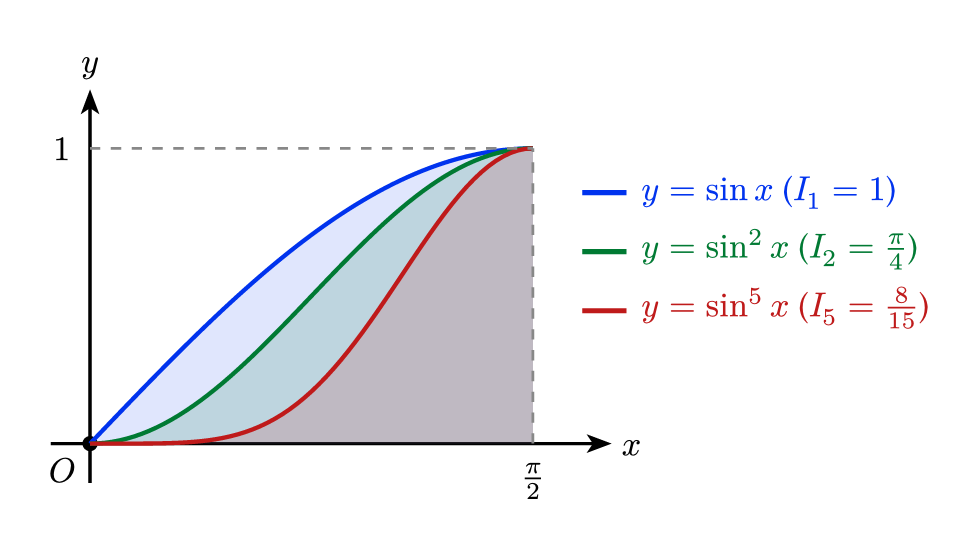
In indefinite integration, a reduction formula keeps track of a complicated algebraic or trigonometric boundary term at every step. In definite integration , something far cleaner happens: when we choose natural limits like [ 0 , π / 4 ] [0, \pi/4] [ 0 , π /4 ] [ 0 , π / 2 ] [0, \pi/2] [ 0 , π /2 ] [ 0 , 1 ] [0, 1] [ 0 , 1 ] [ 0 , ∞ ) [0, \infty) [ 0 , ∞ ) vanish completely or collapse to simple numbers .
As a result, a definite integral I n I_n I n n n n recurrence relation —relating I n I_n I n I n − 1 I_{n-1} I n − 1 I n − 2 I_{n-2} I n − 2 n n n n → ∞ n \to \infty n → ∞
Across definite integration, these recurrences come from two main engines:
Identities and Telescoping Differences , where I n + I n − 2 I_n + I_{n-2} I n + I n − 2 I n − I n − 1 I_n - I_{n-1} I n − I n − 1 Definite Integration by Parts , where the boundary term [ u v ] a b \big[u v\big]_a^b [ uv ] a b
Tangent and Cotangent Powers on Quarter-Period Intervals§
(Note: Let us evaluate these on their standard quarter-period intervals where tan x \tan x tan x cot x \cot x cot x 0 0 0 1 1 1
Definite Reduction for Tangent Powers§
For integers n ≥ 0 n \ge 0 n ≥ 0
I n = ∫ 0 π / 4 tan n x d x I_n = \int_0^{\pi/4} \tan^n x\,dx I n = ∫ 0 π /4 tan n x d x For n ≥ 2 n \ge 2 n ≥ 2 I n I_n I n I n − 2 I_{n-2} I n − 2 tan n − 2 x \tan^{n-2} x tan n − 2 x
I n + I n − 2 = ∫ 0 π / 4 tan n − 2 x ( tan 2 x + 1 ) d x = ∫ 0 π / 4 tan n − 2 x sec 2 x d x I_n + I_{n-2} = \int_0^{\pi/4} \tan^{n-2} x \left(\tan^2 x + 1\right) dx = \int_0^{\pi/4} \tan^{n-2} x \sec^2 x\,dx I n + I n − 2 = ∫ 0 π /4 tan n − 2 x ( tan 2 x + 1 ) d x = ∫ 0 π /4 tan n − 2 x sec 2 x d x Since d d x ( tan x ) = sec 2 x \frac{d}{dx}(\tan x) = \sec^2 x d x d ( tan x ) = sec 2 x
I n + I n − 2 = [ tan n − 1 x n − 1 ] 0 π / 4 = 1 n − 1 ( n ≥ 2 ) I_n + I_{n-2} = \left[ \frac{\tan^{n-1} x}{n - 1} \right]_0^{\pi/4} = \frac{1}{n - 1} \qquad (n \ge 2) I n + I n − 2 = [ n − 1 tan n − 1 x ] 0 π /4 = n − 1 1 ( n ≥ 2 ) Notice how clean this is: there is no + C +C + C 1 n − 1 \frac{1}{n - 1} n − 1 1
Definite Reduction for Cotangent Powers§
For integers n ≥ 0 n \ge 0 n ≥ 0
J n = ∫ π / 4 π / 2 cot n x d x J_n = \int_{\pi/4}^{\pi/2} \cot^n x\,dx J n = ∫ π /4 π /2 cot n x d x By King's Rule on [ 0 , π / 2 ] [0, \pi/2] [ 0 , π /2 ] x = π 2 − t x = \frac{\pi}{2} - t x = 2 π − t cot ( π 2 − t ) = tan t \cot(\frac{\pi}{2} - t) = \tan t cot ( 2 π − t ) = tan t [ π / 4 , π / 2 ] [\pi/4, \pi/2] [ π /4 , π /2 ] [ 0 , π / 4 ] [0, \pi/4] [ 0 , π /4 ] J n = I n J_n = I_n J n = I n n ≥ 0 n \ge 0 n ≥ 0
J n + J n − 2 = 1 n − 1 ( n ≥ 2 ) J_n + J_{n-2} = \frac{1}{n - 1} \qquad (n \ge 2) J n + J n − 2 = n − 1 1 ( n ≥ 2 ) Examples: Tangent and Cotangent Reductions§
Example 1: Evaluating High Powers Step by Step
Evaluate I 5 = ∫ 0 π / 4 tan 5 x d x I_5 = \int_0^{\pi/4} \tan^5 x\,dx I 5 = ∫ 0 π /4 tan 5 x d x I 6 = ∫ 0 π / 4 tan 6 x d x I_6 = \int_0^{\pi/4} \tan^6 x\,dx I 6 = ∫ 0 π /4 tan 6 x d x
Solution:
First compute the two base cases:
I 0 = ∫ 0 π / 4 1 d x = π 4 , I 1 = ∫ 0 π / 4 tan x d x = [ ln ( sec x ) ] 0 π / 4 = 1 2 ln 2 I_0 = \int_0^{\pi/4} 1\,dx = \frac{\pi}{4}, \qquad I_1 = \int_0^{\pi/4} \tan x\,dx = \Big[ \ln(\sec x) \Big]_0^{\pi/4} = \frac{1}{2}\ln 2 I 0 = ∫ 0 π /4 1 d x = 4 π , I 1 = ∫ 0 π /4 tan x d x = [ ln ( sec x ) ] 0 π /4 = 2 1 ln 2 Using I n = 1 n − 1 − I n − 2 I_n = \frac{1}{n-1} - I_{n-2} I n = n − 1 1 − I n − 2
I 3 = 1 2 − I 1 = 1 2 − 1 2 ln 2 I_3 = \frac{1}{2} - I_1 = \frac{1}{2} - \frac{1}{2}\ln 2 I 3 = 2 1 − I 1 = 2 1 − 2 1 ln 2 I 5 = 1 4 − I 3 = 1 4 − ( 1 2 − 1 2 ln 2 ) = 1 2 ln 2 − 1 4 I_5 = \frac{1}{4} - I_3 = \frac{1}{4} - \left(\frac{1}{2} - \frac{1}{2}\ln 2\right) = \frac{1}{2}\ln 2 - \frac{1}{4} I 5 = 4 1 − I 3 = 4 1 − ( 2 1 − 2 1 ln 2 ) = 2 1 ln 2 − 4 1 And for even powers:
I 2 = 1 − I 0 = 1 − π 4 , I 4 = 1 3 − I 2 = π 4 − 2 3 , I 6 = 1 5 − I 4 = 13 15 − π 4 I_2 = 1 - I_0 = 1 - \frac{\pi}{4}, \qquad I_4 = \frac{1}{3} - I_2 = \frac{\pi}{4} - \frac{2}{3}, \qquad I_6 = \frac{1}{5} - I_4 = \frac{13}{15} - \frac{\pi}{4} I 2 = 1 − I 0 = 1 − 4 π , I 4 = 3 1 − I 2 = 4 π − 3 2 , I 6 = 5 1 − I 4 = 15 13 − 4 π Example 2: A Recurrence Sum
Let I n = ∫ 0 π / 4 tan n x d x I_n = \int_0^{\pi/4} \tan^n x\,dx I n = ∫ 0 π /4 tan n x d x n ≥ 0 n \ge 0 n ≥ 0 ∑ n = 1 20 n ( I n − 1 + I n + 1 ) \sum_{n=1}^{20} n (I_{n-1} + I_{n+1}) ∑ n = 1 20 n ( I n − 1 + I n + 1 )
Solution:
Replacing n n n n + 1 n + 1 n + 1 I n + I n − 2 = 1 n − 1 I_n + I_{n-2} = \frac{1}{n - 1} I n + I n − 2 = n − 1 1 I n + 1 + I n − 1 = 1 n I_{n+1} + I_{n-1} = \frac{1}{n} I n + 1 + I n − 1 = n 1 n n n n ( I n − 1 + I n + 1 ) = 1 n(I_{n-1} + I_{n+1}) = 1 n ( I n − 1 + I n + 1 ) = 1 n ≥ 1 n \ge 1 n ≥ 1
∑ n = 1 20 n ( I n − 1 + I n + 1 ) = ∑ n = 1 20 1 = 20 \sum_{n=1}^{20} n (I_{n-1} + I_{n+1}) = \sum_{n=1}^{20} 1 = 20 n = 1 ∑ 20 n ( I n − 1 + I n + 1 ) = n = 1 ∑ 20 1 = 20 Example 3: Sandwiching a Limit via Definite Reduction
Using I n = ∫ 0 π / 4 tan n x d x I_n = \int_0^{\pi/4} \tan^n x\,dx I n = ∫ 0 π /4 tan n x d x lim n → ∞ n I n = 1 2 \lim_{n \to \infty} n I_n = \frac{1}{2} lim n → ∞ n I n = 2 1
Solution:
On the open interval ( 0 , π / 4 ) (0, \pi/4) ( 0 , π /4 ) 0 < tan x < 1 0 < \tan x < 1 0 < tan x < 1 tan n + 2 x < tan n x < tan n − 2 x \tan^{n+2} x < \tan^n x < \tan^{n-2} x tan n + 2 x < tan n x < tan n − 2 x n ≥ 2 n \ge 2 n ≥ 2 [ 0 , π / 4 ] [0, \pi/4] [ 0 , π /4 ]
I n + 2 < I n < I n − 2 I_{n+2} < I_n < I_{n-2} I n + 2 < I n < I n − 2 Adding I n I_n I n
2 I n < I n + I n − 2 = 1 n − 1 and 1 n + 1 = I n + 2 + I n < 2 I n 2 I_n < I_n + I_{n-2} = \frac{1}{n - 1} \qquad \text{and} \qquad \frac{1}{n + 1} = I_{n+2} + I_n < 2 I_n 2 I n < I n + I n − 2 = n − 1 1 and n + 1 1 = I n + 2 + I n < 2 I n Combining both bounds gives:
1 2 ( n + 1 ) < I n < 1 2 ( n − 1 ) \frac{1}{2(n + 1)} < I_n < \frac{1}{2(n - 1)} 2 ( n + 1 ) 1 < I n < 2 ( n − 1 ) 1 Multiplying by n n n
n 2 ( n + 1 ) < n I n < n 2 ( n − 1 ) \frac{n}{2(n + 1)} < n I_n < \frac{n}{2(n - 1)} 2 ( n + 1 ) n < n I n < 2 ( n − 1 ) n As n → ∞ n \to \infty n → ∞ 1 2 \frac{1}{2} 2 1 lim n → ∞ n I n = 1 2 \lim_{n \to \infty} n I_n = \frac{1}{2} lim n → ∞ n I n = 2 1
Secant and Cosecant Powers on Definite Intervals§
When we integrate powers of sec x \sec x sec x csc x \csc x csc x [ 0 , π / 4 ] [0, \pi/4] [ 0 , π /4 ] [ π / 4 , π / 2 ] [\pi/4, \pi/2] [ π /4 , π /2 ]
Definite Reduction for Secant Powers§
For integers n ≥ 1 n \ge 1 n ≥ 1
I n = ∫ 0 π / 4 sec n x d x I_n = \int_0^{\pi/4} \sec^n x\,dx I n = ∫ 0 π /4 sec n x d x For n ≥ 2 n \ge 2 n ≥ 2 sec n x = sec n − 2 x ⋅ sec 2 x \sec^n x = \sec^{n-2} x \cdot \sec^2 x sec n x = sec n − 2 x ⋅ sec 2 x u = sec n − 2 x u = \sec^{n-2} x u = sec n − 2 x d v = sec 2 x d x dv = \sec^2 x\,dx d v = sec 2 x d x v = tan x v = \tan x v = tan x
I n = [ sec n − 2 x tan x ] 0 π / 4 − ( n − 2 ) ∫ 0 π / 4 sec n − 2 x tan 2 x d x I_n = \Big[ \sec^{n-2} x \tan x \Big]_0^{\pi/4} - (n - 2)\int_0^{\pi/4} \sec^{n-2} x \tan^2 x\,dx I n = [ sec n − 2 x tan x ] 0 π /4 − ( n − 2 ) ∫ 0 π /4 sec n − 2 x tan 2 x d x At x = π / 4 x = \pi/4 x = π /4 sec ( π / 4 ) = 2 \sec(\pi/4) = \sqrt{2} sec ( π /4 ) = 2 tan ( π / 4 ) = 1 \tan(\pi/4) = 1 tan ( π /4 ) = 1 x = 0 x = 0 x = 0 tan 0 = 0 \tan 0 = 0 tan 0 = 0 tan 2 x = sec 2 x − 1 \tan^2 x = \sec^2 x - 1 tan 2 x = sec 2 x − 1
I n = ( 2 ) n − 2 − ( n − 2 ) ( I n − I n − 2 ) I_n = (\sqrt{2})^{n-2} - (n - 2)(I_n - I_{n-2}) I n = ( 2 ) n − 2 − ( n − 2 ) ( I n − I n − 2 ) Collecting I n I_n I n
( n − 1 ) I n = ( 2 ) n − 2 + ( n − 2 ) I n − 2 ( n ≥ 2 ) (n - 1)I_n = (\sqrt{2})^{n-2} + (n - 2)I_{n-2} \qquad (n \ge 2) ( n − 1 ) I n = ( 2 ) n − 2 + ( n − 2 ) I n − 2 ( n ≥ 2 ) Definite Reduction for Cosecant Powers§
Similarly, for J n = ∫ π / 4 π / 2 csc n x d x J_n = \int_{\pi/4}^{\pi/2} \csc^n x\,dx J n = ∫ π /4 π /2 csc n x d x x = π 2 − t x = \frac{\pi}{2} - t x = 2 π − t J n = I n J_n = I_n J n = I n
( n − 1 ) J n = ( 2 ) n − 2 + ( n − 2 ) J n − 2 ( n ≥ 2 ) (n - 1)J_n = (\sqrt{2})^{n-2} + (n - 2)J_{n-2} \qquad (n \ge 2) ( n − 1 ) J n = ( 2 ) n − 2 + ( n − 2 ) J n − 2 ( n ≥ 2 ) Example 4: Evaluating Odd Secant Powers on Zero to Pi/4
Evaluate I 3 = ∫ 0 π / 4 sec 3 x d x I_3 = \int_0^{\pi/4} \sec^3 x\,dx I 3 = ∫ 0 π /4 sec 3 x d x I 5 = ∫ 0 π / 4 sec 5 x d x I_5 = \int_0^{\pi/4} \sec^5 x\,dx I 5 = ∫ 0 π /4 sec 5 x d x
Solution:
Start with I 1 = ∫ 0 π / 4 sec x d x = [ ln ∣ sec x + tan x ∣ ] 0 π / 4 = ln ( 2 + 1 ) I_1 = \int_0^{\pi/4} \sec x\,dx = \big[\ln|\sec x + \tan x|\big]_0^{\pi/4} = \ln(\sqrt{2} + 1) I 1 = ∫ 0 π /4 sec x d x = [ ln ∣ sec x + tan x ∣ ] 0 π /4 = ln ( 2 + 1 )
For n = 3 n = 3 n = 3
2 I 3 = ( 2 ) 1 + 1 ⋅ I 1 ⟹ I 3 = 2 + ln ( 2 + 1 ) 2 2 I_3 = (\sqrt{2})^1 + 1 \cdot I_1 \implies I_3 = \frac{\sqrt{2} + \ln(\sqrt{2} + 1)}{2} 2 I 3 = ( 2 ) 1 + 1 ⋅ I 1 ⟹ I 3 = 2 2 + ln ( 2 + 1 ) For n = 5 n = 5 n = 5
4 I 5 = ( 2 ) 3 + 3 I 3 = 2 2 + 3 2 + 3 ln ( 2 + 1 ) 2 ⟹ I 5 = 7 2 + 3 ln ( 2 + 1 ) 8 4 I_5 = (\sqrt{2})^3 + 3 I_3 = 2\sqrt{2} + \frac{3\sqrt{2} + 3\ln(\sqrt{2} + 1)}{2} \implies I_5 = \frac{7\sqrt{2} + 3\ln(\sqrt{2} + 1)}{8} 4 I 5 = ( 2 ) 3 + 3 I 3 = 2 2 + 2 3 2 + 3 ln ( 2 + 1 ) ⟹ I 5 = 8 7 2 + 3 ln ( 2 + 1 ) Sine and Cosine Powers: Walli's Theorem§
The most celebrated definite reduction formula governs powers of sin x \sin x sin x cos x \cos x cos x [ 0 , π / 2 ] [0, \pi/2] [ 0 , π /2 ]
Single-Power Reduction on the Quarter Period§
For integers n ≥ 0 n \ge 0 n ≥ 0
W n = ∫ 0 π / 2 sin n x d x = ∫ 0 π / 2 cos n x d x W_n = \int_0^{\pi/2} \sin^n x\,dx = \int_0^{\pi/2} \cos^n x\,dx W n = ∫ 0 π /2 sin n x d x = ∫ 0 π /2 cos n x d x (The two integrals are equal by King's Rule: sin ( π 2 − x ) = cos x \sin(\frac{\pi}{2} - x) = \cos x sin ( 2 π − x ) = cos x
For n ≥ 2 n \ge 2 n ≥ 2 sin n x = sin n − 1 x ⋅ sin x \sin^n x = \sin^{n-1} x \cdot \sin x sin n x = sin n − 1 x ⋅ sin x u = sin n − 1 x u = \sin^{n-1} x u = sin n − 1 x d v = sin x d x dv = \sin x\,dx d v = sin x d x v = − cos x v = -\cos x v = − cos x
W n = [ − sin n − 1 x cos x ] 0 π / 2 + ( n − 1 ) ∫ 0 π / 2 sin n − 2 x cos 2 x d x W_n = \Big[ -\sin^{n-1} x \cos x \Big]_0^{\pi/2} + (n - 1)\int_0^{\pi/2} \sin^{n-2} x \cos^2 x\,dx W n = [ − sin n − 1 x cos x ] 0 π /2 + ( n − 1 ) ∫ 0 π /2 sin n − 2 x cos 2 x d x Because n − 1 ≥ 1 n - 1 \ge 1 n − 1 ≥ 1 sin n − 1 x cos x \sin^{n-1} x \cos x sin n − 1 x cos x 0 0 0 x = 0 x = 0 x = 0 x = π / 2 x = \pi/2 x = π /2 cos 2 x = 1 − sin 2 x \cos^2 x = 1 - \sin^2 x cos 2 x = 1 − sin 2 x
W n = ( n − 1 ) ( W n − 2 − W n ) ⟹ W n = n − 1 n W n − 2 ( n ≥ 2 ) W_n = (n - 1)(W_{n-2} - W_n) \implies W_n = \frac{n - 1}{n} W_{n-2} \qquad (n \ge 2) W n = ( n − 1 ) ( W n − 2 − W n ) ⟹ W n = n n − 1 W n − 2 ( n ≥ 2 )
Unrolling this recurrence down to W 0 = ∫ 0 π / 2 1 d x = π 2 W_0 = \int_0^{\pi/2} 1\,dx = \frac{\pi}{2} W 0 = ∫ 0 π /2 1 d x = 2 π n n n W 1 = ∫ 0 π / 2 sin x d x = 1 W_1 = \int_0^{\pi/2} \sin x\,dx = 1 W 1 = ∫ 0 π /2 sin x d x = 1 n n n Walli's Formula :
∫ 0 π / 2 sin n x d x = ∫ 0 π / 2 cos n x d x = ( n − 1 ) ( n − 3 ) ( n − 5 ) ⋯ n ( n − 2 ) ( n − 4 ) ⋯ ⋅ K \int_0^{\pi/2} \sin^n x\,dx = \int_0^{\pi/2} \cos^n x\,dx = \frac{(n - 1)(n - 3)(n - 5)\cdots}{n(n - 2)(n - 4)\cdots} \cdot K ∫ 0 π /2 sin n x d x = ∫ 0 π /2 cos n x d x = n ( n − 2 ) ( n − 4 ) ⋯ ( n − 1 ) ( n − 3 ) ( n − 5 ) ⋯ ⋅ K where:
K = { π 2 , if n is even 1 , if n is odd K = \begin{cases} \dfrac{\pi}{2}, & \text{if } n \text{ is even} \\[6pt] 1, & \text{if } n \text{ is odd} \end{cases} K = ⎩ ⎨ ⎧ 2 π , 1 , if n is even if n is odd The Combined Product: General Walli's Theorem§
Now consider the two-parameter family for integers m , n ≥ 0 m, n \ge 0 m , n ≥ 0
I m , n = ∫ 0 π / 2 sin m x cos n x d x I_{m, n} = \int_0^{\pi/2} \sin^m x \cos^n x\,dx I m , n = ∫ 0 π /2 sin m x cos n x d x Derivation
Assume m ≥ 2 m \ge 2 m ≥ 2 sin x \sin x sin x cos n x \cos^n x cos n x
I m , n = ∫ 0 π / 2 sin m − 1 x ⏟ u ⋅ ( cos n x sin x ) d x ⏟ d v I_{m, n} = \int_0^{\pi/2} \underbrace{\sin^{m-1} x}_{u} \cdot \underbrace{(\cos^n x \sin x)\,dx}_{dv} I m , n = ∫ 0 π /2 u sin m − 1 x ⋅ d v ( cos n x sin x ) d x Then d u = ( m − 1 ) sin m − 2 x cos x d x du = (m - 1)\sin^{m-2} x \cos x\,dx d u = ( m − 1 ) sin m − 2 x cos x d x v = − cos n + 1 x n + 1 v = -\frac{\cos^{n+1} x}{n + 1} v = − n + 1 c o s n + 1 x
I m , n = [ − sin m − 1 x cos n + 1 x n + 1 ] 0 π / 2 + m − 1 n + 1 ∫ 0 π / 2 sin m − 2 x cos n + 2 x d x I_{m, n} = \left[ -\frac{\sin^{m-1} x \cos^{n+1} x}{n + 1} \right]_0^{\pi/2} + \frac{m - 1}{n + 1} \int_0^{\pi/2} \sin^{m-2} x \cos^{n+2} x\,dx I m , n = [ − n + 1 sin m − 1 x cos n + 1 x ] 0 π /2 + n + 1 m − 1 ∫ 0 π /2 sin m − 2 x cos n + 2 x d x Since m − 1 ≥ 1 m - 1 \ge 1 m − 1 ≥ 1 n + 1 ≥ 1 n + 1 \ge 1 n + 1 ≥ 1 0 0 0 π / 2 \pi/2 π /2 cos n + 2 x = cos n x ( 1 − sin 2 x ) \cos^{n+2} x = \cos^n x (1 - \sin^2 x) cos n + 2 x = cos n x ( 1 − sin 2 x )
I m , n = m − 1 n + 1 ( I m − 2 , n − I m , n ) ⟹ ( m + n ) I m , n = ( m − 1 ) I m − 2 , n I_{m, n} = \frac{m - 1}{n + 1} (I_{m-2, n} - I_{m, n}) \implies (m + n)I_{m, n} = (m - 1)I_{m-2, n} I m , n = n + 1 m − 1 ( I m − 2 , n − I m , n ) ⟹ ( m + n ) I m , n = ( m − 1 ) I m − 2 , n Hence:
I m , n = m − 1 m + n I m − 2 , n ( m ≥ 2 ) I_{m, n} = \frac{m - 1}{m + n} I_{m-2, n} \qquad (m \ge 2) I m , n = m + n m − 1 I m − 2 , n ( m ≥ 2 ) By symmetry (I m , n = I n , m I_{m, n} = I_{n, m} I m , n = I n , m n ≥ 2 n \ge 2 n ≥ 2
I m , n = n − 1 m + n I m , n − 2 ( n ≥ 2 ) I_{m, n} = \frac{n - 1}{m + n} I_{m, n-2} \qquad (n \ge 2) I m , n = m + n n − 1 I m , n − 2 ( n ≥ 2 ) Unrolling Both Exponents: Walli's Theorem
Stepping m m m 2 2 2 0 0 0 1 1 1 n n n 2 2 2 0 0 0 1 1 1 m + n m + n m + n 2 2 2
∫ 0 π / 2 sin m x cos n x d x = [ ( m − 1 ) ( m − 3 ) ⋯ ] [ ( n − 1 ) ( n − 3 ) ⋯ ] ( m + n ) ( m + n − 2 ) ( m + n − 4 ) ⋯ ⋅ K \int_0^{\pi/2} \sin^m x \cos^n x\,dx = \frac{\big[(m - 1)(m - 3)\cdots\big]\big[(n - 1)(n - 3)\cdots\big]}{(m + n)(m + n - 2)(m + n - 4)\cdots} \cdot K ∫ 0 π /2 sin m x cos n x d x = ( m + n ) ( m + n − 2 ) ( m + n − 4 ) ⋯ [ ( m − 1 ) ( m − 3 ) ⋯ ] [ ( n − 1 ) ( n − 3 ) ⋯ ] ⋅ K where:
K = { π 2 , if both m and n are even 1 , otherwise (at least one of m , n is odd) K = \begin{cases} \dfrac{\pi}{2}, & \text{if both } m \text{ and } n \text{ are even} \\[6pt] 1, & \text{otherwise (at least one of } m, n \text{ is odd)} \end{cases} K = ⎩ ⎨ ⎧ 2 π , 1 , if both m and n are even otherwise (at least one of m , n is odd) (If m ≤ 1 m \le 1 m ≤ 1 ( m − 1 ) ( m − 3 ) ⋯ (m - 1)(m - 3)\cdots ( m − 1 ) ( m − 3 ) ⋯ 1 1 1 n ≤ 1 n \le 1 n ≤ 1
Notice why K = π 2 K = \frac{\pi}{2} K = 2 π both m m m n n n I r , s I_{r, s} I r , s r , s ∈ { 0 , 1 } r, s \in \{0, 1\} r , s ∈ { 0 , 1 } I 0 , 0 = π 2 I_{0,0} = \frac{\pi}{2} I 0 , 0 = 2 π I 1 , 0 = 1 I_{1,0} = 1 I 1 , 0 = 1 I 0 , 1 = 1 I_{0,1} = 1 I 0 , 1 = 1 I 1 , 1 = 1 2 I_{1,1} = \frac{1}{2} I 1 , 1 = 2 1 1 2 \frac{1}{2} 2 1 1 + 1 = 2 1 + 1 = 2 1 + 1 = 2 K = 1 K = 1 K = 1
Examples: Walli's Theorem in Action§
Example 5: Direct and Substituted Walli's Integrals
Evaluate:
∫ 0 π / 2 sin 6 x cos 4 x d x \int_0^{\pi/2} \sin^6 x \cos^4 x\,dx ∫ 0 π /2 sin 6 x cos 4 x d x ∫ 0 1 x 4 ( 1 − x 2 ) 3 / 2 d x \int_0^1 x^4 (1 - x^2)^{3/2}\,dx ∫ 0 1 x 4 ( 1 − x 2 ) 3/2 d x ∫ 0 2 a x 3 2 a x − x 2 d x ( a > 0 ) \int_0^{2a} x^3 \sqrt{2ax - x^2}\,dx \quad (a > 0) ∫ 0 2 a x 3 2 a x − x 2 d x ( a > 0 )
Solution:
(1) Both m = 6 m = 6 m = 6 n = 4 n = 4 n = 4 m + n = 10 m + n = 10 m + n = 10 K = π 2 K = \frac{\pi}{2} K = 2 π
∫ 0 π / 2 sin 6 x cos 4 x d x = ( 5 ⋅ 3 ⋅ 1 ) ( 3 ⋅ 1 ) 10 ⋅ 8 ⋅ 6 ⋅ 4 ⋅ 2 ⋅ π 2 = 45 3840 ⋅ π 2 = 3 π 512 \int_0^{\pi/2} \sin^6 x \cos^4 x\,dx = \frac{(5 \cdot 3 \cdot 1)(3 \cdot 1)}{10 \cdot 8 \cdot 6 \cdot 4 \cdot 2} \cdot \frac{\pi}{2} = \frac{45}{3840} \cdot \frac{\pi}{2} = \frac{3\pi}{512} ∫ 0 π /2 sin 6 x cos 4 x d x = 10 ⋅ 8 ⋅ 6 ⋅ 4 ⋅ 2 ( 5 ⋅ 3 ⋅ 1 ) ( 3 ⋅ 1 ) ⋅ 2 π = 3840 45 ⋅ 2 π = 512 3 π (2) Substitute x = sin θ x = \sin\theta x = sin θ d x = cos θ d θ dx = \cos\theta\,d\theta d x = cos θ d θ θ \theta θ 0 0 0 π / 2 \pi/2 π /2
∫ 0 1 x 4 ( 1 − x 2 ) 3 / 2 d x = ∫ 0 π / 2 sin 4 θ cos 4 θ d θ = ( 3 ⋅ 1 ) ( 3 ⋅ 1 ) 8 ⋅ 6 ⋅ 4 ⋅ 2 ⋅ π 2 = 3 π 256 \int_0^1 x^4 (1 - x^2)^{3/2}\,dx = \int_0^{\pi/2} \sin^4\theta \cos^4\theta\,d\theta = \frac{(3 \cdot 1)(3 \cdot 1)}{8 \cdot 6 \cdot 4 \cdot 2} \cdot \frac{\pi}{2} = \frac{3\pi}{256} ∫ 0 1 x 4 ( 1 − x 2 ) 3/2 d x = ∫ 0 π /2 sin 4 θ cos 4 θ d θ = 8 ⋅ 6 ⋅ 4 ⋅ 2 ( 3 ⋅ 1 ) ( 3 ⋅ 1 ) ⋅ 2 π = 256 3 π (3) Complete the square: 2 a x − x 2 = a 2 − ( x − a ) 2 2ax - x^2 = a^2 - (x - a)^2 2 a x − x 2 = a 2 − ( x − a ) 2 x = 2 a sin 2 θ x = 2a\sin^2\theta x = 2 a sin 2 θ d x = 4 a sin θ cos θ d θ dx = 4a\sin\theta\cos\theta\,d\theta d x = 4 a sin θ cos θ d θ 2 a x − x 2 = 2 a sin θ cos θ \sqrt{2ax - x^2} = 2a\sin\theta\cos\theta 2 a x − x 2 = 2 a sin θ cos θ θ ∈ [ 0 , π / 2 ] \theta \in [0, \pi/2] θ ∈ [ 0 , π /2 ]
∫ 0 2 a x 3 2 a x − x 2 d x = 64 a 5 ∫ 0 π / 2 sin 8 θ cos 2 θ d θ = 64 a 5 ⋅ ( 7 ⋅ 5 ⋅ 3 ⋅ 1 ) ( 1 ) 10 ⋅ 8 ⋅ 6 ⋅ 4 ⋅ 2 ⋅ π 2 = 7 π a 5 8 \int_0^{2a} x^3 \sqrt{2ax - x^2}\,dx = 64a^5 \int_0^{\pi/2} \sin^8\theta \cos^2\theta\,d\theta = 64a^5 \cdot \frac{(7 \cdot 5 \cdot 3 \cdot 1)(1)}{10 \cdot 8 \cdot 6 \cdot 4 \cdot 2} \cdot \frac{\pi}{2} = \frac{7\pi a^5}{8} ∫ 0 2 a x 3 2 a x − x 2 d x = 64 a 5 ∫ 0 π /2 sin 8 θ cos 2 θ d θ = 64 a 5 ⋅ 10 ⋅ 8 ⋅ 6 ⋅ 4 ⋅ 2 ( 7 ⋅ 5 ⋅ 3 ⋅ 1 ) ( 1 ) ⋅ 2 π = 8 7 π a 5 Example 6: Combining Queen's Rule and Even/Odd Symmetry with Walli's Theorem
Evaluate ∫ − π / 2 π sin 4 x cos 5 x d x \int_{-\pi/2}^{\pi} \sin^4 x \cos^5 x\,dx ∫ − π /2 π sin 4 x cos 5 x d x
Solution:
Split the interval at 0 0 0 π / 2 \pi/2 π /2
∫ − π / 2 π sin 4 x cos 5 x d x = ∫ − π / 2 π / 2 sin 4 x cos 5 x d x + ∫ π / 2 π sin 4 x cos 5 x d x \int_{-\pi/2}^{\pi} \sin^4 x \cos^5 x\,dx = \int_{-\pi/2}^{\pi/2} \sin^4 x \cos^5 x\,dx + \int_{\pi/2}^{\pi} \sin^4 x \cos^5 x\,dx ∫ − π /2 π sin 4 x cos 5 x d x = ∫ − π /2 π /2 sin 4 x cos 5 x d x + ∫ π /2 π sin 4 x cos 5 x d x On [ − π / 2 , π / 2 ] [-\pi/2, \pi/2] [ − π /2 , π /2 ] sin 4 x cos 5 x \sin^4 x \cos^5 x sin 4 x cos 5 x even function , so the first integral equals 2 ∫ 0 π / 2 sin 4 x cos 5 x d x 2\int_0^{\pi/2} \sin^4 x \cos^5 x\,dx 2 ∫ 0 π /2 sin 4 x cos 5 x d x
On [ π / 2 , π ] [\pi/2, \pi] [ π /2 , π ] − π / 2 -\pi/2 − π /2 x x x x + π / 2 x + \pi/2 x + π /2 sin ( x + π / 2 ) = cos x \sin(x + \pi/2) = \cos x sin ( x + π /2 ) = cos x cos ( x + π / 2 ) = − sin x \cos(x + \pi/2) = -\sin x cos ( x + π /2 ) = − sin x
∫ π / 2 π sin 4 x cos 5 x d x = − ∫ 0 π / 2 cos 4 x sin 5 x d x = − ∫ 0 π / 2 sin 4 x cos 5 x d x \int_{\pi/2}^{\pi} \sin^4 x \cos^5 x\,dx = -\int_0^{\pi/2} \cos^4 x \sin^5 x\,dx = -\int_0^{\pi/2} \sin^4 x \cos^5 x\,dx ∫ π /2 π sin 4 x cos 5 x d x = − ∫ 0 π /2 cos 4 x sin 5 x d x = − ∫ 0 π /2 sin 4 x cos 5 x d x Adding the two pieces leaves just one copy:
∫ − π / 2 π sin 4 x cos 5 x d x = ∫ 0 π / 2 sin 4 x cos 5 x d x = ( 3 ⋅ 1 ) ( 4 ⋅ 2 ) 9 ⋅ 7 ⋅ 5 ⋅ 3 ⋅ 1 ⋅ 1 = 8 315 \int_{-\pi/2}^{\pi} \sin^4 x \cos^5 x\,dx = \int_0^{\pi/2} \sin^4 x \cos^5 x\,dx = \frac{(3 \cdot 1)(4 \cdot 2)}{9 \cdot 7 \cdot 5 \cdot 3 \cdot 1} \cdot 1 = \frac{8}{315} ∫ − π /2 π sin 4 x cos 5 x d x = ∫ 0 π /2 sin 4 x cos 5 x d x = 9 ⋅ 7 ⋅ 5 ⋅ 3 ⋅ 1 ( 3 ⋅ 1 ) ( 4 ⋅ 2 ) ⋅ 1 = 315 8 Example 7: A Hidden Combinatorial Identity from Walli's Theorem
Prove that for every positive integer n n n
∫ 0 π / 2 sin 2 n x d x = 1 2 2 n ( 2 n n ) π 2 \int_0^{\pi/2} \sin^{2n} x\,dx = \frac{1}{2^{2n}} \binom{2n}{n} \frac{\pi}{2} ∫ 0 π /2 sin 2 n x d x = 2 2 n 1 ( n 2 n ) 2 π and deduce that ∫ 0 π / 2 sin n x cos n x d x = 2 − n ∫ 0 π / 2 sin n x d x \int_0^{\pi/2} \sin^n x \cos^n x\,dx = 2^{-n} \int_0^{\pi/2} \sin^n x\,dx ∫ 0 π /2 sin n x cos n x d x = 2 − n ∫ 0 π /2 sin n x d x
Solution:
From Walli's Formula for 2 n 2n 2 n
∫ 0 π / 2 sin 2 n x d x = ( 2 n − 1 ) ( 2 n − 3 ) ⋯ 1 2 n ( 2 n − 2 ) ⋯ 2 ⋅ π 2 \int_0^{\pi/2} \sin^{2n} x\,dx = \frac{(2n - 1)(2n - 3)\cdots 1}{2n(2n - 2)\cdots 2} \cdot \frac{\pi}{2} ∫ 0 π /2 sin 2 n x d x = 2 n ( 2 n − 2 ) ⋯ 2 ( 2 n − 1 ) ( 2 n − 3 ) ⋯ 1 ⋅ 2 π Multiply both numerator and denominator by 2 n ( 2 n − 2 ) ⋯ 2 = 2 n n ! 2n(2n - 2)\cdots 2 = 2^n n! 2 n ( 2 n − 2 ) ⋯ 2 = 2 n n !
= ( 2 n ) ! ( 2 n n ! ) 2 ⋅ π 2 = 1 2 2 n ( 2 n n ) π 2 = \frac{(2n)!}{(2^n n!)^2} \cdot \frac{\pi}{2} = \frac{1}{2^{2n}} \binom{2n}{n} \frac{\pi}{2} = ( 2 n n ! ) 2 ( 2 n )! ⋅ 2 π = 2 2 n 1 ( n 2 n ) 2 π For the second identity, write sin x cos x = sin ( 2 x ) 2 \sin x \cos x = \frac{\sin(2x)}{2} sin x cos x = 2 s i n ( 2 x )
∫ 0 π / 2 sin n x cos n x d x = 1 2 n ∫ 0 π / 2 sin n ( 2 x ) d x \int_0^{\pi/2} \sin^n x \cos^n x\,dx = \frac{1}{2^n} \int_0^{\pi/2} \sin^n(2x)\,dx ∫ 0 π /2 sin n x cos n x d x = 2 n 1 ∫ 0 π /2 sin n ( 2 x ) d x By the scaling property (2 x = t 2x = t 2 x = t 2 2 2 2 2 2
= 1 2 n + 1 ∫ 0 π sin n t d t = \frac{1}{2^{n+1}} \int_0^{\pi} \sin^n t\,dt = 2 n + 1 1 ∫ 0 π sin n t d t Since sin ( π − t ) = sin t \sin(\pi - t) = \sin t sin ( π − t ) = sin t [ 0 , π ] [0, \pi] [ 0 , π ] ∫ 0 π sin n t d t = 2 ∫ 0 π / 2 sin n t d t \int_0^\pi \sin^n t\,dt = 2\int_0^{\pi/2} \sin^n t\,dt ∫ 0 π sin n t d t = 2 ∫ 0 π /2 sin n t d t
∫ 0 π / 2 sin n x cos n x d x = 2 − n ∫ 0 π / 2 sin n x d x \int_0^{\pi/2} \sin^n x \cos^n x\,dx = 2^{-n} \int_0^{\pi/2} \sin^n x\,dx ∫ 0 π /2 sin n x cos n x d x = 2 − n ∫ 0 π /2 sin n x d x Telescoping Trigonometric Quotients§
A rich class of definite integral reductions involves quotients with sin x \sin x sin x sin 2 x \sin^2 x sin 2 x difference I n − I n − 1 I_n - I_{n-1} I n − I n − 1
Family 1: Even Multiples in the Numerator§
For integers n ≥ 1 n \ge 1 n ≥ 1
I n = ∫ 0 π / 2 sin ( 2 n x ) sin x d x I_n = \int_0^{\pi/2} \frac{\sin(2nx)}{\sin x}\,dx I n = ∫ 0 π /2 sin x sin ( 2 n x ) d x Subtract I n − 1 I_{n-1} I n − 1 I n I_n I n I 0 = 0 I_0 = 0 I 0 = 0
I n − I n − 1 = ∫ 0 π / 2 sin ( 2 n x ) − sin ( 2 ( n − 1 ) x ) sin x d x I_n - I_{n-1} = \int_0^{\pi/2} \frac{\sin(2nx) - \sin\big(2(n - 1)x\big)}{\sin x}\,dx I n − I n − 1 = ∫ 0 π /2 sin x sin ( 2 n x ) − sin ( 2 ( n − 1 ) x ) d x Using sin A − sin B = 2 cos ( A + B 2 ) sin ( A − B 2 ) \sin A - \sin B = 2\cos\left(\frac{A + B}{2}\right)\sin\left(\frac{A - B}{2}\right) sin A − sin B = 2 cos ( 2 A + B ) sin ( 2 A − B )
sin ( 2 n x ) − sin ( ( 2 n − 2 ) x ) = 2 cos ( ( 2 n − 1 ) x ) sin x \sin(2nx) - \sin\big((2n - 2)x\big) = 2\cos\big((2n - 1)x\big)\sin x sin ( 2 n x ) − sin ( ( 2 n − 2 ) x ) = 2 cos ( ( 2 n − 1 ) x ) sin x The sin x \sin x sin x
I n − I n − 1 = ∫ 0 π / 2 2 cos ( ( 2 n − 1 ) x ) d x = [ 2 sin ( ( 2 n − 1 ) x ) 2 n − 1 ] 0 π / 2 = 2 ( − 1 ) n − 1 2 n − 1 I_n - I_{n-1} = \int_0^{\pi/2} 2\cos\big((2n - 1)x\big)\,dx = \left[ \frac{2\sin\big((2n - 1)x\big)}{2n - 1} \right]_0^{\pi/2} = \frac{2(-1)^{n-1}}{2n - 1} I n − I n − 1 = ∫ 0 π /2 2 cos ( ( 2 n − 1 ) x ) d x = [ 2 n − 1 2 sin ( ( 2 n − 1 ) x ) ] 0 π /2 = 2 n − 1 2 ( − 1 ) n − 1 Summing from k = 1 k = 1 k = 1 n n n
I n = 2 ( 1 − 1 3 + 1 5 − 1 7 + ⋯ + ( − 1 ) n − 1 2 n − 1 ) I_n = 2\left(1 - \frac{1}{3} + \frac{1}{5} - \frac{1}{7} + \cdots + \frac{(-1)^{n-1}}{2n - 1}\right) I n = 2 ( 1 − 3 1 + 5 1 − 7 1 + ⋯ + 2 n − 1 ( − 1 ) n − 1 ) Family 2: Odd Multiples in the Numerator (An Exact Invariant)§
Now replace 2 n x 2nx 2 n x odd multiple ( 2 n − 1 ) x (2n - 1)x ( 2 n − 1 ) x n ≥ 1 n \ge 1 n ≥ 1
J n = ∫ 0 π / 2 sin ( ( 2 n − 1 ) x ) sin x d x J_n = \int_0^{\pi/2} \frac{\sin\big((2n - 1)x\big)}{\sin x}\,dx J n = ∫ 0 π /2 sin x sin ( ( 2 n − 1 ) x ) d x Compute J n + 1 − J n J_{n+1} - J_n J n + 1 − J n
J n + 1 − J n = ∫ 0 π / 2 sin ( ( 2 n + 1 ) x ) − sin ( ( 2 n − 1 ) x ) sin x d x = ∫ 0 π / 2 2 cos ( 2 n x ) d x J_{n+1} - J_n = \int_0^{\pi/2} \frac{\sin\big((2n + 1)x\big) - \sin\big((2n - 1)x\big)}{\sin x}\,dx = \int_0^{\pi/2} 2\cos(2nx)\,dx J n + 1 − J n = ∫ 0 π /2 sin x sin ( ( 2 n + 1 ) x ) − sin ( ( 2 n − 1 ) x ) d x = ∫ 0 π /2 2 cos ( 2 n x ) d x Integrating directly:
J n + 1 − J n = [ sin ( 2 n x ) n ] 0 π / 2 = sin ( n π ) − 0 n = 0 J_{n+1} - J_n = \left[ \frac{\sin(2nx)}{n} \right]_0^{\pi/2} = \frac{\sin(n\pi) - 0}{n} = 0 J n + 1 − J n = [ n sin ( 2 n x ) ] 0 π /2 = n sin ( nπ ) − 0 = 0 Since J n + 1 = J n J_{n+1} = J_n J n + 1 = J n n ≥ 1 n \ge 1 n ≥ 1 completely independent of n n n :
J n = J 1 = ∫ 0 π / 2 1 d x = π 2 for all n ≥ 1 J_n = J_1 = \int_0^{\pi/2} 1\,dx = \frac{\pi}{2} \qquad \text{for all } n \ge 1 J n = J 1 = ∫ 0 π /2 1 d x = 2 π for all n ≥ 1 Family 3: Squared Sine Quotients§
Next, for integers n ≥ 0 n \ge 0 n ≥ 0
K n = ∫ 0 π / 2 sin 2 ( n x ) sin 2 x d x K_n = \int_0^{\pi/2} \frac{\sin^2(nx)}{\sin^2 x}\,dx K n = ∫ 0 π /2 sin 2 x sin 2 ( n x ) d x Subtract K n − 1 K_{n-1} K n − 1 K n K_n K n n ≥ 1 n \ge 1 n ≥ 1
K n − K n − 1 = ∫ 0 π / 2 sin 2 ( n x ) − sin 2 ( ( n − 1 ) x ) sin 2 x d x K_n - K_{n-1} = \int_0^{\pi/2} \frac{\sin^2(nx) - \sin^2\big((n - 1)x\big)}{\sin^2 x}\,dx K n − K n − 1 = ∫ 0 π /2 sin 2 x sin 2 ( n x ) − sin 2 ( ( n − 1 ) x ) d x Using sin 2 A − sin 2 B = sin ( A + B ) sin ( A − B ) \sin^2 A - \sin^2 B = \sin(A + B)\sin(A - B) sin 2 A − sin 2 B = sin ( A + B ) sin ( A − B )
K n − K n − 1 = ∫ 0 π / 2 sin ( ( 2 n − 1 ) x ) sin x sin 2 x d x = ∫ 0 π / 2 sin ( ( 2 n − 1 ) x ) sin x d x = J n K_n - K_{n-1} = \int_0^{\pi/2} \frac{\sin\big((2n - 1)x\big)\sin x}{\sin^2 x}\,dx = \int_0^{\pi/2} \frac{\sin\big((2n - 1)x\big)}{\sin x}\,dx = J_n K n − K n − 1 = ∫ 0 π /2 sin 2 x sin ( ( 2 n − 1 ) x ) sin x d x = ∫ 0 π /2 sin x sin ( ( 2 n − 1 ) x ) d x = J n By Family 2, J n = π 2 J_n = \frac{\pi}{2} J n = 2 π n ≥ 1 n \ge 1 n ≥ 1 K n − K n − 1 = π 2 K_n - K_{n-1} = \frac{\pi}{2} K n − K n − 1 = 2 π K 0 = 0 K_0 = 0 K 0 = 0
K n = ∫ 0 π / 2 sin 2 ( n x ) sin 2 x d x = n π 2 ( n ≥ 0 ) K_n = \int_0^{\pi/2} \frac{\sin^2(nx)}{\sin^2 x}\,dx = \frac{n\pi}{2} \qquad (n \ge 0) K n = ∫ 0 π /2 sin 2 x sin 2 ( n x ) d x = 2 nπ ( n ≥ 0 ) Applying the scaling and half-angle identities unlocks two more classic families on [ 0 , π ] [0, \pi] [ 0 , π ]
Cosine Difference Quotient: Let L n = ∫ 0 π 1 − cos ( n x ) 1 − cos x d x L_n = \int_0^\pi \frac{1 - \cos(nx)}{1 - \cos x}\,dx L n = ∫ 0 π 1 − c o s x 1 − c o s ( n x ) d x 1 − cos θ = 2 sin 2 ( θ / 2 ) 1 - \cos\theta = 2\sin^2(\theta/2) 1 − cos θ = 2 sin 2 ( θ /2 ) x = 2 t x = 2t x = 2 t
L n = ∫ 0 π sin 2 ( n x / 2 ) sin 2 ( x / 2 ) d x = 2 ∫ 0 π / 2 sin 2 ( n t ) sin 2 t d t = 2 K n = n π L_n = \int_0^\pi \frac{\sin^2(nx/2)}{\sin^2(x/2)}\,dx = 2 \int_0^{\pi/2} \frac{\sin^2(nt)}{\sin^2 t}\,dt = 2 K_n = n\pi L n = ∫ 0 π sin 2 ( x /2 ) sin 2 ( n x /2 ) d x = 2 ∫ 0 π /2 sin 2 t sin 2 ( n t ) d t = 2 K n = nπ
Full Half-Period Sine Quotient: Let M n = ∫ 0 π sin ( n x ) sin x d x M_n = \int_0^\pi \frac{\sin(nx)}{\sin x}\,dx M n = ∫ 0 π s i n x s i n ( n x ) d x M n − M n − 2 = ∫ 0 π 2 cos ( ( n − 1 ) x ) d x = 0 M_n - M_{n-2} = \int_0^\pi 2\cos\big((n - 1)x\big)\,dx = 0 M n − M n − 2 = ∫ 0 π 2 cos ( ( n − 1 ) x ) d x = 0 n ≥ 2 n \ge 2 n ≥ 2 M 0 = 0 M_0 = 0 M 0 = 0 M 1 = π M_1 = \pi M 1 = π
∫ 0 π sin ( n x ) sin x d x = { π , if n is odd 0 , if n is even \int_0^\pi \frac{\sin(nx)}{\sin x}\,dx = \begin{cases} \pi, & \text{if } n \text{ is odd} \\ 0, & \text{if } n \text{ is even} \end{cases} ∫ 0 π sin x sin ( n x ) d x = { π , 0 , if n is odd if n is even Advanced Examples in Quotient Reduction§
Example 8: Using a Second-Order Trigonometric Difference
For a fixed parameter α ∈ ( 0 , π ) \alpha \in (0, \pi) α ∈ ( 0 , π ) n ≥ 0 n \ge 0 n ≥ 0
P n = ∫ 0 π cos ( n x ) − cos ( n α ) cos x − cos α d x P_n = \int_0^\pi \frac{\cos(nx) - \cos(n\alpha)}{\cos x - \cos\alpha}\,dx P n = ∫ 0 π cos x − cos α cos ( n x ) − cos ( n α ) d x Solution:
First check the base cases: P 0 = 0 P_0 = 0 P 0 = 0 P 1 = ∫ 0 π 1 d x = π P_1 = \int_0^\pi 1\,dx = \pi P 1 = ∫ 0 π 1 d x = π
Now form the three-term combination P n + 1 + P n − 1 − 2 cos α P n P_{n+1} + P_{n-1} - 2\cos\alpha\, P_n P n + 1 + P n − 1 − 2 cos α P n n ≥ 1 n \ge 1 n ≥ 1
P n + 1 + P n − 1 − 2 cos α P n = ∫ 0 π [ cos ( ( n + 1 ) x ) + cos ( ( n − 1 ) x ) − 2 cos α cos ( n x ) ] − [ cos ( ( n + 1 ) α ) + cos ( ( n − 1 ) α ) − 2 cos α cos ( n α ) ] cos x − cos α d x P_{n+1} + P_{n-1} - 2\cos\alpha\, P_n = \int_0^\pi \frac{\big[\cos((n+1)x) + \cos((n-1)x) - 2\cos\alpha\cos(nx)\big] - \big[\cos((n+1)\alpha) + \cos((n-1)\alpha) - 2\cos\alpha\cos(n\alpha)\big]}{\cos x - \cos\alpha}\,dx P n + 1 + P n − 1 − 2 cos α P n = ∫ 0 π cos x − cos α [ cos (( n + 1 ) x ) + cos (( n − 1 ) x ) − 2 cos α cos ( n x ) ] − [ cos (( n + 1 ) α ) + cos (( n − 1 ) α ) − 2 cos α cos ( n α ) ] d x Recall the identity cos ( ( n + 1 ) θ ) + cos ( ( n − 1 ) θ ) = 2 cos ( n θ ) cos θ \cos\big((n+1)\theta\big) + \cos\big((n-1)\theta\big) = 2\cos(n\theta)\cos\theta cos ( ( n + 1 ) θ ) + cos ( ( n − 1 ) θ ) = 2 cos ( n θ ) cos θ 2 cos ( n x ) ( cos x − cos α ) 2\cos(nx)(\cos x - \cos\alpha) 2 cos ( n x ) ( cos x − cos α ) cos x − cos α \cos x - \cos\alpha cos x − cos α
P n + 1 + P n − 1 − 2 cos α P n = ∫ 0 π 2 cos ( n x ) d x = [ 2 sin ( n x ) n ] 0 π = 0 P_{n+1} + P_{n-1} - 2\cos\alpha\, P_n = \int_0^\pi 2\cos(nx)\,dx = \left[ \frac{2\sin(nx)}{n} \right]_0^\pi = 0 P n + 1 + P n − 1 − 2 cos α P n = ∫ 0 π 2 cos ( n x ) d x = [ n 2 sin ( n x ) ] 0 π = 0 Hence P n + 1 = 2 cos α P n − P n − 1 P_{n+1} = 2\cos\alpha\, P_n - P_{n-1} P n + 1 = 2 cos α P n − P n − 1
P 0 = 0 P_0 = 0 P 0 = 0 P 1 = π = π sin α sin α P_1 = \pi = \pi \frac{\sin\alpha}{\sin\alpha} P 1 = π = π s i n α s i n α P 2 = 2 π cos α = π sin ( 2 α ) sin α P_2 = 2\pi\cos\alpha = \pi \frac{\sin(2\alpha)}{\sin\alpha} P 2 = 2 π cos α = π s i n α s i n ( 2 α )
Assuming P k = π sin ( k α ) sin α P_k = \pi \frac{\sin(k\alpha)}{\sin\alpha} P k = π s i n α s i n ( k α ) k ≤ n k \le n k ≤ n
P n + 1 = π 2 sin ( n α ) cos α − sin ( ( n − 1 ) α ) sin α = π sin ( ( n + 1 ) α ) sin α P_{n+1} = \pi \frac{2\sin(n\alpha)\cos\alpha - \sin\big((n-1)\alpha\big)}{\sin\alpha} = \pi \frac{\sin\big((n+1)\alpha\big)}{\sin\alpha} P n + 1 = π sin α 2 sin ( n α ) cos α − sin ( ( n − 1 ) α ) = π sin α sin ( ( n + 1 ) α ) Therefore, for every integer n ≥ 0 n \ge 0 n ≥ 0
P n = π sin ( n α ) sin α P_n = \pi \frac{\sin(n\alpha)}{\sin\alpha} P n = π sin α sin ( n α ) Example 9: Alternating Series with Cosine-Weighted Quotients
Evaluate S n = ∫ 0 π / 2 sin ( 2 n x ) cos x sin x d x S_n = \int_0^{\pi/2} \frac{\sin(2nx)\cos x}{\sin x}\,dx S n = ∫ 0 π /2 s i n x s i n ( 2 n x ) c o s x d x n ≥ 1 n \ge 1 n ≥ 1
Solution:
Write sin ( 2 n x ) cos x = 1 2 [ sin ( ( 2 n + 1 ) x ) + sin ( ( 2 n − 1 ) x ) ] \sin(2nx)\cos x = \frac{1}{2}\big[\sin\big((2n+1)x\big) + \sin\big((2n-1)x\big)\big] sin ( 2 n x ) cos x = 2 1 [ sin ( ( 2 n + 1 ) x ) + sin ( ( 2 n − 1 ) x ) ]
S n = 1 2 ∫ 0 π / 2 sin ( ( 2 n + 1 ) x ) sin x d x + 1 2 ∫ 0 π / 2 sin ( ( 2 n − 1 ) x ) sin x d x = 1 2 J n + 1 + 1 2 J n S_n = \frac{1}{2} \int_0^{\pi/2} \frac{\sin\big((2n + 1)x\big)}{\sin x}\,dx + \frac{1}{2} \int_0^{\pi/2} \frac{\sin\big((2n - 1)x\big)}{\sin x}\,dx = \frac{1}{2} J_{n+1} + \frac{1}{2} J_n S n = 2 1 ∫ 0 π /2 sin x sin ( ( 2 n + 1 ) x ) d x + 2 1 ∫ 0 π /2 sin x sin ( ( 2 n − 1 ) x ) d x = 2 1 J n + 1 + 2 1 J n By Family 2, J n + 1 = J n = π 2 J_{n+1} = J_n = \frac{\pi}{2} J n + 1 = J n = 2 π n ≥ 1 n \ge 1 n ≥ 1
S n = 1 2 ( π 2 ) + 1 2 ( π 2 ) = π 2 S_n = \frac{1}{2}\left(\frac{\pi}{2}\right) + \frac{1}{2}\left(\frac{\pi}{2}\right) = \frac{\pi}{2} S n = 2 1 ( 2 π ) + 2 1 ( 2 π ) = 2 π Definite Algebraic, Exponential, and Logarithmic Reductions§
Outside trigonometry, definite limits like [ 0 , 1 ] [0, 1] [ 0 , 1 ] [ 0 , ∞ ) [0, \infty) [ 0 , ∞ )
1. Logarithmic Powers and Factorials§
For m ≥ 0 m \ge 0 m ≥ 0 n ≥ 0 n \ge 0 n ≥ 0
I n = ∫ 0 1 x m ( ln x ) n d x I_n = \int_0^1 x^m (\ln x)^n\,dx I n = ∫ 0 1 x m ( ln x ) n d x For n ≥ 1 n \ge 1 n ≥ 1 u = ( ln x ) n u = (\ln x)^n u = ( ln x ) n d v = x m d x dv = x^m\,dx d v = x m d x
I n = [ x m + 1 m + 1 ( ln x ) n ] 0 1 − n m + 1 ∫ 0 1 x m ( ln x ) n − 1 d x I_n = \left[ \frac{x^{m+1}}{m + 1} (\ln x)^n \right]_0^1 - \frac{n}{m + 1} \int_0^1 x^m (\ln x)^{n-1}\,dx I n = [ m + 1 x m + 1 ( ln x ) n ] 0 1 − m + 1 n ∫ 0 1 x m ( ln x ) n − 1 d x Because lim x → 0 + x m + 1 ( ln x ) n = 0 \lim_{x \to 0^+} x^{m+1}(\ln x)^n = 0 lim x → 0 + x m + 1 ( ln x ) n = 0 ln 1 = 0 \ln 1 = 0 ln 1 = 0
I n = − n m + 1 I n − 1 I_n = -\frac{n}{m + 1} I_{n-1} I n = − m + 1 n I n − 1 Stepping down to I 0 = ∫ 0 1 x m d x = 1 m + 1 I_0 = \int_0^1 x^m\,dx = \frac{1}{m + 1} I 0 = ∫ 0 1 x m d x = m + 1 1
∫ 0 1 x m ( ln x ) n d x = ( − 1 ) n n ! ( m + 1 ) n + 1 \int_0^1 x^m (\ln x)^n\,dx = \frac{(-1)^n n!}{(m + 1)^{n+1}} ∫ 0 1 x m ( ln x ) n d x = ( m + 1 ) n + 1 ( − 1 ) n n ! In particular, setting m = 0 m = 0 m = 0
∫ 0 1 ( − ln x ) n d x = n ! \int_0^1 (-\ln x)^n\,dx = n! ∫ 0 1 ( − ln x ) n d x = n ! 2. Polynomial-Exponential Reduction on the Unit Interval§
Define:
I n = ∫ 0 1 x n e x d x ( n ≥ 0 ) I_n = \int_0^1 x^n e^x\,dx \qquad (n \ge 0) I n = ∫ 0 1 x n e x d x ( n ≥ 0 ) Integrating by parts with u = x n u = x^n u = x n d v = e x d x dv = e^x\,dx d v = e x d x
I n = [ x n e x ] 0 1 − n ∫ 0 1 x n − 1 e x d x = e − n I n − 1 ( n ≥ 1 ) I_n = \Big[ x^n e^x \Big]_0^1 - n \int_0^1 x^{n-1} e^x\,dx = e - n I_{n-1} \qquad (n \ge 1) I n = [ x n e x ] 0 1 − n ∫ 0 1 x n − 1 e x d x = e − n I n − 1 ( n ≥ 1 ) With I 0 = e − 1 I_0 = e - 1 I 0 = e − 1 I 1 = 1 I_1 = 1 I 1 = 1 I 2 = e − 2 I_2 = e - 2 I 2 = e − 2 I 3 = 6 − 2 e I_3 = 6 - 2e I 3 = 6 − 2 e I 4 = 9 e − 24 I_4 = 9e - 24 I 4 = 9 e − 24
3. Infinite-Interval Rational Reduction and Walli's Connection§
For integers n ≥ 1 n \ge 1 n ≥ 1 a > 0 a > 0 a > 0
I n = ∫ 0 ∞ d x ( x 2 + a 2 ) n I_n = \int_0^\infty \frac{dx}{(x^2 + a^2)^n} I n = ∫ 0 ∞ ( x 2 + a 2 ) n d x For n ≥ 2 n \ge 2 n ≥ 2 1 = ( x 2 + a 2 ) − x 2 a 2 1 = \frac{(x^2 + a^2) - x^2}{a^2} 1 = a 2 ( x 2 + a 2 ) − x 2 I n − 1 I_{n-1} I n − 1
I n − 1 = ∫ 0 ∞ x 2 + a 2 ( x 2 + a 2 ) n d x = ∫ 0 ∞ x 2 ( x 2 + a 2 ) n d x + a 2 I n I_{n-1} = \int_0^\infty \frac{x^2 + a^2}{(x^2 + a^2)^n}\,dx = \int_0^\infty \frac{x^2}{(x^2 + a^2)^n}\,dx + a^2 I_n I n − 1 = ∫ 0 ∞ ( x 2 + a 2 ) n x 2 + a 2 d x = ∫ 0 ∞ ( x 2 + a 2 ) n x 2 d x + a 2 I n Evaluate the first term by parts with u = x u = x u = x d v = x d x ( x 2 + a 2 ) n dv = \frac{x\,dx}{(x^2 + a^2)^n} d v = ( x 2 + a 2 ) n x d x v = − 1 2 ( n − 1 ) ( x 2 + a 2 ) n − 1 v = -\frac{1}{2(n - 1)(x^2 + a^2)^{n-1}} v = − 2 ( n − 1 ) ( x 2 + a 2 ) n − 1 1
∫ 0 ∞ x 2 ( x 2 + a 2 ) n d x = [ − x 2 ( n − 1 ) ( x 2 + a 2 ) n − 1 ] 0 ∞ + 1 2 ( n − 1 ) I n − 1 = 1 2 ( n − 1 ) I n − 1 \int_0^\infty \frac{x^2}{(x^2 + a^2)^n}\,dx = \left[ -\frac{x}{2(n - 1)(x^2 + a^2)^{n-1}} \right]_0^\infty + \frac{1}{2(n - 1)} I_{n-1} = \frac{1}{2(n - 1)} I_{n-1} ∫ 0 ∞ ( x 2 + a 2 ) n x 2 d x = [ − 2 ( n − 1 ) ( x 2 + a 2 ) n − 1 x ] 0 ∞ + 2 ( n − 1 ) 1 I n − 1 = 2 ( n − 1 ) 1 I n − 1 The boundary term vanishes at both 0 0 0 ∞ \infty ∞ 2 ( n − 1 ) ≥ 2 > 1 2(n - 1) \ge 2 > 1 2 ( n − 1 ) ≥ 2 > 1 I n I_n I n
I n = 2 n − 3 2 ( n − 1 ) a 2 I n − 1 ( n ≥ 2 ) I_n = \frac{2n - 3}{2(n - 1)a^2} I_{n-1} \qquad (n \ge 2) I n = 2 ( n − 1 ) a 2 2 n − 3 I n − 1 ( n ≥ 2 ) Starting from I 1 = ∫ 0 ∞ d x x 2 + a 2 = π 2 a I_1 = \int_0^\infty \frac{dx}{x^2 + a^2} = \frac{\pi}{2a} I 1 = ∫ 0 ∞ x 2 + a 2 d x = 2 a π
∫ 0 ∞ d x ( x 2 + a 2 ) n = ( 2 n − 3 ) ( 2 n − 5 ) ⋯ 1 ( 2 n − 2 ) ( 2 n − 4 ) ⋯ 2 ⋅ π 2 a 2 n − 1 \int_0^\infty \frac{dx}{(x^2 + a^2)^n} = \frac{(2n - 3)(2n - 5)\cdots 1}{(2n - 2)(2n - 4)\cdots 2} \cdot \frac{\pi}{2 a^{2n - 1}} ∫ 0 ∞ ( x 2 + a 2 ) n d x = ( 2 n − 2 ) ( 2 n − 4 ) ⋯ 2 ( 2 n − 3 ) ( 2 n − 5 ) ⋯ 1 ⋅ 2 a 2 n − 1 π (Why does this match Walli's Formula? Substituting x = a tan θ x = a\tan\theta x = a tan θ ∫ 0 ∞ d x ( x 2 + a 2 ) n \int_0^\infty \frac{dx}{(x^2+a^2)^n} ∫ 0 ∞ ( x 2 + a 2 ) n d x 1 a 2 n − 1 ∫ 0 π / 2 cos 2 n − 2 θ d θ \frac{1}{a^{2n-1}}\int_0^{\pi/2}\cos^{2n-2}\theta\,d\theta a 2 n − 1 1 ∫ 0 π /2 cos 2 n − 2 θ d θ
4. Two-Parameter Beta Reduction and Shifted Intervals§
For integers m , n ≥ 0 m, n \ge 0 m , n ≥ 0
B ( m , n ) = ∫ 0 1 x m ( 1 − x ) n d x B(m, n) = \int_0^1 x^m (1 - x)^n\,dx B ( m , n ) = ∫ 0 1 x m ( 1 − x ) n d x For n ≥ 1 n \ge 1 n ≥ 1 u = ( 1 − x ) n u = (1 - x)^n u = ( 1 − x ) n d v = x m d x dv = x^m\,dx d v = x m d x
B ( m , n ) = [ x m + 1 m + 1 ( 1 − x ) n ] 0 1 + n m + 1 ∫ 0 1 x m + 1 ( 1 − x ) n − 1 d x = n m + 1 B ( m + 1 , n − 1 ) B(m, n) = \left[ \frac{x^{m+1}}{m + 1} (1 - x)^n \right]_0^1 + \frac{n}{m + 1} \int_0^1 x^{m+1} (1 - x)^{n-1}\,dx = \frac{n}{m + 1} B(m + 1, n - 1) B ( m , n ) = [ m + 1 x m + 1 ( 1 − x ) n ] 0 1 + m + 1 n ∫ 0 1 x m + 1 ( 1 − x ) n − 1 d x = m + 1 n B ( m + 1 , n − 1 ) Repeating this n n n B ( m + n , 0 ) = ∫ 0 1 x m + n d x = 1 m + n + 1 B(m + n, 0) = \int_0^1 x^{m+n}\,dx = \frac{1}{m + n + 1} B ( m + n , 0 ) = ∫ 0 1 x m + n d x = m + n + 1 1
∫ 0 1 x m ( 1 − x ) n d x = m ! n ! ( m + n + 1 ) ! \int_0^1 x^m (1 - x)^n\,dx = \frac{m!\, n!}{(m + n + 1)!} ∫ 0 1 x m ( 1 − x ) n d x = ( m + n + 1 )! m ! n ! By shifting and scaling (x = a + ( b − a ) t x = a + (b - a)t x = a + ( b − a ) t a < b a < b a < b
∫ a b ( x − a ) m ( b − x ) n d x = ( b − a ) m + n + 1 m ! n ! ( m + n + 1 ) ! \int_a^b (x - a)^m (b - x)^n\,dx = (b - a)^{m + n + 1} \frac{m!\, n!}{(m + n + 1)!} ∫ a b ( x − a ) m ( b − x ) n d x = ( b − a ) m + n + 1 ( m + n + 1 )! m ! n ! Advanced Mixed Examples§
Example 10: Rational Recurrence, Sandwich Bounds, and the Alternating Harmonic Series
Let I n = ∫ 0 1 x n 1 + x d x I_n = \int_0^1 \frac{x^n}{1 + x}\,dx I n = ∫ 0 1 1 + x x n d x n ≥ 0 n \ge 0 n ≥ 0
Find a reduction relation between I n I_n I n I n − 1 I_{n-1} I n − 1
Prove that lim n → ∞ n I n = 1 2 \lim_{n \to \infty} n I_n = \frac{1}{2} lim n → ∞ n I n = 2 1
Deduce the alternating harmonic series ∑ k = 1 ∞ ( − 1 ) k − 1 k = ln 2 \sum_{k=1}^\infty \frac{(-1)^{k-1}}{k} = \ln 2 ∑ k = 1 ∞ k ( − 1 ) k − 1 = ln 2
Solution:
(1) Add I n I_n I n I n − 1 I_{n-1} I n − 1
I n + I n − 1 = ∫ 0 1 x n − 1 ( x + 1 ) 1 + x d x = ∫ 0 1 x n − 1 d x = 1 n ( n ≥ 1 ) I_n + I_{n-1} = \int_0^1 \frac{x^{n-1}(x + 1)}{1 + x}\,dx = \int_0^1 x^{n-1}\,dx = \frac{1}{n} \qquad (n \ge 1) I n + I n − 1 = ∫ 0 1 1 + x x n − 1 ( x + 1 ) d x = ∫ 0 1 x n − 1 d x = n 1 ( n ≥ 1 ) (2) On ( 0 , 1 ) (0, 1) ( 0 , 1 ) x n + 1 < x n < x n − 1 x^{n+1} < x^n < x^{n-1} x n + 1 < x n < x n − 1 I n + 1 < I n < I n − 1 I_{n+1} < I_n < I_{n-1} I n + 1 < I n < I n − 1
2 I n < I n + I n − 1 = 1 n and 1 n + 1 = I n + 1 + I n < 2 I n 2 I_n < I_n + I_{n-1} = \frac{1}{n} \qquad \text{and} \qquad \frac{1}{n + 1} = I_{n+1} + I_n < 2 I_n 2 I n < I n + I n − 1 = n 1 and n + 1 1 = I n + 1 + I n < 2 I n Thus:
n 2 ( n + 1 ) < n I n < 1 2 \frac{n}{2(n + 1)} < n I_n < \frac{1}{2} 2 ( n + 1 ) n < n I n < 2 1 By the Sandwich Theorem, lim n → ∞ n I n = 1 2 \lim_{n \to \infty} n I_n = \frac{1}{2} lim n → ∞ n I n = 2 1
(3) Notice that I 0 = ∫ 0 1 1 1 + x d x = ln 2 I_0 = \int_0^1 \frac{1}{1 + x}\,dx = \ln 2 I 0 = ∫ 0 1 1 + x 1 d x = ln 2 I k − 1 + I k = 1 k I_{k-1} + I_k = \frac{1}{k} I k − 1 + I k = k 1
∑ k = 1 n ( − 1 ) k − 1 k = ∑ k = 1 n ( − 1 ) k − 1 ( I k − 1 + I k ) = I 0 + ( − 1 ) n − 1 I n = ln 2 + ( − 1 ) n − 1 I n \sum_{k=1}^n \frac{(-1)^{k-1}}{k} = \sum_{k=1}^n (-1)^{k-1} (I_{k-1} + I_k) = I_0 + (-1)^{n-1} I_n = \ln 2 + (-1)^{n-1} I_n k = 1 ∑ n k ( − 1 ) k − 1 = k = 1 ∑ n ( − 1 ) k − 1 ( I k − 1 + I k ) = I 0 + ( − 1 ) n − 1 I n = ln 2 + ( − 1 ) n − 1 I n Since 0 < I n < 1 2 n → 0 0 < I_n < \frac{1}{2n} \to 0 0 < I n < 2 n 1 → 0 n → ∞ n \to \infty n → ∞ ∑ k = 1 ∞ ( − 1 ) k − 1 k = ln 2 \sum_{k=1}^\infty \frac{(-1)^{k-1}}{k} = \ln 2 ∑ k = 1 ∞ k ( − 1 ) k − 1 = ln 2
Example 11: Binomial Powers and a Combinatorial Sum
For integers n ≥ 0 n \ge 0 n ≥ 0 p ≥ 1 p \ge 1 p ≥ 1 I n = ∫ 0 1 ( 1 − x p ) n d x I_n = \int_0^1 (1 - x^p)^n\,dx I n = ∫ 0 1 ( 1 − x p ) n d x ∑ k = 0 n ( − 1 ) k 2 k + 1 ( n k ) \sum_{k=0}^n \frac{(-1)^k}{2k + 1} \binom{n}{k} ∑ k = 0 n 2 k + 1 ( − 1 ) k ( k n )
Solution:
For n ≥ 1 n \ge 1 n ≥ 1 u = ( 1 − x p ) n u = (1 - x^p)^n u = ( 1 − x p ) n d v = d x dv = dx d v = d x v = x v = x v = x
I n = [ x ( 1 − x p ) n ] 0 1 + n p ∫ 0 1 x p ( 1 − x p ) n − 1 d x I_n = \Big[ x(1 - x^p)^n \Big]_0^1 + np \int_0^1 x^p (1 - x^p)^{n-1}\,dx I n = [ x ( 1 − x p ) n ] 0 1 + n p ∫ 0 1 x p ( 1 − x p ) n − 1 d x Write x p = 1 − ( 1 − x p ) x^p = 1 - (1 - x^p) x p = 1 − ( 1 − x p )
I n = n p ∫ 0 1 ( 1 − x p ) n − 1 d x − n p ∫ 0 1 ( 1 − x p ) n d x = n p I n − 1 − n p I n I_n = np \int_0^1 (1 - x^p)^{n-1}\,dx - np \int_0^1 (1 - x^p)^n\,dx = np\, I_{n-1} - np\, I_n I n = n p ∫ 0 1 ( 1 − x p ) n − 1 d x − n p ∫ 0 1 ( 1 − x p ) n d x = n p I n − 1 − n p I n Solving for I n I_n I n I n = n p n p + 1 I n − 1 I_n = \frac{np}{np + 1} I_{n-1} I n = n p + 1 n p I n − 1 I 0 = 1 I_0 = 1 I 0 = 1
I n = n ! p n ( p + 1 ) ( 2 p + 1 ) ⋯ ( n p + 1 ) I_n = \frac{n!\, p^n}{(p + 1)(2p + 1)\cdots(np + 1)} I n = ( p + 1 ) ( 2 p + 1 ) ⋯ ( n p + 1 ) n ! p n Setting p = 2 p = 2 p = 2
∫ 0 1 ( 1 − x 2 ) n d x = 2 n n ! 3 ⋅ 5 ⋅ 7 ⋯ ( 2 n + 1 ) = 2 2 n ( n ! ) 2 ( 2 n + 1 ) ! \int_0^1 (1 - x^2)^n\,dx = \frac{2^n\, n!}{3 \cdot 5 \cdot 7 \cdots (2n + 1)} = \frac{2^{2n} (n!)^2}{(2n + 1)!} ∫ 0 1 ( 1 − x 2 ) n d x = 3 ⋅ 5 ⋅ 7 ⋯ ( 2 n + 1 ) 2 n n ! = ( 2 n + 1 )! 2 2 n ( n ! ) 2 On the other hand, expanding ( 1 − x 2 ) n = ∑ k = 0 n ( − 1 ) k ( n k ) x 2 k (1 - x^2)^n = \sum_{k=0}^n (-1)^k \binom{n}{k} x^{2k} ( 1 − x 2 ) n = ∑ k = 0 n ( − 1 ) k ( k n ) x 2 k [ 0 , 1 ] [0, 1] [ 0 , 1 ]
∑ k = 0 n ( − 1 ) k 2 k + 1 ( n k ) = 2 2 n ( n ! ) 2 ( 2 n + 1 ) ! \sum_{k=0}^n \frac{(-1)^k}{2k + 1} \binom{n}{k} = \frac{2^{2n} (n!)^2}{(2n + 1)!} k = 0 ∑ n 2 k + 1 ( − 1 ) k ( k n ) = ( 2 n + 1 )! 2 2 n ( n ! ) 2 Example 12: Shifted Beta Integral Without Expansion
Evaluate ∫ 1 4 ( x − 1 ) 3 ( 4 − x ) 4 d x \int_1^4 (x - 1)^3 (4 - x)^4\,dx ∫ 1 4 ( x − 1 ) 3 ( 4 − x ) 4 d x
Solution:
Using the shifted Beta reduction formula ∫ a b ( x − a ) m ( b − x ) n d x = ( b − a ) m + n + 1 m ! n ! ( m + n + 1 ) ! \int_a^b (x - a)^m (b - x)^n\,dx = (b - a)^{m + n + 1} \frac{m!\, n!}{(m + n + 1)!} ∫ a b ( x − a ) m ( b − x ) n d x = ( b − a ) m + n + 1 ( m + n + 1 )! m ! n ! a = 1 a = 1 a = 1 b = 4 b = 4 b = 4 m = 3 m = 3 m = 3 n = 4 n = 4 n = 4
∫ 1 4 ( x − 1 ) 3 ( 4 − x ) 4 d x = ( 4 − 1 ) 3 + 4 + 1 3 ! 4 ! 8 ! = 3 8 ⋅ 6 ⋅ 24 40320 = 6561 280 \int_1^4 (x - 1)^3 (4 - x)^4\,dx = (4 - 1)^{3 + 4 + 1} \frac{3!\, 4!}{8!} = 3^8 \cdot \frac{6 \cdot 24}{40320} = \frac{6561}{280} ∫ 1 4 ( x − 1 ) 3 ( 4 − x ) 4 d x = ( 4 − 1 ) 3 + 4 + 1 8 ! 3 ! 4 ! = 3 8 ⋅ 40320 6 ⋅ 24 = 280 6561
Definite Integral
Reduction Formula
Closed Form / Base Case
I n = ∫ 0 π / 4 tan n x d x I_n = \int_0^{\pi/4} \tan^n x\,dx I n = ∫ 0 π /4 tan n x d x I n + I n − 2 = 1 n − 1 I_n + I_{n-2} = \frac{1}{n - 1} I n + I n − 2 = n − 1 1 I 0 = π 4 , I 1 = 1 2 ln 2 I_0 = \frac{\pi}{4},\; I_1 = \frac{1}{2}\ln 2 I 0 = 4 π , I 1 = 2 1 ln 2
I n = ∫ 0 π / 4 sec n x d x I_n = \int_0^{\pi/4} \sec^n x\,dx I n = ∫ 0 π /4 sec n x d x ( n − 1 ) I n = ( 2 ) n − 2 + ( n − 2 ) I n − 2 (n - 1)I_n = (\sqrt{2})^{n-2} + (n - 2)I_{n-2} ( n − 1 ) I n = ( 2 ) n − 2 + ( n − 2 ) I n − 2 I 1 = ln ( 2 + 1 ) , I 2 = 1 I_1 = \ln(\sqrt{2} + 1),\; I_2 = 1 I 1 = ln ( 2 + 1 ) , I 2 = 1
W n = ∫ 0 π / 2 sin n x d x W_n = \int_0^{\pi/2} \sin^n x\,dx W n = ∫ 0 π /2 sin n x d x W n = n − 1 n W n − 2 W_n = \frac{n - 1}{n} W_{n-2} W n = n n − 1 W n − 2 Walli's Formula (W 0 = π 2 , W 1 = 1 W_0 = \frac{\pi}{2},\; W_1 = 1 W 0 = 2 π , W 1 = 1
I m , n = ∫ 0 π / 2 sin m x cos n x d x I_{m,n} = \int_0^{\pi/2} \sin^m x \cos^n x\,dx I m , n = ∫ 0 π /2 sin m x cos n x d x I m , n = m − 1 m + n I m − 2 , n I_{m,n} = \frac{m - 1}{m + n} I_{m-2, n} I m , n = m + n m − 1 I m − 2 , n Walli's Product Formula
I n = ∫ 0 π / 2 sin ( 2 n x ) sin x d x I_n = \int_0^{\pi/2} \frac{\sin(2nx)}{\sin x}\,dx I n = ∫ 0 π /2 s i n x s i n ( 2 n x ) d x I n − I n − 1 = 2 ( − 1 ) n − 1 2 n − 1 I_n - I_{n-1} = \frac{2(-1)^{n-1}}{2n - 1} I n − I n − 1 = 2 n − 1 2 ( − 1 ) n − 1 I n = 2 ∑ k = 1 n ( − 1 ) k − 1 2 k − 1 I_n = 2\sum_{k=1}^n \frac{(-1)^{k-1}}{2k - 1} I n = 2 ∑ k = 1 n 2 k − 1 ( − 1 ) k − 1
J n = ∫ 0 π / 2 sin ( ( 2 n − 1 ) x ) sin x d x J_n = \int_0^{\pi/2} \frac{\sin((2n-1)x)}{\sin x}\,dx J n = ∫ 0 π /2 s i n x s i n (( 2 n − 1 ) x ) d x J n + 1 − J n = 0 J_{n+1} - J_n = 0 J n + 1 − J n = 0 J n = π 2 J_n = \frac{\pi}{2} J n = 2 π n ≥ 1 n \ge 1 n ≥ 1
K n = ∫ 0 π / 2 sin 2 ( n x ) sin 2 x d x K_n = \int_0^{\pi/2} \frac{\sin^2(nx)}{\sin^2 x}\,dx K n = ∫ 0 π /2 s i n 2 x s i n 2 ( n x ) d x K n − K n − 1 = π 2 K_n - K_{n-1} = \frac{\pi}{2} K n − K n − 1 = 2 π K n = n π 2 K_n = \frac{n\pi}{2} K n = 2 nπ
I n = ∫ 0 1 x m ( ln x ) n d x I_n = \int_0^1 x^m (\ln x)^n\,dx I n = ∫ 0 1 x m ( ln x ) n d x I n = − n m + 1 I n − 1 I_n = -\frac{n}{m + 1} I_{n-1} I n = − m + 1 n I n − 1 I n = ( − 1 ) n n ! ( m + 1 ) n + 1 I_n = \frac{(-1)^n n!}{(m + 1)^{n+1}} I n = ( m + 1 ) n + 1 ( − 1 ) n n !
I n = ∫ 0 ∞ d x ( x 2 + a 2 ) n I_n = \int_0^\infty \frac{dx}{(x^2 + a^2)^n} I n = ∫ 0 ∞ ( x 2 + a 2 ) n d x I n = 2 n − 3 2 ( n − 1 ) a 2 I n − 1 I_n = \frac{2n - 3}{2(n - 1)a^2} I_{n-1} I n = 2 ( n − 1 ) a 2 2 n − 3 I n − 1 I 1 = π 2 a I_1 = \frac{\pi}{2a} I 1 = 2 a π
B ( m , n ) = ∫ 0 1 x m ( 1 − x ) n d x B(m, n) = \int_0^1 x^m (1 - x)^n\,dx B ( m , n ) = ∫ 0 1 x m ( 1 − x ) n d x B ( m , n ) = n m + 1 B ( m + 1 , n − 1 ) B(m, n) = \frac{n}{m + 1} B(m + 1, n - 1) B ( m , n ) = m + 1 n B ( m + 1 , n − 1 ) m ! n ! ( m + n + 1 ) ! \frac{m!\, n!}{(m + n + 1)!} ( m + n + 1 )! m ! n !
I n = ∫ 0 1 ( 1 − x p ) n d x I_n = \int_0^1 (1 - x^p)^n\,dx I n = ∫ 0 1 ( 1 − x p ) n d x I n = n p n p + 1 I n − 1 I_n = \frac{np}{np + 1} I_{n-1} I n = n p + 1 n p I n − 1 n ! p n ( p + 1 ) ( 2 p + 1 ) ⋯ ( n p + 1 ) \frac{n!\, p^n}{(p + 1)(2p + 1)\cdots(np + 1)} ( p + 1 ) ( 2 p + 1 ) ⋯ ( n p + 1 ) n ! p n