In the study of calculus, many fundamental functions repeat their values at regular intervals. Trigonometric functions like sin x \sin x sin x cos x \cos x cos x tan x \tan x tan x { x } = x − ⌊ x ⌋ \{x\} = x - \lfloor x \rfloor { x } = x − ⌊ x ⌋ periodicity .
When we integrate a periodic function over a very wide interval, such as:
∫ 0 200 π ∣ sin x ∣ d x , ∫ 0 100 e { x } d x , ∫ 100 100 + 2 π d x 1 + e sin x \int_0^{200\pi} |\sin x| \, dx, \qquad \int_0^{100} e^{\{x\}} \, dx, \qquad \int_{100}^{100 + 2\pi} \frac{dx}{1 + e^{\sin x}} ∫ 0 200 π ∣ sin x ∣ d x , ∫ 0 100 e { x } d x , ∫ 100 100 + 2 π 1 + e s i n x d x evaluating the integral directly by finding an antiderivative across hundreds of separate sub-intervals is tedious and error-prone.
Because a periodic function is built from identical repeating blocks (or "tiles"), its definite integral over any full period is identical to the integral over any other full period. By understanding how to shift, cut, paste, and tile these fundamental blocks, we can collapse massive integration limits into quick, elegant computations.
Fundamental Concepts of Periodic Functions§
Recall the definition of a periodic function:
[!NOTE] Definition: Periodic Function
A function f ( x ) f(x) f ( x ) periodic if there exists a positive constant T > 0 T > 0 T > 0
f ( x + T ) = f ( x ) for all x in the domain of f f(x + T) = f(x) \qquad \text{for all } x \text{ in the domain of } f f ( x + T ) = f ( x ) for all x in the domain of f The smallest positive number T T T fundamental period of f ( x ) f(x) f ( x )
By repeated application of this definition, f ( x + n T ) = f ( x ) f(x + nT) = f(x) f ( x + n T ) = f ( x ) n ∈ Z n \in \mathbb{Z} n ∈ Z
Common Periodic Functions and Their Fundamental Periods§
sin x \sin x sin x cos x \cos x cos x sec x \sec x sec x csc x \csc x csc x T = 2 π T = 2\pi T = 2 π tan x \tan x tan x cot x \cot x cot x T = π T = \pi T = π ∣ sin x ∣ |\sin x| ∣ sin x ∣ ∣ cos x ∣ |\cos x| ∣ cos x ∣ sin 2 x \sin^2 x sin 2 x cos 2 x \cos^2 x cos 2 x T = π T = \pi T = π The fractional part function { x } = x − ⌊ x ⌋ \{x\} = x - \lfloor x \rfloor { x } = x − ⌊ x ⌋ T = 1 T = 1 T = 1
If f ( x ) f(x) f ( x ) T T T f ( k x ) f(kx) f ( k x ) T / ∣ k ∣ T/|k| T /∣ k ∣ sin ( 4 x ) \sin(4x) sin ( 4 x ) 2 π / 4 = π / 2 2\pi/4 = \pi/2 2 π /4 = π /2 { 3 x } \{3x\} { 3 x } 1 / 3 1/3 1/3
The Cut-and-Paste Principle: Window Invariance§
The foundational theorem of periodic integration states that the integral of a periodic function over any interval whose length equals one full period T T T .
Theorem: Single Period Translation Invariance§
If f ( x ) f(x) f ( x ) T T T a a a
∫ a a + T f ( x ) d x = ∫ 0 T f ( x ) d x \int_a^{a + T} f(x) \, dx = \int_0^T f(x) \, dx ∫ a a + T f ( x ) d x = ∫ 0 T f ( x ) d x Notice the remarkable power of this statement: the starting point a a a . Whether a = 0 a = 0 a = 0 a = 100 a = 100 a = 100 a = − π / 4 a = -\pi/4 a = − π /4 a = 2026 a = \sqrt{2026} a = 2026
Geometric Derivation: The Cut-and-Paste Proof§
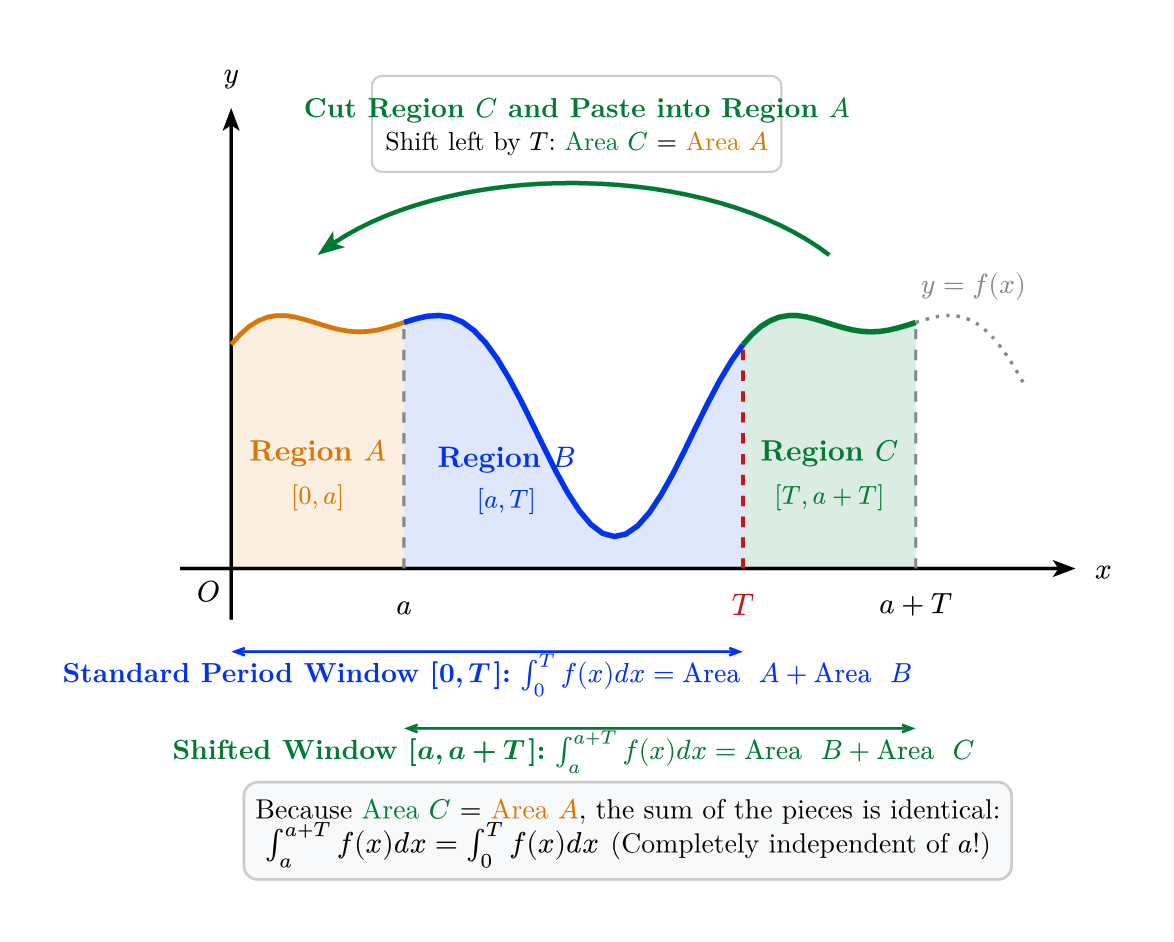
To understand why this independence occurs, let us look at the geometry of the curve:
Consider the standard fundamental interval [ 0 , T ] [0, T] [ 0 , T ]
∫ 0 T f ( x ) d x \int_0^T f(x) \, dx ∫ 0 T f ( x ) d x Now slide the integration window to the right by an offset a a a [ a , a + T ] [a, a + T] [ a , a + T ]
We can split both the standard window [ 0 , T ] [0, T] [ 0 , T ] [ a , a + T ] [a, a + T] [ a , a + T ] a a a T T T
Region A A A The interval [ 0 , a ] [0, a] [ 0 , a ] Region B B B The shared interval [ a , T ] [a, T] [ a , T ] Region C C C The interval [ T , a + T ] [T, a + T] [ T , a + T ]
Now observe what happens to the total area of the two windows:
Standard Window [ 0 , T ] [0, T] [ 0 , T ]
∫ 0 T f ( x ) d x = Area ( A ) + Area ( B ) = ∫ 0 a f ( x ) d x + ∫ a T f ( x ) d x \int_0^T f(x) \, dx = \text{Area}(A) + \text{Area}(B) = \int_0^a f(x) \, dx + \int_a^T f(x) \, dx ∫ 0 T f ( x ) d x = Area ( A ) + Area ( B ) = ∫ 0 a f ( x ) d x + ∫ a T f ( x ) d x Shifted Window [ a , a + T ] [a, a + T] [ a , a + T ]
∫ a a + T f ( x ) d x = Area ( B ) + Area ( C ) = ∫ a T f ( x ) d x + ∫ T a + T f ( x ) d x \int_a^{a + T} f(x) \, dx = \text{Area}(B) + \text{Area}(C) = \int_a^T f(x) \, dx + \int_T^{a + T} f(x) \, dx ∫ a a + T f ( x ) d x = Area ( B ) + Area ( C ) = ∫ a T f ( x ) d x + ∫ T a + T f ( x ) d x Notice that both windows share the exact same middle piece, Region B B B .
What about Region A A A C C C C C C [ T , a + T ] [T, a + T] [ T , a + T ] T T T x → x − T x \to x - T x → x − T [ 0 , a ] [0, a] [ 0 , a ]
Because f ( x ) f(x) f ( x ) T T T C C C f ( t + T ) f(t + T) f ( t + T ) A A A f ( t ) f(t) f ( t )
Area ( C ) = ∫ T a + T f ( x ) d x = ∫ 0 a f ( t + T ) d t = ∫ 0 a f ( t ) d t = Area ( A ) \text{Area}(C) = \int_T^{a + T} f(x) \, dx = \int_0^a f(t + T) \, dt = \int_0^a f(t) \, dt = \text{Area}(A) Area ( C ) = ∫ T a + T f ( x ) d x = ∫ 0 a f ( t + T ) d t = ∫ 0 a f ( t ) d t = Area ( A ) Geometrically, we can literally cut Region C C C paste it onto the left end into Region A A A B B B [ 0 , T ] [0, T] [ 0 , T ]
∫ a a + T f ( x ) d x = Area ( B ) + Area ( C ) = Area ( B ) + Area ( A ) = ∫ 0 T f ( x ) d x \int_a^{a + T} f(x) \, dx = \text{Area}(B) + \text{Area}(C) = \text{Area}(B) + \text{Area}(A) = \int_0^T f(x) \, dx ∫ a a + T f ( x ) d x = Area ( B ) + Area ( C ) = Area ( B ) + Area ( A ) = ∫ 0 T f ( x ) d x Algebraic Proof via Substitution§
We can confirm this result algebraically:
Split the integral at x = T x = T x = T
∫ a a + T f ( x ) d x = ∫ a T f ( x ) d x + ∫ T a + T f ( x ) d x \int_a^{a + T} f(x) \, dx = \int_a^T f(x) \, dx + \int_T^{a + T} f(x) \, dx ∫ a a + T f ( x ) d x = ∫ a T f ( x ) d x + ∫ T a + T f ( x ) d x In the second integral, substitute:
x = t + T ⟹ d x = d t x = t + T \implies dx = dt x = t + T ⟹ d x = d t
When x = T x = T x = T t = T − T = 0 t = T - T = 0 t = T − T = 0
When x = a + T x = a + T x = a + T t = ( a + T ) − T = a t = (a + T) - T = a t = ( a + T ) − T = a
Since f ( t + T ) = f ( t ) f(t + T) = f(t) f ( t + T ) = f ( t )
∫ T a + T f ( x ) d x = ∫ 0 a f ( t + T ) d t = ∫ 0 a f ( t ) d t \int_T^{a + T} f(x) \, dx = \int_0^a f(t + T) \, dt = \int_0^a f(t) \, dt ∫ T a + T f ( x ) d x = ∫ 0 a f ( t + T ) d t = ∫ 0 a f ( t ) d t Renaming the dummy variable t t t x x x
∫ T a + T f ( x ) d x = ∫ 0 a f ( x ) d x \int_T^{a + T} f(x) \, dx = \int_0^a f(x) \, dx ∫ T a + T f ( x ) d x = ∫ 0 a f ( x ) d x Substitute this back into the split sum:
∫ a a + T f ( x ) d x = ∫ a T f ( x ) d x + ∫ 0 a f ( x ) d x = ∫ 0 a f ( x ) d x + ∫ a T f ( x ) d x = ∫ 0 T f ( x ) d x \int_a^{a + T} f(x) \, dx = \int_a^T f(x) \, dx + \int_0^a f(x) \, dx = \int_0^a f(x) \, dx + \int_a^T f(x) \, dx = \int_0^T f(x) \, dx ∫ a a + T f ( x ) d x = ∫ a T f ( x ) d x + ∫ 0 a f ( x ) d x = ∫ 0 a f ( x ) d x + ∫ a T f ( x ) d x = ∫ 0 T f ( x ) d x The Calculus Proof: Differentiating with Respect to the Offset§
There is another elegant perspective on why this integral does not depend on a a a
Define the function:
g ( a ) = ∫ a a + T f ( x ) d x g(a) = \int_a^{a + T} f(x) \, dx g ( a ) = ∫ a a + T f ( x ) d x Differentiate g ( a ) g(a) g ( a ) a a a
g ′ ( a ) = d d a ∫ a a + T f ( x ) d x = f ( a + T ) ⋅ d d a ( a + T ) − f ( a ) ⋅ d d a ( a ) g'(a) = \frac{d}{da} \int_a^{a + T} f(x) \, dx = f(a + T) \cdot \frac{d}{da}(a + T) - f(a) \cdot \frac{d}{da}(a) g ′ ( a ) = d a d ∫ a a + T f ( x ) d x = f ( a + T ) ⋅ d a d ( a + T ) − f ( a ) ⋅ d a d ( a ) g ′ ( a ) = f ( a + T ) ⋅ 1 − f ( a ) ⋅ 1 = f ( a + T ) − f ( a ) g'(a) = f(a + T) \cdot 1 - f(a) \cdot 1 = f(a + T) - f(a) g ′ ( a ) = f ( a + T ) ⋅ 1 − f ( a ) ⋅ 1 = f ( a + T ) − f ( a ) Because f ( x ) f(x) f ( x ) T T T f ( a + T ) = f ( a ) f(a + T) = f(a) f ( a + T ) = f ( a )
g ′ ( a ) = f ( a ) − f ( a ) = 0 g'(a) = f(a) - f(a) = 0 g ′ ( a ) = f ( a ) − f ( a ) = 0 A function whose derivative is zero everywhere must be a constant function ! Therefore, g ( a ) g(a) g ( a ) a a a a = 0 a = 0 a = 0
g ( a ) = g ( 0 ) = ∫ 0 T f ( x ) d x g(a) = g(0) = \int_0^T f(x) \, dx g ( a ) = g ( 0 ) = ∫ 0 T f ( x ) d x Exploiting Parameter Independence in Problem Solving§
Because the value of ∫ a a + T f ( x ) d x \int_a^{a + T} f(x)\,dx ∫ a a + T f ( x ) d x a a a a a a
Example 1: Choosing a Convenient Lower Limit§
Evaluate:
I = ∫ a a + π ∣ cos x ∣ d x for any a ∈ R I = \int_a^{a + \pi} |\cos x| \, dx \qquad \text{for any } a \in \mathbb{R} I = ∫ a a + π ∣ cos x ∣ d x for any a ∈ R Solution:
The function f ( x ) = ∣ cos x ∣ f(x) = |\cos x| f ( x ) = ∣ cos x ∣ T = π T = \pi T = π ( a + π ) − a = π (a + \pi) - a = \pi ( a + π ) − a = π a a a
We can choose any convenient value of a a a a = − π / 2 a = -\pi/2 a = − π /2
I = ∫ − π / 2 π / 2 ∣ cos x ∣ d x I = \int_{-\pi/2}^{\pi/2} |\cos x| \, dx I = ∫ − π /2 π /2 ∣ cos x ∣ d x Why choose − π / 2 -\pi/2 − π /2 [ − π / 2 , π / 2 ] [-\pi/2, \pi/2] [ − π /2 , π /2 ] cos x ≥ 0 \cos x \ge 0 cos x ≥ 0 ∣ cos x ∣ = cos x |\cos x| = \cos x ∣ cos x ∣ = cos x
I = ∫ − π / 2 π / 2 cos x d x = [ sin x ] − π / 2 π / 2 = sin ( π 2 ) − sin ( − π 2 ) = 1 − ( − 1 ) = 2 I = \int_{-\pi/2}^{\pi/2} \cos x \, dx = \Big[ \sin x \Big]_{-\pi/2}^{\pi/2} = \sin\left(\frac{\pi}{2}\right) - \sin\left(-\frac{\pi}{2}\right) = 1 - (-1) = 2 I = ∫ − π /2 π /2 cos x d x = [ sin x ] − π /2 π /2 = sin ( 2 π ) − sin ( − 2 π ) = 1 − ( − 1 ) = 2 Notice how much simpler this was than trying to integrate over an arbitrary interval [ a , a + π ] [a, a + \pi] [ a , a + π ] cos x \cos x cos x
Example 2: Eliminating an Intractable Parameter§
Evaluate:
I = ∫ 100 100 + 2 π sin x 1 + cos 2 x d x I = \int_{100}^{100 + 2\pi} \frac{\sin x}{1 + \cos^2 x} \, dx I = ∫ 100 100 + 2 π 1 + cos 2 x sin x d x Solution:
The integrand f ( x ) = sin x 1 + cos 2 x f(x) = \frac{\sin x}{1 + \cos^2 x} f ( x ) = 1 + c o s 2 x s i n x T = 2 π T = 2\pi T = 2 π
f ( x + 2 π ) = sin ( x + 2 π ) 1 + cos 2 ( x + 2 π ) = sin x 1 + cos 2 x = f ( x ) f(x + 2\pi) = \frac{\sin(x + 2\pi)}{1 + \cos^2(x + 2\pi)} = \frac{\sin x}{1 + \cos^2 x} = f(x) f ( x + 2 π ) = 1 + cos 2 ( x + 2 π ) sin ( x + 2 π ) = 1 + cos 2 x sin x = f ( x ) The interval [ 100 , 100 + 2 π ] [100, 100 + 2\pi] [ 100 , 100 + 2 π ] 2 π 2\pi 2 π 100 100 100 0 0 0
I = ∫ 0 2 π sin x 1 + cos 2 x d x I = \int_0^{2\pi} \frac{\sin x}{1 + \cos^2 x} \, dx I = ∫ 0 2 π 1 + cos 2 x sin x d x Now substitute u = cos x ⟹ d u = − sin x d x u = \cos x \implies du = -\sin x\,dx u = cos x ⟹ d u = − sin x d x
When x = 0 x = 0 x = 0 u = cos 0 = 1 u = \cos 0 = 1 u = cos 0 = 1
When x = 2 π x = 2\pi x = 2 π u = cos 2 π = 1 u = \cos 2\pi = 1 u = cos 2 π = 1
I = ∫ 1 1 − d u 1 + u 2 = 0 I = \int_1^1 \frac{-du}{1 + u^2} = 0 I = ∫ 1 1 1 + u 2 − d u = 0 The intimidating starting point 100 100 100
Example 3: Constant Integral Functions§
Let F ( x ) = ∫ x x + 2 π d t 1 + e sin t F(x) = \int_x^{x + 2\pi} \frac{dt}{1 + e^{\sin t}} F ( x ) = ∫ x x + 2 π 1 + e s i n t d t F ( x ) F(x) F ( x )
Solution:
The integrand f ( t ) = 1 1 + e sin t f(t) = \frac{1}{1 + e^{\sin t}} f ( t ) = 1 + e s i n t 1 T = 2 π T = 2\pi T = 2 π sin ( t + 2 π ) = sin t \sin(t + 2\pi) = \sin t sin ( t + 2 π ) = sin t ( x + 2 π ) − x = 2 π (x + 2\pi) - x = 2\pi ( x + 2 π ) − x = 2 π
By our theorem, F ( x ) F(x) F ( x ) x x x
F ( x ) = ∫ 0 2 π d t 1 + e sin t F(x) = \int_0^{2\pi} \frac{dt}{1 + e^{\sin t}} F ( x ) = ∫ 0 2 π 1 + e s i n t d t To evaluate this integral, apply King's Rule on [ 0 , 2 π ] [0, 2\pi] [ 0 , 2 π ] t t t 2 π − t 2\pi - t 2 π − t
F ( x ) = ∫ 0 2 π d t 1 + e sin ( 2 π − t ) = ∫ 0 2 π d t 1 + e − sin t = ∫ 0 2 π e sin t e sin t + 1 d t F(x) = \int_0^{2\pi} \frac{dt}{1 + e^{\sin(2\pi - t)}} = \int_0^{2\pi} \frac{dt}{1 + e^{-\sin t}} = \int_0^{2\pi} \frac{e^{\sin t}}{e^{\sin t} + 1} \, dt F ( x ) = ∫ 0 2 π 1 + e s i n ( 2 π − t ) d t = ∫ 0 2 π 1 + e − s i n t d t = ∫ 0 2 π e s i n t + 1 e s i n t d t Adding the two expressions:
2 F ( x ) = ∫ 0 2 π [ 1 1 + e sin t + e sin t 1 + e sin t ] d t = ∫ 0 2 π 1 d t = 2 π 2F(x) = \int_0^{2\pi} \left[ \frac{1}{1 + e^{\sin t}} + \frac{e^{\sin t}}{1 + e^{\sin t}} \right] \, dt = \int_0^{2\pi} 1 \, dt = 2\pi 2 F ( x ) = ∫ 0 2 π [ 1 + e s i n t 1 + 1 + e s i n t e s i n t ] d t = ∫ 0 2 π 1 d t = 2 π Dividing by 2 2 2
F ( x ) = π F(x) = \pi F ( x ) = π Thus, F ( x ) = π F(x) = \pi F ( x ) = π x ∈ R x \in \mathbb{R} x ∈ R
Multiple Periods: Tiling and Scaling§
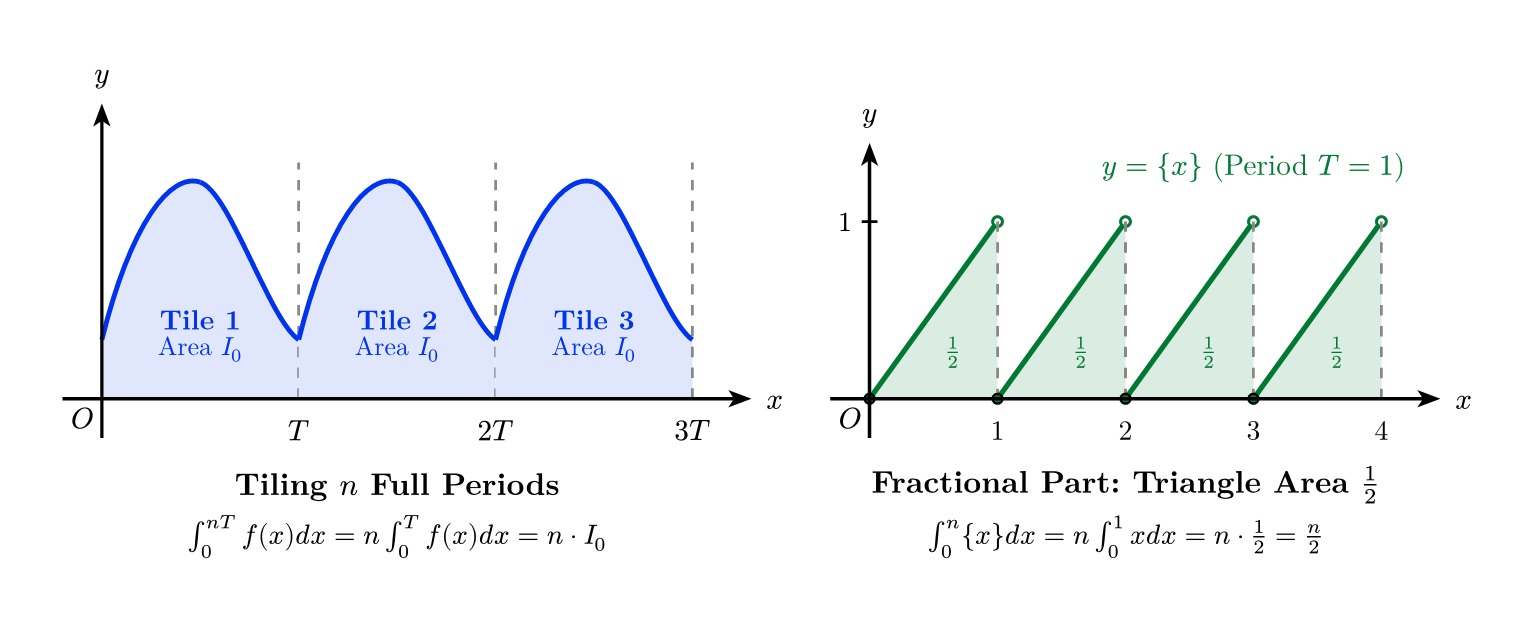
Now that we understand a single period, what happens when we integrate over n n n
Theorem: Multiple Full Periods§
If f ( x ) f(x) f ( x ) T T T n ∈ Z n \in \mathbb{Z} n ∈ Z
∫ 0 n T f ( x ) d x = n ∫ 0 T f ( x ) d x \int_0^{nT} f(x) \, dx = n \int_0^T f(x) \, dx ∫ 0 n T f ( x ) d x = n ∫ 0 T f ( x ) d x and more generally, for any starting point a ∈ R a \in \mathbb{R} a ∈ R
∫ a a + n T f ( x ) d x = n ∫ 0 T f ( x ) d x \int_a^{a + nT} f(x) \, dx = n \int_0^T f(x) \, dx ∫ a a + n T f ( x ) d x = n ∫ 0 T f ( x ) d x Proof
Split the integral over [ a , a + n T ] [a, a + nT] [ a , a + n T ] n n n T T T
∫ a a + n T f ( x ) d x = ∑ k = 0 n − 1 ∫ a + k T a + ( k + 1 ) T f ( x ) d x \int_a^{a + nT} f(x) \, dx = \sum_{k=0}^{n-1} \int_{a + kT}^{a + (k+1)T} f(x) \, dx ∫ a a + n T f ( x ) d x = k = 0 ∑ n − 1 ∫ a + k T a + ( k + 1 ) T f ( x ) d x Notice that each term is an integral over an interval of length T T T
[ a + k T , a + ( k + 1 ) T ] = [ c , c + T ] where c = a + k T [a + kT, \, a + (k+1)T] = [c, \, c + T] \qquad \text{where } c = a + kT [ a + k T , a + ( k + 1 ) T ] = [ c , c + T ] where c = a + k T By our single-period translation invariance theorem, every single one of these n n n ∫ 0 T f ( x ) d x \int_0^T f(x)\,dx ∫ 0 T f ( x ) d x
∫ a + k T a + ( k + 1 ) T f ( x ) d x = ∫ 0 T f ( x ) d x \int_{a + kT}^{a + (k+1)T} f(x) \, dx = \int_0^T f(x) \, dx ∫ a + k T a + ( k + 1 ) T f ( x ) d x = ∫ 0 T f ( x ) d x Summing these n n n
∫ a a + n T f ( x ) d x = ∑ k = 0 n − 1 ∫ 0 T f ( x ) d x = n ∫ 0 T f ( x ) d x \int_a^{a + nT} f(x) \, dx = \sum_{k=0}^{n-1} \int_0^T f(x) \, dx = n \int_0^T f(x) \, dx ∫ a a + n T f ( x ) d x = k = 0 ∑ n − 1 ∫ 0 T f ( x ) d x = n ∫ 0 T f ( x ) d x
Geometrically, integrating over n n n n n n
Theorem: Difference of Integer Multiples§
For any integers m , n ∈ Z m, n \in \mathbb{Z} m , n ∈ Z
∫ m T n T f ( x ) d x = ( n − m ) ∫ 0 T f ( x ) d x \int_{mT}^{nT} f(x) \, dx = (n - m) \int_0^T f(x) \, dx ∫ m T n T f ( x ) d x = ( n − m ) ∫ 0 T f ( x ) d x Proof
Split the integral at 0 0 0
∫ m T n T f ( x ) d x = ∫ 0 n T f ( x ) d x − ∫ 0 m T f ( x ) d x \int_{mT}^{nT} f(x) \, dx = \int_0^{nT} f(x) \, dx - \int_0^{mT} f(x) \, dx ∫ m T n T f ( x ) d x = ∫ 0 n T f ( x ) d x − ∫ 0 m T f ( x ) d x Using the previous theorem:
= n ∫ 0 T f ( x ) d x − m ∫ 0 T f ( x ) d x = ( n − m ) ∫ 0 T f ( x ) d x = n \int_0^T f(x) \, dx - m \int_0^T f(x) \, dx = (n - m) \int_0^T f(x) \, dx = n ∫ 0 T f ( x ) d x − m ∫ 0 T f ( x ) d x = ( n − m ) ∫ 0 T f ( x ) d x Theorem: Incomplete and Fractional Bounds§
What if the upper limit is not an exact integer multiple of T T T
For any integer n ∈ Z n \in \mathbb{Z} n ∈ Z b b b
∫ n T n T + b f ( x ) d x = ∫ 0 b f ( x ) d x \int_{nT}^{nT + b} f(x) \, dx = \int_0^b f(x) \, dx ∫ n T n T + b f ( x ) d x = ∫ 0 b f ( x ) d x Proof
Substitute x = t + n T ⟹ d x = d t x = t + nT \implies dx = dt x = t + n T ⟹ d x = d t
When x = n T x = nT x = n T t = 0 t = 0 t = 0
When x = n T + b x = nT + b x = n T + b t = b t = b t = b
Since f ( t + n T ) = f ( t ) f(t + nT) = f(t) f ( t + n T ) = f ( t )
∫ n T n T + b f ( x ) d x = ∫ 0 b f ( t + n T ) d t = ∫ 0 b f ( t ) d t = ∫ 0 b f ( x ) d x \int_{nT}^{nT + b} f(x) \, dx = \int_0^b f(t + nT) \, dt = \int_0^b f(t) \, dt = \int_0^b f(x) \, dx ∫ n T n T + b f ( x ) d x = ∫ 0 b f ( t + n T ) d t = ∫ 0 b f ( t ) d t = ∫ 0 b f ( x ) d x The General Decomposition Rule
Whenever an integral has limits from 0 0 0 n T + α nT + \alpha n T + α 0 ≤ α < T 0 \le \alpha < T 0 ≤ α < T
∫ 0 n T + α f ( x ) d x = ∫ 0 n T f ( x ) d x + ∫ n T n T + α f ( x ) d x = n ∫ 0 T f ( x ) d x + ∫ 0 α f ( x ) d x \int_0^{nT + \alpha} f(x) \, dx = \int_0^{nT} f(x) \, dx + \int_{nT}^{nT + \alpha} f(x) \, dx = n \int_0^T f(x) \, dx + \int_0^\alpha f(x) \, dx ∫ 0 n T + α f ( x ) d x = ∫ 0 n T f ( x ) d x + ∫ n T n T + α f ( x ) d x = n ∫ 0 T f ( x ) d x + ∫ 0 α f ( x ) d x The integral cleanly decomposes into n n n
The Fractional Part Function in Definite Integration§
The fractional part function { x } = x − ⌊ x ⌋ \{x\} = x - \lfloor x \rfloor { x } = x − ⌊ x ⌋
Key Properties of the Fractional Part§
Periodicity: { x + 1 } = { x } \{x + 1\} = \{x\} { x + 1 } = { x } x x x T = 1 T = 1 T = 1
Piecewise Definition: On each unit interval [ k , k + 1 ) [k, k + 1) [ k , k + 1 ) k ∈ Z k \in \mathbb{Z} k ∈ Z
⌊ x ⌋ = k ⟹ { x } = x − k \lfloor x \rfloor = k \implies \{x\} = x - k ⌊ x ⌋ = k ⟹ { x } = x − k
Range: 0 ≤ { x } < 1 0 \le \{x\} < 1 0 ≤ { x } < 1
Fundamental Integrals of the Fractional Part§
Over the fundamental period [ 0 , 1 ] [0, 1] [ 0 , 1 ] { x } = x \{x\} = x { x } = x g ( { x } ) g(\{x\}) g ({ x }) [ 0 , 1 ] [0, 1] [ 0 , 1 ] g ( x ) g(x) g ( x )
∫ 0 1 { x } d x = ∫ 0 1 x d x = [ x 2 2 ] 0 1 = 1 2 \int_0^1 \{x\} \, dx = \int_0^1 x \, dx = \left[ \frac{x^2}{2} \right]_0^1 = \frac{1}{2} ∫ 0 1 { x } d x = ∫ 0 1 x d x = [ 2 x 2 ] 0 1 = 2 1 ∫ 0 1 { x } 2 d x = ∫ 0 1 x 2 d x = [ x 3 3 ] 0 1 = 1 3 \int_0^1 \{x\}^2 \, dx = \int_0^1 x^2 \, dx = \left[ \frac{x^3}{3} \right]_0^1 = \frac{1}{3} ∫ 0 1 { x } 2 d x = ∫ 0 1 x 2 d x = [ 3 x 3 ] 0 1 = 3 1 ∫ 0 1 e { x } d x = ∫ 0 1 e x d x = [ e x ] 0 1 = e − 1 \int_0^1 e^{\{x\}} \, dx = \int_0^1 e^x \, dx = \Big[ e^x \Big]_0^1 = e - 1 ∫ 0 1 e { x } d x = ∫ 0 1 e x d x = [ e x ] 0 1 = e − 1 ∫ 0 1 d x 1 + { x } = ∫ 0 1 d x 1 + x = [ ln ( 1 + x ) ] 0 1 = ln 2 \int_0^1 \frac{dx}{1 + \{x\}} = \int_0^1 \frac{dx}{1 + x} = \Big[ \ln(1 + x) \Big]_0^1 = \ln 2 ∫ 0 1 1 + { x } d x = ∫ 0 1 1 + x d x = [ ln ( 1 + x ) ] 0 1 = ln 2 Evaluating Large Limits with Fractional Parts§
Using the periodic tiling theorem ∫ 0 n f ( x ) d x = n ∫ 0 1 f ( x ) d x \int_0^n f(x)\,dx = n \int_0^1 f(x)\,dx ∫ 0 n f ( x ) d x = n ∫ 0 1 f ( x ) d x T = 1 T = 1 T = 1
∫ 0 n { x } d x = n ∫ 0 1 x d x = n 2 \int_0^n \{x\} \, dx = n \int_0^1 x \, dx = \frac{n}{2} ∫ 0 n { x } d x = n ∫ 0 1 x d x = 2 n ∫ 0 n e { x } d x = n ∫ 0 1 e x d x = n ( e − 1 ) \int_0^n e^{\{x\}} \, dx = n \int_0^1 e^x \, dx = n(e - 1) ∫ 0 n e { x } d x = n ∫ 0 1 e x d x = n ( e − 1 ) ∫ 0 n d x 1 + { x } = n ∫ 0 1 d x 1 + x = n ln 2 \int_0^n \frac{dx}{1 + \{x\}} = n \int_0^1 \frac{dx}{1 + x} = n \ln 2 ∫ 0 n 1 + { x } d x = n ∫ 0 1 1 + x d x = n ln 2 Interplay Between Floor and Fractional Part§
Integrals often combine the floor function ⌊ x ⌋ \lfloor x \rfloor ⌊ x ⌋ { x } \{x\} { x }
I = ∫ 0 n ⌊ x ⌋ f ( { x } ) d x ( n ∈ N ) I = \int_0^n \lfloor x \rfloor f(\{x\}) \, dx \qquad (n \in \mathbb{N}) I = ∫ 0 n ⌊ x ⌋ f ({ x }) d x ( n ∈ N ) The Evaluation Strategy
Split the interval [ 0 , n ] [0, n] [ 0 , n ] n n n [ k , k + 1 ] [k, k + 1] [ k , k + 1 ]
I = ∑ k = 0 n − 1 ∫ k k + 1 ⌊ x ⌋ f ( { x } ) d x I = \sum_{k=0}^{n-1} \int_k^{k+1} \lfloor x \rfloor f(\{x\}) \, dx I = k = 0 ∑ n − 1 ∫ k k + 1 ⌊ x ⌋ f ({ x }) d x On each sub-interval [ k , k + 1 ) [k, k + 1) [ k , k + 1 )
⌊ x ⌋ = k \lfloor x \rfloor = k ⌊ x ⌋ = k { x } = x − k \{x\} = x - k { x } = x − k
Substitute t = x − k ⟹ d x = d t t = x - k \implies dx = dt t = x − k ⟹ d x = d t t t t 0 0 0 1 1 1
∫ k k + 1 ⌊ x ⌋ f ( { x } ) d x = k ∫ k k + 1 f ( x − k ) d x = k ∫ 0 1 f ( t ) d t \int_k^{k+1} \lfloor x \rfloor f(\{x\}) \, dx = k \int_k^{k+1} f(x - k) \, dx = k \int_0^1 f(t) \, dt ∫ k k + 1 ⌊ x ⌋ f ({ x }) d x = k ∫ k k + 1 f ( x − k ) d x = k ∫ 0 1 f ( t ) d t Now pull the integral outside the summation:
I = ∑ k = 0 n − 1 ( k ∫ 0 1 f ( t ) d t ) = ( ∑ k = 0 n − 1 k ) ∫ 0 1 f ( t ) d t I = \sum_{k=0}^{n-1} \left( k \int_0^1 f(t) \, dt \right) = \left( \sum_{k=0}^{n-1} k \right) \int_0^1 f(t) \, dt I = k = 0 ∑ n − 1 ( k ∫ 0 1 f ( t ) d t ) = ( k = 0 ∑ n − 1 k ) ∫ 0 1 f ( t ) d t Recall the arithmetic sum ∑ k = 0 n − 1 k = ( n − 1 ) n 2 \sum_{k=0}^{n-1} k = \frac{(n-1)n}{2} ∑ k = 0 n − 1 k = 2 ( n − 1 ) n
∫ 0 n ⌊ x ⌋ f ( { x } ) d x = n ( n − 1 ) 2 ∫ 0 1 f ( x ) d x \int_0^n \lfloor x \rfloor f(\{x\}) \, dx = \frac{n(n - 1)}{2} \int_0^1 f(x) \, dx ∫ 0 n ⌊ x ⌋ f ({ x }) d x = 2 n ( n − 1 ) ∫ 0 1 f ( x ) d x Miscellaneous Examples§
Example 4: A Large Trigonometric Power Integral§
Evaluate:
I = ∫ 0 100 π 1 − cos 2 x d x I = \int_0^{100\pi} \sqrt{1 - \cos 2x} \, dx I = ∫ 0 100 π 1 − cos 2 x d x Solution:
Use the half-angle trigonometric identity 1 − cos 2 x = 2 sin 2 x 1 - \cos 2x = 2\sin^2 x 1 − cos 2 x = 2 sin 2 x
1 − cos 2 x = 2 sin 2 x = 2 ∣ sin x ∣ \sqrt{1 - \cos 2x} = \sqrt{2\sin^2 x} = \sqrt{2} |\sin x| 1 − cos 2 x = 2 sin 2 x = 2 ∣ sin x ∣ The function ∣ sin x ∣ |\sin x| ∣ sin x ∣ T = π T = \pi T = π 100 π 100\pi 100 π n = 100 n = 100 n = 100
Applying the tiling theorem:
I = ∫ 0 100 π 2 ∣ sin x ∣ d x = 100 2 ∫ 0 π ∣ sin x ∣ d x I = \int_0^{100\pi} \sqrt{2} |\sin x| \, dx = 100 \sqrt{2} \int_0^\pi |\sin x| \, dx I = ∫ 0 100 π 2 ∣ sin x ∣ d x = 100 2 ∫ 0 π ∣ sin x ∣ d x On the interval [ 0 , π ] [0, \pi] [ 0 , π ] sin x ≥ 0 \sin x \ge 0 sin x ≥ 0 ∣ sin x ∣ = sin x |\sin x| = \sin x ∣ sin x ∣ = sin x
∫ 0 π ∣ sin x ∣ d x = ∫ 0 π sin x d x = [ − cos x ] 0 π = − ( − 1 ) − ( − 1 ) = 2 \int_0^\pi |\sin x| \, dx = \int_0^\pi \sin x \, dx = \Big[ -\cos x \Big]_0^\pi = -(-1) - (-1) = 2 ∫ 0 π ∣ sin x ∣ d x = ∫ 0 π sin x d x = [ − cos x ] 0 π = − ( − 1 ) − ( − 1 ) = 2 Therefore:
I = 100 2 ⋅ 2 = 200 2 I = 100\sqrt{2} \cdot 2 = 200\sqrt{2} I = 100 2 ⋅ 2 = 200 2 Example 5: Incomplete Boundary Integral§
Evaluate:
I = ∫ 0 20 π + π / 4 ∣ sin x ∣ d x I = \int_0^{20\pi + \pi/4} |\sin x| \, dx I = ∫ 0 20 π + π /4 ∣ sin x ∣ d x Solution:
The fundamental period of ∣ sin x ∣ |\sin x| ∣ sin x ∣ T = π T = \pi T = π n T + α nT + \alpha n T + α n = 20 n = 20 n = 20 T = π T = \pi T = π α = π / 4 \alpha = \pi/4 α = π /4
Apply the incomplete bound decomposition rule:
I = 20 ∫ 0 π ∣ sin x ∣ d x + ∫ 0 π / 4 ∣ sin x ∣ d x I = 20 \int_0^\pi |\sin x| \, dx + \int_0^{\pi/4} |\sin x| \, dx I = 20 ∫ 0 π ∣ sin x ∣ d x + ∫ 0 π /4 ∣ sin x ∣ d x Evaluate the two pieces:
The full period piece: ∫ 0 π sin x d x = 2 \int_0^\pi \sin x\,dx = 2 ∫ 0 π sin x d x = 2
The partial piece on [ 0 , π / 4 ] [0, \pi/4] [ 0 , π /4 ]
∫ 0 π / 4 sin x d x = [ − cos x ] 0 π / 4 = − 1 2 − ( − 1 ) = 1 − 1 2 \int_0^{\pi/4} \sin x \, dx = \Big[ -\cos x \Big]_0^{\pi/4} = -\frac{1}{\sqrt{2}} - (-1) = 1 - \frac{1}{\sqrt{2}} ∫ 0 π /4 sin x d x = [ − cos x ] 0 π /4 = − 2 1 − ( − 1 ) = 1 − 2 1 Combining both parts:
I = 20 ( 2 ) + ( 1 − 1 2 ) = 40 + 1 − 2 2 = 41 − 1 2 I = 20(2) + \left( 1 - \frac{1}{\sqrt{2}} \right) = 40 + 1 - \frac{\sqrt{2}}{2} = 41 - \frac{1}{\sqrt{2}} I = 20 ( 2 ) + ( 1 − 2 1 ) = 40 + 1 − 2 2 = 41 − 2 1 Example 6: Floor and Fractional Part Interaction§
Evaluate:
I = ∫ 0 10 x { x } d x I = \int_0^{10} x \{x\} \, dx I = ∫ 0 10 x { x } d x Solution:
Write x x x x = ⌊ x ⌋ + { x } x = \lfloor x \rfloor + \{x\} x = ⌊ x ⌋ + { x }
I = ∫ 0 10 ( ⌊ x ⌋ + { x } ) { x } d x = ∫ 0 10 ⌊ x ⌋ { x } d x + ∫ 0 10 { x } 2 d x I = \int_0^{10} \big( \lfloor x \rfloor + \{x\} \big) \{x\} \, dx = \int_0^{10} \lfloor x \rfloor \{x\} \, dx + \int_0^{10} \{x\}^2 \, dx I = ∫ 0 10 ( ⌊ x ⌋ + { x } ) { x } d x = ∫ 0 10 ⌊ x ⌋ { x } d x + ∫ 0 10 { x } 2 d x Evaluate each term separately:
First term: Using our formula ∫ 0 n ⌊ x ⌋ { x } d x = n ( n − 1 ) 2 ∫ 0 1 x d x \int_0^n \lfloor x \rfloor \{x\}\,dx = \frac{n(n - 1)}{2} \int_0^1 x\,dx ∫ 0 n ⌊ x ⌋ { x } d x = 2 n ( n − 1 ) ∫ 0 1 x d x n = 10 n = 10 n = 10
∫ 0 10 ⌊ x ⌋ { x } d x = 10 × 9 2 ∫ 0 1 x d x = 45 × 1 2 = 45 2 \int_0^{10} \lfloor x \rfloor \{x\} \, dx = \frac{10 \times 9}{2} \int_0^1 x \, dx = 45 \times \frac{1}{2} = \frac{45}{2} ∫ 0 10 ⌊ x ⌋ { x } d x = 2 10 × 9 ∫ 0 1 x d x = 45 × 2 1 = 2 45 Second term: Using periodic tiling for { x } 2 \{x\}^2 { x } 2 T = 1 T = 1 T = 1
∫ 0 10 { x } 2 d x = 10 ∫ 0 1 x 2 d x = 10 × 1 3 = 10 3 \int_0^{10} \{x\}^2 \, dx = 10 \int_0^1 x^2 \, dx = 10 \times \frac{1}{3} = \frac{10}{3} ∫ 0 10 { x } 2 d x = 10 ∫ 0 1 x 2 d x = 10 × 3 1 = 3 10 Adding the two components:
I = 45 2 + 10 3 = 135 + 20 6 = 155 6 I = \frac{45}{2} + \frac{10}{3} = \frac{135 + 20}{6} = \frac{155}{6} I = 2 45 + 3 10 = 6 135 + 20 = 6 155 Example 7: Combining Periodicity with King's Rule§
Evaluate:
I = ∫ 0 200 π d x 1 + e sin x I = \int_0^{200\pi} \frac{dx}{1 + e^{\sin x}} I = ∫ 0 200 π 1 + e s i n x d x Solution:
The integrand f ( x ) = 1 1 + e sin x f(x) = \frac{1}{1 + e^{\sin x}} f ( x ) = 1 + e s i n x 1 T = 2 π T = 2\pi T = 2 π 200 π = 100 × ( 2 π ) 200\pi = 100 \times (2\pi) 200 π = 100 × ( 2 π ) n = 100 n = 100 n = 100
By the periodic tiling theorem:
I = 100 ∫ 0 2 π d x 1 + e sin x I = 100 \int_0^{2\pi} \frac{dx}{1 + e^{\sin x}} I = 100 ∫ 0 2 π 1 + e s i n x d x Now evaluate J = ∫ 0 2 π d x 1 + e sin x J = \int_0^{2\pi} \frac{dx}{1 + e^{\sin x}} J = ∫ 0 2 π 1 + e s i n x d x [ 0 , 2 π ] [0, 2\pi] [ 0 , 2 π ] x x x 2 π − x 2\pi - x 2 π − x
J = ∫ 0 2 π d x 1 + e sin ( 2 π − x ) = ∫ 0 2 π d x 1 + e − sin x = ∫ 0 2 π e sin x 1 + e sin x d x J = \int_0^{2\pi} \frac{dx}{1 + e^{\sin(2\pi - x)}} = \int_0^{2\pi} \frac{dx}{1 + e^{-\sin x}} = \int_0^{2\pi} \frac{e^{\sin x}}{1 + e^{\sin x}} \, dx J = ∫ 0 2 π 1 + e s i n ( 2 π − x ) d x = ∫ 0 2 π 1 + e − s i n x d x = ∫ 0 2 π 1 + e s i n x e s i n x d x Adding the two equations:
2 J = ∫ 0 2 π 1 + e sin x 1 + e sin x d x = ∫ 0 2 π 1 d x = 2 π ⟹ J = π 2J = \int_0^{2\pi} \frac{1 + e^{\sin x}}{1 + e^{\sin x}} \, dx = \int_0^{2\pi} 1 \, dx = 2\pi \implies J = \pi 2 J = ∫ 0 2 π 1 + e s i n x 1 + e s i n x d x = ∫ 0 2 π 1 d x = 2 π ⟹ J = π Therefore:
I = 100 ⋅ J = 100 π I = 100 \cdot J = 100\pi I = 100 ⋅ J = 100 π Example 8: Rational Function of the Fractional Part§
Evaluate:
I = ∫ 0 50 d x 2 + { x } I = \int_0^{50} \frac{dx}{2 + \{x\}} I = ∫ 0 50 2 + { x } d x Solution:
The integrand 1 2 + { x } \frac{1}{2 + \{x\}} 2 + { x } 1 T = 1 T = 1 T = 1 0 0 0 50 50 50 n = 50 n = 50 n = 50
Applying the periodic property:
I = 50 ∫ 0 1 d x 2 + { x } I = 50 \int_0^1 \frac{dx}{2 + \{x\}} I = 50 ∫ 0 1 2 + { x } d x On the fundamental interval [ 0 , 1 ] [0, 1] [ 0 , 1 ] { x } = x \{x\} = x { x } = x
I = 50 ∫ 0 1 d x 2 + x = 50 [ ln ( 2 + x ) ] 0 1 = 50 ( ln 3 − ln 2 ) = 50 ln ( 3 2 ) I = 50 \int_0^1 \frac{dx}{2 + x} = 50 \Big[ \ln(2 + x) \Big]_0^1 = 50 \big( \ln 3 - \ln 2 \big) = 50 \ln\left(\frac{3}{2}\right) I = 50 ∫ 0 1 2 + x d x = 50 [ ln ( 2 + x ) ] 0 1 = 50 ( ln 3 − ln 2 ) = 50 ln ( 2 3 ) Summary of Periodic Properties§
Property
Formula
Geometric Meaning
Window Invariance ∫ a a + T f ( x ) d x = ∫ 0 T f ( x ) d x \int_a^{a + T} f(x)\,dx = \int_0^T f(x)\,dx ∫ a a + T f ( x ) d x = ∫ 0 T f ( x ) d x Area over any interval of width T T T a a a
n n n ∫ 0 n T f ( x ) d x = n ∫ 0 T f ( x ) d x \int_0^{nT} f(x)\,dx = n \int_0^T f(x)\,dx ∫ 0 n T f ( x ) d x = n ∫ 0 T f ( x ) d x Tiling n n n
n n n a a a ∫ a a + n T f ( x ) d x = n ∫ 0 T f ( x ) d x \int_a^{a + nT} f(x)\,dx = n \int_0^T f(x)\,dx ∫ a a + n T f ( x ) d x = n ∫ 0 T f ( x ) d x Tiling n n n a a a
Difference of Multiples ∫ m T n T f ( x ) d x = ( n − m ) ∫ 0 T f ( x ) d x \int_{mT}^{nT} f(x)\,dx = (n - m)\int_0^T f(x)\,dx ∫ m T n T f ( x ) d x = ( n − m ) ∫ 0 T f ( x ) d x Net area over n − m n - m n − m
Incomplete Bounds ∫ n T n T + b f ( x ) d x = ∫ 0 b f ( x ) d x \int_{nT}^{nT + b} f(x)\,dx = \int_0^b f(x)\,dx ∫ n T n T + b f ( x ) d x = ∫ 0 b f ( x ) d x Shifting the boundary interval back to the origin
Fractional Part Rule ∫ 0 n g ( { x } ) d x = n ∫ 0 1 g ( x ) d x \int_0^n g(\{x\})\,dx = n \int_0^1 g(x)\,dx ∫ 0 n g ({ x }) d x = n ∫ 0 1 g ( x ) d x Integrating periodic { x } \{x\} { x } n n n T = 1 T = 1 T = 1
Floor & Fraction Product ∫ 0 n ⌊ x ⌋ f ( { x } ) d x = n ( n − 1 ) 2 ∫ 0 1 f ( x ) d x \int_0^n \lfloor x \rfloor f(\{x\})\,dx = \frac{n(n - 1)}{2} \int_0^1 f(x)\,dx ∫ 0 n ⌊ x ⌋ f ({ x }) d x = 2 n ( n − 1 ) ∫ 0 1 f ( x ) d x Factoring out constant integer steps