The modulus, absolute value, or magnitude of a real number x is denoted by ∣x∣ and is defined as the distance of x from the origin on the real number line. This distance is always non-negative.
Consider the numbers 5, -5, and 0:
For x=5, the modulus is ∣5∣=5. This is the distance from 0 to 5 on the number line, which is 5 units.
For x=−5, the modulus is ∣−5∣=5. Although -5 is 5 units left of the origin, distance is measured positively, thus it is also 5 units.
For x=0, the modulus is ∣0∣=0. The point 0 itself is at the origin, so its distance from the origin is zero.
The modulus ∣x∣ of a number x is defined by the following piecewise expression:
∣x∣={x−xif x≥0if x<0
In this piecewise definition:
If x is positive or zero (x≥0), then ∣x∣=x. Here, the output is the same as the input because the distance from the origin to a positive number or zero is the number itself.
If x is negative (x<0), then ∣x∣=−x. This calculation effectively removes the negative sign, turning x into a positive value. This is because the distance, being a measure of magnitude without direction, must always be positive or zero.
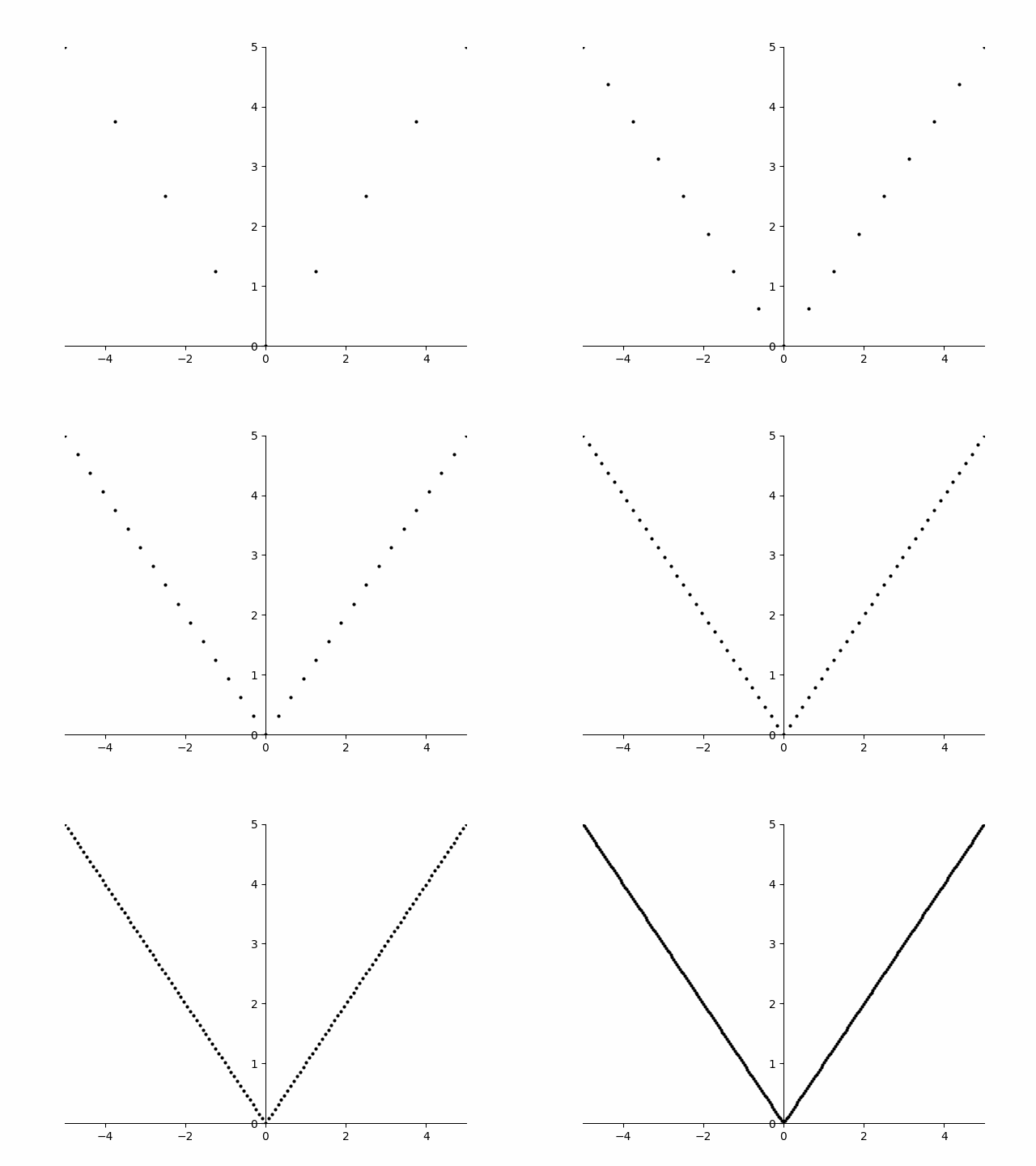
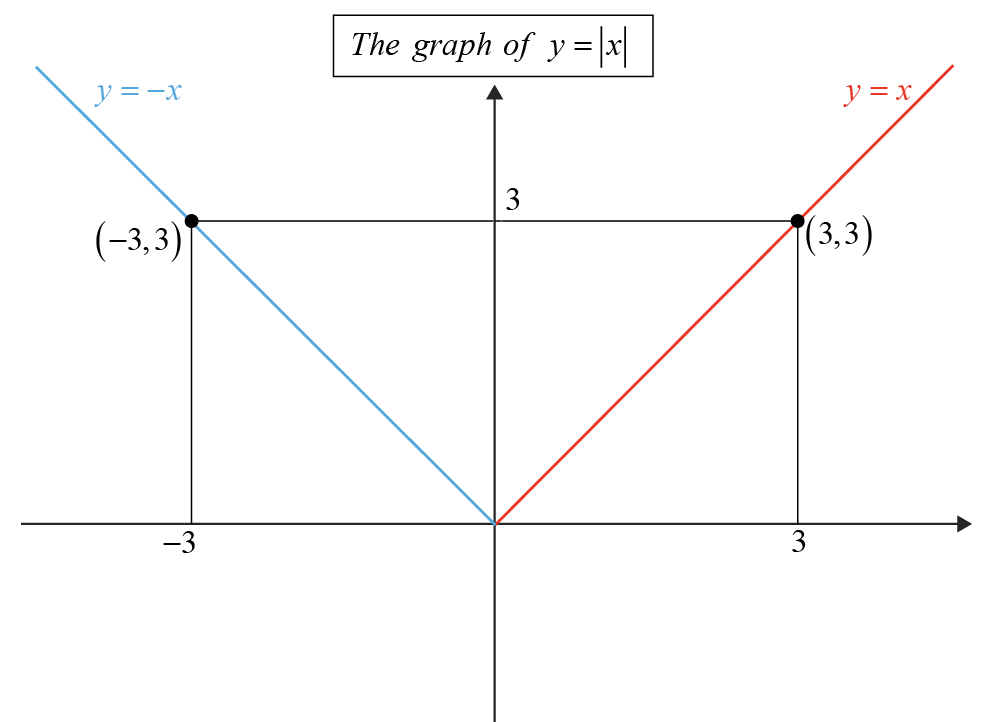
Begin by recognizing that when the input x is not negative, the output y is equal to x. Place marks on the graph where the input and the output match: (0,0), (1,1), (2,2), (3,3), and so on. There are infinite inputs and correspoding outputs, which results in infinte points. these infinite points form a continuous path that extends indefinitely to the right, starting from the origin and moving diagonally upward in a straight direction.
Conversely, for inputs x that are less than zero, the output y becomes the opposite of x. Mark the points (-1,1), (-2,2), (-3,3), continuing this pattern. Connecting these points forms a continuous path that extends indefinitely to the left, starting from the origin and moving diagonally upward in a straight direction but mirrored compared to the previous path.
Merging these two paths at the origin, the complete graph forms a V shape with the bottom point at the origin, rising to the right and left. This V represents all pairs of inputs and their corresponding outputs for y=∣x∣, where the distance from the origin reflects the magnitude of the input without regard to whether it was originally a negative or a positive number.
The absolute value of any real number x, denoted ∣x∣, is always non-negative. This aligns with the geometric interpretation of absolute value as the distance of x from the origin on the real number line, and distance is never negative.
The expression ∣x∣=0 if and only if x=0. This means the only scenario where the distance from the origin is zero is when the point is at the origin itself.
If ∣x∣>0, it implies that x is in the set of all real numbers except zero, R∖{0}. This is because a non-zero distance from the origin indicates the point is not at the origin.
Square Root Relationship:
The equation x2=∣x∣ holds for any real number x. This can be understood through the squaring and square root operations:
Squaring any real number x results in a non-negative number x2, as the square of both positive and negative numbers is positive (e.g., (2)2=4 and (−2)2=4).
Taking the square root of a non-negative number yields a non-negative result. Thus, x2 effectively removes the sign of x, yielding the non-negative magnitude of x, which is exactly what ∣x∣ represents.
Identity of Inverse:∣−x∣=∣x∣
The absolute value of the additive inverse (negative) of x is equal to the absolute value of x.
Multiplicative Property:∣xy∣=∣x∣∣y∣
The absolute value of the product of x and y is the product of their respective absolute values.
Quotient Property:yx=∣y∣∣x∣ for y=0
The absolute value of the quotient of x and y is the quotient of their respective absolute values, provided y is non-zero.
Power Property:∣xn∣=∣x∣n for any integer n
The absolute value of x raised to the power of n is equal to the absolute value of x raised to the power of n.
Product of Absolute Values:∣a1a2…an∣=∣a1∣∣a2∣…∣an∣
The absolute value of the product of several numbers a1,a2,…,an is the product of the absolute values of each number.
∣x∣2=x2
Proof:
The absolute value of x, denoted ∣x∣, is defined by:
∣x∣={x−xif x≥0if x<0
Squaring ∣x∣ gives us:
∣x∣2={x2(−x)2if x≥0if x<0
Since (−x)2=x2 for all real numbers x, whether x is positive or negative, we have:
If ∣x∣=a and a>0, then x=±a. This indicates two possible real solutions for x since both a and −a have the same absolute value when a is positive.
If ∣x∣=0, then x=0. The only number with an absolute value of zero is zero itself.
If ∣x∣=a and a<0, then no real solution for x exists. Absolute values are always non-negative; thus, they cannot equal a negative number.
If ∣x∣=∣y∣, then x=±y. This indicates that if two numbers have the same absolute value, they are either equal or opposites of each other.
Triangle's Inequality
The triangle inequality is a fundamental property of real numbers that states:
For any two real numbers x and y, the absolute value of their sum is less than or equal to the sum of their absolute values. Mathematically, this is represented as:
∣x+y∣≤∣x∣+∣y∣
This inequality holds for all x,y∈R and can be understood with following examples:
For x=5 and y=3, the direct sum ∣5+3∣ equals 8, which is exactly the sum of their absolute values ∣5∣+∣3∣.
When both x and y are negative, such as x=−5 and y=−3, the absolute value of their sum ∣−5+(−3)∣ is also 8, matching ∣−5∣+∣−3∣.
If x and y have opposite signs, for instance x=5 and y=−3, the absolute value of their sum ∣5+(−3)∣ is 2, which is less than the sum of their absolute values.
When one of the numbers is zero, such as x=−5 and y=0, the absolute value of their sum ∣−5+0∣ equals the absolute value of the non-zero number.
The strict inequality ∣x+y∣<∣x∣+∣y∣ is observed specifically when x and y are of opposite signs because the effect of one number's negation partially cancels out the magnitude of the other when summed.
Conversely, the equality ∣x+y∣=∣x∣+∣y∣ occurs in two cases:
When both numbers have the same sign, their magnitudes directly add together without any cancellation.
When one of the numbers is zero, it does not contribute to the magnitude of the sum, effectively leaving the absolute value of the other number.
Second Triangle's Inequality
For all x,y∈R,
∣∣x∣−∣y∣∣≤∣x−y∣
The strict inequality ∣∣x∣−∣y∣∣<∣x−y∣ occurs when x and y have opposite signs, which is mathematically stated as xy<0. When x and y are of opposite signs, the difference ∣x∣−∣y∣ does not fully capture the distance between x and y on the number line, since it neglects the fact that they are in different directions from zero.
The equality ∣∣x∣−∣y∣∣=∣x−y∣ occurs when x and y have the same sign or at least one is zero, which is represented as xy≥0. When both x and y are non-negative or non-positive, ∣x∣−∣y∣ precisely measures the distance between them. If one of them is zero, the absolute values and the actual difference are equivalent.
The following inequations help you solve inequations:
For a>0,
∣x∣<a⟹−a<x<a
Proof:
To validate this, consider the nature of absolute values and break it down into two cases based on the value of x:
Case 1: x≥0
For non-negative values of x, the absolute value ∣x∣ is simply x itself. Hence, the condition ∣x∣<a translates to:
x<a
This means that for x≥0, the values of x must be less than a. Thus, x∈[0,a)
Case 2: x<0
For negative values of x, the absolute value ∣x∣ is −x (since absolute value measures distance from zero on a number line, which is always positive). Therefore, the condition ∣x∣<a translates to:
−x<a
Multiplying both sides of the inequality by -1 (and flipping the inequality because of the multiplication by a negative number) yields:
x>−a
Thus, for x<0, the values of x must be greater than −a. Thus, x∈(−a,0)
Combining the Solutions:
Combining both solutions x∈[0,a) and x∈(−a,0), we get
−a<x<a
For a>0, the inequality ∣x∣>a implies x>a or x<−a.
Proof:
To prove this, consider the definition of absolute value, which states ∣x∣=x if x≥0 and ∣x∣=−x if x<0:
If x≥0, then ∣x∣=x, and ∣x∣>a simplifies to x>a.
If x<0, then ∣x∣=−x, and ∣x∣>a simplifies to −x>a. Multiplying both sides by −1 (and reversing the inequality) gives x<−a.
Combining both cases, x must either be greater than a or less than −a, which completes the proof.
Section 6 of 7 · Basic Maths
Mark this section complete when you have worked through its proofs.
Type any topic, theorem, or concept to jump directly to the section.