
More Properties of Real Numbers
Reciprocal Properties§
The reciprocal properties of real numbers relate to how the sign and relative magnitude of non-zero numbers affect their reciprocals. Here are the properties clearly outlined:
-
Positive Numbers and Their Reciprocals:
- If , then its reciprocal .
This property states that the reciprocal of a positive number is also positive. Since dividing by a positive number does not change the sign, the reciprocal maintains the positivity.
-
Negative Numbers and Their Reciprocals:
- If , then its reciprocal .
In contrast to positive numbers, the reciprocal of a negative number is also negative. Dividing by a negative number reverses the sign, so the negative sign is preserved when taking the reciprocal.
-
Comparing Positive Numbers and Their Reciprocals:
- If and , then .
When comparing two positive numbers where one is larger than the other, their reciprocals will have the opposite inequality. This "reversal" happens because, as grows larger, becomes smaller.
-
Comparing Negative Numbers and Their Reciprocals:
- If and , then .
Similarly, when comparing two negative numbers, the one that is more negative (or smaller in absolute value) will have a larger reciprocal. This is also a reversal of the inequality and follows from the fact that for negative numbers, as the absolute value increases, the reciprocal decreases.
These reciprocal properties are fundamental in understanding the behavior of real numbers under division, especially when dealing with inequalities, and they are particularly useful in algebraic manipulations and solving equations.
We can apply these properties to prove the following important results:
-
If and , then for such that , the reciprocal will satisfy .
We can also state the ibove in the interval form as: for in the interval , the reciprocal will be in the interval .
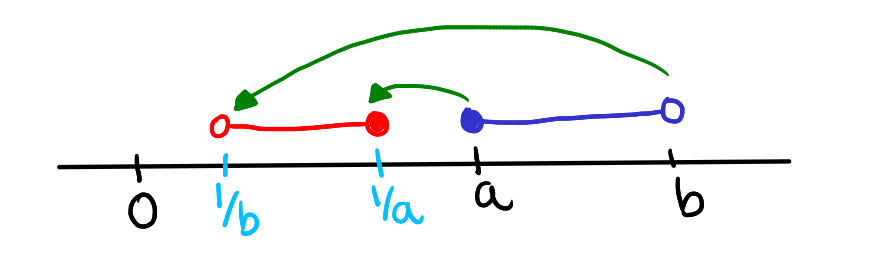
Proof:
-
From the inequality , where , by taking the reciprocal of each side, we get .
-
From the inequality , where and , taking reciprocals reverses the inequality to .
-
Combining these results, for within the interval , the reciprocal must lie within .
-
-
If and , then for such that , the reciprocal will satisfy .
In interval form: for in the interval , the reciprocal will be in the interval .
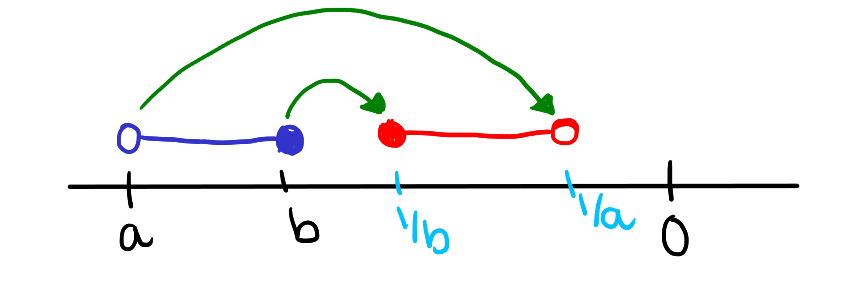
Proof:
-
Starting with , and knowing that both and are negative, the reciprocal of each side yields because reciprocating two negative numbers reverses the inequality sign, and the larger the negative number, the smaller its reciprocal in magnitude.
-
Similarly, from , where both and are negative, the reciprocal of each side results in , as a smaller or equal negative number leads to a larger or equal reciprocal.
-
When these reciprocal inequalities are combined, they imply that for in the interval , must fall within the interval . Here, is included because is the upper bound for and thus can equal , while is excluded because is the lower bound for and cannot equal , as that would require to be , which is outside the given interval for .
-
-
If , then for such that , the reciprocal satisfies .
In interval form, for in the interval , the reciprocal falls within the interval .
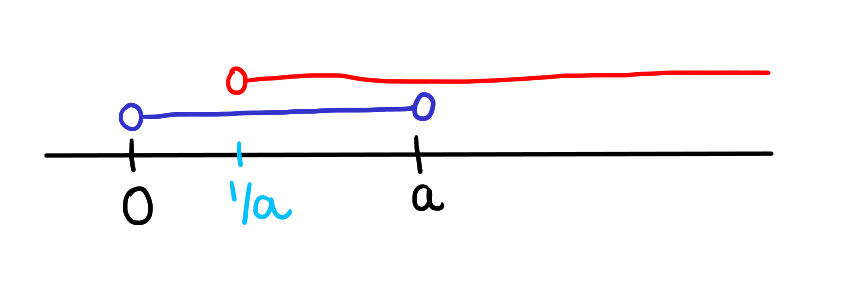
Proof:
-
Comparing and :
- Since is positive and less than (also positive), the reciprocal of will be larger than the reciprocal of . This happens because dividing one by a smaller number gives a larger result.
-
Effect of Approaching 0:
- As gets closer to zero but remains positive, starts to increase, moving towards a very large number. In fact, as approaches zero, keeps increasing and can become as large as we can imagine.
Within the interval , as gets smaller, becomes larger. Starting from , moves beyond this value and continues to increase indefinitely as approaches zero. Thus, the values of will be within , demonstrating that the smaller gets within this interval, the larger becomes.
-
-
If , then for such that , the reciprocal satisfies . That is, if , and is in the interval , then the reciprocal will be in the interval .
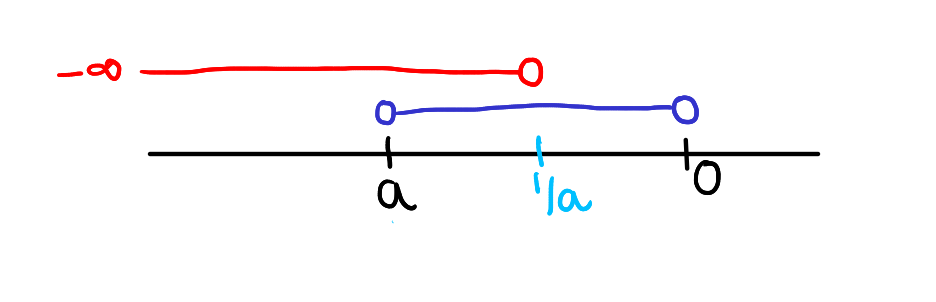
Proof:
-
Relative Position and Reciprocation:
- Since both and are negative with , is closer to zero. The reciprocity rule states that for two negative numbers, the one closer to zero has the greater reciprocal. Therefore, .
-
Limits as Approaches Zero:
- As approaches zero from the left (increasing in value but remaining negative), grows and heads towards positive infinity, following the property that the reciprocal of a negative number close to zero trends towards large positive values.
-
-
If and , then for such that , the reciprocal satisfies either or . That is, for in the interval , the reciprocal will be in the intervals .
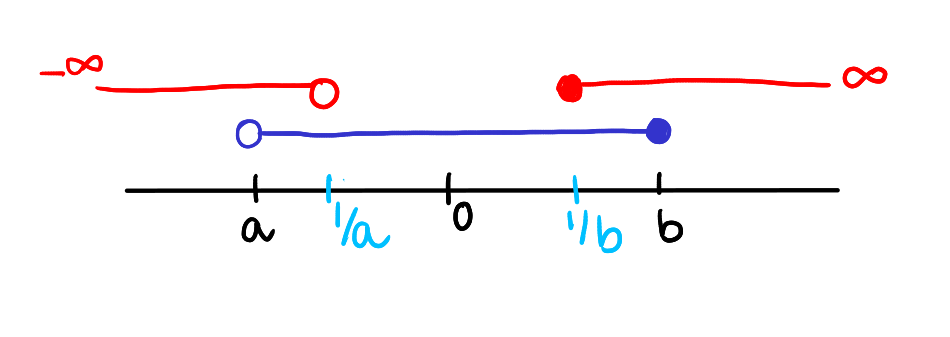
Proof:
Divide into two parts and . We utilize previous reciprocal theorems concerning positive and negative intervals and apply them to the divided segments of : for negative and for positive .
-
For Interval :
- Applying the theorem for negative values, since , the reciprocal falls in .
-
For Interval :
- Utilizing the theorem for positive values, with , the reciprocal spans .
Combining the findings from both segments, the overall reciprocal interval for in is the union of and . Therefore, for within , lies within . This conclusion is drawn directly from the previously established properties of reciprocals for positive and negative real numbers.
-
Squaring§
-
Given , , if then .
The inequality does not reverse when squaring positive numbers. If one positive number is smaller than another, its square will also be smaller.
Example:
- and
- Therefore, implies .
-
Given , , if then .
The inequality reverses when squaring negative numbers. If one negative number is less than another, its square will be greater because the signs cancel out, leaving the absolute values to determine the inequality, which reverses due to the initial negative values.
Example:
- and
- Therefore, implies .
-
Property 1: implies , or .
Proof:
Starting from the given inequality:
This can be rewritten as:
Factoring the difference of squares:
From this wavy curve, the expression is negative only in the interval , confirming that:
Property 2: implies , or .
Property 3: implies or , or .
Property 4: implies or , or .
Property 5: implies or , or .
Proof:
To prove the property that if then , we can break this down into two separate inequalities and analyze the intersection of their solutions:
-
Break Down the Inequality:
Consider the inequality as two separate parts:
-
Solve Each Inequality:
-
For :
-
For :
-
-
Intersection of Solutions:
To find the solution to the original compound inequality , take the intersection of the two intervals derived above:
- The interval represents all values where the magnitude of is greater than .
- The interval represents all values where the magnitude of is less than .
The intersection of these two sets, considering , is:
-
Mark this section complete when you have worked through its proofs.