
Quadratic Expressions
A quadratic expression is one of the simplest forms of a polynomial, characterized by an exponent of two as its highest power. Written in its most recognizable form, , each of the constants—, , and —play a specific role in shaping its graph. Here, must be a non-zero number to ensure that the expression is indeed quadratic. is the variable of the expression and it can be any real number.
Consider a quadratic expression as a machine where you put in a number for , and it gives you a number back. This is like feeding a number into a calculator programmed with the quadratic expression, and it displays the result. You put some input into it and it produces some output. When you put some value of , say into it, it gives you the output .
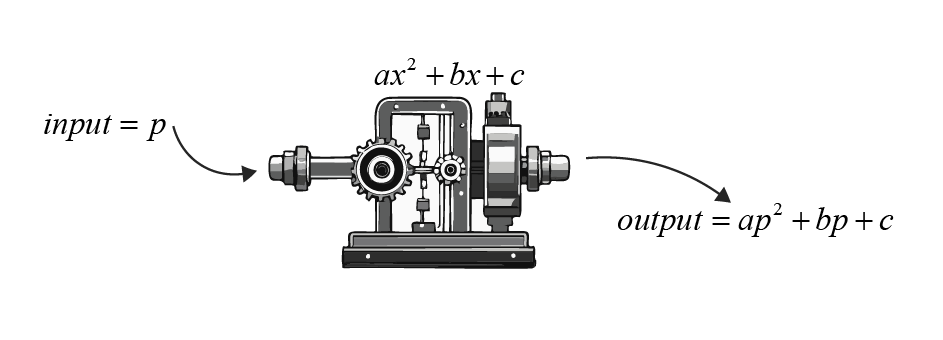
Take an example.
For the quadratic expression , we can find the output for different inputs. For example:
- If we input , the output is 3, because .
- With , the output is 0, making a special input known as a root of the equation.
- An input of gives us an output of , calculated by .
Since can be any number, there are infinitely many possible inputs. We can visualize these infinite input-output relationship using aa cartesian coordinate sytem. Each input and its output can be written as a pair of numbers, (input, output). For example, , , and are all pairs that we can place on a graph. Upon plotting all these infinite pairs on a graph, they don't just fall anywhere; they align to trace a specific curve. This alignment isn't random but rather a reflection of the inherent relationship dictated by the quadratic formula.
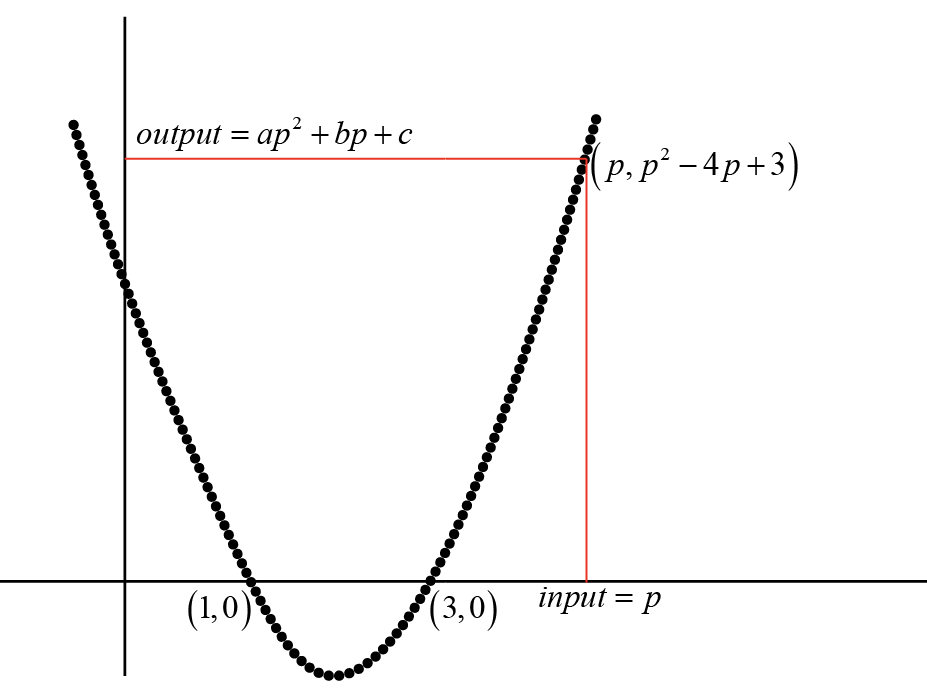
The curve that we visualize as a result of plotting a quadratic expression is the parabola. Its distinctive 'U' shape, whether it opens upwards like a cup or downwards like an umbrella, depends on the sign of the coefficient . The parabola is symmetrical and has a vertex, which is either the highest or lowest point of the curve.
While we're not going into the detailed method of plotting the entire graph, it's important to recognize how the graph's appearance varies with the values of and the discriminant (commonly represented as , and calculated as ). These determine the direction in which the parabola opens and whether it crosses the horizontal axis.
Different Possibilities of Graphs of a Quadratic Expression§
Solving quadratic inequalities is a pivotal skill in algebra. To master this, one must become familiar with the foundational aspects of the graphs of quadratic expressions, especially how they vary based on two key parameters: the coefficient , and the discriminant , where .
The value of , the coefficient of the quadratic term , dictates the direction in which the parabola—the graph of a quadratic expression—opens. If is positive, the parabola opens upwards like a smile; if is negative, it opens downwards like a frown. This aspect of the quadratic graph tells us about the general behavior of the expression's values—whether they tend to be positive or negative as moves away from the vertex.
The discriminant , on the other hand, gives us insight into the nature and position of the roots of the quadratic expression. It tells us whether the expression has two distinct real roots, one real repeated root, or no real roots at all. These roots are the points where the graph intersects the x-axis, and knowing their nature is crucial because it informs us about the intervals where the quadratic expression takes positive or negative values.
When we set out to solve a quadratic inequality, such as or , our goal is to find the range of values that make the inequality true. By visualizing the graph of the related quadratic expression , we can intuitively determine these ranges. The graph acts as a guide, illustrating when the expression's values lie above or below the x-axis—corresponding to positive or negative values, respectively.
Consider a Quadratic Expression . There six distinctive possibilities that you should know.
Case 1: Leading coefficient is positive and Discriminant is also positive§
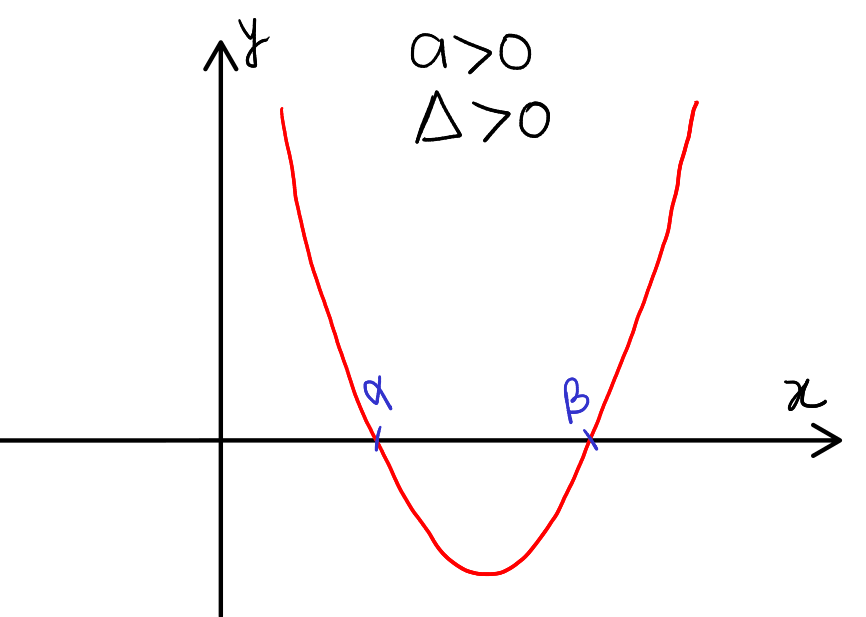
In this case, indicates that the parabola opens upwards, and the discriminant being greater than zero indicates that there are two distinct real roots, labeled here as and .
For the inequality , the solution set includes all values of for which the quadratic expression is positive. Given the upward-opening parabola with roots and , the expression is positive outside the interval between the roots. This yields the solution as .
Conversely, for the inequality , the solution set is the interval between the roots where the parabola dips below the x-axis. Therefore, the solution is .
Case 2: Leading coefficient is positive and Discriminant is zero§
When and , the quadratic expression represents a parabola that opens upwards and has its vertex lying on the x-axis. This vertex is the single solution to the equation , and it occurs at . The significance of this single intersection point is that the quadratic expression will always yield non-negative values for all real numbers . Thus, the expression is never negative.
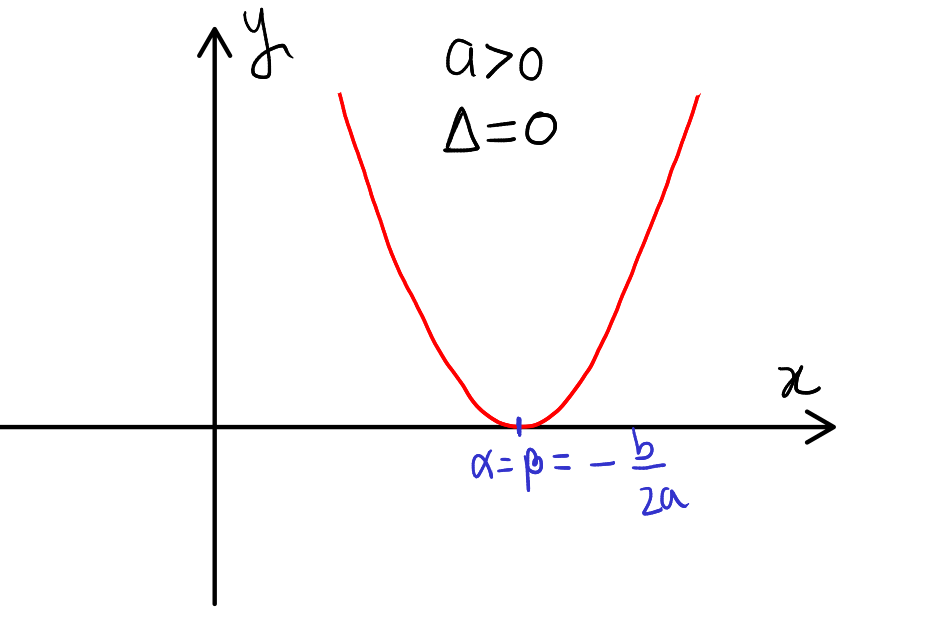
This understanding is neatly captured in a theorem which states:
Case 3: Leading coefficient is positive and Discriminant is also negative§
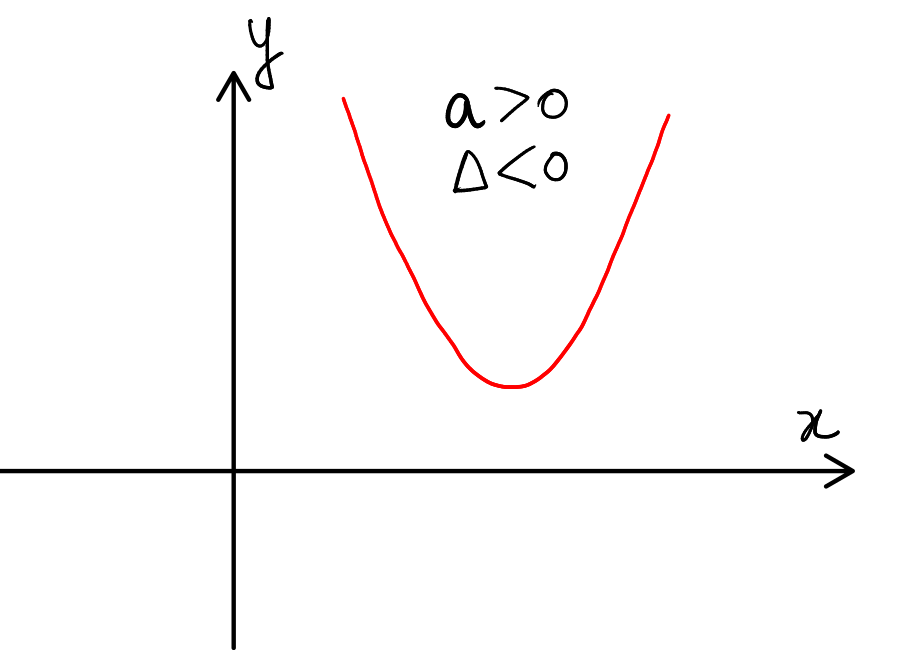
When we examine the graph of a quadratic expression with a positive leading coefficient and a negative discriminant , it shows a parabola that opens upward and does not intersect the x-axis at any point. If it never intersects the x-axis, it means there no real roots. This absence of real roots (x-intercepts) is a direct consequence of the negative discriminant ().
Implications of and :
For such a parabola, since it opens upwards and the vertex lies above the x-axis, the quadratic expression will always yield values greater than or equal to zero for all real numbers . The vertex represents the minimum value of the quadratic expression. No matter how far left or right along the x-axis we travel, the value of the quadratic expression remains non-negative.
Case 4: Leading Coefficient Negative and Discriminant Positive§
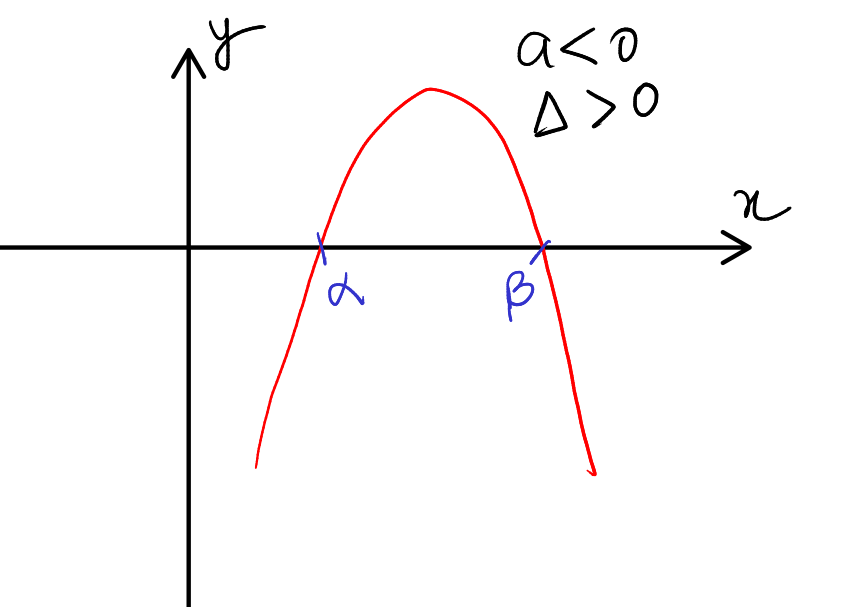
In this case, where the leading coefficient of the quadratic expression is negative (), and the discriminant () is positive (), the graph is characterized by a downward-opening parabola that intersects the x-axis at two distinct points. The positive discriminant indicates the parabola will intersect the x-axis at two distinct points, which are the real and distinct solutions (roots) of the equation .
Inequality Solutions for :
Given the downward orientation of the parabola, the expression will be greater than zero in the intervals where the graph is above the x-axis, which occurs between the roots. Therefore, the solution for the inequality is:
Inequality Solutions for :
Conversely, the expression will be less than zero where the graph lies below the x-axis, which is to the left of the smaller root and to the right of the larger root. Hence, the solution for the inequality is:
Case 5: Leading Coefficient Negative and Discriminant Zero§
In this case, the quadratic expression has a negative leading coefficient () and a discriminant () of zero (). This particular combination leads to a graph that displays a downward-opening parabola which touches the x-axis at exactly one point, often referred to as the vertex of the parabola.
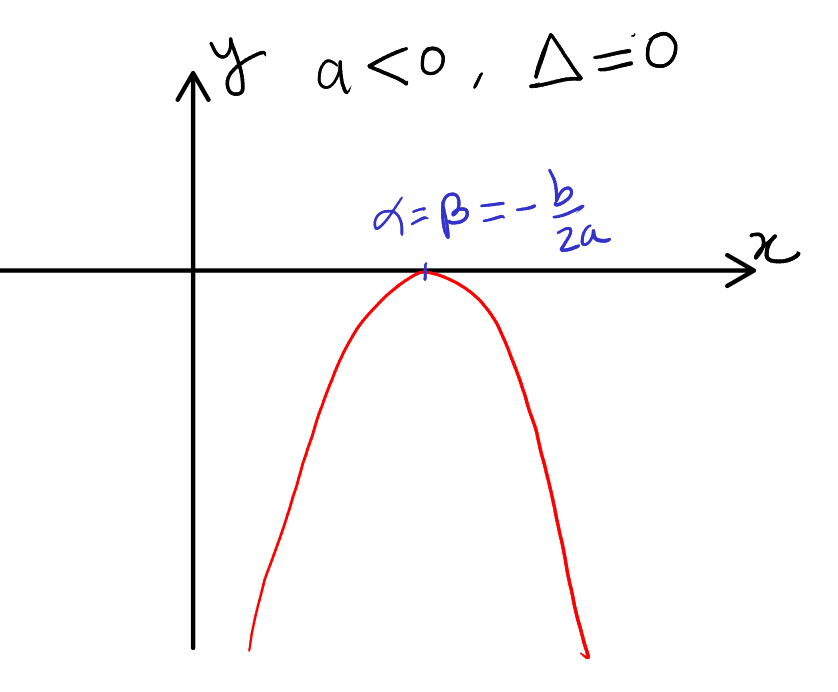
If the leading coefficient is negative and the discriminant is zero, the quadratic expression is always less than or equal to zero for all real numbers . This is symbolically represented as:
Case 6: Leading Coefficient Negative and Discriminant Negative§
For a quadratic expression where the leading coefficient is negative () and the discriminant () is negative (), the graph is a parabola that opens downwards and has no real intersections with the x-axis, which means that the entire graph of the quadratic expression lies below the x-axis.
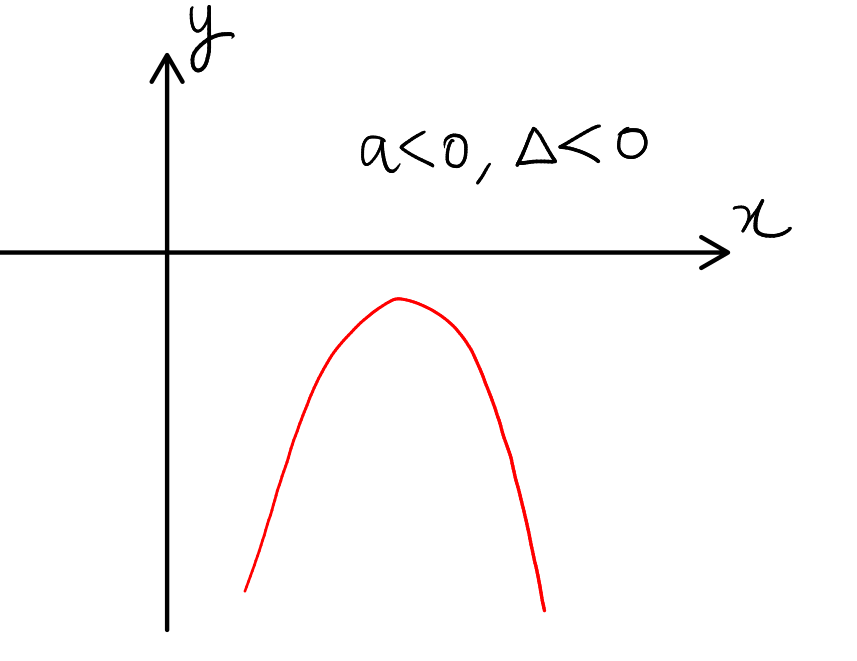
If the leading coefficient is negative and the discriminant is negative for the quadratic expression , then the expression is strictly less than zero for all real numbers . This can be formally stated as:
Conclusion§
The six cases of quadratic expressions categorized by the signs of the leading coefficient and the discriminant provide a comprehensive framework for solving quadratic inequalities. This framework is grounded in understanding the shape and position of the parabola on the graph, which is determined by these two parameters.
- When and , the parabola opens upwards with two distinct real roots, and the expression is positive outside the interval between the roots.
- If and , the parabola opens upwards, touching the x-axis at one point, the vertex, and the expression is non-negative for all real numbers.
- When and , the parabola again opens upwards but has no real roots, remaining positive for all real numbers.
- For and , the parabola opens downwards with two real roots, and the expression is negative outside the interval between the roots.
- If and , the downward-opening parabola touches the x-axis at the vertex, and the expression is non-positive for all real numbers.
- Lastly, when and , the parabola opens downwards without intersecting the x-axis, making the expression strictly negative for all real numbers.
By identifying which of these six cases applies to a given quadratic inequality, we can immediately determine the intervals on the real number line where the expression is positive or negative. This significantly simplifies the process of finding the solution sets for inequalities such as or , as we can infer the behavior of the quadratic expression without having to perform the complete square or use other algebraic methods.
Mark this section complete when you have worked through its proofs.