Up to now, almost every enclosed region you calculated was trapped between two different curves—like a parabola and a line, or a circle and a parabola.
Yet many equations trace out a single curve that closes back on itself to form a loop, enclosing an area all by itself! Examples look like:
y2=x2(1−x),(y−x)2=x(1−x),2y2−4xy+3x2−2x=0
How can one equation trap a closed area? And how do you find its upper branch, lower branch, and loop boundaries without getting lost in complicated sketching?
1. Splitting a Loop Equation Into Upper and Lower Branches§
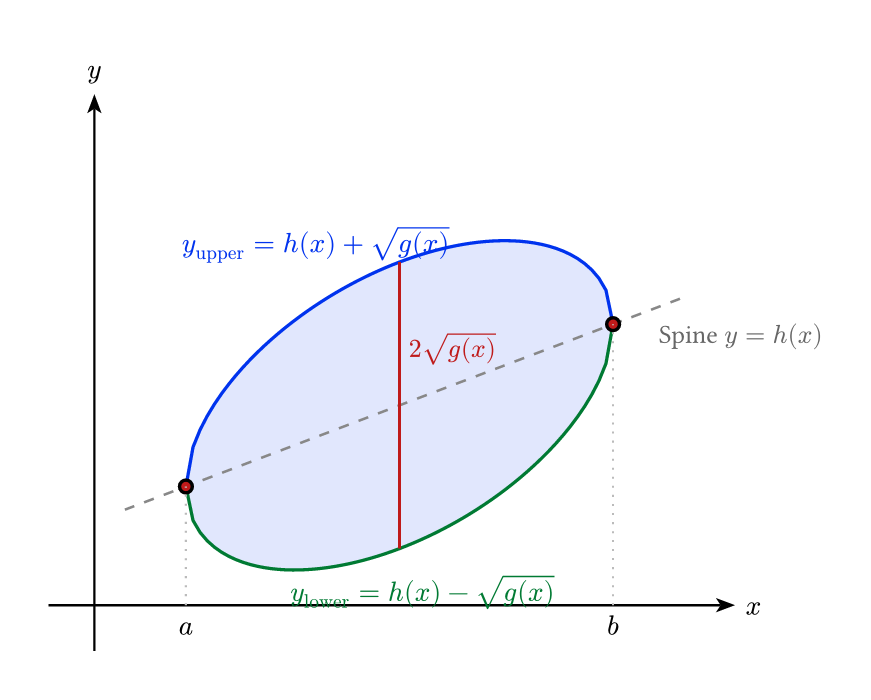
An ordinary function y=f(x) has at most one y-value for every x, so it can never loop back on itself. A curve can form a closed loop only when the equation gives two y-values for each x inside an interval [a,b]—which happens whenever y appears to the second degree (y2 or a quadratic in y).
Taking square roots on both sides immediately splits the single equation into two branches:
Upper branch:yupper=h(x)+g(x)
Lower branch:ylower=h(x)−g(x)
Watch closely what happens:
Domain condition: Real y-values exist only where g(x)≥0.
Where the loop seals shut: Wherever g(x)=0 (say at x=a and x=b), the square root vanishes (g(x)=0), so both branches collide at the exact same point—(a,h(a)) and (b,h(b))! That seals the region into a closed loop over [a,b].
The Spine Cancellation Magic: What is the height of a vertical strip stretching from ylower to yupper?
yupper−ylower=(h(x)+g(x))−(h(x)−g(x))=2g(x)
Look at that result: the central spine h(x) cancels out completely! Whether the loop sits on the x-axis (h(x)=0), tilts diagonally along y=x, or bends along a parabola y=x2, the vertical slice at x always has exact length 2g(x), so the area is simply:
A=∫ab2g(x)dx
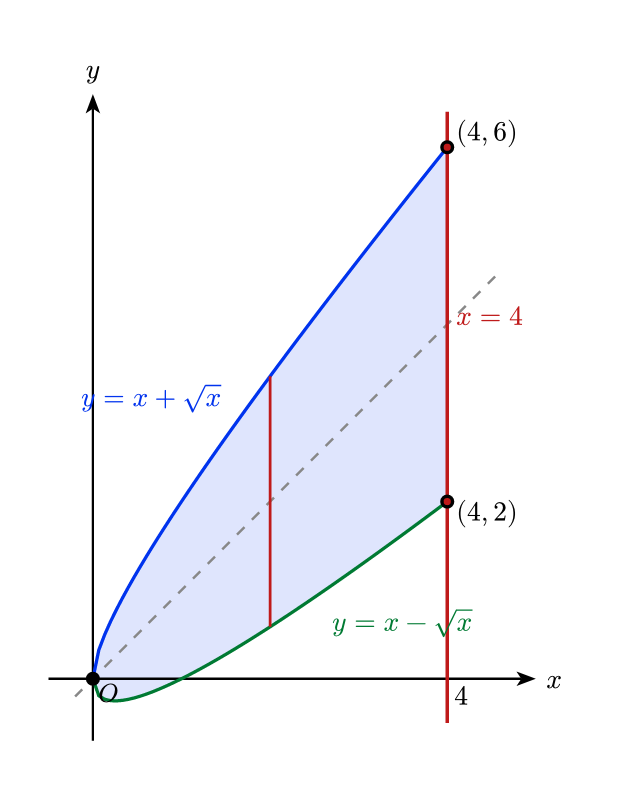
(Note: Sometimes g(x)≥0 holds on an unbounded ray like x≥0—for example, (y−x)2=x. Then the two branches y=x±x start together at (0,0) and never meet again, so a boundary line like x=4 is needed to close the region!)
What if the equation is written completely expanded as a general quadratic in y?
A(x)y2+B(x)y+C(x)=0(A(x)=0)
You do not even need to guess a sketch first! Treat x as a constant and apply the quadratic formula to solve for y:
y=2A(x)−B(x)±D(x),where D(x)=B(x)2−4A(x)C(x)
Upper branch: takes the + sign (when A(x)>0).
Lower branch: takes the − sign (when A(x)>0).
Domain & Loop Endpoints: The curve exists only where the discriminant D(x)≥0. Any bounded interval [a,b] where D(x)≥0 and D(a)=D(b)=0 forms a closed loop!
Direct Area Formula (Spine Cancels Automatically!): Subtracting the two roots removes −2A(x)B(x) immediately:
yupper−ylower=∣A(x)∣D(x)⟹Area of loop=∫ab∣A(x)∣D(x)dx
Example 1: Classic Loop Symmetric About the x-Axis
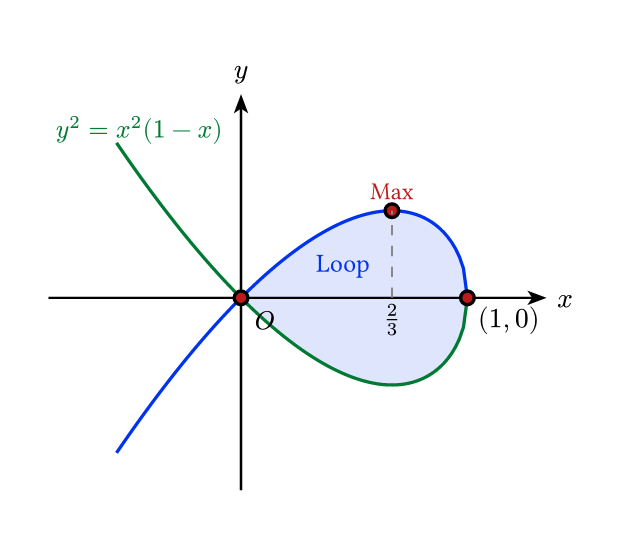
Sketch the curve y2=x2(1−x) and find the area of its closed loop.
Solution:
Here h(x)=0 and g(x)=x2(1−x).
1. Domain: Since y2≥0 and x2≥0, we need 1−x≥0⟹x≤1.
2. Where the branches meet: Setting y=0 gives x2(1−x)=0⟹x=0 and x=1. On [0,1], we have g(x)≥0 with g(0)=g(1)=0, forming a single closed loop between (0,0) and (1,0).
3. Upper and lower branches on [0,1]: Since x≥0 on [0,1], x2(1−x)=x1−x, giving:
yupper=x1−xandylower=−x1−x
(For x<0, ∣x∣=−x, so the two branches y=±x1−x open outward indefinitely to the left.)
4. Area of the loop: Using yupper−ylower=2x1−x on [0,1]:
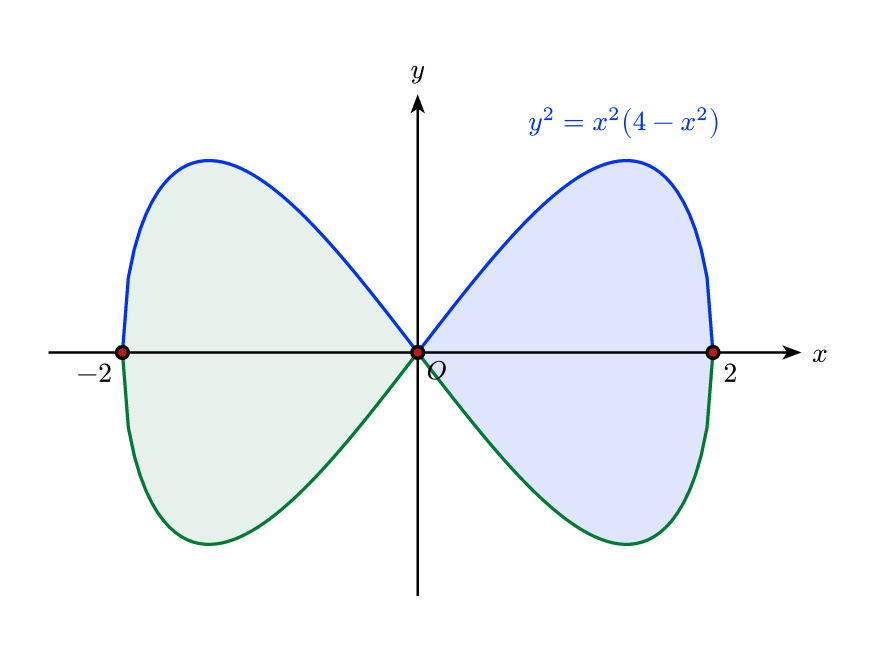
Find the total area enclosed by the curve y2=x2(4−x2).
Solution:
Look at the domain condition 4−x2≥0⟹−2≤x≤2. Setting y=0 gives three points where upper and lower branches meet: x=−2, x=0, and x=2. That splits [−2,2] into two symmetric loops forming a figure-eight!
Upper branch: yupper=∣x∣4−x2.
Lower branch: ylower=−∣x∣4−x2.
Because both x→−x and y→−y leave the equation unchanged, the total area of both loops equals 4× the first-quadrant piece (0≤x≤2):
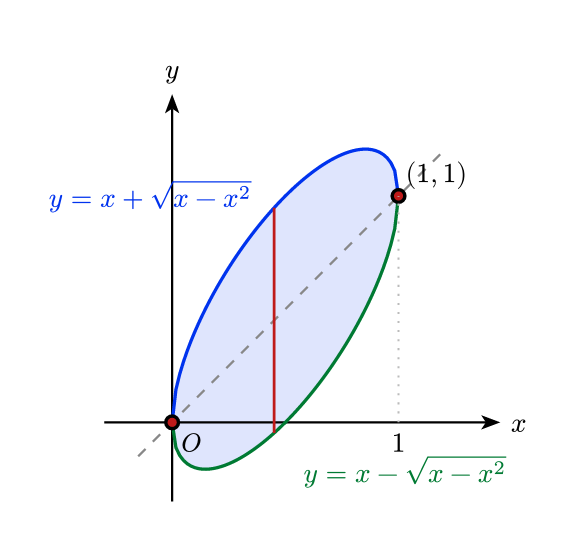
Find the area enclosed by the curve (y−x)2=x(1−x).
Solution:
Taking square roots splits the curve around the diagonal spine y=x:
Upper branch:yupper=x+x(1−x)
Lower branch:ylower=x−x(1−x)
Real values exist only when x(1−x)≥0⟹0≤x≤1. At x=0 and x=1, the branches meet at (0,0) and (1,1), sealing a tilted loop (a sheared ellipse)!
Notice how the spine x vanishes when taking the vertical strip height yupper−ylower=2x(1−x):
A=∫012x−x2dx=2∫0141−(x−21)2dx
The integral ∫01(21)2−(x−21)2dx is simply the area of a semicircle of radius r=21 (centered at x=21), which equals 21π(21)2=8π. Multiplying by 2:
A=2⋅8π=4π sq. units.
Example 4: Two Branches Along y = x Closed by a Vertical Line
Find the area bounded by the curve (y−x)2=x and the vertical line x=4.
Solution:
Here g(x)=x≥0 holds for all x≥0. Taking square roots gives:
Upper branch:yupper=x+x
Lower branch:ylower=x−x
Notice that these two branches meet at (0,0) and diverge to infinity as x→∞—so (y−x)2=x cannot close on its own, which is why the boundary line x=4 is given (cutting the two branches at (4,2) and (4,6)).
Subtracting upper minus lower branch cancels the spine x:
(Notice: This is the exact same area as the upright parabola y2=x bounded by x=4!)
Example 5: Closed Loop With a Curved Parabolic Spine
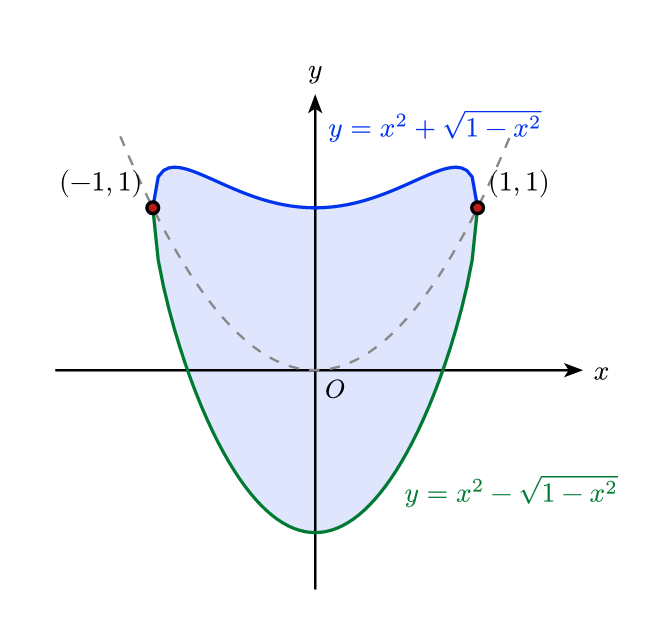
Find the area enclosed by (y−x2)2=1−x2.
Solution:
The domain requires 1−x2≥0⟹−1≤x≤1. Around the curved spine y=x2:
Upper branch:yupper=x2+1−x2
Lower branch:ylower=x2−1−x2
At x=−1 and x=1, 1−x2=0, so both branches merge at (−1,1) and (1,1) to form a heart-shaped closed loop!
Again, subtracting upper minus lower branch completely eliminates x2:
A=∫−1121−x2dx=2⋅(semicircle of radius 1)=2⋅2π(1)2=π sq. units.
Example 6: Finding a Loop From an Expanded Quadratic in y
Find the area of the closed curve 2y2−4xy+3x2−2x=0.
Solution:
Do not try to guess the shape! Group the equation as a quadratic in y:
2y2+(−4x)y+(3x2−2x)=0
Here A(x)=2, B(x)=−4x, and C(x)=3x2−2x. Compute the discriminant D(x):
D(x)=(−4x)2−4(2)(3x2−2x)=16x2−24x2+16x=8x(2−x)
Real points exist only where D(x)≥0⟹8x(2−x)≥0⟹0≤x≤2. At x=0 and x=2, D(x)=0, closing the loop! Using the vertical distance between the upper and lower roots:
Integrating from x=0 to x=2 (where ∫021−(x−1)2dx is a semicircle of radius 1):
A=2∫021−(x−1)2dx=2⋅2π=2π sq. units.
Example 7: Cubic Curve Forming a Single Tear-Drop Loop
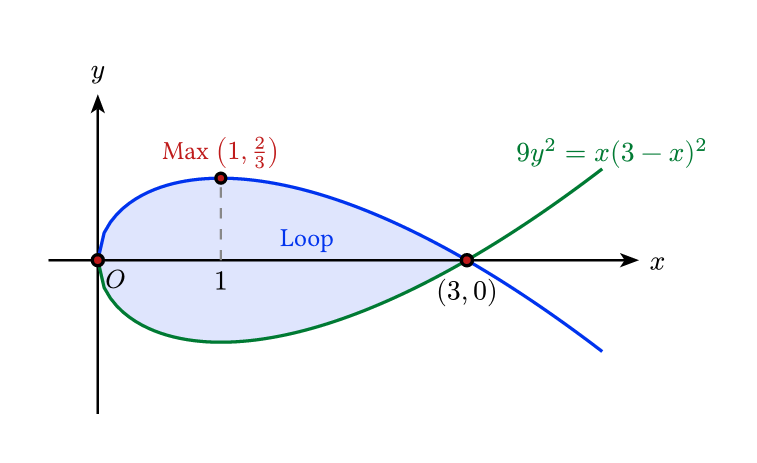
Find the area of the closed loop of the curve 9y2=x(3−x)2.
Solution:
Since 9y2≥0 and (3−x)2≥0, the domain is x≥0. Setting y=0 shows that the upper and lower branches cross each other at x=0 and x=3, sealing a loop on [0,3].
On [0,3], we have 3−x≥0, so taking square roots gives:
yupper=31(3−x)xandylower=−31(3−x)x
(Checking the turning point of the upper branch: dxdy=6x3−3x=0⟹x=1, height 32.)
2. Area of an Oblique Ellipse (General Second-Degree Equation)§
Suppose you are given a general second-degree equation containing an xy term alongside linear and constant terms, such as:
ax2+2hxy+by2+2gx+2fy+c=0
Because of the 2hxy cross-term and the 2gx+2fy terms, this conic is both rotated (oblique) and shifted away from the origin. How do we recognize when it is a genuine ellipse—and how do we find its area cleanly without computing complicated rotation angles?
Look closely at the coefficient of x2 inside the bracket: (h2−ab)!
Because h2−ab<0, this quadratic in xopens downward! Factoring out (ab−h2)>0 and completing the square gives:
D(x)=4(ab−h2)[r2−(x−x0)2]
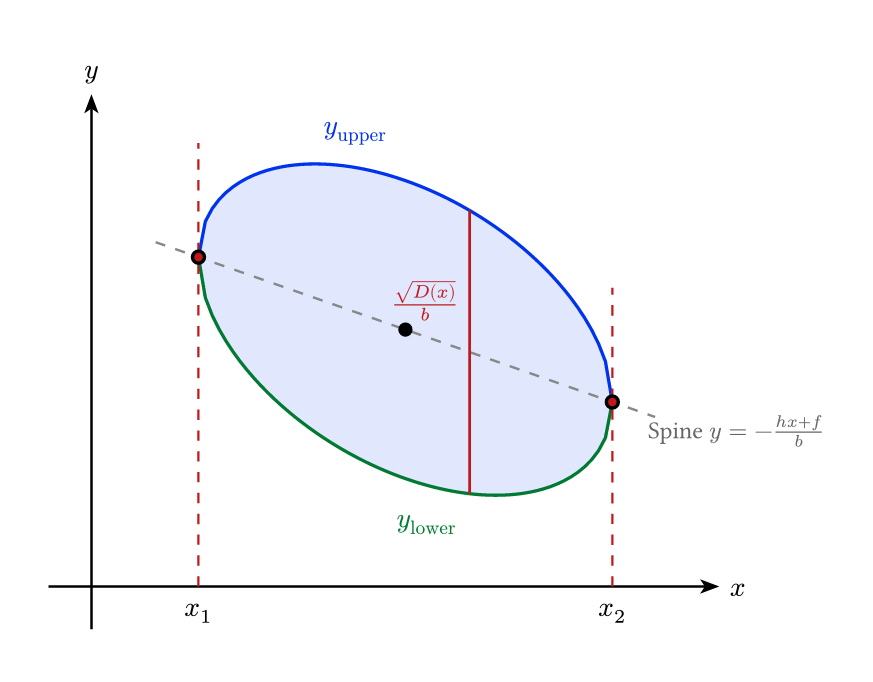
where (x0,y0) is the center of the ellipse and r is its horizontal half-width! Real points exist only for x∈[x0−r,x0+r], and at the endpoints x1=x0−r and x2=x0+r, D(x)=0, giving the two vertical tangents where the upper and lower branches meet and seal the ellipse!
Step 3: Integrate the Difference Between Upper and Lower Branches§
Subtracting the two quadratic roots kills the spine −bhx+f:
yupper−ylower=bD(x)=b2ab−h2r2−(x−x0)2
Integrating from x0−r to x0+r (where ∫x0−rx0+rr2−(x−x0)2dx=21πr2 is simply a semicircle of radius r):
A=b2ab−h2⋅(21πr2)=bπab−h2r2
(And if you compute r2 from the discriminant of (h2−ab)x2+2(hf−bg)x+(f2−bc), algebra gives r2=(ab−h2)2−bΔ—which both proves why bΔ<0 is needed for r2>0 and yields the compact formula:)
A=(ab−h2)3/2π∣Δ∣
(Notice: You never have to memorize this determinant formula if you just write the equation as a quadratic in y, complete the square on D(x), and use the semicircle integral!)
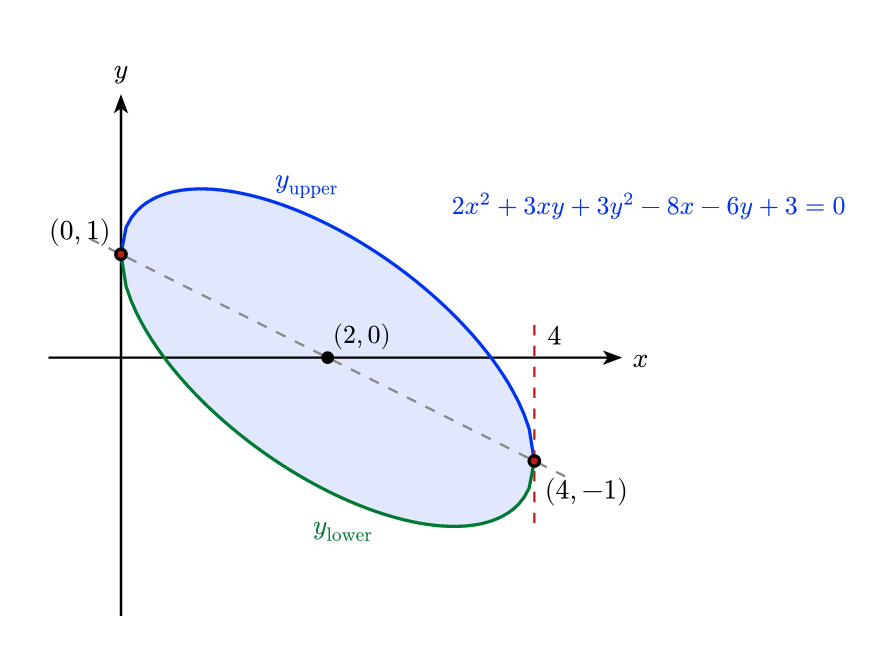
Example 8: Oblique Shifted Ellipse With 2x^2 + 3xy
Verify that 2x2+3xy+3y2−8x−6y+3=0 represents a real ellipse, sketch it via upper and lower branches, and find its area.
Solution:
1. Check the conic conditions:
Matching with ax2+2hxy+by2+2gx+2fy+c=0 gives a=2, h=23, b=3, g=−4, f=−3, and c=3.
Real values exist when 15x(4−x)≥0⟹0≤x≤4. At x=0 and x=4, D(x)=0, giving the vertical-tangent endpoints (0,1) and (4,−1) on the spine (with center at (2,0)).
3. Compute the area from the vertical strip:
Writing x(4−x)=4−(x−2)2:
yupper−ylower=3D(x)=3154−(x−2)2
Integrating from x=0 to x=4 (a semicircle of radius r=2, area 21π(2)2=2π):