MatheramaMatherama
← Area Under Curves
Area Under Curves·Section 2·9 min read

Region Plotting and Areas Bounded by Inequalities

In many problems, a region is not described by naming its boundary curves in words. Instead, it is given as a set of points (x,y)(x, y) satisfying one or more inequalities, such as:

{(x,y):y2≥2x and x2+y2≤8}\big\{(x, y) : y^2 \ge 2x \text{ and } x^2 + y^2 \le 8\big\}

Before you can set up any integral, you must first identify and shade the exact region represented by those inequalities. Fortunately, there is a simple, rock-solid method that works every single time.


1. How a Curve Divides the Plane§

Take any continuous function f(x,y)f(x, y) of two variables. The equation

f(x,y)=0f(x, y) = 0

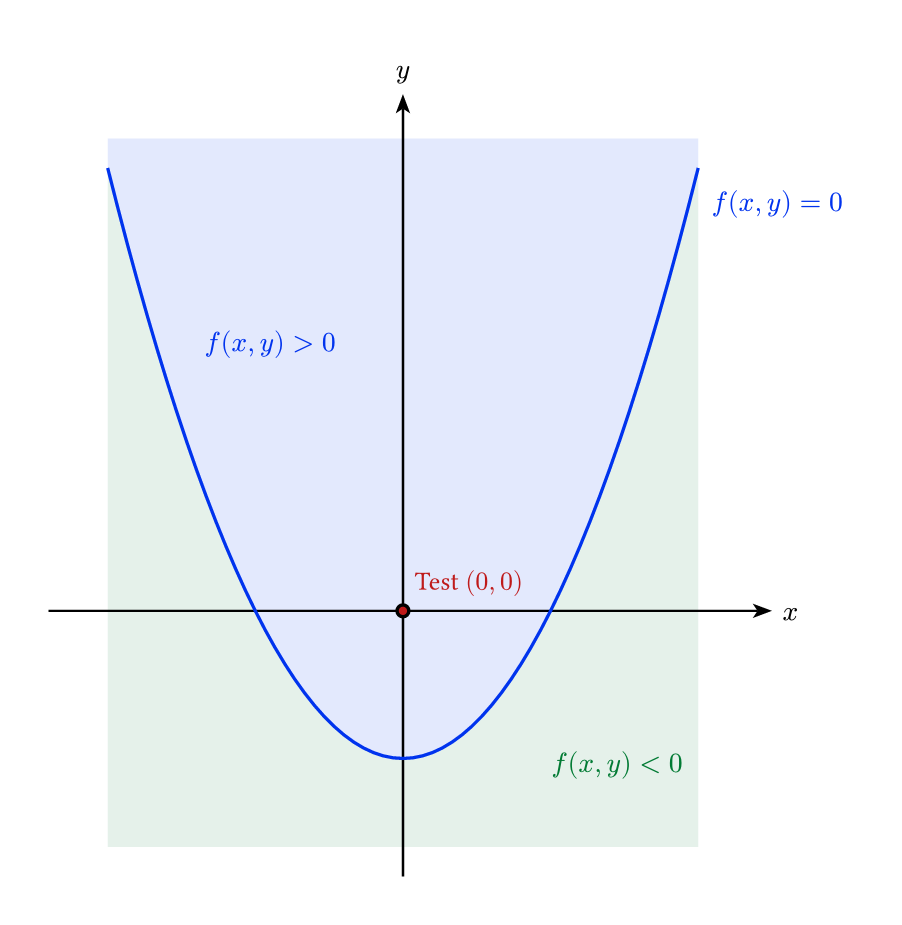
traces out a boundary curve in the xyxy-plane. This boundary curve acts like a fence: it divides the rest of the plane into separate sides:

  • On the curve itself, f(x,y)=0f(x, y) = 0.
  • On one side of the curve, f(x,y)>0f(x, y) > 0.
  • On the other side of the curve, f(x,y)<0f(x, y) < 0.

Because f(x,y)f(x, y) is continuous, its sign cannot flip from positive to negative without crossing the boundary f(x,y)=0f(x, y) = 0. That means every point on the same side of the boundary gives the same sign!

A boundary curve f(x,y) = 0 dividing the plane into f(x,y) > 0 and f(x,y) < 0

The Two-Step Method to Plot Any Inequality§

Whenever you see an inequality such as f(x,y)≥0f(x, y) \ge 0 or f(x,y)≤0f(x, y) \le 0:

  1. Plot the boundary: Replace the inequality sign with == and sketch the curve f(x,y)=0f(x, y) = 0.

  2. Pick a test point: Choose any convenient point (x0,y0)(x_0, y_0) that does not lie on the boundary (the origin (0,0)(0, 0) is usually the easiest choice; if (0,0)(0, 0) lies on the curve, pick (1,0)(1, 0) or (0,1)(0, 1)). Plug (x0,y0)(x_0, y_0) into the inequality:

    • If it makes the inequality true, shade the side that contains (x0,y0)(x_0, y_0).
    • If it makes the inequality false, shade the opposite side.

When a set lists multiple inequalities (separated by commas or "and"), the required region is the overlap (intersection) where all the inequalities hold at the same time.

(Note: Whether an inequality is strict, like <<, or inclusive, like ≤\le, does not change the area—a boundary curve has zero thickness and contributes zero area.)


2. Worked Examples on Inequality Regions§

Example 1: Parabola and Line Inequality

Find the area of the region R={(x,y):x2≤y≤x+2}R = \big\{(x, y) : x^2 \le y \le x + 2\big\}.

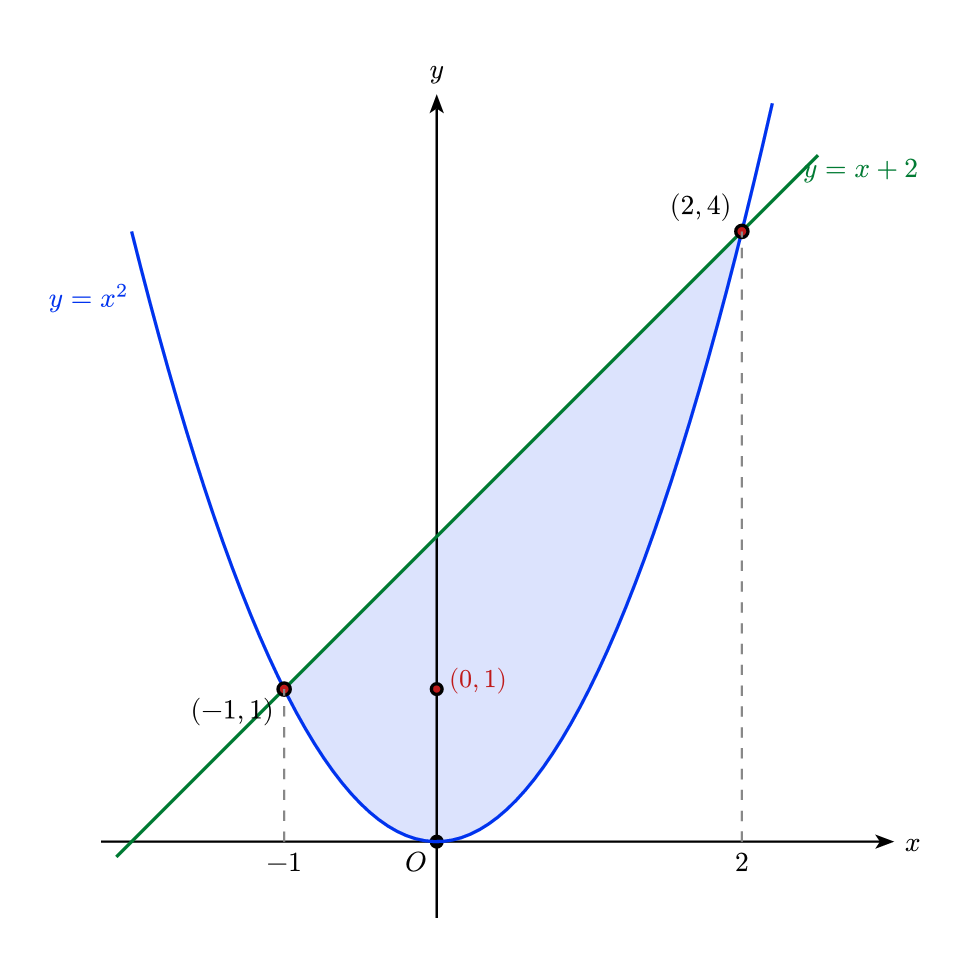
Solution: The double inequality x2≤y≤x+2x^2 \le y \le x + 2 stands for two simultaneous conditions: y≥x2y \ge x^2 and y≤x+2y \le x + 2.

  1. Plot the boundaries:

    • y=x2y = x^2 (upward parabola with vertex at (0,0)(0, 0)).
    • y=x+2y = x + 2 (straight line).
  2. Test a point: Choose (0,1)(0, 1) (which is not on either boundary):

    • In y≥x2y \ge x^2: 1≥01 \ge 0 is true, so we shade above/inside the parabola.
    • In y≤x+2y \le x + 2: 1≤21 \le 2 is true, so we shade below the line.

Region bounded by x^2 <= y <= x + 2

The overlapping region is trapped above y=x2y = x^2 and below y=x+2y = x + 2. Find the intersections:

x2=x+2  ⟹  x2−x−2=0  ⟹  (x−2)(x+1)=0  ⟹  x=−1,  x=2x^2 = x + 2 \implies x^2 - x - 2 = 0 \implies (x - 2)(x + 1) = 0 \implies x = -1, \; x = 2

Using vertical strips from x=−1x = -1 to x=2x = 2:

A=∫−12(x+2−x2) dx=[x22+2x−x33]−12=(2+4−83)−(12−2+13)=92 sq. units.A = \int_{-1}^{2} (x + 2 - x^2)\,dx = \left[\frac{x^2}{2} + 2x - \frac{x^3}{3}\right]_{-1}^{2} = \left(2 + 4 - \frac{8}{3}\right) - \left(\frac{1}{2} - 2 + \frac{1}{3}\right) = \frac{9}{2}\text{ sq. units.}

Example 2: Inside a Circle and Outside a Parabola

Find the area of the region R={(x,y):x2+y2≤8,  y2≥2x}R = \big\{(x, y) : x^2 + y^2 \le 8, \; y^2 \ge 2x\big\}.

Solution: Be careful here! Many students see y2=2xy^2 = 2x and automatically shade the inside of the parabola—let the test point guide you instead.

  1. Plot the boundaries:

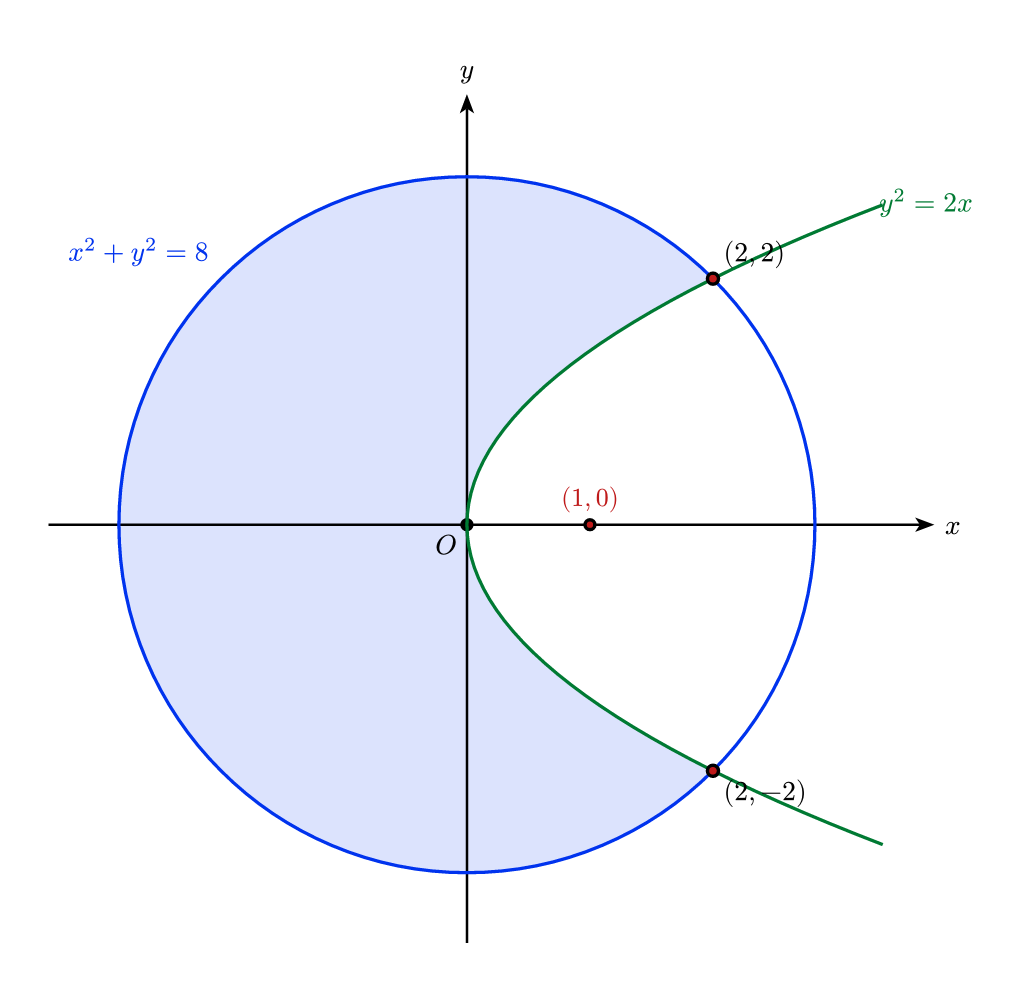
    • x2+y2=8x^2 + y^2 = 8: circle centered at (0,0)(0, 0) with radius 8=22\sqrt{8} = 2\sqrt{2}.
    • y2=2xy^2 = 2x: rightward-opening parabola with vertex at (0,0)(0, 0).
  2. Test the point (1,0)(1, 0):

    • In x2+y2≤8x^2 + y^2 \le 8: 12+02=1≤81^2 + 0^2 = 1 \le 8 is true   ⟹  \implies inside the circle.
    • In y2≥2xy^2 \ge 2x: 02≥2(1)  ⟹  0≥20^2 \ge 2(1) \implies 0 \ge 2 is false   ⟹  \implies outside the parabola (the side not containing (1,0)(1, 0)).

Region inside the circle x^2 + y^2 <= 8 and outside the parabola y^2 >= 2x

Find where the circle and parabola intersect:

x2+2x=8  ⟹  x2+2x−8=0  ⟹  (x+4)(x−2)=0x^2 + 2x = 8 \implies x^2 + 2x - 8 = 0 \implies (x + 4)(x - 2) = 0

Since 2x=y2≥02x = y^2 \ge 0, we must have x=2x = 2, which gives y=±2y = \pm 2.

To find the shaded area cleanly, notice that the full circle has area πr2=8π\pi r^2 = 8\pi. We simply subtract the unshaded part inside both the circle and the parabola (where yy runs from −2-2 to 22). Using horizontal strips on that unshaded lens:

Aunshaded=∫−22(8−y2−y22) dy=2∫028−y2 dy−2∫02y22 dyA_{\text{unshaded}} = \int_{-2}^{2} \left(\sqrt{8 - y^2} - \frac{y^2}{2}\right)\,dy = 2\int_0^2 \sqrt{8 - y^2}\,dy - 2\int_0^2 \frac{y^2}{2}\,dy

Using the standard formula ∫a2−y2 dy=y2a2−y2+a22sin⁡−1(ya)\int \sqrt{a^2 - y^2}\,dy = \frac{y}{2}\sqrt{a^2 - y^2} + \frac{a^2}{2}\sin^{-1}\left(\frac{y}{a}\right) with a=8a = \sqrt{8}:

2∫028−y2 dy=[y8−y2+8sin⁡−1(y8)]02=2(2)+8⋅π4=4+2π2\int_0^2 \sqrt{8 - y^2}\,dy = \left[y\sqrt{8 - y^2} + 8\sin^{-1}\left(\frac{y}{\sqrt{8}}\right)\right]_0^2 = 2(2) + 8 \cdot \frac{\pi}{4} = 4 + 2\pi

And the second integral is:

2∫02y22 dy=[y33]02=832\int_0^2 \frac{y^2}{2}\,dy = \left[\frac{y^3}{3}\right]_0^2 = \frac{8}{3}

So Aunshaded=4+2π−83=2π+43A_{\text{unshaded}} = 4 + 2\pi - \frac{8}{3} = 2\pi + \frac{4}{3}. Subtracting this from the circle's area 8π8\pi gives:

A=8π−(2π+43)=6π−43 sq. units.A = 8\pi - \left(2\pi + \frac{4}{3}\right) = 6\pi - \frac{4}{3}\text{ sq. units.}

Example 3: Shifted Circle and Parabola in the First Quadrant

Find the area of the region R={(x,y):x2+y2≤2x,  y2≥x,  y≥0}R = \big\{(x, y) : x^2 + y^2 \le 2x, \; y^2 \ge x, \; y \ge 0\big\}.

Solution:

  1. Plot the boundaries:

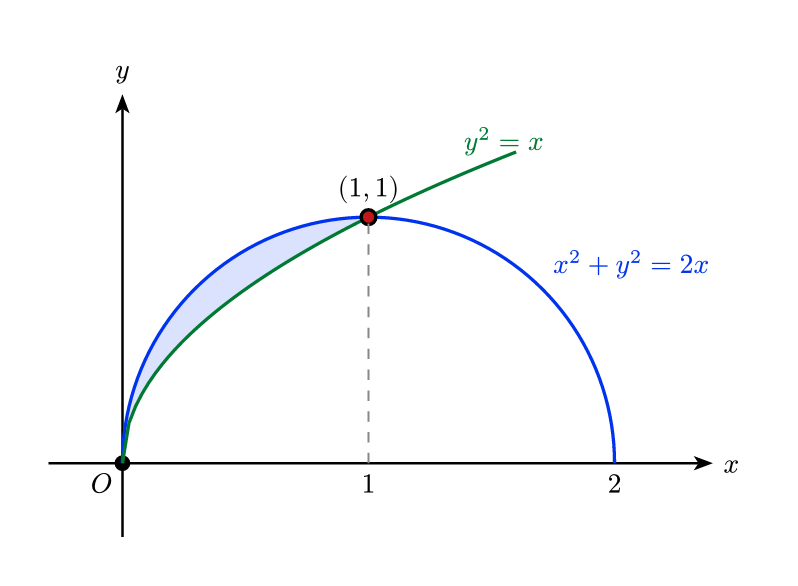
    • Complete the square on x2+y2=2xx^2 + y^2 = 2x: (x−1)2+y2=1(x - 1)^2 + y^2 = 1, a circle centered at (1,0)(1, 0) with radius 11.
    • y2=xy^2 = x: rightward parabola with vertex at (0,0)(0, 0).
    • y=0y = 0: the xx-axis.
  2. Test the point (1,12)(1, \frac{1}{2}):

    • y≥0y \ge 0: 12≥0\frac{1}{2} \ge 0 is true (upper half-plane).
    • x2+y2≤2xx^2 + y^2 \le 2x: 1+14≤21 + \frac{1}{4} \le 2 is true (inside the circle).
    • y2≥xy^2 \ge x: 14≥1\frac{1}{4} \ge 1 is false (so we want the region outside/above the parabola y=xy = \sqrt{x}).

Region inside x^2 + y^2 <= 2x and above y^2 >= x in the first quadrant

Find the intersection of x2+y2=2xx^2 + y^2 = 2x and y2=xy^2 = x:

x2+x=2x  ⟹  x2−x=0  ⟹  x=0,  x=1x^2 + x = 2x \implies x^2 - x = 0 \implies x = 0, \; x = 1

In the first quadrant (y≥0y \ge 0), they meet at (0,0)(0, 0) and (1,1)(1, 1)—which is the very top point of the circle! Thus, on [0,1][0, 1], the region lies inside the left quarter-circle of radius 11 and above the parabola y=xy = \sqrt{x}:

A=Area of quarter-circle−∫01x dx=π(1)24−[23x3/2]01=π4−23 sq. units.A = \text{Area of quarter-circle} - \int_0^1 \sqrt{x}\,dx = \frac{\pi (1)^2}{4} - \left[\frac{2}{3}x^{3/2}\right]_0^1 = \frac{\pi}{4} - \frac{2}{3}\text{ sq. units.}

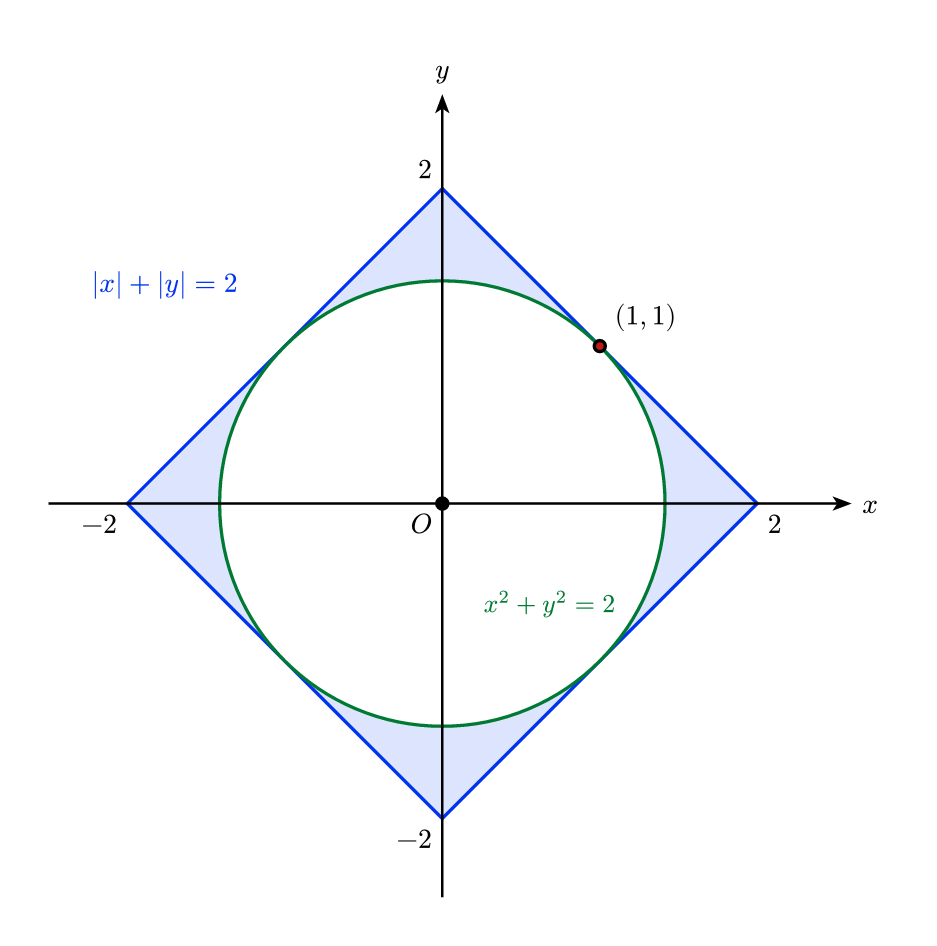
Example 4: Modulus Diamond Outside an Inscribed Circle

Find the area of the region R={(x,y):∣x∣+∣y∣≤2 and x2+y2≥2}R = \big\{(x, y) : |x| + |y| \le 2 \text{ and } x^2 + y^2 \ge 2\big\}.

Solution:

  1. Plot the boundaries:

    • ∣x∣+∣y∣=2|x| + |y| = 2: a square (diamond) with vertices (2,0)(2, 0), (0,2)(0, 2), (−2,0)(-2, 0), and (0,−2)(0, -2). Each side has length 22+22=22\sqrt{2^2 + 2^2} = 2\sqrt{2}, so the diamond's area is (22)2=8(2\sqrt{2})^2 = 8.
    • x2+y2=2x^2 + y^2 = 2: a circle centered at (0,0)(0, 0) with radius 2\sqrt{2}. Notice that the perpendicular distance from (0,0)(0, 0) to the line x+y=2x + y = 2 is 22=2\frac{2}{\sqrt{2}} = \sqrt{2}, so the circle is inscribed inside the diamond, touching each side at (±1,±1)(\pm 1, \pm 1)!
  2. Test the origin (0,0)(0, 0):

    • In ∣x∣+∣y∣≤2|x| + |y| \le 2: 0≤20 \le 2 is true   ⟹  \implies inside the diamond.
    • In x2+y2≥2x^2 + y^2 \ge 2: 0≥20 \ge 2 is false   ⟹  \implies outside the circle.

Region inside the diamond |x| + |y| <= 2 and outside the circle x^2 + y^2 >= 2

Because the circle sits completely inside the diamond, the area is simply the diamond's area minus the circle's area:

A=8−π(2)2=8−2π sq. units.A = 8 - \pi(\sqrt{2})^2 = 8 - 2\pi\text{ sq. units.}

Example 5: Parabola, Line, and Upper Half-Plane

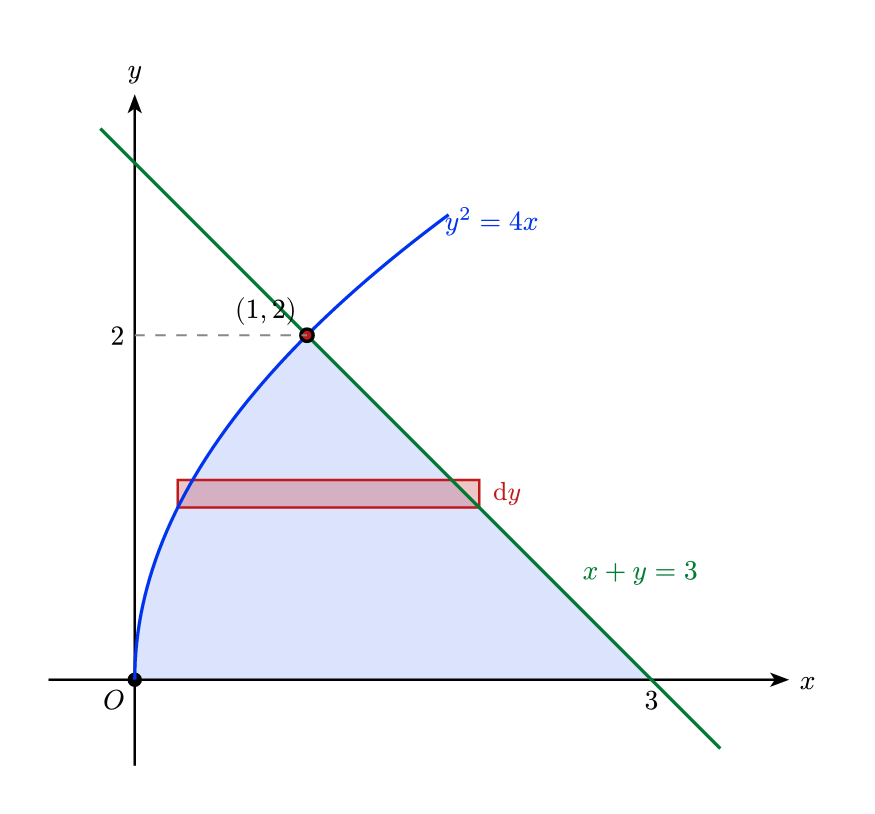
Find the area of the region R={(x,y):y2≤4x,  x+y≤3,  y≥0}R = \big\{(x, y) : y^2 \le 4x, \; x + y \le 3, \; y \ge 0\big\}.

Solution:

  1. Plot the boundaries: y2=4xy^2 = 4x (parabola), x+y=3x + y = 3 (line), and y=0y = 0 (xx-axis).

  2. Test the point (1,12)(1, \frac{1}{2}):

    • y2≤4xy^2 \le 4x: 14≤4\frac{1}{4} \le 4 is true (inside the parabola).
    • x+y≤3x + y \le 3: 1.5≤31.5 \le 3 is true (below/left of the line).
    • y≥0y \ge 0: 12≥0\frac{1}{2} \ge 0 is true (above the xx-axis).

Region bounded by y^2 <= 4x, x + y <= 3, and y >= 0

Find where y2=4xy^2 = 4x intersects x+y=3x + y = 3:

y2=4(3−y)  ⟹  y2+4y−12=0  ⟹  (y+6)(y−2)=0y^2 = 4(3 - y) \implies y^2 + 4y - 12 = 0 \implies (y + 6)(y - 2) = 0

Since y≥0y \ge 0, we get y=2y = 2 and x=3−2=1x = 3 - 2 = 1. Using horizontal strips from y=0y = 0 to y=2y = 2 (right boundary x=3−yx = 3 - y, left boundary x=y24x = \frac{y^2}{4}):

A=∫02((3−y)−y24) dy=[3y−y22−y312]02=6−2−812=4−23=103 sq. units.A = \int_0^2 \left((3 - y) - \frac{y^2}{4}\right)\,dy = \left[3y - \frac{y^2}{2} - \frac{y^3}{12}\right]_0^2 = 6 - 2 - \frac{8}{12} = 4 - \frac{2}{3} = \frac{10}{3}\text{ sq. units.}

Example 6: Symmetric Double Inequality With Absolute Value

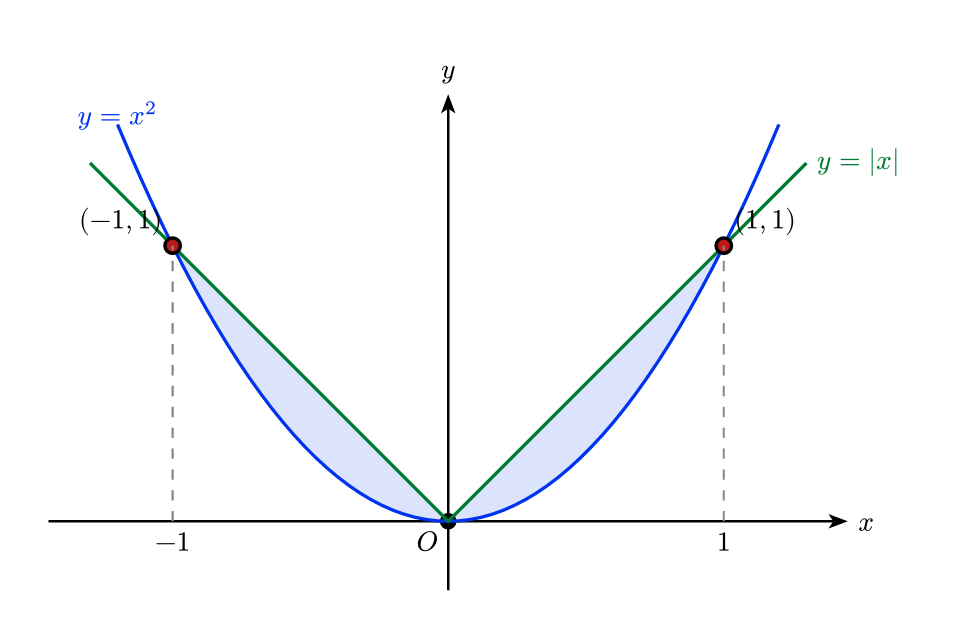
Find the area of the region R={(x,y):x2≤y≤∣x∣}R = \big\{(x, y) : x^2 \le y \le |x|\big\}.

Solution: The inequality x2≤y≤∣x∣x^2 \le y \le |x| requires y≥x2y \ge x^2 (above the parabola) and y≤∣x∣y \le |x| (below the V-shaped graph of ∣x∣|x|). Because both x2x^2 and ∣x∣|x| are even functions of xx, the region is completely symmetric about the yy-axis.

Symmetric region bounded by x^2 <= y <= |x|

In the first quadrant (x≥0x \ge 0), ∣x∣=x|x| = x, and x2=xx^2 = x gives intersections at x=0x = 0 and x=1x = 1. On [0,1][0, 1], x≥x2x \ge x^2, so the area is twice the first-quadrant area:

A=2∫01(x−x2) dx=2[x22−x33]01=2(12−13)=13 sq. units.A = 2 \int_0^1 (x - x^2)\,dx = 2\left[\frac{x^2}{2} - \frac{x^3}{3}\right]_0^1 = 2\left(\frac{1}{2} - \frac{1}{3}\right) = \frac{1}{3}\text{ sq. units.}

Example 7: When an Inequality Automatically Restricts the Interval

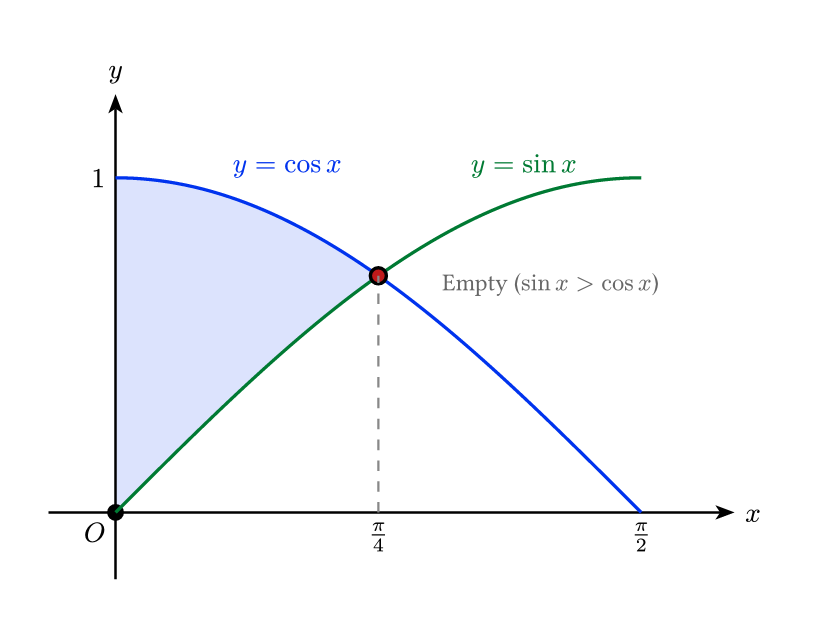
Find the area of the region R={(x,y):sin⁡x≤y≤cos⁡x,  0≤x≤π2}R = \big\{(x, y) : \sin x \le y \le \cos x, \; 0 \le x \le \frac{\pi}{2}\big\}.

Solution: Notice a subtle catch here! For a point (x,y)(x, y) to satisfy sin⁡x≤y≤cos⁡x\sin x \le y \le \cos x, we must first have sin⁡x≤cos⁡x\sin x \le \cos x.

  • For x∈[0,π4]x \in \left[0, \frac{\pi}{4}\right], sin⁡x≤cos⁡x\sin x \le \cos x holds, so yy can lie between sin⁡x\sin x and cos⁡x\cos x.
  • For x∈(π4,π2]x \in \left(\frac{\pi}{4}, \frac{\pi}{2}\right], sin⁡x>cos⁡x\sin x > \cos x, so no value of yy can satisfy sin⁡x≤y≤cos⁡x\sin x \le y \le \cos x! The region is empty on (π4,π2]\left(\frac{\pi}{4}, \frac{\pi}{2}\right].

Region sin x <= y <= cos x on [0, pi/2] collapsing to [0, pi/4]

Therefore, the inequality itself restricts xx to [0,π4]\left[0, \frac{\pi}{4}\right], and the area is:

A=∫0π/4(cos⁡x−sin⁡x) dx=[sin⁡x+cos⁡x]0π/4=(12+12)−(0+1)=2−1 sq. units.A = \int_0^{\pi/4} (\cos x - \sin x)\,dx = \Big[\sin x + \cos x\Big]_0^{\pi/4} = \left(\frac{1}{\sqrt{2}} + \frac{1}{\sqrt{2}}\right) - (0 + 1) = \sqrt{2} - 1\text{ sq. units.}
Section 2 of 7 · Area Under Curves

Mark this section complete when you have worked through its proofs.