A function f(x) is said to be continuous on an open interval(a,b) if it is continuous at every point x in (a,b). This means that for every x∈(a,b), the limit
x→climf(x)
exists and equals f(c) for all c∈(a,b).
Since the interval (a,b) does not include its endpoints, continuity is only required for points strictly inside the interval. There is no need to check left or right continuity at x=a or x=b, as these points do not belong to the domain under consideration.
For example, the function
f(x)=x2
is continuous on (−1,1) because the polynomial x2 is continuous for all real numbers, and in particular, for every x in (−1,1), the limit x→climf(x)=f(c) holds.
However, consider the function
f(x)=x1
on the interval (−1,1). At x=0, the function is not defined, and the limit as x→0 does not exist since f(x)→∞ from one side and f(x)→−∞ from the other. Hence, f(x) is not continuous on (−1,1) because it fails to be continuous at x=0, even though it is continuous at every other point in the interval.
A function f(x) is said to be continuous on a closed interval[a,b] if it is continuous at every point inside (a,b) and satisfies one-sided continuity at the endpoints. This requires:
Continuity at interior points: For every x∈(a,b),
x→climf(x)=f(c).
Right continuity at x=a: The function must satisfy
x→a+limf(x)=f(a).
Left continuity at x=b: The function must satisfy
x→b−limf(x)=f(b).
A function that is continuous on a closed interval must not have any jumps, missing points, or infinite oscillations inside the interval, and it must not have any discontinuities at the endpoints.
Consider the function
f(x)=x3,x∈[−1,1].
For every x in (−1,1), the function is continuous because polynomials are continuous everywhere. Checking the endpoints:
At x=−1: The right-hand limit is
x→−1+limx3=(−1)3=−1=f(−1).
At x=1: The left-hand limit is
x→1−limx3=13=1=f(1).
Since both one-sided limits match the function values, f(x)=x3 is continuous on [−1,1].
Now consider the function
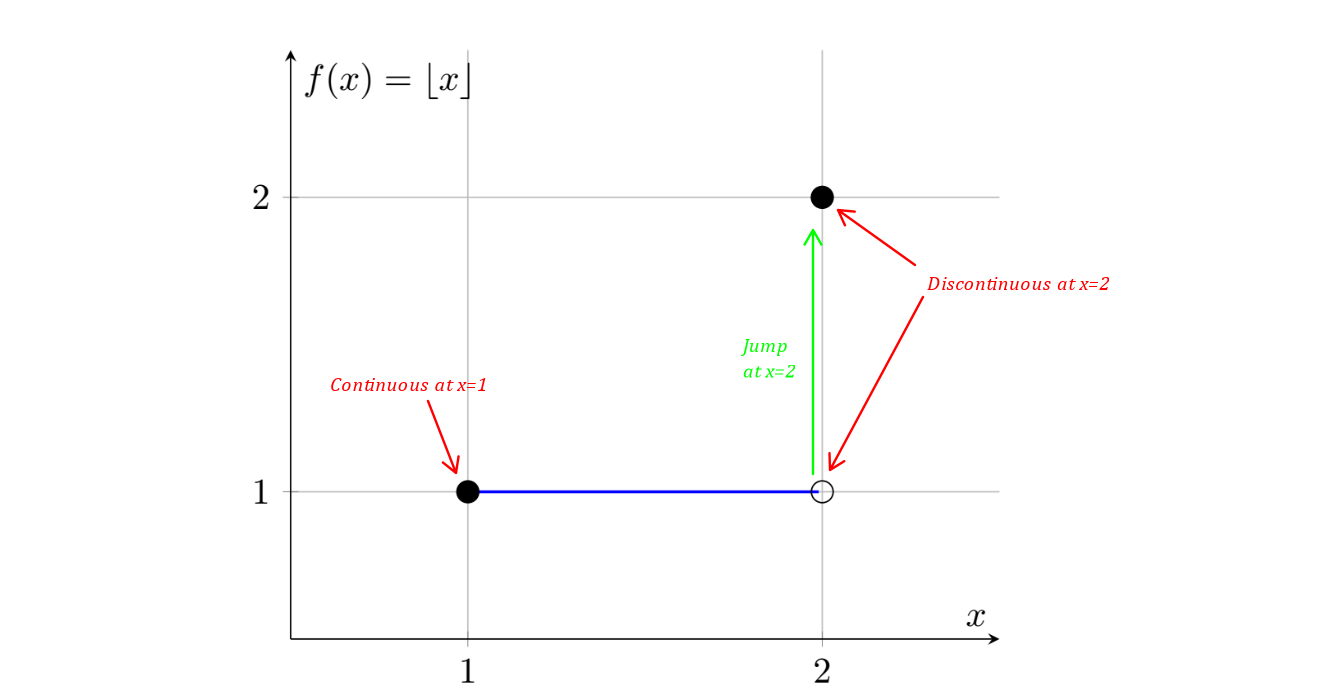
f(x)=⌊x⌋,x∈[1,2].
For x∈(1,2), the function takes constant values. Specifically,
f(x)=1,1≤x<2,andf(2)=2.
Checking continuity at x=2:
Left-hand limit:
x→2−lim⌊x⌋=1.
Function value:
f(2)=2.
Since x→2−limf(x)=f(2), the function has a jump discontinuity at x=2.
However, at x=1, the right-hand limit is
x→1+lim⌊x⌋=1=f(1),
so f(x) is right-continuous at x=1 but not continuous at x=2.
Thus, f(x)=⌊x⌋ is not continuous on [1,2] because of the discontinuity at x=2, even though it satisfies right-continuity at x=1.
To determine all points of discontinuity of a function in an interval, it is not feasible to test the function at every point, as there are infinitely many. Instead, a systematic approach is required, analyzing the function’s structure to identify locations where discontinuities may occur.
First, we analyze where elementary functions can be discontinuous. Polynomials, exponential functions, logarithmic functions, trigonometric functions, and rational functions are all continuous on their domains, meaning any discontinuity must arise from restrictions on their definition. For example, a rational function is continuous except where its denominator becomes zero. The function
f(x)=x1
is continuous everywhere except at x=0, where the denominator vanishes, causing an infinite discontinuity.
Discontinuities in a function do not always come from the elementary functions themselves but can also appear because of how the function is built. A piecewise function can have a jump discontinuity at a point where two different expressions meet if the left-hand and right-hand limits are not the same.
Dividing by a function can also create discontinuities. If the denominator becomes zero at some point, the function is undefined there, unless the numerator also becomes zero in a way that allows the fraction to be simplified.
To find all discontinuities in a function, we must carefully examine both the elementary functions it is made of and how they are combined.
Elementary functions and their Continuity
Let us analyze the continuity of some fundamental functions commonly used in mathematics. Understanding where these functions are continuous and where they exhibit discontinuities helps in identifying points of discontinuity in more complex functions.
1. Polynomial Functions
Polynomial functions are continuous everywhere in R. That is, if f(x) is a polynomial, then
x→alimf(x)=f(a)for all a∈R.
Since polynomials are composed of sums, differences, and products of powers of x, they have no points of discontinuity.
2. Exponential and Logarithmic Functions
The exponential functionex is also continuous for all x∈R.
The natural logarithm functionlnx is continuous on its domain (0,∞).
3. Trigonometric Functions
All trigonometric functions are continuous on their domains. However, some have points of discontinuity where their denominators become zero:
The tangent functiontanx is discontinuous at points where cosx=0, which occurs at
x=2(2n+1)π,n∈Z.
The cotangent functioncotx is discontinuous at points where sinx=0, which occurs at
x=nπ,n∈Z.
The secant functionsecx is discontinuous at the same points as tanx, namely
x=2(2n+1)π,n∈Z.
The cosecant functioncscx is discontinuous at the same points as cotx, namely
x=nπ,n∈Z.
4. Inverse Trigonometric Functions
All inverse trigonometric functions are continuous on their respective domains:
sin−1x and cos−1x are continuous on [−1,1].
tan−1x and cot−1x are continuous on R.
sec−1x and csc−1x are continuous on (−∞,−1]∪[1,∞].
5. Greatest Integer and Fractional Part Functions
The greatest integer function (or floor function) f(x)=⌊x⌋ is discontinuous at all integer points, i.e., at
x=n,n∈Z.
At these points, the function exhibits a jump discontinuity, where the left-hand limit is n−1 and the right-hand limit is n.
The fractional part functionf(x)={x}=x−⌊x⌋ is also discontinuous at all integer points n∈Z since the left-hand limit at x=n is 1 while the right-hand limit is 0.
6. Signum Function
The signum function, defined as
sgn(x)=⎩⎨⎧1,0,−1,x>0,x=0,x<0,
is discontinuous at x=0 because the left-hand limit is −1, the right-hand limit is 1, and f(0)=0, meaning the function exhibits a jump discontinuity at x=0.
Discontinuity due to Division
Discontinuities can arise in a function of the form
f(x)=q(x)p(x)
whenever the denominator q(x) is zero. If p(x) is nonzero at those points, the function exhibits infinite discontinuities, as the function value tends to ∞ or −∞.
However, in some cases where both the numerator p(x) and denominator q(x) vanish at the same point, the function may instead have a missing point discontinuity. Whether the discontinuity is removable depends on whether the limit of the function exists at that point after simplification.
For example, consider
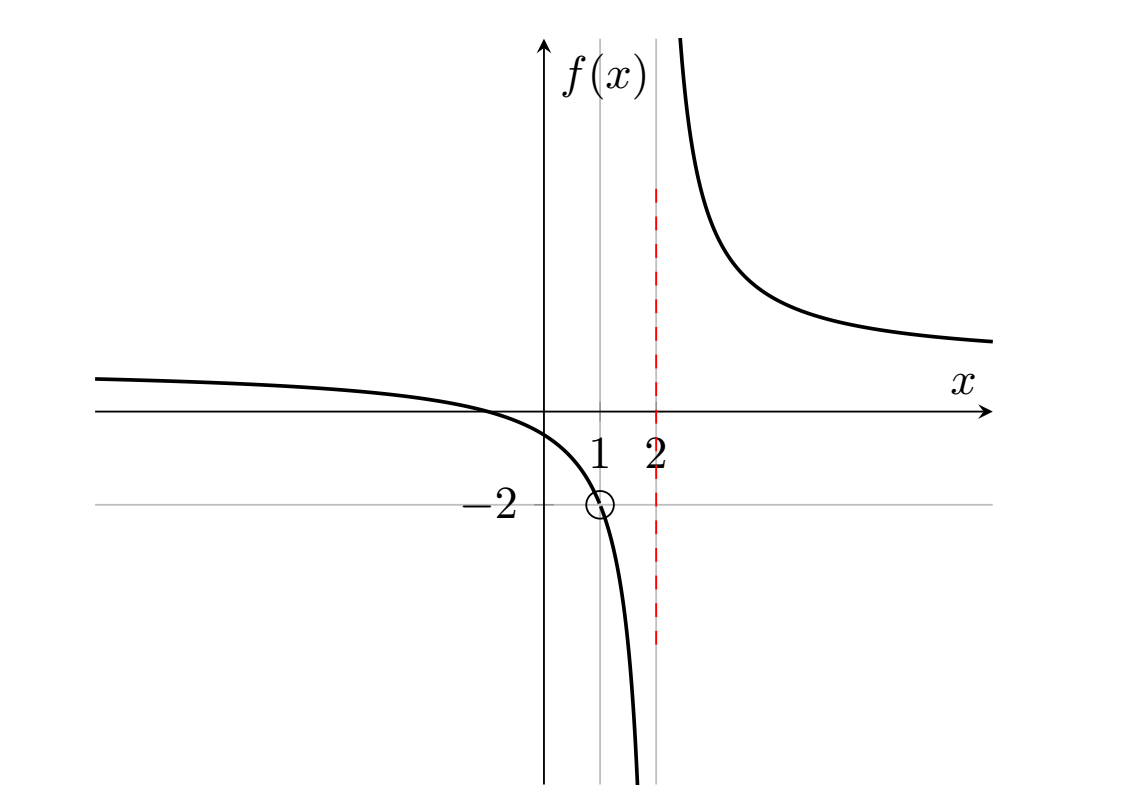
f(x)=x2−3x+2x2−1.
Factoring the denominator,
x2−3x+2=(x−1)(x−2),
shows that the function is undefined at x=1 and x=2. Examining the numerator,
x2−1=(x−1)(x+1),
reveals that both p(x) and q(x) vanish at x=1, allowing simplification:
f(x)=(x−1)(x−2)(x−1)(x+1)=x−2x+1,x=1.
Since the simplified function has a well-defined limit at x=1,
x→1limf(x)=1−21+1=−2,
but f(x) is not defined at x=1, this is a missing point discontinuity. On the other hand, at x=2, the denominator still vanishes but the numerator does not, leading to an infinite discontinuity at x=2.
Discontinuities in Piecewise-Defined Functions at Transition Points
A piecewise-defined function is a function that is defined by different expressions over different intervals. Discontinuities in such functions often occur at the transition points, which are the points where the function changes from one expression to another.
For a piecewise function to be continuous at a transition pointx=a, the left-hand limit, right-hand limit, and function value must all be equal, that is:
x→a−limf(x)=x→a+limf(x)=f(a).
If this condition fails, the function is discontinuous at x=a. The type of discontinuity depends on how the function behaves at that point.
Consider the piecewise function
f(x)=⎩⎨⎧x+1,3,x−1,x<2,x=2,x>2.
To check continuity at x=2, we compute the left-hand and right-hand limits:
Left-hand limit:
x→2−limf(x)=x→2−lim(x+1)=2+1=3.
Right-hand limit:
x→2+limf(x)=x→2+lim(x−1)=2−1=1.
Since
x→2−limf(x)=x→2+limf(x),
the function has a jump discontinuity at x=2. Even though f(2)=3 is defined, the discontinuity cannot be removed because the left-hand and right-hand limits are not equal.
Composition of greatest integer function with other functions
The composition of the greatest integer function with other functions, written as ⌊f(x)⌋, is a common type of function that may introduce discontinuities. Discontinuities in such functions typically occur wherever f(x) crosses an integer value, but not necessarily at every such point. This is why we say the function may be discontinuous, rather than always being so.
For example, consider the function
f(x)=⌊x/2⌋.
Since the greatest integer function ⌊x⌋ is discontinuous at integer values of x, the composition ⌊x/2⌋may be discontinuous at points where
2x is an integer.
This happens when
2x=nor equivalently,x=2n,n∈Z.
To determine whether the function is actually discontinuous at these points, we check the left-hand and right-hand limits at x=2n.
Left-hand limit:
x→2n−lim⌊x/2⌋=n−1.
Right-hand limit:
x→2n+lim⌊x/2⌋=n.
Since the left-hand and right-hand limits are not equal, f(x)=⌊x/2⌋ is indeed discontinuous at x=2n, for all n∈Z.
On the other hand, consider the function
f(x)=⌊x2⌋.
A natural question is whether this function is discontinuous at x=0. Since the greatest integer function ⌊x2⌋ may introduce discontinuities at points where x2 is an integer, we check whether such a discontinuity occurs at x=0.
First, compute the left-hand and right-hand limits.
Right-hand limit: For x→0+, we have x2→0+, meaning
x→0+lim⌊x2⌋=0.
Left-hand limit: Similarly, for x→0−, we still have x2→0+ (since squaring eliminates the sign), so
x→0−lim⌊x2⌋=0.
Since both one-sided limits are equal and also equal to f(0)=⌊02⌋=0, the function is continuous at x=0.
This example illustrates that while functions of the form ⌊f(x)⌋may be discontinuous at points where f(x) is an integer, they are not necessarily discontinuous at every such point. In this case, x2 smoothly approaches 0 from both sides, so no jump occurs, making the function continuous at x=0.
Composition of Signum Function with any other Function
If f(x) is not a constant function, then sgn(f(x)) is always discontinuous at x whenever f(x)=0. If f(x) crosses 0 at x=a, then on one side of x=a, f(x) is positive, and on the other side, it is negative. This implies that sgn(f(x)) takes the value +1 on one side and −1 on the other. Since at x=a, f(a)=0, we have sgn(f(a))=0. Clearly, there is a discontinuity at x=a because the left-hand limit and right-hand limit are not equal.
If f(x) is such that it is positive before it becomes zero at x=a and positive again after x=a, then
x→alimsgn(f(x))=1,but f(a)=0⇒sgn(f(a))=0.
Again, we get a discontinuity at x=a. Thus, in any case where f(x)=0 at some point and f(x) is not constant, there is a discontinuity in sgn(f(x)) at that point.
Now, if f(x) is constant, the behavior of sgn(f(x)) depends on whether f(x) is positive, negative, or zero:
If f(x)=c is positive, then sgn(f(x))=1 for all x, which is clearly continuous.
If f(x)=c is negative, then sgn(f(x))=−1 for all x, which is also continuous.
If f(x)=0 for all x, then sgn(f(x))=0 everywhere, which is again continuous.
Thus, the signum function is always discontinuous at points where f(x)changes sign, but remains continuous when f(x) is a nonzero constant or identically zero. For example,
consider the function
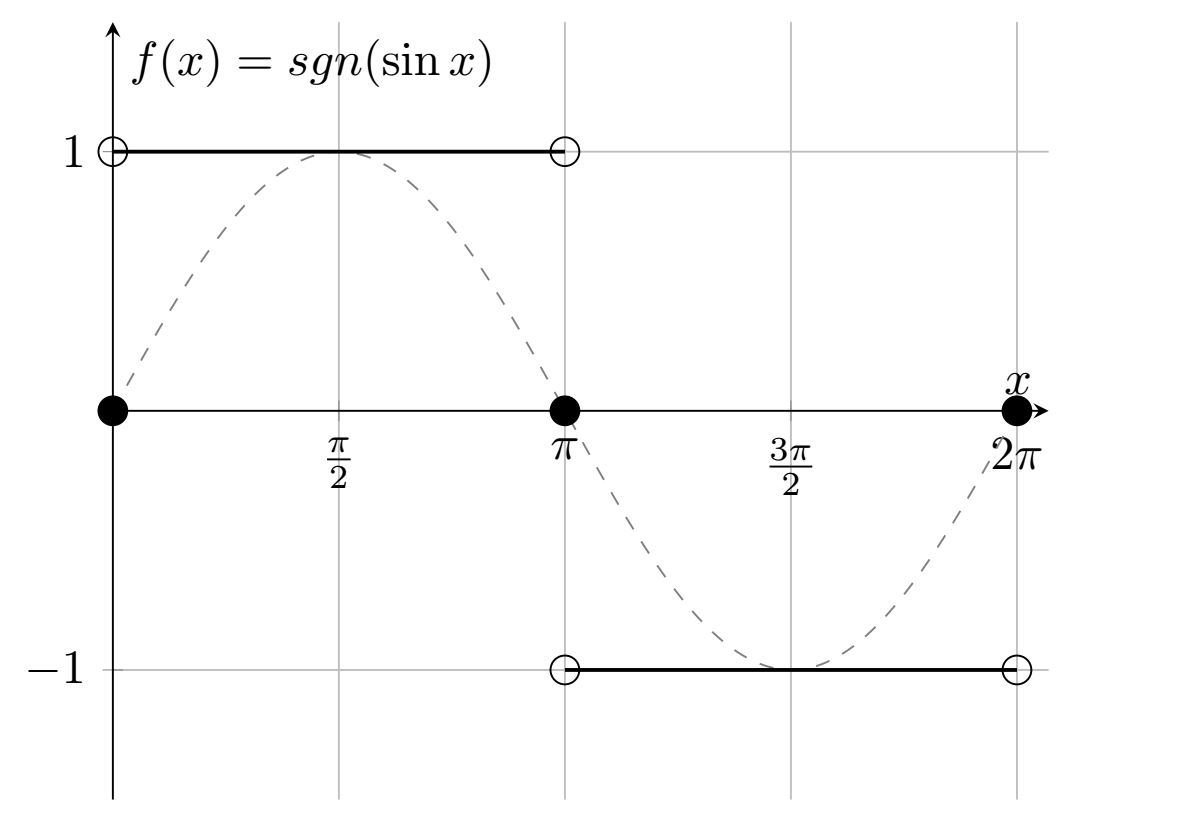
f(x)=sgn(sinx),x∈[0,2π].
Since sinx is positive for x∈(0,π) and negative for x∈(π,2π), the signum function takes values:
f(x)=⎩⎨⎧1,0,−1,x∈(0,π),x=0,π,2π,x∈(π,2π).
At x=0,π,2π, sinx=0, so sgn(sinx)=0, represented by filled circles at these points. The function exhibits jump discontinuities at x=π and x=2π, as shown by the hollow circles at the left endpoints of each step. The underlying dashed curve represents sinx, helping visualize where sgn(sinx) transitions.
When functions are combined using basic operations such as addition, subtraction, multiplication, division, or composition, the continuity or discontinuity of the resulting function depends on the continuity of the original functions. Understanding these properties allows for quick conclusions about the continuity or discontinuity of functions, helping to efficiently identify all points of discontinuity while avoiding unnecessary computations.
I: Continous with Continuous
Let f(x) and g(x) be functions that are continuous at x=a. Then, the following functions are also continuous at x=a:
f(x)+g(x),
f(x)−g(x),
f(x)g(x),
g(x)f(x), provided that g(a)=0.
Each of these results follows from the fundamental limit properties and is straightforward to prove, so we proceed without proof. These properties form the basis of algebraic continuity rules, allowing for quick determination of whether a function remains continuous after basic operations.
II. Continuous and Discontinuous
Sum and Difference
If f(x) is continuous at x=a and g(x) is discontinuous at x=a, then the sum f(x)+g(x) inherits the discontinuity from g(x). Since f(x) behaves smoothly at x=a, any discontinuity in g(x) will be present in their sum, making f+g discontinuous at x=a.
For example, consider the function
f(x)=x+⌊x⌋.
The function x is continuous everywhere, while ⌊x⌋ has jump discontinuities at every integer point. To analyze the continuity of f(x), consider the behavior at an integer x=n:
For x→n−,
x→n−limf(x)=x→n−lim(x+⌊x⌋)=n+(n−1)=2n−1.
For x→n+,
x→n+limf(x)=x→n+lim(x+⌊x⌋)=n+n=2n.
Since x→n−limf(x)=x→n+limf(x), the function f(x)=x+⌊x⌋ has a jump discontinuity at every integer x=n.
Product
If f(x) is continuous at x=a and g(x) is discontinuous at x=a, then the product f(x)g(x)may be either continuous or discontinuous at x=a. The behavior depends on how f(x) interacts with the discontinuity of g(x). To illustrate this, we examine two cases.
Consider the functions
f(x)=x,g(x)=⌊x⌋.
The function f(x)=x is continuous everywhere, while g(x)=⌊x⌋ is discontinuous at every integer.
At x=1, the function f(x) is continuous, but g(x) has a jump discontinuity. Checking the limits of their product:
For x→1−,
x→1−limf(x)g(x)=x→1−lim(x⌊x⌋)=(1⋅0)=0.
For x→1+,
x→1+limf(x)g(x)=x→1+lim(x⌊x⌋)=(1⋅1)=1.
Since x→1−limf(x)g(x)=x→1+limf(x)g(x), the function f(x)g(x) is discontinuous at x=1.
Now, consider the same functions at x=0. The function g(x)=⌊x⌋ is discontinuous at x=0, but computing the limits of f(x)g(x):
For x→0−,
x→0−limf(x)g(x)=x→0−lim(x⌊x⌋)=(0⋅(−1))=0.
For x→0+,
x→0+limf(x)g(x)=x→0+lim(x⌊x⌋)=(0⋅0)=0.
Since both one-sided limits agree and are equal to f(0)g(0)=0, the function f(x)g(x) is continuous at x=0 despite g(x) being discontinuous there.
Thus, the product of a continuous function and a discontinuous function may or may not be discontinuous, depending on how the continuous function behaves at the point of discontinuity of the other function.
The conclusion from the previous discussion is that we cannot make a general statement about the continuity of f(x)g(x) at x=a when f(x) is continuous at x=a and g(x) is discontinuous at x=a. Each case must be checked individually using the basic method of evaluating left-hand and right-hand limits.
However, there is one particular case where we can make a definite conclusion:
To see why, let g(x) have a jump discontinuity at x=a, meaning that the left-hand and right-hand limits of g(x) exist but are not equal:
x→a−limg(x)=g1,x→a+limg(x)=g2,g1=g2.
Since f(x) is continuous at x=a, we have
x→alimf(x)=f(a).
Given that f(a)=0, we compute the left and right limits of f(x)g(x):
Since both left-hand and right-hand limits exist and are equal to 0, we conclude that
x→alimf(x)g(x)=0=f(a)g(a).
Thus, f(x)g(x) is continuous at x=a.
For example, consider
f(x)=x−1,g(x)=⌊x⌋.
At x=1, the function f(x) is continuous and f(1)=0, while g(x) has a jump discontinuity at x=1. Computing the limits:
For x→1−,
x→1−limf(x)g(x)=x→1−lim(x−1)⌊x⌋=(1−1)⋅0=0.
For x→1+,
x→1+limf(x)g(x)=x→1+lim(x−1)⌊x⌋=(1−1)⋅1=0.
Since both limits are equal to 0, f(x)g(x) is continuous at x=1, demonstrating the special case.
Division
If f(x) is continuous at x=a and g(x) is discontinuous at x=a, then the quotient f(x)/g(x)may or may not be continuous at x=a. Unlike sum and difference, where discontinuity is guaranteed, or the product, where certain cases allow direct conclusions, the quotient function requires careful case-by-case analysis. No general conclusion can be drawn without explicitly checking the limits.
Discontinuous and Discontinuous
If both f(x) and g(x) are discontinuous at x=a, then no general conclusion can be drawn about the continuity of their sum f+g, difference f−g, product fg, or quotient f/g at x=a. Each case must be analyzed separately, as different types of discontinuities may interact in different ways.
Summary Table for all cases:
Case
f±g
f⋅g
gf
f continuous, g continuous
Continuous
Continuous
Continuous (if g=0)
f continuous, g discontinuous
Discontinuous
May or may not be continuous
May or may not be continuous
f discontinuous, g discontinuous
May or may not be continuous
May or may not be continuous
May or may not be continuous
Section 3 of 8 · Continuity and Differentiability
Mark this section complete when you have worked through its proofs.
Type any topic, theorem, or concept to jump directly to the section.