
Introduction
A function is said to be continuous if its graph can be drawn without lifting the pen from the paper. This intuitive idea suggests that a continuous function does not exhibit sudden jumps, breaks, or holes. More precisely, continuity captures the idea that small changes in the input should lead to small changes in the output, ensuring that the function behaves predictably and smoothly.
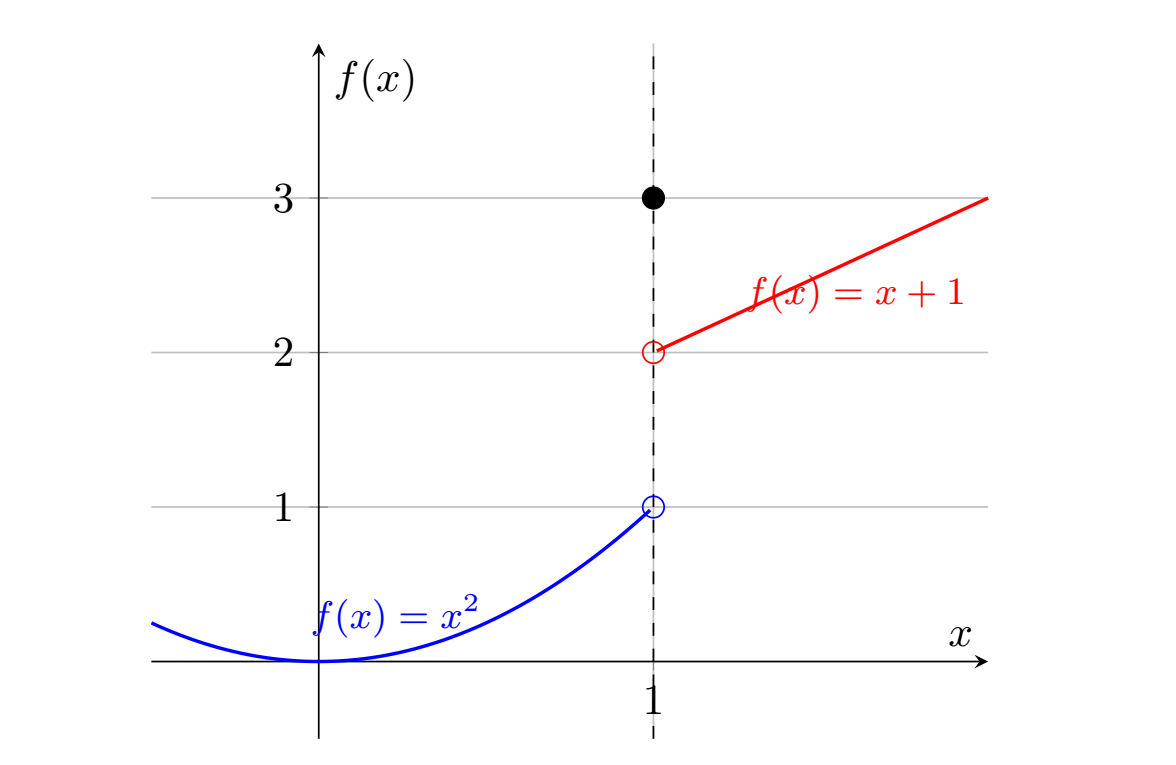
This notion of predictability is fundamental in mathematical analysis. If a function is continuous at a point, then as the input approaches that point, the output of the function approaches the function’s value at that point. There is no sudden or arbitrary change in the function’s behavior. A discontinuous function, on the other hand, introduces an abrupt variation in value, indicating an essential failure of smoothness. For example, the function
exhibits a discontinuity at because the limit from the left differs from the limit from the right, creating a break in the graph. Such a function does not allow a seamless transition from one side of to the other, making the discontinuity evident.
This concept of continuity has strong physical and geometric significance. In real-world scenarios, continuity often corresponds to smooth and stable change. Consider the position of an object moving along a path. If the position of the object as a function of time is continuous, then it does not teleport from one location to another instantaneously. The motion occurs smoothly, without sudden jumps. However, if the function governing position were discontinuous, this would imply an instantaneous shift in location, which contradicts physical reality. Similarly, if a temperature function were discontinuous, it would mean a sudden and unphysical jump in temperature at some moment, which is inconsistent with how heat transfer operates in real materials.
Continuity helps a function represent smooth and natural changes in physical and geometric processes. When a function is discontinuous, it means there is a sudden break or jump, which could indicate something unrealistic, like an object instantly changing position. This makes continuity an important property, not just for mathematical convenience, but for accurately modeling real-world situations in science and engineering.
Mark this section complete when you have worked through its proofs.