
Asymptotes of a Curve
Definition of Asymptote of a Curve §
An asymptote of a curve is a line that the curve approaches but never actually touches as or tends to infinity or some finite value. Mathematically, an asymptote represents the limiting behavior of the function, describing how it behaves at extreme values of or near singularities.
Try to understand from the following example:
Consider a curve given by
For large values of , or as , the term tends to . This means that the function behaves approximately as
This suggests that the curve tends to the straight line as grows larger in magnitude. To see this more clearly, we observe that the difference
approaches zero as , meaning the curve gets closer and closer to the line . This is a strong indication that serves as an asymptote to the given curve, confirming that for sufficiently large , the graph of follows the straight-line behavior of .
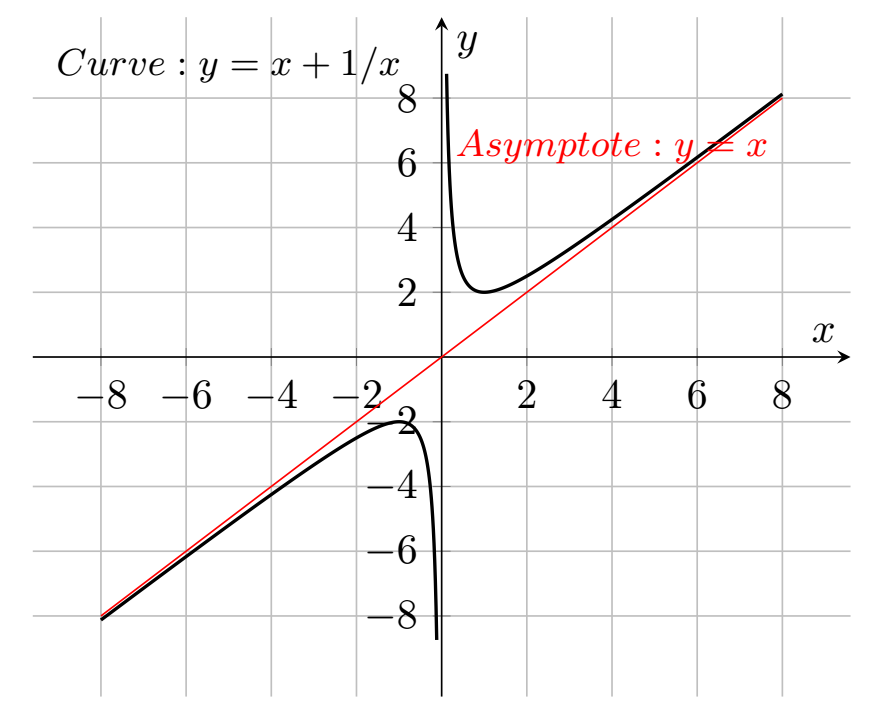
There is another asymptote here—the y-axis itself—as can be seen from the graph. As , the function grows unbounded, tending to depending on the direction of approach. This suggests that the vertical line (the y-axis) is also an asymptote.
Types of Asymptotes§
There are three types of asymptotes:
-
Horizontal Asymptotes – These occur when the function approaches a constant value as . The equation of a horizontal asymptote is found by evaluating:
If this limit exists and is finite, the asymptote is given by .
Consider the following example:
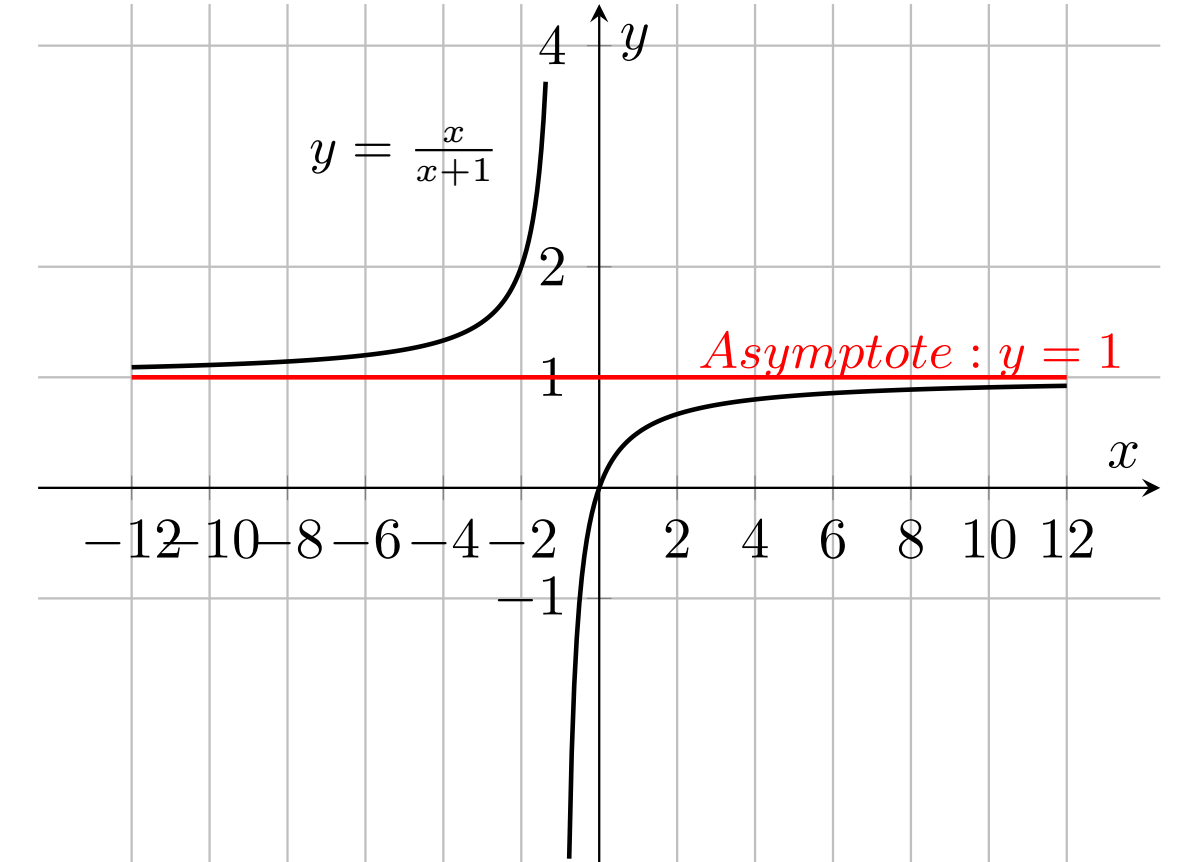
The function
has a horizontal asymptote at because as , the leading terms in the numerator and denominator dominate, allowing us to compute the limit:
Dividing both the numerator and denominator by , we get:
Since as , the fraction simplifies to
Thus, the function approaches as , meaning the horizontal asymptote is .
-
Vertical Asymptotes
A function has a vertical asymptote at if, as approaches , the function tends to , meaning:
This typically occurs when the denominator of a rational function becomes zero at , while the numerator remains nonzero. That is, if is a rational function of the form:
where and are polynomials, then vertical asymptotes are found by solving:
If and , then will tend to infinity or negative infinity as approaches , depending on the signs of the numerator and denominator near . Thus, is a vertical asymptote.
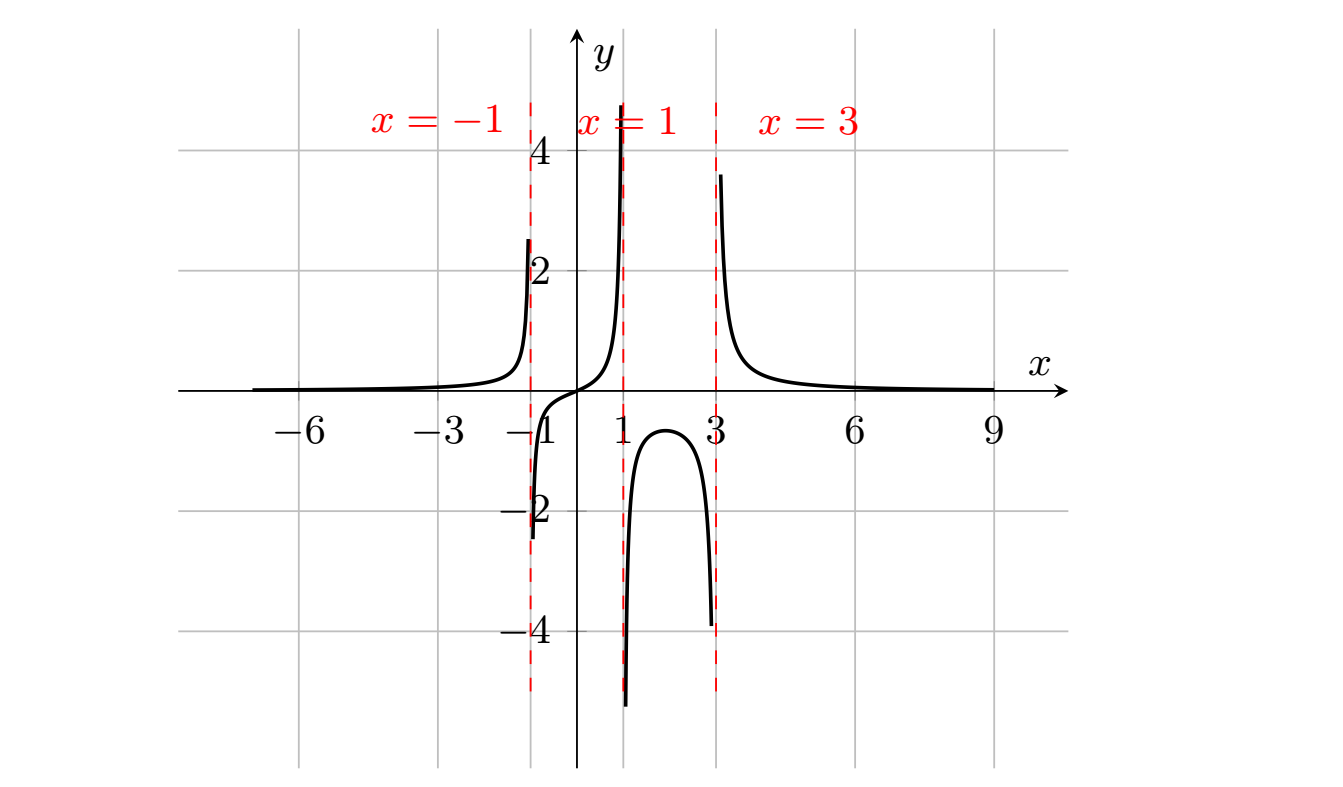
Consider the function
To find the vertical asymptotes, we identify the points where the denominator becomes zero while the numerator remains nonzero. The denominator is:
Setting it equal to zero,
gives the solutions . Since at these points the denominator is zero but the numerator is nonzero, the function tends to . This confirms that the function has three vertical asymptotes at , , and .
Thus, as approaches any of these values, the function diverges, meaning the graph will exhibit infinite behavior near these points.
-
Oblique Asymptotes of the Form Where
An oblique asymptote of a curve is a non-horizontal slanting line that the function approaches as . Mathematically, it satisfies:
This means the vertical distance between the curve and the line tends to zero at large , ensuring that describes the asymptotic behavior of .
Finding the Slope
Since gets closer to as , we assume:
Since we are assuming the asymptote is oblique, it means as , making the limit an form.
Rewriting:
Since as , this simplifies to:
Thus, solving for :
This gives the slope of the asymptote.
Finding the Intercept
Once is determined, we use the fact that:
Rearranging for :
This formula gives the intercept of the oblique asymptote.
Finding Asymptotes of Rational Functions§
A rational function is given by
where and are polynomials. The type of asymptotes depends on the degrees of these polynomials.
-
Vertical Asymptotes:
- Vertical asymptotes occur where the denominator is zero while the numerator is nonzero.
- To find them, solve and check that at those points.
-
Horizontal Asymptotes (Degree of = Degree of ):
-
If the degrees of and are equal, perform polynomial long division:
where is a constant quotient and is the remainder with a degree lower than .
-
As , the remainder term , meaning
-
The function approaches the constant , which is the horizontal asymptote.
-
-
Oblique Asymptotes (Degree of is One Greater Than Degree of ):
-
If the degree of is exactly one greater than that of , perform long division:
where is the quotient and as .
-
This means:
-
The function behaves like the linear equation , which is the oblique asymptote.
-
Mark this section complete when you have worked through its proofs.