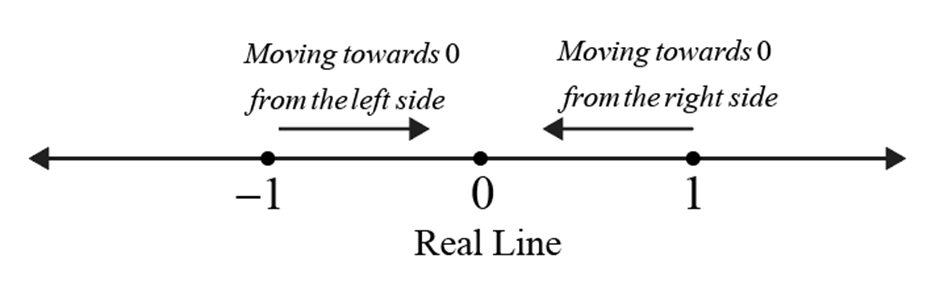
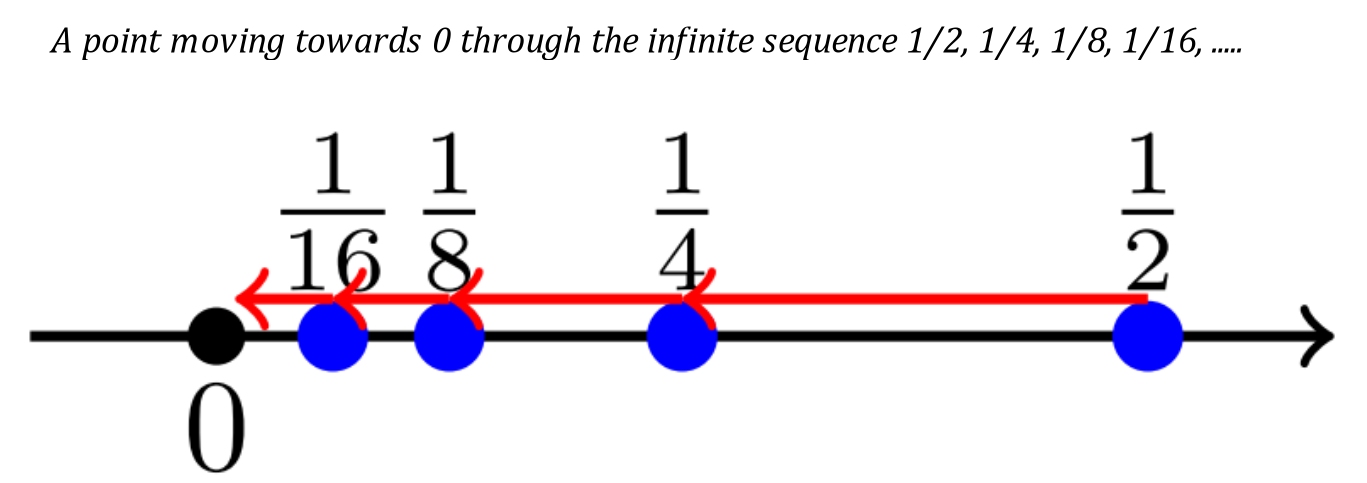
But we may evaluate f(x) for values of x near 0 but not equal to zero. Let us put values near 0, starting with x=1 and successively reducing x by a factor of 10, making the value smaller with each step. Using a calculator, the results are tabulated below:
What do you observe? We are trying to approach x=0 (i.e., 1>0.1>0.01>0.001>⋯>0) without actually reaching 0. Each step reduces x to a value 10 times smaller than the previous one. Even if we repeat this process infinitely, the value of x will never equal 0. This is because dividing by zero is undefined.
At the same time, observe the corresponding values of f(x). As x gets closer to 0, the values of f(x) approach a specific value: approximately 2.7182818….
As x gets closer to 0, the decimal places in f(x) stabilize and freeze one by one. This specific number, 2.7182818…, is known as the exponential constant or Euler's number (e). It is an irrational number with an infinite, non-repeating decimal expansion.
What if we move from the left side?
Let us move in steps towards 0 as shown in the table:
When we move from the left side towards 0, the value of the function moves closer to the constant e. We say that the limit of the function at x=0 is the exponential constant.
Consider the function f(x)=xx, where x>0. This function is not defined at x=0, but it is well-defined for all x>0, that is, on the right side of 0. To explore the behavior of this function as x approaches 0 from the right, we calculate f(x) for progressively smaller positive values of x. The table below summarizes these values:
As we approach x=0 from the right, the function values f(x)=xx get closer and closer to 1. This suggests that the function f(x) converges to a fixed value, even though it is not defined at x=0.
This numerical exploration helps us understand the function's behavior and the value it approaches, despite being undefined at x=0.
In this chapter, we will focus on analyzing the behavior of functions at limit points of their domain. But what exactly is a limit point?
Informally, a point a is called a limit point of a set or interval if we can move closer and closer to a, however close we want, while staying inside the set or interval.For example, 2 is a limit point of the open interval (2,6). We can move as close to 2 as we want by choosing points from the interval, such as the sequence:
x1=2.1,x2=2.01,x3=2.001,x4=2.0001,…
In this sequence, the points xn get closer and closer to 2, but always remain within the interval (2,6).
Similarly, 6 is a limit point of (2,6). We can approach 6 using a sequence like:
x1=5.9,x2=5.99,x3=5.999,x4=5.9999,…
Here, the points xn get closer and closer to 6, while staying inside the interval (2,6).
The point 3 is also a limit point of (2,6) because we can move closer to 3 from within the interval using a sequence like:
These sequences approach 3 from either side, always staying inside (2,6).
However, 1 is not a limit point of (2,6) because there are no points in the interval (2,6) that can get arbitrarily close to 1. The interval simply does not "crowd around" 1, so it cannot be approached from within (2,6).
Actually all points from 2 to 6, including 2 and 6, are limit points of (2,6).
Why Are limit Points Important?
We are not interested in just any point of the domain when studying the behavior of a function f(x). Instead, we focus on limit points because these are the points where we can approach a from within the domain of the function, even if a itself is not part of the domain.
For example, consider the function f(x)=lnx, which has the domain (0,∞).
All points in [0,∞) are limit points of the domain:
For any point a>0, we can approach a from within the domain (0,∞). For instance, we can get closer and closer to a=2 using a sequence like x1=1.9,x2=1.99,x3=1.999,…, which lies entirely in the domain.
The point 0 is also a limit point, even though it is not part of the domain. We can approach 0 using a sequence like x1=0.1,x2=0.01,x3=0.001,…, which stays within the domain (0,∞).
However, the point −1 is not a limit point of the domain. There are no points in the domain (0,∞) that can get arbitrarily close to −1, as all points in the domain are strictly positive. Thus, −1 is irrelevant for our analysis of the behavior of f(x).
We are only interested in points within [0,∞), the set of all limit points of the domain (0,∞), as these are the points that determine how the function f(x)=lnx behaves.
This means that we study the limits of functions only at the limit points of their domain. For any point a that is not a limit point of the domain, there is no meaningful way to calculate the limit because we cannot approach a from within the domain.
Let f:A→R, where A is the domain of f. Let a be a limit point of A. We define the limit of f(x) as x approaches a as follows:
If f(x) gets closer and closer to a number L as x moves closer and closer to a (but not equal to a), then we say that the limit of f(x) as x→a is L, and we write:
x→alimf(x)=L.
How to Approach a point a?
When analyzing the behavior of a function f(x) at a limiting point a, the idea of approaching a is fundamental. To approach a, we consider values of x that get closer and closer to a from within the domain of the function. The way x approaches a can vary, but the limit of f(x) at a will always depend on the behavior of f(x) as x gets arbitrarily close to a, regardless of the path (or sequence) taken.
The key idea is that when x approaches a (here a=0), the specific path or sequence taken does not matter. As long as x gets arbitrarily close to a within the domain of f(x), the limit is determined by the behavior of f(x). This is why we can confidently conclude that:
x→0limxsin(x)=1.
We can also define limits using the idea of sequences.
The concept of a one-sided limit focuses on the behavior of a function f(x) as x approaches a point afrom only one side—either from the left (x→a−) or from the right (x→a+).
Let f:A→R, where A is the domain of f(x), and let a be a limiting point of A.
Right-Hand Limit (x→a+):
The right-hand limit of f(x) at a is the value L that f(x) approaches as x gets arbitrarily close to a from the right (x>a). Mathematically:
x→a+limf(x)=L
This means the function values f(x) approach L as x moves toward a from the right side.
Left-Hand Limit (x→a−):
The left-hand limit of f(x) at a is the value L that f(x) approaches as x gets arbitrarily close to a from the left (x<a). Mathematically:
x→a−limf(x)=L
This means the function values f(x) approach L as x moves toward a from the left side.
The limit of a function f(x) as x→a exists if f(x)→L∈R, no matter how we approach a. This means that, regardless of the sequence of points x1,x2,x3,… getting closer and closer to a, the corresponding function values f(x1),f(x2),f(x3),… must approach the same number L.
When Does a Limit Not Exist?
The limit does not exist in the following scenarios:
Function Values Approach Infinity or Negative Infinity:
If f(x) becomes arbitrarily large (+∞) or arbitrarily small (−∞) as x approaches a, then the limit does not exist because f(x) does not approach a specific number L∈R.
Function Oscillates:
If f(x) oscillates between different values without settling on a particular number as x approaches a, the limit does not exist. For example, functions like sin(x1) near x=0 show this behavior.
Two Different Sequences Approach Different Values:
If we can find two sequences of points, both getting arbitrarily close to a, but the corresponding function values approach two different numbers L1=L2, the limit does not exist.
One-Sided Limits are Not Equal:
For most limits, if the left-hand limit (limx→a−f(x)) and the right-hand limit (limx→a+f(x)) exist but are not equal, the two-sided limit limx→af(x) does not exist.
More We Can Learn From Examples
To better understand the existence (or non-existence) of limits, it is helpful to analyze specific examples of functions where these scenarios occur. Examples will clarify how functions behave as x approaches a particular point a.
Section 1 of 12 · Limits
Mark this section complete when you have worked through its proofs.
Type any topic, theorem, or concept to jump directly to the section.