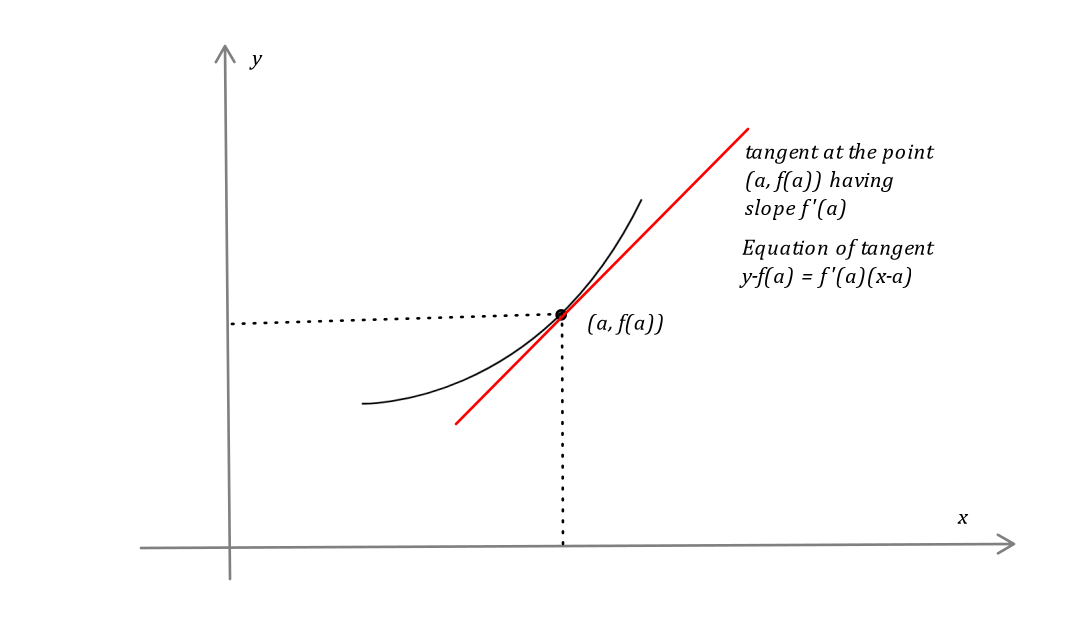
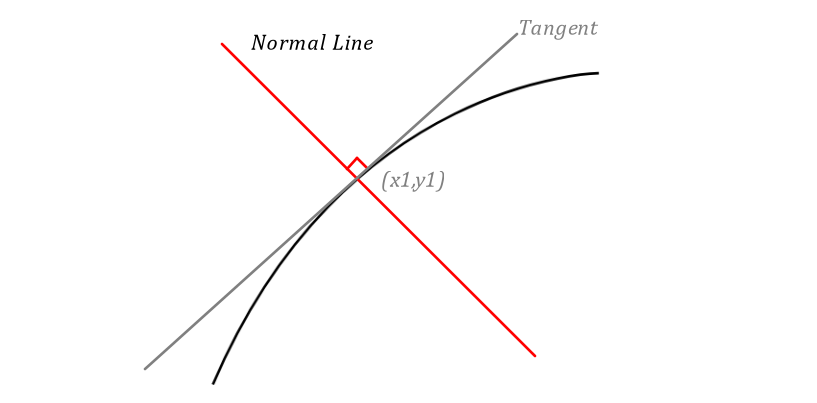
In this chapter, we study the fundamental concepts of tangents and normals to curves. Given a function y = f ( x ) y = f(x) y = f ( x ) tangent , which is a straight line that just touches the curve at that point without crossing it (locally). The normal at that point is a line perpendicular to the tangent.
The fundamental idea relies on the derivative d y d x \frac{dy}{dx} d x d y y = f ( x ) y = f(x) y = f ( x ) ( x 0 , y 0 ) (x_0, y_0) ( x 0 , y 0 )
m tangent = f ′ ( x 0 ) . m_{\text{tangent}} = f'(x_0). m tangent = f ′ ( x 0 ) . Using this, we can write the equation of the tangent line in its point-slope form:
y − y 0 = f ′ ( x 0 ) ( x − x 0 ) . y - y_0 = f'(x_0) (x - x_0). y − y 0 = f ′ ( x 0 ) ( x − x 0 ) . Since the normal is perpendicular to the tangent, its slope is the negative reciprocal of the tangent's slope:
m normal = − 1 f ′ ( x 0 ) , provided f ′ ( x 0 ) ≠ 0. m_{\text{normal}} = -\frac{1}{f'(x_0)}, \quad \text{provided } f'(x_0) \neq 0. m normal = − f ′ ( x 0 ) 1 , provided f ′ ( x 0 ) = 0. Thus, the equation of the normal at ( x 0 , y 0 ) (x_0, y_0) ( x 0 , y 0 )
y − y 0 = − 1 f ′ ( x 0 ) ( x − x 0 ) . y - y_0 = -\frac{1}{f'(x_0)} (x - x_0). y − y 0 = − f ′ ( x 0 ) 1 ( x − x 0 ) . The mathematical methods covered here serve as essential tools for more advanced topics in calculus, including curvature, envelopes, and optimization problems.
Equation of the Tangent Line § Let y = f ( x ) y = f(x) y = f ( x ) x = a x = a x = a ( a , f ( a ) ) (a, f(a)) ( a , f ( a )) f ′ ( a ) f'(a) f ′ ( a ) equation of the tangent line is:
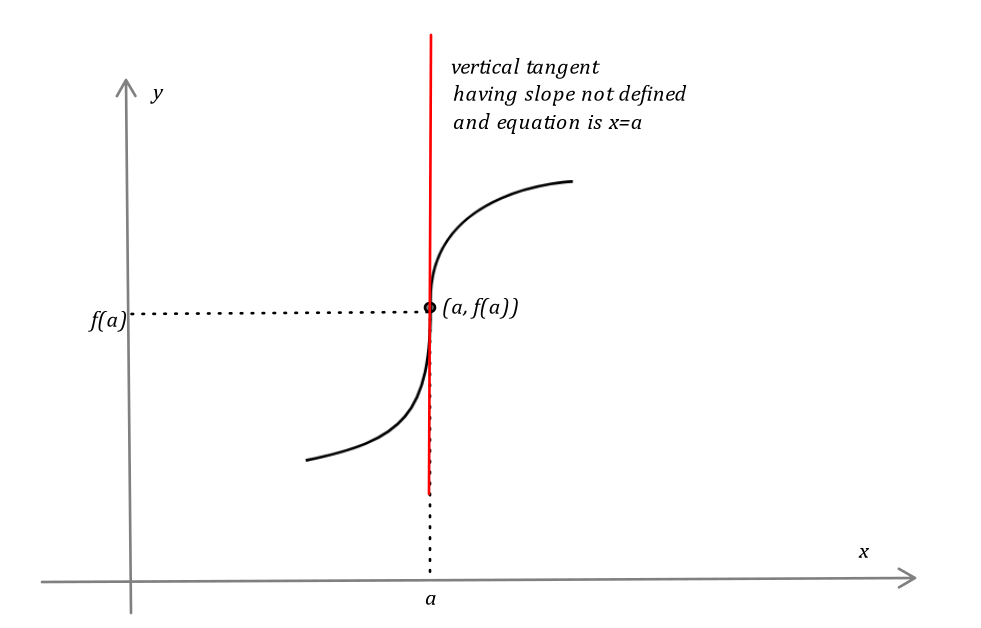
y − f ( a ) = f ′ ( a ) ( x − a ) . y - f(a) = f'(a) (x - a). y − f ( a ) = f ′ ( a ) ( x − a ) . The tangent line is well-defined whenever f ′ ( a ) f'(a) f ′ ( a ) special case of vertical tangents , which arise when the derivative fails to exist in a finite form.
Vertical Tangents § A tangent is vertical when its slope is undefined due to the derivative tending to ± ∞ \pm\infty ± ∞
lim x → a − f ′ ( x ) = ± ∞ and lim x → a + f ′ ( x ) = ± ∞ , \lim_{x \to a^-} f'(x) = \pm \infty \quad \text{and} \quad \lim_{x \to a^+} f'(x) = \pm \infty, x → a − lim f ′ ( x ) = ± ∞ and x → a + lim f ′ ( x ) = ± ∞ , then the tangent is vertical and given by the equation:
x = a . x = a. x = a . The point x = a x = a x = a inflection point with a vertical tangent , meaning that the concavity changes while the curve remains nearly vertical.
A classic example is:
f ( x ) = x 1 / 3 , f(x) = x^{1/3}, f ( x ) = x 1/3 , which has:
f ′ ( x ) = 1 3 x − 2 / 3 . f'(x) = \frac{1}{3} x^{-2/3}. f ′ ( x ) = 3 1 x − 2/3 . Here, we see that:
lim x → 0 − f ′ ( x ) = − ∞ , lim x → 0 + f ′ ( x ) = + ∞ . \lim_{x \to 0^-} f'(x) = -\infty, \quad \lim_{x \to 0^+} f'(x) = +\infty. x → 0 − lim f ′ ( x ) = − ∞ , x → 0 + lim f ′ ( x ) = + ∞. Thus, x = 0 x = 0 x = 0 inflection point with a vertical tangent .
Horizontal Tangents § A tangent is horizontal when f ′ ( a ) = 0 f'(a) = 0 f ′ ( a ) = 0 x = a x = a x = a
y = f ( a ) . y = f(a). y = f ( a ) . Horizontal tangents typically occur at local maxima, local minima, or stationary points.
We call the point where a tangent line touches a curve the point of tangency . If a curve is given by y = f ( x ) y = f(x) y = f ( x ) x = a x = a x = a ( a , f ( a ) ) (a, f(a)) ( a , f ( a )) same function value and slope.
Find the equation of the tangent to the curve
y = 2 x 2 − x + 1 y = 2x^2 - x + 1 y = 2 x 2 − x + 1 at the point whose abscissa is x = 1 x = 1 x = 1
Solution:
The equation of the tangent to a curve at a given point is given by
y − y 0 = m ( x − x 0 ) , y - y_0 = m (x - x_0), y − y 0 = m ( x − x 0 ) , where m m m ( x 0 , y 0 ) (x_0, y_0) ( x 0 , y 0 )
To determine the slope, differentiate y = 2 x 2 − x + 1 y = 2x^2 - x + 1 y = 2 x 2 − x + 1 x x x
d y d x = 4 x − 1. \frac{dy}{dx} = 4x - 1. d x d y = 4 x − 1. Evaluating at x = 1 x = 1 x = 1
m = 4 ( 1 ) − 1 = 3. m = 4(1) - 1 = 3. m = 4 ( 1 ) − 1 = 3. In the problem we are only provided the abscissa of the point of tangency, we also need to calculate the ordinate of the point to write the equation. The corresponding point on the curve is found by substituting x = 1 x = 1 x = 1
y = 2 ( 1 ) 2 − 1 + 1 = 2. y = 2(1)^2 - 1 + 1 = 2. y = 2 ( 1 ) 2 − 1 + 1 = 2. Thus, the point of tangency is ( 1 , 2 ) (1,2) ( 1 , 2 )
Substituting x 0 = 1 x_0 = 1 x 0 = 1 y 0 = 2 y_0 = 2 y 0 = 2 m = 3 m = 3 m = 3
y − 2 = 3 ( x − 1 ) . y - 2 = 3(x - 1). y − 2 = 3 ( x − 1 ) . Expanding,
y = 3 x − 1. y = 3x - 1. y = 3 x − 1. Thus, the required equation of the tangent is
y = 3 x − 1. y = 3x - 1. y = 3 x − 1. Find the equation of the tangent to the curve
y = sin x y = \sin x y = sin x at the point where the abscissa is x = π 6 x = \frac{\pi}{6} x = 6 π
Solution:
The equation of the tangent to a curve at a given point is given by
y − y 0 = m ( x − x 0 ) , y - y_0 = m (x - x_0), y − y 0 = m ( x − x 0 ) , where m m m ( x 0 , y 0 ) (x_0, y_0) ( x 0 , y 0 )
To determine the slope, differentiate y = sin x y = \sin x y = sin x x x x
d y d x = cos x . \frac{dy}{dx} = \cos x. d x d y = cos x . Evaluating at x = π 6 x = \frac{\pi}{6} x = 6 π
m = cos π 6 = 3 2 . m = \cos \frac{\pi}{6} = \frac{\sqrt{3}}{2}. m = cos 6 π = 2 3 . The corresponding point on the curve is
y 0 = sin π 6 = 1 2 . y_0 = \sin \frac{\pi}{6} = \frac{1}{2}. y 0 = sin 6 π = 2 1 . Thus, the point of tangency is ( π 6 , 1 2 ) \left( \frac{\pi}{6}, \frac{1}{2} \right) ( 6 π , 2 1 )
Substituting x 0 = π 6 x_0 = \frac{\pi}{6} x 0 = 6 π y 0 = 1 2 y_0 = \frac{1}{2} y 0 = 2 1 m = 3 2 m = \frac{\sqrt{3}}{2} m = 2 3
y − 1 2 = 3 2 ( x − π 6 ) . y - \frac{1}{2} = \frac{\sqrt{3}}{2} \left( x - \frac{\pi}{6} \right). y − 2 1 = 2 3 ( x − 6 π ) . Expanding,
y = 3 2 x − 3 π 12 + 1 2 . y = \frac{\sqrt{3}}{2} x - \frac{\sqrt{3} \pi}{12} + \frac{1}{2}. y = 2 3 x − 12 3 π + 2 1 . Thus, the required equation of the tangent is
y = 3 2 x + ( 1 2 − 3 π 12 ) . y = \frac{\sqrt{3}}{2} x + \left( \frac{1}{2} - \frac{\sqrt{3} \pi}{12} \right). y = 2 3 x + ( 2 1 − 12 3 π ) . Find the equation of the tangent to the curve
x + 2 y = y x x + 2y = y^x x + 2 y = y x at the point ( − 1 , 1 ) (-1,1) ( − 1 , 1 )
Solution:
Rewriting the given equation in a differentiable form,
x + 2 y = e x ln y . x + 2y = e^{x \ln y}. x + 2 y = e x l n y . Differentiating both sides with respect to x x x
1 + 2 y ′ = y x ( ln y + x y y ′ ) . 1 + 2y' = y^x \left( \ln y + \frac{x}{y} y' \right). 1 + 2 y ′ = y x ( ln y + y x y ′ ) . There is no point in simplifying this further; we simply substitute x = − 1 x = -1 x = − 1 y = 1 y = 1 y = 1 y ′ y' y ′
Since ln 1 = 0 \ln 1 = 0 ln 1 = 0
1 + 2 y ′ = 1 x ( 0 + − 1 1 y ′ ) , 1 + 2y' = 1^x \left( 0 + \frac{-1}{1} y' \right), 1 + 2 y ′ = 1 x ( 0 + 1 − 1 y ′ ) , which simplifies to
1 + 2 y ′ = − y ′ . 1 + 2y' = -y'. 1 + 2 y ′ = − y ′ . Solving for y ′ y' y ′
3 y ′ = − 1 ⟹ y ′ = − 1 3 . 3y' = -1 \implies y' = -\frac{1}{3}. 3 y ′ = − 1 ⟹ y ′ = − 3 1 . Thus, the slope of the tangent at ( − 1 , 1 ) (-1,1) ( − 1 , 1 ) − 1 3 -\frac{1}{3} − 3 1
The equation of the tangent line is given by
y − y 0 = m ( x − x 0 ) . y - y_0 = m (x - x_0). y − y 0 = m ( x − x 0 ) . Substituting ( x 0 , y 0 ) = ( − 1 , 1 ) (x_0, y_0) = (-1,1) ( x 0 , y 0 ) = ( − 1 , 1 ) m = − 1 3 m = -\frac{1}{3} m = − 3 1
y − 1 = − 1 3 ( x + 1 ) . y - 1 = -\frac{1}{3} (x + 1). y − 1 = − 3 1 ( x + 1 ) . Expanding,
y = − 1 3 x + 2 3 . y = -\frac{1}{3} x + \frac{2}{3}. y = − 3 1 x + 3 2 . Thus, the required equation of the tangent is
y = − 1 3 x + 2 3 . y = -\frac{1}{3} x + \frac{2}{3}. y = − 3 1 x + 3 2 . Finding the Tangent to a Curve with a Given Slope § When we need to find a tangent to a curve that has a given slope, or equivalently, a tangent parallel to a given line, we follow a systematic approach.
Let the curve be given by
y = f ( x ) . y = f(x). y = f ( x ) . We assume the point of tangency to be ( x 0 , y 0 ) (x_0, y_0) ( x 0 , y 0 ) x 0 x_0 x 0 y 0 y_0 y 0
First equation: The point ( x 0 , y 0 ) (x_0, y_0) ( x 0 , y 0 )
y 0 = f ( x 0 ) . y_0 = f(x_0). y 0 = f ( x 0 ) .
Second equation: The derivative d y d x \frac{dy}{dx} d x d y x 0 x_0 x 0
d y d x ∣ ( x 0 , y 0 ) = given slope . \left. \frac{dy}{dx} \right|_{(x_0, y_0)} = \text{given slope}. d x d y ( x 0 , y 0 ) = given slope .
These two equations are then solved simultaneously to find x 0 x_0 x 0 y 0 y_0 y 0 x 0 x_0 x 0 y 0 y_0 y 0
y − y 0 = ( given slope ) ( x − x 0 ) . y - y_0 = (\text{given slope}) (x - x_0). y − y 0 = ( given slope ) ( x − x 0 ) . Find the equation of the tangent to the curve
y = x 2 − 5 x + 5 y = x^2 - 5x + 5 y = x 2 − 5 x + 5 that is parallel to the line
2 y = 4 x + 1. 2y = 4x + 1. 2 y = 4 x + 1. Solution:
Let the point of tangency be ( x 0 , y 0 ) (x_0, y_0) ( x 0 , y 0 )
y 0 = x 0 2 − 5 x 0 + 5. y_0 = x_0^2 - 5x_0 + 5. y 0 = x 0 2 − 5 x 0 + 5. By differentiating the given curve we obtain the general slope.
d y d x = 2 x − 5. \frac{dy}{dx} = 2x - 5. d x d y = 2 x − 5. The slope of the tangent at ( x 0 , y 0 ) (x_0, y_0) ( x 0 , y 0 )
d y d x ∣ ( x 0 , y 0 ) = 2 x 0 − 5. \left. \frac{dy}{dx} \right|_{(x_0, y_0)} = 2x_0 - 5. d x d y ( x 0 , y 0 ) = 2 x 0 − 5. Since the required tangent is parallel to the given line 2 y = 4 x + 1 2y = 4x + 1 2 y = 4 x + 1
2 x 0 − 5 = 2. 2x_0 - 5 = 2. 2 x 0 − 5 = 2. Solving for x 0 x_0 x 0
2 x 0 = 7 ⟹ x 0 = 7 2 . 2x_0 = 7 \implies x_0 = \frac{7}{2}. 2 x 0 = 7 ⟹ x 0 = 2 7 . Substituting x 0 = 7 2 x_0 = \frac{7}{2} x 0 = 2 7
y 0 = ( 7 2 ) 2 − 5 ( 7 2 ) + 5 = − 1 4 . y_0 = \left(\frac{7}{2}\right)^2 - 5\left(\frac{7}{2}\right) + 5 = -\frac{1}{4}. y 0 = ( 2 7 ) 2 − 5 ( 2 7 ) + 5 = − 4 1 . Thus, the point of tangency is ( 7 2 , − 1 4 ) \left(\frac{7}{2}, -\frac{1}{4}\right) ( 2 7 , − 4 1 )
The equation of the tangent line at this point is
y − y 0 = m ( x − x 0 ) . y - y_0 = m (x - x_0). y − y 0 = m ( x − x 0 ) . Substituting m = 2 m = 2 m = 2
y + 1 4 = 2 ( x − 7 2 ) . y + \frac{1}{4} = 2 \left( x - \frac{7}{2} \right). y + 4 1 = 2 ( x − 2 7 ) . Expanding,
y = 2 x − 29 4 . y = 2x - \frac{29}{4}. y = 2 x − 4 29 . Thus, the required equation of the tangent is
y = 2 x − 29 4 . y = 2x - \frac{29}{4}. y = 2 x − 4 29 . Let S S S x x x
y = f ( x ) = x 3 − x 2 − 2 x y = f(x) = x^3 - x^2 - 2x y = f ( x ) = x 3 − x 2 − 2 x at ( x , y ) (x, y) ( x , y ) ( 1 , f ( 1 ) ) (1, f(1)) ( 1 , f ( 1 )) ( − 1 , f ( − 1 ) ) (-1, f(-1)) ( − 1 , f ( − 1 )) S S S
Solution:
Let the given curve be
y = f ( x ) = x 3 − x 2 − 2 x . y = f(x) = x^3 - x^2 - 2x. y = f ( x ) = x 3 − x 2 − 2 x . The points ( 1 , f ( 1 ) ) (1, f(1)) ( 1 , f ( 1 )) ( − 1 , f ( − 1 ) ) (-1, f(-1)) ( − 1 , f ( − 1 ))
f ( 1 ) = ( 1 ) 3 − ( 1 ) 2 − 2 ( 1 ) = 1 − 1 − 2 = − 2. f(1) = (1)^3 - (1)^2 - 2(1) = 1 - 1 - 2 = -2. f ( 1 ) = ( 1 ) 3 − ( 1 ) 2 − 2 ( 1 ) = 1 − 1 − 2 = − 2. f ( − 1 ) = ( − 1 ) 3 − ( − 1 ) 2 − 2 ( − 1 ) = − 1 − 1 + 2 = 0. f(-1) = (-1)^3 - (-1)^2 - 2(-1) = -1 - 1 + 2 = 0. f ( − 1 ) = ( − 1 ) 3 − ( − 1 ) 2 − 2 ( − 1 ) = − 1 − 1 + 2 = 0. The slope of the line joining these two points is given by
m = f ( 1 ) − f ( − 1 ) 1 − ( − 1 ) = − 2 − 0 1 + 1 = − 2 2 = − 1. m = \frac{f(1) - f(-1)}{1 - (-1)} = \frac{-2 - 0}{1 + 1} = \frac{-2}{2} = -1. m = 1 − ( − 1 ) f ( 1 ) − f ( − 1 ) = 1 + 1 − 2 − 0 = 2 − 2 = − 1. The equation of the tangent to the curve at ( x 0 , y 0 ) (x_0, y_0) ( x 0 , y 0 ) f ( x ) f(x) f ( x )
d y d x = 3 x 2 − 2 x − 2. \frac{dy}{dx} = 3x^2 - 2x - 2. d x d y = 3 x 2 − 2 x − 2. Since the tangent must be parallel to the line segment, its slope must also be − 1 -1 − 1
3 x 2 − 2 x − 2 = − 1 , 3x^2 - 2x - 2 = -1, 3 x 2 − 2 x − 2 = − 1 , we obtain
3 x 2 − 2 x − 1 = 0. 3x^2 - 2x - 1 = 0. 3 x 2 − 2 x − 1 = 0. Factoring,
( x − 1 ) ( 3 x + 1 ) = 0. (x - 1)(3x + 1) = 0. ( x − 1 ) ( 3 x + 1 ) = 0. Solving for x x x
x = 1 , x = − 1 3 . x = 1, \quad x = -\frac{1}{3}. x = 1 , x = − 3 1 . Thus, the required set is
S = { − 1 3 , 1 } . S = \left\{ -\frac{1}{3}, 1 \right\}. S = { − 3 1 , 1 } . Consider the curve given by
y = x + sin y . y = x + \sin y. y = x + sin y . A tangent to this curve at some point ( a , b ) (a,b) ( a , b )
( 0 , 3 2 ) and ( 1 2 , 2 ) . \left(0, \frac{3}{2} \right) \text{ and } \left(\frac{1}{2}, 2\right). ( 0 , 2 3 ) and ( 2 1 , 2 ) . Find ∣ b − a ∣ |b - a| ∣ b − a ∣
Solution:
Differentiating both sides of the given curve with respect to x x x
d y d x = 1 + cos y ⋅ d y d x . \frac{dy}{dx} = 1 + \cos y \cdot \frac{dy}{dx}. d x d y = 1 + cos y ⋅ d x d y . Rearranging,
d y d x − cos y d y d x = 1 \frac{dy}{dx} - \cos y \frac{dy}{dx} = 1 d x d y − cos y d x d y = 1 d y d x ( 1 − cos y ) = 1 \frac{dy}{dx} (1 - \cos y) = 1 d x d y ( 1 − cos y ) = 1 d y d x = 1 1 − cos y . \frac{dy}{dx} = \frac{1}{1 - \cos y}. d x d y = 1 − cos y 1 . The slope of the given line joining ( 0 , 3 2 ) \left(0, \frac{3}{2} \right) ( 0 , 2 3 ) ( 1 2 , 2 ) \left(\frac{1}{2}, 2\right) ( 2 1 , 2 )
m = 2 − 3 2 1 2 − 0 = 1 2 1 2 = 1. m = \frac{2 - \frac{3}{2}}{\frac{1}{2} - 0} = \frac{\frac{1}{2}}{\frac{1}{2}} = 1. m = 2 1 − 0 2 − 2 3 = 2 1 2 1 = 1. Since the tangent at ( a , b ) (a, b) ( a , b )
d y d x ∣ ( a , b ) = 1. \frac{dy}{dx} \Big|_{(a,b)} = 1. d x d y ( a , b ) = 1. Equating with the derivative obtained earlier,
1 1 − cos b = 1. \frac{1}{1 - \cos b} = 1. 1 − cos b 1 = 1. 1 − cos b = 1. 1 - \cos b = 1. 1 − cos b = 1. cos b = 0. \cos b = 0. cos b = 0. Since cos b = 0 \cos b = 0 cos b = 0
sin b = ± 1. \sin b = \pm 1. sin b = ± 1. Using the equation of the curve at ( a , b ) (a, b) ( a , b )
b = a + sin b . b = a + \sin b. b = a + sin b . b − a = sin b . b - a = \sin b. b − a = sin b . Since sin b = ± 1 \sin b = \pm 1 sin b = ± 1
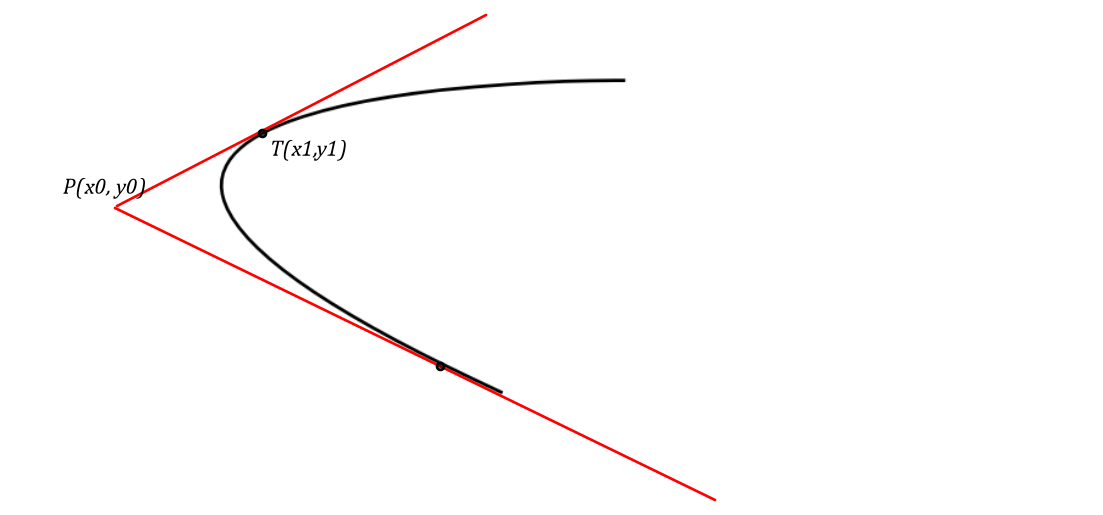
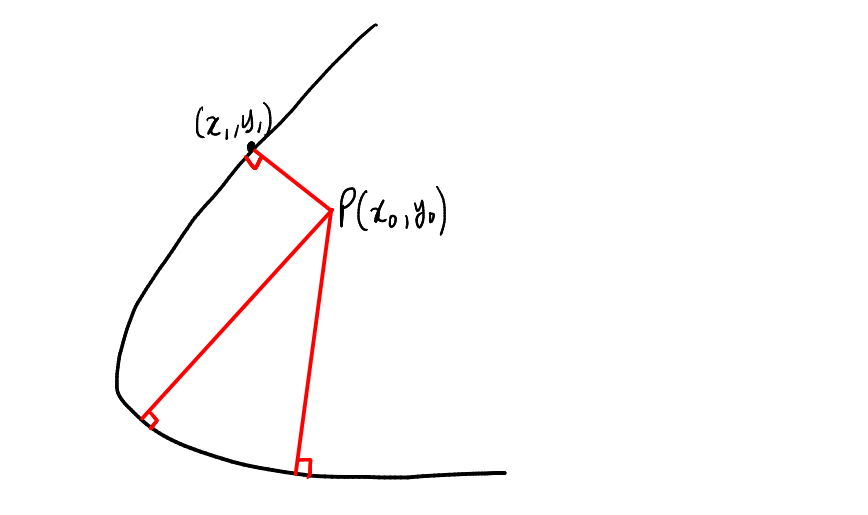
∣ b − a ∣ = 1. |b - a| = 1. ∣ b − a ∣ = 1. Tangent from a Given Point to a Curve § Sometimes, we need to determine tangents from a given external point to a curve. The given point, say P ( x 0 , y 0 ) P(x_0, y_0) P ( x 0 , y 0 ) P P P
For many curves, there can be more than one such tangent. The number of tangents depends on the nature of the curve and the position of the external point. To find the equation of the tangent(s), we follow this procedure:
Let the point of tangency be T ( x 1 , y 1 ) T(x_1, y_1) T ( x 1 , y 1 ) x 1 , y 1 x_1, y_1 x 1 , y 1 x 1 x_1 x 1 y 1 y_1 y 1
First equation (Curve Condition): Since T ( x 1 , y 1 ) T(x_1, y_1) T ( x 1 , y 1 )
y 1 = f ( x 1 ) . y_1 = f(x_1). y 1 = f ( x 1 ) .
Second equation (Slope Condition): The slope of the tangent at T ( x 1 , y 1 ) T(x_1, y_1) T ( x 1 , y 1 ) x 1 x_1 x 1
d y d x ∣ ( x 1 , y 1 ) . \left. \frac{dy}{dx} \right|_{(x_1, y_1)}. d x d y ( x 1 , y 1 ) . This slope must be equal to the slope of the line joining P ( x 0 , y 0 ) P(x_0, y_0) P ( x 0 , y 0 ) T ( x 1 , y 1 ) T(x_1, y_1) T ( x 1 , y 1 )
y 1 − y 0 x 1 − x 0 . \frac{y_1 - y_0}{x_1 - x_0}. x 1 − x 0 y 1 − y 0 . Equating these slopes, we obtain the second equation:
d y d x ∣ ( x 1 , y 1 ) = y 1 − y 0 x 1 − x 0 . \left. \frac{dy}{dx} \right|_{(x_1, y_1)} = \frac{y_1 - y_0}{x_1 - x_0}. d x d y ( x 1 , y 1 ) = x 1 − x 0 y 1 − y 0 .
These two equations are then solved simultaneously to determine x 1 x_1 x 1 y 1 y_1 y 1
y − y 1 = d y d x ∣ ( x 1 , y 1 ) ( x − x 1 ) . y - y_1 = \left. \frac{dy}{dx} \right|_{(x_1, y_1)} (x - x_1). y − y 1 = d x d y ( x 1 , y 1 ) ( x − x 1 ) . This method ensures that all possible tangents from the given external point are determined systematically.
Find the equations of all tangents that can be drawn from the point ( − 1 , − 2 ) (-1, -2) ( − 1 , − 2 )
y = x 2 4 . y = \frac{x^2}{4}. y = 4 x 2 . Solution:
Let T ( x 1 , y 1 ) T(x_1, y_1) T ( x 1 , y 1 ) ( − 1 , − 2 ) (-1, -2) ( − 1 , − 2 )
Since T ( x 1 , y 1 ) T(x_1, y_1) T ( x 1 , y 1 )
y 1 = x 1 2 4 . (1) y_1 = \frac{x_1^2}{4}. \quad \text{(1)} y 1 = 4 x 1 2 . (1) Differentiating both sides of the equaiton of the curve with respect to x x x
d y d x = 2 x 4 = x 2 . \frac{dy}{dx} = \frac{2x}{4} = \frac{x}{2}. d x d y = 4 2 x = 2 x . Evaluating at ( x 1 , y 1 ) (x_1, y_1) ( x 1 , y 1 )
d y d x ∣ ( x 1 , y 1 ) = x 1 2 . \left. \frac{dy}{dx} \right|_{(x_1, y_1)} = \frac{x_1}{2}. d x d y ( x 1 , y 1 ) = 2 x 1 . The slope of the tangent line P T PT P T
x 1 2 = y 1 + 2 x 1 + 1 . \frac{x_1}{2} = \frac{y_1 + 2}{x_1 + 1}. 2 x 1 = x 1 + 1 y 1 + 2 . Rearranging,
x 1 2 + x 1 = 2 y 1 + 4. (2) x_1^2 + x_1 = 2y_1 + 4. \quad \text{(2)} x 1 2 + x 1 = 2 y 1 + 4. (2) Substituting equation (1) into equation (2),
x 1 2 + x 1 = 2 × x 1 2 4 + 4. x_1^2 + x_1 = 2 \times \frac{x_1^2}{4} + 4. x 1 2 + x 1 = 2 × 4 x 1 2 + 4. x 1 2 + x 1 = x 1 2 2 + 4. x_1^2 + x_1 = \frac{x_1^2}{2} + 4. x 1 2 + x 1 = 2 x 1 2 + 4. Simplifying,
x 1 2 + 2 x 1 − 8 = 0. x_1^2 + 2x_1 - 8 = 0. x 1 2 + 2 x 1 − 8 = 0. Factoring,
( x 1 + 4 ) ( x 1 − 2 ) = 0. (x_1 + 4)(x_1 - 2) = 0. ( x 1 + 4 ) ( x 1 − 2 ) = 0. x 1 = − 4 , x 1 = 2. x_1 = -4, \quad x_1 = 2. x 1 = − 4 , x 1 = 2. Substituting these values into equation (1),
For x 1 = 2 x_1 = 2 x 1 = 2
y 1 = 2 2 4 = 4 4 = 1. y_1 = \frac{2^2}{4} = \frac{4}{4} = 1. y 1 = 4 2 2 = 4 4 = 1. For x 1 = − 4 x_1 = -4 x 1 = − 4
y 1 = ( − 4 ) 2 4 = 16 4 = 4. y_1 = \frac{(-4)^2}{4} = \frac{16}{4} = 4. y 1 = 4 ( − 4 ) 2 = 4 16 = 4. Thus, the points of tangency are ( 2 , 1 ) (2,1) ( 2 , 1 ) ( − 4 , 4 ) (-4,4) ( − 4 , 4 )
The equation of the tangent line is given by
y − y 1 = m ( x − x 1 ) . y - y_1 = m (x - x_1). y − y 1 = m ( x − x 1 ) . For ( 2 , 1 ) (2,1) ( 2 , 1 ) m = x 1 2 = 2 2 = 1 m = \frac{x_1}{2} = \frac{2}{2} = 1 m = 2 x 1 = 2 2 = 1
y − 1 = 1 ( x − 2 ) . y - 1 = 1(x - 2). y − 1 = 1 ( x − 2 ) . y = x − 1. y = x - 1. y = x − 1. For ( − 4 , 4 ) (-4,4) ( − 4 , 4 ) m = x 1 2 = − 4 2 = − 2 m = \frac{x_1}{2} = \frac{-4}{2} = -2 m = 2 x 1 = 2 − 4 = − 2
y − 4 = − 2 ( x + 4 ) . y - 4 = -2(x + 4). y − 4 = − 2 ( x + 4 ) . y = − 2 x − 4. y = -2x - 4. y = − 2 x − 4. Thus, the equations of the two tangents are
y = x − 1 and y = − 2 x − 4. y = x - 1 \quad \text{and} \quad y = -2x - 4. y = x − 1 and y = − 2 x − 4.
Condition of Tangency § A given line
y = m x + c y = mx + c y = m x + c is a tangent to the curve
y = f ( x ) y = f(x) y = f ( x ) if they touch at a single point without crossing. Such problems can be easily handled by following this procedure:
Let the point of tangency be ( x 1 , y 1 ) (x_1, y_1) ( x 1 , y 1 )
Since the point lies on the curve , we must have
y 1 = f ( x 1 ) . y_1 = f(x_1). y 1 = f ( x 1 ) .
Since the point also lies on the given line , we must have
y 1 = m x 1 + c . y_1 = m x_1 + c. y 1 = m x 1 + c .
Since the line is a tangent, its slope must match the slope of the curve at ( x 1 , y 1 ) (x_1, y_1) ( x 1 , y 1 )
m = d y d x ∣ ( x 1 , y 1 ) . m = \frac{dy}{dx} \Big|_{(x_1, y_1)}. m = d x d y ( x 1 , y 1 ) .
Now, from these three equations, we eliminate the unknowns x 1 x_1 x 1 y 1 y_1 y 1 condition of tangency .
Equation of the Normal Line § Let the equation of the curve be
y = f ( x ) . y = f(x). y = f ( x ) . The normal to the curve at a given point is the straight line perpendicular to the tangent at that point.
Let ( x 1 , y 1 ) (x_1, y_1) ( x 1 , y 1 ) slope of the tangent at this point is given by
m tangent = d y d x ∣ ( x 1 , y 1 ) . m_{\text{tangent}} = \left. \frac{dy}{dx} \right|_{(x_1, y_1)}. m tangent = d x d y ( x 1 , y 1 ) . Since the normal is perpendicular to the tangent, its slope is given by the negative reciprocal of the tangent slope:
m normal = − 1 m tangent , provided that m tangent ≠ 0. m_{\text{normal}} = -\frac{1}{m_{\text{tangent}}}, \quad \text{provided that } m_{\text{tangent}} \neq 0. m normal = − m tangent 1 , provided that m tangent = 0. Thus, the equation of the normal at ( x 1 , y 1 ) (x_1, y_1) ( x 1 , y 1 )
y − y 1 = − 1 m tangent ( x − x 1 ) , y - y_1 = -\frac{1}{m_{\text{tangent}}} (x - x_1), y − y 1 = − m tangent 1 ( x − x 1 ) , where m tangent = f ′ ( x 1 ) m_{\text{tangent}} = f'(x_1) m tangent = f ′ ( x 1 )
Vertical Normal § A vertical normal occurs when the normal line is perpendicular to the x-axis, meaning it has an equation of the form
x = x 1 . x = x_1. x = x 1 . For the normal to be vertical, the normal slope m normal m_{\text{normal}} m normal undefined , which happens when
m tangent = 0. m_{\text{tangent}} = 0. m tangent = 0. That is, vertical normals exist at points where the tangent is horizontal , i.e.,
d y d x = 0. \frac{dy}{dx} = 0. d x d y = 0. At any such point ( x 1 , y 1 ) (x_1, y_1) ( x 1 , y 1 )
x = x 1 . x = x_1. x = x 1 . Thus, vertical normals always occur at critical points of the function where the derivative vanishes.
Find the equation of the normal to the curve
y ( x − 2 ) ( x − 3 ) = x + 6 y(x - 2)(x - 3) = x + 6 y ( x − 2 ) ( x − 3 ) = x + 6 at the point where the curve intersects the Y Y Y
Solution:
To find the intersection of the curve with the Y Y Y x = 0 x = 0 x = 0
y ( 0 − 2 ) ( 0 − 3 ) = 0 + 6. y(0 - 2)(0 - 3) = 0 + 6. y ( 0 − 2 ) ( 0 − 3 ) = 0 + 6. y ( − 2 ) ( − 3 ) = 6. y(-2)(-3) = 6. y ( − 2 ) ( − 3 ) = 6. 6 y = 6. 6y = 6. 6 y = 6. y = 1. y = 1. y = 1. Thus, the curve intersects the Y Y Y ( 0 , 1 ) (0,1) ( 0 , 1 )
Rewriting the given equation for y y y
y = x + 6 ( x − 2 ) ( x − 3 ) . y = \frac{x + 6}{(x - 2)(x - 3)}. y = ( x − 2 ) ( x − 3 ) x + 6 . Differentiating both sides,
d y d x = ( 1 ) ( x − 2 ) ( x − 3 ) − ( x + 6 ) ( x − 3 + x − 2 ) ( x − 2 ) 2 ( x − 3 ) 2 . \frac{dy}{dx} = \frac{(1)(x - 2)(x - 3) - (x + 6)(x - 3 + x - 2)}{(x - 2)^2 (x - 3)^2}. d x d y = ( x − 2 ) 2 ( x − 3 ) 2 ( 1 ) ( x − 2 ) ( x − 3 ) − ( x + 6 ) ( x − 3 + x − 2 ) . d y d x = ( x − 2 ) ( x − 3 ) − ( x + 6 ) ( 2 x − 5 ) ( x − 2 ) 2 ( x − 3 ) 2 . \frac{dy}{dx} = \frac{(x - 2)(x - 3) - (x + 6)(2x - 5)}{(x - 2)^2 (x - 3)^2}. d x d y = ( x − 2 ) 2 ( x − 3 ) 2 ( x − 2 ) ( x − 3 ) − ( x + 6 ) ( 2 x − 5 ) . Evaluating at ( 0 , 1 ) (0,1) ( 0 , 1 )
( d y d x ) ( 0 , 1 ) = 36 36 = 1. \left( \frac{dy}{dx} \right)_{(0,1)} = \frac{36}{36} = 1. ( d x d y ) ( 0 , 1 ) = 36 36 = 1. Since the normal is perpendicular to the tangent, its slope is
m normal = − 1 1 = − 1. m_{\text{normal}} = -\frac{1}{1} = -1. m normal = − 1 1 = − 1. Thus, the equation of the normal at ( 0 , 1 ) (0,1) ( 0 , 1 )
y − 1 = − 1 ( x − 0 ) . y - 1 = -1(x - 0). y − 1 = − 1 ( x − 0 ) . x + y − 1 = 0. x + y - 1 = 0. x + y − 1 = 0. To determine a point through which this normal passes, rewrite the equation as
y = 1 − x . y = 1 - x. y = 1 − x . Setting x = 1 2 x = \frac{1}{2} x = 2 1
y = 1 − 1 2 = 1 2 . y = 1 - \frac{1}{2} = \frac{1}{2}. y = 1 − 2 1 = 2 1 . Thus, the normal passes through ( 1 2 , 1 2 ) \left( \frac{1}{2}, \frac{1}{2} \right) ( 2 1 , 2 1 )
Consider the function
f ( x ) = tan − 1 ( 1 + sin x 1 − sin x ) , x ∈ ( 0 , π 2 ) . f(x) = \tan^{-1} \left( \sqrt{\frac{1 + \sin x}{1 - \sin x}} \right), \quad x \in \left(0, \frac{\pi}{2} \right). f ( x ) = tan − 1 ( 1 − sin x 1 + sin x ) , x ∈ ( 0 , 2 π ) . Find the equation of the normal to the curve y = f ( x ) y = f(x) y = f ( x ) x = π 6 x = \frac{\pi}{6} x = 6 π
Solution:
First, we simplify the given expression of the function:
f ( x ) = tan − 1 ( 1 + sin x 1 − sin x ) . f(x) = \tan^{-1} \left( \sqrt{\frac{1 + \sin x}{1 - \sin x}} \right). f ( x ) = tan − 1 ( 1 − sin x 1 + sin x ) . Using the identities
1 + sin x = ( cos x 2 + sin x 2 ) 2 , 1 − sin x = ( cos x 2 − sin x 2 ) 2 , 1 + \sin x = \left( \cos \frac{x}{2} + \sin \frac{x}{2} \right)^2, \quad 1 - \sin x = \left( \cos \frac{x}{2} - \sin \frac{x}{2} \right)^2, 1 + sin x = ( cos 2 x + sin 2 x ) 2 , 1 − sin x = ( cos 2 x − sin 2 x ) 2 , we rewrite f ( x ) f(x) f ( x )
f ( x ) = tan − 1 ( ( cos x 2 + sin x 2 ) 2 ( cos x 2 − sin x 2 ) 2 ) . f(x) = \tan^{-1} \left( \sqrt{\frac{\left( \cos \frac{x}{2} + \sin \frac{x}{2} \right)^2}{\left( \cos \frac{x}{2} - \sin \frac{x}{2} \right)^2}} \right). f ( x ) = tan − 1 ( cos 2 x − sin 2 x ) 2 ( cos 2 x + sin 2 x ) 2 . Since z 2 = ∣ z ∣ \sqrt{z^2} = |z| z 2 = ∣ z ∣
f ( x ) = tan − 1 ∣ cos x 2 + sin x 2 cos x 2 − sin x 2 ∣ . f(x) = \tan^{-1} \left| \frac{\cos \frac{x}{2} + \sin \frac{x}{2}}{\cos \frac{x}{2} - \sin \frac{x}{2}} \right|. f ( x ) = tan − 1 cos 2 x − sin 2 x cos 2 x + sin 2 x . Now, since x ∈ ( 0 , π / 2 ) x \in (0, \pi/2) x ∈ ( 0 , π /2 ) x / 2 ∈ ( 0 , π / 4 ) x/2 \in (0, \pi/4) x /2 ∈ ( 0 , π /4 ) cos x 2 > sin x 2 \cos \frac{x}{2} > \sin \frac{x}{2} cos 2 x > sin 2 x
f ( x ) = tan − 1 ( cos x 2 + sin x 2 cos x 2 − sin x 2 ) . f(x) = \tan^{-1} \left( \frac{\cos \frac{x}{2} + \sin \frac{x}{2}}{\cos \frac{x}{2} - \sin \frac{x}{2}} \right). f ( x ) = tan − 1 ( cos 2 x − sin 2 x cos 2 x + sin 2 x ) . Dividing numerator and denominator by cos x 2 \cos \frac{x}{2} cos 2 x
f ( x ) = tan − 1 ( 1 + tan x 2 1 − tan x 2 ) . f(x) = \tan^{-1} \left( \frac{1 + \tan \frac{x}{2}}{1 - \tan \frac{x}{2}} \right). f ( x ) = tan − 1 ( 1 − tan 2 x 1 + tan 2 x ) . Using the identity
1 + tan A 1 − tan A = tan ( π 4 + A ) , \frac{1 + \tan A}{1 - \tan A} = \tan(\frac{\pi}{4} + A), 1 − tan A 1 + tan A = tan ( 4 π + A ) , we simplify further to
f ( x ) = tan − 1 tan ( π 4 + x 2 ) = π 4 + x 2 . f(x) = \tan^{-1} \tan \left( \frac{\pi}{4} + \frac{x}{2} \right) = \frac{\pi}{4} + \frac{x}{2}. f ( x ) = tan − 1 tan ( 4 π + 2 x ) = 4 π + 2 x . Differentiating both sides,
f ′ ( x ) = 1 2 . f'(x) = \frac{1}{2}. f ′ ( x ) = 2 1 . Evaluating at x = π 6 x = \frac{\pi}{6} x = 6 π
f ′ ( π 6 ) = 1 2 . f'\left(\frac{\pi}{6}\right) = \frac{1}{2}. f ′ ( 6 π ) = 2 1 . Since the normal is perpendicular to the tangent, its slope is
m normal = − 2. m_{\text{normal}} = -2. m normal = − 2. Using the point-slope form of the equation of the normal,
y − f ( π 6 ) = − 2 ( x − π 6 ) . y - f\left(\frac{\pi}{6} \right) = -2 \left(x - \frac{\pi}{6} \right). y − f ( 6 π ) = − 2 ( x − 6 π ) . Since
f ( π 6 ) = π 4 + π 12 = π 3 , f\left(\frac{\pi}{6}\right) = \frac{\pi}{4} + \frac{\pi}{12} = \frac{\pi}{3}, f ( 6 π ) = 4 π + 12 π = 3 π , the equation of the normal becomes
y − π 3 = − 2 ( x − π 6 ) . y - \frac{\pi}{3} = -2 \left( x - \frac{\pi}{6} \right). y − 3 π = − 2 ( x − 6 π ) . Expanding,
y = − 2 x + π 3 + π 3 = − 2 x + 2 π 3 . y = -2x + \frac{\pi}{3} + \frac{\pi}{3} = -2x + \frac{2\pi}{3}. y = − 2 x + 3 π + 3 π = − 2 x + 3 2 π . Setting x = 0 x = 0 x = 0 Y Y Y
y = − 2 ( 0 ) + 2 π 3 = 2 π 3 . y = -2(0) + \frac{2\pi}{3} = \frac{2\pi}{3}. y = − 2 ( 0 ) + 3 2 π = 3 2 π . Thus, the normal passes through the point ( 0 , 2 π 3 ) \left( 0, \frac{2\pi}{3} \right) ( 0 , 3 2 π )
Find the equation of the normal to the curve
x 2 + 2 x y − 3 y 2 = 0 x^2 + 2xy - 3y^2 = 0 x 2 + 2 x y − 3 y 2 = 0 at the point ( 1 , 1 ) (1,1) ( 1 , 1 )
Solution:
Differentiating both sides implicitly,
2 x + 2 x d y d x + 2 y − 6 y d y d x = 0. 2x + 2x \frac{dy}{dx} + 2y - 6y \frac{dy}{dx} = 0. 2 x + 2 x d x d y + 2 y − 6 y d x d y = 0. Rearranging,
( 2 x − 6 y ) d y d x = − ( 2 x + 2 y ) . (2x - 6y) \frac{dy}{dx} = - (2x + 2y). ( 2 x − 6 y ) d x d y = − ( 2 x + 2 y ) . d y d x = − ( 2 x + 2 y ) 2 x − 6 y . \frac{dy}{dx} = \frac{- (2x + 2y)}{2x - 6y}. d x d y = 2 x − 6 y − ( 2 x + 2 y ) . Evaluating at ( 1 , 1 ) (1,1) ( 1 , 1 )
( d y d x ) ( 1 , 1 ) = − ( 2 ( 1 ) + 2 ( 1 ) ) 2 ( 1 ) − 6 ( 1 ) = − 4 − 4 = 1. \left( \frac{dy}{dx} \right)_{(1,1)} = \frac{- (2(1) + 2(1))}{2(1) - 6(1)} = \frac{-4}{-4} = 1. ( d x d y ) ( 1 , 1 ) = 2 ( 1 ) − 6 ( 1 ) − ( 2 ( 1 ) + 2 ( 1 )) = − 4 − 4 = 1. Since the normal is perpendicular to the tangent, its slope is
m normal = − 1. m_{\text{normal}} = -1. m normal = − 1. Using the point-slope form,
y − 1 = − 1 ( x − 1 ) . y - 1 = -1(x - 1). y − 1 = − 1 ( x − 1 ) . x + y − 2 = 0. x + y - 2 = 0. x + y − 2 = 0. Thus, the equation of the normal is
x + y − 2 = 0. x + y - 2 = 0. x + y − 2 = 0. Find the equation of the normal to the curve
y = ∣ x 2 − 5 ∣ x ∣ + 6 ∣ y = \left| x^2 - 5|x| + 6 \right| y = x 2 − 5∣ x ∣ + 6 at the point whose abscissa is x = − 1 x = -1 x = − 1
Solution:
In the small neighborhood around x = − 1 x = -1 x = − 1 x < 0 x < 0 x < 0 ∣ x ∣ = − x |x| = -x ∣ x ∣ = − x
y = ∣ x 2 − 5 ( − x ) + 6 ∣ . y = \left| x^2 - 5(-x) + 6 \right|. y = x 2 − 5 ( − x ) + 6 . = ∣ x 2 + 5 x + 6 ∣ . = \left| x^2 + 5x + 6 \right|. = x 2 + 5 x + 6 . Factoring the quadratic expression inside the absolute value,
y = ∣ ( x + 2 ) ( x + 3 ) ∣ . y = \left| (x + 2)(x + 3) \right|. y = ∣ ( x + 2 ) ( x + 3 ) ∣ . Now, in the small neighborhood around x = − 1 x = -1 x = − 1 x + 2 x + 2 x + 2 x + 3 x + 3 x + 3 ( x + 2 ) ( x + 3 ) (x + 2)(x + 3) ( x + 2 ) ( x + 3 )
y = ( x + 2 ) ( x + 3 ) . y = (x + 2)(x + 3). y = ( x + 2 ) ( x + 3 ) . Differentiating both sides,
d y d x = ( x + 2 ) ⋅ d d x ( x + 3 ) + ( x + 3 ) ⋅ d d x ( x + 2 ) . \frac{dy}{dx} = (x + 2) \cdot \frac{d}{dx}(x + 3) + (x + 3) \cdot \frac{d}{dx}(x + 2). d x d y = ( x + 2 ) ⋅ d x d ( x + 3 ) + ( x + 3 ) ⋅ d x d ( x + 2 ) . = ( x + 2 ) ( 1 ) + ( x + 3 ) ( 1 ) . = (x + 2)(1) + (x + 3)(1). = ( x + 2 ) ( 1 ) + ( x + 3 ) ( 1 ) . = ( x + 2 ) + ( x + 3 ) . = (x + 2) + (x + 3). = ( x + 2 ) + ( x + 3 ) . = 2 x + 5. = 2x + 5. = 2 x + 5. Evaluating at x = − 1 x = -1 x = − 1
( d y d x ) x = − 1 = 2 ( − 1 ) + 5 = 3. \left( \frac{dy}{dx} \right)_{x=-1} = 2(-1) + 5 = 3. ( d x d y ) x = − 1 = 2 ( − 1 ) + 5 = 3. Since the normal is perpendicular to the tangent, its slope is
m normal = − 1 3 . m_{\text{normal}} = -\frac{1}{3}. m normal = − 3 1 . The corresponding point on the curve is
y = ( − 1 + 2 ) ( − 1 + 3 ) = ( 1 ) ( 2 ) = 2. y = (-1 + 2)(-1 + 3) = (1)(2) = 2. y = ( − 1 + 2 ) ( − 1 + 3 ) = ( 1 ) ( 2 ) = 2. Using the point-slope form,
y − 2 = − 1 3 ( x + 1 ) . y - 2 = -\frac{1}{3} (x + 1). y − 2 = − 3 1 ( x + 1 ) . 3 ( y − 2 ) = − ( x + 1 ) . 3(y - 2) = - (x + 1). 3 ( y − 2 ) = − ( x + 1 ) . x + 3 y − 7 = 0. x + 3y - 7 = 0. x + 3 y − 7 = 0. Thus, the equation of the normal is
x + 3 y − 7 = 0. x + 3y - 7 = 0. x + 3 y − 7 = 0.
Tangents and Normals to a Parametric Curve § When the equation of a curve is given in parametric form as
x = f ( θ ) , y = g ( θ ) , x = f(\theta), \quad y = g(\theta), x = f ( θ ) , y = g ( θ ) , the tangent at θ \theta θ ( f ( θ ) , g ( θ ) ) (f(\theta), g(\theta)) ( f ( θ ) , g ( θ )) normal at θ \theta θ
Equation of the Tangent § Differentiating both equations with respect to θ \theta θ
d x d θ = f ′ ( θ ) , d y d θ = g ′ ( θ ) . \frac{dx}{d\theta} = f'(\theta), \quad \frac{dy}{d\theta} = g'(\theta). d θ d x = f ′ ( θ ) , d θ d y = g ′ ( θ ) . The slope of the tangent is
d y d x = d y d θ d x d θ = g ′ ( θ ) f ′ ( θ ) . \frac{dy}{dx} = \frac{\frac{dy}{d\theta}}{\frac{dx}{d\theta}} = \frac{g'(\theta)}{f'(\theta)}. d x d y = d θ d x d θ d y = f ′ ( θ ) g ′ ( θ ) . Using the point-slope form, the equation of the tangent at θ \theta θ
y − g ( θ ) = g ′ ( θ ) f ′ ( θ ) ( x − f ( θ ) ) . y - g(\theta) = \frac{g'(\theta)}{f'(\theta)} (x - f(\theta)). y − g ( θ ) = f ′ ( θ ) g ′ ( θ ) ( x − f ( θ )) . Equation of the Normal § Since the normal is perpendicular to the tangent, its slope is
m normal = − 1 m tangent = − f ′ ( θ ) g ′ ( θ ) . m_{\text{normal}} = -\frac{1}{m_{\text{tangent}}} = -\frac{f'(\theta)}{g'(\theta)}. m normal = − m tangent 1 = − g ′ ( θ ) f ′ ( θ ) . Thus, the equation of the normal at θ \theta θ
y − g ( θ ) = − f ′ ( θ ) g ′ ( θ ) ( x − f ( θ ) ) . y - g(\theta) = -\frac{f'(\theta)}{g'(\theta)} (x - f(\theta)). y − g ( θ ) = − g ′ ( θ ) f ′ ( θ ) ( x − f ( θ )) . Prove that the normal to the curve
x = a ( cos θ + θ sin θ ) , y = a ( sin θ − θ cos θ ) x = a (\cos\theta + \theta \sin\theta), \quad y = a (\sin\theta - \theta \cos\theta) x = a ( cos θ + θ sin θ ) , y = a ( sin θ − θ cos θ ) at any point θ \theta θ
Solution:
Differentiating both parametric equations with respect to θ \theta θ
d x d θ = a ( − sin θ + sin θ + θ cos θ ) = a θ cos θ , \frac{dx}{d\theta} = a (-\sin\theta + \sin\theta + \theta \cos\theta) = a \theta \cos\theta, d θ d x = a ( − sin θ + sin θ + θ cos θ ) = a θ cos θ , d y d θ = a ( cos θ − cos θ + θ sin θ ) = a θ sin θ . \frac{dy}{d\theta} = a (\cos\theta - \cos\theta + \theta \sin\theta) = a \theta \sin\theta. d θ d y = a ( cos θ − cos θ + θ sin θ ) = a θ sin θ . The slope of the tangent is
d y d x = a θ sin θ a θ cos θ = tan θ . \frac{dy}{dx} = \frac{a \theta \sin\theta}{a \theta \cos\theta} = \tan\theta. d x d y = a θ cos θ a θ sin θ = tan θ . Since the normal is perpendicular to the tangent, its slope is
m normal = − cot θ . m_{\text{normal}} = -\cot\theta. m normal = − cot θ . Using the point-slope form, the equation of the normal at ( x , y ) (x, y) ( x , y )
y − a ( sin θ − θ cos θ ) = − cot θ [ x − a ( cos θ + θ sin θ ) ] . y - a (\sin\theta - \theta \cos\theta) = -\cot\theta \left[ x - a (\cos\theta + \theta \sin\theta) \right]. y − a ( sin θ − θ cos θ ) = − cot θ [ x − a ( cos θ + θ sin θ ) ] . Expanding the right-hand side,
y − a sin θ + a θ cos θ = − cot θ ⋅ x + a cot θ ( cos θ + θ sin θ ) . y - a \sin\theta + a \theta \cos\theta = -\cot\theta \cdot x + a \cot\theta (\cos\theta + \theta \sin\theta). y − a sin θ + a θ cos θ = − cot θ ⋅ x + a cot θ ( cos θ + θ sin θ ) . Rewriting cot θ = cos θ sin θ \cot\theta = \frac{\cos\theta}{\sin\theta} cot θ = s i n θ c o s θ
y − a sin θ + a θ cos θ = − cos θ sin θ x + a cos θ sin θ ( cos θ + θ sin θ ) . y - a \sin\theta + a \theta \cos\theta = -\frac{\cos\theta}{\sin\theta} x + a \frac{\cos\theta}{\sin\theta} (\cos\theta + \theta \sin\theta). y − a sin θ + a θ cos θ = − sin θ cos θ x + a sin θ cos θ ( cos θ + θ sin θ ) . Multiplying both sides by sin θ \sin\theta sin θ
y sin θ − a sin 2 θ + a θ cos θ sin θ = − x cos θ + a cos 2 θ + a θ cos θ sin θ . y \sin\theta - a \sin^2\theta + a \theta \cos\theta \sin\theta = -x \cos\theta + a \cos^2\theta + a \theta \cos\theta \sin\theta. y sin θ − a sin 2 θ + a θ cos θ sin θ = − x cos θ + a cos 2 θ + a θ cos θ sin θ . Rearranging terms,
y sin θ + x cos θ = a ( cos 2 θ + sin 2 θ ) = a . y \sin\theta + x \cos\theta = a (\cos^2\theta + \sin^2\theta) = a. y sin θ + x cos θ = a ( cos 2 θ + sin 2 θ ) = a . Thus, the equation of the normal simplifies to
y sin θ + x cos θ = a . y \sin\theta + x \cos\theta = a. y sin θ + x cos θ = a . The perpendicular distance of this line from the origin is given by
∣ 0 ⋅ cos θ + 0 ⋅ sin θ − a ∣ cos 2 θ + sin 2 θ . \frac{|0 \cdot \cos\theta + 0 \cdot \sin\theta - a|}{\sqrt{\cos^2\theta + \sin^2\theta}}. cos 2 θ + sin 2 θ ∣0 ⋅ cos θ + 0 ⋅ sin θ − a ∣ . Since cos 2 θ + sin 2 θ = 1 \cos^2\theta + \sin^2\theta = 1 cos 2 θ + sin 2 θ = 1
Distance = ∣ − a ∣ 1 = a . \text{Distance} = \frac{| -a |}{1} = a. Distance = 1 ∣ − a ∣ = a . Thus, the normal to the curve is always at a constant distance a a a
Prove that the sum of the intercepts of the tangent at any point on the curve
x + y = a \sqrt{x} + \sqrt{y} = \sqrt{a} x + y = a on the coordinate axes is constant.
Solution:
Since the given curve involves square roots, it is defined for 0 ≤ x ≤ a 0 \leq x \leq a 0 ≤ x ≤ a 0 ≤ y ≤ a 0 \leq y \leq a 0 ≤ y ≤ a
x = a cos 4 θ , y = a sin 4 θ . x = a \cos^4\theta, \quad y = a \sin^4\theta. x = a cos 4 θ , y = a sin 4 θ . Differentiating both sides with respect to θ \theta θ
d x d θ = − 4 a cos 3 θ sin θ , \frac{dx}{d\theta} = -4a \cos^3\theta \sin\theta, d θ d x = − 4 a cos 3 θ sin θ , d y d θ = 4 a sin 3 θ cos θ . \frac{dy}{d\theta} = 4a \sin^3\theta \cos\theta. d θ d y = 4 a sin 3 θ cos θ . The slope of the tangent is
d y d x = 4 a sin 3 θ cos θ − 4 a cos 3 θ sin θ = − sin 2 θ cos 2 θ . \frac{dy}{dx} = \frac{4a \sin^3\theta \cos\theta}{-4a \cos^3\theta \sin\theta} = -\frac{\sin^2\theta}{\cos^2\theta}. d x d y = − 4 a cos 3 θ sin θ 4 a sin 3 θ cos θ = − cos 2 θ sin 2 θ . The equation of the tangent at ( x ~ , y ~ ) = ( a cos 4 θ , a sin 4 θ ) (\tilde{x}, \tilde{y}) = (a\cos^4\theta, a\sin^4\theta) ( x ~ , y ~ ) = ( a cos 4 θ , a sin 4 θ )
y − a sin 4 θ = − sin 2 θ cos 2 θ ( x − a cos 4 θ ) . y - a\sin^4\theta = -\frac{\sin^2\theta}{\cos^2\theta} (x - a\cos^4\theta). y − a sin 4 θ = − cos 2 θ sin 2 θ ( x − a cos 4 θ ) . Cross-multiplying by cos 2 θ \cos^2\theta cos 2 θ
( y − a sin 4 θ ) cos 2 θ = − sin 2 θ ( x − a cos 4 θ ) . (y - a\sin^4\theta) \cos^2\theta = -\sin^2\theta (x - a\cos^4\theta). ( y − a sin 4 θ ) cos 2 θ = − sin 2 θ ( x − a cos 4 θ ) . Expanding,
y cos 2 θ − a sin 4 θ cos 2 θ = − x sin 2 θ + a sin 2 θ cos 4 θ . y \cos^2\theta - a \sin^4\theta \cos^2\theta = -x \sin^2\theta + a \sin^2\theta \cos^4\theta. y cos 2 θ − a sin 4 θ cos 2 θ = − x sin 2 θ + a sin 2 θ cos 4 θ . Rearranging,
x sin 2 θ + y cos 2 θ = a ( sin 2 θ cos 4 θ + sin 4 θ cos 2 θ ) . x \sin^2\theta + y \cos^2\theta = a (\sin^2\theta \cos^4\theta + \sin^4\theta \cos^2\theta). x sin 2 θ + y cos 2 θ = a ( sin 2 θ cos 4 θ + sin 4 θ cos 2 θ ) . Factoring out a sin 2 θ cos 2 θ a \sin^2\theta \cos^2\theta a sin 2 θ cos 2 θ
x sin 2 θ + y cos 2 θ = a sin 2 θ cos 2 θ ( cos 2 θ + sin 2 θ ) . x \sin^2\theta + y \cos^2\theta = a \sin^2\theta \cos^2\theta (\cos^2\theta + \sin^2\theta). x sin 2 θ + y cos 2 θ = a sin 2 θ cos 2 θ ( cos 2 θ + sin 2 θ ) . Since cos 2 θ + sin 2 θ = 1 \cos^2\theta + \sin^2\theta = 1 cos 2 θ + sin 2 θ = 1
x sin 2 θ + y cos 2 θ = a sin 2 θ cos 2 θ . x \sin^2\theta + y \cos^2\theta = a \sin^2\theta \cos^2\theta. x sin 2 θ + y cos 2 θ = a sin 2 θ cos 2 θ . Finding the Intercepts
For the x-intercept , set y = 0 y = 0 y = 0
x sin 2 θ = a sin 2 θ cos 2 θ . x \sin^2\theta = a \sin^2\theta \cos^2\theta. x sin 2 θ = a sin 2 θ cos 2 θ . If sin 2 θ ≠ 0 \sin^2\theta \neq 0 sin 2 θ = 0 sin 2 θ \sin^2\theta sin 2 θ
x = a cos 2 θ . x = a \cos^2\theta. x = a cos 2 θ . For the y-intercept , set x = 0 x = 0 x = 0
y cos 2 θ = a sin 2 θ cos 2 θ . y \cos^2\theta = a \sin^2\theta \cos^2\theta. y cos 2 θ = a sin 2 θ cos 2 θ . If cos 2 θ ≠ 0 \cos^2\theta \neq 0 cos 2 θ = 0 cos 2 θ \cos^2\theta cos 2 θ
y = a sin 2 θ . y = a \sin^2\theta. y = a sin 2 θ . Summing the intercepts,
x int + y int = a cos 2 θ + a sin 2 θ . x_{\text{int}} + y_{\text{int}} = a \cos^2\theta + a \sin^2\theta. x int + y int = a cos 2 θ + a sin 2 θ . Using cos 2 θ + sin 2 θ = 1 \cos^2\theta + \sin^2\theta = 1 cos 2 θ + sin 2 θ = 1
x int + y int = a ( 1 ) = a . x_{\text{int}} + y_{\text{int}} = a(1) = a. x int + y int = a ( 1 ) = a . Since this sum is independent of θ \theta θ constant .
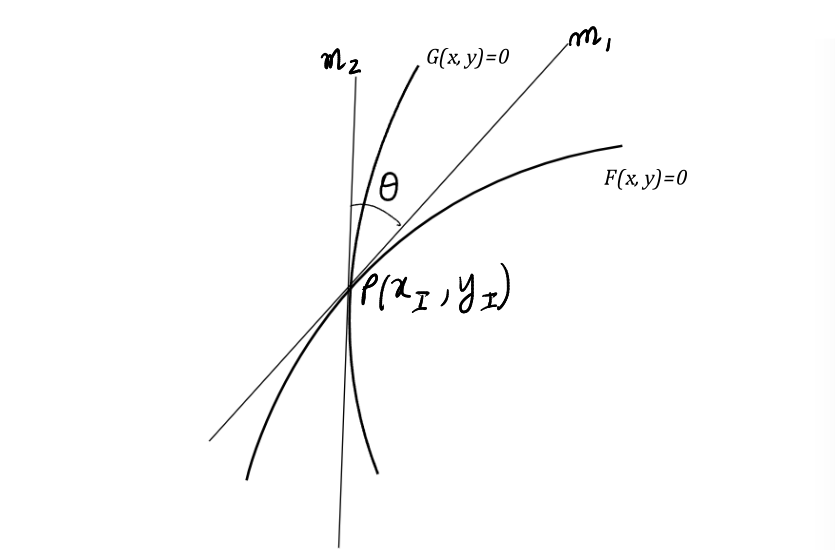
Angle of Intersection of Two Curves § If two curves intersect at a point P ( x I , y I ) P(x_I, y_I) P ( x I , y I ) angle of intersection of the two curves at that point is defined as the angle between their respective tangents at P P P
Let the given curves be
F ( x , y ) = 0 and G ( x , y ) = 0. F(x, y) = 0 \quad \text{and} \quad G(x, y) = 0. F ( x , y ) = 0 and G ( x , y ) = 0. To determine the angle between the two curves at P ( x I , y I ) P(x_I, y_I) P ( x I , y I ) d y d x \frac{dy}{dx} d x d y
m 1 = d y d x ∣ ( x I , y I ) for F ( x , y ) = 0 , m_1 = \frac{dy}{dx} \Big|_{(x_I, y_I)} \quad \text{for} \quad F(x, y) = 0, m 1 = d x d y ( x I , y I ) for F ( x , y ) = 0 , m 2 = d y d x ∣ ( x I , y I ) for G ( x , y ) = 0. m_2 = \frac{dy}{dx} \Big|_{(x_I, y_I)} \quad \text{for} \quad G(x, y) = 0. m 2 = d x d y ( x I , y I ) for G ( x , y ) = 0. The acute angle θ \theta θ
tan θ = ∣ m 1 − m 2 1 + m 1 m 2 ∣ . \tan \theta = \left| \frac{m_1 - m_2}{1 + m_1 m_2} \right|. tan θ = 1 + m 1 m 2 m 1 − m 2 .
Special Cases
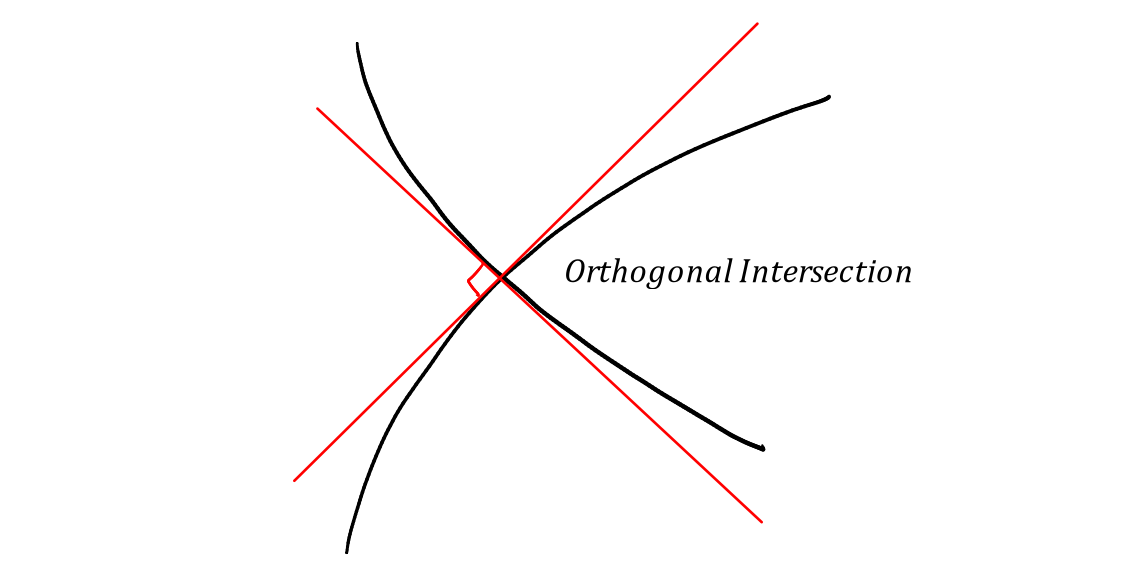
Orthogonal Intersection: If the curves intersect at P ( x I , y I ) P(x_I, y_I) P ( x I , y I )
m 1 m 2 = − 1. m_1 m_2 = -1. m 1 m 2 = − 1. In this case, θ = 90 ∘ \theta = 90^\circ θ = 9 0 ∘
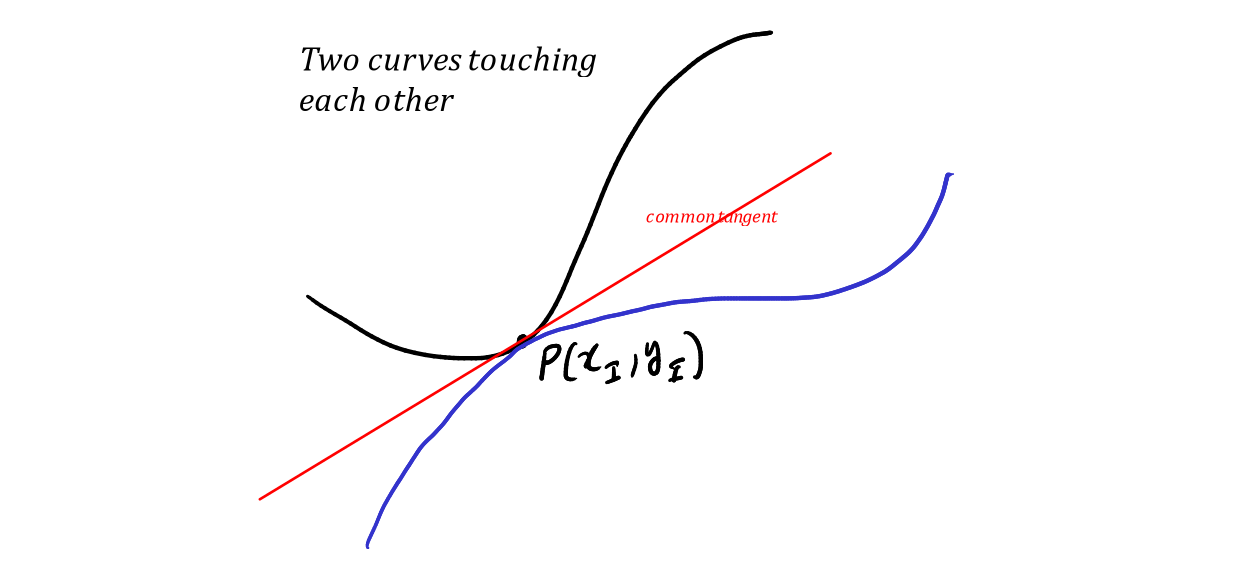
Curves Touching Each Other: If the curves intersect at P ( x I , y I ) P(x_I, y_I) P ( x I , y I )
m 1 = m 2 , m_1 = m_2, m 1 = m 2 , then the two curves share the same tangent at P ( x I , y I ) P(x_I, y_I) P ( x I , y I ) common tangent at the point of intersection.
Find the angle of intersection of the curves
y = 10 − x 2 y = 10 - x^2 y = 10 − x 2 and
y = 2 + x 2 y = 2 + x^2 y = 2 + x 2 at their points of intersection.
Solution:
The points of intersection are obtained by solving
10 − x 2 = 2 + x 2 . 10 - x^2 = 2 + x^2. 10 − x 2 = 2 + x 2 . Rearranging,
10 − 2 = x 2 + x 2 . 10 - 2 = x^2 + x^2. 10 − 2 = x 2 + x 2 . 8 = 2 x 2 . 8 = 2x^2. 8 = 2 x 2 . x 2 = 4 ⟹ x = ± 2. x^2 = 4 \implies x = \pm 2. x 2 = 4 ⟹ x = ± 2. Substituting x = 2 x = 2 x = 2
y = 10 − 4 = 6. y = 10 - 4 = 6. y = 10 − 4 = 6. Similarly, for x = − 2 x = -2 x = − 2
y = 10 − 4 = 6. y = 10 - 4 = 6. y = 10 − 4 = 6. Thus, the curves intersect at ( 2 , 6 ) (2,6) ( 2 , 6 ) ( − 2 , 6 ) (-2,6) ( − 2 , 6 )
To find the angle of intersection, compute the slopes of the tangents to both curves at these points. Differentiating the given equations,
d y d x = − 2 x for y = 10 − x 2 , \frac{dy}{dx} = -2x \quad \text{for} \quad y = 10 - x^2, d x d y = − 2 x for y = 10 − x 2 , d y d x = 2 x for y = 2 + x 2 . \frac{dy}{dx} = 2x \quad \text{for} \quad y = 2 + x^2. d x d y = 2 x for y = 2 + x 2 . At ( 2 , 6 ) (2,6) ( 2 , 6 )
m 1 = − 2 ( 2 ) = − 4 , m 2 = 2 ( 2 ) = 4. m_1 = -2(2) = -4, \quad m_2 = 2(2) = 4. m 1 = − 2 ( 2 ) = − 4 , m 2 = 2 ( 2 ) = 4. The angle θ \theta θ
tan θ = ∣ m 2 − m 1 1 + m 1 m 2 ∣ . \tan \theta = \left| \frac{m_2 - m_1}{1 + m_1 m_2} \right|. tan θ = 1 + m 1 m 2 m 2 − m 1 . Substituting values,
tan θ = ∣ 4 − ( − 4 ) 1 + ( − 4 ) ( 4 ) ∣ = ∣ 4 + 4 1 − 16 ∣ . \tan \theta = \left| \frac{4 - (-4)}{1 + (-4)(4)} \right| = \left| \frac{4 + 4}{1 - 16} \right|. tan θ = 1 + ( − 4 ) ( 4 ) 4 − ( − 4 ) = 1 − 16 4 + 4 . = ∣ 8 − 15 ∣ = 8 15 . = \left| \frac{8}{-15} \right| = \frac{8}{15}. = − 15 8 = 15 8 . Similarly, at ( − 2 , 6 ) (-2,6) ( − 2 , 6 )
m 1 = − 2 ( − 2 ) = 4 , m 2 = 2 ( − 2 ) = − 4. m_1 = -2(-2) = 4, \quad m_2 = 2(-2) = -4. m 1 = − 2 ( − 2 ) = 4 , m 2 = 2 ( − 2 ) = − 4. tan θ = ∣ − 4 − 4 1 + ( 4 ) ( − 4 ) ∣ = ∣ − 8 1 − 16 ∣ . \tan \theta = \left| \frac{-4 - 4}{1 + (4)(-4)} \right| = \left| \frac{-8}{1 - 16} \right|. tan θ = 1 + ( 4 ) ( − 4 ) − 4 − 4 = 1 − 16 − 8 . = ∣ − 8 − 15 ∣ = 8 15 . = \left| \frac{-8}{-15} \right| = \frac{8}{15}. = − 15 − 8 = 15 8 . Thus, in both cases,
tan θ = 8 15 . \tan \theta = \frac{8}{15}. tan θ = 15 8 . Always use symmetry to avoid extraneous calculations. In the above example, both curves intersect at two distinct points. At both points, the angle of intersection is the same. The reason is the same symmetry in both curves —both are symmetrical about the y y y
To check this symmetry, replace x x x − x -x − x
For y = 10 − x 2 y = 10 - x^2 y = 10 − x 2 x x x − x -x − x
y = 10 − ( − x ) 2 = 10 − x 2 . y = 10 - (-x)^2 = 10 - x^2. y = 10 − ( − x ) 2 = 10 − x 2 . Since the equation remains unchanged, the curve is symmetric about the y y y
For y = 2 + x 2 y = 2 + x^2 y = 2 + x 2 x x x − x -x − x
y = 2 + ( − x ) 2 = 2 + x 2 . y = 2 + (-x)^2 = 2 + x^2. y = 2 + ( − x ) 2 = 2 + x 2 . Again, the equation remains unchanged, confirming symmetry about the y y y
Since both curves are symmetric about the y y y ( 2 , 6 ) (2,6) ( 2 , 6 ) ( − 2 , 6 ) (-2,6) ( − 2 , 6 )
Thus, if we identify symmetry before calculations , we can use it to avoid extra work and simplify computations efficiently.
Find the angle of intersection of the curves
x 2 a 2 + y 2 b 2 = 1 \frac{x^2}{a^2} + \frac{y^2}{b^2} = 1 a 2 x 2 + b 2 y 2 = 1 and
x 2 + y 2 = a b x^2 + y^2 = ab x 2 + y 2 = ab given that a > b a > b a > b
Solution:
To determine the points of intersection, express y 2 y^2 y 2
y 2 = a b − x 2 . y^2 = ab - x^2. y 2 = ab − x 2 . Substituting this into the first equation,
x 2 a 2 + a b − x 2 b 2 = 1. \frac{x^2}{a^2} + \frac{ab - x^2}{b^2} = 1. a 2 x 2 + b 2 ab − x 2 = 1. Multiplying throughout by a 2 b 2 a^2 b^2 a 2 b 2
b 2 x 2 + a 2 ( a b − x 2 ) = a 2 b 2 . b^2 x^2 + a^2 (ab - x^2) = a^2 b^2. b 2 x 2 + a 2 ( ab − x 2 ) = a 2 b 2 . b 2 x 2 + a 3 b − a 2 x 2 = a 2 b 2 . b^2 x^2 + a^3 b - a^2 x^2 = a^2 b^2. b 2 x 2 + a 3 b − a 2 x 2 = a 2 b 2 . Rearranging,
( b 2 − a 2 ) x 2 = a 2 b ( b − a ) . (b^2 - a^2)x^2 = a^2 b (b - a). ( b 2 − a 2 ) x 2 = a 2 b ( b − a ) . Solving for x 2 x^2 x 2
x 2 = a 2 b a + b ⟹ x = ± b a a + b x^2 = \frac{a^2 b}{a + b} \implies x = \pm \frac{\sqrt{b} a}{\sqrt{a + b}} x 2 = a + b a 2 b ⟹ x = ± a + b b a Using y 2 = a b − x 2 y^2 = ab - x^2 y 2 = ab − x 2
y 2 = a b − a 2 b a + b . y^2 = ab - \frac{a^2 b}{a + b}. y 2 = ab − a + b a 2 b . = a b ( a + b ) − a 2 b a + b ⟹ y = ± a b a + b . = \frac{ab(a + b) - a^2 b}{a + b} \implies y = \pm \frac{\sqrt{a} b}{\sqrt{a + b}}. = a + b ab ( a + b ) − a 2 b ⟹ y = ± a + b a b . Thus, the points of intersection are
( ± a b a + b , ± a b a + b ) . \left( \pm \frac{a\sqrt{b}}{\sqrt{a + b}}, \pm \frac{\sqrt{a}b}{\sqrt{a + b}} \right). ( ± a + b a b , ± a + b a b ) . Since, both curves are symmetrical around x-axis and y-axis. There are four intersection points, but the angle of intersection at each intersection point is the same. So we need to just consider one point ( a b a + b , a b a + b ) . \left( \frac{a\sqrt{b}}{\sqrt{a + b}}, \frac{\sqrt{a}b}{\sqrt{a + b}} \right). ( a + b a b , a + b a b ) .
To find the angle of intersection, differentiate both curves. Differentiating the first equation implicitly,
d d x ( x 2 a 2 + y 2 b 2 ) = d d x ( 1 ) . \frac{d}{dx} \left( \frac{x^2}{a^2} + \frac{y^2}{b^2} \right) = \frac{d}{dx} (1). d x d ( a 2 x 2 + b 2 y 2 ) = d x d ( 1 ) . 2 x a 2 + 2 y b 2 d y d x = 0. \frac{2x}{a^2} + \frac{2y}{b^2} \frac{dy}{dx} = 0. a 2 2 x + b 2 2 y d x d y = 0. Solving for d y d x \frac{dy}{dx} d x d y
d y d x = − b 2 x a 2 y . \frac{dy}{dx} = -\frac{b^2 x}{a^2 y}. d x d y = − a 2 y b 2 x . For the second equation,
d d x ( x 2 + y 2 ) = d d x ( a b ) . \frac{d}{dx} (x^2 + y^2) = \frac{d}{dx} (ab). d x d ( x 2 + y 2 ) = d x d ( ab ) . 2 x + 2 y d y d x = 0. 2x + 2y \frac{dy}{dx} = 0. 2 x + 2 y d x d y = 0. Solving for d y d x \frac{dy}{dx} d x d y
d y d x = − x y . \frac{dy}{dx} = -\frac{x}{y}. d x d y = − y x . Let the slopes of the tangents to the first and second curves be m 1 m_1 m 1 m 2 m_2 m 2
m 1 = − b 2 x a 2 y , m 2 = − x y . m_1 = -\frac{b^2 x}{a^2 y}, \quad m_2 = -\frac{x}{y}. m 1 = − a 2 y b 2 x , m 2 = − y x . The angle θ \theta θ
tan θ = ∣ m 1 − m 2 1 + m 1 m 2 ∣ . \tan \theta = \left| \frac{m_1 - m_2}{1 + m_1 m_2} \right|. tan θ = 1 + m 1 m 2 m 1 − m 2 . Substituting values,
tan θ = ∣ − b 2 x a 2 y + x y 1 + ( − b 2 x a 2 y ) ( − x y ) ∣ . \tan \theta = \left| \frac{-\frac{b^2 x}{a^2 y} + \frac{x}{y}}{1 + \left(-\frac{b^2 x}{a^2 y}\right) \left(-\frac{x}{y}\right)} \right|. tan θ = 1 + ( − a 2 y b 2 x ) ( − y x ) − a 2 y b 2 x + y x . = ∣ x y ( 1 − b 2 a 2 ) / ( 1 + b 2 x 2 a 2 y 2 ) ∣ . = \left| \frac{x}{y} \left( 1 - \frac{b^2}{a^2} \right) \bigg/ \left( 1 + \frac{b^2 x^2}{a^2 y^2} \right) \right|. = y x ( 1 − a 2 b 2 ) / ( 1 + a 2 y 2 b 2 x 2 ) . Since x = a b a + b x = \frac{a\sqrt{b}}{\sqrt{a + b}} x = a + b a b y = a b a + b y = \frac{\sqrt{a}b}{\sqrt{a + b}} y = a + b a b x y = a b \frac{x}{y} = \sqrt{\frac{a}{b}} y x = b a
tan θ = ∣ a b ( 1 − b 2 a 2 ) / ( 1 + b 2 a 2 ⋅ a b ) ∣ . \tan \theta = \left| \sqrt{\frac{a}{b}} \left( 1 - \frac{b^2}{a^2} \right) \bigg/ \left( 1 + \frac{b^2}{a^2} \cdot \frac{a}{b} \right) \right|. tan θ = b a ( 1 − a 2 b 2 ) / ( 1 + a 2 b 2 ⋅ b a ) . = ∣ a b ⋅ a 2 − b 2 a 2 / ( 1 + b a ) ∣ . = \left| \sqrt{\frac{a}{b}} \cdot \frac{a^2 - b^2}{a^2} \bigg/ \left( 1 + \frac{b}{a} \right) \right|. = b a ⋅ a 2 a 2 − b 2 / ( 1 + a b ) . = ∣ a b ⋅ a 2 − b 2 a 2 / a + b a ∣ . = \left| \sqrt{\frac{a}{b}} \cdot \frac{a^2 - b^2}{a^2} \bigg/ \frac{a + b}{a} \right|. = b a ⋅ a 2 a 2 − b 2 / a a + b . = ∣ a − b a b ∣ = ∣ a − b a b ∣ . = \left| \frac{a - b}{\sqrt{ab}} \right| = \left| \frac{a - b}{\sqrt{ab}} \right|. = ab a − b = ab a − b . as a > b a>b a > b
Thus, the angle of intersection is
θ = tan − 1 ( a − b a b ) . \theta = \tan^{-1} \left( \frac{a - b}{\sqrt{ab}} \right). θ = tan − 1 ( ab a − b ) . If the curves
y 2 = 6 x y^2 = 6x y 2 = 6 x and
9 x 2 + b y 2 = 16 9x^2 + by^2 = 16 9 x 2 + b y 2 = 16 intersect at right angles, find the value of b b b
Solution:
Let the point of intersection be ( x 1 , y 1 ) (x_1, y_1) ( x 1 , y 1 ) x 1 x_1 x 1 y 1 y_1 y 1 b b b b b b x 1 x_1 x 1 y 1 y_1 y 1
Since ( x 1 , y 1 ) (x_1, y_1) ( x 1 , y 1 )
y 1 2 = 6 x 1 . y_1^2 = 6x_1. y 1 2 = 6 x 1 . Since ( x 1 , y 1 ) (x_1, y_1) ( x 1 , y 1 )
9 x 1 2 + b y 1 2 = 16. 9x_1^2 + b y_1^2 = 16. 9 x 1 2 + b y 1 2 = 16. Since the curves intersect at right angles, the product of their slopes must satisfy
m 1 m 2 = − 1. m_1 m_2 = -1. m 1 m 2 = − 1. Differentiating the first equation implicitly,
2 y d y d x = 6. 2y \frac{dy}{dx} = 6. 2 y d x d y = 6. Solving for d y d x \frac{dy}{dx} d x d y
d y d x = 3 y . \frac{dy}{dx} = \frac{3}{y}. d x d y = y 3 . Thus, the slope of the tangent to the first curve at ( x 1 , y 1 ) (x_1, y_1) ( x 1 , y 1 )
m 1 = 3 y 1 . m_1 = \frac{3}{y_1}. m 1 = y 1 3 . Differentiating the second equation implicitly,
18 x + 2 b y d y d x = 0. 18x + 2by \frac{dy}{dx} = 0. 18 x + 2 b y d x d y = 0. Solving for d y d x \frac{dy}{dx} d x d y
d y d x = − 9 x b y . \frac{dy}{dx} = \frac{-9x}{by}. d x d y = b y − 9 x . Thus, the slope of the tangent to the second curve at ( x 1 , y 1 ) (x_1, y_1) ( x 1 , y 1 )
m 2 = − 9 x 1 b y 1 . m_2 = \frac{-9x_1}{b y_1}. m 2 = b y 1 − 9 x 1 . Using the condition of perpendicular tangents,
m 1 m 2 = − 1. m_1 m_2 = -1. m 1 m 2 = − 1. Substituting the values of m 1 m_1 m 1 m 2 m_2 m 2
3 y 1 ⋅ − 9 x 1 b y 1 = − 1. \frac{3}{y_1} \cdot \frac{-9x_1}{b y_1} = -1. y 1 3 ⋅ b y 1 − 9 x 1 = − 1. − 27 x 1 b y 1 2 = − 1. \frac{-27 x_1}{b y_1^2} = -1. b y 1 2 − 27 x 1 = − 1. 27 x 1 b y 1 2 = 1. \frac{27 x_1}{b y_1^2} = 1. b y 1 2 27 x 1 = 1. Using y 1 2 = 6 x 1 y_1^2 = 6x_1 y 1 2 = 6 x 1
27 x 1 b ( 6 x 1 ) = 1. \frac{27 x_1}{b (6x_1)} = 1. b ( 6 x 1 ) 27 x 1 = 1. 27 6 b = 1. \frac{27}{6b} = 1. 6 b 27 = 1. b = 9 2 . b = \frac{9}{2}. b = 2 9 . Thus, the required value of b b b
b = 9 2 . b = \frac{9}{2}. b = 2 9 . Prove that if the curves
a x 2 + b y 2 = 1 (1) ax^2 + by^2 = 1 \quad \text{(1)} a x 2 + b y 2 = 1 (1) and
c x 2 + d y 2 = 1 (2) cx^2 + dy^2 = 1 \quad \text{(2)} c x 2 + d y 2 = 1 (2) intersect each other orthogonally, then
1 a − 1 b = 1 c − 1 d . \frac{1}{a} - \frac{1}{b} = \frac{1}{c} - \frac{1}{d}. a 1 − b 1 = c 1 − d 1 . Solution:
Let the point of intersection be ( x 0 , y 0 ) (x_0, y_0) ( x 0 , y 0 )
a x 0 2 + b y 0 2 = 1 , (3) a x_0^2 + b y_0^2 = 1, \quad \text{(3)} a x 0 2 + b y 0 2 = 1 , (3) c x 0 2 + d y 0 2 = 1. (4) c x_0^2 + d y_0^2 = 1. \quad \text{(4)} c x 0 2 + d y 0 2 = 1. (4) These two equations provide a system in terms of x 0 2 x_0^2 x 0 2 y 0 2 y_0^2 y 0 2 x 0 2 x_0^2 x 0 2 y 0 2 y_0^2 y 0 2
Differentiating equation (1) implicitly,
2 a x + 2 b y d y d x = 0. 2a x + 2b y \frac{dy}{dx} = 0. 2 a x + 2 b y d x d y = 0. Solving for d y d x \frac{dy}{dx} d x d y
d y d x = − a x b y . \frac{dy}{dx} = -\frac{a x}{b y}. d x d y = − b y a x . Similarly, differentiating equation (2),
2 c x + 2 d y d y d x = 0. 2c x + 2d y \frac{dy}{dx} = 0. 2 c x + 2 d y d x d y = 0. Solving for d y d x \frac{dy}{dx} d x d y
d y d x = − c x d y . \frac{dy}{dx} = -\frac{c x}{d y}. d x d y = − d y c x . Since the curves intersect orthogonally , the tangents must be perpendicular, so
m 1 m 2 = − 1. m_1 m_2 = -1. m 1 m 2 = − 1. Substituting the values of m 1 m_1 m 1 m 2 m_2 m 2
( − a x 0 b y 0 ) ⋅ ( − c x 0 d y 0 ) = − 1. \left( -\frac{a x_0}{b y_0} \right) \cdot \left( -\frac{c x_0}{d y_0} \right) = -1. ( − b y 0 a x 0 ) ⋅ ( − d y 0 c x 0 ) = − 1. x 0 2 y 0 2 ⋅ a c b d = − 1. \frac{x_0^2}{y_0^2} \cdot \frac{ac}{bd} = -1. y 0 2 x 0 2 ⋅ b d a c = − 1. x 0 2 y 0 2 = − b d a c . (5) \frac{x_0^2}{y_0^2} = -\frac{bd}{ac}. \quad \text{(5)} y 0 2 x 0 2 = − a c b d . (5) Now, subtracting equation (4) from equation (3):
a x 0 2 + b y 0 2 − ( c x 0 2 + d y 0 2 ) = 0. a x_0^2 + b y_0^2 - (c x_0^2 + d y_0^2) = 0. a x 0 2 + b y 0 2 − ( c x 0 2 + d y 0 2 ) = 0. ( a − c ) x 0 2 + ( b − d ) y 0 2 = 0. (a - c)x_0^2 + (b - d)y_0^2 = 0. ( a − c ) x 0 2 + ( b − d ) y 0 2 = 0. Rearranging,
( a − c ) x 0 2 = ( d − b ) y 0 2 . (a - c)x_0^2 = (d - b)y_0^2. ( a − c ) x 0 2 = ( d − b ) y 0 2 . Dividing by y 0 2 y_0^2 y 0 2
( a − c ) x 0 2 y 0 2 = d − b . (a - c) \frac{x_0^2}{y_0^2} = d - b. ( a − c ) y 0 2 x 0 2 = d − b . Substituting (5),
( a − c ) ( − b d a c ) = d − b . (a - c) \left(-\frac{bd}{ac} \right) = d - b. ( a − c ) ( − a c b d ) = d − b . a − c a c = b − d b d . \frac{a - c}{ac} = \frac{b - d}{bd}. a c a − c = b d b − d . Rearranging,
1 a − 1 c = 1 d − 1 b . \frac{1}{a} - \frac{1}{c} = \frac{1}{d} - \frac{1}{b}. a 1 − c 1 = d 1 − b 1 . Thus,
1 a − 1 b = 1 c − 1 d . \frac{1}{a} - \frac{1}{b} = \frac{1}{c} - \frac{1}{d}. a 1 − b 1 = c 1 − d 1 . which is the required condition for orthogonal intersection of the given curves.
Prove that the curves
y = x 3 y = x^3 y = x 3 and
y = e 3 ( x − 1 ) y = e^{3(x-1)} y = e 3 ( x − 1 ) touch each other at the point ( 1 , 1 ) (1,1) ( 1 , 1 )
Solution:
For the curves to touch each other at ( 1 , 1 ) (1,1) ( 1 , 1 )
The point ( 1 , 1 ) (1,1) ( 1 , 1 ) The slopes of their tangents at ( 1 , 1 ) (1,1) ( 1 , 1 ) Substituting x = 1 x = 1 x = 1
y = 1 3 = 1. y = 1^3 = 1. y = 1 3 = 1. For the second curve,
y = e 3 ( 1 − 1 ) = e 0 = 1. y = e^{3(1-1)} = e^0 = 1. y = e 3 ( 1 − 1 ) = e 0 = 1. Thus, both curves pass through ( 1 , 1 ) (1,1) ( 1 , 1 )
Differentiating y = x 3 y = x^3 y = x 3
d y d x = 3 x 2 . \frac{dy}{dx} = 3x^2. d x d y = 3 x 2 . Evaluating at x = 1 x = 1 x = 1
d y d x ∣ x = 1 = 3 ( 1 ) 2 = 3. \left. \frac{dy}{dx} \right|_{x=1} = 3(1)^2 = 3. d x d y x = 1 = 3 ( 1 ) 2 = 3. Differentiating y = e 3 ( x − 1 ) y = e^{3(x-1)} y = e 3 ( x − 1 )
d y d x = e 3 ( x − 1 ) ⋅ 3. \frac{dy}{dx} = e^{3(x-1)} \cdot 3. d x d y = e 3 ( x − 1 ) ⋅ 3. Evaluating at x = 1 x = 1 x = 1
d y d x ∣ x = 1 = e 3 ( 1 − 1 ) ⋅ 3 = e 0 ⋅ 3 = 3. \left. \frac{dy}{dx} \right|_{x=1} = e^{3(1-1)} \cdot 3 = e^0 \cdot 3 = 3. d x d y x = 1 = e 3 ( 1 − 1 ) ⋅ 3 = e 0 ⋅ 3 = 3. Since both curves have the same slope at ( 1 , 1 ) (1,1) ( 1 , 1 ) common tangent at this point. Hence, the curves touch each other at ( 1 , 1 ) (1,1) ( 1 , 1 )
Shortest Distance Between a Point and a Curve § In many problems, we are interested in finding the shortest distance between a given point P ( x 0 , y 0 ) P(x_0, y_0) P ( x 0 , y 0 )
f ( x , y ) = 0. f(x, y) = 0. f ( x , y ) = 0. The shortest distance always lies along the normal from the given point to the curve. However, in some cases, there may be more than one normal from the given point to the curve, meaning multiple points on the curve can act as the foot of the normal .
To solve this problem, assume the foot of the normal is ( x 1 , y 1 ) (x_1, y_1) ( x 1 , y 1 )
Since ( x 1 , y 1 ) (x_1, y_1) ( x 1 , y 1 )
f ( x 1 , y 1 ) = 0. f(x_1, y_1) = 0. f ( x 1 , y 1 ) = 0.
The normal at ( x 1 , y 1 ) (x_1, y_1) ( x 1 , y 1 ) ( x 0 , y 0 ) (x_0, y_0) ( x 0 , y 0 ) ( x 1 , y 1 ) (x_1, y_1) ( x 1 , y 1 )
Differentiating f ( x , y ) = 0 f(x, y) = 0 f ( x , y ) = 0 tangent at ( x 1 , y 1 ) (x_1, y_1) ( x 1 , y 1 )
m tangent = d y d x ∣ ( x 1 , y 1 ) . m_{\text{tangent}} = \frac{dy}{dx} \Big|_{(x_1, y_1)}. m tangent = d x d y ( x 1 , y 1 ) . Since the normal is perpendicular to the tangent, its slope satisfies
m tangent ⋅ y 1 − y 0 x 1 − x 0 = − 1. m_{\text{tangent}} \cdot \frac{y_1 - y_0}{x_1 - x_0} = -1. m tangent ⋅ x 1 − x 0 y 1 − y 0 = − 1.
This provides two equations:
Curve Equation: f ( x 1 , y 1 ) = 0 f(x_1, y_1) = 0 f ( x 1 , y 1 ) = 0 Normal Condition: d y d x ∣ ( x 1 , y 1 ) ⋅ y 1 − y 0 x 1 − x 0 = − 1 \frac{dy}{dx} \Big|_{(x_1, y_1)} \cdot \frac{y_1 - y_0}{x_1 - x_0} = -1 d x d y ( x 1 , y 1 ) ⋅ x 1 − x 0 y 1 − y 0 = − 1
Solving these two equations for x 1 x_1 x 1 y 1 y_1 y 1 multiple normal lines from the given point to the curve.
To find the shortest distance, compute the Euclidean distance between P ( x 0 , y 0 ) P(x_0, y_0) P ( x 0 , y 0 )
d = ( x 1 − x 0 ) 2 + ( y 1 − y 0 ) 2 . d = \sqrt{(x_1 - x_0)^2 + (y_1 - y_0)^2}. d = ( x 1 − x 0 ) 2 + ( y 1 − y 0 ) 2 . Among all possible distances, the smallest one gives the shortest distance between the point and the curve.
A helicopter is flying along the curve
y − x 3 / 2 = 7 , x ≥ 0. y - x^{3/2} = 7, \quad x \geq 0. y − x 3/2 = 7 , x ≥ 0. A soldier positioned at ( 1 2 , 7 ) \left(\frac{1}{2}, 7 \right) ( 2 1 , 7 )
Solution:
Let the foot of the normal be ( x 1 , y 1 ) (x_1, y_1) ( x 1 , y 1 ) ( 1 2 , 7 ) \left(\frac{1}{2}, 7 \right) ( 2 1 , 7 ) ( x 1 , y 1 ) (x_1, y_1) ( x 1 , y 1 ) ( 1 2 , 7 ) \left(\frac{1}{2}, 7 \right) ( 2 1 , 7 )
Since ( x 1 , y 1 ) (x_1, y_1) ( x 1 , y 1 )
y 1 = x 1 3 / 2 + 7. (1) y_1 = x_1^{3/2} + 7. \quad \text{(1)} y 1 = x 1 3/2 + 7. (1) Differentiating both sides of the equation y = x 3 / 2 + 7 y = x^{3/2} + 7 y = x 3/2 + 7
d y d x = 3 2 x 1 / 2 . \frac{dy}{dx} = \frac{3}{2} x^{1/2}. d x d y = 2 3 x 1/2 . Thus, the slope of the tangent at ( x 1 , y 1 ) (x_1, y_1) ( x 1 , y 1 )
m tangent = 3 2 x 1 1 / 2 . (2) m_{\text{tangent}} = \frac{3}{2} x_1^{1/2}. \quad \text{(2)} m tangent = 2 3 x 1 1/2 . (2) Since the normal is perpendicular to the tangent, the slope of the normal is
m normal = − 1 m tangent = − 2 3 x 1 − 1 / 2 . (3) m_{\text{normal}} = -\frac{1}{m_{\text{tangent}}} = -\frac{2}{3} x_1^{-1/2}. \quad \text{(3)} m normal = − m tangent 1 = − 3 2 x 1 − 1/2 . (3) Since the normal passes through both ( x 1 , y 1 ) (x_1, y_1) ( x 1 , y 1 ) ( 1 2 , 7 ) \left(\frac{1}{2}, 7 \right) ( 2 1 , 7 )
m normal = y 1 − 7 x 1 − 1 2 . (4) m_{\text{normal}} = \frac{y_1 - 7}{x_1 - \frac{1}{2}}. \quad \text{(4)} m normal = x 1 − 2 1 y 1 − 7 . (4) Equating (3) and (4),
− 2 3 x 1 − 1 / 2 = y 1 − 7 x 1 − 1 2 . -\frac{2}{3} x_1^{-1/2} = \frac{y_1 - 7}{x_1 - \frac{1}{2}}. − 3 2 x 1 − 1/2 = x 1 − 2 1 y 1 − 7 . Substituting y 1 = x 1 3 / 2 + 7 y_1 = x_1^{3/2} + 7 y 1 = x 1 3/2 + 7
− 2 3 x 1 − 1 / 2 = x 1 3 / 2 + 7 − 7 x 1 − 1 2 . -\frac{2}{3} x_1^{-1/2} = \frac{x_1^{3/2} + 7 - 7}{x_1 - \frac{1}{2}}. − 3 2 x 1 − 1/2 = x 1 − 2 1 x 1 3/2 + 7 − 7 . − 2 3 x 1 − 1 / 2 = x 1 3 / 2 x 1 − 1 2 . -\frac{2}{3} x_1^{-1/2} = \frac{x_1^{3/2}}{x_1 - \frac{1}{2}}. − 3 2 x 1 − 1/2 = x 1 − 2 1 x 1 3/2 . Multiplying both sides by 3 ( x 1 − 1 2 ) 3(x_1 - \frac{1}{2}) 3 ( x 1 − 2 1 )
− 2 x 1 − 1 / 2 ( x 1 − 1 2 ) = 3 x 1 3 / 2 . -2 x_1^{-1/2} (x_1 - \frac{1}{2}) = 3x_1^{3/2}. − 2 x 1 − 1/2 ( x 1 − 2 1 ) = 3 x 1 3/2 . Multiplying both sides by x 1 1 / 2 x_1^{1/2} x 1 1/2
− 2 ( x 1 − 1 2 ) = 3 x 1 2 . -2(x_1 - \frac{1}{2}) = 3x_1^2. − 2 ( x 1 − 2 1 ) = 3 x 1 2 . Rearranging,
3 x 1 2 + 2 x 1 − 1 = 0. 3x_1^2 + 2x_1 - 1 = 0. 3 x 1 2 + 2 x 1 − 1 = 0. Factoring,
( 3 x 1 − 1 ) ( x 1 + 1 ) = 0. (3x_1 - 1)(x_1 + 1) = 0. ( 3 x 1 − 1 ) ( x 1 + 1 ) = 0. Since x 1 ≥ 0 x_1 \geq 0 x 1 ≥ 0
x 1 = 1 3 . x_1 = \frac{1}{3}. x 1 = 3 1 . Using (1),
y 1 = ( 1 3 ) 3 / 2 + 7. y_1 = \left(\frac{1}{3} \right)^{3/2} + 7. y 1 = ( 3 1 ) 3/2 + 7. y 1 = 1 3 3 + 7. y_1 = \frac{1}{3\sqrt{3}} + 7. y 1 = 3 3 1 + 7. Thus, the foot of the normal is
( 1 3 , 1 3 3 + 7 ) . \left(\frac{1}{3}, \frac{1}{3\sqrt{3}} + 7\right). ( 3 1 , 3 3 1 + 7 ) . The shortest distance is the Euclidean distance between ( x 1 , y 1 ) (x_1, y_1) ( x 1 , y 1 ) ( 1 2 , 7 ) \left(\frac{1}{2}, 7 \right) ( 2 1 , 7 )
d = ( 1 2 − 1 3 ) 2 + ( 7 − ( 1 3 3 + 7 ) ) 2 . d = \sqrt{\left(\frac{1}{2} - \frac{1}{3} \right)^2 + \left(7 - \left(\frac{1}{3\sqrt{3}} + 7\right) \right)^2 }. d = ( 2 1 − 3 1 ) 2 + ( 7 − ( 3 3 1 + 7 ) ) 2 . = ( 3 − 2 6 ) 2 + ( − 1 3 3 ) 2 . = \sqrt{\left(\frac{3 - 2}{6} \right)^2 + \left(\frac{-1}{3\sqrt{3}} \right)^2 }. = ( 6 3 − 2 ) 2 + ( 3 3 − 1 ) 2 . = ( 1 6 ) 2 + ( 1 27 ) . = \sqrt{\left(\frac{1}{6} \right)^2 + \left(\frac{1}{27} \right)}. = ( 6 1 ) 2 + ( 27 1 ) . = 1 36 + 1 27 . = \sqrt{\frac{1}{36} + \frac{1}{27}}. = 36 1 + 27 1 . = 7 108 = 7 6 3 . = \frac{\sqrt{7}}{\sqrt{108}} = \frac{\sqrt{7}}{6\sqrt{3}}. = 108 7 = 6 3 7 . = 1 6 7 3 . = \frac{1}{6} \sqrt{\frac{7}{3}}. = 6 1 3 7 . Thus, the corrected shortest distance is
1 6 7 3 . \frac{1}{6} \sqrt{\frac{7}{3}}. 6 1 3 7 . Shortest Distance Between a Line and a Curve § Consider a given line
L : a x + b y + c = 0. L: ax + by + c = 0. L : a x + b y + c = 0. Suppose this line does not intersect the curve
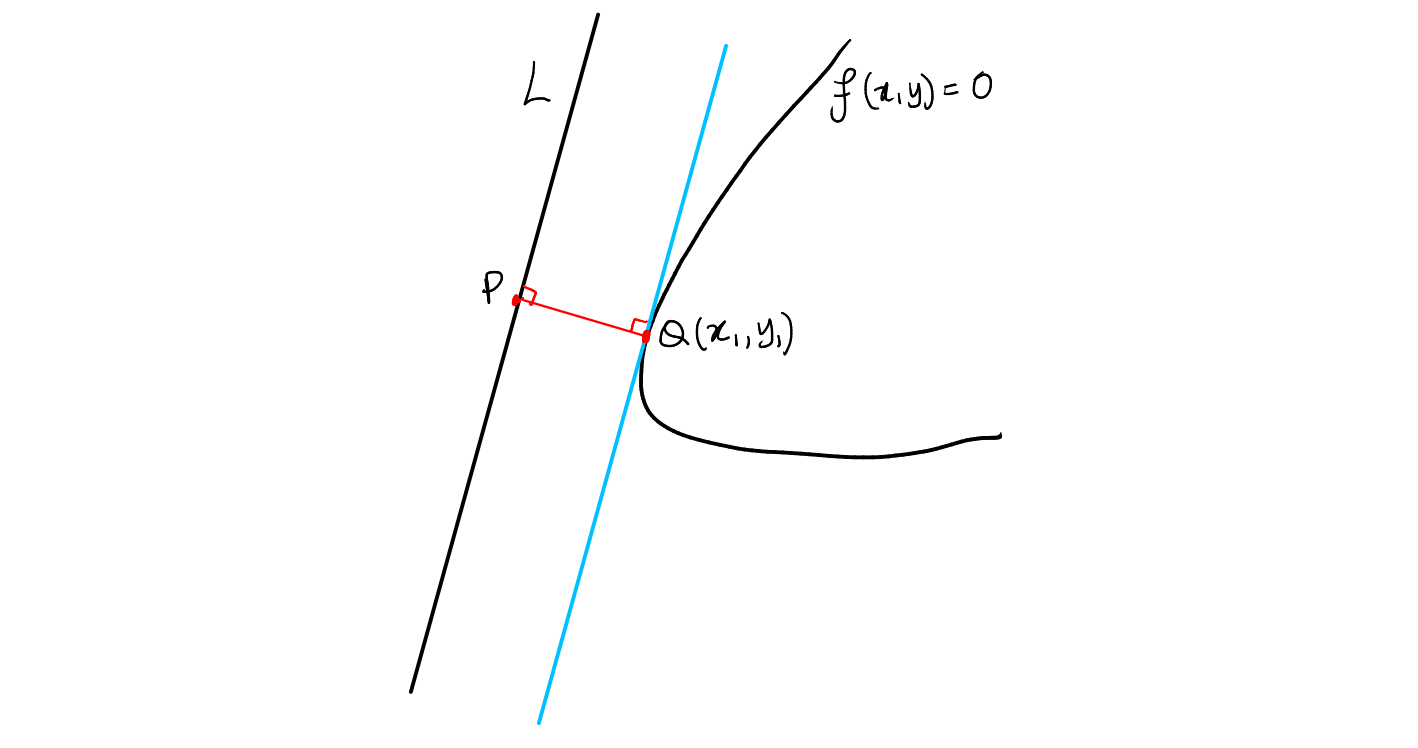
f ( x , y ) = 0. f(x, y) = 0. f ( x , y ) = 0. The goal is to determine the shortest distance from the line to the curve. This is defined as the minimum distance between any point P P P Q Q Q
min d ( P , Q ) . \min \limits_{} d(P, Q). min d ( P , Q ) . This minimum distance occurs when PQ is normal to both the line and the curve . This is equivalent to saying the tangent at Q is parallel to the given line L. The approach is to first find the foot of the normal Q ( x 1 , y 1 ) Q(x_1, y_1) Q ( x 1 , y 1 )
Since there are two unknowns x 1 x_1 x 1 y 1 y_1 y 1 two independent equations to determine their values:
Curve Condition: Since Q ( x 1 , y 1 ) Q(x_1, y_1) Q ( x 1 , y 1 )
f ( x 1 , y 1 ) = 0. (1) f(x_1, y_1) = 0. \quad \text{(1)} f ( x 1 , y 1 ) = 0. (1)
Parallel Tangent Condition:
Differentiating the curve implicitly, the slope of the tangent at Q ( x 1 , y 1 ) Q(x_1, y_1) Q ( x 1 , y 1 )
m tangent = d y d x ∣ ( x 1 , y 1 ) . m_{\text{tangent}} = \frac{dy}{dx} \Big|_{(x_1, y_1)}. m tangent = d x d y ( x 1 , y 1 ) .
The slope of the given line is − a b -\frac{a}{b} − b a
Since the tangent at Q ( x 1 , y 1 ) Q(x_1, y_1) Q ( x 1 , y 1 ) , their slopes must be equal:
d y d x ∣ ( x 1 , y 1 ) = − a b . (2) \frac{dy}{dx} \Big|_{(x_1, y_1)} = -\frac{a}{b}. \quad \text{(2)} d x d y ( x 1 , y 1 ) = − b a . (2)
Solving (1) and (2) simultaneously gives the coordinates ( x 1 , y 1 ) (x_1, y_1) ( x 1 , y 1 )
Once ( x 1 , y 1 ) (x_1, y_1) ( x 1 , y 1 ) perpendicular distance from Q ( x 1 , y 1 ) Q(x_1, y_1) Q ( x 1 , y 1 )
d = ∣ a x 1 + b y 1 + c ∣ a 2 + b 2 . d = \frac{|ax_1 + by_1 + c|}{\sqrt{a^2 + b^2}}. d = a 2 + b 2 ∣ a x 1 + b y 1 + c ∣ . Thus, the shortest distance between the line and the curve is found by determining the foot of the normal and computing its perpendicular distance to the line.
Find the shortest distance of the line
x − 4 y + 5 = 0 x - 4y + 5 = 0 x − 4 y + 5 = 0 from the curve
y = x − 1 , x ≥ 1. y = \sqrt{x - 1}, \quad x \geq 1. y = x − 1 , x ≥ 1. Solution:
Let PQ be a common normal to the given line and the curve, where P P P Q ( x 1 , y 1 ) Q(x_1, y_1) Q ( x 1 , y 1 ) Q Q Q
y 1 = x 1 − 1 . (1) y_1 = \sqrt{x_1 - 1}. \quad \text{(1)} y 1 = x 1 − 1 . (1) Differentiating the curve implicitly,
d y d x = 1 2 x − 1 . \frac{dy}{dx} = \frac{1}{2\sqrt{x - 1}}. d x d y = 2 x − 1 1 . Thus, at Q ( x 1 , y 1 ) Q(x_1, y_1) Q ( x 1 , y 1 )
d y d x = 1 2 x 1 − 1 . (2) \frac{dy}{dx} = \frac{1}{2\sqrt{x_1 - 1}}. \quad \text{(2)} d x d y = 2 x 1 − 1 1 . (2) The slope of the given line is obtained by rewriting its equation in slope-intercept form:
y = 1 4 x + 5 4 . y = \frac{1}{4}x + \frac{5}{4}. y = 4 1 x + 4 5 . Thus, its slope is
m = 1 4 . m = \frac{1}{4}. m = 4 1 . Since the shortest distance occurs when the tangent at Q ( x 1 , y 1 ) Q(x_1, y_1) Q ( x 1 , y 1 ) parallel to the given line , equating slopes from (2),
1 2 x 1 − 1 = 1 4 . \frac{1}{2\sqrt{x_1 - 1}} = \frac{1}{4}. 2 x 1 − 1 1 = 4 1 . Solving for x 1 x_1 x 1
2 x 1 − 1 = 4. 2\sqrt{x_1 - 1} = 4. 2 x 1 − 1 = 4. x 1 − 1 = 2. \sqrt{x_1 - 1} = 2. x 1 − 1 = 2. x 1 − 1 = 4. x_1 - 1 = 4. x 1 − 1 = 4. x 1 = 5. x_1 = 5. x 1 = 5. Substituting x 1 = 5 x_1 = 5 x 1 = 5
y 1 = 5 − 1 = 4 = 2. y_1 = \sqrt{5 - 1} = \sqrt{4} = 2. y 1 = 5 − 1 = 4 = 2. Thus, the foot of the normal is Q ( 5 , 2 ) Q(5,2) Q ( 5 , 2 )
The shortest distance is the perpendicular distance from Q ( 5 , 2 ) Q(5,2) Q ( 5 , 2 ) x − 4 y + 5 = 0 x - 4y + 5 = 0 x − 4 y + 5 = 0
d = ∣ ( 1 ) ( 5 ) + ( − 4 ) ( 2 ) + 5 ∣ 1 2 + ( − 4 ) 2 . d = \frac{|(1)(5) + (-4)(2) + 5|}{\sqrt{1^2 + (-4)^2}}. d = 1 2 + ( − 4 ) 2 ∣ ( 1 ) ( 5 ) + ( − 4 ) ( 2 ) + 5∣ . = ∣ 5 − 8 + 5 ∣ 1 + 16 . = \frac{|5 - 8 + 5|}{\sqrt{1 + 16}}. = 1 + 16 ∣5 − 8 + 5∣ . = ∣ 2 ∣ 17 . = \frac{|2|}{\sqrt{17}}. = 17 ∣2∣ . = 2 17 . = \frac{2}{\sqrt{17}}. = 17 2 . Thus, the required shortest distance is
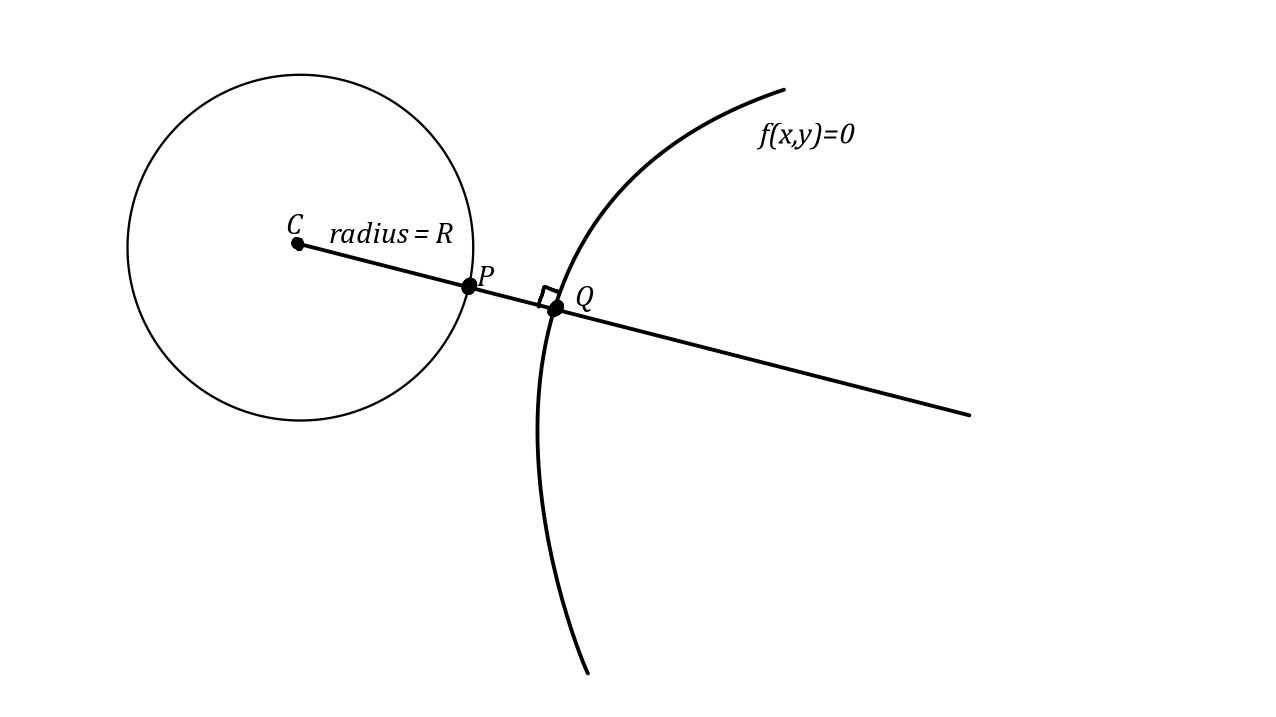
2 17 . \frac{2}{\sqrt{17}}. 17 2 . Shortest Distance Between a Circle and a Curve § The shortest distance between a circle and a curve refers to the minimum length of a segment PQ , where P P P Q Q Q PQ is minimized when it is a common normal to both the circle and the curve .
A circle has a special property : the normal at any point on the circle always passes through the center of the circle. Let the center of the circle be C ( h , k ) C(h, k) C ( h , k ) R R R
To determine the shortest distance P Q PQ P Q C Q CQ C Q Q is the foot of the normal from C C C .
Thus, the problem reduces to finding the shortest distance from the center C ( h , k ) C(h, k) C ( h , k ) , which has already been discussed previously.
Find Q ( x 1 , y 1 ) Q(x_1, y_1) Q ( x 1 , y 1 ) C ( h , k ) C(h, k) C ( h , k )
The point Q ( x 1 , y 1 ) Q(x_1, y_1) Q ( x 1 , y 1 )
f ( x 1 , y 1 ) = 0. f(x_1, y_1) = 0. f ( x 1 , y 1 ) = 0.
The slope of the normal at Q ( x 1 , y 1 ) Q(x_1, y_1) Q ( x 1 , y 1 )
d y d x ∣ ( x 1 , y 1 ) . \frac{dy}{dx} \Big|_{(x_1, y_1)}. d x d y ( x 1 , y 1 ) .
Since C Q CQ C Q Q Q Q
d y d x ∣ ( x 1 , y 1 ) ⋅ ( y 1 − k x 1 − h ) = − 1. \frac{dy}{dx} \Big|_{(x_1, y_1)} \cdot \left(\frac{y_1 - k}{x_1 - h}\right) =-1. d x d y ( x 1 , y 1 ) ⋅ ( x 1 − h y 1 − k ) = − 1.
Solve these equations for x 1 , y 1 x_1, y_1 x 1 , y 1
Compute C Q CQ C Q C ( h , k ) C(h, k) C ( h , k ) , using the Euclidean formula:
C Q = ( x 1 − h ) 2 + ( y 1 − k ) 2 . CQ = \sqrt{(x_1 - h)^2 + (y_1 - k)^2}. C Q = ( x 1 − h ) 2 + ( y 1 − k ) 2 .
Compute the required shortest distance between the circle and the curve:
P Q = C Q − R . PQ = CQ - R. P Q = C Q − R .
Thus, the shortest distance between a circle and a curve is the shortest distance from the center of the circle to the curve, minus the radius of the circle .
Shortest Distance Between Two General Curves § The shortest distance between two given curves f ( x , y ) = 0 f(x, y) = 0 f ( x , y ) = 0 g ( x , y ) = 0 g(x, y) = 0 g ( x , y ) = 0 P ( x 1 , y 1 ) P(x_1, y_1) P ( x 1 , y 1 ) Q ( x 2 , y 2 ) Q(x_2, y_2) Q ( x 2 , y 2 )
min ( x 1 , y 1 ) ∈ f ( x , y ) = 0 , ( x 2 , y 2 ) ∈ g ( x , y ) = 0 d ( P , Q ) . \min \limits_{(x_1, y_1) \in f(x, y) = 0, \, (x_2, y_2) \in g(x, y) = 0} d(P, Q). ( x 1 , y 1 ) ∈ f ( x , y ) = 0 , ( x 2 , y 2 ) ∈ g ( x , y ) = 0 min d ( P , Q ) . Key Observation: Common Normal or Parallel Tangents The shortest distance occurs when PQ is normal to both curves . This means that the tangent at P ( x 1 , y 1 ) P(x_1, y_1) P ( x 1 , y 1 ) parallel to the tangent at Q ( x 2 , y 2 ) Q(x_2, y_2) Q ( x 2 , y 2 )
Procedure to Find the Shortest Distance Since there are four unknowns, x 1 , y 1 , x 2 , y 2 x_1, y_1, x_2, y_2 x 1 , y 1 , x 2 , y 2
Curve Condition at P ( x 1 , y 1 ) P(x_1, y_1) P ( x 1 , y 1 ) : Since P ( x 1 , y 1 ) P(x_1, y_1) P ( x 1 , y 1 )
f ( x 1 , y 1 ) = 0. (1) f(x_1, y_1) = 0. \quad \text{(1)} f ( x 1 , y 1 ) = 0. (1)
Curve Condition at Q ( x 2 , y 2 ) Q(x_2, y_2) Q ( x 2 , y 2 ) : Since Q ( x 2 , y 2 ) Q(x_2, y_2) Q ( x 2 , y 2 )
g ( x 2 , y 2 ) = 0. (2) g(x_2, y_2) = 0. \quad \text{(2)} g ( x 2 , y 2 ) = 0. (2)
Slope Condition for Parallel Tangents : The tangents at P P P Q Q Q f ( x , y ) = 0 f(x, y) = 0 f ( x , y ) = 0 g ( x , y ) = 0 g(x, y) = 0 g ( x , y ) = 0 P P P Q Q Q
d y d x ∣ ( x 1 , y 1 ) = d y d x ∣ ( x 2 , y 2 ) . (3) \frac{dy}{dx} \Big|_{(x_1, y_1)} = \frac{dy}{dx} \Big|_{(x_2, y_2)}. \quad \text{(3)} d x d y ( x 1 , y 1 ) = d x d y ( x 2 , y 2 ) . (3)
Normal Condition : The shortest distance line P Q PQ P Q
y 2 − y 1 x 2 − x 1 = − 1 d y d x ∣ ( x 1 , y 1 ) . (4) \frac{y_2 - y_1}{x_2 - x_1} = -\frac{1}{\frac{dy}{dx} \Big|_{(x_1, y_1)}}. \quad \text{(4)} x 2 − x 1 y 2 − y 1 = − d x d y ( x 1 , y 1 ) 1 . (4)
Solving (1), (2), (3), and (4) simultaneously gives the points ( x 1 , y 1 ) (x_1, y_1) ( x 1 , y 1 ) ( x 2 , y 2 ) (x_2, y_2) ( x 2 , y 2 )
Complexity of the General Case In most general cases, solving these four nonlinear equations algebraically is extremely difficult. Therefore, additional information is often provided or used to simplify the problem.
Alternatively, if one of the curves is a straight line or a circle, then the problem reduces to previously discussed special cases, which are computationally simpler.
Find the shortest distance between the curves
y = e x and y = ln x . y = e^x \quad \text{and} \quad y = \ln x. y = e x and y = ln x . Solution:
Observe that the curve y = e x y = e^x y = e x reflection of the curve y = ln x y = \ln x y = ln x y = x y = x y = x twice the shortest distance between the line y = x y = x y = x y = e x y = e^x y = e x
To find this shortest distance, let the foot of the common normal between the line y = x y = x y = x curve y = e x y = e^x y = e x N ( x 1 , y 1 ) N(x_1, y_1) N ( x 1 , y 1 ) N N N
y 1 = e x 1 . (1) y_1 = e^{x_1}. \quad \text{(1)} y 1 = e x 1 . (1) The slope of the tangent at N N N
d y d x = e x 1 . \frac{dy}{dx} = e^{x_1}. d x d y = e x 1 . For the shortest distance, the tangent to the curve must be parallel to the line y = x y = x y = x 1 . Equating the slopes,
e x 1 = 1. e^{x_1} = 1. e x 1 = 1. Solving for x 1 x_1 x 1
x 1 = 0. x_1 = 0. x 1 = 0. Substituting in (1),
y 1 = e 0 = 1. y_1 = e^0 = 1. y 1 = e 0 = 1. Thus, the foot of the normal is N ( 0 , 1 ) N(0,1) N ( 0 , 1 ) N ( 0 , 1 ) N(0,1) N ( 0 , 1 ) y = x y = x y = x
d = ∣ 0 − 1 ∣ 1 2 + ( − 1 ) 2 = 1 2 = 2 2 . d = \frac{|0 - 1|}{\sqrt{1^2 + (-1)^2}} = \frac{1}{\sqrt{2}} = \frac{\sqrt{2}}{2}. d = 1 2 + ( − 1 ) 2 ∣0 − 1∣ = 2 1 = 2 2 . Since the shortest distance between y = e x y = e^x y = e x y = ln x y = \ln x y = ln x twice this distance, the final answer is
2 × 2 2 = 2 . 2 \times \frac{\sqrt{2}}{2} = \sqrt{2}. 2 × 2 2 = 2 .