
Introduction
Differentiation is the process of finding the derivative of a function, which we studied in the chapter on differentiability. There, we defined the derivative as the limit of the difference quotient and understood it as the rate of change of the function. In this chapter, we will focus on techniques to compute derivatives quickly and efficiently, without relying on the first-principles definition every time.
We will learn standard differentiation rules that make the process straightforward, such as the power rule, product rule, quotient rule, and chain rule. These rules allow us to differentiate functions systematically, avoiding the need to evaluate limits repeatedly. We will also explore higher-order derivatives and their significance in analyzing the behavior of functions.
By the end of this chapter, we will be able to differentiate a wide range of functions, including polynomials, trigonometric functions, exponential functions, and logarithmic functions, using a set of well-defined rules and techniques.
Derivative§
Let us recall the general definition of the derivative:
where is a general point in the domain of the function. The function is said to be differentiable at if this limit exists. If the limit does not exist at some point, then does not exist at that point.
We know that represents the slope of the tangent to the curve at the point . If the function is differentiable at , then the graph of has a well-defined tangent line at , and its slope is given by .
Differentiability implies continuity, meaning that if is differentiable at , then must also be continuous at . However, the converse is not necessarily true; a function can be continuous at a point but not differentiable there. This happens, for example, at points where the graph has sharp corners or cusps.
In this chapter, we will learn methods to compute derivatives efficiently, using differentiation rules that allow us to find without directly evaluating the limit definition each time. But before we do that let us have a look at another interpretation of derivative.
Derivative as Rate of Change§
The derivative of a function can be interpreted as the rate of change of the output with respect to the input. Consider a function , where is the independent variable and is the dependent variable. If the input is increased by a small amount , then the output also changes, leading to a corresponding change . The new output is given by
The change in the function value, , is given by
Comparing this with the definition of the derivative in previous sections, in the difference quotient corresponds to . Thus, the formulation in terms of is consistent with the previous definition of the derivative.
The average rate of change of with respect to over the interval is defined to be
The average rate of change measures how much the function value changes per unit change in over a finite interval. This expression represents the slope of the secant line joining the points and on the graph of . The secant line provides a linear approximation of the function over that interval, but it does not capture instantaneous behavior.
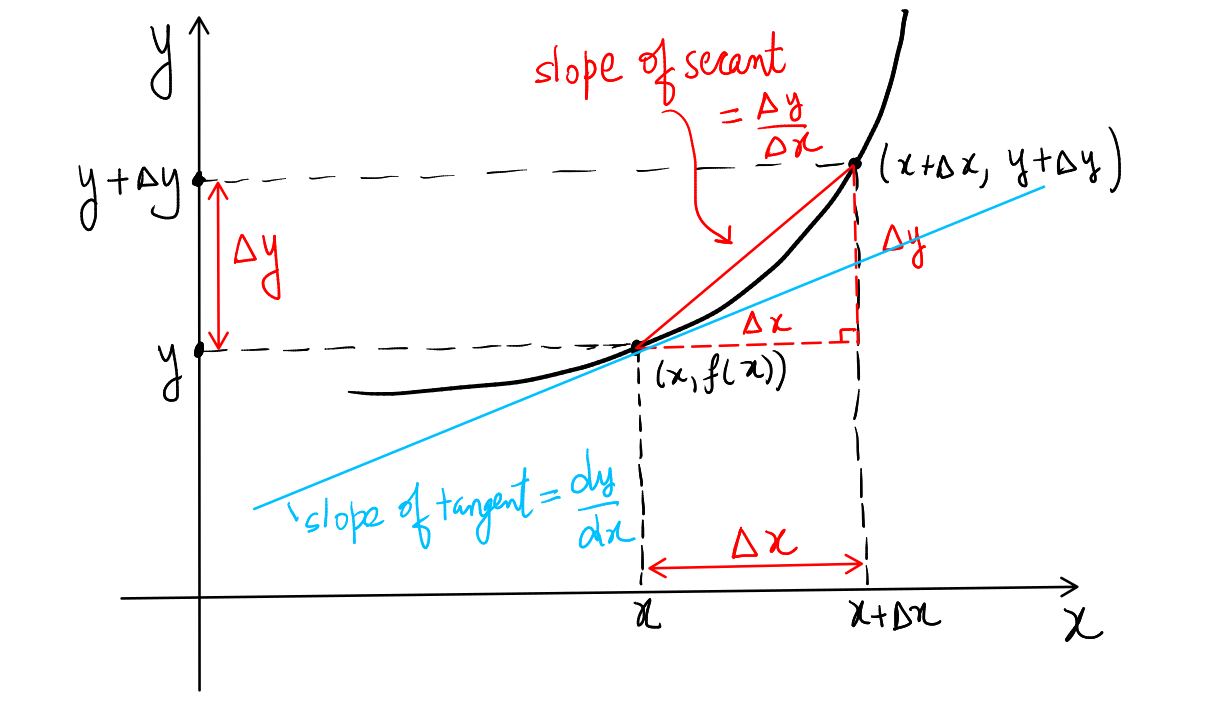
The instantaneous rate of change is obtained by letting , giving the limiting value:
This limit, if it exists, defines the derivative of at and represents the slope of the tangent line to the curve at . Unlike the secant line, which depends on a finite interval, the tangent line captures the precise behavior of the function at a single point.
The derivative is denoted by
The derivative provides a rigorous mathematical formulation of instantaneous rate of change. The notation is called Leibniz notation, named after Gottfried Wilhelm Leibniz.
Mark this section complete when you have worked through its proofs.