
Dividing Polynomials
Rational Expression§
A rational expression is a fraction in which both the numerator and the denominator are polynomials. The numerator represents the dividend, and the denominator represents the divisor. The degree of the polynomial in the numerator can be less than, equal to, or greater than the degree of the polynomial in the denominator. Rational expressions are analogous to rational numbers, where the numerator and denominator are integers.
Here are four examples of rational expressions:
Proper and Improper Rational Expressions§
A rational expression is classified as proper if the degree of the numerator polynomial is less than the degree of the denominator polynomial. Conversely, it is termed improper if the degree of the numerator is equal to or greater than the degree of the denominator.
Examples of each include:
Proper rational expression:
(The degree of the numerator is 1, and the degree of the denominator is 2.)
Improper rational expression:
(The degree of the numerator is 3, and the degree of the denominator is 2.)
Euclidian Division of Polynomials§
Before we understand what the algorithm is, let us try to solve the following problem:
The Euclidean Division of Polynomials is an algorithmic process akin to the familiar division of integers. It states that for any two polynomials and , where is not the zero polynomial and its degree is less than or equal to the degree of , there exist unique polynomials and such that:
Here, is known as the quotient polynomial and as the remainder polynomial, with the degree of strictly less than the degree of . This relationship can also be written as a rational expression:
This resembles the division of integers, where you divide a number to get a quotient and a remainder.
In the context of polynomials:
- is referred to as the dividend.
- is the divisor.
- The outcome of the division is the quotient.
- is the remainder.
The degree of the quotient polynomial is the difference between the degrees of and . Specifically, if the degree of is and the degree of is , then:
The division can be performed using long division, which is methodical and mirrors integer division, or synthetic division, which is a shortcut applicable when the divisor is a monic linear polynomial. The Euclidean Division algorithm is particularly useful for finding roots, factoring polynomials, and simplifying rational expressions.
Long Division of Polynomials§
The long division of polynomials is a systematic method that mirrors the traditional long division of integers. Here's the step-by-step algorithm:
-
Arrange Polynomials: Start by writing both the dividend and the divisor in descending order of their degrees. If there's any missing term in the polynomial sequence, introduce that term with a zero coefficient to maintain order.
-
Divide Leading Terms: Take the leading term (the term with the highest power of ) of the dividend and divide it by the leading term of the divisor. This gives you the first term of the quotient.
-
Multiply and Subtract: Multiply the entire divisor by this first term of the quotient. Then, subtract this result from the dividend, which will give you a new polynomial, often referred to as the remainder.
-
New Dividend: This remainder becomes the new dividend. Now, take its leading term and divide it by the leading term of the original divisor to get the next term of the quotient.
-
Iterate the Process: Repeat the multiplication and subtraction steps with the new dividend and the divisor. Continue this process, each time appending the next term to the quotient, until you obtain a remainder with a degree that is less than the degree of the divisor.
-
Conclude with Remainder: The process stops when you can no longer divide because the remainder's degree is lower than the divisor's. This remainder is then written over the divisor to complete the expression of the result.
Let us understand with a few examples how it works.
Synthetic Method of division of Polynomials:§
This is faster and requires lesser numerical calculations than long division method. Also instead of subtractions we are only dealing with the addition, so synthetic division is less prone to sign errors.
We can have two cases based on whether the divisor is a monic polynomial or not.
-
Divisor is a monic polynomial.
Let us explain this method with an example. Suppose we want to divide by .
Step 1: Put the terms of divisor and dividend in descending order of degrees. The missing terms are replaced by terms having zero coefficients. Multiply the divisor with -1 (Negate all coefficients of divisor)
Step 2: Neglect the leading coefficient and put the rest of coefficient in diagonal (let us call this diagonal the "divisor diagonal") as shown in the example. Also put the coefficients of dividend in a row (let us call this row as "dividend row") as shown in the example.
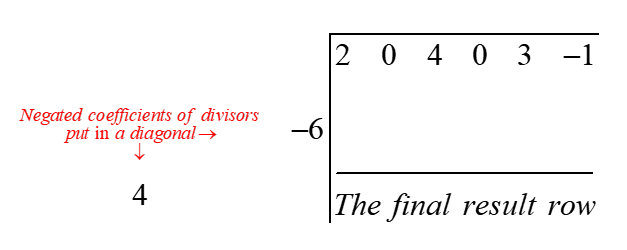
Step 3: Leave the space of number of rows equal to the number of elements in divisor diagonal(which is equal to degree of divisor) Copy down the first element of dividend row directly to the final result row.
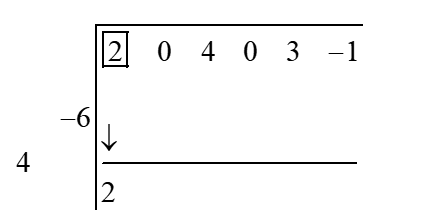
Step 4: Now multiply the first element of final result row with the elements of divisor diagonal row. You will obtain a diagonal whose lower left most element is in the second column of dividend coefficients.
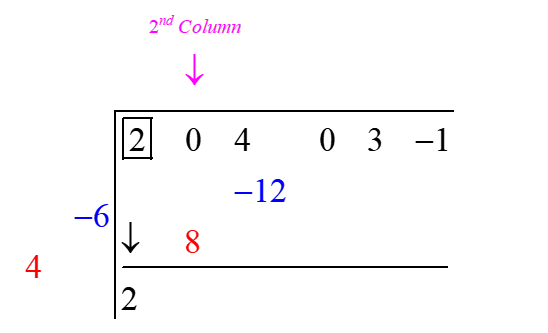
Step 5: Add the elements of second column and put the sum in result row.
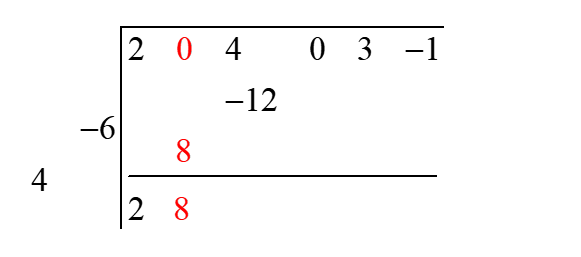
Step 6: Multiply the second element of the final result row to the divisor diagonal and put the obtained diagonal below dividend row that lower left most element now is in the third column.
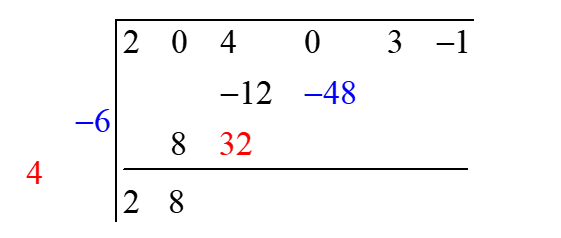
Step 7: Now add the elements of the third column.
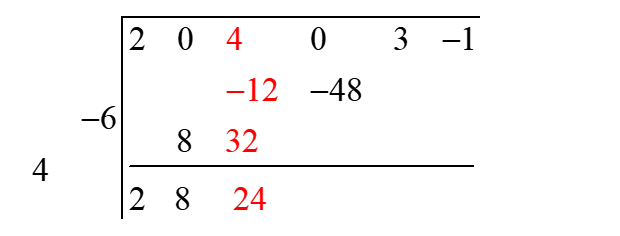
Step 8: Now continue with this process in Step 6 and Step 7. Stop as soon as the last column is filled with upper right most element of diagonal and add the last column elements to get the last element of the final result row.
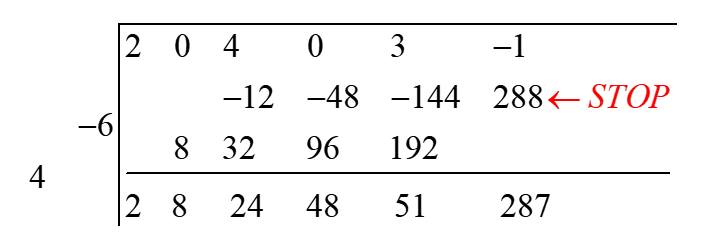
Step 9: If the degree of the divisor is , then the last elements of the final result row are the coefficients of the remainder and the remaining elements are the coefficients of the quotient.
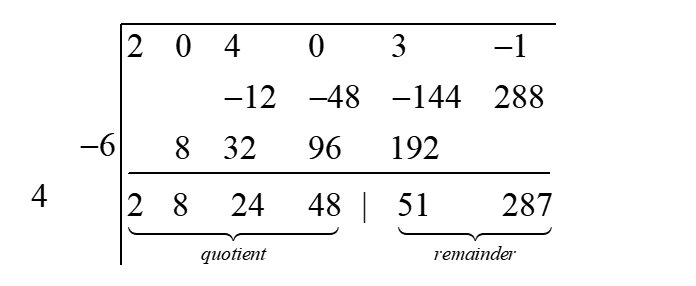
So in the example the remainder is finally and the quotient is . Thus,
Let us take more examples which will make process clearer.
-
Divisor is a non-monic polynomial
When the divisor is a non-monic polynomial the synthetic division is modified a little bit. We first take the leading coefficient of divisor, let’s say , and what is left is a monic polynomial. We divide the dividend with this monic polynomial with the usual method. We obtain the quotient and .
Then is the required quotient and is the remainder (remainder is the same).
Why?
Suppose we want to divide polynomial by non-monic polynomial . Let us make monic by taking the leading coefficient common. Let’s say that the new monic divisor is . Then by Euclid’s Division Lemma, when we divide by , there exists polynomials and such that
Suppose we rewrite [1] as
Which is same as (Since, ) .....[3]
Now [3] says that if we divide by then the quotient is and the remainder is .
We may thus write the following theorem:
"When a polynomial is divided by a non-zero polynomial if is the quotient and is the remainder, then when is divided by , the remainder remains but the quotient becomes ."
Mark this section complete when you have worked through its proofs.