A geometric progression (GP), or geometric sequence, is a sequence of numbers where each term after the first is found by multiplying the previous one by a fixed, non-zero number called the common ratio. The recursive definition of a geometric progression can be described as follows:
Let a1 denote the first term of the geometric progression, and let r denote the common ratio, where r=0. Then, the n-th term of the geometric progression, denoted by an, can be defined recursively by:
a1=a, where a is the first term of the sequence.
For n>1, an=an−1⋅r, where an−1 is the term immediately preceding an, and r is the common ratio.
So, in a geometric progression (GP) with the first term a and common ratio r, the sequence is: a, ar, ar2, ar3, ..., where each term is obtained by multiplying the previous term by r.
For example: For a geometric progression (GP) with the first term a=2 and a common ratio r=31, the sequence is: 2, 2⋅31, 2⋅(31)2, 2⋅(31)3, ..., resulting in the series: 2, 32, 92, 272, ....
To derive the n-th term of a geometric progression with the first term a and common ratio r, we observe the relationship between successive terms:
a1a2=r,a2a3=r,a3a4=r,…,an−1an=r
Multiplying these equations together, we get:
a1a2⋅a2a3⋅a3a4⋅…⋅an−1an=r⋅r⋅r⋅…⋅r
Notice the telescoping effect, where all intermediate terms a2,a3,…,an−1 cancel out, leaving:
aan=rn−1
Thus, we arrive at the general formula for the n-th term of the geometric progression:
an=a⋅rn−1
This demonstrates that the n-th term is obtained by multiplying the first term a by the common ratio r raised to the power of n−1, encapsulating the essence of geometric progression.
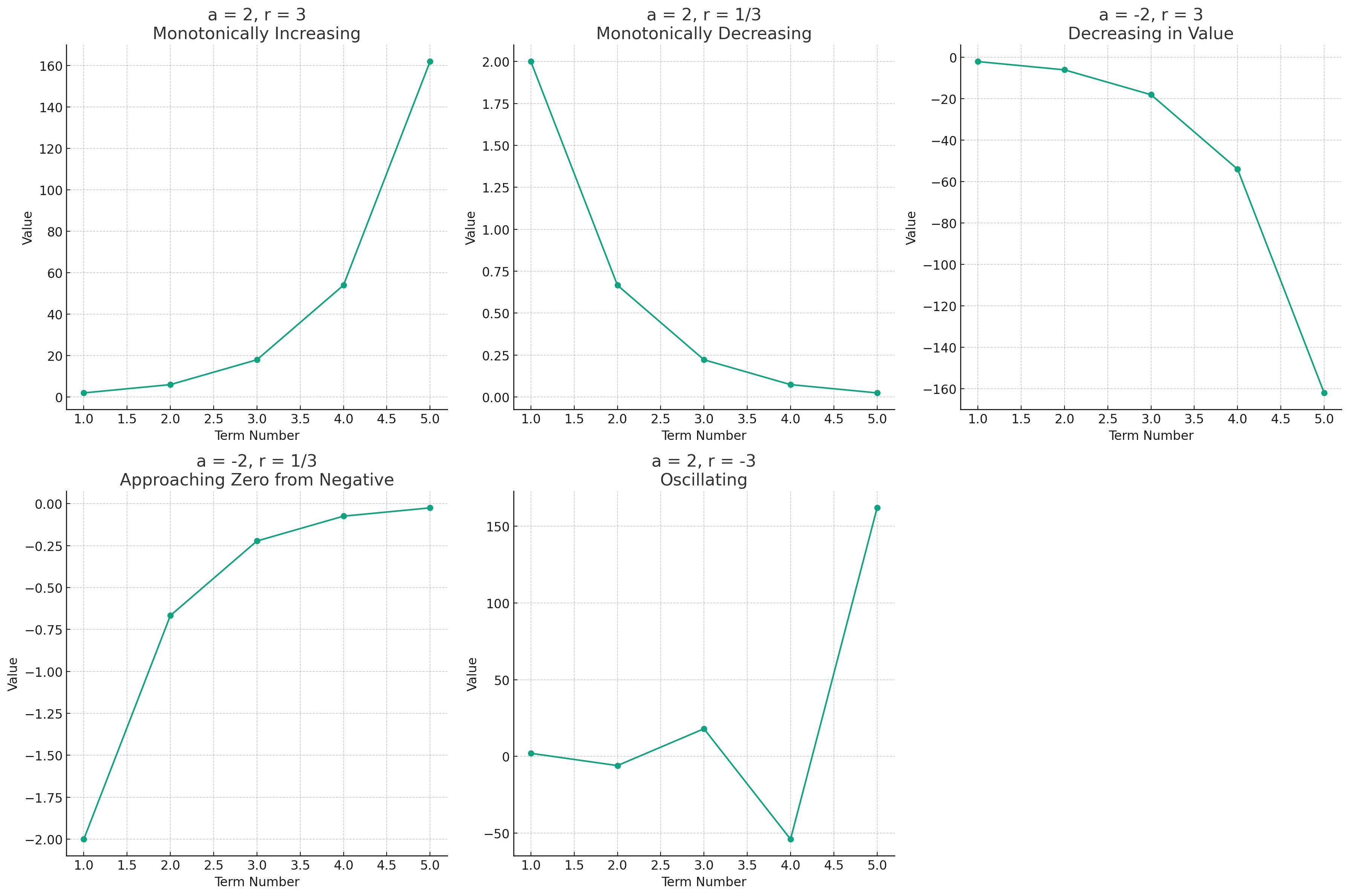
Consider the characteristics of the following geometric progressions (GPs), each defined by a distinct pair of initial term a and common ratio r:
For a=2, r=3:
The sequence begins as 2,6,18,54,…. Given a and r are positive, with r exceeding unity, the progression is monotonically increasing. Each term exceeds its predecessor, amplifying the sequence exponentially.
For a=2, r=31:
This progression, 2,32,92,272,…, demonstrates a decrease in magnitude. The positive initial term combined with a common ratio between zero and one ensures a gradual reduction towards zero.
For a=−2, r=3:
Manifesting as −2,−6,−18,−54,…, this series, while consistently multiplying in magnitude due to a common ratio greater than one, starts with a negative term. The sequence, therefore, remains negative, diverging to negative infinity.
For a=−2, r=31:
The series −2,−32,−92,−272,… diminishes in absolute value. Originating from a negative term and reduced by a factor less than one, it converges towards zero from the negative side.
For a=2, r=−3:
With terms 2,−6,18,−54,…, the progression alternates in sign due to the negative common ratio. The sequence exhibits neither a pure increase nor decrease but expands in absolute magnitude, signifying an oscillatory behavior.
We can easily see that:
a>0,r>1: The GP is monotonically increasing, as each term is larger than the previous one due to a positive starting term and a common ratio greater than one.
a>0,0<r<1: The GP is monotonically decreasing, with each term getting closer to zero, starting from a positive first term and a common ratio between zero and one.
a<0,r>1: The GP decreases in value (becomes more negative) but increases in absolute magnitude, diverging negatively as the sequence progresses.
a<0,0<r<1: The GP approaches zero from the negative side, decreasing in absolute value, but remains negative throughout due to a negative starting term and a fractional common ratio.
a=0,r<0: The GP oscillates, with terms alternating in sign. The sequence does not strictly increase or decrease but grows in absolute value if ∣r∣>1 or diminishes in absolute value if ∣r∣<1.
When r=1 in a geometric progression (GP), each term of the sequence is equal to the first term a, resulting in a constant sequence. This means that the GP does not change from term to term, remaining the same throughout the sequence. For any n, the n-th term an is always equal to a, illustrating a special case of a geometric progression where the common ratio does not lead to growth or decay in the sequence. Thus, the series would be a,a,a,…, indefinitely.
A finite geometric series is a sum of terms in a geometric progression where each term is obtained by multiplying the previous term by a constant ratio, and the series has a specific number of terms. Formally, if a is the first term, r the common ratio, and n the total number of terms, the finite geometric series is given by:
Sn=a+ar+ar2+…+arn−1
The sum of a finite geometric series can be calculated using the formula:
Sn=1−ra(1−rn)
for r=1. This formula encapsulates the sum of all terms in the series, efficiently allowing for the computation of the series' total based on its initial term, common ratio, and length.
Proof:
To prove the formula for the sum of a finite geometric series of n terms, consider the series:
Sn=a+ar+ar2+ar3+…+arn−1
Step 1: Multiply both sides by r:
rSn=ar+ar2+ar3+…+arn−1+arn
Step 2: Shift the above series to the right by one term and subtract rSn from Sn:
This yields the formula for the sum of a finite geometric series of n terms, providing a concise method to calculate the total sum based on the first term a, the common ratio r, and the number of terms n.
For an infinite geometric series to converge to a finite value, the absolute value of the common ratio must be less than one (∣r∣<1). If ∣r∣≥1, the series diverges, meaning it grows without bound.
Before addressing the infinite case, let's consider a finite geometric series with n terms:
Sn=a+ar+ar2+⋯+arn−1
We know that the sum of this series can be found using the formula:
Sn=1−ra(1−rn)
where a is the first term, r is the common ratio, and n is the number of terms.
Transition to Infinity
To examine the behavior of Sn as n approaches infinity, we rewrite the formula for Sn by dividing the numerator and the denominator by 1−r, yielding:
Sn=1−ra−1−rarn
As n becomes larger and approaches infinity, and given ∣r∣<1, the term rn approaches zero. This behavior is due to the property of geometric progressions where, if the absolute value of the ratio is less than one, the terms of the sequence become closer and closer to zero as n increases.
With the understanding that rn→0 as n→∞ for ∣r∣<1, we can now consider the limit of Sn as n approaches infinity:
n→∞limSn=n→∞lim(1−ra−1−rarn)
Given rn→0, the second term in the expression above vanishes, leading to:
S∞=1−ra
This result shows that the sum of an infinite geometric series converges to a/(1−r) under the condition that ∣r∣<1. The convergence to a finite sum highlights a remarkable property of infinite geometric series, where despite the addition of infinitely many terms, the series sums to a finite, well-defined value.
In a geometric progression (GP) consisting of terms a,ar,ar2,ar3,…,arn−1,
where a is the first term,
r is the common ratio, and n is the total number of terms, athe kth term from the end is given by arn−k.
Constant Product of Equidistant Terms in a Geometric Progression§
In a geometric progression (GP) consisting of n terms, represented as a1,a2,a3,…,an, with a1 being the first term and r the common ratio, the product of terms equidistant from the start and end of the series is constant across the series. For any term ak and its counterpart an−k+1 equidistant from the opposite end, the product is given by:
For a geometric progression (GP) with n terms, denoted by a,ar,ar2,ar3,…,arn−1, where a is the first term and r is the common ratio, the product of all terms in the sequence is given by anr2n(n−1).
When each term of a GP with a common ratio r is multiplied by a real number k (where k is not equal to zero), the resulting sequence remains a GP. The common ratio of the new GP is unchanged at r.
Proof: Consider a GP {a,ar,ar2,…}. Multiplying each term by k results in the sequence {ka,kar,kar2,…}, which is still geometric with the same common ratio r, as kakar=r.
Division by k
Similarly, dividing each term of a GP by a non-zero real number k results in a sequence that is also a GP, with the common ratio remaining r.
Proof: Starting with a GP {a,ar,ar2,…} and dividing each term by k, we obtain {ka,kar,kar2,…}. This sequence maintains the common ratio r, as kakar=r.
Addition or Subtraction by k
Adding or subtracting a real number k (where k is not equal to zero) to each term of a GP does not result in a GP.
Proof: Consider a GP {a,ar,ar2,…}. Adding k to each term results in {a+k,ar+k,ar2+k,…}. The ratio between successive terms varies, as a+kar+k=ar+kar2+k in general, hence the resulting sequence is not a GP.
Logarithmic Transformation and Exponentiation
Logarithmic Transformation: Taking the logarithm base b of each term in a GP {a,ar,ar2,…} results in an arithmetic progression (AP) with a common difference of logbr.
Proof: The logarithm base b of the GP terms gives {logba,logbar,logbar2,…}, which simplifies to {logba,logba+logbr,logba+2logbr,…}, clearly an AP with common difference logbr.
Exponentiation: Conversely, exponentiating each term of an AP by a base b results in a GP.
Proof: Consider an AP {a,a+d,a+2d,…}. Exponentiating each term by base b yields {ba,ba+d,ba+2d,…}. This forms a GP, as the ratio between successive terms is bd, showing exponential growth by a constant factor.
Raising Each Term of a Geometric Progression to a Power k
Given a geometric progression (GP) with terms a,ar,ar2,… and a common ratio r, when each term of the GP is raised to a certain power k, the resulting sequence {ak,(ar)k,(ar2)k,…} is also a geometric progression with a common ratio of rk.
Combining Terms of Two Geometric Progressions via Arithmetic Operations
Given two geometric progressions (GPs) G1 and G2 with terms {a1,a1r1,a1r12,…} and {a2,a2r2,a2r22,…} respectively, where a1 and a2 are the first terms and r1 and r2 are the common ratios, the result of combining corresponding terms of G1 and G2 via arithmetic operations (multiplication, division, addition, subtraction) follows specific patterns:
Multiplication: Produces a GP with the first term a1a2 and common ratio r1r2.
Division: Results in a sequence that is a GP with the first term a1/a2 (assuming a2=0) and common ratio r1/r2 (assuming r2=0).
Addition or Subtraction: Does not generally result in a GP.
Forming a Subsequence from a Geometric Progression by Selecting Terms at a Constant Interval
Given a geometric progression (GP) with a common ratio r, if we form a subsequence by choosing terms at a constant interval of length k, the resulting subsequence is also a GP with a common ratio of rk.
Definition of Interval
In the context of sequences, an interval of length k refers to the practice of selecting every kth term from a sequence, effectively skipping k−1 terms between selections. For example, an interval of length k=2 means selecting every second term from the sequence.
A recurring decimal is a decimal number in which a digit or group of digits repeats infinitely. For example, in 0.6666…, the digit 6 repeats indefinitely, and in 0.123123…, the sequence 123 repeats.
Recurring Decimals and Infinite Geometric Progressions
Recurring decimals can be represented as infinite geometric progressions (GPs). This representation is based on the observation that each repetition of the recurring digits can be seen as a term in a GP, where the common ratio is a power of 10 inversely proportional to the length of the repeating sequence.
Section 4 of 10 · Sequence and Series
Mark this section complete when you have worked through its proofs.
Type any topic, theorem, or concept to jump directly to the section.