
Set Operations
In mathematics, whenever a new type of mathematical object is introduced or studied, one important aspect is defining appropriate operations that can be performed with or on these objects. These operations help in understanding the properties and behaviors of the objects and allow for their manipulation and analysis within the framework of mathematical theory.
- For numbers (like integers, real numbers), we define operations such as addition, subtraction, multiplication, and division.
- For sets, we define operations like union, intersection, and difference.
- For vectors, operations like vector addition and scalar multiplication are defined.
- For matrices, operations include matrix addition, multiplication, and finding the inverse or determinant.
Each type of mathematical object has operations that are sensibly defined based on the nature of the objects and the needs of the mathematical or applied context in which they are used. These operations are not arbitrary; they are usually designed to be consistent with existing mathematical principles and to provide useful tools for exploration and problem-solving in various domains.
 {align left}
Set Equality§
Two sets and are considered equal, denoted as , if both of the following conditions are met:
- Every element of is an element of . In other words, is a subset of , denoted as .
- Every element of is an element of . In other words, is a subset of , denoted as .
Examples:
-
Let and .
- Since all elements of are in , .
- Since all elements of are in , .
Therefore, .
-
Let and .
- (as all elements of are in ).
- However, (as but ).
Therefore, .
Union of Sets§
The union of two sets and is denoted as . This union set contains all the elements that are either in , in , or in both.
Examples:
-
Let and . Then, the union is .
-
Let and . The union is .
-
Let and .
The union is .
-
Let and .
The union is .
-
Let and .
The union is .
Algebraic Properties§
The union operation on sets satisfies several algebraic properties:
- Closure: The union of any two sets is itself a set.
- Identity: The union of a set with the empty set yields the original set, .
- Universal Bound: The union of a set with the universal set yields the universal set, .
- Idempotence: A set unioned with itself yields the set, .
- Commutativity: The union operation is commutative, .
- Associativity: The union operation is associative, .
- Absorption: If is a subset of , the union of with is , implies .
The union of sets is denoted by
Intersection of sets§
The intersection of two sets contains only the elements common to both sets. For sets and , the intersection is denoted and is defined as:
An element belongs to if and only if is an element of both and .
Here are some examples:
-
Consider and . The intersection is .
-
Let and . The intersection is .
-
Define and .
The intersection is .
-
Let and .
The intersection is .
-
Consider and .
intersection is .
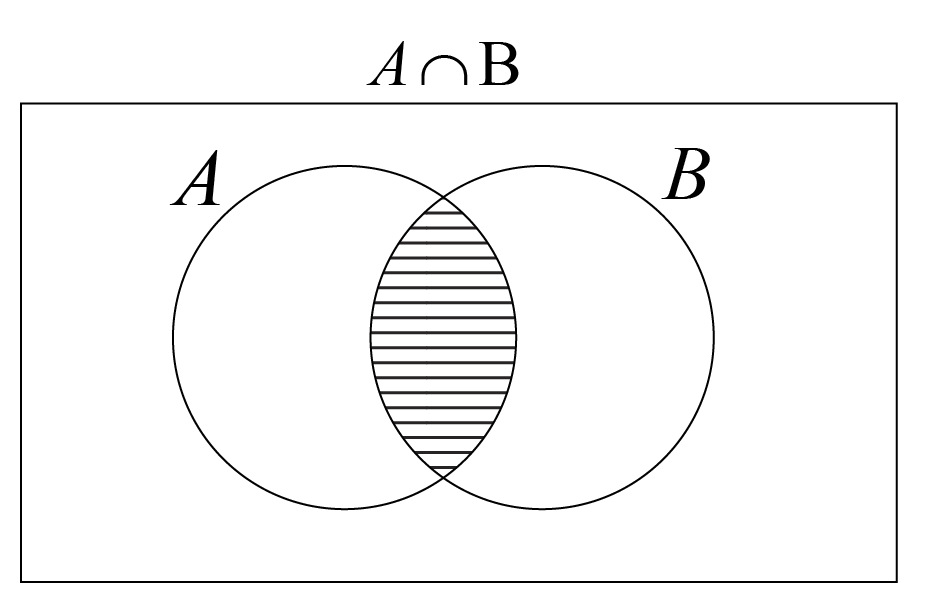
In Venn diagrams, the intersection of and is represented by the area common to both circles representing the sets. This region highlights the elements shared by and .
Properties of Intersection§
The intersection of sets exhibits the following fundamental properties:
-
Null Set: The intersection of any set with the null set is the null set, .
-
Identity: The intersection of a set with the universal set is the set itself, .
-
Commutative Law: The intersection of two sets is commutative, .
-
Associativity: The intersection of a set with the intersection of two other sets can be grouped in any order without affecting the result,
-
Idempotent Law: A set intersected with itself is the set, .
-
Subset Property: A set is a subset of another set if and only if their intersection is the first set, if and only if .
Disjoint Sets§
Two sets and are considered disjoint if they have no common elements, explicitly stated as .
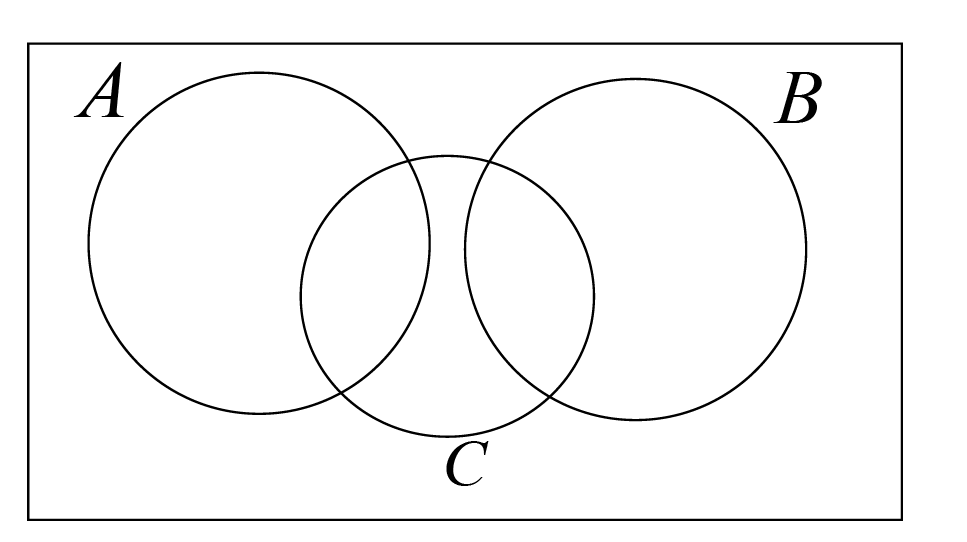
In the figure, sets and are disjoint as there is no overlapping region between them, indicating no common elements. On the other hand, set intersects with both and , showing common elements with each.
Pairwise Disjoint Sets: For any collection of sets , these sets are pairwise disjoint if every pair of distinct sets in the collection has an empty intersection; that is, for all , with and ranging from 1 to .
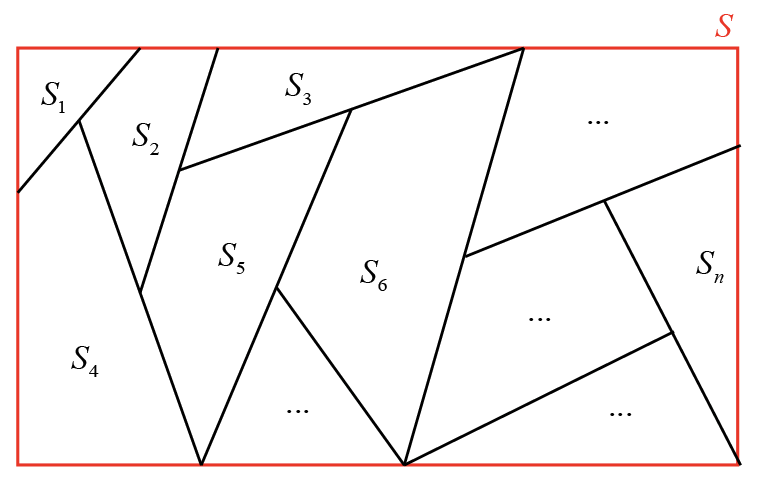
Partitioning: Partitioning a set involves dividing it into distinct, non-empty subsets such that two conditions are met:
-
Each subset is mutually exclusive; there is no overlap between them, which is formally described as for every pair of indices within the index set . This property ensures that the subsets are pairwise disjoint.
-
The union of all subsets reconstructs the original set , denoted by . This indicates that the subsets are collectively exhaustive, covering all elements of without omission.
Each subset represents a unique piece or component of the entire set , akin to a puzzle piece that fits into the larger picture formed by the set's partition.
Mark this section complete when you have worked through its proofs.